From dark to light

DSC_0743Daylight saving turns

The dimmer knob of the day,

And the afternoons are cut short.

Dusk chases my children in.

They stare through

windows at the settling gloom.

They are no longer young.

They remember what autumn brings.

“When?” they ask.

“When will daylight grow again?”

“Around Christmas,” I tell them.

They sigh. Still so far away!

With a more gradual movement,

A global twisting,

We lean away from the Sun.

Darkness now pursues

us home from school.

Outdoor hours are few

And precious.

Suddenly, new light!

Not much—small, twinkling,

Strung in trees, across porches—

But shining bright with hope

against the encroaching shadows.

My children’s eyes sparkle.

Though tiny, these pinpoint lights

Remind us: Christ did come!

They proclaim: He will come again!

True Light will return

Triumphant

Once and for all!

Until then, my children,

Even as dark presses close,

Let us, filled with True Light,

Shine as small beacons,

Gleam like tiny stars

Beam as heralds of Hope.

Christ has died.

Christ has risen.

Christ will come again.

The good work of refugee care

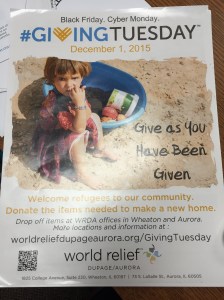
World Relief poster“(God) creates each of us by Christ Jesus to join him in the work he does, the good work he has gotten ready for us to do, work we had better be doing.” Ephesian 2:9, The Message

I believe with all my heart that refugee care is good work. A few weeks ago I posted the news that the ESL classes at my local World Relief (WR) office are in jeopardy because they have not received federal funding. Last Tuesday I sat in a meeting with other WR volunteers and listened as the ESL director outlined a plan that will provide as many refugees and immigrants with regular classes while still cutting costs (and staff) dramatically. Despite the great stress she was under, Sue smiled at us and reminded us that God is at work. He will provide. He so clearly cares for the poor, the orphan, the widow, the oppressed, and the foreigner. She said something like this: The decreased government funding gives the church a chance to step up and in with their money and their time. It pushes us to be more generous and creative.

Hear, Hear!

poster backAt the bottom of this post, I have links to both the national and local (western suburbs of Chicago) World Relief websites as well as specific ways to support WR DuPage/Aurora.

But before I get to that, I have links to four articles: the first three specifically related to refugees, the third about cultivating a generous heart toward all those in need.

The first is a Q&A with World Relief DuPage’s Executive Director Emily Gray. PLEASE read this article. Emily is informed and wise and above all, seeking to be likeminded with Christ.

5 Objects to Fuel Your Prayers,” is a great article about concrete ways to remember those in need. It’s specifically about refugees, but you could use the same techniques to remind you to pray for the poor, the persecuted church, victims of sex trafficking, those suffering from mental illness, orphans, etc.)

WR fundraisingGrowing in generosity with the Believing Poor” is by Elizabeth Drury. It challenges our views of generosity that do not extend past our wallets, that don’t impact our comfort levels.

What Refugees in Your Neighborhood Need from You” gives a bit of an inside look at how difficult it is to be uprooted and transplanted (often several times) and how the body of Christ can step into that difficulty.

~~~

For those outside Chicago’s western suburbs: visit the international home page of World Relief and click on the “Get Involved” tab to see if WR has a location in your area.

For those IN Chicago’s western suburbs: The ESL arm of WR DuPage needs volunteers. If you have some morning hours free beginning in January or would like to tutor a refugee one-on-one, email me at jenunderwood0629@gmail.com and I can get you connected with the volunteer coordinator. You don’t need any experience or qualifications other than the ability to speak English, and it is truly a blessing.

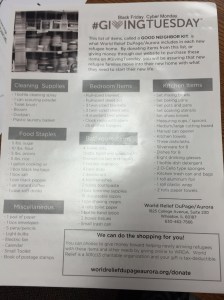
If you’ll take a look at the poster I have pictured above, you’ll find information about items needed for Good Neighbor kits. The back side (with items needed) is the second picture. One of WR’s dropoff locations is at K’Tizo–my favorite tea/coffee shop. You can drop off items and get a yummy drink!

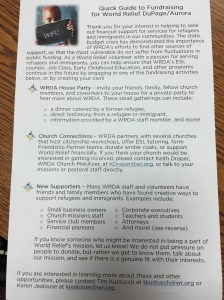
The third picture (sorry it’s so small) is a “Quick Guide to Fundraising for World Relief DuPage/Aurora.” If you live in another location but have a WR nearby, I’m sure you could use all the same techniques to fundraise for your area location.


A family, a people

Small Carolina town

Throwback general store

Both my boys looking at the comics

Side by side

Yet the sharp “What’chu doin’, boy?”

Is not directed at the two,

Just the one,

My child with dark skin.

Years before,

Sitting in a crowded Ugandan church

Watching his tiny self

Dance in the aisles,

I wondered,

What are we doing—

Giving him a family

But displacing him from a people?

When he was small, our conversations about race

Were easy.

He called himself chocolate,

The rest of us vanilla,

In high summer, I became

Milky coffee.

Now, though, they are harder.

How to explain to him,

To his sisters and brother,

That the odds facing them

Are not exactly equal?

That what we’ve told them—

Human is human. Period.—

Is not a reality out there

And King’s dream

Is still a dream.

And underneath all this,

Even now,

the question haunts me:

We’ve become a family

But what about his people?

~~~~

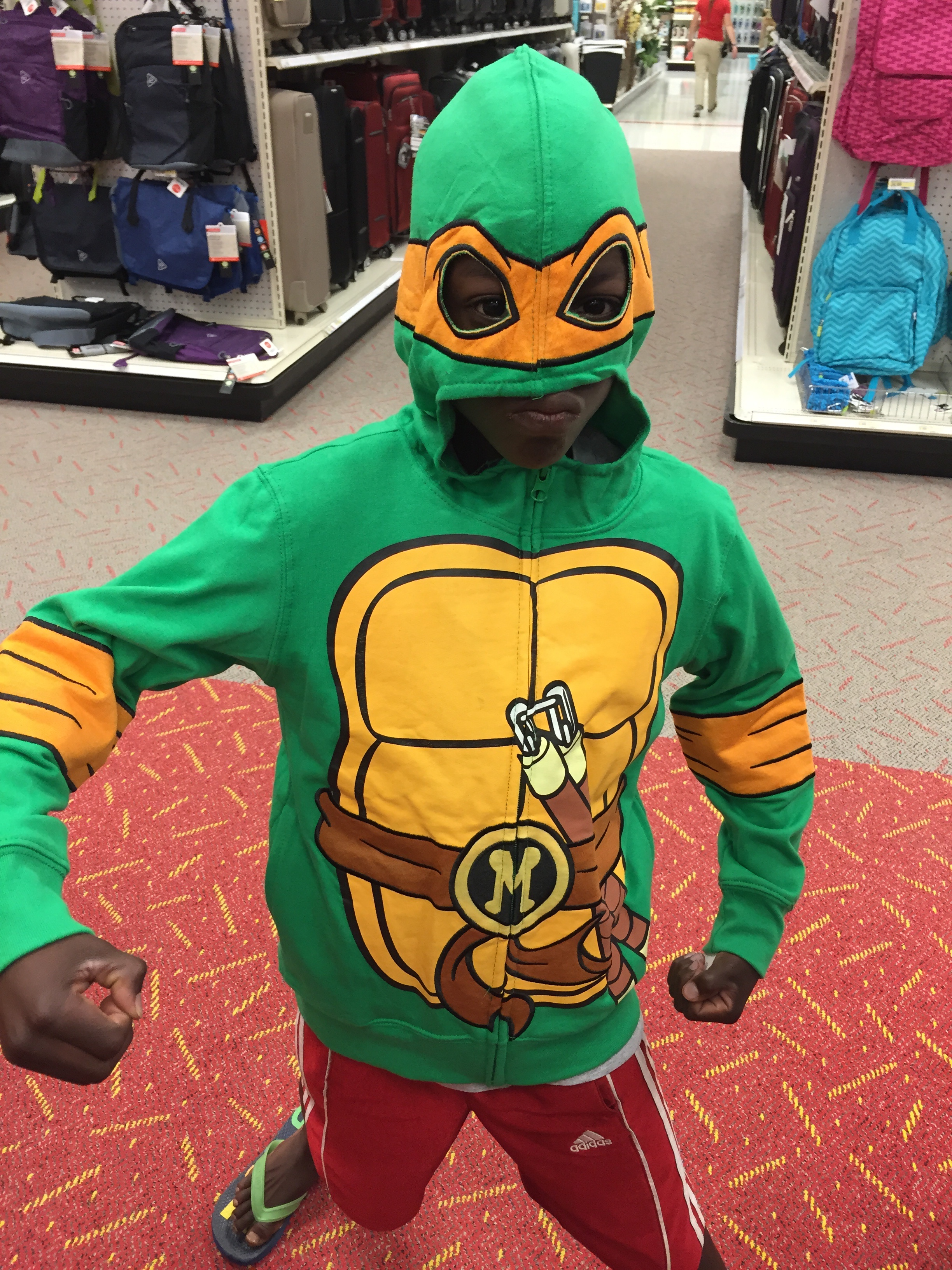
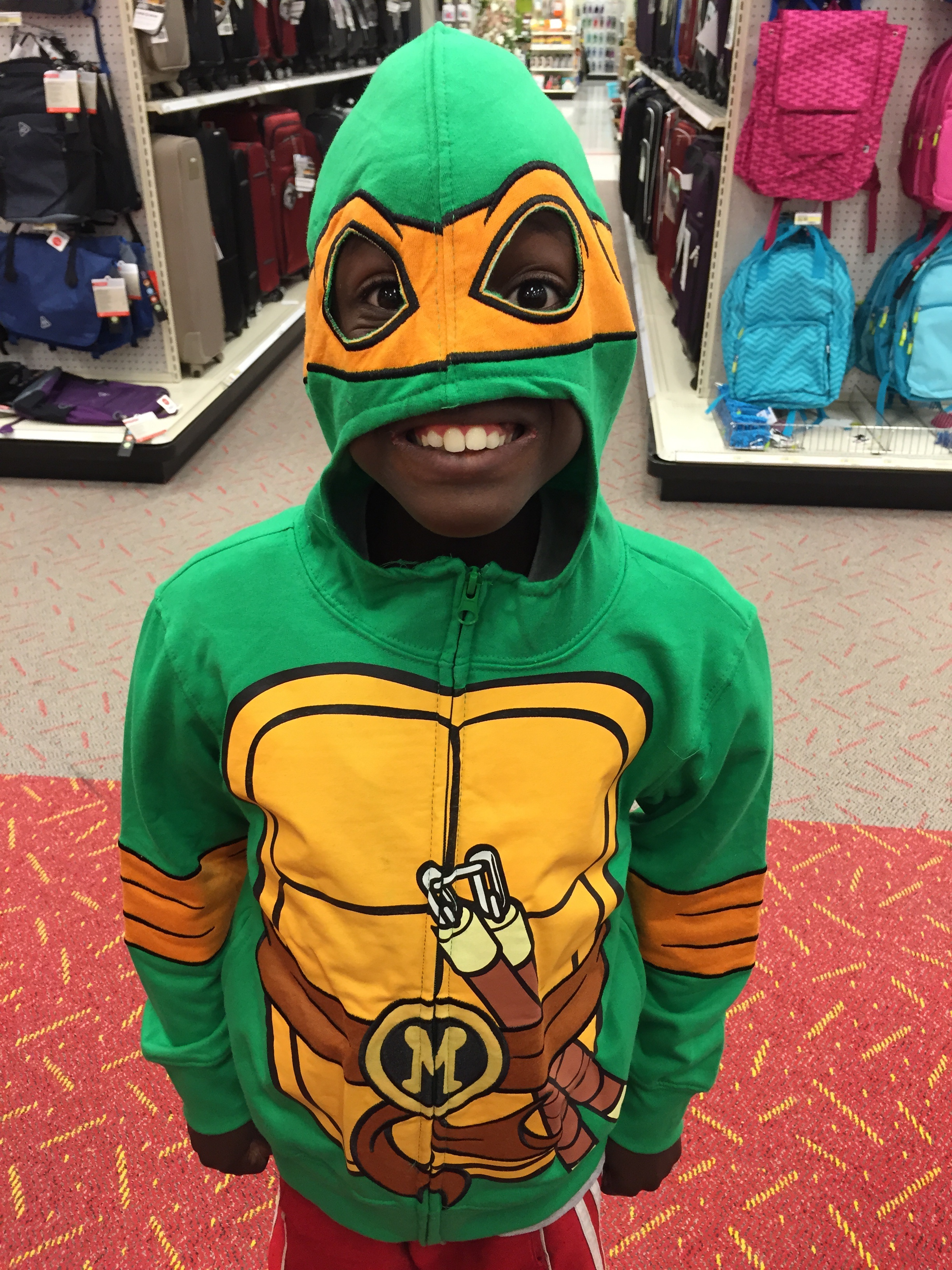
I thought this post could use a little lift. This was a fun, impromptu moment in Target when PJ saw this awesome Teenage Mutant Ninja Turtle jacket!

I thought this post could use a little lift. This was a fun, impromptu moment in Target when PJ saw this awesome Teenage Mutant Ninja Turtle jacket!

Our fourth child was born in Uganda. His mother died of AIDS; his father was estranged and never met him till we began the adoption process. In many miraculous ways God made it very clear that we were to adopt our son. But even as I worked in Africa to get legal guardianship, I wondered about the issues he would face growing up as an African child in a white family, in a predominately white area, in a country where the color of your skin still determines a lot. Racial reconciliation takes on a whole new level of importance when you have a child who is a different race. When I read about the horrifically high numbers of African American men in prison; when I learn that five times the number of African American babies are aborted compared to white babies; when I hear that an African American college professor in the town just two over from mine has been stopped by police more than 20 times in the last couple years just so they could “see what

I couldn't resist posting this one, too!

I couldn’t resist posting this one, too!

he was up to”… I think, “This is what’s facing my son,” and I ask God how I am meant to draw attention to this injustice, how I am meant to fight it—both for my own son and the sons and daughters of other women.

And under all this, I still fear the effects on my son of growing up without a community that looks like him.

Giving Tuesday and a funny

blanketGiving Tuesday is coming up (December 1), and while I don’t really care if you “observe” Black Friday or Cyber Monday, I hope you celebrate Giving Tuesday big time! For the last couple years I’ve posted a list of gifts-that-give-back opportunities on Giving Tuesday, and I plan to do it again this year. This year’s list will include most of last year’s, but it will also have some new additions. Do any of you have suggestions to add to the list? If you do, leave me a comment here or email me at jenunderwood0629@gmail.com. I’d love to hear from you!

Speaking of “giving,” my kids are already gearing up for Christmas presents. They swapped names for their sibling gifts a couple weeks ago (the list is stuck on the refrigerator as a ready reminder!) and this past weekend they all gathered around the dining room table to discuss their collective gift for me and my husband. A couple years ago they got us a beautiful blanket from Hand and Cloth (it’s on the Giving Tuesday list!). You can see a picture of it above.

Anyway, I was in the kitchen just a few feet away, so they made me put on my daughter’s big old headphones and listen to music while I washed dishes so I couldn’t hear. Suddenly my youngest was by my side, rubbing his eyes in the way he does when he is trying very, very hard not to cry. I looked at him and then into the dining room where the older girls were motioning me to take off the headphones.

When I did, Em said, “Ask him why you don’t deserve a Christmas present.” She was grinning.

I laughed. “So, bud, why don’t your dad and I deserve a Christmas present.”

“Christmas is just for kids,” he said, very, very seriously.

This child is quite attached to his wallet, so I suspected the reason might be more a fiscal than philosophical matter. “How much are they wanting you to put in?” I asked.

“Fifteen cents!” he wailed, and when I started to laugh, his older brother hollered, “It’s all he has!”

Named and Naming

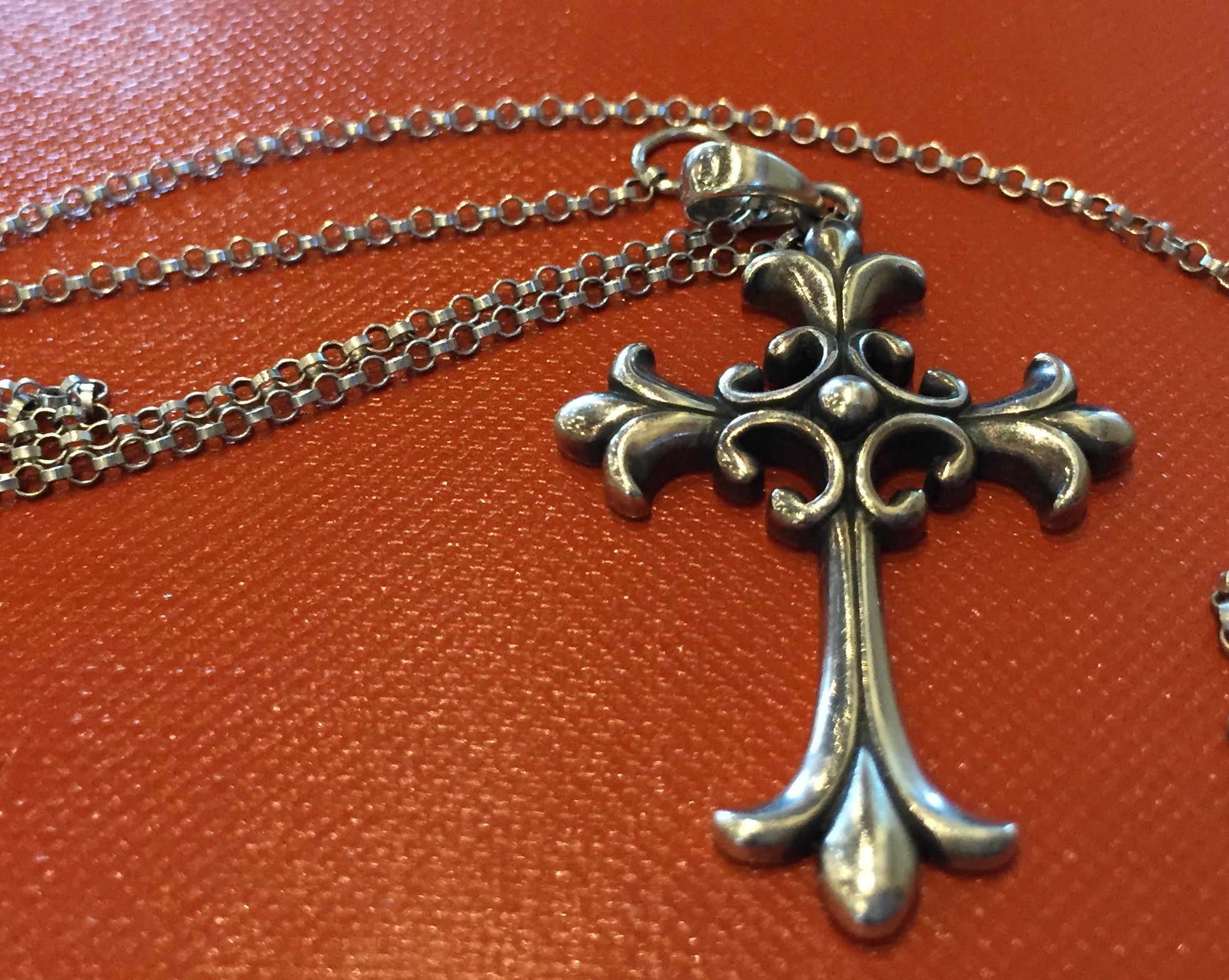
cross picI can still see in my mind one picture from my very first children’s Bible. There’s Adam, his back facing me, a plant strategically covering his butt. Both arms are by his sides, but one hand is lifted slightly. The pose seems to say, “I’m thinking. The right name will come to me, and it will be perfect.”

In front of Adam is a vast line of animals, stretching off into the horizon. I remember a few of them: the lion, his mane-surrounded face looking wise and calm, a giraffe just behind, its neck and head arching toward Adam, and a gazelle-like creature, poised as if standing still was an extreme effort.

I’ve always been fascinated with this story, with humans having the privilege of naming. Naming, I feel, is a small act of creating, a small act that opens the door to vast possibility.

We humans love to name—our children, our pets, our businesses, even inanimate personal belongings. We seem to think that when we name, we hold a bit of interest in that person. We feel we’ve set them on a path because names carry connotation for us. Some names are strong; others are beautiful or quirky or unique. When we name, we confer not only possibility, but a hoped-for direction or purpose.

Could this love for naming be a longing for the privilege we had pre-Fall?

We lost so much at the Fall, relationship with God paramount, so perhaps the loss of our naming privilege does not seem very big, but I wonder about that. I think it must have been fairly significant: names are a big deal in Scripture. In historical accounts, the naming of children or places is often included. God changed people’s names several times, and in each instance the name change carried weight. It signified a new direction, a new identity, and a different relationship with God.

I’ve learned that the very fact we have names is important. I’m reading a book on Genesis* right now, and in the section about the serpent/Satan in Genesis 3, the author made this statement: “What is interesting is that in all but one of these … occurrences (of the name ‘Satan’), ‘satan’ has attached to it the definite article, ‘the satan.’ This indicates ‘the satan’ is a title, not a personal name. Satan is not who he is, but what he is. He does not merit a name, and in antiquity, not to have a name was to be reduced to virtual nonexistence.” (emphasis mine)

I often tell my children Satan is not capable of creating. He can only twist toward evil what God created for good, and this quote expanded my thinking: Satan un-named himself when he turned away from the Creator, and in so doing, he separated himself from any participation in creation. In a way, he undid himself. He made himself nothing, incapable of doing anything true.

In the Fall, we, too, un-named ourselves. We spurned “beloved” and “image-bearer” and put on false names like “self-sufficient” and “independent.”

But God snatched up the true names we cast off so flippantly. God kept them safe, and through the magnificent work of Immanuel, God restores them to us. Truly named ourselves, we can once again join God in the creative work of naming others.

I’ve been pondering this idea for a long time, particularly in my context as a mother. Each day I contribute to the naming of my children. With the attitudes, actions, and words I direct toward them (and in the absence of those as well), I shape their concept of themselves. I can name them “beloved” and “valuable” and “growing.” But I can also twist their concept of their name: “You are a bother.” “You are incapable.” “You are not worth my time right now.” I can reinforce their un-naming.

This is not only true for parents. We all have people we are called to nurture in one way or another, and we can be a part of naming them as God wants them named: valuable, unique, and beloved.

We can name even the people we simply pass on the street. When we make eye contact with a person, we “say,” “I see you. I acknowledge you as a fellow human being.” That is naming.

And when we avert our eyes, what then?

In I Peter, we are told we are “chosen (to be) God’s instruments to do his work and speak out for him, to tell others of the night-and-day difference he made for (us)—from nothing to something, from rejected to accepted.” **

And in this “telling,” we get to name others—with the names God has for them. He says, “I’ll call nobodies and make them somebodies; I’ll call the unloved and make them beloved. In the place where they yelled out, “You’re nobody!” they’re calling you “God’s living children.” **

We name: You are Somebody. You are Beloved. You are God’s living child!

What incredible work!

*Handbook on the Pentateuch by Victor P. Hamilton, published by Baker Book House, 1982. The quote I reference is on page 43 in this edition of the book. The link in the book title takes you to its page at Christianbook.com’s site, where you can buy the 2005 edition.

**The Scripture links take you to Bible Gateway, to that Scripture in three versions (The Message, the Amplified, and the NIV) side by side. It’s awesome to look at them in this way!