the Love

As the presidential election results came in last night, one of my sons watched with a Mexican flag wrapped around him. He did this in support of his Mexican-American friends. He did this because he loves them, because he doesn’t want them to be seen as second-class citizens, because he doesn’t want them to live in fear for those among them who are undocumented—like some of their parents.

My husband teared up this morning as he got ready to go in and teach his Latino-American and African-American students. “What do I tell my kids?” he said. “A lot of them have been really scared about this. What do I say?”

A few weeks ago when Trump made comments about African Americans in inner-city neighborhoods living in “hell” and how “stop and frisk” would be a possible solution, my children wanted to know what that meant. Then they asked, “Who would they stop? Our neighbors? On the street?”

They knew it probably wouldn’t be their white dad getting frisked on the way home. The gentleman across the street, though, the one they wave to every day and tell where they’re going and how they’re doing—he might.

A couple weeks ago, an ad popped up of a mother whose son has autism. She was offended by Donald Trump’s hand-flapping gesture. She said something like this: “My son isn’t welcome in Trump’s world. I don’t agree with much of Clinton’s stances, but I can’t vote for him.”

_________ isn’t welcome in Trump’s world. You can fill in the blank with a lot of words, all of them representing human beings, generally marginalized, without much voice. I couldn’t vote for him either.

I know some people reading this would say that my husband and I have filled our children’s heads with a lot of soft, pie-in-the-sky ideology.

But in the course of the evening, one of my older son’s friends—who would identify as a Christian—posted a pro-Trump slogan on social media and followed it with the hashtag “#build that wall.”

My son, tears in his eyes, asked me, “Mom, where’s the love?”

Oh, I’m glad for that heart.

Where is the love?

I understand that some at this point—were this a dialogue—would refer to love for the unborn.

And I get that. I really do, but I also wonder this: if we can’t love those right in front of us, those that some in the majority might see as “not-like-me, might-be-taking-my-tax-dollars” folks, then any love for the unborn, who are easy to love because we’re not changing their diapers and footing their bills, seems a little suspect.

And, I might add, what also seems suspect is that Trump has some sense of love and justice for the unborn.

The electoral college just elected a businessman whose entire career is based on success for himself regardless of the cost to others; a man who sees women as little more than sexual objects; a man who seems to view most others as beneath him (and that’s almost automatic if you have a different skin color or ethnicity than his); a man who wants a return to good old days—days when almost all white churches supported or tolerated racial injustice of many kinds.

I don’t think small government and lower taxes were worth that much.

I know I’m simplifying this—that so many will say there were other issues, but I fail to see the biblical, ethical, righteous concern in many of them. I find a lot of “rights” involved, and I struggle with this because I don’t find my rights touted in Scripture, and I do find a lot of statements about standing up for others when they’re oppressed.

At one point this morning, my children gathered around me in the kitchen, “What do we do?”

“We remember who we are,” I told them. “As Americans, President-elect Trump will be our president, but we are not Americans first. We are followers of Jesus. He is our King, and we live first and foremost as his followers, as his citizens. We will love Him, and we will love our neighbors, and when we need to stand with and for them, we will.”

An unexpected neighbor

I was in full mom mode, in route from an evening parents’ meeting at the elementary/middle school to pick Em up from art class across the city.

I stopped at a red light in North Lawndale, Douglas Park dark and deep on my right, and noticed a girl standing on the corner. The lights from across the street barely lit her face.

But it was enough to make her tears shine. It was enough I could see her mouth, open with sobs, her hands, clenched in fists, pressed tight against her cheeks.

I rolled down the window. “You ok?”

I startled her; then the words came rushing out.

“I missed my bus, and another one hasn’t come. I need to get home, but I don’t know how.”

I pulled around the corner onto the deserted dark street leading into the park and called her to come to the window.

The red line. She needed to get to the red line, and she needed a bus to get to the red line. She’d missed the right bus, ran after, but didn’t make it. And she’d stood there, alone on this corner, till fear kicked in and she started crying.

Anything beyond the green and brown lines, and I’m a bit clueless about the Chicago L system. In that moment I couldn’t even remember which direction the red line runs.

But I knew this girl couldn’t stand on this corner any longer.

“Will you get in?” I asked her.

She hesitated, then figured the gray-haired woman playing soft music in her car was a better option, and got in.

I turned the car around and headed east, into the city. Em’s art class is on the north side; surely there would be a way I could get this child to the red line on the way.

We talked. I tried to drop as many reassuring bits of information as I could. Mom of four (turns out she’s the oldest of four), the ages of my kids (she’s fourteen, a freshman in high school; siblings are 12, 10, and 5), mother of twins (she’s a twin, too, though her brother died soon after birth, right on her mother’s chest. “His lungs weren’t developed enough.”) My name, her name.

She wasn’t breathing so hard any more, but I had to check. “Did anything bad happen to you? Anything besides missing the bus?”

She said no. My shoulders relaxed.

“You need a Kleenex?” I asked her.

“Yes. Is it okay if I blow my nose? Sorry, I got a little cold, so it might be noisy.”

I laughed and told her that was just fine.

She asked if I was a teacher—I have no idea why: do I still give off that vibe?

“Used to be,” I said. “Now I’m a writer.”

She wanted to know if I was famous.

I laughed again. Far from it, I said.

“You write books, though?”

“Well, I have one written, but it’s not published. I write magazine and news articles for a school.”

We talked about her school then, how her mom and grandma and she picked it because it’s college prep, because it helps its students get scholarship money, because she wants to go to college.

I pulled over to check the red line map, making sure I was under a street light, telling her what I was doing.

I called Dave just to confirm what I thought would be the closest stop to Em’s art school.

We talked more as I drove. Her face lit up when I asked about sports. Basketball is a favorite, track, too.

We talked about her siblings, what they’re like. Younger sister by a year is actually taller, but she doesn’t want to play basketball; she wants to be a cheerleader, even with her long legs. Their aunt said she should play basketball like her sister, that if she became a cheerleader, she’d knock out the whole first row of fans when she kicked. We talked about her grandma, a police officer, about her own long commute to school from the south side to the west side, about where she lived before moving to Chicago.

I saw the L track ahead and pointed it out to her. “I’m going to turn left just before it,” I told her. “The side street’s not so busy and I can let you out. And I’m gonna’ give you my business card so you can call or text me when you get home and let me know you made it safe. Will you do that for me?”

She said she would. I told her again where to cross the street, where to go up the steps to the platform. She got out and was gone.

Later that night I got a text from her grandma.

Her grandgirl had made it home safe.

She’d made it home safe.

And her grandma was very, very thankful.

On Roosevelt Road at 7 p.m.

Driving from one mom “job” to another,

Unaware of the Father’s hand orchestrating/planning/moving,

I’d been exactly where I was supposed to be

To see a neighbor.

O God, make haste

I’m struggling with worry right now. On the other side of this move, with some things settled (like Dave’s teaching position), other things are still very much up in the air: a job for me that brings in more income but still allows me to homeschool Em and “mom” my kids well; Em’s schooling—is this the best path longterm?; soccer and friendships for the kids; church; adjustment to a decreased budget…

I finger all the strands in my mind, till it’s simply a snarled mess and I’m hopelessly tangled in it.

In very low moments, I ask, “Are you there, God?”

In other moments I know He is. I remember His faithfulness, the fact that he has never, ever failed, that the darkest moments of the past have then turned into seasons of watching and marveling at the creativity and goodness of God.

I feel like I’m cycling through the lament psalms, repeating the psalmist’s rhythm of despair/crying out/remembering God’s faithfulness/hope.

By the time I get to the remembering part, I’m ready to dump my entire snarled mess in God’s lap. “Please take this. I can’t do it. I can’t figure this out.” This brings relief, because his lap is large, big enough to hold me as well as my mess.

But, just a day or two later, sometimes only a few hours later, I find a fresh snarl of yarns in my head and the cycle begins again. Who knew my mind could gather fluff so quickly and spin so much so fast!

God has used my neighborhood to help shred my worry web, to help me move past myself to others. When I get out and about in the neighborhood and pass mothers waiting at bus stops, holding children on hips, others by the hand, I think, How many of them are running a rat race that feels hopeless? How many are working minimum-wage jobs, trying to feed and shelter a family on $350 a week, with childcare swallowing up a huge chunk of a paycheck? And, comparing these struggles to my current light-in-contrast worries—which I’m flattened by pretty easily—I wonder how long it would take before the hopelessness of that kind of grind would wear a person into the ground.

My husband’s work also shapes my perspective. The other morning he got a text from one of his student’s mothers, asking if Dave has heard from her son, that he ran away the night before and she’s hoping against all the fear in her heart that he shows up at school, that he hasn’t succumbed to some gang that’s promising him belonging, that he’ s not using, that… oh, the darkness that can swallow up all our hope.

And so my prayers change, and when I say, “O God, make speed to save us. O Lord, make haste to help us,” I do not have just my family in mind but my neighbors, my city, beyond.

As I recite Psalm 143, I imagine myself standing before God linked hand-in-hand with a long line of people: “Hear (our) prayer, O Lord, and in your faithfulness give ear to (our) supplications; answer (us) in your righteousness.”

And for those who are so burdened they cannot even whisper the words, whose heads are bowed low, whose knees are week, I change the singular pronouns to plural; I speak louder; I raise my voice: “Our spirit faints within us; our heart within is desolate. We stretch out our hands to you; our soul gasps for you like a thirsty land.

“O Lord, make haste to answer us; our spirits fail us; hide not your face from us lest we be like those who go down to the Pit. Let us hear of your loving-kindness in the morning,

For in you we put our trust.”

Fear driving out love

Processed with VSCO with hb1 preset

Photo and lettering by Emily (daughter). If you like what you see, visit her Etsy shop LetteringbyEm to see if you’d like to order a piece. 

I have tried to stay out of the current political storm for a couple of reasons. First, I don’t know a whole lot, so I don’t see much point in my making a less than fully informed comment. Second, I simply don’t want to add to the division, and I’ve got friends on both sides.

And it’s these “sides” that are getting to me.

You see, I’m taking a Jesus and the Gospels class right now, and we’re looking at Jesus’ message and life and how he didn’t fit into any of the political camps among the Jews of his day. He wasn’t a seize-back-control/power militant; he wasn’t a “maintain differences” but work-the-system guy; and he wasn’t a separatist who withdrew from politics and society completely.

He said things like the Sermon on the Mount and taught people to pray for God’s kingdom to come, for his will to be done on earth. He told stories about crossing ethnic divides and putting ourselves out to love our neighbors, and he ate with “sinners” and outcasts.

He didn’t fit into anybody’s mold. As soon as someone tried to make him a member of their camp, he said something that made it clear he wasn’t.

But he wasn’t a maverick, just out to find his own way, different simply to be different. He was adamant about that. He was actually following orders. He was doing his Father’s will, doing it all the way to the cross.

And Jesus encouraged his followers to do the same. “Take up your cross and follow me,” he said, in his invitation to a cruciform, God- and others-focused life.

N. T. Wright wrote this about Jesus’ call: “Jesus was summoning his hearers to give up their whole way of life, their national and social agendas, and to trust him for a different agenda, a different set of goals.”*

I don’t think Jesus is summoning us today to anything less than this.

Now I don’t want to simplify the political complexities of the United States. I don’t want to make it seem as if we shouldn’t have opinions or discussions about the current campaign and issues.

But I’m seeing a lot of anger on Facebook and Twitter, and behind the anger I see fear. There’s fear that the world ahead will not look anything like the world of the past—and there’s fear that it will look far too much like the past. There’s a fear of lost power, lost say and influence and majority control. There’s a fear that our agendas and goals might be set aside.

And this makes me think of this verse: Perfect love drives out fear.**

I know sentences are not like mathematical equations. You cannot simply flip the two sides of that sentence around and have it mean exactly the same thing. But I’ve wondered if many of us Christians have let “Fear drive out perfect love.”

When we fear (and anger is often, I believe, a result of fear), it is a sign of a lack of trust. Somewhere deep down we are not trusting in the perfect love of God. We are trusting in something else, something less certain, something other than God.

And why?

Because deep down I think we know God’s agenda and goals do not match up with our own. His agenda and goals are not about our safety and comfort; His agenda and goals are not about Christianity retaining power in our political and economic systems. They are not about America being seen as a great nation.

His end goal is that the will of God be done on earth as it is in heaven, that Christ reign as King, and God be worshiped by all.

And while he promises that all of the workings toward this goal will result in our good, he doesn’t promise that this good won’t also involve discomfort and danger and tribulation for us. In fact, he promises the opposite.

But that is perfect love: love that is perfect not only in character but also in foresight. It knows the good end and understands what trouble along the way is necessary for that end result.

This is the perfect love that can drive out fear.

But we must trust this Perfect Love.

We must trust this God.

Where does our hope lie?

If it depends on a candidate or a party or a human agenda, we will fear, and love will be driven out.

But if we trust in the perfect love of God, fear will be driven out.

We will know we are loved.

We will live without fear.

We will love…

Without fear.


*from The Challenge of Jesus: Rediscovering Who Jesus Was and Is. Here’s a link to a recent Christianity Today article in which Mike Bird, author of What Christians Ought to Believe, interviews N. T. (Tom) Wright about his latest book, The Day the Revolution Began.

**Please follow the link to see this verse in context (I John 4:8). I have to admit I am taking the verse a bit out of context, as the fear it is talking about specifically is fear of God’s judgment. But in our modern, Western world, I feel we have swung so much to the other side of who/what we fear, that we must acknowledge that misplaced fear, remind ourselves that God is the one we SHOULD fear–and then take great comfort from this verse.

Housekeeping Notes

flower-side*I have a couple of blog/writing-related notes at the end of this post. Thanks for reading!
Earlier this year, trapped in a quiet waiting room while one of my children was doing academic testing, I picked up a book from a shelf and flipped through it. It was a book about Christian missionaries ministering to Muslim women, and it was compiled from the experiences and wisdom of women missionaries who’d served in Muslim countries for many years. I loved reading the accounts, but oddly enough, now there is only one I can recall with any clarity. It was from a woman missionary who felt amazed she’d been asked to contribute to the conversation. She, her husband, and their two daughters had been sent, years before, to a strict society, one in which she had very little freedom even as a Western woman, one in which her daughters had even less freedom.  She said something like this: “I have spent most of my time ministering to only two young women, our daughters. I have been their teacher, their spiritual mentor, and their mother. That has been my ministry. I do not know what wisdom I will be able to share.”

And yet, I remember clearly, she had much wisdom, the kind that comes from humility, quietness, watching, waiting, praying.

I wonder if I have been called to just such a season. My husband’s work is most definitely ministry, and it requires deep attention. It is good, good work, and we know he is impacting young men and women who desperately need good education and good male role models. Many of them need father figures. He is being used.

My children are in the middle of good work as well. They go to schools where they are the racial minority (except for my youngest, of course); they go to an after-school program with kids from our neighborhood; they befriend the three young boys who end up at our house many afternoons.

And I? I get them all out the door to do these works. I do the laundry and fix the meals and help with homework and encourage and remind and pray with and, when belonging seems far away, cry with. I homeschool the oldest child part-time, and my paid work is writing, which most of the time is done in quiet. Most days, I do not feel as if I am doing much of anything that is related to what we feel we’ve been called to here, to the work of being integrated, to the work of equality and justice and being/showing Jesus.

I recently wrote an article on the documentary film made about Lilias Trotter, one of the pioneer missionaries to Algeria in the late 1800s (look for a blog post in the next week or so about this). In the research process, I read this quote from her:

Surrender – stillness – a ready welcoming of all stripping, all loss, all that brings us low, low into the Lord’s path of humility  – a cherishing of every whisper of the Spirit’s voice, every touch of the prompting that comes to quicken the hidden life within: that is the way God’s human seed-vessels ripen and Christ becomes “magnified” even through the things that seem against us.
– 
Parables of the Christ Life

This, too, I am reminded, is good.

This, too, is God’s good work—in me, through me.

~~~

NOTE 1: If you’ve never visited my “freelance writing” page (follow the link here or scroll to the top of the page and click on the link there just under the header picture), check it out. If you have any writing or editing needs, please feel free to contact me. I love to help people get their ideas out of their heads and onto paper in clear and lovely ways. No job is too small!

NOTE 2: I added a donate button to my blog (well, actually it reads “Buy Now,” simply because I can’t get the formatting right for it to say “Donate”–oops!). Please do not feel any obligation to donate; I just wanted to give readers the option of contributing to the work of this blog and, through it, to the pro bono work I do for non-profits and churches.


Insignificant barriers

flw-house-1-copy

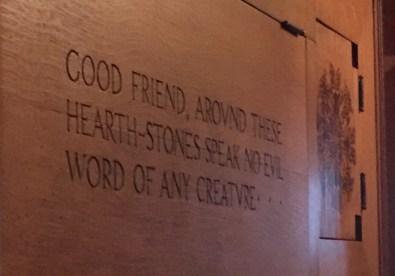
When Emily and I toured the Frank Lloyd Wright home in Oak Park, IL, a couple weeks ago, I was struck by the quote carved above the fireplace: “Good friend, around these hearth-stones speak no evil word of any creature.”

A few days ago at the small fenced park where I let the dog (Chai) run, she chased a squirrel behind some deep, thick bushes. When I crouched down to check on her, I noticed a piece of foam tucked against the fence behind the bushes, a small blanket spread along one edge of it.

“Someone’s been sleeping there,” I told Em.

Today I met the someone.

The man on the bench on the sunny side of the park wore a ball cap, a hooded sweatshirt with the hood pulled up, a big stadium jacket, insulated work pants, and boots.

A big bottle of liquor, almost a jug, sat at his feet.

I entered the park on the opposite side, tied Chai’s leash to a bench there, sat down, and started to work. I assumed the man would soon leave, and I could let Chai run free.

He didn’t leave, and something tickled the back of my brain.

What if Jesus had entered the park with me?

Because, after all, didn’t he?

Come with me, be in me?

Suddenly sitting there, across the park, back turned to this person, waiting for him to leave—it didn’t feel so right, didn’t feel like Jesus’s way.

I shoved my laptop in my bag, stood up, and turned in the man’s direction. He waved. I waved back and walked the circular path toward his side of the park.

I stopped next to his bench.

“I don’t bite,” he said, his voice gravelled but warm.

I smiled. “She doesn’t either,” I said, gesturing at Chai, and sat down.

We shook hands, exchanged names—John, Jen—and talked.

Mostly, he did. Felt like he needed a listening ear.

His eyes were heavy lidded and watery. He wiped them often on his sleeve. His nails curved over clubbed fingertips, reminding me of my Pappaw, whose hands looked the same. When I was a kid, my mom told me it was from years of smoking. I looked it up later. In my Pappaw’s case, she was right: the smoking led to the lung disease, which led to the clubbed fingertips.

John “confessed” first—not with any sense of guilt, but more to get it out of the way, probably to stall any questions from me. Maybe he noticed my cross. Maybe he’d heard the questions a hundred times.

It was cheap beer in the bottle, no apologies. He likes beer.

It’s his bed in the bushes; new tenants bought the place where he was staying, so he’s in between “permanent” housing. He should be sleeping on foam for only a week. He’s just praying the rain holds off.

He does odd jobs, cleans a little, wears a mascot suit for a local business (“That’s me behind the mask,” he laughs. “They started me at $9 an hour; now I’m up to $14).

He hangs out at different places, is “like the furniture” at a local bar.

He showed me his ring of souvenirs, given to him by different friends who’ve travelled, a bracelet from a friend from Africa, his phone, his latest phone bill. Each item led to a story.

And then, unprompted, he went back, launching into tales from childhood, growing up in Canada, in French Canada.

He spoke some French for me, talked about learning English because, “Well, you just had to.”

He played baseball growing up.

One baseball buddy was Italian. He remembered eating at his house once. “So much food! We sat there for four hours! I told them they’d have to roll me away in a wheelbarrow. But I couldn’t refuse the food. Those Italians, they’re crazy about food! You can’t offend their mama’s cooking!”
I laughed. “I know. I’m half Italian. Maiden name is Del Vecchio.”

He nodded. “That’s Italian.”

He got off on a tangent then, and it was time for me to go, so I waited for a break and told him I’d enjoyed sitting and talking with him. “You’ll probably see me around,” he said.

I probably will.

When I thought about this later, I wondered at the ease of it, at the simplicity of sharing a park bench. What almost kept me from that?

Why would I let anything keep me from that?

Oh, Jesus, you wiped away the biggest boundary ever when you put on flesh. With that chasm crossed, how silly the gates we humans erect of status and race and gender and education must seem!

Help me.

Help me to see them as insignificant as well.

Doing and Being

img_2530

pic by Emily Underwood

As I pray for Chicago and my neighborhood, I often find myself saying to God, “I don’t know what to do.” “How do I get involved?” I ask, “How do I feel as if I am helping in some way?”

He’s not answering the way I’d like—with a beam of light or voice from heaven, or even an email or phone call. Instead I hear, “Patience. Steadfastness. Stillness,” the words I believe I was given months before we moved—that I thought were just for during the move.

Maybe not.

I’m reading A Light to the Nations right now, a book about the mission of God revealed in the Old Testament, about the nation Israel as a participant in that mission to bless and bring light to the entire world. The big idea is that Israel’s very reason for being—for being chosen, for being a nation—is missional, is for the purpose of revealing God to the entire world. “All the nations of the earth will be blessed through you,” God told Abraham. God’s people are chosen and privileged not for their own sake or for the purpose of hoarding or mere enjoyment, but to be a display and contrast people to those around them.

But Goheen makes the point that this mission was not primarily about going but about being, about “living an attractive lifestyle to God’s glory before the surrounding nations,” about living “publicly to God’s praise” (Barth, quoted in Goheen 634/7002, Kindle edition).

So when I asked God again this morning, “What do I do?” these ideas from Light to the Nations came to my mind. I have, honestly, plenty of “doing” to do. Much of it seems mundane or even focused primarily on my family rather than my neighborhood, but this everyday doing, when “done” in the sight of my neighborhood or the other places I go in the course of my week, is a display, a way of being.

My next question, then, is if my way of doing/being is also a contrast. The Torah given to the Israelites reached into every area of life so they would understand that even the normal, everyday things all humans do belong to God. He is God of every area of life, and all can be done in the knowledge that we are his and not our own; and this is to His glory. When everyday life is done with this truth in mind, then it will certainly be a contrast from those outside the faith. It will also be a way of being, a distinct and different way of being.

I pray that through this being, we are a light to the neighborhood…

and I pray for patience, steadfastness, and stillness to wait for and recognize God’s calls to “doing” as well.

P.S. This piece came out of a class assignment that I wrote for my Former Prophets class at Northern. When I read the original assignment to Dave (husband), he suggested I should add it to this post, so it follows below. The post above stands alone, but if you’re interested in the topic of God’s mission as it is revealed in both the Old and New Testaments, then feel free to read on. The class is studying the books of Joshua, Judges, and 1 and 2 Samuel.  

Gile (professor teaching the class) expresses the concern that many Christians have jumped for far too long from Genesis 3 to Jesus, from God’s promise that the serpent would be “crushed” to the coming of the One who defeated sin and death. The intervening story, including all the history of Israel, has been reduced, sometimes to mere examples or morality lessons. And when we look at it this way, we lose sight of God and his big story, his mission that did not take a hiatus from chapter 3 to the New Testament but has always been in motion. God breaks onto the darkening scene in Genesis 12 with the promises given to Abraham, chosen by God to participate in God’s mission to restore his fallen creation and move them forward into the consummation of a full restoration on a new earth. In this action of choosing one man and through him, one nation, it is as if God has focused his intense beam of light on one side of a prism, not for the purpose of hiding it or simply making that one side glow, but for the light to move through that and emerge on the other side as a full spectrum, revealing the holiness and goodness of a God who longs for all his creation to be in right relationship with Himself and each other.

Looked at in this way, the Old Testament becomes God’s story, with Israel commissioned as its major participant. Goheen (author of Light to the Nations, referred to in the above post) quotes Wolff and calls Genesis 12:2-3 a “‘stupendous utterance’ for ecclesiology—indeed for the whole story of the Bible” (740/7002). Election has a “so that” purpose: “God’s people are a so that people: they are chosen so that they might know God’s salvation and then invite all nations into it.” This makes the story of Israel a revelation of God’s mission, of God himself. As God redeems his people, binds them to Himself in covenant, and dwells with them, the people of God are empowered to a particular kind of being, a holy people on “display” who live in right relationship with God and then reveal and mediate him to others as a kingdom of priests. Their display is one of great distinction from the nations around them; their entire society was to be righteous, walking in the way of Yahweh, and characterized by justice for all, the least as well as the great. This distinct display, this “light to the nations,” was to be winsome, drawing people in to learn more of the God who so transformed his people and then inspiring them to worship and praise this great God.


Shepherd me, O God~a hymn share

flw house 2.JPG

A homeschooling perk: Em and I took a field trip last week to the Frank Lloyd Wright house in Oak Park (that’s US history, right?). Em took this pic of one of his window designs.

This hymn showed up in my daily prayer app the other day, and I re-read the first stanza several times: “Shepherd me, O God, beyond my wants/beyond my fears/from death into life.” My default wants are safety, security, comfort, acclaim… And why am I so fixated on those? Because I fear that if I am not concerned about them, God will not be either. So I also need shepherding “beyond my fears.” I need God to move me “from death into life.”

I love the shift from prayer to truth-telling in this hymn, with the prayer for shepherding alternating with verses from Psalm 23, reminding the pray-er of God’s faithfulness and goodness. It is because of this goodness that we can confidently ask Jesus to shepherd us. Jesus, the Good Shepherd, knows our true needs, well beyond our wants or what we think will satisfy us. He will lead us through dark valleys of fear and doubt into abiding faith. He will lead us from death (which sometimes looks quite lively and self-satisfying) into true, full life. At the bottom of the post there are two links (to a Youtube audio recording of the song and to the hymn writer’s website) and a verse.

Hymn: Shepherd me, O God

Shepherd me, O God, beyond my wants,
beyond my fears, from death into life.

God is my shepherd, so nothing I shall want,
I rest in the meadows of faithfulness and love,
I walk by the quiet waters of peace.

Shepherd me, O God, beyond my wants,
beyond my fears, from death into life.

Gently you raise me and heal my weary soul,
you lead me by pathways of righteousness and truth,
my spirit shall sing the music of your Name.

Shepherd me, O God, beyond my wants,
beyond my fears, from death into life.

Though I should wander the valley of death,
I fear no evil, for you are at my side,
your rod and your staff, my comfort and my hope.

Shepherd me, O God, beyond my wants,
beyond my fears, from death into life.

You have set me a banquet of love in the face of hatred,
crowning me with love beyond my pow’r to hold.

Shepherd me, O God, beyond my wants,
beyond my fears, from death into life.

Surely your kindness and mercy follow me all the days of my life;
I will dwell in the house of my God forevermore.

Shepherd me, O God, beyond my wants,
beyond my fears, from death into life.

Words and Music: Marty Haugen

To hear the music, follow this link.

Visit Marty Haugen’s website for more of his music.

“If God gives such attention to the appearance of wildflowers—most of which are never even seen—don’t you think he’ll attend to you, take pride in you, do his best for you? What I’m trying to do here is to get you to relax, to not be so preoccupied with getting, so you can respond to God’sgiving. People who don’t know God and the way he works fuss over these things, but you know both God and how he works. Steep your life in God-reality, God-initiative, God-provisions. Don’t worry about missing out. You’ll find all your everyday human concerns will be met.

Matthew 6:33 MSG

God’s ear

If every act of violence—every single one—

boomed like heavy bass,

or screeched like nails on a chalkboard,

would it be less common?

But what if it IS loud—

and we’ve just grown hard of hearing it?

What if we’ve turned down the volume

till urban killings, wars in far-off nations, child abuse,

slavery, the rape of girls in other places

is merely white noise, background buzz?

Has God, too? Has He grown deaf

or simply unplugged the speakers of our pain?

Wouldn’t you—if that’s all you heard from this broken world?

Remember the crucifixion?

What a soundtrack that had!

Moaning, wailing, cries of pain and terror, sobs of grief,

shouts of anger and hatred, too.

The clamorous theme of our broken humanity.

Darkness covered it—could God not bear to watch?—

But He didn’t cover His ears!

No, He added to the noise.

Not with a whimper or a whisper—

with a loud cry!

“My God, my God, why have you forsaken me?”

The shout of the Son Incarnate,

victim of intentional violence,

carrier as well of the entire burden of the image-bearers

who’d spurned the image and lived the loss.

The Father heard,

listened,

responded—

with gusting winds,

rumbling skies,

a shaking earth,

and then, a final, awesome noise:

the tearing of a thick, dividing curtain.

Top to bottom, it split

With a rip that shook the universe,

Opening the way for us

to whisper our pain

Directly into God’s ear.

*I always feel like I must add a disclaimer when I attempt poetry. I’m not a poet! There are lines in here I like, but the whole lacks something (the problem with not being a poet is that you don’t know what’s lacking!). So, if there are any poets out there who read this and think, “I know what I would do!”, PLEASE feel free to tinker with it. I would love to post an updated, collaborative version.

Working through poopy

Processed with VSCO with hb1 preset

Em’s lettering–and Em’s photography (I think she’s amazing!)

My friend B calls it “working through poopy.” I think it’s a very accurate description. I worked through a little bit of my own poopy this morning: some jealousy, the desire to be noticed more/sought out more, some self-pity and fear and insecurity…

I’ll stop there.

After I spilled it all out in my journal, I felt better: ready to pray, ready to confess, ready to be grateful for the oh-so-much that has been gifted to me.

But God had one more step, one more gift.

I got up from the bench in the park where I’d been writing (so Chai [dog] could be outside) and noticed another woman entering the gate. She, too, had a dog. We exchanged pet names and then our own. In the chitchat that followed, we discovered we are both writers and the chitchat became conversation, with the shared language that comes with a shared vocation and shared concerns/frustrations/struggles/fears.

It was time for both of us to go, and as I walked toward the gate, I remembered, again, that we all—not just my fellow writer and I—are working through poopy. We’re all wondering about our purpose. We all want to be seen/known. We all struggle with identity. We all have very deep fears.

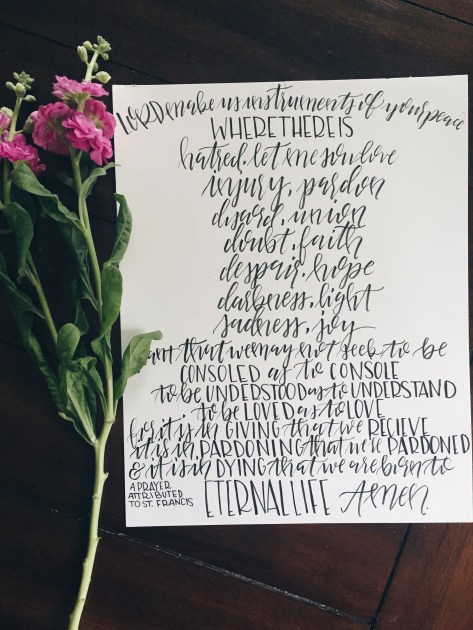
The second half of the St. Francis* prayer came to mind (another gift, that St. Francis!): Grant that we may not so much seek to be consoled as to console; to be understood as to understand; to be loved as to love. For it is in giving that we receive; it is in pardoning that we are pardoned; and it is in dying that we are born to eternal life.

Amen.


*Technically this poem is “attributed to St. Francis.” Here is the full text (also seen in the picture above):

“Lord, make us instruments of your peace. Where there is hatred, let us sow love; where there is injury, pardon; where there is discord, union; where there is doubt, faith; where there is despair, hope; where there is darkness, light; where there is sadness, joy. Grant that we may not so much seek to be consoled as to console; to be understood as to understand; to be loved as to love. For it is in giving that we receive; it is in pardoning that we are pardoned; and it is in dying that we are born to eternal life.”