Praying for Chicago

pc-77-east-garfield-parkWednesday night I went to a PrayChicago event, where church members and leaders from all over the Chicago area gathered to pray together. PrayChicago announced a partnership that night. They’ve joined with Prayercast (a great ministry that makes short prayer videos for nations and groups around the world–I really suggest checking out the Prayercast website) to create 77 prayer videos for Chicago, one for each neighborhood. They are releasing a new prayer video each day for the next 76 days (it started yesterday), and each video is accompanied by an informational page on that neighborhood’s history and particular prayer points.

If God has laid Chicago on your heart, please join me in praying for each of its unique neighborhoods over the next couple months. Just go the PrayChicago website, scroll down, and click on the “sign up for daily Chicago 77 updates.” You’ll receive an email each day with a link to the daily prayer video.

If you’d like to check out the videos before you subscribe, go to the Prayercast site, where you’ll find LOTS of prayer videos, for many, many countries as well as for Chicago’s 77 neighborhoods. Just look at the options in the top menu bar. Maybe you’ll decide to pray for a country a day, too.

Looking for the image

pilsen-mural

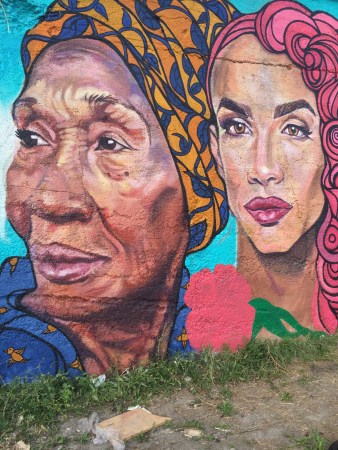
When my niece Anna visited, we spent an afternoon hunting murals. This is a mural in progress in Pilsen.

Before we moved, we held one last yard sale in an effort to avoid extra drop-offs at the thrift store. People asked, naturally, “Where are you moving?” Our response—inner city—garnered a lot of head shaking, puzzled looks, raised eyebrows. A couple people even offered gloomy predictions. “You’ll miss this,” they said, gesturing at the trees and yard. “You’ll get tired of the noise and the people and the dirt.”

I nodded. I was sure they were right. I’m sure now they’re right. I will certainly miss, deep in my soul, the waving trees and open spaces and wooded trails that were a great part of my life in our old town.

But I’ve asked, since even before we moved, that God would open my eyes to see loveliness right here in our new neighborhood. I’ve asked him to gift my eyes to look beyond the trash and poverty and sorrow and see elements of beauty.

He’s answering this prayer, but not in the way I expected. Yes, I do notice the old, turn-of-last-century architecture in our neighborhood—somehow-still-complete stained glass, gorgeous old stonework, intricately carved wooden doors—and the neighborhood gardens and the creativity of things like truck-tires-turned-flower-planters and murals brightening abandoned buildings.

But I’ve been most surprised by the beauty I’m noticing in God’s masterpieces, His people, these fellow bearers of His image. I’m seeing more than the destitution of those who hang out all day at the closest L station—I’m seeing the ways they cram close under the bus shelter when it rains, waving their arms at those outside to join them. I’m taking joy in the older men playing chess at dusk at the edge of the park, just under the rumbling L train, their heads bent low in concentration. I get a thrill of excitement at every baby I see, with face fresh and innocent, at every little girl with her hair fixed just-so, at every daddy proudly walking his kids to school. I’m looking for potential and not threat in the groups of young men sitting on doorsteps or walking, strong and sure, down the streets. I’m noticing the city worker riding on the back of the trash truck, dancing in plain sight of everyone to the music coming through his headphones. I’m thankful for the watchful eye and gentle wisdom of the neighbor who’s lived in the house across the street nearly his entire life. I love that on the same street corner on a Sunday morning I saw a man dressed for church—cane, hat, polished shoes, vest, and tie! so sharp!—and an older woman dressed in cheetah pajamas, hood with cat ears pulled up around her face. They seemed comfortable in each other’s presence. I’m noticing the woman, sitting on the seat of her push walker, earnestly carrying on a conversation with the air in front of her, and rather than feeling discomfort, I’m wondering if maybe she isn’t talking with God, maybe she “sees” more than I do.

Will I miss my regular romps through the woods? Absolutely. That forest spoke to me of the beauty and grandeur and glory of God. I saw God in it. But it’s not God’s greatest handiwork.

We humans are. No matter what brokenness we carry—be it obvious or more subtle (even socially acceptable—like greed)— we are still his intricate, beloved creations who carry the image of God!

And that’s not limited to only the “beautiful ones” among us, nor to the saintly, the brilliant or the gifted. You, me, the lady in cheetah pajamas, those who hang out at the L station all day/every day, the alcoholic who regularly sleeps it off in the alley behind our house…

Made in the image of God.

I’m looking for that.

Father Heart

This past spring, when we felt certain the Lord was moving us into Chicago, one of our first steps was to explore school options for our kids. The search for the younger three didn’t last too long. We visited two schools; one of them felt like a good fit to both them and us; and that decision was confirmed when we attended their back-to-school night this past week. Yes, they will face the difficulties of making new friends and learning new systems, but we know already they will be in a nurturing environment, one in which they already feel comfortable.

This, however, has not been the scenario for our oldest child, Emily. Our first choice fell through. Then she found a magnet school she really wanted to attend. She made it past the first round of selections, but not the second. That was heartbreaking and sudden and late. We scrambled and discovered a charter school option. It wasn’t close; it didn’t have some of the classes she wanted, but we thought it would do. So she started classes there, but we found, after a week of trying to make it work, it simply was too far away.

So late Thursday night, Dave and I discussed, again, her schooling choices. We weighed pros and cons and talked through different scenarios, and then, with exhaustion sucking us into sleep, we prayed a plea of confused desperation.

The next morning I woke before the alarm. As I lay there, quiet, I received an insight into my daughter. I got a glimpse into why the less obvious, more complicated schooling choice might be the very best thing for her.

I looked over at Dave and saw he was also awake. I shared with him the insight I’d received. He nodded and told me what he’d woken up thinking about. The two insights meshed; they fit together; they formed something that was enough of an answer for us to move forward with peace.

But even greater than the answer was this: the Spirit’s whispered insights were not just a reminder of God’s great wisdom, they were even more a reminder of God’s Father heart for our girl, for our family.

In that moment of shared insights I got a glimpse of God’s great, beating heart for my girl, who is, even more and always, HIS girl. He knows her, inside and out, through and through, better than I know her, better than her dad knows her, better than she knows herself.

And He loves her.

He loves her oh so well, so tenderly, so knowledgably.

And that understanding is the best answer of all.


Post script: When I opened up the Daily Office on my phone later on Friday morning—just after what I described above—I discovered the day’s hymn was “Day by Day,” one I remembered from my childhood. It was like a loving letter written just for us, but I suspect, in God’s incredible way of loving all his people, together yet so uniquely, it’s for many of us, so I’m sharing the words below.


“Day by Day” by Karolina Sandell-Berg

Day by day, and with each passing moment,

Strength I find to meet my trials here;

Trusting in my Father’s wise bestowment,

I’ve no cause for worry or for fear.

He, whose heart is kind beyond all measure,

Gives unto each day what He deems best,

Lovingly its part of pain and pleasure,

Mingling toil with peace and rest.

Every day the Lord Himself is near me,

With a special mercy for each hour;

All my cares He fain would bear and cheer me,

He whose name is Counselor and Pow’r.

The protection of His child and treasure

Is a charge that on Himself he laid;

“As your days, your strength shall be in measure,”

This the pledge to me He made.

Help me then, in every tribulation,

So to trust Thy promised, O Lord,

That I lose not faith’s sweet consolation,

Offered me within Thy holy Word.

Help me, Lord, when toil and trouble meeting,

E’er to take, as from a father’s hand,

One by one, the days, the moments fleeting,

Till I reach the promised land.

Made for Good

Chicago night skyline, Em's

photo by Emily Underwood (to see more of her work, click on her name.)

This past Sunday my family and I attended the Missionary Baptist church right around the corner from our house. It was their annual outdoor service, so we sat under a tent in the church parking lot and sang, danced, listened, worshiped—and fanned ourselves—along with the church’s very welcoming congregation. Pastor Turk, speaking about how Christ’s purpose gives us purpose, reminded us near the end of the service that not one of us—not one human being given being by God, made in the image of God—was ever created for evil purposes.

“You were made for good,” he said. “You were made to be a blessing.”

The very next day—Monday—as Em and I drove and walked along North Avenue to shop for her school uniform pants, we saw several people holding signs, asking for money. Begging.

I want to set the record straight right now. This post is NOT about whether those with means should or shouldn’t give cash to homeless people. It’s not about the reasons they are homeless or begging or about what they might do with the money they receive.

This post is about the people themselves: the woman and teenage girl sitting outside one of the upscale clothing stores, jacket hoods pulled tight against the rain; the man who squats with his back against a metal fence, his leashed cat next to him; the guy, clearly strung out, asking for train fare; and the lady who chants the same phrase, “Just a dollar. Only need a dollar,” over and over and over again All. Day. Long.

These human beings make sorrow rise in my heart every time I see them. And whether I give them money or not (I’m not telling.), I try to make eye contact, to say “hello,” to smile, to see them.

This past Monday, there was one man, one man in particular…

An older gentleman, standing at an intersection, his head up, his eyes looking straight ahead, his sign reading, “Lost job. Need help to get back on my feet.”

Grey haired.

And there was something about him that felt like a punch in the gut.

The words of Pastor Turk came back to me. “He was not made for this,” I thought. “He was not made for sorrow and humiliation. He was not made for other human beings to pass by, some obviously trying their hardest NOT to see him, some scanning him as if he were an animal in a zoo. In God’s kingdom, he will not be doing this. No one will be. We will each have a clear understanding of each other’s dignity, of the God image in every single person, including ourselves.”

This—some humans walking past and around those who hold cardboard signs as if they were no more than a tree or a light pole—is not right.

This—those humans holding signs, most of them with their eyes downcast because it’s less painful to not know you’re being blatantly ignored—is not right.

The sorrow lingered. As I prayed, a question wandered into my mind. Jesus, is this how you felt all the time you were on earth? Was there always a sorrow because you knew this is not what we were made for? Because you saw each human, created to be citizens in God’s world, walking around instead without true knowledge of Him, oblivious of each other at best, downright cruel at worst, full of fear and anger.

Did you walk through each day looking at those around you and thinking, “This is wrong. This is not Kingdom life”?

Is this what I am meant to think, to wonder? Is this sorrow supposed to linger, to always color my perspective, to remind me this is not the Kingdom? And is this sorrow ironically supposed to lead to hope? Because a Kingdom must, by definition, have a King—and ours is coming.

And he is good, and He works good.

He works good—even through and among and in his broken people.

Thy kingdom come, Thy will be done,

On earth as it is in heaven.


*If you’re a regular reader, you’ll recognize a new look to the blog. The header photo was taken by daughter Emily, and she chose the new format as well. Hope you like it!

Today I Awake

Processed with VSCO with hb1 preset

The Garfield Conservatory is just down the street from our house–so beautiful! And free! This is the entrance to the fern room. (shot by Emily Underwood)

In the Daily Office app I use on my phone (The Daily Office from Mission St. Clare), yesterday’s hymn was “Today I Awake” by John Bell. (I’ve shared another of John Bell’s hymns, “Take O Take Me As I Am,” in a past post [click on the title above to see the post, which has the words as well as a link to a recording of the hymn].) Bell’s treatment of the Trinity is beautiful, and it reminded me of the book Delighting in the Trinity (this link leads to a blog post recommending that book–so good!)

I re-read this hymn all day long yesterday, and last night I found a Youtube recording of it so I could also hear the tune. Click on the title below to listen to the recording. Hope you enjoy as well.

Today I Awake” by John Bell

Today I awake and God is before me.

At night, as I dreamt, God summoned the

Processed with VSCO with c1 preset

Fish @ the Conservatory  (by Em)

day;

For God never sleeps but patterns the morning

with slithers of gold or glory in grey.

Today I arise and Christ is beside me.

He walked through the dark to scatter new light.

Yes, Christ is alive, and beckons his people

to hope and to heal, resist and invite.

Today I affirm the Spirit within me

at worship and work, in struggle and rest.

The Spirit inspires all life which is changing

Processed with VSCO with hb1 preset

Another Conservatory pic (by Em)

from fearing to faith, from broken to blest.

Today I enjoy the Trinity round me,

above and beneath, before and behind;

the Maker, the Son, the Spirit together

They called me to life and call me

their friend.

Black Movers, White Neighborhoods

Perhaps it’s just that my current life chapter could be titled, “White Movers, African-American Neighborhood” or that the author of this piece, Esau McCaulley, is a fellow Anglican who desires more African American leadership and presence in the Anglican/Episcopal church in the United States, but I nearly cried when I read this piece. I want to sit down and have a really, really long conversation with this man. And, oh, do I wish he were in Chicago instead of in New York.

Missional churches

Early in June–before we got completely crazy with moving, I took a five-day intensive class at Northern Seminary. It was taught by Dr. Michael Frost. It was excellent, and I wrote a blog post about it (“Exiles in a post-Christian era“) for Northern Seminary’s blog. If you’re interested in missional living and the missional church, Dr. Frost is a leading thinker in this area, and the post has links in it to several of his books. If you’re at all wrestling with feeling separated from your neighbors or community–or church, I highly recommend Frost’s book Incarnate.

Click on the title above to read the post. While you’re on Northern Seminary’s site, I also recommend checking out some of the other posts. Northern Seminary leaders have written some really good pieces this summer on the violence plaguing and tearing apart our country.


Moving grief–and greed

I wrote this piece a week or so before we closed on our house, but Dave (husband) told me I couldn’t post it till after we were completely out of the house! 🙂 Seriously, though, despite my awful thoughts during the selling process (which you’ll read about later in this post), we do hope and pray the very best for the new owners of our old home. 

I wouldn’t normally consider greed as one of my besetting sins.

But when we decide to move, and we begin the process of selling our home…

the green-eyed nasty comes out.

I get insulted by offers that are lower than the asking price; I want to quibble (I don’t actually do it, but the impulse is there) over the inspection results; I begin to think of the homebuyers as “those people.”

Case in point: Two weeks ago, when we got an offer on the house—and it was a good one and such an answer to prayer—my first response was greedy.

Dave, very excited, got off the phone with our realtor and turned to me. “We’ve got an offer!”

He was ready to rejoice, but I wanted to know the amount. He told me.

My first words?

“That low?”

Dave wasn’t even mildly surprised. He laughed and called me out. “You get so greedy when we sell a house.”

Yes, I do.

And even though I try to fight it, it’s a constant all through the process. When the home inspection report from the city comes back, I say things like, “Shouldn’t the inspection report from when we bought the house have revealed this?” (What I’m leaving unsaid are these words: “…so the previous homeowners could have paid for the repair?”) When, during this current home-selling process, we got the request from the owners to provide two working garage door remotes, I said, only partly joking (I’m embarrassed to even admit this), “Someone told me that if an automatic garage door opener isn’t on the house listing, you can just unplug it and say it’s a manual.” Dave just stared at me after that one.

Every time this greed rises up like bile in my mind or actually vomits out my mouth, I’m appalled, and I try to figure out where it’s coming from (as if it simply can’t be a part of ME!); I pray about it; I try to talk myself out of it; I remind myself how really awful it is. After all, in this current sale, our home was on the market only two weeks—incredible!; the offer was good to begin with; when our realtor countered, the homebuyers accepted it; and their “fix-it” requests have been minimal. Knowing all this, I ask myself, “Jen, what is wrong with you?”

About a week after we sold our house, I was reading the novel Gilead by Marilynne Robinson (fantastic book, by the way) and I came to a line that was so good, so applicable, it made me stop and put the book down. The narrator of the book, John Ames, a pastor, is reflecting on the long, lonely years following the death of his young wife and their only child. In particular, he is remembering when, during that time of singleness, he christened his best friend’s child. He said the correct words, he blessed the child, but his inward thoughts were quite different.

“…my heart froze in me,” he wrote, “and I thought, This is not my child…”

The line that follows that statement is the one that made me set the book down.

“I don’t know exactly what covetise is, but in my experience it is not so much desiring someone else’s virtue or happiness as rejecting it, taking offense at the beauty of it.”

Oh.

Yes.

There is a grief in moving. I am leaving behind friends whom I love, neighbors whose stories I’ve learned, a house which has been a home, memories of Dave and I and our four children and our two international girls becoming a family…

…and there is a part of me that is flat-out jealous of the new homeowners. This right here is so good, I think, and what is ahead for us is so unknown that I’m simmer-level jealous of these people who are moving into what we are sorrowfully—though willingly—leaving behind.

I am, in John Ames’ words, taking offense at someone else moving into the happiness I’ve experienced here.

To be honest, I think there’s a good dose of penny-pinching, old-fashioned, straight-up greed involved as well.

So confession is in order; repentance is in order; but also in order is acceptance of the forgiveness of God.

Because it is in times like this–when I see some of the twisted nature of sin, its stem reaching deep into self-focus, its branches weaving through hurt and fear–that I remember I need absolution from Another, that there is no way I can ever pluck something like this from out of my heart.

A few days after I read the passage in Gilead, I read a section of Accidental Saints by Nadia Bolz Weber, a Lutheran pastor, in which she was writing about this very thing. Forgiveness, she said, is not like a dry erase board that we are frantically trying to keep clean so God will be happy with us. Rather, it is freedom from the bondage of self, wrought for us by Christ, who is fully aware of our deep sinfulness, more aware than we ourselves are.

We need to know this truth about forgiveness, she says, and then she writes about the Maundy Thursday practice of individual absolution. In it she lays her hands on each congregant’s head and pronounces, “In obedience to the command of our Lord Jesus Christ, I proclaim to you the entire forgiveness of all your sins, Amen.”

Jesus—not my efforts or repentance—sets me free from my sins, so that I may, as the prayer of confession says, “delight in (his) will, and walk in (his) ways, to the glory of His name.“

Amen!

Treasured sons

PJ's preschool picIs lament possible without identification? We white mothers must come to the point of understanding that we cannot say, “This could happen to my son—for no good reason—through no fault of his own—through no action of his own,” and really mean it, BUT nearly every African American mother CAN, and with these words a little surge of real terror spikes in her heart.

That is an example of white privilege.

I know it is, because as a white mother of a black son, I have a hard time really believing those words. Though I know my son’s risk factors are high (he is black, very dark-skinned in fact, and he has pronounced ADHD and high impulsivity), I don’t have the history that makes his danger REAL to me. I don’t have the from-birth distrust of a system, of a majority group that sees me as inferior (though they don’t come right out and say so). My skin doesn’t ripple with a subtle prickle of fear when I see a man in uniform. Even though I am truly “in the shoes” of other African American mothers, my white privilege keeps them loose in the day-to-day. They’re not pinching my every step.

I remember, several years ago, driving through rural Indiana with a Latina friend. As we approached one city-limits sign, I remarked, off-hand, casual, “This is a pretty town, but it was a KKK hotbed until just a few years ago. It’s more hidden now, but it’s still here.”

Her response was immediate, and it wasn’t just emotional. Her breathing quickened; her face went pale, and she was unable to relax until we were miles into the country on the other side. I couldn’t identify, but I “got it.” She’s experienced “difference” her entire life. And I, except for when travelling in Africa (and the “difference” I experienced there brought, for the most part, privilege), have not.

This morning I woke early. We are preparing for a move to one of those very neighborhoods where the other mothers in it live everyday with this fear for their children, where I, too, will experience it more, simply because of location. Because of this upcoming move, our house looks like a picked-over junk shop. It is at the stage when everything formerly “in”—cupboards, closets, drawers—is out, and all knickknacks are off shelves and ledges, revealing hidden dust.

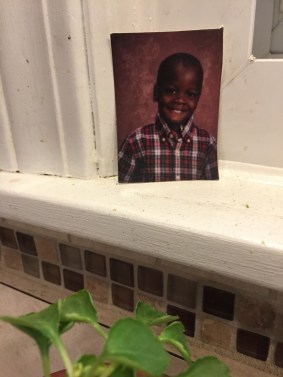
Late last night I moved the verse plaque from the windowsill above my kitchen sink. Behind the plaque I found a picture of my black son taken several years ago when he was in preschool. At some point I’d tucked it behind the plaque and forgotten about it.

This morning, up before anyone else, I read updates on the shootings of Philando Castile and Alton Sterling. I cried. I prayed. Then I went to the sink to fix myself some tea. And there was the smiling face of my beautiful son, like a treasured photo of a lost loved one, placed in a spot where one sees it several times a day.

And for one moment, the shoes tightened, hard, and I remembered the words I’d read just a few minutes earlier in one of the news reports. Philando Castile’s mother, speaking to a group of African Americans mourning the death of her child, told them, “This could be your son.”

If one is truly to grieve, lament, repent, this is what we must understand.

Education Confronts Injustice

My family is in the middle of packing for our move, so I haven’t been blogging, but I do have a piece that went live on Master Teaching today. Master Teaching is a website run by LEAPAsia “for teachers who follow the Master Teacher” and is currently hosting a series on “Education as Justice.” Through my connections at World Relief, I was asked a couple months ago if I would like to contribute a piece to the series, and, as this is a subject near and dear to me, I said I would love to.

My piece is titled “Education Confronts Injustice” and is specifically about refugee education. Click on the title to read the piece. I also highly suggest another piece in the series titled “Education as a Wealth-building Strategy is Bankrupt.” It’s got great wisdom for everyone, not just those in the education field. Following each piece are questions for reflection and articles for further reading.

Thanks for reading!

Jen