First: a link to a piece on The Well Blog (a blog produced by InterVarsity specifically for women) titled “My Sacrilege, Our Sacrilege” by Ashley Van Dragt. Here’s an excerpt to tempt you to click the link and read the whole thing–which, if you want to know the “moment” she refers to in the first sentence, you will have to do.
Over the course of Lent, I’ve kept coming back to that moment. I keep going back to it because I came to realize that there are words for it.
“Crucify him.”
And these are the words that get at the significance of Lent, of Good Friday. It’s the time of year when we remember Jesus on the cross. And at the end of it, on one horrible night we carry ourselves and our preoccupations and our snotty-nosed children to church to mentally put Jesus on the cross and into the grave. And we say together the most hellish sounding words:
“Crucify him!”
And it’s profane and terrible…and important.
Because — my God, my God — we have indeed done something wrong.
Here’s the link again–so you don’t even have to scroll up!
Second: Today I went to our church’s Stations of the Cross service. I wrote a post about what emerged for me from this service last year. This year two things were fresh and new:
1. Jesus’ heart for US–WHILE while enduring SO much pain and suffering. “Father, forgive them, they know not what they do,” he said, and then he interacted with the thief on the cross. “I say to you, today you will be with me in Paradise.” Oh, the heart of God revealed in these moments! Forgiveness beyond what we can imagine!
2. This prayer–so simple, yet coupled with the heart of God, so powerful: O blessed Lord Jesus, be gracious to us and all who have gone astray from your ways, and bring us home again with penitent hearts and steadfast faith; who now live and reign with the Father and the Holy Spirit, one God, for ever and ever. Amen.
Third, this is a link to “Good Friday Blues,” a piece published at Christianity Today. It’s about Texas gospel bluesman Blind Willie Johnson’s recording of “Dark Was the Night—Cold Was the Ground” with Columbia Records in 1927. Though the song has no lyrics, it is about Good Friday, with the title borrowed from an 18th century English hymn by Thomas Haweis:
Dark was the night, cold was the ground
on which the Lord was laid;
His sweat, like drops of blood, ran down;
In agony he prayed.
The article about Blind Willie Johnson tells part of his story and contains a link to a recording of this song. Both are wonderful.
All my creativity seems to be going into other kinds of writing these days, but that’s okay! The creativity of the Word and of other friends is encouraging me. This morning I read the verse of the day on Bible Gateway (in The Message, which makes it startling–exactly what I want) and then I noticed a friend of mine had just posted something new on her blog. The verse and her post go together perfectly. May you be blessed as I was!
So, chosen by God for this new life of love, dress in the wardrobe God picked out for you: compassion, kindness, humility, quiet strength, discipline. Be even-tempered, content with second place, quick to forgive an offense. Forgive as quickly and completely as the Master forgave you. And regardless of what else you put on, wear love. It’s your basic, all-purpose garment. Never be without it. Colossians 3:12 (the link takes you to the side-by-side translations of the verse in the Message, Amplified, and NIV).
And here’s the link to Joellyn’s post “Life in Death to Self.” And here’s a quote to encourage you to click the link and read the whole thing 🙂
We do not find joy by fulfilling all of our own desires and getting our way. Again, we have to look upside down in this world. Die to self. Lay down your life. Find real life in Jesus. … If I can get to this place of surrender I often enjoy the privilege of seeing His glorious resurrection work in action, and tasting the fruit of it myself.
Midpoint of the Ash Wednesday service. We have listened to the Word; the crosses have already been marked on foreheads; and we are waiting to receive the Sacrament of the Eucharist. The father of the young family seated in front of us leaves to get his smallest one from the children’s service. When he returns, his little boy runs ahead, right into his mother’s arms. She lifts him to her lap, and he settles, content, his chin nuzzled into her neck. I am seated behind them. His eyes meet mine, and we smile at each other, but then his eyes widen.
He has seen the dark cross on my forehead. He looks past me at my children, each marked with a cross of ash. He pulls back and looks up at his mother’s face. He cannot see her forehead, so he places his small hands on her cheeks and pulls her face down until her ashes, too, are visible to him. In wonder he gently touches his small finger to her forehead, tracing the dark lines there. He pulls his hand away and looks at the dark smudge on his fingertip. “A cross?” he asks. She nods. He looks past her again, at me, my children, the friends next to us. We are all marked with ashes. He pulls aside the hair on his own forehead. “Where’s my cross, Mommy? I want a cross, too.”
She tries to hush him, but he asks again—and again. Soon he is weeping. He is quiet, but tears stream down his cheeks.
After the service, his mother stands, holding him in her arms, and turns to my husband, still wearing the purple and white robes that signify him as one who marked others with ash this night.
“Can you put a cross on his forehead?” she asks.
“I would, but I don’t have the ash anymore,” he answers.
“It’s all right. He just wants someone to mark him with the sign of the cross, and you…” She gestures at the robes.
My husband stands and smiles at the small child. He lifts one hand to the boy’s head and brushes his soft hair to the side. With the thumb of his other hand, he gently rubs the child’s forehead, down and then across.
In my mind I hear, again, the two lines said over each person who received a cross of ashes this day:
“Remember that you are dust, and to dust you shall return.”
“Repent and believe the Gospel.”
My husband’s thumb leaves no smudge, but the boy smiles and something glistens on his rounded cheek, a silver line that almost glows when the light hits it just right. It is the trail of his tears, his mark this night, his ash cross, the sign that he has accepted his humanity, his frailty, his need.
May we all accept.
May we all remember.
That we may repent.
That we may believe.
Rend your heart and not your garments.
Return to the Lord your God,
for he is gracious and compassionate,
slow to anger and abounding in love,
I delivered this sermon to the women’s gathering at our church last week, so for a blog post, it’s SUPER looong and it sounds more like a “talk” than an essay! If you’d rather listen, I recorded it (about 25 minutes in length). Just click below.
I first read the prayer below in a book I was reading on the Old Testament Law. It’s called the “Prayer to an Unknown God” and was found on a tablet dating from the mid-seventh century BC. The original prayer is from Sumer and probably dates from somewhat earlier. What follows is just a small portion of this prayer:
May the wrath of the heart of my god be pacified!
May the god who is unknown to me be pacified!
The sin which I have committed I know not.
An offense against my god I have unwittingly committed.
The iniquity, which I have done, I know not.
The lord, in the anger of his heart, hath looked upon me.
The god, in the wrath of his heart, hath visited me.
I sought for help, but no one took my hand.
I wept, but no one came to my side.
I am afflicted, I am overcome, I cannot look up.
I kiss the feet of my god and [crawl before him] . . .
How long, known and unknown god, until the anger of thy heart be pacified?
Can you imagine being in that situation? We don’t live in an ancient near eastern culture, so the idea of having to appease an unknown god is pretty strange for us, but this was the norm in that time. When you listen to that prayer—and I only read a very short portion of it—you hear the desperation and you begin to see why people did so many strange and even terrible things to appease these gods they didn’t even know. About a month ago I read a fictional book about a village in ancient times that was oppressed by a demon. This oppression had gone on for decades, so by the time the story takes place, the villagers have made up a religion to try and please this demon. They’ve elected a priestess to serve the demon, and she spends her entire life trying to determine what the demon wants. But things have gotten worse and worse, and they’ve finally begun offering their children to the dragon, a different child each month. They choose the child by lottery and take the child up into the hills and leave it there to be consumed by this demon. The author allows you to get into the mind of the young priestess, and you get to feel her confusion, her dread, her sorrow at the death of children she has known and played with. But she doesn’t know what else to do. She doesn’t know how to please this angry, hungry god. It’s heartbreaking! They give and give and give to meet the demon’s needs, but it’s never enough.
This isn’t just ancient history, is it? That scenario describes so many of the religions or systems that people follow even today. Many of our systems are governed by questions of “Is this enough? Is this what I should be doing?” People who follow them are plagued by feelings of inadequacy and failure and hopelessness.
Does this sound familiar? If we’re honest, we have to admit that WE often put ourselves under those systems—without even realizing it. And then we discover ourselves asking those same questions, feeling those same feelings of inadequacy and failure.
But we don’t have to. We don’t pray to an unknown God. We don’t live with an unknown God. We follow a God who has made Himself known, who has revealed Himself to be a God of goodness, a God of light and love.
And what is more, in complete contrast to every system we’ve created, to every demon that has demanded worship, God doesn’t ask US to figure out an offering for Him. HE OFFERS HIMSELF!
This is unheard of! Unprecedented! It’s so far outside our natural inclination as to be CRAZY!
God gives Himself to us.
Do you see this in the passage we just read, in John 6:25-35? Let’s look at it again.
25 When they found him on the other side of the lake, they asked him, “Rabbi, when did you get here?”
26 Jesus answered, “Very truly I tell you, you are looking for me, not because you saw the signs I performed but because you ate the loaves and had your fill. 27 Do not work for food that spoils, but for food that endures to eternal life, which the Son of Man will give you. For on him God the Father has placed his seal of approval.”
28 Then they asked him, “What must we do to do the works God requires?”
29 Jesus answered, “The work of God is this: to believe in the one he has sent.”
30 So they asked him, “What sign then will you give that we may see it and believe you? What will you do? 31 Our ancestors ate the manna in the wilderness; as it is written: ‘He gave them bread from heaven to eat.’[c]”
32 Jesus said to them, “Very truly I tell you, it is not Moses who has given you the bread from heaven, but it is my Father who gives you the true bread from heaven. 33 For the bread of God is the bread that comes down from heaven and gives life to the world.”
34 “Sir,” they said, “always give us this bread.”
35 Then Jesus declared, “I am the bread of life.Whoever comes to me will never go hungry, and whoever believes in me will never be thirsty.
Now we have to go back before we go forward. In the section just before this one, Jesus fed the 5,000 with five loaves and two small fish. That’s what Jesus is referring to in verse 26.
So he tells these people who have followed him to focus more on eternal life rather than physical food, and they respond with a question, a very typical question, one that is our normal response when we’re told that what we’re doing isn’t quite right, isn’t “enough.” They ask, “What should we do? What is the work God requires?”
Such a normal question! Whenever we’re told—or we even feel that what we’ve done or who we are isn’t enough, isn’t completely right—we do the same. We, too, ask, “What do I do?”
But Jesus’s answer is NOT normal—is SO “not normal.” It’s a shocking, crazy, upside down answer!
“Believe in the one God has sent.”
Believe in the offering of God!
He doesn’t tell them how to fix THEIR offering. He doesn’t give them more specific instructions. He tells them to believe in him.
He goes on to explain that this belief, though, is not just a head decision; it’s not flippant. The Amplified Bible gives several of the meanings inherent in the word and translates “believe” as “adhere to, trust in, rely on, and have faith in.”
Then Jesus takes this further, and equates belief to “eating his flesh and drinking his blood.” Let’s look at verses 47-58:
47 Very truly I tell you, the one who believes has eternal life. 48 I am the bread of life. 49 Your ancestors ate the manna in the wilderness, yet they died. 50 But here is the bread that comes down from heaven, which anyone may eat and not die. 51 I am the living bread that came down from heaven. Whoever eats this bread will live forever. This bread is my flesh, which I will give for the life of the world.”
52 Then the Jews began to argue sharply among themselves, “How can this man give us his flesh to eat?”
53 Jesus said to them, “Very truly I tell you, unless you eat the flesh of the Son of Man and drink his blood,you have no life in you. 54 Whoever eats my flesh and drinks my blood has eternal life, and I will raise them up at the last day. 55 For my flesh is real food and my blood is real drink. 56 Whoever eats my flesh and drinks my blood remains in me, and I in them. 57 Just as the living Father sent me and I live because of the Father, so the one who feeds on me will live because of me. 58 This is the bread that came down from heaven. Your ancestors ate manna and died, but whoever feeds on this bread will live forever.”
Jesus tells us to ingest Him, to eat and drink of Him. Think of all the implications in that: tasting, chewing, swallowing, and then a digesting that spreads his being into every part of our being!
He’s telling us to believe in him to the point that we take him into our own selves—THIS is what will please God!
It sounds a little crazy, doesn’t it! And how, exactly, are we supposed to do that?
Now I want to point out that in this passage John brings up two Old Testament events that “fill out” this command of Jesus and might help us understand this I Am statement. First, John opens chapter 6 by mentioning that the Passover was coming. He just throws it in there like a throwaway statement, but it’s not. The Passover was the celebration of God’s deliverance of the Israelites from the Egyptians; it was His rescue of them from slavery and oppression. So the word Passover was synonymous for the Jews with the word salvation, and John mentioning the Passover is a clue that this entire passage is about Jesus being salvation—that the miracle that opens this chapter and leads into Jesus ‘s statement about his being the Bread of Life is about way more than Jesus just providing physical food.
So when Jesus tells us He is the Bread of Life; he’s telling us He is our salvation, our deliverance. This is central every time we celebrate Eucharist. “This is my body, broken for you. Take this in remembrance of Me.” His flesh, offered for us, brought us deliverance.
That’s amazing! That God was in Christ, reconciling the world to Him—through His own Body. HE made the offering. We don’t have to. All he asks us to do is believe that He actually did this for us—and that it’s enough!
But remember that I said there were two Old Testament events that John brings up in the passage? I think the second one actually helps us to believe the first one. The second one is what moves our belief in Christ from our heads to our hearts. We can SAY, “yes, I believe Jesus is the bread of life for me”—but it’s in the nitty gritty, every day “eating” of him that this belief becomes something real and warm and true inside us!
So let’s look at the second Old Testament event. In verse thirty, right after Jesus tells the people that the work of God is to believe in the one God sent (Jesus!), the people bring up the manna in the wilderness. “What sign then will you give that we may see it and believe you? … Our ancestors ate the manna in the wilderness; as it is written: ‘He gave them bread from heaven to eat.’”
Now just a little backstory. The Israelites wandered in the wilderness AFTER their deliverance—that’s important—and the manna was bread that came from heaven every single day for their sustenance. They’d already been delivered from slavery, but they needed something to carry them through the gap between the deliverance and arrival in the Promised Land.
We, too, need sustenance. Our salvation is one of those “Now and not yet,” things. We have eternal life, but we’re not living in the actuality of it right now.
But hold on! Let’s not just gloss past this, let’s not SETTLE for something less than what Christ offers us. Remember, Christ told us that he came that we might have LIFE—and have that life to the full! He’s still offering us Himself—and He’s holding it out to us every day! He’s saying—that eternal life that I offered myself for—that my death provided for you—I want you to start living it NOW, HERE!
He doesn’t mean that we never struggle; he doesn’t mean that we don’t experience problems; he doesn’t mean that we’ll never have to fight against our sin tendencies.
But He does mean that He is making available to us a life in the here and now that is full of love, joy, peace, patience, kindness, gentleness, self-control, a life that is able to consider others’ interests ahead of our own without resentment or bitterness, a life that is drawn to the noble, beautiful, lovely, and the good!
We know what it’s like to have moments of that eternal life here, don’t we? But we also know a lot about the half-life, the shadowed life, the pseudo=life we usually live in—the life we plod through, always struggling with ourselves, with others, lacking joy, lacking peace. The church father Athanasius described this life as a return to “nothingness.” He described it kind of like being a zombie (okay, the word “zombie” is MY take on Athanasius’s idea!—wandering around, walking dead, grunting and geared toward grumpiness and destruction!)
That’s a little how I’ve felt in the last 30 days. My husband and fifteen-year-old daughter went on a Whole 30 diet about a month ago—for a month—and in sympathy I went on a modified Whole 30 with them (I did NOT give up my afternoon sweet chai ritual or cream in my coffee!). But I did give up bread, which is not terribly difficult for me outside our house, but I MAKE our bread at home, and it’s darn good, whole wheat, incredible toasted with some butter! Mmmm.
I discovered that there was another side effect of giving up bread. One morning I ate some leftover stew for breakfast (you eat weird meals sometimes with Whole 30). I worked for a couple hours and then took the dog for a walk in the woods. It was good—until I just bonked. My energy was gone. The stew—the little bits of meat and lots of veggies—were gone. My legs and arms felt heavy, and every step was hard. I thought, “Oh, if I’d had a slice of bread this morning, I wouldn’t feel this way,” and I longed for a warm slice right then! Instead I had to drag myself the rest of the way out of the woods to the car.
That’s a picture of the half life, and it’s not the full life Christ is offering us.That full life fills us full! It spreads the fruits of the Christ’s Spirit all through us and gives us the power to live like Christ did, energized by the Spirit, motivated by the love of the Father, in fellowship with God and his people.
We KNOW how to live the half-life, the dragging, defaulting-to-self-and-negative-emotions life. That is completely natural to us. But we don’t really want that—not deep down. Deep down we want the full life Christ tells us about—and we SHOULD. C.S. Lewis once said that the problem is not that we desire too much but that we desire too little. The Holy Spirit wants us to recognize that desire for more, that desire to be filled with Christ, to be empowered by his Spirit, to have life to the full.
But how do we do this? (Oh, I’m back to asking what do WE do, am I not?)
Here’s how: we eat Jesus like the Israelites ate manna in the wilderness (which often describes our here and now, doesn’t it!).
That means daily!
We can learn from the Israelites’ wilderness experience here. God sent the manna every day to them, and he told them not to store it up. They tried to—a few of them went out and gathered a whole bunch of it—either because they didn’t want to gather it the next day or because they doubted God would provide it the next day or they were trying to be resourceful—but when they opened up their “stored” manna bread, it had worms in it. It was stinky and rotten.
We do that, don’t we? We try to do life on our own. We follow our own plan. We want to be in control. We want to prove ourselves—that we’re strong and capable. We don’t believe God really means it when he says he wants us to come to him empty handed every day! We don’t believe he’ll love us or want to be with us if we’re too needy.
But we have to believe that he really wants us to come with our bellies empty and our hands empty, empty but ready to receive from him. He doesn’t ask us to gather the wheat or press the oil or grind the salt. He just tells us to come and believe that he is who he says he is—the one who made us and loves us and feeds us. He wants us to believe that like we take bread into our mouths and chew it and swallow it down inside us, filling us.
Our only work in this is to come to him, to cup our hands or, if we’re simply too weary to even do that, to open our mouths and let the Holy Spirit feed us the Bread of Life.
Practically speaking, what does this look like? It looks like us coming out of sleep each morning and saying, “I got nothing. If I try to feed myself with myself—or anything else— today, if I try to function on my reserves, it will be disastrous. I will crash. I will struggle through my day, feeling overwhelmed or weary or struggling with negative attitudes” OR we acknowledge, “I will seem to function just fine but I’ll be charging through without the ability to really care for those around me or to notice God and the gifts He is giving me.” (Those are just a couple of examples of what it is like to live the not-life—you probably have some ideas in your own minds of what it looks like for you.)
But if we eat Jesus as our daily bread, we dwell in Him—who is Life itself!—and Life Itself—Jesus—dwells in us! And THAT is a life worth living. THAT is eternal life NOW!
So how do we eat this daily Bread of Life? I came up with three action steps:
First, we Look at Jesus.
Second, eyes still on him, we Reveal our brokenness and emptiness.
We acknowledge it—to ourselves and to him.
And third, we Accept His fullness for us.
We say, “Oh, I want to really believe in You today. I want You to be my all in all. I want to know and rely on and trust in you—completely! Help me to do this.”
We do these steps at the beginnings of our days, in the middles, at the ends—daily bread might need to be hourly! We probably need to graze on Jesus all day long!
Look at Jesus.
Reveal your brokenness.
And Accept His fullness for you.
May the grace of our Lord Jesus Christ and the love of our God and the fellowship of the Holy Spirit abide with you, now and forever. Amen.
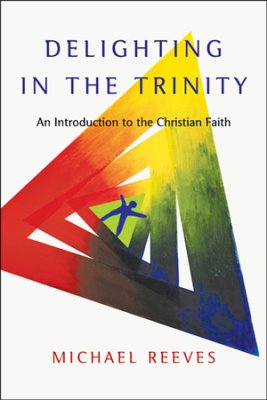
Books about theology are not known for their humor, but Delighting in the Trinity by Michael Reeves is an exception! I found myself smiling and even laughing aloud as I read it. The back cover content calls it “witty, lively, conversational, accessible,” but it also says it is a “rich and enjoyable portrayal of the basic beliefs of Christianity that opens up the profound and life-changing truths of our faith.”
I couldn’t agree more. To give you just a feel for the book (and to tempt you to get and read it for yourselves), I’m going to share the first two paragraphs of Reeves’ introduction—and then I might have to share just a few more quotes (I underlined a LOT in this book!).
“’God is love’: those three words could hardly be more bouncy. They seem lively, lovely and as warming as a crackling fire. But ‘God is Trinity’? no, hardly the same effect: that just sounds cold and stodgy. All quite understandable, but the aim of this book is to stop the madness. Yes, the Trinity can be presented as a fusty and irrelevant dogma, but the truth is that God is love because God is a Trinity.
“This book, then, will simply be about growing in our enjoyment of God and seeing how God’s triune being makes all his ways beautiful. It is a chance to taste and see that the Lord is good, to have your heart won and yourself refreshed. For it is only when you grasp what it means for God to be a Trinity that you really sense the beauty, the overflowing kindness, the heart-grabbing loveliness of God. If the Trinity were something we could shave off God, we would not be relieving him of some irksome weight; we would be shearing him of precisely what is so delightful about him. For God is triune, and it as triune that he is so good and desirable.” (page 9)
Can’t resist! Four more quotes:
“Here is a God who is not essentially lonely, but who has been loving for all eternity as the Father has loved the Son in the Spirit. Loving others is not a strange or novel thing for this God at all: it is at the root of who he is.” (page 41)
“…the Father sent his Son to make himself known—meaning not that he wanted simply to download some information about himself, but that the love the Father eternally had for the Son might be in those who believe in him, and that we might enjoy the Son as the Father always has. Here, then, is a salvation no single-person God could offer even if they wanted to: the Father so delights in his eternal love for the Son that he desires to share it with all who will believe. Ultimately, the Father sent the Son because the Father so loved the Son—and wanted to share that love and fellowship.” (pages 69-70)
“The Spirit of the Father and the Son would never be interested in merely empowering us to ‘do good.’ His desire (which is the desire of the Father and the Son) is to bring us to such a hearty enjoyment of God through Christ that we delight to know him, that we delight in all his ways, and that therefore we want to do as he wants and we hate the thought of ever grieving him.” (pages 101-102)
“For Christ is the Word of God. Without him we would be ‘blinder than moles,’ never dreaming of how fatherly God is. But the Spirit-breathed Scriptures proclaim him as the radiance of his Father, the only one who can share with us the true life of knowing, loving and being loved by his Father.” (page 84)
Interested? Did I mention it’s fairly short? 130 pages. Did I mention it has pictures? It does! And sidebars of fun, “extra” information? Yep! It’s available as a paperback of ebook at Christianbook.com.
My friend Sandy taught last week at our church’s women’s Gathering service. We are studying a few of Jesus’s I Am statements this winter term, and though she was teaching on “I am the Light of the World,” she began with some background on all the I Am pronouncements. She pointed out that when Jesus’s audience heard his statements beginning with “I Am,” they knew what he meant: he was identifying himself as God!
So, as WE study the I Am statements, we can understand that they reveal to us great truths about God Himself: Father, Son, and Spirit. Sandy reminded us that Jesus doesn’t finish these “I Am” statements with abstract ideas but rather “link(s) every I AM with a tangible, material thing—something of this world, part of Jesus’ humanity—a light, a grapevine, a shepherd, a door, a gate. Each of these things is Jesus’ way to help us understand and believe this great God who loves us with a great love. Jesus describes the love of God in ways we can understand, so we can believe and love him back!”
Then Sandy shared this beautiful quote from St. Ignatius: “All the things in this world are also created because of God’s love, and they become a context of gifts, presented to us so that we can know God more easily and make a return of love more readily.”
I loved what she said, and I thought that today I would just share a few pictures of the “God gifts” I’ve noticed and taken pictures of in the last couple weeks. May you notice many God gifts today.
I love to walk in the woods. I don’t know why this red tanker car has been left on the tracks so long, but I love seeing it against the dark woods–with a brilliant pink sky blazing above and shimmering below in its reflection on the pond ice.
a wider view of the same sunset
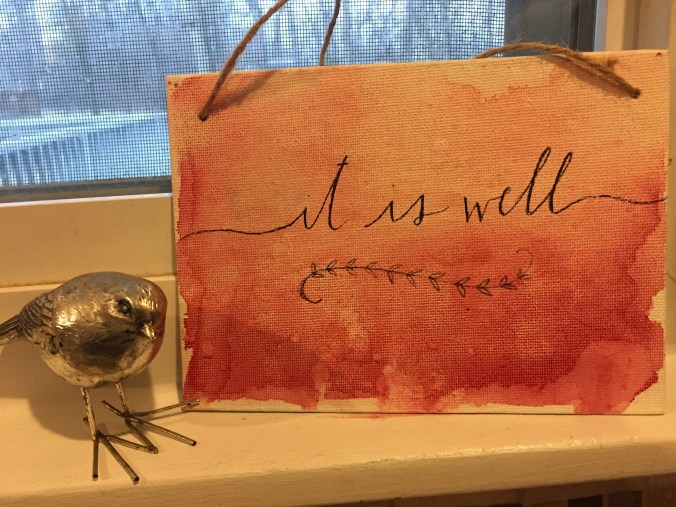
one of my daughters gave me this sign. It sits next to a bird, another gift, this one from a dear friend.
They (my children) are all four of them gifts, but I had to take a picture of my youngest dressed up as a Secret Service agent! Those glasses barely stayed on for the picture!
ANOTHER view of that train, but this time in the very early morning light–almost blue!
I have no idea how I blurred this picture so badly, and I almost deleted it, but then I thought it looked like an impressionist painting–so soft. Look close and you can see the red train.
According to her, there is no point in stopping and taking pictures. “Come on!”
My husband’s and youngest child’s hands–in an incredible shot taken by my oldest
“Mom, how do you know you’re a Christian?”
My child who has never seen shades of grey—least of all in herself—has begun wrestling with some of the hard questions of faith. Tonight she is struggling with a question I remember from my own growing-up years.
How do I know I’m saved? I don’t feel saved. I’m not doing a very good job as a Christian right now. I’m not loving God much—others either. I feel distant, and God seems vague—or worse. What if it was all fake—and I’m not really saved?
Oh, yes, I remember.
I also remember what I did in response: said the sinner’s prayer again (and again, and again), just to be sure, just to “seal the deal.”
But that’s not what I suggested to my troubled child. Instead I used a metaphor.
Do you remember when you were little and I would carry both you and your brother on my hips from the car into the store?
A nod.
Did you always hold onto me?
Head shake.
Sometimes you did. Sometimes you clutched tight, arms and legs. I could have let go completely, and you would have still hung there like a little monkey.
But much of the time you were like a sack of potatoes—you left it all up to me—and other times you actually struggled to get down. You pushed against me. I had to hold on tight.
I looked into her eyes.
We’re all like that with God. There are times we cling, times we know our desperate need for God, and we hang on for dear life. But that’s not all the time; it’s not most of the time. Most of the time we sit like a disinterested sack of potatoes. We’re not really concerned with our relationship with God. We’re not working on it. Sometimes we actually push him away. We don’t want anything to do with Him.
Her look changes from worried to thoughtful.
Did I ever just drop you when you acted like that?
No.
Neither does He. He’s still holding you, no matter what.
And because I have learned much lately about the Body of Christ and our deep responsibilities as members of it, I told her this.
Darling, I see the evidence of God’s work in you. I’ve seen it for years. I remember the first moment you said you really wanted to follow Christ, and I saw transformation even then. It’s still happening now. I am testifying to you of God’s work in you, of His faithfulness to continue His work in you.
Not long after this conversation, I read a book about us Christians being invited into a community of atonement, and I remembered a story someone once told me about a man, a Christian, who was in deep distress. He’d lost a dear loved one and his grief was overwhelming him. A fellow Christian encouraged him to continue coming to church, and the man responded, “I can’t participate. I can’t pray. I can’t even recite the Lord’s Prayer or sing the Doxology. I can’t do any of it.”
His friend told him, “That doesn’t matter. We will do it for you, on your right, on your left, in front of and behind you. We will praise and confess and worship around you, for you, in a sense. It will carry you along, and when you are ready, you can join in again.”
I have long loved the prayer cried out by the father who asked Jesus to heal his child: Lord, I believe; help my unbelief. I have prayed it many, many times myself. And I am beginning to understand that not only does the Lord personally help—with the Father’s strong, gentle hand, with the whisper and comfort of the Holy Spirit, with the active Gospel accomplished by and in the Son—but He also helps through His Body, His Church.
Hebrews 10:23-25 (RSV)~ Let us hold fast the confession of our hope without wavering, for he who promised is faithful; 24 and let us consider how to stir up one another to love and good works, 25 not neglecting to meet together, as is the habit of some, but encouraging one another, and all the more as you see the Day drawing near.
Hebrews 10: 19-25 (Message)~ So, friends, we can now—without hesitation—walk right up to God, into “the Holy Place.” Jesus has cleared the way by the blood of his sacrifice, acting as our priest before God. The “curtain” into God’s presence is his body. 22-25 So let’s do it—full of belief, confident that we’re presentable inside and out. Let’s keep a firm grip on the promises that keep us going. He always keeps his word. Let’s see how inventive we can be in encouraging love and helping out, not avoiding worshiping together as some do but spurring each other on, especially as we see the big Day approaching.
Two days after my sister sent me the Matthew 6 commentary on generosity and giving that I shared in my last post, I opened up my podcast library on my phone to listen to the latest Tim Keller Sermon and found that it is titled “Blessed Are the Poor.” It so closely relates to the Matthew 6 commentary that I am blown away. Clearly this is something the Lord wants me to meditate on and pray about more–and, of course, DO! Click on the link above to listen to this sermon via Podbay. Keller doesn’t pull any punches, but he ends by drawing our attention back to grace. He reminds us that “generosity” that is based on guilt is simply religion; it’s not founded in the Gospel.
One image from the Matthew 6 commentary that I keep thinking about is the “single eye.” Here’s a quote from that section: Jesus’ illustration about the “single” (NIV good) eye and the evil eye would immediately make sense to his hearers: a “good” eye was literally a healthy eye, but figuratively also an eye that looked on others generously (Sirach 32:8). In the Greek text of the Gospels, Jesus literally calls the eye a “single” eye, which is a wordplay: the Greek version of the Hebrew Bible also uses this word for “single” to translate the Hebrew term for “perfect”-thus “single-minded” devotion to God, with one’s heart set on God alone. An “evil eye,” conversely, was a stingy, jealous or greedy eye; yet it also signifies here a bad eye (Mt 6:23), one that cannot see properly. Jesus uses the “single” eye as a transition to his next point, for the “single” eye is literally undivided, having the whole picture: thus one is not divided between two masters, as the text goes on to explain (v. 24).
I’ve posted this picture (shot by my older daughter [the subject is my younger daughter]) before, but I felt it was very appropriate for this post.
I want the generous, single eye Jesus speaks of. I want to see more and more clearly God’s great, incredible, beautiful love for me–until my eye is filled up with Love-Light so that my view of every other person is filtered with Love. This morning I was reminded that this not only applies to those in physical or social need when I realized I was viewing an interaction with a neighbor without a bit of Love in my gaze. There was no generosity in my view of her. I was thinking of her only in relation to myself, of how she had inconvenienced me. God had to remind me that the generosity He calls us to is a way of life that impacts how we see EVERYONE!
Lord, help us to open our eyes wide in wonder at your amazing love. Help us to believe and trust that you love us more than we can ever understand. Fill up our eyes with the light of your love so that we don’t squint our eyes in greed and distrust but look instead with generosity on others. May we deny and abandon the self-worship we are so drawn to and worship you alone. This single worship will fill our entire lives with Light!
 First: a link to a piece on The Well Blog (a blog produced by InterVarsity specifically for women) titled “My Sacrilege, Our Sacrilege” by Ashley Van Dragt. Here’s an excerpt to tempt you to click the link and read the whole thing–which, if you want to know the “moment” she refers to in the first sentence, you will have to do.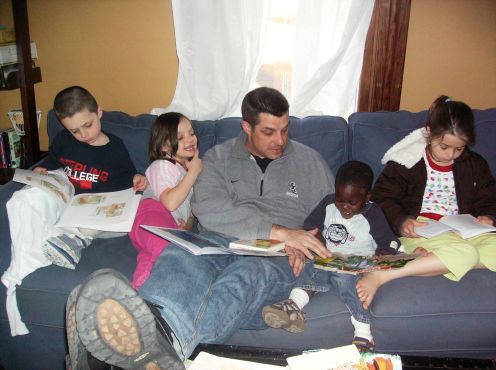
 Midpoint of the Ash Wednesday service. We have listened to the Word; the crosses have already been marked on foreheads; and we are waiting to receive the Sacrament of the Eucharist. The father of the young family seated in front of us leaves to get his smallest one from the children’s service. When he returns, his little boy runs ahead, right into his mother’s arms. She lifts him to her lap, and he settles, content, his chin nuzzled into her neck. I am seated behind them. His eyes meet mine, and we smile at each other, but then his eyes widen.
 I first read the prayer below in a book I was reading on the Old Testament Law. It’s called the “Prayer to an Unknown God” and was found on a tablet dating from the mid-seventh century BC. The original prayer is from Sumer and probably dates from somewhat earlier. What follows is just a small portion of this prayer:
 Books about theology are not known for their humor, but Delighting in the Trinity by Michael Reeves is an exception! I found myself smiling and even laughing aloud as I read it. The back cover content calls it “witty, lively, conversational, accessible,” but it also says it is a “rich and enjoyable portrayal of the basic beliefs of Christianity that opens up the profound and life-changing truths of our faith.”







 Jen Underwood