Author: jdunderwood
Living Confessionally, Part 4: Inviting the Holy Spirit’s Conviction
I’ve had two recent conversations about confession. In both the other person told me they are often not sure what to confess. They want a specific recognition of sin in their lives beyond the “we have not loved (God) with our whole heart/We have not loved our neighbor as ourselves.” The prayer of confession* also refers to sinning against God in “thoughts, words, and deeds” and by “what we have done” and “left undone.” What, in particular, are these—and how do we become more aware of them in our lives?
It’s generally not too difficult to recognize when we commit one of the “big” sins: an outright lie; a lustful thought; an outburst of anger; blatant, hurtful gossip, etc.** But the less obvious ones, the ones that pop up like weeds from our inherent self-focus/self-love, are often overlooked. Our bishop at Church of the Resurrection, Stewart Ruch, calls self-love/focus the “seed of sin.” It’s a very prolific seed, and the “small” sins it sprouts are harmful, no less harmful than the “big” ones. But they are also insidious (I love that word—it actually sounds evil!), working subtly and gradually. Many of them can even disguise themselves as something culture sees as good (like selfish ambition). How can we recognize these in our lives?
A couple of verses from the Psalms have been a great help for me as I’ve thought about this problem. Psalm 139 opens with these lines: “You have searched me, LORD, and you know me.” It goes on to show how intimate this knowledge is and the section ends with this statement: “Such knowledge is too wonderful for me, too lofty for me to attain.” This “knowledge” is about me—ME! God’s knowledge of me is far, far greater than my own knowledge of myself. He knows me in ways I am completely unable to know myself. That can seem terrifying—but it’s actually very, very helpful. Each of us has major blind spots in our lives; we can point out faults in others but remain unable to see the very same sins in ourselves. Psalm 19:12 says, “…who can discern their own errors? Forgive my hidden faults.” The last two verses in Psalm 139 say, “Search me, God, and know my heart; test me and know my anxious thoughts. See if there is any offensive way in me, and lead me in the way everlasting.” In the New Living Translation that last verse reads, “Point out anything in me that offends you”; the Message paraphrases it “Investigate my life, O God, find out everything about me; cross-examine and test me, get a clear picture of what I’m about;”.
I’ve discovered the Holy Spirit really does answer that prayer and does so in very gracious, gentle ways—in exactly the ways that make me recognize and face my sin without completely crushing me. The Spirit is also incredibly creative in this process: I’ve become aware of insidious sin in my life through a particular word that keeps popping up in my mind, through sermons I’ve listened to, books I’ve read (even fiction), my children’s struggles…
Almighty God, to you all hearts are open, all desires known, and from you no secrets are hid: Cleanse the thoughts of our hearts by the inspiration of your Holy Spirit, that we may perfectly love you, and worthily magnify your holy Name; through Christ our Lord.***
*The first blog post in this series has the prayer of confession in its entirety.
**It can be helpful to simply read some of the lists of sins in Scripture and ask the Spirit to reveal those in our lives. Here are links to some of them: Galatians 5:19-21, Colossians 3:5-6, Proverbs 6:16-19.
***This is the Collect for Purity from the Book of Common Prayer.
Living Confessionally, Part 3: Stretching my view of God
NOTE: The italicized phrases in this blog post are drawn from the prayer of confession, which follows the post.
In the last blog post in this series, I wrote about how confession has expanded my view of sin: it is not limited to thoughts, words, or actions, for these spring from a self-focus that keeps me from loving God and others. This understanding of sin has also stretched my view of God, for I see that He, unlike me, has NO sin in Him. His Spirit is not bent in self-focus; His every intent and action are for good.
As a child I equated God’s sinlessness (holiness) with a lot of “not” statements. God does not lie, does not steal (kind of impossible for Him to do that!), does not…
But the holiness of God is so much greater than that. I turn to my definition of “not-sin” from the last blog post to help me with this idea. “Not sin” (holiness) is loving God with all my heart, soul, mind, and strength and loving my neighbor as myself.
Does God do that?
Yes!
First, He loves Himself with all His heart, soul, mind, and strength.
That’s a strange statement, and one my mind falls far short of comprehending, but when I consider the Trinity (another idea that blows my mind), I see that in the Three-in-One, God keeps this first-and-greatest commandment perfectly. The Father loves and honors the Son and the Spirit; the Son loves and honors the Father and the Spirit; the Spirit loves and exalts the Father and the Son. (For a GREAT and readable article on this, read “The Good News of the Trinity” by Tim Chester. By the way, he uses the term “perichoresis” in that article; click on the word to find the definition–which I had to look up!)
In the Trinity we catch a glimpse of how relationships are supposed to be. No self-centeredness taints the fellowship of the Trinity. Its members are for each other, loving each other with purity and kindness. The members of the Trinity completely act out the love described in I Corinthians 13 and the fruits of the Spirit listed in Galatians 5.
Second, God loves His neighbors (all His creation) as Himself. This doesn’t negate justice. God wouldn’t allow sin within Himself; He cannot accept it in us. And this is exactly where God’s love for us, His “neighbors” shines brightest. Rather than leave us in a state of separation from all that is purely good (Himself), He loved us as Himself and GAVE Himself. There is no greater example of the second commandment. For the sake of the Son, Christ, He forgives us and has mercy on us.
And so the prayer of confession takes my eyes UP—away from my self, away even from my sin—and I am amazed at the Goodness of God. In all His thoughts, words, and deeds toward us, in what He does and does not do—
He is Good.
Here is the Prayer of confession in its entirety:
Most merciful God, we confess that we have sinned against you in thought, word, and deed, by what we have done, and by what we have left undone.
We have not loved you with our whole heart;
We have not loved our neighbors as ourselves.
We are truly sorry and we humbly repent.
For the sake of your Son Jesus Christ, have mercy on us and forgive us;
That we may delight in your will,
And walk in your ways,
To the glory of your Name.
Amen
Almighty God, have mercy on us,
Forgive us all our sins through our Lord Jesus Christ,
Strengthen us in all goodness,
And by the power of the Holy Spirit keep us in eternal life.
Amen.
Living Confessionally, Part 2: Expanding our view of sin
Not long ago I listened as a group of women talked about Bible studies they’d recently been involved in. One spoke of studying First John. “What surprised me most was the emphasis on confession,” she said. “We don’t do this in my church service, and I find I don’t do it very often personally either. I mean, I do when I see I’ve lied or been unkind, but most of the time I have a hard time recognizing my sin.”
It was an honest acknowledgement, and I understood her. We can easily fall into the trap of seeing sin as a list of things to avoid. The rich young ruler did this; he checked off the Ten Commandments as complete. And even though I understand this is impossible, I sometimes fool myself into thinking that if I attack the sins listed in the Scriptures, one by one, I can be free from them. This is not sanctification; this is self-improvement, the belief that I am really okay at the core, it’s just that I have these sins stuck to my surface.
The prayer of confession deepens my view of sin far, far beyond this.
“… we have sinned against you in thought, word, and deed, by what we have done, and by what we have left undone.
We have not loved you with our whole heart;
We have not loved our neighbors as ourselves.”
In this blog entry I want to look at the last two statements, for these define sin: not loving God with the whole heart; not loving one’s neighbor as oneself.
The “whole heart” includes all of our being: mind, soul, and strength (physical self), and the term “neighbor,” as explained by Christ in His parable of the Good Samaritan, does not exclude ANYONE, no matter how unlike me they happen to be.
So for me to NOT sin would mean I would need to wholly/completely love God AND every person I encounter each and every minute of my life
What would that be like?
I have no idea! I don’t even know what it would be like for a single moment because I can’t do it. I am unable to look completely away from myself, unable to focus upward and outward without one eye—at least—always gazing in. Even my “good” works are tainted with this “looking in.” I may do them with partially pure motives, but at some level I am hoping they will make me feel better about myself or exalt me in God’s or others’ sight.
I am incapable of pure love, even when the object is the pure and wonderful God, even when it is a newborn infant, as innocent and beautiful as a human can be.
The prayer of confessions helps me understand that I am not a sinner because I sin. No, I sin because I am broken at my very core.
The prayer of confession leads me to the huge depth of my need.
Note: As I was thinking about this, I listened to a Tim Keller podcast in which he said the phrase “homo curvatus in se,” and explained it was Martin Luther’s definition of sin. In researching this phrase, I discovered an article on theotherjournal.com by Matt Jenson (Associate Professor of Theology in the Torrey Honors Institute at Biola University) titled “The Shape of Our Sin.” Here’s a summary of part of his article, which is drawn from his book The Gravity of Sin: Augustine, Luther and Barth on ‘homo incurvatus in se’:
Augustine and Martin Luther wrote about sin as “humanity curved in on itself” (homo curvatus in se). Augustine said that because of this “curvatus,” we use everything, even God, for the enjoyment or comfort of ourselves, and Luther said this sin extends throughout our entire person—there is not a single part of us that is not centered on self. Karl Barth builds upon Augustine’s and Luther’s views and says that curvatus is also seen when we believe ourselves rather than God. We exalt our own statements as “truth” and reject God’s truths as lies. And he further makes the point that while we often see our “curvatus” as pride, the opposite is also true: when we debase ourselves and are constantly focused on our shortcomings, this is but another form of the curvatus. We are still focused on ourselves.
Living confessionally
I have been praying the Confession (from the Book of Common Prayer) in church now for a little over a year. More recently, it has become a daily prayer.
The same words, over and over.
I understand that liturgy, through its sheer repetition, can become meaningless. The most wonderful prayers, though filled beginning to end with Truth, can be rote when they are said without thought.
But my experience with this prayer in particular has been quite the opposite: it gains new meaning nearly every time I pray it. Because of this, I have been thinking a great deal about confession, not just the actual prayer but the idea of living “confessionally,” individually and as the Church, the body of Christ. I’ve not given much brainpower to this idea before now, and as I’ve thought about it, it’s grown in its significance for me. I’m planning to write a short series on it. I hope this is not simply a one-way presentation but that it prompts discussion. I feel I still have a great deal to learn about confession (as I do about so very many things), and I would love to learn WITH you.
Today’s post is simply the prayer itself and the prayer/benediction that always follows it.
Most merciful God, we confess that we have sinned against you in thought, word, and deed, by what we have done, and by what we have left undone.
We have not loved you with our whole heart;
We have not loved our neighbors as ourselves.
We are truly sorry and we humbly repent.
For the sake of your Son Jesus Christ, have mercy on us and forgive us;
That we may delight in your will,
And walk in your ways,
To the glory of your Name.
Amen
Almighty God, have mercy on us,
Forgive us all our sins through our Lord Jesus Christ,
Strengthen us in all goodness,
And by the power of the Holy Spirit keep us in eternal life.
Amen.
the truth that keeps me out of the cave of despair
Scotland trip, final day
The last post I wrote was after our full day at Deans Community High School. The following morning we were at Deans for our last assembly, presenting the cardboard testimonies to another group of students. Afterward, our students hung out with several of the Deans students they’d attended classes with the day before. We finally broke up the party and trekked the students to the train station. The attendant didn’t make it to our car till about 50 minutes into our trip to Glasgow. When he entered, Dave and I motioned to him and he walked past the rows of students to get to us. “They’re all with us,” Dave told him. He looked back at the kids, each one either asleep or zoned out, and then turned back to us. “What’d you do, drug them?” he asked.
The students livened up a bit after we got off the train, and they had some free time at Buchanan Galleries (one of the major shopping districts) before we went to the People’s Palace, a museum that celebrates the lives of ordinary people in Glasgow. We returned to Livingston North in the late afternoon and went straight to a church in Linlithgow. We had a chance to hold a debrief meeting before the church’s youth—the same kids we’d danced with at the ceilidh the Friday before—arrived for a joint youth gathering.
This meeting unveiled so much. We knew our students were tired, and after more than 10 days of the trip, with a lot of late nights/early mornings, and miles upon miles of walking, this was understandable. But Dave and I had guessed that for many of them, the fatigue was also tied to the day before, the day spent entirely at Deans. The debrief bore this out. Many talked about the nervousness they’d felt about being in a public school, about being questioned about their faith, about spending the day with peers they didn’t know. But they also shared how powerful the day had actually been for them. We asked each student to share a “takeaway,” and I’d like to record here (without names) some of their comments.
-This was my first missions trip. I’ve known for much of my life that I was interested in working in missions in one way or another, but now—on this trip—I’ve seen God’s power at work as we’ve shared about Him, and I want to do this.
-It was refreshing to see the Holy Spirit at work and cool to see apologetics in action—outside the WA “bubble.”
-I’ve always been so nervous about talking about my faith, and that was a huge weight that was lifted off because I actually shared. It was great preparation for going to a secular college.
-This was different than other mission trips I’ve been on because we actually got to interact with other teens who don’t know Christ.
-I’ve been inspired to have more courage.
-This was very stretching.
-I haven’t had a lot of chances to be with non-Christians, and on this trip, I was—and we talked about faith.
-Going on other missions trips has never stretched me like this trip did. I want to look for other Gospel-sharing opportunities.
-We are spiritually and physically rich in Wheaton. I’ve been to places that are physically poor, but Scotland is spiritually poor. I had to pray for courage like I haven’t before, and God clearly answered.
-We had to trust that the Holy Spirit would work—and we saw Him do it.
-I’ve been in Christian schools my whole life, and meeting kids face-to-face who worship other things/gods was shocking. It makes me want to grow deeper in the Word so I can give answers.
-That was huge to have someone ask me about my faith.
-I learned that when I am truly genuine and vulnerable—when I take off the mask and really show my struggles—it builds connections.
-I was tested and couldn’t fall back on my friends.
-To share my cardboard testimony was terrifying, but in doing that, I saw the clear transformation that has been worked in me—I’m a “new me.”
-The spiritual warfare here is huge, and apathy is dangerous.
-It was hard for me to share my testimony with all of you, my teammates on this trip.
-This trip was hard for me. I’ve never gotten homesick before, and I thought we’d be doing more missions, and I thought that would pull me out of homesickness. But even when we were “doing mission work,” it didn’t make me feel good. As I’ve been thinking about that, God’s been showing me that it’s not about me, about my “feeling good.”
Every single student shared. The Scottish youth group arrived just before we finished, and Lorna, their youth leader, split the kids into small groups (with a mix of U.S. and Scottish teens), and led them in a wonderful time of discussion and prayer. It was incredible. They were sharing deep things with each other, and the time was rich.
It was late before we finished, and the kids still had to return to their host families and pack up. We left for the airport the next morning and arrived safely in Chicago with no lost luggage—or students!—the same evening.
We’re now four days post-trip. We were very, very glad to get back to our kids, but Dave and I are still discussing and thinking about this trip. We want to bring the lessons learned during it into everyday life, and we want to continue to pray fervently for Scotland. That’s our prayer for the students as well.
Scotland, days 8 and 9
In some ways our entire trip led up to these last few days. The students have prepared their stories of how Christ has transformed and rescued them; they’ve learned Scotland’s rich history of faith and its current low spiritual point through tours and speakers; and they’ve visited churches and youth groups whose members have expressed how very alone they sometimes feel.
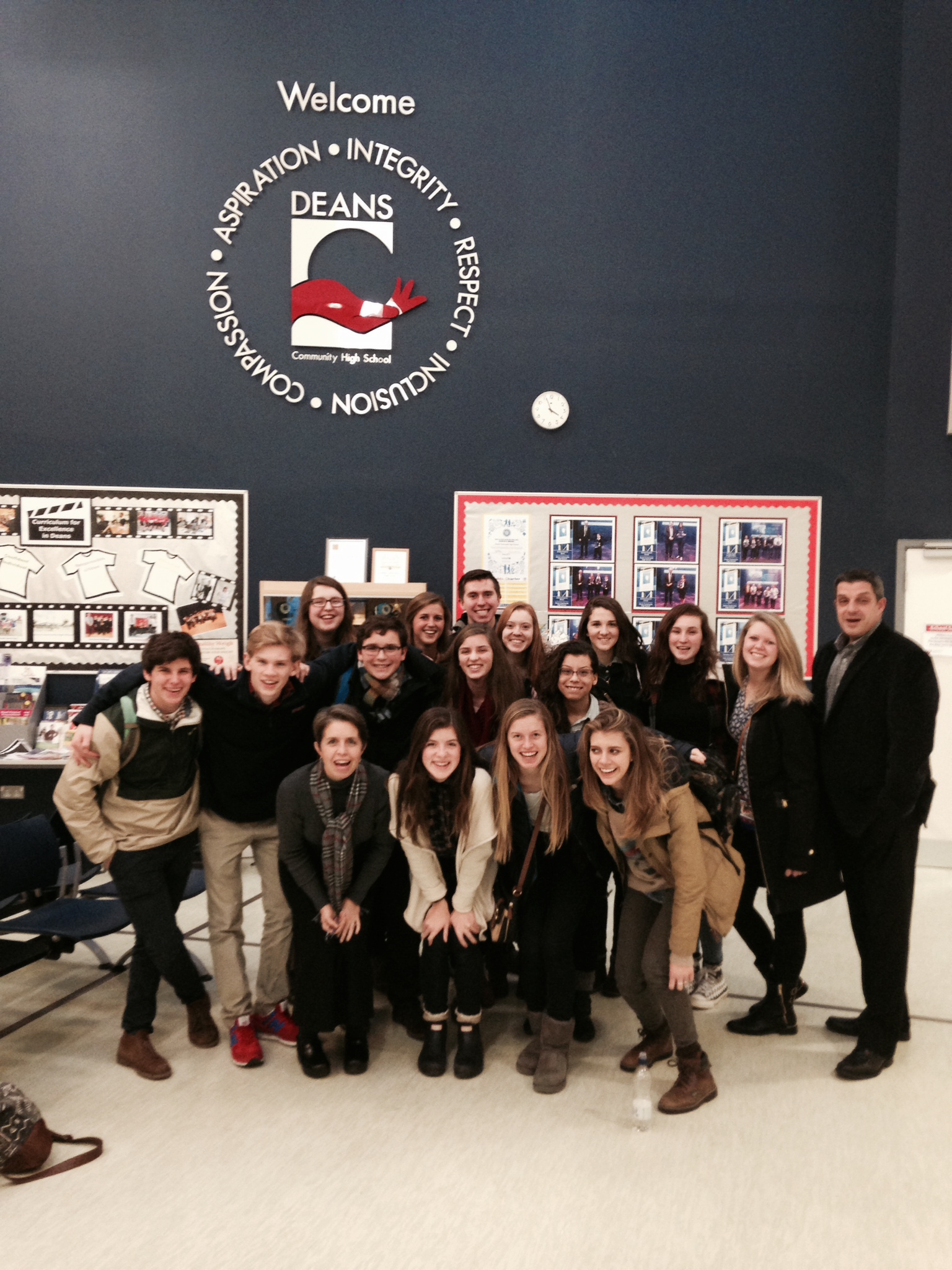
Yesterday and today, our students were able to do their small part to step into that need. Yesterday morning we visited Deans Community High School here in Scotland. Rob Bell is the chaplain at Deans and meets with students each week. Both the administration and students know and respect him. Because they do, we are welcome to do assemblies and school visits there. In assembly we showed the video of our school (prepared by TJ Tyrrell) and then Grace and Jacklyn explained their cardboard testimonies. On one side of the cardboard testimony is a statement expressing a deep need, hurt, or struggle; on the other side is how Christ met that need and transformed the student in the process. After Grace and
Jacklyn explained and showed theirs, the other students then shared theirs silently. Here are a few:
“Before Christ, there was no meaning to my life/With Christ I have a purpose.”
“I used to think God would only love me if I was perfect/Now I know God loves me even with my imperfections.”
“I used to HATE how I looked/Now I know I am made beautifully in God’s image.”
“I felt worthless/Now I know God values me and made me for a purpose.”
“I used all my talents to make others notice and love me/When I use my talents for God, I feel His love.”
“I was controlled by fear/now I am made bold through Christ’s freedom”
“I used to feel unlovable/now I feel consumed by Christ’s love.”
The vulnerability of the students was bold
and beautiful, and the students at Deans responded. We left the school following the assembly yesterday, but today we
spent the entire day there. We did assembly for a different group of Deans students and then paired our students up with Deans students and sent them off to classes. They talked
about cultural differences and personal likes/dislikes but many of the Deans students also asked about our students’ belief in Christ. Some even went with their partners to Religious Education classes, where the teachers opened up the floor for the students to discuss
different aspects of the Christian faith. Dave and I were in Religious Education classes all day; in three of them the teacher invited us to the front of the class and allowed us to field questions from the students. Nearly every single question led to us sharing some aspect of the Gospel. They asked about our favorite parables, how we know the Bible is true; why the God of the Old Testament seems different from the God of the New Testament; how science and religion deal with origins; Scripture’s views on abortion, etc. In one of the classes, our students Abby and Jacklyn joined us and answered quite a few of the questions,
and in the final class, our students answered all the questions, and Dave and I just listened.
By the end of the day, our students were exhausted. Most were really encouraged, though a few felt that their conversations with their new friends hadn’t gone as deeply as they’d hoped they would. But that gave Dave and I the opportunity to remind them of God’s timing and the Holy Spirit’s ability to use even the things we consider very, very small.
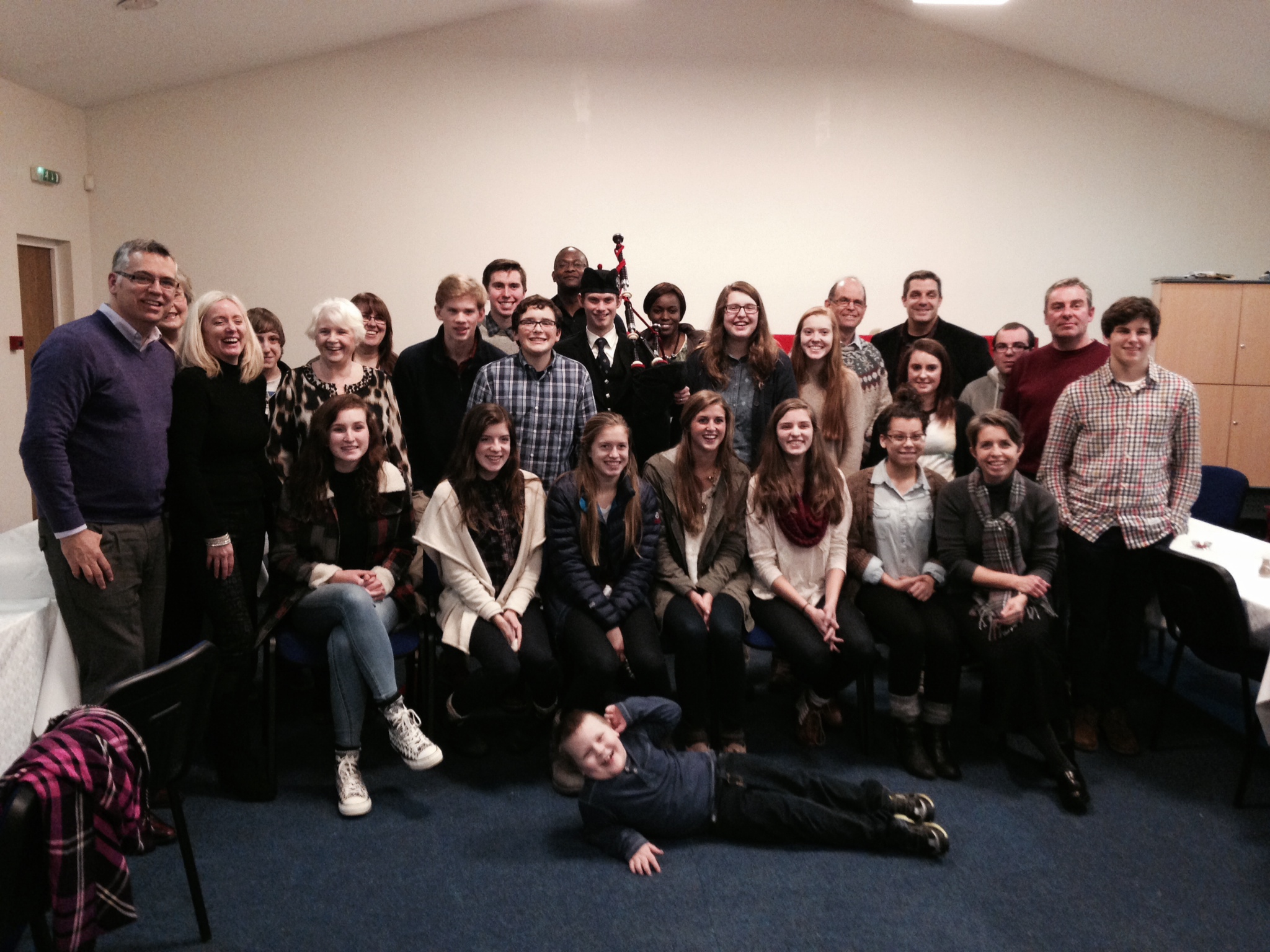
We had our host family dinner tonight at Rob and Louise’s church, eating the traditional Scottish meal of haggis, neeps, and tatties (turnips and potatoes) and celebrating a Burns supper a bit early (it’s celebrated on January 25th) with a bagpiper and a recitation of Burns’ poem “To a Haggis.” We are very, very thankful for these families who have welcomed completely unknown teens into their homes and cared so well for them.
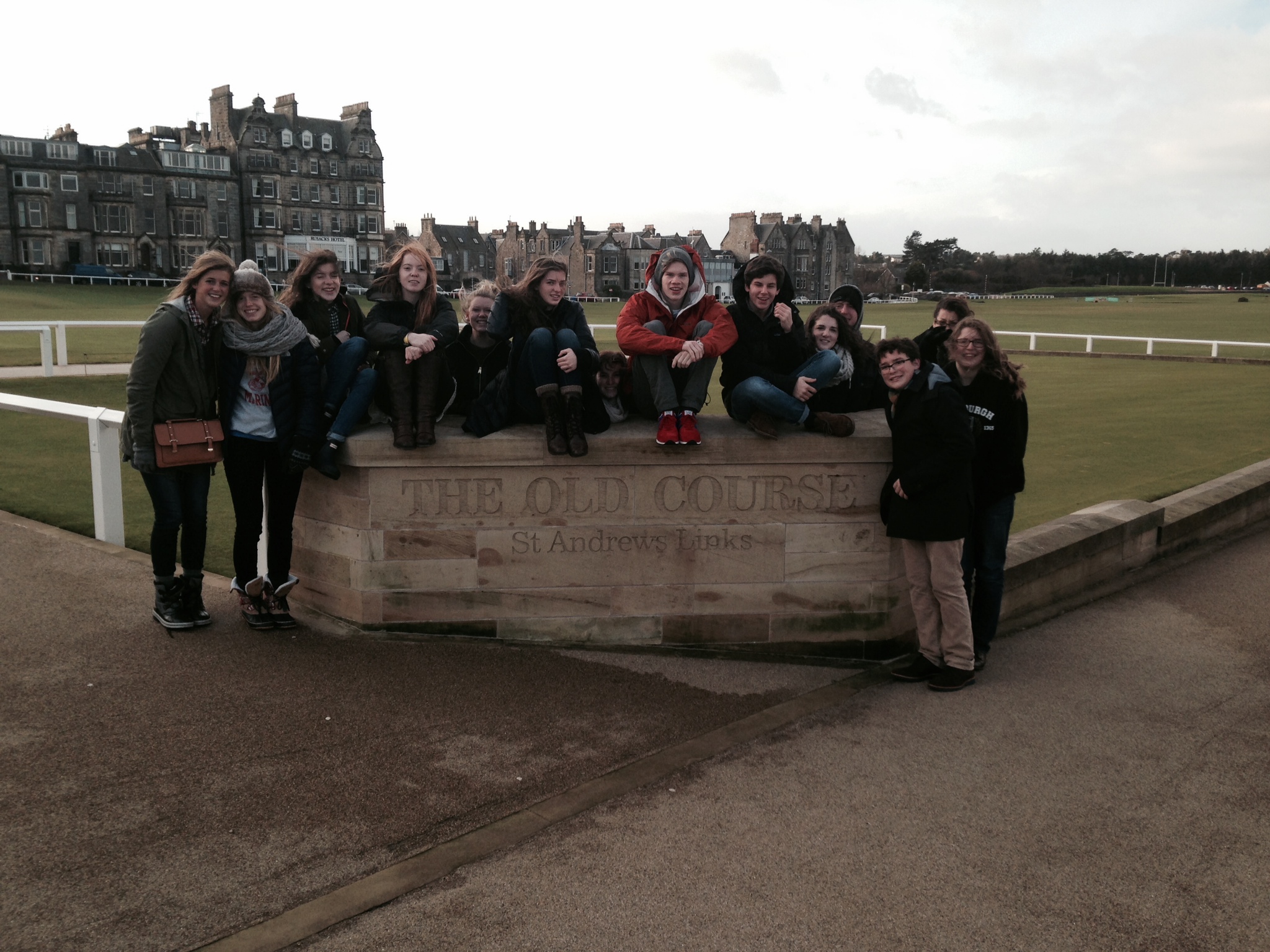
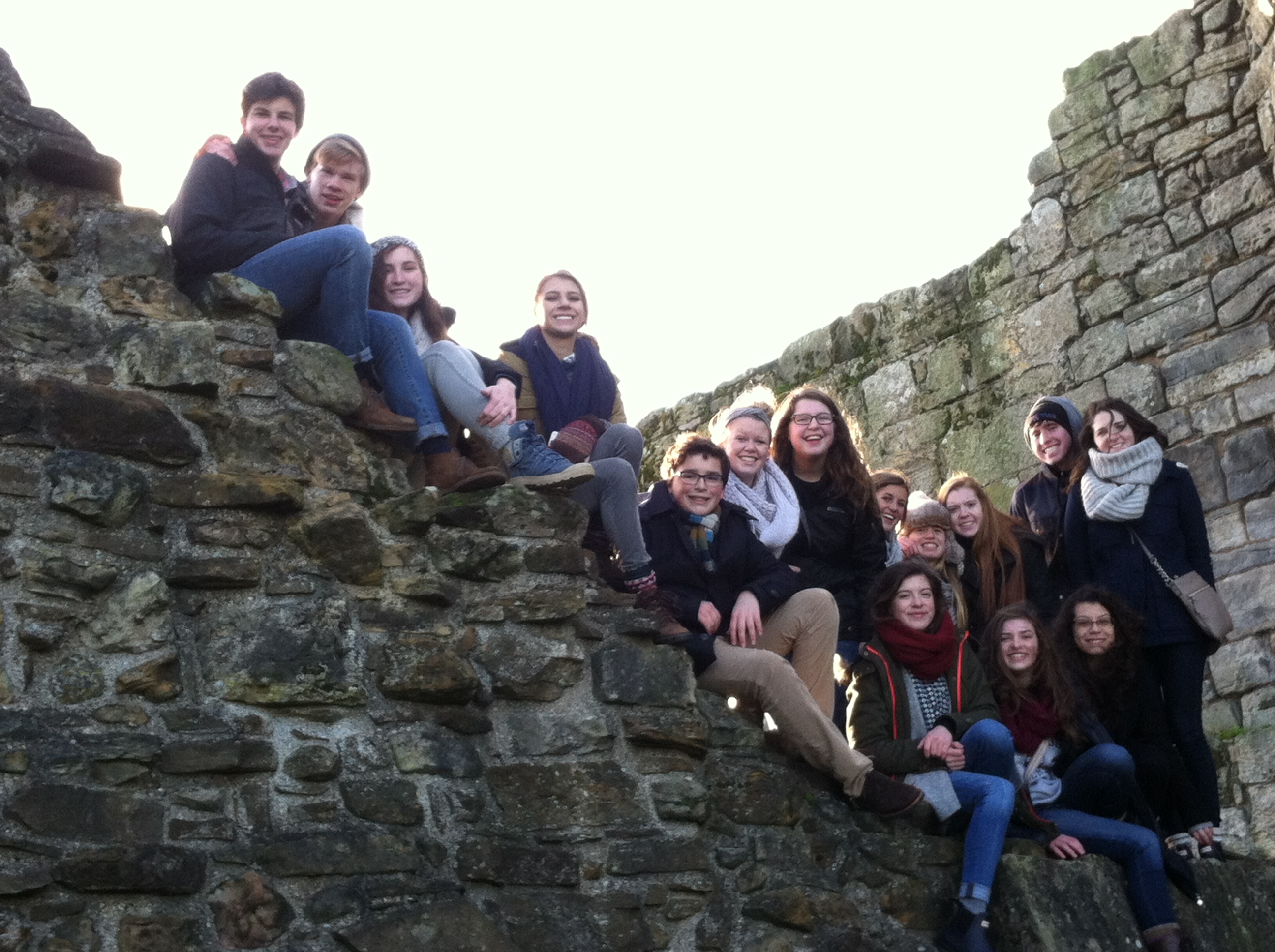
I need to backtrack to yesterday. Following assembly at Deans, we headed up with Billy the bus driver to Saint Andrews. We enjoyed a fairly sunny day (the first since we’ve arrived) in this small town with its legendary golf course, beautiful university (where Prince William and Kate both attended and met), lovely cathedral and castle ruins (our kids acted like they were on a playground!); and quaint streets (lots of bookshops!). On the way back to Livingston we got Anstruther’s famous fish and chips (so very good, but I almost couldn’t believe I was putting that much grease in my stomach!) and then enjoyed a game and snack night back at Rob and Louise’s house (they are incredibly hospitable).
Please pray for tomorrow. In the morning we will hold our last assembly at Deans (for yet another group of students), and because many of the Deans kids met our students yesterday, the cardboard testimonies have the potential to be even more powerful and impacting. Please pray that the seeds sown—some of them unknown—will take root.
Scotland, days 6-7
We spent Saturday on the Royal Mile in Edinburgh. This cobbled street is the main thoroughfare of Old Town, with Edinburgh Castle at the top end (literally the highest point of the city), and the Palace of Holyrood House at the bottom. In between is enough history and beauty to choke a T-Rex.
This would generally make me happy, but, though I am fascinated by Edinburgh, it makes me feel melancholy. It has such a rich history of faith, with the fiery Reformation leader John Knox, the missionary-explorer David Livingstone (educated at the University of Edinburgh), and the martyrdom of the Covenanters (who refused to say the king was the head of the church) and so many other stories of Christians who made wonderful discoveries in science and math, who initiated incredible progress in education, social reform, and medicine. (Antiseptics, anesthesia, public schooling, social reform, etc.)
But the glory is all gone, and the church in Scotland is dying, with only 1-2% of the population confessing themselves to be Christ followers. Some former cathedrals are now nightclubs, and witchcraft is on the rise. Nearly every believer we’ve met has told us, “Please pray for us. Pray for the church in Scotland.”
We learned much of Edinburgh’s wonderful history on the Reformation Tour, led by Paul James-Griffiths of the Edinburgh City Mission. Dressed in a burlap robe, carrying a wooden staff, he told us how the heads of the Covenanters were stuck on the walls of Edinburgh. With our feet standing on the cobbles, and the stone churches rising high around us, it wasn’t difficult to imagine we were back in that time. And even though it was really, really bitter, with intermittent snow and sleet, no one complained of the cold till much later in the tour—when we were talking about a less dark period in the history.
We finished the tour in the basement of the church where we’d started, and Paul talked to us about the current state of the Church in Scotland. It’s dismal, and though he has seen some recent spiritual interest, he said, “We are not yet desperate enough.”
May we be desperate to pray for the Church in Scotland, in the U.S., in the entire world.
We finished the day with a trip to Edinburgh Castle, with its convoluted history. I tried really hard to follow the family trees of all the monarchs, but I finally gave up and simply enjoyed the individual stories without having to fix each one into the big picture. The story that sticks with me most is that of Saint Margaret (1045-1093), the Queen of Scotland who so loved Christ and wanted to follow His example that she often left the castle to care for the poorest people in Edinburgh, feeding them and washing their feet.
This morning (Sunday) we led the church service at Elim Church in Livingston, and it was wonderful. Dave and I always have so much fun watching the Holy Spirit orchestrate these things. Three of our students testified of the transformation Christ has worked in their lives; our worship team played and sang two songs; four students gave a dramatic reading of Scripture; and while Dave preached, Meghan created a beautiful piece of art that illustrated the message and passage of Scripture. Dave spoke on Luke 7:36-50, the story of the sinful woman anointing Christ’s feet, and though I organized the dramatic Scripture reading to include that, and Meghan was inspired by the story, nothing else was really “driven” by it. But it all worked together beautifully to focus on our great need for Christ and His great love for us. We ended the service by repeating one of the songs, and the words “There’s no place I’d rather be than here in Your love” jumped out at me. I told Dave later: “That’s exactly the song I can imagine the woman in the story singing.”
We mingled with the church members following the service and heard several stories of their lives transformed by Christ. Many, though, are in marriages or families in which they are the only believer. I felt driven to pray for them but also blessed beyond belief for my own marriage and the faith heritage of both our families.
The afternoon was spent with host families, and then we returned to the church for the youth service. Many of these youth consider the youth group to be their sole lifeline. The church is the one place they learn about Christ, are encouraged in their faith, and can fellowship with other believers. They are the extreme minority in their schools.
Tomorrow we begin the day by sharing cardboard testimonies at Deans Community Secondary School during their morning assembly time. Please pray.
Thanks,
Jen
Scotland, days 4-5
It is one thing to study “why we believe Christianity is real” as part of an academic class; it is an entirely different thing to study it when you are fairly certain someone will ask you that question—genuinely—in just a few days.
We spent most of Thursday in orientation sessions, first hearing from Ian Leitch, one of the original members of The Heralds (the Scottish gospel band of the 1950s/60s), which eventually became The Heralds Trust. For the last 40-odd years, Ian has been presenting and defending the Gospel in Scotland and around the world. The kids listened attentively, though most of Ian’s jokes went, as he said, “over their heads.” I liked them, though. For instance, when Ian was talking about Mahatma Gandhi’s belief in Christ as merely a good teacher, he said he remembered when Gandhi’s brother came to Scotland. “Mahatma Coat, remember him?” he asked the kids.
The kids just looked blank. Oh, well.
Following Ian’s presentation, we met with an American couple, Jerry and Elizabeth, who are here in Scotland using the arts, specifically drama, to encourage and minister to the church and to enable the church to reach out to the community. They talked specifically with our kids about Scripture reading, about allowing the meaning and power that is in the Word of God to shine through in their voices. A few brave volunteers stood up to read a passage of Scripture. Jerry and Elizabeth gave them pointers, and then they read the passages again. Huge improvement, and it was wonderful to hear Scripture read in a vibrant way by young people.
In the afternoon, we spent a short time at the nearby mall, but then we returned to the church to practice the testimonies, music, and dramatic reading we will be giving during the church service and youth service we will be leading on Sunday morning and night.
We worked till evening and then went to the local bowling alley. It was a fierce competition between the teams (not really), and my team came in second (which surely had very little to do with the fact that we had the bumpers in our lane put up—and no other team did. Claire had a great rebound shot perfected—off the bumper about halfway down the lane and right into the side of the lead pin.
This morning we met up with our bus driver, Billy, who is from the same town as William Wallace (of Braveheart fame—though, as we learned today, it is NOT anywhere near historical accuracy). Billy, of course, is named after Wallace, as are a very large number of boys born in his town. He drove us to the Wallace monument, where we climbed up the hill to the monument and then up the monument’s 240-something steps. The top parapet was closed due to high winds (as a chaperone, I was just fine with that), but we learned all kinds of interesting facts about Wallace’s victory at Stirling Bridge and his eventual martyrdom at the hand of the English king. His sword (or at least its replica) was MASSIVE!
We briefly stopped by Doune Castle (where Monty Python and the Holy Grail was filmed and, more recently, the Scottish show The Outlanders), and we saw the approximate site of the bridge where Wallace defeated the English. Then we were off to Stirling Castle. It brought together a lot of the history we’d been learning over the last few days, but I think the kids enjoyed most the rooms that had been remodeled to look as they would have when James IV and his wife actually lived there (and if you’re a Scot reading this, and I’ve got the wrong James, PLEASE forgive me.)
We learned a few new words from Billy, one being dreich, which described the weather of the day: drizzly, windy, cold. Others: kil (relating to religion), loch (lake), glen (valley), inver (mouth of a river), ben (high point).
Then, finally, the highlight of the day: a caleidh with the members of a Scottish youth group. A caleidh is a traditional Scottish dance party, generally held at a wedding. But we did it with teens, and it was a blast, and they all mingled and danced and talked (when they needed a break from the dancing, which was quite energetic). Besides the traditional caleidh dances, we discovered our young Scottish friends are quite fond of the music from Grease and a few other oldies our kids had clearly never heard (including one of my favorites: “I’m Gonna’ Be (500 Miles)” by the Scottish band The Proclaimers). But YMCA was, as always, a big hit; our kids requested “Hoedown Throwdown” (a new one for the Scots); and we closed out the night with “Auld Lang Syne,” written by the Scotsman Robert Burns.
A grand night! And it set the stage well for next Wednesday, when we will join the two groups of youth again to have a more serious time of Bible discussion and fellowship.
Good night, all.
Jen