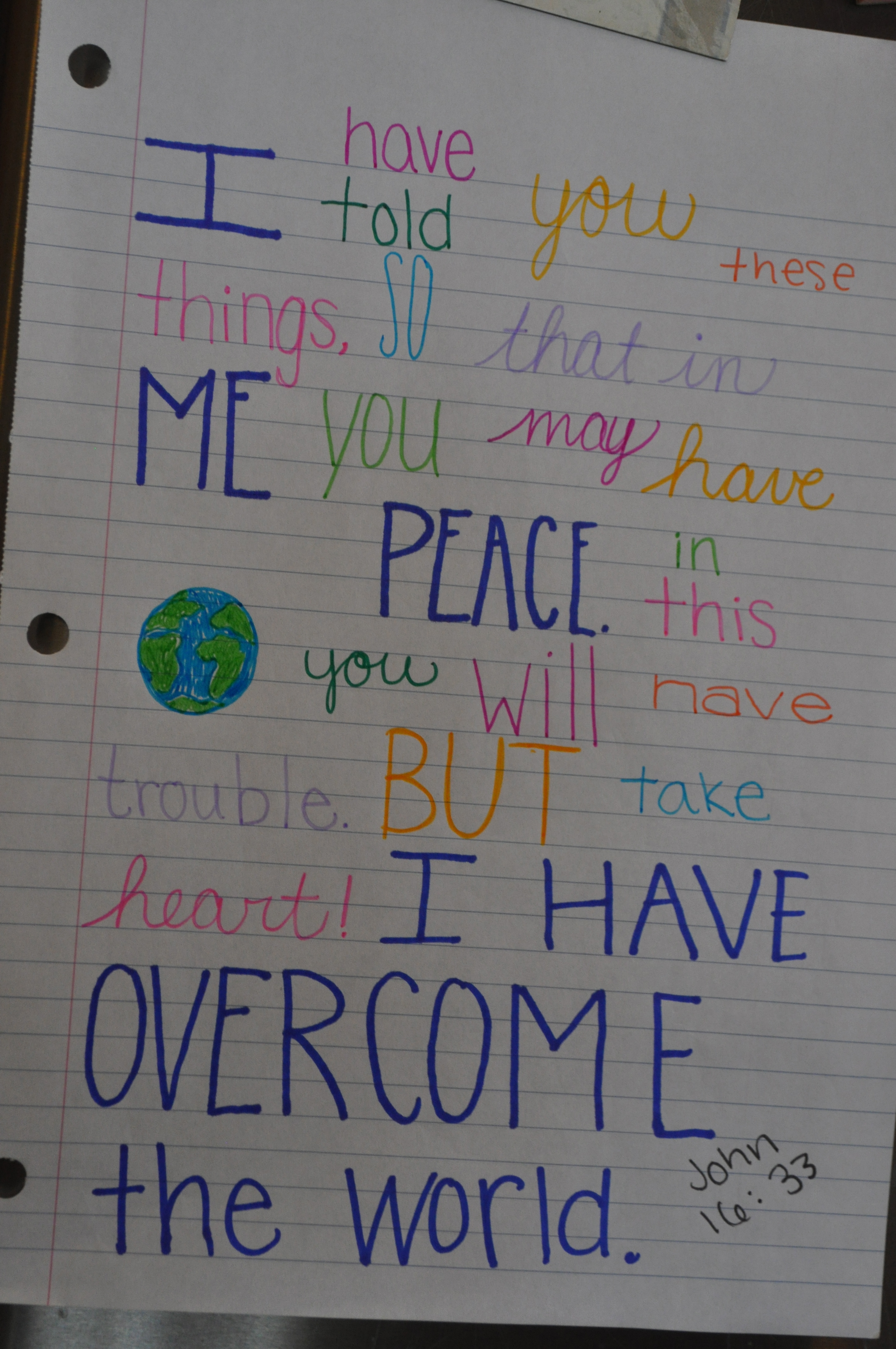
Like we’re loved

*Scroll to the bottom of this post for the audio version.

We puppy-sat Nora, a 14-week-old English Bulldog, last week, and my children, as well as many of the neighborhood kids, were enamored with her.

PJ, Nora, and Chai playing tug of war

PJ, Nora, and Chai playing tug of war

But soon they discovered the not-so-pleasant side of caring for a pup. “She’s like a baby in her judgment but with a lot more mobility,” I reminded them when she chomped a plant in the garden, peed on the living room rug, or left tooth pricks in a Barbie doll’s arm.

“It’s a good thing she’s cute, huh?” I asked them. “Children and puppies. They require a lot of work, but at least they’re adorable.”

Chai was the only one who was happy to see Nora go back to her owners. Of course, the rest of us didn't have a puppy clawing at our face all week either.

Chai was the only one who was happy to see Nora go back to her owners. Of course, the rest of us didn’t have a puppy clawing at our face all week either.

They glared at her squashed face a moment more and then relented.

“Yeah.”

I find I still have that mentality with God.

He loves me because there is something inherently endearing about me.

I would never say it aloud, but the belief is there sometimes.

But the older I get, the more I understand how untrue it is—of myself or anyone, no matter how honorable or upright we seem.

In Lamentations, Jeremiah speaks of “compassionate” women of Jerusalem cooking and eating their own children (4:10). Before the starvation brought about by the siege of Babylon, these same women would have been appalled at the thought, but distress revealed a darkness in their hearts that had been there all along.

It is hard for me, too, to imagine myself capable of the horrific acts I read about in news articles. But I am. Put me in the right (or wrong) circumstances, strip me of comforts and necessities, replace my upbringing with an abusive situation…

“But for the grace of God,” my father used to say.

This truth is actually not discouraging (despite how it makes us feel). Reminders of our incapacity for good help us see that the love of God is certain—no matter what we do or don’t do.

This past season my husband’s soccer team made a poster for their locker room, and they put it right above the doorway they walk through on their way to the field. It read, big and bold, “Play like you’re loved.”

Perfect love casts out fear.

The fear we all have of God (it’s a good and necessary place to start in our relationship with Him) is based on the right belief that we can never measure up. God answered this fear with a love that fully accepts our inability to deserve it. His love has no conditions for us. We cannot earn it, and He has never expected us to.

Yet we still “play to be loved,” and we are always disappointed to find that all our efforts effect no true change in us. We do all kinds of good works and find that the bitterness or envy or self-loathing in our hearts is still there!

How paradoxical that only when we give up the striving to change ourselves can we be changed—by a love that is not dependent on our changing!

In the early pages of The Practice of the Presence of God, written about and by Brother Lawrence, a lay monk in the 17th century, his interviewer shared this about him. “When he sinned, he confessed it to God with these words: ‘I can do nothing better without You. Please keep me from falling and correct the mistakes I make.’ After that he did not feel guilty about the sin.” … “Brother Lawrence was aware of his sins and was not at all surprised by them. ‘That is my nature,’ he would say, ‘the only thing I know how to do.’ He simply confessed his sins to God, without pleading with Him or making excuses. After this, he was able to peacefully resume his regular activity of love and adoration. If Brother Lawrence didn’t sin, he thanked God for it, because only God’s grace could keep him from sinning.”

It is biblical to sorrow over our sin, but when we beat ourselves up over it, it is a reverse kind of pride. We get down on ourselves because we believe we are capable of better.

But we’re not, and it is far more profitable to confess and move on into God’s unconditional love. Confession is simply admitting to God, “I am sinful, and You are not. I acknowledge that great difference and Your perfection, and I am grateful You did something about it.”

He did do something about our inability! He did something incredible! And the result of that amazing sacrifice is that He is in us! We are in Him!

The “Play like you’re loved” poster came from the team’s season verse, John 17:23, in which Christ says, “I in them and you in me—so that they may be brought to complete unity. Then the world will know that you sent me and have loved them even as you have loved me.”

This day, let’s play, live, work, and be like we are loved!

Prayer: fighting the powers of darkness

I am in the middle of reading Half the Sky, a highly regarded book on the worldwide issue of violence against women and girls.

Some nights I get through a full chapter. More often, though, it is a couple pages, a few paragraphs. The stories of neglect, rape, beating, and horrific disfigurement and execution wear me down, and I close the cover and set it aside.

Yesterday a friend from the West Chicagoland Anti-Trafficking Coalition (WCATC) sent out an email to all members of the WCATC leadership team. In the body of the email, she wrote, “This article (attached to the email) is simply horrible. It makes me sick just reading it. … However, it is important for all of us to be aware of this side of the situation and be on our knees in prayer.”

The title of the article is “The Rape of Men: the Darkest Secret of War.”

I can’t read it in full yet.

After I hear such stories, I often close my eyes and see a scene from A Wrinkle in Time, one of my all-time favorite books. I want to share it with you. Meg, Charles Wallace, and Calvin are on a journey to another galaxy to rescue Meg and Charles Wallace’s father, a scientist for the U.S. government who has unexpectedly traveled through space with disastrous results. The three wise guides who are escorting the children take them en route to visit the Medium in Orion’s Belt. They ask her to show the children Earth in her crystal ball. She is reluctant and first zooms in on a sparkling clear planet in the same solar system.

“’No, no, Medium dear, that’s Mars,’ one guide told her.

‘Do I have to?’ the Medium asked. …

The bright planet moved out of their vision. For a moment there was the darkness of space; then another planet. The outlines of this planet were not clean and clear. It seemed to be covered with a smoky haze.”

Meg then asks if the haze is the atmosphere, but she knows it is not. She knows it is the same Dark Thing that terrified them earlier on their journey.

“’Did it just come?’ Meg asked in agony, unable to take her eyes from the sickness of the shadow which darkened the beauty of the earth. …

‘No, Meg. It hasn’t just come. It has been there for a great many years. That is why your planet is such a troubled one.’ …

‘I hate it!’ Charles Wallace cried passionately. ‘I hate the Dark Thing!’ …

‘But what is it?’ Calvin demanded. ‘We know that it’s evil, but what is it?’”

The oldest and wisest of their guides then shouts, in her quavery voice, “’Yyouu hhave ssaidd itt! … Itt iss Eevill. Itt iss thee Ppowers of Ddarrkknesss!’”

I forget sometimes that all the pain and evil inflicted by humans upon humans has the powers of darkness behind it. I also forget that for a supernatural problem, we must seek a supernatural answer. “What can I do about it?” I think, after hearing of another atrocity.

Then, failing to come up with an immediate, concrete solution, I say, “Well, I could at least pray.”

There is no “at least” about prayer. If the power behind acts of rape, ‘honor’ killings, mutilation… is the power of darkness, then engaging in earnest prayer is like bombing enemy headquarters, like being dropped into the heart of the battle and targeting the commanders who are giving the orders.

I’m not saying we should not also DO. Absolutely we should. But we must stop thinking of prayer as an “at the least” action. I recently read that Mary Queen of Scots said that she feared the prayers of reformer John Knox more than the combined armies of France and Spain (from A Spiritual History of the Royal Mile by Paul James-Griffiths).

I don’t know exactly what prayer does, but I know it does MUCH. It may aid angels who are fighting the powers of darkness. It may provide supernatural encouragement to the victims of violence. It may open the hearts of perpetrators to God. It may thwart evil. I have heard story upon story of believers feeling suddenly called to pray for a specific need or person far, far away and discovering later there was a correlation between their prayer and a miraculous change.

I DO know this about prayer: when I engage in it, it impacts my heart. It opens my soul to needs; it enables me to see opportunities for action and readies me to embark upon them; it fills my heart with compassion for victims and perpetrators alike.

I often feel helpless about sex trafficking; therefore, it drives me most easily to gut-wrenching, sleep-interfering prayer. That may not be the same for you. The persecuted church, abortion, pornography, child abuse, orphans, the mistreatment of those with special needs, the destruction of marriages and families, dying churches, starvation, the plight of refugees, racial tension… The enemy is waging war on many, many fronts.

Let’s fight back with prayer.

There will be no “at the least” about it.


Ephesians 6:10-20    Finally, be strong in the Lord and in his mighty power. 11 Put on the full armor of God, so that you can take your stand against the devil’s schemes. 12 For our struggle is not against flesh and blood, but against the rulers, against the authorities, against the powers of this dark world and against the spiritual forces of evil in the heavenly realms. 13 Therefore put on the full armor of God, so that when the day of evil comes, you may be able to stand your ground, and after you have done everything, to stand. 14 Stand firm then, with the belt of truth buckled around your waist, with the breastplate of righteousness in place, 15 and with your feet fitted with the readiness that comes from the gospel of peace. 16 In addition to all this, take up the shield of faith, with which you can extinguish all the flaming arrows of the evil one. 17 Take the helmet of salvation and the sword of the Spirit, which is the word of God.

18 And pray in the Spirit on all occasions with all kinds of prayers and requests. With this in mind, be alert and always keep on praying for all the Lord’s people. 19 Pray also for me, that whenever I speak, words may be given me so that I will fearlessly make known the mysteryof the gospel, 20 for which I am an ambassador in chains. Pray that I may declare it fearlessly, as I should.

Let the Mom Wars…Stop

One year ago, as the mom of a 7th grader, I was on the games committee for the 7th and 8th grade gala at my daughter’s school. I chose that committee because I assumed it wouldn’t involve decorating and because, during the actual event, my only responsibility would be to run a game and hang out with kids. But on set-up day, after I’d put together an indoor basketball hoop (which I enjoyed doing), I was asked to hang some fancy paper on the walls. Other moms were busily—and seemingly happily—doing similar jobs, but with each passing minute, I wanted more and more to escape to a quiet corner, pull out my laptop, and write.

The parents of 8th graders have virtually no responsibilities for the gala, so this year, after taking a few pictures of Em and friends in fancy attire, I went out to eat with a few other 8th grade moms. At some point one mom asked, “So what does everyone want to accomplish this summer?”

One mom said she wanted to paint her kitchen. Another wanted to work on memory books for her child moving on to high school. I didn’t voice the writing goals which jumped up immediately, waving their hands—because they had nothing to do with running my household or mothering my kids. I cast about for a less self-absorbed goal: plant a garden? (I’ve thought briefly about it!), clean the attic?… and decided to say nothing.

A few years ago my daughter was dealing with some girl drama at school. It involved an “in group” and an “out group” and those who were somewhere in between.

When she asked me for advice, I said, “Just give it time. It gets better as you get older. Women are more sure of who they are and less worried about what group they fit into.”

I don’t think I meant to outright lie. I must have been feeling fairly self confident in that second, and maybe there is a little truth to it; she was in fifth grade, after all.

But I don’t think we’ve outgrown this.

Deep down we are afraid that others’ callings or gifts or interests have more significance than our own. So we compare to convince ourselves that our own interests/gifts/callings (i/g/c) matter—and since sin always takes a good thing (in this case, significance) and twists it—we cannot simply accept our own i/g/c as valuable but must de-value others’ differences in order to feel better in comparison.

My family has recently begun attending a church that strongly emphasizes the unity of the Body, so I’ve been doing much thinking about differences and gifts in the context of the church.

But it applies to my mom-world as well.

To look down on someone else’s i/g/c—be it paid or volunteer—is to denigrate the body of Christ (whether it is represented by a church family or a group of moms pulling off a school event). A single human—or mom—cannot do all the different tasks and assignments God is weaving together into one great whole. Therefore, each person’s unique contribution is needed. Crayola doesn’t produce nearly enough shades to accomplish God’s varied and beautiful masterpiece: one mom must color with her chartreuse; I with my burnt umber; another with cerulean blue:.

So some moms like to volunteer a lot in their kid’s school; some don’t. Some enjoy working outside the home; others don’t. Some like crafts and scrapbooking and recording life events in beautiful, handmade books; others—like me—hate that. Some are convinced that motherhood is the best phase of their lives; others of us are still wondering how it happened.

When we compare differences instead of celebrating them, we harm God’s work. Comparison keeps us from relationship with those who have varied interests or passions; it strips from us enjoyment and appreciation of another’s i/g/c (and therefore we don’t encourage others to use their gifts); ultimately, comparison robs us of joy in our own work.

I’ve thought a lot about valuing those who are down-and-out, who have a different ethnicity than mine, who feel “other.”

But what about valuing those who, from the outside, look so much like me?

Yesterday morning I attended the final session of the spring women’s Bible study at my church. With my contribution in hand (a plastic bag of bagels and cream cheese still in its container), I looked for the food drop-off area before heading to the chapel. I found a table laden with wonderful food, beautifully staged with lovely fabrics and antique pieces. Each of the eating tables nearby had sprays from a bridal veil bush artfully arranged in pots and jars.

I couldn’t do that if I had step-by-step instructions with a kit provided.

I wouldn’t even think of doing that.

And in spiteful moments, I might even look down on that gift as less necessary or valuable than the gifts of the women about to minister to me with their teaching and music and administration.

But—God be thanked—spite was absent.

Instead I noticed. I valued. I enjoyed.


Dry Wells

A reading of this post is at its end.

I really DO like dandelions--and wild violets.

I really DO like dandelions–and wild violets.

The well has run dry. At first it was simply, “I have to push off writing a blog post until I meet other writing deadlines.” Then, during a weekend when I spent MUCH time in the car running errands, I noticed an emptiness. No strings of thoughts connected in my head. Phrases popped up, but a blog post generally requires more than my observations on the nude dandelion stems I noticed when stopped at a red light. (Trying to put together a line that sounded like poetry, I played with ideas like “a tangle of hollow stems, wound round each other, trying to hide their nakedness” and “look-at-me blossoms withered to fluff. Now even that has blown away”).

But not only did that seem very negative toward dandelions–which I like–it was as far as I got. The thought trail ended, and my mind jumped next to “what to fix for dinner.”

Still, there wasn’t time to actually write, so the vague feeling of emptiness was easily shoved aside.

But this afternoon, the deadlines aren’t as pressing, so I’m writing a blog post.

And nothing is coming!

Usually panic would already be fluttering (“Will I ever be able to write again? Am I done?”), but today I’ve been able to pin its wings and tell it to “Settle down” in a firm voice.

It has.

That’s Grace.

Grace in painful kindness lets my well get bone dry so I stop looking at it and stop trying to sponge up the droplets. Grace helps me to see the cracks in my cistern and, oddly, to be at peace about my own brokenness.

Then Grace turns me to the spring that never runs dry.

Sometimes this Source is like a waterfall, spilling over me with power. Today, though, it is a gently bubbling brook, smooth, with no undercurrent. I will eventually wade, will plunge in, but for right now I am content to stretch out in the quiet shallows.

Grace knows exactly what I need.

I am very grateful for this, not only for the trust I am able to rest in today in regards to my writing, but for the understanding that this applies to my motherhood, to my marriage, to my friendships, to my running of a busy household.

My wells run dry—much of the time.

Making way for Grace.

And that’s good.

NOTE: I wrote this yesterday afternoon. This morning, at my church’s women’s Bible study, we sang “You’ll Come” by Hillsong United. These words jumped out at me: “You’ll come, let Your glory fall/As You respond to us/Spirit rain/Flood into our thirsty hearts again/You’ll come, You’ll come.” Here’s a link to the entire song performed by Hillsong: “You’ll Come.”

NOTE 2: I had already discovered some beautiful verses in Isaiah 58 that are incredibly inspiring (who doesn’t want to be known as a “repairer” and “restorer” of things/people who are broken!?). Then, also in the Bible study, I was reminded of the following verses in John 7. Enjoy–and thanks for reading.

John 7:37-39a (click on the link to read the entire chapter)

On the last and greatest day of the festival, Jesus stood and said in a loud voice, “Let anyone who is thirsty come to me and drink. 38 Whoever believes in me, as Scripture has said, rivers of living water will flow from within them.”[c] 39 By this he meant the Spirit,whom those who believed in him were later to receive.

Isaiah 58:10-12 (click on the link to read the entire chapter)

“If you do away with the yoke of oppression,
with the pointing finger and malicious talk,
10 and if you spend yourselves in behalf of the hungry
and satisfy the needs of the oppressed,
then your light will rise in the darkness,
and your night will become like the noonday.
11 The Lord will guide you always;
he will satisfy your needs in a sun-scorched land
and will strengthen your frame.
You will be like a well-watered garden,
like a spring whose waters never fail.
12 Your people will rebuild the ancient ruins
and will raise up the age-old foundations;
you will be called Repairer of Broken Walls,
Restorer of Streets with Dwellings.

Mother’s Day–and the other 364 days

*Audio is at end of post.

On Mother’s Day, my motherhood is all clean and shiny; I get cards that tell me I’m very much appreciated for all the things I often feel go unnoticed, and my mom-failures don’t get mentioned.

But during the 364 other days in the year, I often feel like my motherhood needs some spit and elbow-grease polishing.

So, with the assumption that almost all other mothers feel the same, I’d like to share with you part of a message I listened to this past week. Dr. Crawford Loritts was speaking on Psalm 23, and his comments on one phrase in verse 6 spoke directly into my mothering.

“Surely goodness and mercy will follow me all the days of my life”.

“Why ‘follow’?” Loritts asked. “Why not ‘go ahead of’?”

He then shared how he and his wife, Karen, love it when their seven grandkids visit, but with all of them aged 8 and under, it doesn’t take long before the house looks like a disaster zone. Each night, though, after the children have gone to bed, Karen gets out the vacuum and the Magic Eraser sponge. And she cleans up after the kids.

“God does the same for us, following us with His goodness and mercy,” Loritts suggested.

I know this applies to every area of/relationship in our lives, but my mind jumped immediately to relationship with my kids. So many times I’ve prayed, “God, I just blew it with them. Please undo my damage. Heal any wounds. Establish them in You. Restore our relationship.” In situations when I’m not even sure if I’m messing up or not, I pray, “God, I have no idea if how I’m handling this situation is good or bad, wise or foolish. Please work good out of it in their lives.”

Vacuum cleaner and Magic Eraser.

But WAY better.

Goodness and Mercy!

God’s goodness to flood over the wounds I have inflicted and will inflict. God’s goodness to fill in the gaps I’m missing, that I’m blind to.

And God’s mercy, defined as lovingkindness and compassion, as the character quality of God that urges Him to form and pursue and repair relationships with those who not only don’t deserve it but sometimes don’t even want it.

His goodness and mercy have come behind me again and again with my kids. I’ve witnessed it in their supernatural capacity to forgive me. I’ve experienced it when the aftermath of my wrong and subsequent confession is a deeper, truer relationship. I’ve benefitted when they are more willing to admit their faults to me because I have been vulnerable with them.

And it will come behind when I experience heartache with my kids beyond anything we’ve gone through yet.

That’s one to hold onto.

Surely goodness and mercy shall follow us all the days of our lives…

Even when Mother’s Day seems very far away.


Lessons from my children

DSC_1377It was a Saturday morning after a late Friday night. Husband out of town. Schedule packed with kids’ activities and cleaning my messy house (I don’t mind laundry or dishes, but whole-house cleaning brings out my nasty).

I was still in bed but mentally working through my to-do list when I heard my younger three coming down the stairs. I hopped out of bed… and discovered I’d gotten up on the wrong side.

I was grumpy—from the get-go!

They came in with iPad in hand, a Youtube Disney music video blaring.

More grumpy. “Can’t you guys start off the day with a book or a game? Why do you have to go straight to screen time?”

“We’ll just watch this one video, and then we’ll be done, Mom.”

I grunted my assent and went upstairs to begin de-cluttering so I could then clean.

Five minutes.

iPad still going.

Ten minutes.

iPad still going.

Deeper grumpiness, and the homework-and-craft-covered dining room table wasn’t improving my mood.

I stomped downstairs. “I told you guys to stop watching videos after that first one.”

Wide, innocent eyes. “It’s the same video, Mom.”

I looked at the screen, and, yes, it was the same 36-minute long Youtube video.

“You knew I didn’t mean you could watch a video that’s more than a half hour long!”

Still wide-eyed.

“Seriously!”

Suddenly one of my sons was right in front of me. He put his arms around my neck and held his face up for a kiss.

And, honest to goodness, this is what came out of my mouth. “I don’t want a kiss right now. I’m trying to fuss at you and your brother and sister.”

Seriously!

More encouragement from one of my kids. Em hung these creations of hers on the fridge yesterday. Such good reminders.

More encouragement from one of my kids. Em hung these creations of hers on the fridge yesterday. Such good reminders.

That was when the Holy Spirit smacked me upside the head.

What I’d said sunk in, and I looked down into the face of the son who is getting a lot better at reading my moods—and who wants to fix me when I clearly display my brokenness.

“I’m sorry, sweetheart. You’re right. I do want a kiss.”*

I said my “sorry”s for my grumpiness, got my kids doing something more productive than watching videos (though they would certainly disagree with my evaluation), and went back to straightening.

But though I was more aware and cautious of my mood, I was still in it.

When I went upstairs to check on how Maddie was doing at cleaning her room, she asked me, “Mom, would you want to have devotions with me?”**

Another Holy Spirit moment: I answered, “Mads, that’s a great idea.”

We read it together on her bed.

Then we looked at each other. “That was exactly what I needed to hear,” I told her. “Thank you.”

She nodded wisely. “That happens a lot for me, too.”

In one morning I received the kiss of forgiveness and the olive branch of restoration.

Oh, the lessons I learn from my children.


*The reason I didn’t use a name for this child is that he is at the age when he doesn’t want too much affection in public (“Only side hugs, please, Mom.) and doesn’t want to be called “honey,” “sweetheart,” or “baby” unless it’s inside the walls of our home. So if you’re reading this and you actually know my family, don’t mention this story to any of my kids and please don’t repeat it to any kids they know. If you do, my days of hugging my son may be over for a really long time. 

**We gave Maddie the kids’ version of Jesus Calling for Easter. I highly recommend it for kids aged about 8 and up. I used it a couple years ago with high school students, and many of them still preferred the kid version over the adult one.

An Invitation for Local Readers

Click on the link below to see the formal invite to this Thursday’s Anti-Trafficking Coalition Mixer. If you feel a tug on your heart about this, please plan to attend and RSVP. I’d love to see you there!

May 1 Event Invite

Joy, Resurrected

*The audio link of my reading is at the bottom.

How do you lose joy? She must have failed to hold onto it. Perhaps she’d forgotten it completely, left it in a corner, and it had wandered off, hoping to find a home where it wouldn’t be neglected. “I’ve lost my joy,” she tells her husband, and he nods.

Oh dear, it’s noticeable! she thinks.

Where do you begin looking for joy?

She tries singing as she does the tasks that annoy her most. She hums as she packs the children’s lunches, warbles in the car, belts it out when she de-clutters the living room.

Where are you, joy? she wonders, I can’t sing any louder. Can’t you hear me?

She tries putting on a show of it. Didn’t she hear a pastor say once that the outward action of love can kindle the feeling?

Or was that her college drama director talking about action and emotion?

She’s not sure, but she tries it.

Smile, she tells herself.

Smile bigger!

She shoves grumpiness down. She swats selfish thoughts like pesky gnats.

Joy, come back! Please.

She is sitting, alone at her desk, absorbed in work, when she senses a presence nearby.

Joy? Are you there? I caught a glimpse of you.

Man, I wish my knees still bent like that!

Man, I wish my knees still bent like that!

But when the house bustles again, when children’s squabbles break the quiet—joy recedes.

Oh, she realizes, I am allowing the noise to drive joy away. But joy doesn’t have to have peace and quiet. Joy doesn’t mind chaos, excitement.

I haven’t lost joy.

I’ve sent it away.

I am telling it when it can be present, and when it can’t.

How do I invite joy into my full life—all of it? How do I keep from shutting it out?

Still missing joy, she goes to the Good Friday service.

It is good to reflect, to be with others, all reflecting together.

They sing, they read, they listen.

But she is waiting, though she doesn’t know what she is waiting for.

There is something here for me tonight, she thinks. I’m not sure how I know this, but I do.

The sermon is finished. They have taken communion. Her shoulders slump. It was good, but…

The pastor speaks again. “Some of you have lost your joy,” he says. “You’ve lost the joy of your salvation, your redemption. Come to the cross.”

Her hands tremble.

Her body feels light.

She knows this is for her.

It may be for others as well, but it is clearly for her.

But she will have to get up, cross the room, walk in front of so many sets of eyes.

He is still speaking. “Come. We will pray for you, that here at the cross you will remember your source of joy.”

She gets up, quick.

Her husband, beside her, stands, too.

“Do you want me to come with you?”

She nods.

By the time they reach the cross, there are others.

I am not the only one, she thinks. We have all lost joy.

Pastors pray. She hears only snatches of their words over the music.

But that is all right, because it is the song she needs to hear.

“Behold the man upon the cross,

My sin upon his shoulders;

Ashamed, I hear my mocking voice

Call out among the scoffers.

It was my sin that held him there…”

Somehow, in the second of space before the next line of the song, she experiences guilt, sorrow, despair. I did send you there. It was my sin. It was my selfishness. Oh God, I love You, but I don’t know how to stop hurting You. I am unable to pull my thoughts away from myself, away from what I am feeling or not feeling.

All this in a God-stretched moment.

And then…

“Until it was accomplished;

His dying breath has brought me life—

I know that it is finished.”

Stop, she commands herself. See truth. Christ does not have to die again. He has done it! I AM redeemed. It is not the chaos that is driving joy away; it is my fear that when I sink into moodiness, into selfishness, that I have stepped out of redemption. But that can never be. He finished it.

“I will not boast in anything,

No gifts, no pow’r, no wisdom;

But I will boast in Jesus Christ,

His death and resurrection.

But this I know with all my heart,

His wounds have paid my ransom.”

Paid, accomplished, finished—in a transaction that is outside the scope of time. It is not undone when she grows grumpy yet again, not taken back when she fails or is petty. She looks up at the Christ figure on the cross. Through that finished work, she tellsherself, I am redeemed. My sin does not for one single moment make that untrue. It is present and ongoing, without conditions. Without resting at all on me. I can have joy IN my grumpiness. It is not limited only to when I am feeling peaceful and good but is a reality even when I am fully aware of my own sinful nature.

She feels her husband’s hands on her shoulders. They have been there all along. She just now senses their gentle weight.

“Behold the man upon a cross,

My sin upon His shoulders”

He took it from me—and He abolished it. Why do I try to carry what He has already taken?

The load rolls off.

And joy resurrects.


Take and Eat

NOTE: The audio of my reading of this post is at the bottom. Thanks for reading (or listening).

It is whole, not a tooth mark on it. This is some kind of magic—because I ate from the fruit yesterday—and every day before. Yet it re-appears, beautiful and enticing, just as it was when Eve first considered it.

She ate it to the core. Why is it still here?

And why do I keep eating it?

It is sweet to the taste, that first bite, exploding with flavor in my mouth, but then it sits, acidic and heavy in my gut, and I regret my choice every time.

Yet, like Eve, I daily eat the fruit. The desire to set my own standards, to be MYSELF (separate from God) and for everything to be about ME, to be in control… oh, it lures me in.

It sounds like it’s promising LIFE, doesn’t it?

False advertising. LIFE would not burn so. LIFE would not eat away at my gut, eat away at me.

Yet I cannot stop myself.

I hunger!

I need. I am not complete.

I am empty.

“Eat it. Be like God. See. Know.” The whisper enchants. It flows with the rhythm of my blood. I cannot tell if it is within or without. All I know is my emptiness.

But this fruit fills it full with dark.

“Take, eat.”

Another voice.

Another food.

A morsel of bread, torn, crushed.

It does not delight the eye. It does not entice the taste.

“This is My body, broken for you.”

I recoil. To take this means I admit this lack within me. I allow Another in to witness it, to fill it—with Someone other than me.

But who am I?

I need.

I lack.

“I am the living bread.

I was broken for you.

Eat and live.”

A poem (though I’m NOT a poet!)

Though I did nothing to produce the flame,

I want to “contribute,”

so I pile on “good works,” busy-ness, “rightness”

till the fire nearly smothers.

The result: a smoldering smudge

that burns my eyes, sears my nostrils—

All the “good” doing no Good at all

And my vision is bound by Self.

I “do” more, petition with frantic edges, praise with listless duty

and, deep down, miss the pure flame

utterly outside my power to create.

I arrive weary at Christmas Eve service,

just in time to see the bishop wave the incense,

sending up wisps of white

that fade from sight but waft sweet scent—

even to my row near the back.

“Nothing magical,” the bishop explains.

“Just a symbol of the psalmist’s cry,

‘Let my prayer be set before You as incense.’”

I breathe deep and wonder-

What could transform my smoldering smudge

To this?

I examine the Psalm and find no commands to

do, work, fix.

Instead, verbs requesting action on God’s part,

Not mine.

“Set a guard,” “Do not let…” “Leave me not.”

“I cry out to You,” the songwriter begins.

And ends, “My eyes are upon You.”

Such kind deliverance.

The truth releases me to

Receive,

Listen,

I sense Holy Spirit hovering.

Wing beats unceasing

fan buried flame

lift the wordless wail.

Set free in stillness,

The Hallowed wind sweeps me

To the edge of myself

And I fall

Deep into the intercession of

Pierced-flesh-and-spilt-blood.

Flame–and incense–rise.

NOTES: 1. If anyone reading this is a poet and has suggestions (and would be willing to share them), I would LOVE to hear them. 2. Because I don’t really feel this is “finished,” I didn’t record this one.