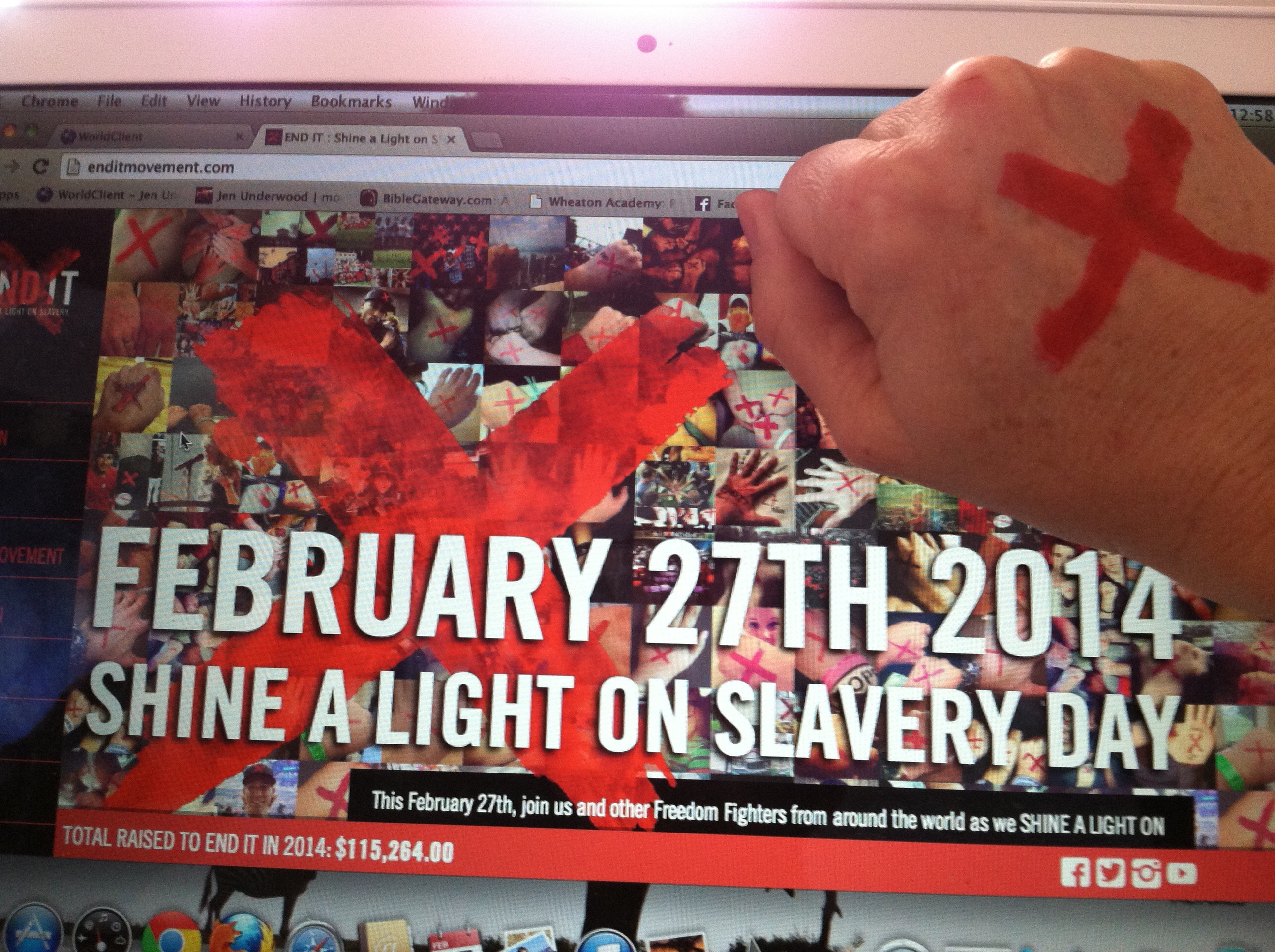
Visit enditmovement.com for more information. #enditmovement
Hi everyone,
This is not exactly a post, more of an update. I added audio capability to my blog and made a recording of a recent post. You can check it out here. I might be doing this simply because my kids are growing past the stage when I read to them aloud all the time, but I did have fun doing it. I’m working on putting a caption (“Hear Jen read this post.”) next to the audio “button,” but I haven’t yet figured out how to do that. Anyway, in the future, you’ll have the option of reading or listening to some of the posts.
I hope you are enjoying the gift of today.
Thanks for reading,
Jen
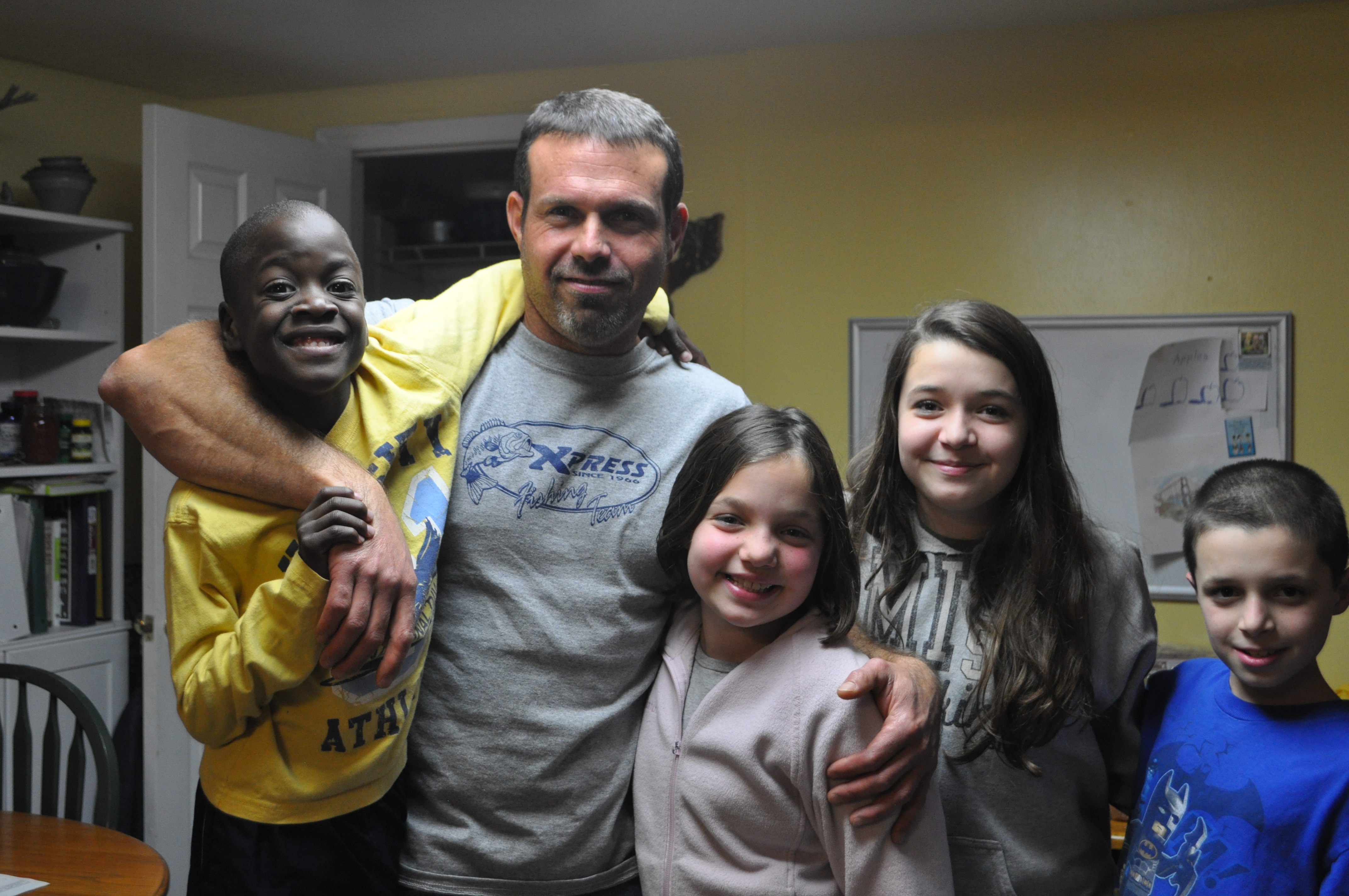 Dave was watching football while grading papers (a common Sunday afternoon for him). I stopped as I walked by because a commercial caught my eye.
Scene: a man sits at the foot of his immaculate bed at the end of his day. He slips off his work shoes and then his socks. He sits there, socks dangling from one hand. Voice over says, “Just as Phil is about to drop his socks on the floor, as he does every evening, something occurs to him for the very first time: The clothes hamper is only four feet away, straight across from him.” Phil then leans forward and tosses the socks in the hamper. The camera pans to a woman just about to walk into the bedroom. Voice over: “Proving to Phil’s wife that miracles really can happen.” Her jaw falls slack, the shot holds for another beat and then fades to an Illinois State Lottery logo.
I howled with laughter.
Howled.
Dave raised his eyebrows at me, with a look that said, “Please tell me you don’t identify with that woman because I am NOT a slob, and if you tell me I am, I will have to remind you that I—yes, I—cleaned up after YOU in the early days of our marriage.”
When I finally stopped laughing, I said, “It’s not because it’s the husband. I mean, they could easily do it from the opposite point of view, wife for husband. Plus, for me, this is not really about you. Just think of all the things the kids do that could have been used for this commercial. I mean, if I went in the kitchen and found that someone had actually put the clean pots and pans away, I would think our house had been broken into by someone who was trying to stock their kitchen!”
He laughed then, too, and we brainstormed a couple together, but I decided to journal a longer list that, were they to change, I might just consider that a miracle:
Oh, kids! Gotta’ love ‘em! And we gotta’ laugh, right?
Got any of your own? Let’s share a chuckle!
 For years I taught the short story plot graph to middle and high school students. You first encounter the exposition—where you meet everyone and discover the setting. Then a conflict is introduced—things get exciting. The action rises (called “rising action”—surprise!) and culminates in the climax! (Trust me—I know that high school boys get the innuendo.) Then there is falling action and the resolution. Some stories have a denouement (a French term I was never sure I pronounced correctly), which is like an afterward—the “____ years later” addition to stories. (I love denouements).
Last fall my good friend Susanna visited. She’s in her first job, working as a third-shift ER nurse, and we talked about how she often leaves so many “stories” unfinished when her shift ends at 11 in the morning, before the doctors or social workers or psychiatrists see the patients admitted during the wee hours of the morning. “Often, all I’ve done is stabilize them,” she told me. “I never hear what happens with them unless they come in again.”
We talked about what that does to our souls when we continually leave stories (the real ones that people live) unfinished. Susanna doesn’t like doing this with her patients, and the stress of constantly living in the rising action of her patients’ hospital stories often makes her weary and numb.
But we also talked about the human tendency to exit stories before the ending or to dream about entering other, more exciting stories.
Susanna and I both have this tendency. We like traveling to needy places, and we’re constantly intrigued by the thought of going someplace new/doing something new.
Part of that desire is driven by the instinct to live only the more exciting half of the story, to move on when the action is no longer rising, when a climax is not around every turn.
To live out full stories, though—through the falling action, into the resolution, even past the denouement—requires determination and commitment.
I think of child-rearing—particularly when the child has a special need or illness or trauma;
Nursing older parents—especially when the years of diminishing ability or memory stretch long;
Marriage past the honeymoon stage;
Keeping the same job when the promotion offers begin passing us by.
These long-term stories sometimes seem short on excitement and long on the daily grind.
Until trauma hits! Then we remember the daily grind with nostalgia. “Oh, if I could only have that again,” we think. “I wouldn’t complain about …”
But when we are in the doldrums of our long stories, excitement beckons. We get weary. We long for … something. We forget that God has put us right in the middle of these stories for a reason. We forget that every daily grind moment has purpose and how we live these times affects the Story-at-Large. We may never know the hows or the whys or the specific effects, but we can know these times have meaning.
Oh, Lord, help us to remember this.

No connection to today’s post–I just like the look of joy on Mad’s face.
I went to a women’s service at our church yesterday. For two days I’d wrestled with a strange melancholy. I’d tried and tried to understand it, but couldn’t. I’d searched my soul, confessed the self-focus I saw, and asked the Holy Spirit to reveal other issues. I’d looked at the level of my mommy martyrdom—yes, there was some, but it wasn’t high enough to explain my strange sadness. I thought of things going on around me: my renewed research on sex trafficking, a friend going through a very difficult time, the transition to being a mom of a teenager…
Nothing jumped forward as a principal cause.
I tried reminding myself that others were dealing with horrible losses and troubles. They had real reason to be sad. I did not.
That didn’t help.
Is it all right to sometimes not know the reasons for our lows? Is it all right to simply be sad sometimes without clear cause?
I think it might be, if only because of the ways the Lord ministered to me yesterday morning without my ever learning the why and what of my mood.
The speaker for our service had chosen II Chronicles 20 as the text. King Jehoshaphat and the people of Judah knew a great enemy was coming against them. They chose not to trust in their own might or in the might of allies. Instead, they turned to God. They fasted and prayed and cried, and finally Jehoshaphat stood in front of his people and said, “Oh, Lord, we do not know what to do, but our eyes are on you” (vs. 12b).
Well, I’m not really faced with a decision right now, but the not-knowing certainly fits me right now, I thought.
At the close of the service, we sang “I Heard the Voice of Jesus Say” by Horatius Bonar, one of my favorite hymn writers.
I heard the voice of Jesus say
Come unto Me and rest
Lay down thy weary one
Lay down thy head upon My breast
I came to Jesus as I was
Weary, worn, and sad
I found in Him a resting place
And He has made me glad.
It was as if the Holy Spirit whispered the words to my heart. Weary?—yes. Worn and sad?—yes, yes. I didn’t know why (still don’t) and that’s all right.
Because, finally, when I rested and simply said, “I’m sad, Lord. I don’t know why. Here’s my sorrow,” He gave rest to my soul.
And He made me glad.
*The second and third stanzas of the hymn are truly beautiful as well. Here’s the link. And if you’d like to hear/sing it, here’s a Youtube video with words and music.
Late last summer I took my children to the dentist for their pre-school-year checkups. One of them had some kind of procedure done, and the usual “thirty minutes before you can eat solid foods” was extended to two hours. So I decided to treat everyone to milkshakes from Scoobys.
On the way there I stopped in at Walgreens to pick up a picture order. The kids began to troop in with me, but a voice behind made us all stop.
“Hi m’am. Hi kids.”
We turned. “M’am, I was hoping to get some lunch at Subway. Do you have something to spare?”
He had big eyes and a mouth that grinned wide.
I pulled a bill from my wallet and handed it over.
He said it before I could. “God bless you, m’am. And your children.”
“God bless you, too,” I told him.
We picked up the photos, got back in the car, and headed to Scoobys. The children talked about the man. “I wonder what he’s ordering at Subway?” one said. “Do you think he has a home?” said another.
No one was in the drive-through at Scoobys, a good thing since my kids suddenly couldn’t make up their minds about flavors. I stopped about a car length from the order board so we could decide.
Suddenly a loud honk interrupted our deciding. A man in a large, shiny SUV, parked in the small lot to our right, was trying to back out, and we were in his way.
We weren’t keeping him from getting out of the lot. His was the only car in it. He could have moved straight back and had clear access to the road. We were in the drive-through lane, exactly where we would have been had another car been in front of us. But he wanted to go where we were.
And he was angry we hadn’t noticed.
Very angry.
Our windows shielded us from deciphering his actual words, but the volume of his scream penetrated the car. His face had turned deep red and his mouth twisted and distorted as he screamed. He jabbed his left hand up, middle finger skyward in a clear gesture.
For a brief second I froze. Then I eased the car forward.
He screeched back and rocketed out of the lot.
Silence.
I tried to bring back the celebratory mood. “So, you guys know what you want now?”
There was no more banter, no more fun in deciding. “Two chocolates, one vanilla, one strawberry,” I told the woman at the window.
The quiet persisted until one of the children softly asked, “Why was he so angry?”
We talked about it then, and Emily eventually cracked a joke that eased the tension.
But my kids haven’t forgotten. The other day I asked Patrick, “Hey, do you remember the man who yelled at us at Scooby’s?”
Patrick’s eyes went wide. “He was scary,” he said.
But he’s forgotten the man who asked for money just minutes before.
I have not.
They were so different—the one with his well-worn clothing and cracked shoes, the other with his giant, shiny car.
Yet they were also alike—with matching inward needs that stretch to the soul.
Would SUV man able to admit this inner need? Subway man admitted to his outward, obvious one. SUV man didn’t have Subway man’s obvious, outer needs, yet his angry outburst was evidence of something broken within him.
As I’ve thought about these two people, I’ve wondered which one would be more open to Christ. If God were holding out His hands to both men, which one would be more likely to grab hold? Could outward vulnerability make people more able to admit to an inner need as well? Could this hint at what Christ meant when he called the poor in spirit “blessed”?
I don’t know, and honestly, it’s not really a valid question as it pertains to those two men. I know nothing of them. I don’t know if Subway man was conning me with charm or if SUV man had just experienced something horrific and was simply overwhelmed with emotion. I’ve never seen either man again.
Will you acknowledge your soul-deep needs and cling to God’s hands?
I don’t need to know their answers to that question.
I need to know mine.
Dear Readers,
I have gotten so much response and information related to the last post that I’m writing a followup post mostly comprised of all the links/books/info I’ve been given through Facebook/blog comments.
First off, some continued reading:
I found an article, “The Super Bowl Could Never Not Be Breeding Grounds for Sexual Exploitation,” written by the Chief of Policy and Planning for NYS’ Unified Court System, Judy Kluger. She is also the Executive Director at Sanctuary for Families, the leading nonprofit in New York State dedicated exclusively to serving domestic violence victims, sex trafficking victims, and their children. She wrote in response to several articles which said the hype about the Super Bowl being a “trafficking magnet” was not only overblown but was also potentially harmful to trafficking victims.
Then a friend suggested reading Half the Sky (the link is to its Amazon page) Without having read it yet (though it is now in my shopping cart at Amazon.com–my friend offered to let me borrow her copy, but I’m thinking I will probably want to mark it all up!), I can tell you that Amazon.com calls it “a passionate call to arms against our era’s most pervasive human rights violation: the oppression of women and girls in the developing world” AND, only moments after my one friend posted the suggestion on Facebook, another friend called the book a “must read.” This friend should know, as she, with several of her friends, started the West Chicagoland Anti-Trafficking Coalition to inform and activate people about the issue right here in our area. While I’m on this topic, here is a link to the Coalition’s Facebook page and another to an article written about it.
And, on that note, more about this issue in my local area, the western suburbs of Chicago:
Over the weekend my husband forwarded to me a prayer email from New Name, a ministry of Parkview Community Church in Glen Ellyn, IL, (that’s my area) that “partners with local churches to reach out to and help walk along side the women who are caught up in these industries.” I prayed my way through the message (heartbreaking stories) and then emailed its sender, asking to be added to the list of people who regularly receive it. I mentioned New Name to my Anti-Trafficking Coalition friend, and she wrote back: “New Name is awesome!” She’s used its videos when she has spoken about trafficking in the West Chicagoland area. If you go to the “New Name” link above, you’ll find more information about it as well as a contact email.
Another friend mentioned A21, which is an official coalition partner with End It, an organization I mentioned in the last post. Both these sites have great information.
I’m also sharing the blog site One Small Voice–which I found through New Name’s prayer email. The blogger says this about the site: “My goal is to post information about global human trafficking issues as well what’s happening right here in the Chicagoland area including strides that are being made by the government regarding this issue.” Right at the top of the site is information about a forum being held this Saturday on this topic.
Lastly, I just want to remind all of us why we should care.
Many years ago, when I was a very young middle-school teacher with no children of my own, I sat in a meeting that involved a student, her father, and our team of teachers. The father was overbearing and belittling to his daughter, and we left the meeting feeling discouraged. One of our team members, the lone male on the team, father to a young daughter himself, was more than discouraged. He was angry. “Any man can be a sperm donor,” he said, “but it takes a real man to be a father, and that girl doesn’t have one.”
Most of the girls involved in trafficking have never had a true father, one who protected them, cherished them, and honored them. God longs to be their Father. He’s angry and sad they’ve never experienced true love, and He’s called us to have His heart for them. He says He “will bring justice to the orphans and the oppressed, so mere people can no longer terrify them” (Psalm 10:18), and He’s called us to enact that justice in the here and now.
Let’s pray for some genuine religion, friends.
And then let’s do it.
Thanks for reading,
Jen
NOTE: The topic and the links I’m sharing are not comfortable.
A year and a half ago I wrote an article (it’s on page four of the link) about two American women who provide dignified employment for at-risk women in Bangladesh, a country known for its sex slave industry. At the same time my husband, Dave, was teaching a new class at Wheaton Academy titled Culture and Theology. One of the units in the class was modern-day slavery, so we were both researching the issue and how it impacts every single country, including the U.S., where we live. I read a book titled The White Umbrella about the sex slave trade in the U.S. and about one specific ministry in the Atlanta, Georgia-area that reaches out to girls rescued from it. Dave discovered ministries like End It Movement and Love 146, which fight against human trafficking. At some point in our research, Dave discovered that the Super Bowl creates a huge market for trafficking.
That’s the reason for this particular post at this particular time.
“In 2010, the National Center of Missing and Exploited Children reported that 10,000 women were sold for sex at the Miami Super Bowl.” That quote is from an article published today that calls the Super Bowl a “sex-trafficking magnet.” Here’s a link to the several articles The Huffington Post has recently published on this topic.
Please pray.
Thanks for reading,
Jen
My youngest child had academic testing yesterday. He and I arrived at an office in the morning, and I was ushered into a room and handed three inventories to complete. One had 86 questions; one had 275; the last had 160. Needless to say, they were thorough.
I answered “true” or “yes” to quite a few questions, most of them related to high energy levels and difficulty focusing, and there were others about which I thought, “Well, that doesn’t relate to Patrick but it’s true for Jake”—or Maddie—or Emily—or me! I recognized each of my four children—and myself—in some of the items.
But most of the statements brought me both perspective and gratitude. For every “false” or “no” I checked, that was another issue we were not facing.
I texted some of these to Dave, my husband.
“My child has very low self esteem.”
Um, no.
“My child is painfully shy around new people.”
Definitely not.
Then one of the statements simply made me stop.
#53: “I’m afraid my child is going insane.”
True or False.
And I felt a little sick.
Because, obviously, there must be parents who have to mark “true.”
We each have troubles we can talk about, things like frustrations with our children or our parents, illnesses and actual losses.
But there is also a list of unmentionables we generally keep hidden: addiction, mental illness, rage issues, money troubles, marital conflict…
Our voices literally hush, softened with shame, when we speak of those. If we speak of those.
When the testing finished for the day, Patrick and I put on coats, hats, and gloves to brave the deep cold. Our drive home took us past the middle-class suburban neighborhoods I drive through nearly every day. One after another, the homes presented neat, tidy fronts. Trim siding and smoke from the chimneys proclaimed “All is well!” but I wondered about the unmentionable topics hid away inside. If I slipped an inventory under each door, which ones would come back with “true” marked for #53? Which ones would affirm “I’m afraid in my own home,” “My child is a real threat to himself or others,” or “One of the child’s parents continually threatens abandonment”?
No adults shoveled driveways; no children played in the snow. The cold had driven everyone inside.
Where secrets can be kept, and unmentionables are lived out.
All is not well.
Oh come, Lord Jesus, come.
And in the meantime, help your people to see and speak.

 Jen Underwood