Skipping the “A” in the ABCs

Jake! (In the fake mustache, he makes me think of author Agatha Christie's Detective Poirot, famous for his "little grey cells"!

Jake! (In the fake mustache, he makes me think of author Agatha Christie’s Detective Poirot, famous for his “little grey cells”!)

“Pride goes before destruction,” says the King James Version of Proverbs 16:18, “and a haughty spirit before a fall.” Here’s how the Message puts it: “First pride, then the crash—the bigger the ego, the harder the fall.”

Wise words.

The “crash” can range in severity and form. For me today it was an edginess, a tendency to blame everything on someone other than myself. Sarcastic retorts were my first responses, and a couple times I didn’t bite my tongue fast enough to keep them in. I should have worn a sign that read, “Leave me alone—for your own good!” I didn’t know what I wanted. I didn’t know why I felt so terribly grouchy. I couldn’t pinpoint any particular person or event that legitimately could be the cause.

I fought back. This is not me, I told myself. I can control this. I can change this attitude.

I’ll just grit my teeth and smile, smile, smile.

It didn’t work. Well, outwardly it did, sort of. But nothing changed inside.

I went for a walk at the dog park. Cold air, outdoors, the physical effort of breaking a path through nearly knee-height snowfall—those are all things I love.

But that didn’t work either. I still wanted to bite the head off the first person I saw.

Poor person.

At home I continued my battle to snap myself out of it.

Until I sank into it and waved the white flag.

The truth, I finally acknowledged, is that the edgy, grumpy, sarcastic, self-centered person I’d been all day IS me. With all masks and Southern “lady” upbringing stripped aside, the true me is self-righteous, self-focused, and accusatory.

I looked out the window at the bright snow that blanketed the patio. “I’m not feeling too clean right now, Lord,” I prayed. “Feeling pretty stained, pretty dirty.”

The bulletin from the morning church service was next to me. I looked at the Old Testament Scripture reading from Jeremiah 31. God said, “With weeping they shall come, and with pleas for mercy I will lead them back. I will make them walk by brooks of water, in a straight path in which they shall not stumble…” (Jeremiah 31-verse 9).

I’d been doing nothing all day but stumbling, tripping, and falling all over myself in my attempts to be a “nice” person on my own. I sighed with relief. You say You will lead me back, Lord. I don’t have to find the way myself.

I read further: “’(M)y people shall be satisfied with my goodness,’ declares the Lord.” (verse 14)

That was the root of my problem. I’d been satisfied with my own goodness—till I discovered it was anything but good!

Several years ago, when Em was 10, the twins 6, and PJ only 4, Em shared with the entire family the ABCs of salvation she’d learned in Sunday School. “A is Admit you’re a sinner,” she told us. “B is Believe that Jesus paid for your sins. C is Choose to follow Christ.”

“Hmm,” Jake said. “I think I’ll take B and C.”

Funny–but true.

Too often I still want to drop the A. I want to have some personal righteousness to boast about.

But I don’t! And mercy isn’t sweet and grace isn’t beautiful unless I see how desperately I need it.

And I’m not really following Christ unless I’m following Him as my only hope.

‘Tis more blessed…

If “‘Tis more blessed to give than to receive” is true–and I believe it is–then on Saturday night I was doubly blessed.

It seemed unfair to use the Christmas gift I gave him before he had a chance to even try it out…

But I did.

Up early and gone all day for one child’s wrestling meet, driving to and from the girls’ soccer practice in the late afternoon, I lost daylight time for my run with the dog.

So I strapped on the headlamp I’d given Dave so he could run in the early-morning dark…

and drove myself and Chai to the dog park so I could try it out in the late.

Snow glittered before me. I ran on fairy dust. In the light of the headlamp, the dog’s eyes glowed weirdly–orange from the side, green head-on, and red when she was close. Pleased with her first off-leash run since before Christmas day, Chai sprinted past me. For a moment, as snow fell in front of me, spotlit in the lamp’s circle, I thought the forecaster’s prediction of next-day flurries had come early and sudden. But when it stopped just as quickly and then happened again when Chai did another fly by, I realized she was kicking it up with her paws.

A siren wailed in the distance, and deep in the woods, the coyotes echoed. Ahead of me, Chai paused to listen. Then–they must have been too far away to awaken either concern or longing–she bent her head and chomped up some packed snow, the canine version of shaved ice, flavored with who-knows-what.

The trees’ tops were lost to the night, but in my peripheral vision, their trunks floated like gray stripes on a dark suit. Hit with the direct light of the headlamp, though, they appeared almost white, bleached of color.

I felt no fear, except that my rule-keeping mind expected a policeman any moment to remind me that the dog park closed at dusk, and it was well past.

When Dave got home from cleaning up after the wrestling meet, I told him I tried out his present. “Thank you,” I said.

“How did it work?” he asked.

“Great!” I told him how beautiful the run had been. “It worked wonderfully. You’ll love using it.”

“Well, then, thank you,” he told me.

‘Tis better to give than to receive.

True.

But perhaps giving and receiving, when done wholeheartedly, are more connected than I’d realized.


Redeemed. Redeemed…

redeemedThe writing I do in my head is beautiful! As I walk at the dog park or fold laundry in the basement, words, lines, and ideas float through my mind and I am awed at their perfection.

First chance, I grab pen and paper and fix down the words that hang like masterpieces in my brain.

This fixing destroys them, or, rather, it unveils them. What I imagined as a Renoir is nothing more than a child’s cartoon drawing. “What happened?” I wonder. “Did I remember it wrong? Was it not really that beautiful to begin with?”

I am not alone in this, not as a writer, nor even as a person. We all long for perfection. We plan perfect dinners, evenings, vacations, outfits. Those are small imaginings. Bigger are our dreams of ideal families, marriages, lives, homes.

This fascinates me. Why do we have this obsession with perfection when we have never, not ever, experienced it?

And isn’t it ironic that though we long for perfection, our very natures seem bent to ruin any good we do encounter?

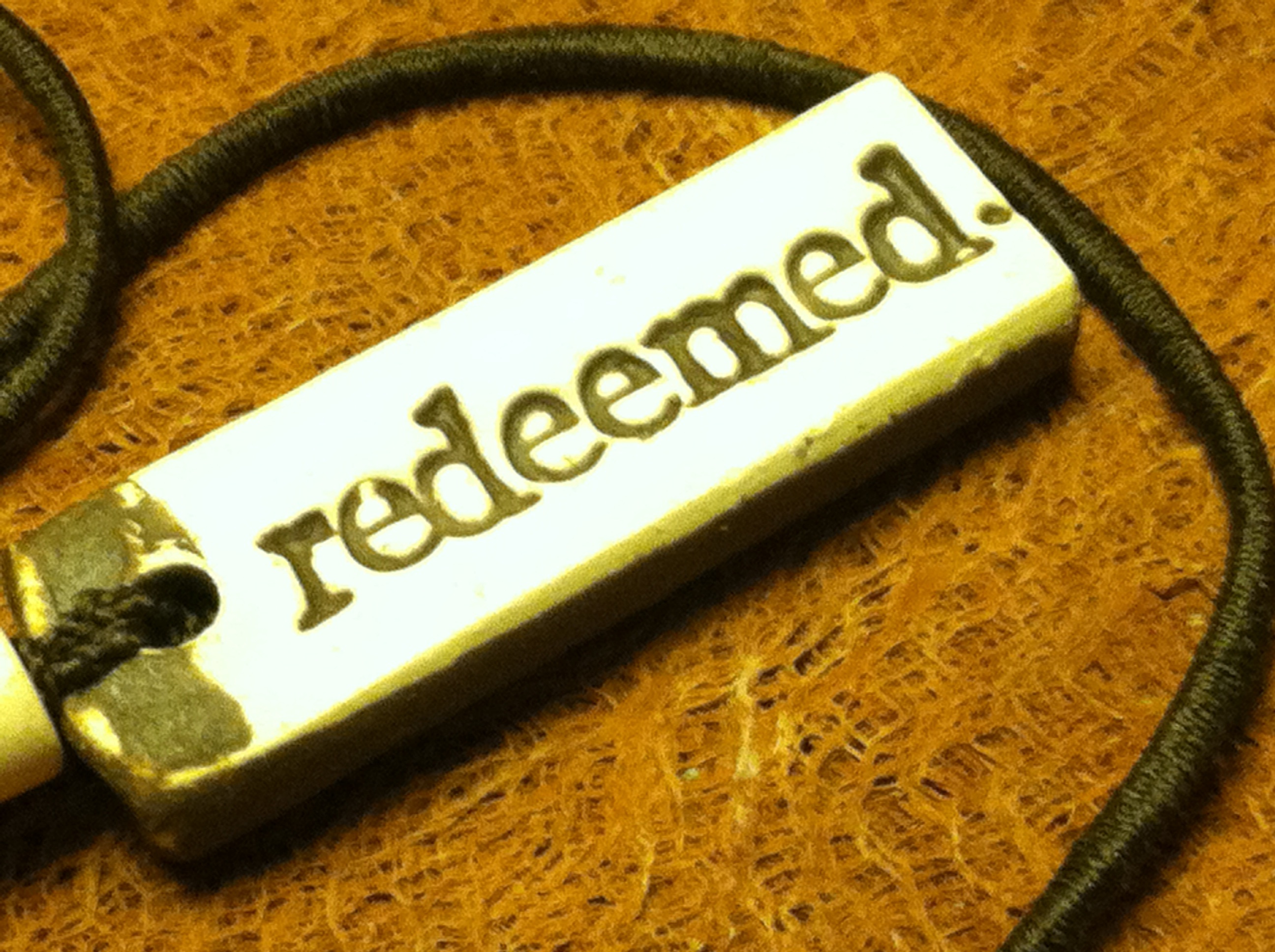
A few days ago I bought myself a new MudLOVE necklace (http://www.mudlove.com/index.htm). It says “Redeemed.” I picked this one over others that read “Blessed,” “Believe,” “Hope.” I picked it even over the “Set Free” necklace, which I bought last year but then gave away to a young man in Africa this past summer.

Redeemed.

MudLOVE does not have a necklace that reads “Perfect” or even “Perfected.”

That’s not surprising. Few of us are that egotistical, at least outwardly.

Perfection implies there is no need for any kind of change, no need for redemption. If something is perfect, it simply is. There are no marks of fixed flaws, no evidence of past issues.

Yet Christ told us to “be perfect, even as the Heavenly Father is perfect.” (http://www.biblegateway.com/passage/?search=Matthew+5:48&version=ESV)

Impossible—which was pretty much the point.

Which brings me back to redemption.

I look at my reference tools and find the definition of “redemption” that fits the Biblical idea of the word: “the buying back of something.” But when I switch to the thesaurus, it’s the synonyms that catch my attention: “recovery, renovation, reclamation (I like that one), restoration, revitalization.”

Yes, I think. This is what I do with my writing. I tinker, trying to reclaim a bit of the perfection the words seemed to have when they floated through my head.

But our perfection is more than a puff of smoke in our Creator’s mind. There once was perfection, when our actuality matched His design. Now, however, there can be no more perfection. We’ve been marred. So there must be “the buying back,” accomplished by the unmarred Christ, whose Perfection stepped in for us. (http://www.biblegateway.com/passage/?search=Hebrews+10:14&version=ESV)

So the positional perfection, the positional redemption has been accomplished. But what about all the synonyms? I don’t continually feel or act restored, recovered, revitalized.

I look at my necklace again. “redeemed.” There is a period after the word.

Hmm.

Bought back—past tense, completed? Yes.

Still being revitalized, reclaimed, restored?

Yes.

Redeemed. AND Redeemed…

Word Play: Sacred

This is Emily's creation, who both took the pic and added the graphic. using the app Rhonna. Merry Christmas, everyone.

This is the creation of my daughter, Emily, who both took the pic and added the graphic. using the app Rhonna. Merry Christmas, everyone.

Awhile ago I became fascinated by the interplay between the words “sacred” and “scared,” that with the shift of just one letter, such an amazing change is made. Then I played more with the letters from those words, and discovered I can also spell the words “care/cares/cared,” “scar,” and “red.”

So, though I am NOT a poet, I wrote a poem.


Created sacred, we once walked with the Sacred Himself,

Till, rejecting communion, we chose independence

And broke away from Sacred Life.

The rupture scarred us to our very core.

Scared of the Sacred, we hid, pretended, postured.

But–oh blessed Word work–the Sacred Himself took on our Scar and bled red with lavish care

To move us from scared to sacred,

From scarred to Life.

When death breaks in

This morning I learned of the death of a former student.

Sudden, unexpected death.

Now, in this season of life, when we read verses like Zechariah’s pronouncement about Christ’s birth: “…the morning light from heaven is about to break upon us,” death has again triumphed, and a family is weeping. Christmas will forever be changed for them. Even when the great waves of grief have passed, every year, in the midst of celebration, there will be a tinge of sorrow.

Death has broken in.

My soul rages when I hear news like this. Somewhere deep down in me is the knowledge that this is wrong. It should not be like this. We learn to live with dysfunctional families, fallen bodies, mental illness–all the “subtle” reminders of a broken system. But then death breaks in and hauls us up short. We turn the corner from “life is hard but endurable–even good at times” to find that the passage before us is gone. It has dropped off and all we see is darkness.

“This is unacceptable,” I want to say.

But I have no power to change it. In fact, in my own small way, I, too, will wreak death as I walk through my days: wounding those I love most, including my own self.

I don’t always notice this, but then a life that intersects with my own is snuffed out, and capital-D Death makes me wail with a specific-yet-vague knowing of the shadow that hovers over our planet and in our very hearts.

At times like this I get a glimpse into what God must have felt when His beloved image-bearers made that irrevocable choice that doomed all of creation to groaning and travailing in a bondage of corruption.

God sorrowed–far more than we because He could see the great contrast between what was planned and what we chose.

But then He did more! The Lion of the tribe of Judah roared.

We thought it was simply a whimper–an insignificant birth, a controversial life, an ignominious death.

But no! It was a roar! “It is finished!” was a victory cry. His death had swallowed up death itself.

We are in the night of sorrow.

But morning will come.


The Teller and Star of the Best Story Ever

DSC_0743The “Prodigal Son” is one of the best-known stories in the world: a rebellious child runs away from a loving father; the father mourns; the child returns; the father welcomes; the sibling struggles with the restoration. (Luke 15:11-32)

Now I know the story speaks of “sons,” but because I am a woman and because many who read this blog are women, I want to remind us that we can fully identify with these two sons. We know we can do this because of how Jesus treated women and because of Paul’s words later in the New Testament. So even though I’m going to refer to the two characters as “sons” simply because I think it might be confusing if I didn’t, we can substitute “daughters” if it helps us to identify more easily.

The first “character” in this story is this wonderful Father figure. He loves His children. He longs for them to have fullness of life with Him. There’s no hidden story or sin. He is what we see: the beautiful, perfect Dad.

This Father has two children. (There’s actually a third one, but we’ll get to Him later.)

One of his kids is called the prodigal.

It’s an accurate title. This kid thumbs his nose at all his dad stands for. He is rude and disrespectful to him. We Westerners can’t quite get the full cultural ramifications of what he does in this story, but he is basically saying, “You’re standing in my way, old man. I don’t want to wait until you’re dead to do what I want to do. So fork over now what’s going to be mine when you kick the bucket, and I’m outa’ here. I don’t care about your way. I think all this love and peace stuff is boring and stupid. I want some excitement, and I want it MY way.”

He’s an obvious prodigal. Obvious. Some of us identify with this prodigal. We think, “Yes, that’s me!”

But some of us identify more with the other son. He’s the one working out in his dad’s business. He’s the one who looks like he’s his dad’s right-hand man. This guy appears pretty good, squeaky clean in fact. He’s very focused on pleasing his Dad, and he wants the other brother and everyone else to see that he’s the “good child.”

Somehow we see that as “better” than the prodigal’s attitude.

It’s really not, though.

Because deep down, this son is just as self-serving as the prodigal.

He doesn’t really “get” the Father’s way of living either. He doesn’t think it’s measurable enough, so he adds rules of his own. He wants the Father to look at him and say, “Good job! You’ve come up with such a great system. Why didn’t I think of that? This, yes, this, is how I should measure people’s rightness.”

This child is a legalist.

Not long ago I read a fantastic quote by Max Lucado. “Legalism,” Lucado wrote, “is the search for innocence—not forgiveness.”

The legalist child doesn’t want God to be bigger than he is. He wants to think that his level of “goodness” is better than God’s, so that God has to declare him INNOCENT.

He’s not seeking forgiveness. That would mean he was WRONG!

But he is.

He’s missing the mark just like the prodigal is! Neither of their ways—the lawlessNESS or the nit-picky rule-keeping—is anything like the beautiful GOODNESS of the Father.

The prodigal is at least honest about his waywardness. He leaves.

But the hypocrisy of the “good son” becomes very evident when the prodigal returns and the father’s will and desire are drastically different from the “good son’s.”

The father wants to forgive and restore and love and celebrate and move forward.

Not the “good child.” He wants to hold grudges and remember wrongdoing and use the “rules” to condemn the prodigal and exalt himself. His “goodness” is revealed to be self-serving, bitter, and proud.

They are BOTH prodigals.

WE are prodigals. All of us. Like one or the other of the two kids in this story—or somewhere in between them.

The Father is holding out His arms to all the prodigals. “Come to me!” He calls. “I’m looking for you. I want to hold you in my arms and heal your heart wounds and draw you into right, real relationship with ME! Come into the house and celebrate with me.”

Somewhere inside us we want this—but we also don’t want it. We’re not capable of choosing it for ourselves because we’re not good—and true, unselfish goodness is alien to our core nature.

If we stopped right here—with the Father’s open arms and our inability to be in His embrace—this story would be a tragedy.

And if some regular human were telling the story, it would be nothing more than a fairytale, a story told to entertain for a few minutes before we have to return to “real life.”

But the storyteller, Jesus, is not a regular human being. And he didn’t tell the story as mere entertainment. He told it because He has the power to make it come true—for each of us—and He wants it to become true.

Though He is the narrator of the story, He is also IN it. He’s the Son of the Father’s heart, the perfect representation and exact image of Him. He reveals to us in the flesh the beauty of the Father and the Father’s way. When we look at Him, we see our need for something bigger and better than ourselves.

In the story, the prodigal did both of these in the far country. In the pigpen he realized how lost he was. Then he thought about his Father and saw clearly the Father’s goodness. He went home because he knew the Father would extend mercy. (Little did he know how MUCH mercy the Father would extend.)

At this point, we still have a problem. Jesus awakens in us the realization of the Father’s perfection. In Him we clearly recognize that WE are not perfect. But if He simply told the story, and then didn’t DO anything more, we would still be in the far country like the prodigal or laboring in the fields with bitter hearts like the legalist.

We are simply not capable of true, eternal heart change.

But the Storyteller did more.

He died.

And through his death, He became the Way to the Father’s embrace.

He made the story Truth rather than fiction.

He delivered real Life that does not disappoint—unlike any fairytale we can imagine.

He accomplished LIFE through horrific death. That vertical line of His cross created a way for relationship between God and humanity. Clothed in the perfection of Christ, the Father can pull us close to His perfect heart. You and I both know that we couldn’t be there on our own.

Now here’s another wonderful thing about the cross of Christ. Its horizontal line created relationship between humans. When we’re gathered together at the foot of the cross, awed by the Christ and the Father’s perfection and goodness, all our own personal differences fade into nothing. The prodigal and the legalist can have relationship with each other because coming to the Father requires a stripping away of the outer to find we are all the same underneath. Put us in the light of eternity and in the presence of the holy, wholly good God, and those outward differences are GONE! Then we can relate—in reality, in truth and honesty, without pretense and masks, without competition.

Jesus is the Teller of the Best Story, in which He stars as our Way, our Truth, our Life.

NOTE: This is the script of a Gospel presentation I recently prepared, so it may sound more like a “talk” than a blog post in some spots.

From death to life: the blessing of communion

Jumping in leaves at Nana and Papa's house (my in-laws).

Jumping in leaves at Nana and Papa’s house (my in-laws).

For two mornings I have been disgruntled with my younger children.

Picked at faults, pointed out shortcomings. Ranted about the fact that—though I have made a bulletin board with pictures that “tell” them all they need to accomplish in the mornings before we get in the car (so even my beginning reader can understand)—we have experienced the “we’re going to be late” scrambling rush two days in a row.

After driving to school the second morning, I came home and sat in my sin for a bit. I tried to shut down the excuses and even the premature/slightly false confession and asked the Holy Spirit to help me simply listen.

DSC_0485The Spirit peeled back a few layers and I saw some of the roots of my sin.

Then, more painful, I saw what these sins are doing to my kids: in bearing down on my children with a harsh spirit, I am crushing them; I am cutting off communication with them; I am modeling for them the very things I tell them they shouldn’t do to each other (pointing out faults, not allowing for differences, assuming that everyone should regard their time/likes/dislikes as most important, being inflexible, losing their sense of humor and grace.)

DSC_0486In doing all these, I practice hypocrisy right in front of them.

I was all set to wallow in this (oh, how often I forget the second part of repentance: to turn TO God) when I remembered a conversation I had earlier this fall with my mother-in-law. She shared that one Sunday morning a few weeks before, she’d been disgruntled. She’d snapped at her husband and said harsh words to her granddaughter (who was staying with them at the time). Though she then apologized, she’d gone to church still bruised with guilt. Once there she remembered she was supposed to serve communion. She leaned over to her husband and whispered, “I don’t think I should serve communion this morning.”

DSC_0490When she told me this story, she paused at this point. Then she said, “A few minutes later, Dad passed me a note. He’d written Romans 8:1 out for me to read. “Therefore, there is now no condemnation for those who are in Christ Jesus.”

“I served communion,” she told me.

She served it—and took it—in the exact mindset in which we should always participate in communion: authentic gratitude.

The Holy Spirit brought this conversation to mind because I, too, was being invited into communion. In my state of guilt and hopelessness, my eyes were drawn to Christ, to His broken body and spilt blood that accomplished for me what I have no possibility of accomplishing for myself. I was invited, once again, to move from death to life, to receive grace.

Suddenly, I longed to have my children home from school. I looked forward to the moment when I could pull them close and say, “I’m sorry, truly sorry.”

From death to life, once again.

The blessing of communion.


From phileo to agape

“Would you die for your beliefs?”

That might be an odd question to ask here in the U.S., in an age that promotes “tolerance” above all, but it’s a question I’ve asked myself. When I’ve read about martyrs—in the past or present—or about believers being persecuted for their faith, I’ve wondered, “How devoted am I? If I were going through what that believer is, would I be able to stand strong?”

I tend to think of those believers as “better” Christ-followers than I. One day, as I was leafing through a Voice of the Martyrs magazine (www.persecution.com), I expressed this thought to my husband, Dave.

“I disagree,” he said. First, he argued, what does it mean to be a “better Christian”?

All the answers that popped into my head, I realized, had to do with ME, with what I do or don’t do. They had nothing to do with Christ’s work in and through me.

Second, Dave exposed the root of my guilt. “You feel like a second-rate Christ follower because you’re not enduring really hard things, but in doing this, aren’t you kind of questioning God? He’s the one Who has placed you exactly where you are. When you feel guilt over not being somewhere else, suffering like someone else, you’re not willing to be the person He created you to be in this time and place.”

His third argument is one I’m not sure I agree with. “I think loving God and loving neighbor is in many ways a harder task here in suburban American than it is in violence- and poverty-riddled cultures,” he said. “With so many distractions and such a great emphasis on comfort, it’s harder to focus on what is really important.”

As I thought about all this, I studied Peter’s declaration that he could die for his beliefs, for Christ. After Jesus told the disciples they would “all fall away on account of me,” Peter said, “Even if all fall away on account of you, I never will.”

Jesus disagreed. “Truly I tell you…you will disown me three times.”

Yet Peter was still certain of himself. He protested, “Even if I have to die with you, I will never disown you.” (This story can be found in both Luke 22 and Matthew 26. The above quotes are from the Matthew passage.)

Here’s what strikes me about the passage: Jesus didn’t ask Peter to make a declaration; He wasn’t impressed when he did make it; and He didn’t seem too fazed by Peter’s denial of Him. I’m not saying Peter’s denial wasn’t a big deal (it certainly was for Peter), but I am saying that Peter’s statement of devotion had a lot more to do with himself than with Christ, and Christ knew that.

As part of my study on this, I also looked at the John 21 passage, in which Christ restores Peter. I found it significant that Christ asked Peter three times if he loved Him—the same number of times Peter denied Him—and that Christ ended with telling Peter that he would actually die for Christ. He would eventually have the level of devotion that Peter had wanted and claimed to have before Christ’s death.

But I was still puzzled.

Then, a couple weeks ago, I listened to a sermon in which the pastor pointed out the difference in the Greek verb forms used in the John 21 passage (in the English they are all translated simply as “love.”) I went home and looked it up in my Amplified Bible and was amazed at how that shed light on my understanding of devotion.

When Jesus first asks Peter, “Do you love me?” He uses the Greek verb “agape” for “love,” which the Amplified translates as “reasoning, intentional, spiritual devotion, as one loves the Father).

Peter answers, “Lord, You know that I love you,” but he uses the Greek verb “phileo,” which the Amplified translates as “deep, instinctive, personal affection, as for a close friend.” Jesus asked using a higher form, but Peter, more knowledgeable of his shortcomings at this point, answered with a lesser form.

Jesus accepts Peter’s answer and gives him a charge: “Feed My lambs.”

Then Jesus asks again, “(D)o you love me?” using the agape form.

Peter answers, again, with the phileo.

And Jesus again charges him: “Shepherd My sheep.”

Then a third time Jesus asks Peter, “Do you love me?” but this time He, too, uses the phileo form of the verb.

Peter is “grieved that He should ask him the third time,” and he says, “Lord, You know everything; You know that I (phileo) You.”

Peter now understands his own limitations. He longs to say that he agape-loves Christ, but he knows he cannot produce that kind of love. So he says only what he knows to be true: he does phileo-love Christ.

And that is enough. Christ tells Peter again, “Feed My sheep,” and then He tells Peter something that sounds very, very strange to our modern, Western-world ears. “You will indeed die for me,” He says to Peter, and John, the writer of this gospel, adds, “He said this to indicate by what kind of death Peter would glorify God. And after this, He said to him, ‘Follow Me!’”

That must have been very, very encouraging to Peter. Jesus is telling him, “Peter, I know that you want your love to pure and beautiful and deep, but in reality your love is small, weak, and limited. That’s okay. I am still entrusting you with a great charge: to feed and care for My people. And as you follow Me in this—aware that you must abide in Me to find what you need—I will work transformation in you so that when you are old, your devotion will be such that you will not only not deny me, you will die for Me—and in so doing you will glorify Me.”

Father, I, too, want to love you with my entire heart, soul, mind, and spirit, and I want to love my neighbor as I love myself. But I am learning that my love, like Peter’s, is weak and frail. I am grateful that You understand and accept my weakness. Please help me to accept it, too, for You tell me that Your grace is enough for all my weaknesses. Help me to follow You in what You have set in front of me and to trust that You will transform me.

The Nativity Wars Begin Again

Question: Why am I posting three pictures of nativity sets with all the people facing away from you? (especially in the blue Mary’s case)

Answer: The Nativity Wars have begun again in the Underwood household. I wrote about this last year. Here’s the link: http://wp.me/pCmd8-dZ

silver nativity nativity nativity, mammaw

Snowflakes: a short conversation

Last week we trekked to North Carolina to spend Thanksgiving with my sister and her family:

At one point we drove through snow. Flakes swirled around us.

Jake: How is each snowflake unique? How can that be possible?

Me: Because God is infinitely creative. He never ever runs out of ideas.

Jake: That’s unimaginable!

Pragmatic Maddie: Isn’t it possible because snowflakes lose arms and partially melt and then form other shapes?

Hmm.

Moment of thought for everyone.

Me: But isn’t that cool, too, that God takes what we see as negative and makes something beautiful out of it?

Maddie: It’s like they’re God’s fingerprints, each one different.

Snowflakes and people–fingerprints of God.