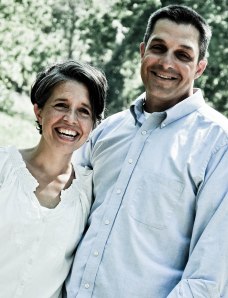
Jake, PJ, and the Marble

DSC_0887-2“PJ’s swallowed a marble!”

They–five of the six kids–greeted me with this news when I stepped in the back door Monday evening.

PJ was front and center in the group. He was just as loud as the rest. “I swallowed a marble, Mom! A marble!”

“Well,” I said, “since PJ is talking clearly and nothing is obstructing his airway, I think we’re okay.”

That’s when Jake lost it. “Noooo!” he wailed. “He swallowed a marble! I don’t want my brother to die.” He buried his face in my shirt. Behind him, big sister Emily was nodding her head and mouthing, “He’s been really upset–way more upset than PJ.”

I tried reason first. “Jake, hon, PJ is fine. Just look at him.”

He continued to shake his head. “His birthday is next week. I want to celebrate it with him. I don’t want him to di-i-i-e!”

He was completely serious.

It was, in some ways, beautiful to see. I’ve always known the two brothers loved each other (though when Jake pushed PJ off a deck over a toy, I had my doubts), but this was very real anguish.

I picked up Jake and hugged him. “Honey, a marble is smooth, with no sharp edges. Since it didn’t get stuck on the way down his throat, it will most probably just pass through him. No problem.”

He didn’t believe me. “Do you want me to look it up online?”

Yes. (What does that say when your 8-year-old trusts the Internet more than his own mother?)

I Googled “What if your child swallows a marble?” and read the headings aloud to Jake (all of them said what I had said).

Jake stopped crying and looked at me. “So he’s just going to poop it out?”

“Yep.”

He was off to find PJ. “Do you need to poop? It’s just going to come out of you.”

I had to explain to his that it wasn’t immediate, but for the next two days, Jake asked the question nonstop. “Have you pooped yet?” (I once asked Dave when the boys would outgrow ‘potty humor.’ He rolled his eyes at me and pointed at himself. “Jen, look at me! Boys NEVER outgrow potty humor.” He has a point.)

After things settled a bit, I asked PJ how he had come to swallow the marble. I assumed–being PJ–that this had been a purposeful experiment on his part, but no! He had peeled and segmented an orange and was eating the pieces as he watched Jake and Maddie play a game with marbles. Without looking, he reached down for a piece of orange and picked up a marble instead. He swallowed it and then said, “I think I just ate a marble!”

I asked him. “Didn’t you notice the orange was awfully round and hard?”

He just shrugged.

There is never a dull moment in this house.

Discomfort and the white umbrella

Isn't it beautiful! It was a complete surprise on Christmas morning to get this. This is a kantha blanket, made from used saris by women at risk in Bangladesh. The company that sells these blankets is Hand and Cloth (handandcloth.org). Through making blankets for Hand and Cloth, these women can support themselves and their families with dignified work and they also hear the Word of God that tells them they have value simply because they are creations of God.

Isn’t it beautiful! It was a complete surprise on Christmas morning to get this. This is a kantha blanket, made from used saris by women at risk in Bangladesh. The company that sells these blankets is Hand and Cloth (handandcloth.org). Through making blankets for Hand and Cloth, these women can support themselves and their families with dignified work and they also hear the Word of God that tells them they have value simply because they are creations of God.

I have been hearing about the White Umbrella Campaign for over a week now, and I just decided to order the book. It’s about human trafficking here in the U.S. With a magazine article I began researching last fall (and just finished writing last week), I’ve been doing much reading on human trafficking statistics worldwide, and I have been staggered by the numbers here in the States.

Though I ordered the book, I’m not really looking forward to the reading of it. It will be, at best, UNcomfortable and quite probably heartbreaking. But I’m learning, more and more, that God is not all that concerned with my comfort. It’s not really good for my character or my heart. Comfortable hearts and settled lives have negative tendencies: being closed off, quick to judge, unwilling to stretch.

I will let you know what I think of the book. I have a few others I’ve read recently that I would also like to post about.

And, tomorrow, hopefully (my husband is overseas at the moment, and I’m holding down the fort with the six kids, teaching a two-week bread-making course, and trying to finish up a few writing deadlines), I’ll post a sweet, funny story about PJ, Jake, and a marble. And, then, of course, I also plan to write and post “Marriage advice, part 2”!

Flu perspective

I know several moms who LOVE the holidays, with their children all home from school. I tend to be more like the parents in “It’s Beginning to Look a Lot Like Christmas” who “can hardly wait for school to start again.”

There are WONDERFUL moments—like staying up late with Em last night and this morning when all three younger kids crawled in bed with us (Then the dog joined in, too, prompting Dave to say, “Well, would someone go wake up the older three and tell them to join us, too.” PJ took this for a literal question and was halfway off the bed before Dave stopped him.)

But there is also no quiet—which my introvert self craves. So I was already praying about this before Christmas break began, and Dave was already telling me to get away some each day, alone, without any children. And he was already bemoaning the fact that, although he tells me to do this all the time, I DON’T— because I believe the lie that “good moms don’t need time away from their children” (along with a host of other lies that perfectionistic people believe to make them feel better about themselves).

Anyway, we were a good eight days into it and I hadn’t gone away—as I’d promised I would.

So God allowed me to get sick.

Fever, chills, flat-on-the-back sick.

For two days.

I’ve decided it was a really good thing.

I got peace and quiet. I got lots of sweet affection—hands patting my back, hot tea from Em, backrubs from Dave… On the second day, when my brain was a little less foggy, I even got a rough draft of an article written (which was what I was supposed to be doing on my “times away.”)

And then, in the couple days following my time in the bed, when I was up and about but still woozy, I had a different perspective. I cared a lot less than I usually do about keeping the house tidy and accomplishing everything on my to-do list. I was too foggy to have a to-do list.

On Friday I went to the grocery store in this fuzzy state. I used the self-checkout line and made a mistake as I was processing my order. The clerk said something pretty snotty to me, but I didn’t even notice it, just nodded at her, thanked her, and walked away. It wasn’t until I was in the car that I realized that I SHOULD have felt snubbed, should have been offended.

A time of rest, a softer, gentler outlook, a break from my driven personality—and then, bonus, a chance to see how this lack of self-focus can positively impact my interactions with others: I’m actually–post chills and fever–grateful for the flu!

Marriage Advice, Part 1

DSC_0806When I’m at bridal showers and the hostess asks all the married women to write down their most valued marriage advice for the bride, I blank. Other women begin scratching almost immediately but not me. “The most important?” I think. “On this little card?”

A few days ago Dave and I celebrated our anniversary. Son Jake kept reminding me of it throughout the day, hugging me and whispering in my ear, “Happy 21 years of marriage, Mom.” (It was a welcome change from the zerberts on the cheek and burps in the ear I more often get from my eight year old.)

We’re amazed by the 21 years. We went into marriage young; we’ve never been organized or systematic about it; and plenty of couples we thought were stronger or more compatible have been split apart. We were reminded of that not long ago when Dave saw a picture on Facebook of a friend from long ago with someone other than his wife. The “someone other” turned out to be a relative, but there were certainly no signs—on either his or the wife’s page—that the two of them are still together, and this was a couple we had really looked up to.

(Side note: Their lack of “together” pictures made me think about my own Facebook account, so I checked my photos and info page for evidence of our marriage. Dave must have been doing the same because a message popped up in the middle of my checking. “Dave Underwood has posted that he is married to you. Is this correct?” “Yes,” I clicked. “Jennifer Underwood is now married to Dave Underwood” became my new status—which several friends “liked” and one of my former students commented on: “About time!”)

Last spring Dave and I walked through pre-marital counseling with a young couple. We re-discovered that every bit of advice we gave—about finances, family differences, personality types, love languages, disagreements and fights—has its roots in grace.

I think that’s perhaps the “most important thing,” though the purpose for marriage and a right view of it would also have to be on my “advice for the bride” card. Maybe I’ll write it down and put it in my wallet so I can copy it at the next bridal shower I attend.

Part 1: “Cling to grace—hard! Require daily that your soul be nourished by God’s boundless grace for you. Then let it overflow for your husband. Let grace bridle your tongue and season the words you do say—and how you say them. Let grace be the undercurrent of your actions, your silences, even the looks you give him. And never, ever think you are past your need for it.”

our second Advent

Here are the four beautiful girls Dave and I took to The Nutcracker in downtown Chicago (with the Joliffe Ballet--woohoo!) last Friday. It was a much-anticipated event, and it did not disappoint. Best part for Dave and me: watching the girls' faces as they watched the ballet!

Here are the four beautiful girls Dave and I took to The Nutcracker in downtown Chicago (with the Joliffe Ballet–woohoo!) last Friday. It was a much-anticipated event, and it did not disappoint. Best part for Dave and me: watching the girls’ faces as they watched the ballet! The boys spent the night with friends–which they said was the better deal! 

Just past 7 on Christmas morning Jake came into our bedroom—we’d said the digital clock could not have a 6 at the front—to announce that he, Patrick, and Maddie were awake.

As Dave and I sloshed mouthwash, Jake chattered, mostly about presents. Then, in the middle of his ramble, he announced, ““Christmas and Easter are the BEST! They’re God’s plan of redemption.”

Well put and true, though we still laughed at the way he said it.

It is now two days after Christmas, our celebration of the Savior’s birth. We anticipated Christmas through Advent, and then we will expect Good Friday and Easter through Lent. As Jake said: The whole picture of God’s capital-R Redemptive Plan.

Advent means “the arrival of a notable person, thing, or event.” Lent is a “season of penitence and fasting in preparation for Easter.” The only reason we are able to anticipate or prepare is because we know the outcome. We know the full scope of the story. So even our Lent preparation is tinged with hope, with expectancy of joy at the end.

But the Redemption begun at Christmas, finished on Good Friday, confirmed at Easter, still has a final chapter. This final chapter will end all tears, all injustice, all war. It will dethrone evil and establish God as the visible King of Kings and Christ as the Prince of Peace.

It will make us individually and collectively right and unbroken.

But this second Advent, second arrival, has not yet happened.

We still wait for it.

It is a waiting sustained by a sure hope, but this is often hard to remember.

For though the hope is certain, we know very little about the details. How could all that we see in the world around us, in our very lives—how could we ourselves, broken and flawed as we are—be part of this final Redemption?

Paul calls it “seeing through a glass, darkly.”

We are in many ways like the people of Israel during the first Advent, unable to see that the promises of old were about to unfold in tiny little Bethlehem—unable to see that Roman occupation, a travel edict, a young girl, a loving, faithful carpenter—and a slew of other details and people we know nothing of—could be used to usher in the Incarnation.

Perhaps the details of our lives are such that we, too, wonder if we are of any purpose in the Majestic Plan. Perhaps we, too, have tried to silence our soul-whispers of grand desire and settled for “the best we can make of life.” Perhaps we are going through heartache that makes us moan and cry out “Why?”

That is the reality of our earth-life. Uncertain at best, wailing at worst—waiting, waiting—because there must, must be more.

We must cling to the promise that there is. That the Promise Himself will return and shed light on this world so that the purposes of all that went before will be revealed. We will be amazed at how all of our lives, even the smallest details, was being used in God’s Plan.

Let’s not be like the sleepers in Bethlehem. As Christ was born yards from their beds, they slumbered and then woke the next morning with no difference in perspective.

They missed the Miracle.

If we fail to cling to God’s sovereign goodness (such a beautiful mystery—that in God “sovereign” and “goodness” are inseparably linked), we, too, will miss miracles, particularly the everyday ones of relationship and personal growth. We will lose sight of Purpose.

Anna and Simeon waited for years for the first Advent. There must have been times when they felt they waited in vain, when it was lonely and painful and hard.

But at the end of it, the Purpose they held in their arms shed light on the purposes of every one of their past moments.

So in this long period of the second Advent, let us wait and endure with the understanding that God’s Plan incorporates even our heartache, even our daily grind. Though we are in the dark involving the purposes, He is not.

For now we see through a glass, darkly; but then face to face: now I know in part; but then shall I know even as also I am known. I Corinthians 13:12, KJV

Glory and Goodness: a sure hope.

Communion Transformed

DSC_0269Communion terrified me for much of my growing-up years. Not because I believed I was ingesting real flesh and blood—oh, no. My father, a converted Catholic, was quite clear on his teaching against that. But he was also very clear regarding the I Corinthians verses about the Lord’s Supper. I got the message: Communion was NOT to be taken lightly. I was to do some self-examining prior to partaking and my attitude should be serious.

He needn’t have worried. I was SERIOUS!

As the pastor read from either I Corinthians or the Gospels, I would wrench my spirit, examining my life for sin. “Oh, God, please, please show me. I don’t want to do this in an unworthy manner,” I would pray, rolodex-ing through my past few days, looking for sins I had committed.

I don’t remember ever taking the little pill tablet of bread or the small cup of grape juice with joy. It was always with fear—“Did I do okay? Did I find everything to confess?”

Thankfully, that is no longer the case. I take Communion now as a symbol of Christ’s doing what I cannot do: (though I tried to for years on years) to rid myself of sin.

But there is another ironic change. I view sin differently, perhaps, oddly enough, more seriously than I did then.

Because I have realized it goes far deeper in my soul than I once thought it did.

I am “steeped” in sin. I like that description. The Pharisees used it when speaking to the man born blind—since, of course, his blindness proved that either his mother or he must have been more sinful than most—hence the blindness.

The word “steeped” makes me think of tea—the teabag infusing the entire pot—or of a chicken cooked all day in a sauce—till every bite of meat tastes of it. Separated from the goodness of God that I need at my very core, my being instead has steeped in my own selfishness. Hurtful actions, attitudes, and words are merely outpourings of this “steeping.”

I remember a Seinfeld episode in which George decided to do the opposite of all his natural impulses. It worked well for him—because every one of his natural impulses was actually destructive to either himself, others, or to relationship between himself and others.

If my sin issues are deeper than my actions or words, even thoughts… If my sin is actually the belief that I am most important in the universe—more important than any other person and certainly than God… If my sin is an attitude of self-sufficiency, of conviction that I am good and right—and, therefore, that anyone who disagrees with me is wrong…

Then the problem is not what I do, what I say, what I feel.

The problem is me, myself, I.

And I need transformation.

And I need to stop settling for conformation.

Back to communion.

My fears were based on the wrong belief that God wants conformation.

But Communion itself bears witness against this. If God wanted conformation, our sacrament would result in us putting something on, something that could be seen by others, like a perpetual Ash Wednesday.

But the commanded sacrament—“Do THIS in remembrance of Me”—is an ingestion that does not seem to change our outer selves at all. Eat of me, Christ says. Drink of me. Take Me into yourselves. Let Me be the nutrients that change you on the inside.

And “Do” this, present tense and ongoing. Again and again we must remember that Christ came to change the inner first. His work on the cross was complete—I am not saying that He must die again and again, oh, no—but I forget so easily and settle for conformity because I believe I can do that work myself.

So we take communion over and over and are reminded that He is in us, creating new hearts within, that THIS inner transformation is the substance of our faith, and outer change is merely the reflection, the outworking.

I no longer need to be terrified—either of my sin or that God is check-marking my confessions against a list of outward actions. What a wonderful change!

I take the wine: His blood covered and still covers my sin.

I take the bread: He is IN me!

The two together equal communion: friendship between human and GOD!

The terror is gone.

And I celebrate.

The God Who Mourns

It is in times of tragedy that we find that the “God” we have created in our own image simply will not work.

As news continues to break about the killings at Sandy Hook elementary school, I have attempted to follow Romans 12:15, “Rejoice with those who rejoice; mourn with those who mourn” and Hebrews 13:3, “Continue to remember those in prison as if you were together with them in prison, and those who are mistreated as if you yourselves were suffering.”

But I can’t do it.

I’m too fickle.

Right now, after the U.S.’s latest mass killing, I know there are 26 families whose hearts have been crushed. Because of our country’s advanced media, I can know the names and see the pictures.

But I am unable to keep them in my heart.

I pray for them, and I remind myself of them, but then I go about my daily activities. I fix meals and do laundry, I write articles, I carpool and help with homework.

All good, all necessary.

But I also slip into ingratitude. I find myself frustrated with the amount of laundry my family produces and the daily question of “What’s for dinner?” Four kids try to talk over each other at the dinner table, and I think, “I don’t want to deal with this.”

But even as I think that, I know there are 20 families that would love to be dealing with this right now. They long to be making lunches for all their kids, to be doing mundane tasks like writing a grocery list and thinking about Christmas gifts for teachers.

Yet I lose my gratitude over the tiniest, silliest little things.

And I will do this again and again.

For the last several days and for the next week or so we have been and will be faced with these 26 families, but then we will forget.

We are good at forgetting. It’s a survival tactic, a way to pretend that things are okay.

We know they aren’t. Even when we are in the lulls between tragedies—when this summer’s killing in the movie theater faded from front and center and the mass killing in Sandy Hook hadn’t yet happened—things were not right, not here in the U.S. and not all across the world. Injustice is rampant.

I cannot hold all that sorrow.

In the book (and movie) The Secret Life of Bees, there is a character named May who feels others’ sorrows as if they are her own. May’s sisters shield her from the radio and television because a 15-second report of an abuse or death or injustice will make her wail with heartfelt pain.

At the end of the movie May gives up. “I can’t do this anymore,” she writes to her sisters. “I can’t carry any more pain.”

I can’t either. None of us can. So most of us choose not to even try. We don’t continue to pray. We don’t mourn. We distract ourselves with fun or with frustration.

We forget.

But not God.

Tragedies like this remind me that I really, really don’t want a God who is like me.

And this time of year, with nativities all around my home, reminds me that He is not.

The all-powerful, completely just, sovereign God of this universe chose to remember us. He chose to put on flesh. He chose to touch lepers and wander homeless and attend funerals and befriend women and children. He chose to be “a Man of sorrows, acquainted with grief” to show us that God the righteous is also Savior, Redeemer, and Friend.

And He chose to die so that we might actually know this God who never forgets, never forsakes, never loses interest in us.

I will forget.

God will not.

Bonhoeffer’s words on tragedy born of evil

I, like most of the nation, have been following the terrible news of the deaths of the children and adults this past Friday. A few minutes ago Dave said, “Listen to this. It’s very fitting for us right now.” He then read to me from a small booklet by Dietrich Bonhoeffer titled “Who Stands Fast?”, an essay written only two years before his death. Bonhoeffer wrote it for his comrades, who stood with him against the Nazi regime. The following quote is under Bonhoeffer’s subtitle: “A Few Articles of Faith on the Sovereignty of God in History.”

“I believe that God can and will bring good out of evil, even out of the greatest evil. For that purpose he needs men who make the best use of everything. I believe that God will give us all the strength we need to help us to resist in all times of distress. But he never gives it in advance, lest we should rely on ourselves and not on him alone. A faith such as this should allay all our fears for the future.”

We have witnessed great evil. I think that requires us to be thoughtful, to be much in prayer, and to be sympathetic and empathetic to those hurting. Perhaps, in these kinds of actions, we will be “mak(ing) the best use” of an act which had no good in it and become part of God’s transformative power.

“Done good to” so we can “do good”

Do Good!

Let the good that’s been done to you overflow in kind looks, generosity, gestures of love—acknowledgement that all humanity was made in God’s image and has equal value to yourself.

Do Good!

God can and will use this testament to His goodness lavished on us. When people ask Why?, we have a wonderful answer: Because God has been so good—through easy times and oh, so hard times—to me.

We’ve been “done good to!”

So we can Do Good!

DSC_0381


Luke 6:35 But love your enemies, do good to them, and lend to them without expecting to get anything back. Then your reward will be great, and you will be children of the Most High, because he is kind to the ungrateful and wicked.

Romans 12:21 Do not be overcome by evil, but overcome evil with good.

Galatians 6:9-10 Let us not become weary in doing good, for at the proper time we will reap a harvest if we do not give up.10 Therefore, as we have opportunity, let us do good to all people, especially to those who belong to the family of believers.

Ephesians 2:8-10 For it is by grace you have been saved, through faith—and this is not from yourselves, it is the gift of God— not by works, so that no one can boast. 10 For we are God’s handiwork, created in Christ Jesus to do good works, which God prepared in advance for us to do.

II Thessalonians 3:13 And as for you, brothers and sisters, never tire of doing what is good.

I Timothy 6:18 Command them to do good, to be rich in good deeds, and to be generous and willing to share.

Hebrews 13:20-21 Now may the God of peace, who through the blood of the eternal covenant brought back from the dead our Lord Jesus, that great Shepherd of the sheep, 21 equip you with everything good for doing his will, and may he work in us what is pleasing to him, through Jesus Christ, to whom be glory for ever and ever. Amen.

Remembering the Miracles

the Underwood fam, summer 2012

the Underwood fam, summer 2012

A few weeks back I wrote a piece for our church’s newsletter about how we adopted our son, PJ. Writing it in such a short form reminded me of what an amazing story it is, so I’m sharing it with all of you.

Miracle 1: In 2007 a high school student went on a church mission trip to Uganda. She was so touched, she convinced her parents to let her go back—alone—two days after her high school graduation. Miracle 2: A Ugandan mother, Eva, dying of AIDS, managed to keep her infant son alive even though she dared not nurse him for fear of passing on her disease. Miracle 3: After her death her friends took the 9 pound, 15-month-old baby to Mercy House orphanage. Miracle 4: The high school student, Jody Schwartz (now Hoekstra), arrived in Uganda the day after Eva’s dying baby was taken to Mercy. Jody asked if she could try to save the baby’s life, and she did.

The miracles kept coming. Seven months later, I went on our church’s 2008 mission trip to Uganda. I spent a lot of time with Jody and the little boy she’d named Patrick, and thoughts of adoption began creeping into my mind. One night on the trip, I prayed, “Lord, if You want this, please talk to Dave about it. I don’t want to adopt this child based on my desire alone.” The night after I returned home, Dave said, “While you were gone, God kept bringing Patrick to my mind. I think we should pray about adopting him.”

Still more miracles happened. When Patrick’s biological father, Abusolom, was discovered to still be alive, we were advised to abandon the adoption, but Abusolom, weak with AIDS and unable to care for his other children, was glad to hear Patrick would be in a family (this is truly a miracle!). The U.S. approval was completed in record time, and I flew to Uganda exactly one year after my first trip. Five weeks later, after Orphanage Director Wilfred and I witnessed countless miracles in the court process and with government officials, Patrick and I flew home.

And on February 13, 2009, all six of us Underwoods were together for the first time.