They have given me much

They murmur, “Thank you,” as they leave the classroom. But instead of saying, “You’re welcome,” I tell them, “Thank you,” back.

I mean it. They have given me far more than I have given them.

Mondays I serve as an aide at the local World Relief ESL program, supporting Krista, who teaches the Job Class. The refugees in her class are recently arrived (some as “recently” as a week ago) and have only six weeks of preparation before joining the American workforce. Job Class, therefore, doesn’t mess with non-essentials.

Today we are learning the “doctor appointment” conversation:

A: This is Dr. ________’s office. How can I help you?

B. I need to make an appointment. My ________ hurts.

A. I’m sorry. How about _________ at ____:_____?

B. _______ at ____:_____? Yes. Thank you.

A. See you soon.

B. See you.

I teach the dialogue to the majority of the class while Krista works on travel directions with three students who’ve already learned the conversation. Then she and I switch groups. As Krista leads the large group in a fun practice session, I show the small group how to use Google Maps. I zoom in on the map of the world until northern Illinois covers the entire screen. “Where would you like to go?” I ask them. “The grocery? I can show you how to get directions from your apartment to the closest store.”

One of the women—she’s a “take-charge” gal!—has a different idea. She pulls a flyer out of her folder. “Free Computer and Literacy Classes,” it boldly proclaims. She reads the address to me. I type in her apartment address as the starting point and the other as the end point. “Do you have a car?” I ask her. She shakes her head. The two others, who live in the same apartment building as she, shake theirs, too.

I switch the default icon from “car” to “pedestrian,” and the time jumps from six minutes to forty. They laugh.

Soon it is time to work on applications. We fill out applications galore in this class—since, after all, getting hired is the ultimate point. The app they start with has two blanks: one for “name,” one for “country.” It simply determines if they can actually recognize those words. The final one, number 12, is a standard three-page application, with blanks for items like their social security number, their full address (including zip code), and work history.

Job counselors at World Relief help each refugee create a résumé. We use these to fill in addresses and former jobs on the application templates. I help a gentleman write “Family farmer” in the blank for his earliest job and then, in the space for his latest, we write “Kitchen worker,” the job he was able to get when he had to flee home and find temporary shelter in a neighboring country. It is the same for nearly all the refugees from his home. They began as farmers and now live far, far from their land.

I explain to another man that he does not have a maiden name, but his wife does—or perhaps not—names are cultural things, after all.

Back and forth they come and go from the table where I have organized all the applications. “Excuse me, I need help.” “Excuse me, I am finished.” I check their work. I remind some that Americans write on top of the blank line rather than across the middle of it. I refer to their intake sheets to check birthdates—months and days can be tricky. One man and I have the same birth year. We smile at each other with the commonality of age. Another man has circled “yes” next to “children?” and “no” next to “married?” Beneath the “no,” he has penciled in “widow.” I do not change it to “widower.” Should I have? Surely no one will point that out to him.

I find myself noticing their shoes—actually, their socks. It’s been a cold winter, and Monday after Monday I’ve shivered when I noticed women in plastic slides—no socks—and men in dress shoes—no socks. It’s not that World Relief doesn’t provide them with socks. They have them, but many come from homelands where they never before had to wear anything but sandals on their feet.

It must feel strange.

This day, though, I see lots of socks, and, oddly, it makes me glad.

Near the end of class, Krista assigns the homework. A few still linger at my table, wanting me to check their corrections, wanting—ultimately—to learn, to understand, to “make it” in this new, strange country.

Please, God, smooth their paths, I pray. They’ve already traveled such hard, treacherous roads. Bring kind people to them when they need aid. Protect them from prejudice and hate. Let them meet You in gentle eyes, in helping hands, in mouths that share Your Name gracefully, truthfully.

I slide the blank applications into the correct folders, ready for another day of practice, and leave with a strange mix of sorrow and joy and great gratitude.

“Thank you,” I say again to a few who are still waiting in the vestibule for their ride to arrive.

For they have given me much.
The Real Battle: followup post

Dear Readers,

I have gotten so much response and information related to the last post that I’m writing a followup post mostly comprised of all the links/books/info I’ve been given through Facebook/blog comments.

First off, some continued reading:

I found an article, “The Super Bowl Could Never Not Be Breeding Grounds for Sexual Exploitation,” written by the Chief of Policy and Planning for NYS’ Unified Court System, Judy Kluger. She is also the Executive Director at Sanctuary for Families, the leading nonprofit in New York State dedicated exclusively to serving domestic violence victims, sex trafficking victims, and their children. She wrote in response to several articles which said the hype about the Super Bowl being a “trafficking magnet” was not only overblown but was also potentially harmful to trafficking victims.

Then a friend suggested reading Half the Sky (the link is to its Amazon page) Without having read it yet (though it is now in my shopping cart at Amazon.com–my friend offered to let me borrow her copy, but I’m thinking I will probably want to mark it all up!), I can tell you that Amazon.com calls it “a passionate call to arms against our era’s most pervasive human rights violation: the oppression of women and girls in the developing world” AND, only moments after my one friend posted the suggestion on Facebook, another friend called the book a “must read.” This friend should know, as she, with several of her friends, started the West Chicagoland Anti-Trafficking Coalition to inform and activate people about the issue right here in our area. While I’m on this topic, here is a link to the Coalition’s Facebook page and another to an article written about it.

And, on that note, more about this issue in my local area, the western suburbs of Chicago:

Over the weekend my husband forwarded to me a prayer email from New Name, a ministry of Parkview Community Church in Glen Ellyn, IL, (that’s my area) that “partners with local churches to reach out to and help walk along side the women who are caught up in these industries.” I prayed my way through the message (heartbreaking stories) and then emailed its sender, asking to be added to the list of people who regularly receive it. I mentioned New Name to my Anti-Trafficking Coalition friend, and she wrote back: “New Name is awesome!” She’s used its videos when she has spoken about trafficking in the West Chicagoland area. If you go to the “New Name” link above, you’ll find more information about it as well as a contact email.

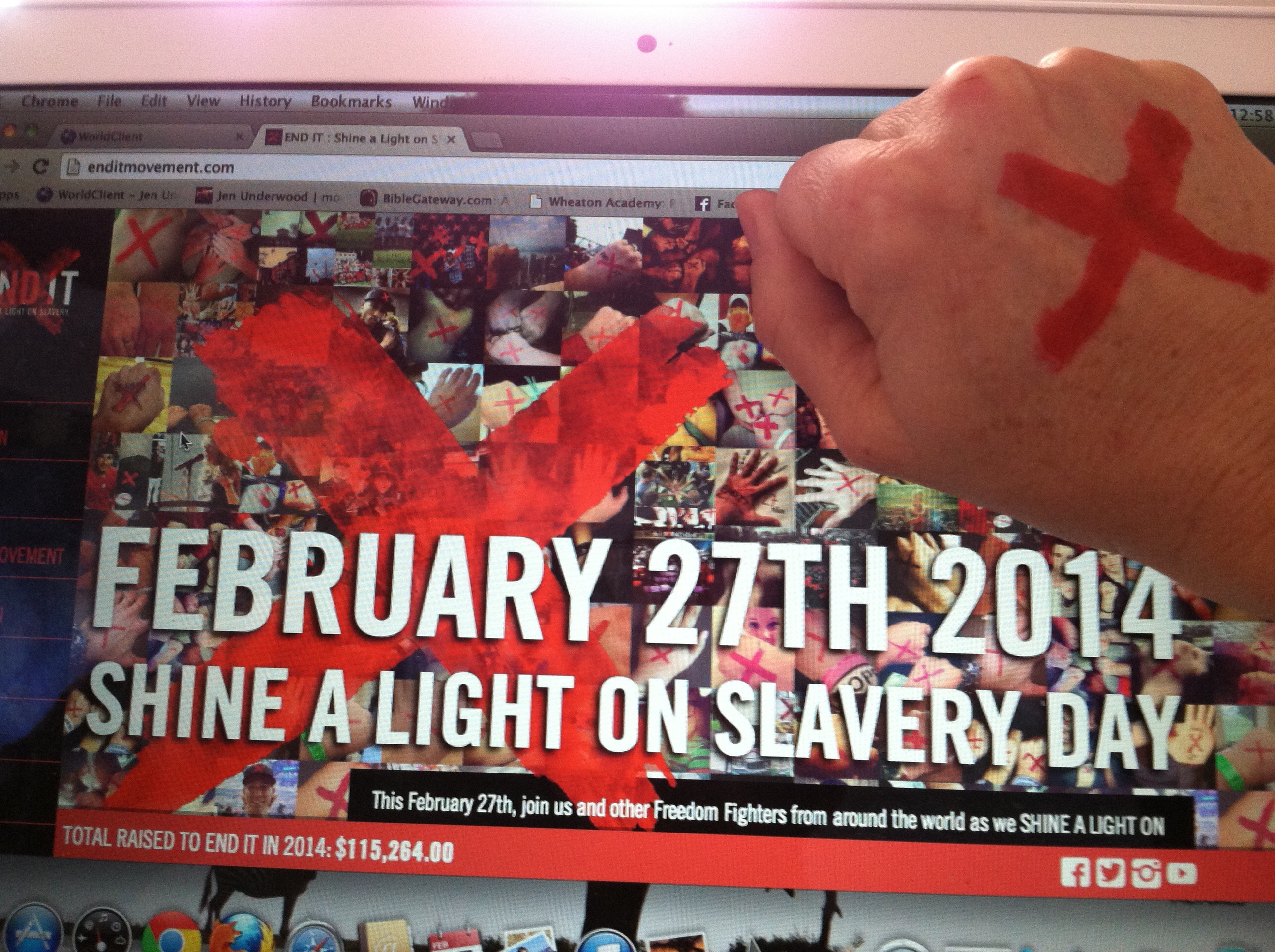
Another friend mentioned A21, which is an official coalition partner with End It, an organization I mentioned in the last post. Both these sites have great information.

I’m also sharing the blog site One Small Voice–which I found through New Name’s prayer email. The blogger says this about the site: “My goal is to post information about global human trafficking issues as well what’s happening right here in the Chicagoland area including strides that are being made by the government regarding this issue.” Right at the top of the site is information about a forum being held this Saturday on this topic.

Lastly, I just want to remind all of us why we should care.

Many years ago, when I was a very young middle-school teacher with no children of my own, I sat in a meeting that involved a student, her father, and our team of teachers. The father was overbearing and belittling to his daughter, and we left the meeting feeling discouraged. One of our team members, the lone male on the team, father to a young daughter himself, was more than discouraged. He was angry. “Any man can be a sperm donor,” he said, “but it takes a real man to be a father, and that girl doesn’t have one.”

Most of the girls involved in trafficking have never had a true father, one who protected them, cherished them, and honored them. God longs to be their Father. He’s angry and sad they’ve never experienced true love, and He’s called us to have His heart for them. He says He “will bring justice to the orphans and the oppressed, so mere people can no longer terrify them” (Psalm 10:18), and He’s called us to enact that justice in the here and now.

Let’s pray for some genuine religion, friends.

And then let’s do it.

Thanks for reading,

Jen

The REAL battle this weekend

NOTE: The topic and the links I’m sharing are not comfortable.

A year and a half ago I wrote an article (it’s on page four of the link) about two American women who provide dignified employment for at-risk women in Bangladesh, a country known for its sex slave industry. At the same time my husband, Dave, was teaching a new class at Wheaton Academy titled Culture and Theology. One of the units in the class was modern-day slavery, so we were both researching the issue and how it impacts every single country, including the U.S., where we live. I read a book titled The White Umbrella about the sex slave trade in the U.S. and about one specific ministry in the Atlanta, Georgia-area that reaches out to girls rescued from it. Dave discovered ministries like End It Movement and Love 146, which fight against human trafficking. At some point in our research, Dave discovered that the Super Bowl creates a huge market for trafficking.

That’s the reason for this particular post at this particular time.

“In 2010, the National Center of Missing and Exploited Children reported that 10,000 women were sold for sex at the Miami Super Bowl.” That quote is from an article published today that calls the Super Bowl a “sex-trafficking magnet.” Here’s a link to the several articles The Huffington Post has recently published on this topic.

Please pray.

Thanks for reading,

Jen

Praying for Sudan today

This past weekend Dave and I watched most of the documentary God Grew Tired of Us about the Lost Boys of Sudan who left their homes during the long, drawn-out war between north Sudan and south Sudan (as of 2011 a separate country). Thousands upon thousands of South Sudanese were displaced by the conflict, among them 20,000 boys who trekked their way to Ethiopia, finding relief (those who didn’t die on the long journey) of a sort in refugee camps there. Violence forced them to move again, and those who survived eventually settled in camps in Kenya. They were dubbed the “lost boys of Sudan,” and the documentary tells the story of a few who were eventually relocated in the United States (you can watch it free on Hulu). It isn’t short, so if you are interested, you’ll need to set aside a couple hours to watch it. Warning: there’s footage and pictures of boys close to death from starvation, so not one to watch with small children. There is another film (which I have not seen) on this story titled, appropriately, Lost Boys of Sudan.

This is a popular topic, made so by the films and books written on it and by the involvement of the actor George Clooney. Due to the publicity, many of the lost boys who settled in the U.S. were able to begin relief work in their country and to advocate for their country’s separation from northern Sudan. When South Sudan gained its independence, many of them returned to celebrate. However, violence has broken out in Sudan again. John Bul Dau explains the conflict well in an article by National Geographic. Here’s another article about it at the New York Times. South Sudanese are being displaced once again.

I know this is only one of hundreds of conflicts in our world today, one of hundreds of issues that grieve God’s heart, but it’s the particular one I prayed for this morning. I was reading Isaiah 63, and this verse jumped out at me: “I (God) was amazed to see that no one intervened to help the oppressed. So I myself stepped in to save them with my strong arm, and my wrath sustained me” (verse 5). The “oppressed” who came to my mind when I read that were the South Sudanese. I did some quick research, read about the current conflict, and wanted to share.

ADDITION: World Vision, of course, is already in the area and taking donations for their efforts. Here’s the link if you want to read more/donate: World Vision.