A big reason to run

Fourteen years ago I ran my one and only marathon. My husband, Dave, ran his first that day as well. It was November, and we were living in Okinawa, Japan. The course was incredibly hilly, and the weather was unnaturally hot for that time of year. With the constant high humidity, the effects were brutal. More people dropped out of that race than finished it, and several were rushed off in ambulances due to heat stroke.

I finished well beyond my expected time and thought, “That’s it. I’m done.”

I’ve never run another since.

Dave however, ran several in the next few years.

Then he had an eight-year gap.

This summer, he decided to try it again. But he needed a really good reason, one bigger than his desire to drop a few pounds and increase his endurance.

So he decided to run for World Vision.

I offered to do some of his training runs with him. One weekend, I even ran a 14-miler (he says it was only 13, but I’m adding the distance between the end of the trail and the parking lot–and padding it a bit.)

School started then, with all its weekend activities, so the next weekend, when he ran 16, I ran only 8 of it with him. The next week, only 6. The last couple weekends, a friend of his ran the first half or so with him.

But after his friend or I called it quits, Dave would grab his iPod and head back to the trail, slogging out more miles.


He tells me that when his hips ache, when his knees burn, he remembers two little girls from our last trip to Uganda. The first is little Comfort, abandoned in the Katanga Slum by her mother and father, placed in Dave’s arms by neighbors who didn’t want to watch her die of starvation. In recent pictures we’ve seen of her, her eyes are still somber, but her cheeks are full, and her arms have the plump roundness they should have at 10 months of age. In every picture, she’s cuddled in the arms of the nurse at Mercy Children’s Home, who looks pretty darn proud of her progress.

The second little girl is Scovia. She’s six but about the size of a four year old. She was born with damaged legs; her mother died; and her father left her locked in their shack for days at a time while he looked for work. When she was rescued by Mercy Children’s Home, she had pressure sores, malnutrition, and severe developmental delays. Now she walks pushing a wheeled contraption, she babbles happily, and she has unending, overflowing JOY.

Comfort and Scovia are healthy today because of child sponsorship, because people who are not worried where their next meal is coming from have concerned themselves with those who do have to worry about such basic needs.

Mercy Children’s Home and hundreds of other orphanages around the world benefit from child sponsorship. Two of the largest sponsoring agencies are Compassion International and World Vision.

So even though Dave is running the Chicago Marathon this Sunday specifically for World Vision, in a way he’s running it for all the orphanages in the world, for all the children who need a safe place and someone to love them. He’s ultimately running it for Jesus, who welcomes children and holds them in His arms.

If you would like to sponsor Dave, please visit this link:

http://team.worldvision.org/site/TR/TeamWorldVision/TeamWorldVision?px=1375760&pg=personal&fr_id=2120

All proceeds go directly to World Vision.

Thanks,
Jen


Living in GRACE

We leave for a trip to Africa on July 7. Dave and I will go with 12 girls from his soccer team, our oldest child (Emily), one of his assistant coaches, and two soccer moms to Kenya and Uganda.

Dave gave each girl going on the trip a copy of Kisses from Katie, and he asked me to write devotions for each day of the trip using Scripture and sections from the book.

“I would love to,” I told him.

Well, I still “will love to,” and I probably will post many of them here on the blog, but I have to admit that the book sent me into a spiritual funk for about a week—sorry for the silence.

Kisses from Katie is the story of a young suburban-raised girl who decided to visit Uganda during Christmas break of her senior year in high school. Then she just had to go back after graduation for a gap year before college. (I know, this sounds eerily like the story of Jody—who rescued our PJ). Katie’s “job” for the year was to teach kindergarten, but she soon felt led by God to rent a house, and abandoned children began showing up on her doorstep. She is now in the process of adopting 13 Ugandan girls and lives full-time in Uganda, coming back to the States only for visits and fundraising purposes. Her life is filled with sharing Christ—through words and actions—with the poorest of the poor.

I’m not doing enough. I’m not doing enough. This nasty chorus ran rampant through my mind as I read the book—though I knew that was not Katie’s reason for writing it and I also knew it wasn’t good theology.

What dug my spiritual funk deeper was the fact that I had bought a rug for the living room the day before beginning the book. Like we needed a rug, I thought as I read about Katie raising money to pay school fees for the children in her village. I should have sent the money to World Vision!

(BTW, I felt quite a bit better about the new rug when we spread the old rug out on our grass for the yard sale we had last weekend. Sunlight exposed a LOT more than my living room lamps did. The all-ivory rug may have worked for the empty-nesters we bought the house from, but with our six kids, their friends, our dog—yeesh!)

As I read further, I defaulted to guilt wallowing, and God felt very, very far away.

I know now—and knew then—this kind of guilt is not from God, but I was stuck and digging in deeper. Saturday morning, I woke tired, glum, discouraged already. But this was yard-sale-for-Africa day, filled with opportunities to meet neighbors, make new friends, share life.

Oh God, I prayed, I don’t have the strength for this, and I am so spiritually bankrupt right now. I can’t do this. But rather than drawing me closer to God, my prayer made me more convinced of my failure.

But a beautiful thing happened as the day went on. One of the soccer moms came and helped, and we had genuine fellowship. I met a lovely little woman from Syria who asked me to pray for persecuted believers in her native country. Before she left, she pronounced Christ’s blessings on us and our trip. I met another neighbor, large with her third child, who had moved in just that day down the street. I liked her; Dave hit it off with her husband; Em was ready to babysit. Dave had fun conversation with our next-door neighbor when he asked, “So why are you going to Africa?”

As soon as the yard sale was over, though, the cloud descended again.

All week Dave gave me funny looks when I answered, “Fine,” in response to his, “How are you?” Finally, on our early Sunday morning run (yes, we’re running again, and, oh, I am so sore!), he didn’t let my “Fine” slide by. “No, you’re not,” he pressed. “What’s up?”

“I’m missing God,” I cried. “I just feel like I’m not pleasing Him, that I’m so filled up with self I’m missing Him. I’m trying and trying, but all I can think of is what I’m NOT doing, and then I feel guilty and farther away than ever.”

Dave didn’t let that answer slide by, either. He pushed quite a bit on my faulty theology—and I said, “I know, I know! My head sees it, but what do I do with my heart?”

What ultimately led to a breakthrough was this question he asked: “If you’re so far away from God, then what was going on yesterday at the yard sale?”

That stopped me. I’d gone into the yard sale with dread, with a lack of strength and purpose—with guilt at my attitude.

But somewhere during the day, I’d forgotten ME. I’d forgotten to try so, so hard. I’d let go of guilt and let others minister to me (oh, how Christ works through His body!), and in the process I was able to share myself with them and others. I’d felt joy and peace—and I know where those come from. (Galatians 5:22)

Later on Sunday morning, when I had a few quiet minutes to be still, I wrote in my journal: “If MY doing never truly accomplishes anything—for myself or anyone else, then why do I try so hard? If I really believe that my ‘righteousness is as filthy rags,’ then doing more in my own strength, out of my own guilt, accomplishes no good.”

Not long ago, I listened to a sermon by Rick McKinley, pastor of Imago Dei Church in Portland, about the importance of the Gospel in our lives AFTER salvation. He said something like this: We Christians have little problem seeing our need for complete grace for salvation, but then we act as if we have to accomplish the Christian life on our own. We need the Gospel just as much after salvation as we did before.

In Acts 13, Paul and Barnabus are speaking to people who have just trusted Christ. The two missionaries “urged them to continue to rely on the grace of God.” (emphasis mine)

It’s so, so easy to abandon grace in our daily lives. My tendency is to forget that I have no ability to please God on my own; I feel I must do more, do more, do more to make Him like me. What heresy! And it has such terrible results: guilt, broken sleep, fatigue, a broken spirit.

I wasn’t relying on God to work in me and through me last week. I put far more responsibility on myself than He ever wants me to have. HE guides; HE convicts; HE leads and directs.

I must live in the Gospel:

I need rescuing, every day, often from myself.

And my God is a God who saves.

Will work for food

Red light. I stop, wait to turn, notice the man standing on the sidewalk beside the right lane.

His sign is crude: Will work. Need money for food, gas, home.

But his gaze is direct. And across two lanes he finds my eyes. He stands tall—not a challenge, just acknowledgment: “Yes, I stand on a street corner, I hold a sign that tells you I need help.”

I consider a U-turn, glance at my dashboard clock, estimate the time it will take me to get home to meet the scheduled repairman.

I turn left.

Drive three blocks.

Slower and slower.

I hear You, Lord.

Turn around.

Pull into the grocery store lot, stop behind his tidy old-model Taurus station wagon.

He meets me halfway.

Taller even than I’d thought.

My left hand holds out the money. He tucks it away, fast. Not grabbing, just… like he doesn’t want it. Like putting it away makes it less real.

My mind is blank. I’ve forgotten to ask for words. God bless you, I think. I offer my right hand.

He shakes it. His eyes slip above my head.

“I’m a mechanic. I can fix cars.” Urgent voice. “Do you have any that need work?”

I shake my head. “I don’t.”

“I can work. I can… You don’t have cars that need…?”

“No, but… God bless you.”

Our eyes meet again—closer now than across two lanes of traffic.

He juts his chin at me, eyes slip up again to the blue sky. “I like your necklace.”

Pressed clay, sitting right at the base of my throat, stamped firm and clear with the words “Set Free.”

Good to receive, not just give. “Thanks.”

Back on the road, the regrets. Why didn’t I say more? Why didn’t I get a name, number? He’s a mechanic. I could have sent word out through e-mail, Facebook: “Mechanic, corner of Main and Geneva: if you’re willing to take a chance, he’d appreciate it. Name, number.”  At under 142 characters, I could even tweet it. What is social media good for if not for this?!

Marketing background kicks in: he needs a better sign, one that advertises his specific skills while still expressing willingness to do odd jobs.

Stop.

Stop, Jen.

Let it go.

But this day it’s hard.

Because I’ve been set free not only from

But for.

And in the callused handshake and averted eyes, the money tucked quick out of sight, the urgent plea for the dignity of work, I felt a moment of his pain.

Through love

I am

Set free

To care.

lovin’ like he loved

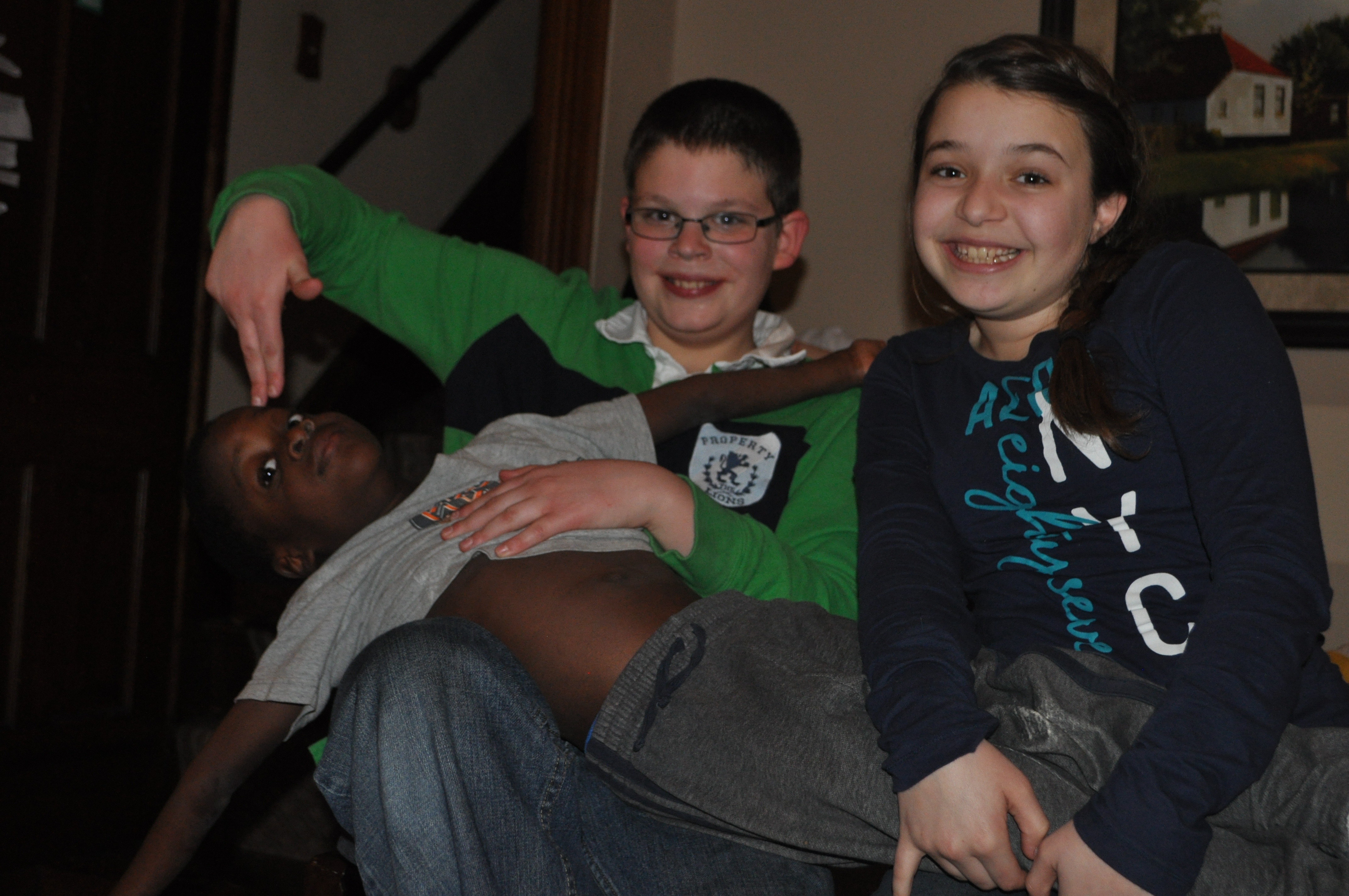
All the kids--and a couple cousins--at the grandparents over Christmas break

All the kids–and a couple cousins–at the grandparents’ over Christmas break. You can tell there are several people taking this picture: the kids are looking about three different directions!

Each Sunday during my senior year of high school, I drove from the southern suburbs of Birmingham, Alabama, where I lived, into the roughest housing project in the city. I picked up ten-year-old “Peanut” from his apartment and together we canvassed his neighborhood on foot, collecting children from the streets and other apartments. As the only white person in sight, I got strange looks from the men leaning against streetlights. Each week I stood in the open doors of some of the worst of the worst apartments, those with bare, pockmarked concrete floors and walls, those that reeked with the smells of drugs, unwashed bodies, and neglect. I passed by the streets Peanut told me not to enter—they were the ”drug streets,” and not even the children who followed me would go down them. We ended up eventually at Peanut’s house, where his mother welcomed me and the little gang we’d collected into her living room. I taught a Bible lesson that those kids drank like Coca-Cola, and we bellowed songs like “Jesus Loves Me” and “Father Abraham.”

And then I left. Three hours, start to finish.

Not long ago I listened to a podcast on John 13:34-35: “… Love each other. Just as I have loved you, you should love each other. Your love for one another will prove to the world that you are my disciples.”

The speaker’s point was this: Jesus didn’t say, “Love each other as I have loved the little girl I raised from the dead.” Or, “as I have loved the leprous guys I healed.” Or, “as I have loved the people I fed with those few loaves and fishes.”

He didn’t tell them to love in a “Here I’ve come to save the day,” “in-and-out,” “mission accomplished” sort of way.

His love example was the relationship He’d modeled with the twelve disciples: you know, those twelve guys He lived with day-in-and-day-out for three years; those self-centered, complaining, power-hungry, often-childish, squabbling-like-siblings disciples. They may have been on their best behavior for the first couple months, but I’m guessing it didn’t take long for that to wear thin. The Gospels give us one example after another of the disciples’ issues. Jesus lived with all of it, put up with all of it, and loved through all of it.

And that’s the kind of love He tells us to love with.

It’s not that difficult for me to tutor refugees and international students each week. It’s kind of exciting. I leave grateful.

Aha—I leave.

But I come home to the six children who present the biggest love challenge I have: to love in the daily grind, through all their imperfections—and mine!, with all those fruits of the Spirit that I don’t naturally have. (Just last night I told my husband, “I’m too selfish to be a mom. What was God thinking?”)

This is “I Corinthians 13” love fleshed out.

I must admit, I prefer the in-and-out kind of loving. Two to three hours, a day, maybe a week or two—then I can say, “Whew, that’s over.”

But that’s not the love God’s called us to.

We are not called to a “quick fix,” easy kind of love. That’s not truly love. It’s described in I Corinthians 13:1-3 as “nothing.”

True love requires SO much of us.

It is patient and kind because it HAS to be.

It is not jealous or proud or rude or irritable even when there is certainly reason to be all those things.

It doesn’t demand its own way—even when no one else seems to be considering it.

It keeps no record of wrong.

It doesn’t rejoice about injustice.

It rejoices whenever the truth wins out.)

It never gives up, never loses faith, is always hopeful, and endures through every circumstance.

The disciples saw this kind of love firsthand, as Christ loved them even when they were petty and childish, even when they deserted Him.

After Christ left earth, the disciples had some difficult lives. But I am certain there was not a single time when they could honestly say, “This is way more difficult than what Christ did for us.”

That’s the kind of love I have to practice at home: the kind that takes practice, that often does not feel glorious or fun or exciting. Ultimately, it’s the kind that drops me to my knees with cries of “I can’t do this. I NEED YOU!”

This is also the kind of love that I have to learn to give to others outside my home. James echoes I Corinthians 13: 1-3 when he writes: “Suppose you see a brother or sister who has no food or clothing, and you say, ‘Goodbye and have a good day; stay warm and eat well’—but then you don’t give that person any food or clothing. What good does that do?”

My love for the “neighbors” God puts in my path and on my heart is meant to be like the love I practice with my family. It should cost something. It should be something I can’t do in my own strength.

This is not easy stuff. Christ’s command seems so simple, especially compared to all the rules we create with our religions.

But it’s a command that reduces us to the realization that we CANNOT do it.

What a good place to be.

Because the more difficult the loving, the greater the testimony to the God who is loving through us, the God who loves the least loveable—all of us—with a perfect, never-ending love.

“Just as I have loved you, you should love each other.

Your love for one another will prove to the world that you are my disciples.”

Discomfort and the white umbrella

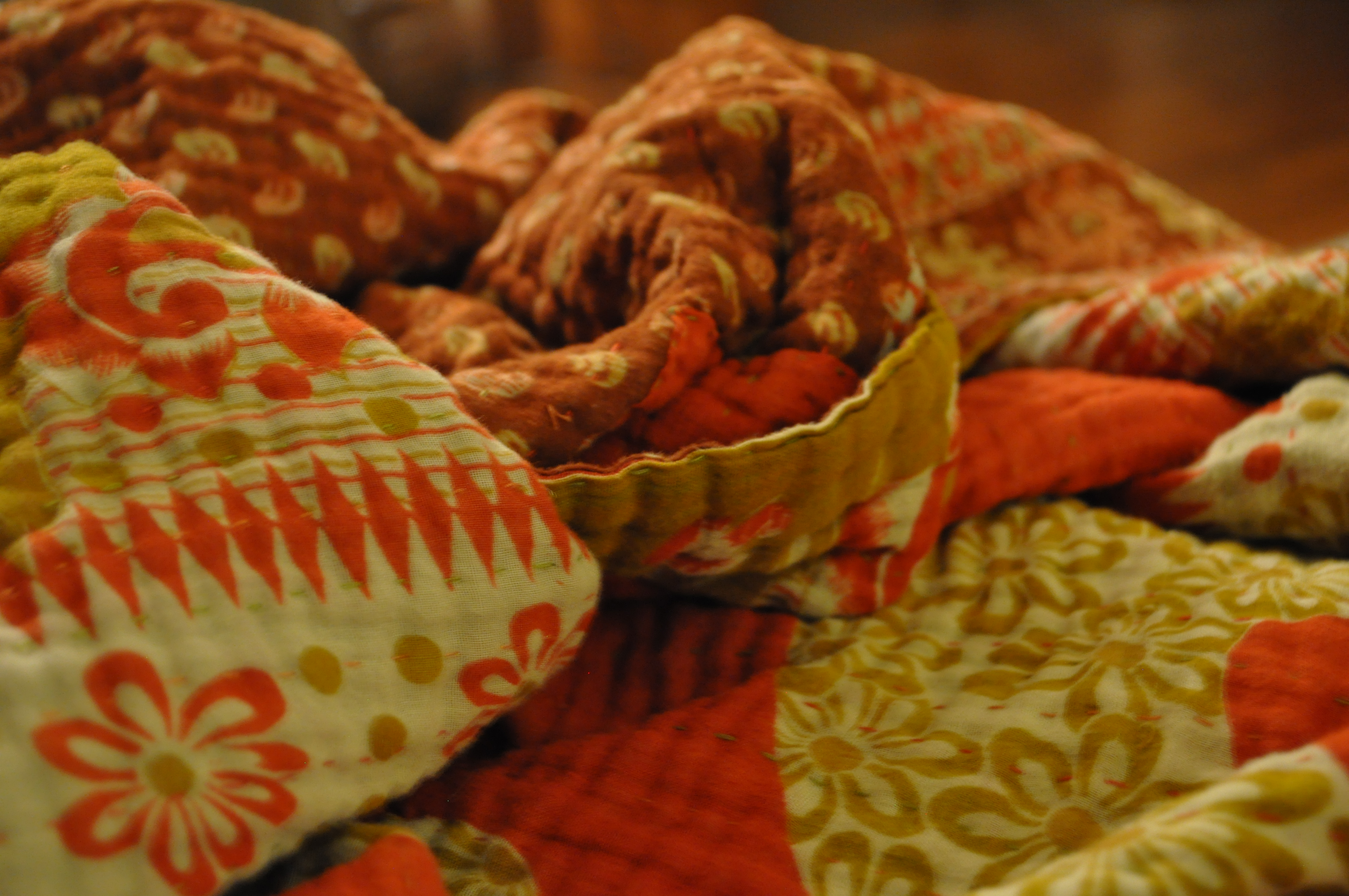
Isn't it beautiful! It was a complete surprise on Christmas morning to get this. This is a kantha blanket, made from used saris by women at risk in Bangladesh. The company that sells these blankets is Hand and Cloth (handandcloth.org). Through making blankets for Hand and Cloth, these women can support themselves and their families with dignified work and they also hear the Word of God that tells them they have value simply because they are creations of God.

Isn’t it beautiful! It was a complete surprise on Christmas morning to get this. This is a kantha blanket, made from used saris by women at risk in Bangladesh. The company that sells these blankets is Hand and Cloth (handandcloth.org). Through making blankets for Hand and Cloth, these women can support themselves and their families with dignified work and they also hear the Word of God that tells them they have value simply because they are creations of God.

I have been hearing about the White Umbrella Campaign for over a week now, and I just decided to order the book. It’s about human trafficking here in the U.S. With a magazine article I began researching last fall (and just finished writing last week), I’ve been doing much reading on human trafficking statistics worldwide, and I have been staggered by the numbers here in the States.

Though I ordered the book, I’m not really looking forward to the reading of it. It will be, at best, UNcomfortable and quite probably heartbreaking. But I’m learning, more and more, that God is not all that concerned with my comfort. It’s not really good for my character or my heart. Comfortable hearts and settled lives have negative tendencies: being closed off, quick to judge, unwilling to stretch.

I will let you know what I think of the book. I have a few others I’ve read recently that I would also like to post about.

And, tomorrow, hopefully (my husband is overseas at the moment, and I’m holding down the fort with the six kids, teaching a two-week bread-making course, and trying to finish up a few writing deadlines), I’ll post a sweet, funny story about PJ, Jake, and a marble. And, then, of course, I also plan to write and post “Marriage advice, part 2”!

Shopping advice? From me?

No one—and I mean no one—comes to me for Christmas shopping advice.

I’m not a good shopper at any time of the year. As my husband and older daughter say, “You start grumpy and just get worse.” They generally refuse to go with me—especially if they know the stores will be crowded.

Despite this, though, I’m actually going to share some shopping tips in this blog entry.

If you like the idea of giving gifts that give back, then you might be interested in some of these very cool businesses and nonprofits that allow you to do just that. Giving these items won’t help you to buy more with less money, but you’ll know that every purchase enables an organization to do more for someone who desperately needs hope.

IF YOU’RE SHOPPING FOR PRETEENS/TEENS

Check out www.mudlove.com. This company, based in Winona Lake, Indiana (home of my wonderful in-laws and my alma mater, Grace College), sells made-on-site clay bracelets and necklaces. The most popular version is stamped with a word or phrase, and you can even custom order a word or phrase that has particular meaning to you. Twenty percent of each purchase goes to provide clean water in Africa, and $5 spent provides an African with clean drinking water for a year. My girls (ages 8, 12, 13, and 15) ALL love them.

www.entertheventure.com doesn’t have a whole lot of items for sale, but I love the heart behind this small nonprofit, which was started by some young friends of ours. They have African-made bracelets and necklaces made out of rolled paper. If you haven’t seen these, don’t think, “Paper? Tacky.” They’re NOT. Plus, each one purchased helps support two children’s homes in Africa: Jerusalem Children’s ministry and Springs of Hope.

BIG-TICKET BEAUTY

www.handandcloth.com sells gorgeous, one-of-a-kind blankets made from used saris by women rescued from the slave trade in Bangladesh. I’ve featured this ministry before on my blog (https://journeytojen.wordpress.com/2012/09/27/blankets-handmade-by-women-women-handmade-by-god/).  These are perfect buys for the person who appreciates beautiful, handmade artisan items (hmm—maybe that describes you yourself!). They start at $98 dollars and go up to around $200. Check out the blankets at the website—which itself is beautiful—and read their story while you are there. “Blankets handmade by women. Women handmade by God.” Wonderful work!

TWO OTHERS FOR WOMEN AT RISK

If you want something other than blankets made by women rescued from the slave trade, visit www.warinternational.org. The acronym WAR, standing for Women at Risk, was started in 2006. You can find jewelry, accessories, home décor, and children’s items made by women in 13 countries, including the United States.

www.stoptraffickfashion.com has t-shirts, jewelry, and totes/bags made from recycled materials. Many of their t-shirts express the heart of the women who run this website. One with a barcode also has the logo “People are not products” and several sport the logo “free.loved.radiant.”

LITTLE BIT OF EVERYTHING

Need to shop for kids, men, women—want to spend a little for this one, more for that one? Go to www.tenthousandvillages.com. Gorgeous jewelry, decorative items, and woven/knitted items for women; toys and games for children; even things like chess sets, bookends, and bicycle-chain frames for men. Their website is very easy to navigate and has some very helpful tools. If you click on the “gift ideas” tab at the top of the page, you can shop for holiday items, for men, women, or children, or by type of item.  You can spend a little (items as low as $4) or a lot. They also have shops (there is one near me in Glen Ellyn, IL). You can find a shop locater on the website.

FOR THE COFFEE LOVERS

Land of a Thousand Hills Coffee Company has “Drink Coffee. Do Good” as its motto. It started with farmers in Rwanda (the founder saw the effects of the genocide and had to do SOMETHING) and now works with farmers in Haiti and Thailand as well. They sell 100% Arabica, fairly traded, fresh roasted coffee. They sell ground, whole bean, and decaf, teas, and coffee accessories at www.landofathousandhills.com.

LOOKING FOR HANDCRAFTED CROCHETED ITEMS?

My husband just told me about this one, and I checked it out and love their website. What a great story! A group of high school guys learned to crochet simply because they wanted unique ski hats on the local slopes. Others dubbed them the Krochet Kids. Long story short (if you want to know the whole thing, visit the website), they taught these skills to women in northern Africa and then Peru, and they sell these handmade items at www.krochetkids.org. Each item carries with it the signature of the woman who crocheted it, and you can visit the website to learn her story.

AND, FINALLY, FOR THE PERSON WHO HAS EVERYTHING

Buy them a goat—bet they don’t have that. Seriously, go to  www.worldvision.org or www.compassion.com and look under “ways to give.” The gift catalog has items like school supplies, ducks, and clean-water wells. You can honor someone with your gift, and that person will receive a card telling about your gift and what it will accomplish.

ANY OTHER IDEAS???

If you have other ideas, please leave a comment and share! I’d love to hear your ideas.

Thanks for reading! I sure enjoyed pulling the list together.

Refugee Joseph

This morning I subbed as an aide for one of the World Relief English-as-a-Second Language (ESL) classes that meet in Wheaton. Refugees from well over a dozen countries come together with a single goal: to improve the language skills that will enable them to assimilate more into U.S. culture. Some want to go to college for the first time. Others hope to validate degrees they earned in their home countries that carry no weight here. Mothers come hoping to be able to communicate with their children’s teachers or even simply to talk with the clerk at the grocery store.

They all have stories; the U.N. doesn’t label just anyone a “refugee,” and it doesn’t relocate most —far from it—across the globe. There have to be reasons, good ones, considering that, if given a viable choice between returning home or going to the United States, almost all of these refugees would choose their homeland. But home—and the family still there—is not a realistic option.

Today, during the small chapel break that splits the class into two halves, several aides acted out the story of Joseph. I stood next to a young mother of two. We chatted before the skit began, and I learned her young boys’ names and ages. Her husband, who was a photographer at home, is now working part-time construction, hoping to get full-time, hoping, somehow, to return to the work he really enjoys.

The skit began and we watched as Joseph was thrown into the well and sold into slavery and his father was given the news of his death. “Joseph had many troubles in Egypt” was used to fast-forward the narrative to his interpretation of Pharoah’s dreams and his promotion to being the second in command. Then his brothers came looking for grain. Joseph had to turn aside to weep, but he did not tell them who he was. Then the brothers came again, this time bringing Benjamin, Joseph’s younger brother, the only other child of Joseph’s beloved mother Rachel. Joseph hugged him and cried. He forgave his other brothers. The audience, filled with the small sounds of tea drinking and softly murmured comments before, was completely still now.

The woman who narrated the story looked out at the audience. “You have all been through hard times. Many of you are going through difficult times now. Remember that there is a God who is good. Hold onto what Joseph said: ‘You meant it for evil, but God meant it for good.’ He is a good God. You can cling to that. He can work good out of what you are going through.”

Next to me I could hear the young mother crying. I’m sure many faces in front of me were wet as well.

I hugged the young mother, and we filed back to classes far more quietly than we had come in. One of the teachers and I made eye contact. “Somehow means a lot more in this context, doesn’t it?” she said.

Yes, it does.

Great numbers of the least

Joseph Stalin reportedly said, “A single death is a tragedy; a million deaths is a statistic,” and there’s a lot of truth to that statement. In the last week I’ve been reminded of a lot of numbers. I’m going to spout a few of them at you in the next couple of paragraphs but please know that the numbers are not the focus.

On Saturday I attended a training seminar at our local World Relief center (http://worldrelief.org/). Did you know there are 43.7 MILLION refugees in the world? Eighty percent of them are women and children.

On the radio last week I listened to an interview with Kathi Macias, an author who has written a fiction series on sex slave trafficking around the globe. More than 27 million slaves live in our world now. Two million of them are children exploited in the sex slave trade. This trade touches nearly every single country in the world and has a very real presence in the United States—not just in cities but in small towns as well (http://www.huffingtonpost.com/corban-addison/modern-slavery_b_1214371.html) (http://kathimacias.com/kathis-books/).

On Saturday night—and again on Sunday—I spent time with Wilfred Rugumba, who is very special to our family. Wilfred is the director of the orphanage where Patrick, our youngest, lived before becoming an Underwood (http://www.mercychildcare.org/). Wilfred reminded me that there are between 143 and 210 million orphans in the world. The number of orphans in sub-Saharan Africa is greater than the total number of children in Denmark, Norway, Ireland, Canada, and Sweden.

Those are overwhelming statistics! Obviously they overlap—a lot. Many of those refugees are also orphans. Many orphans are the ones abducted into the slave trade. But regardless of how you slice and dice it, it adds up to a lot of people. A lot of hurting people.

Sometimes I can forget these numbers. I can go for a few days, a week, maybe two without actively remembering that every minute people are being abused, sold, orphaned, displaced, and widowed. There have been other times in my life, though, when I have felt paralyzed by the thought of the vicious evil being done in any given moment.

It is in those moments when I have been reminded that God NEVER forgets. I CAN forget. I can get wrapped up in my days that are filled with activity. But God never forgets. If He knows the number of hairs on my head, He certainly knows the numbers of those being abused and exploited. He knows exactly how many stomachs are hungry. He knows how many children are wailing or dazed with grief over dead parents. And they are not just numbers to Him. They are faces, hearts, and souls to Him! And He is present in their pain. He is there when the young girl or boy is sold for sex. He is there when the widow watches her child grow listless and blank-eyed because hunger has dulled everything. He sees every village that is marauded for political or ethnic reasons.

He was there during the Armenian massacres, and there during the Holocaust and there during the Rwandan and Cambodian and Bosnian genocides and others we don’t even know about. He is in Darfur today.

And He is not untouched.

My God, what a heart You must have! We cannot blame you for these atrocities—though we try. These are crimes we commit against each other, crimes we allow because we are too concerned with our own safety and status quo to be bothered. But You are bothered. I know that with our present-day, developed-world mentality, we tend to ask questions like, “How could a loving God judge our world? How could a loving God hold us to account when we cannot see Him?” But even if God did not hold us guilty for how we have forgotten and disrespected HIM, we would stand condemned for how we have disrespected and abused and ignored His image that is seen so clearly in the children of the world. In fact, some moments, when I read about atrocities done to children and defenseless women and oppressed people groups, I think, “How do you hold back, God? How do you keep from not just wiping us completely off the face of the earth?” Even with the Western, rights-focused bent that I must fight for the rest of my life, I am more amazed by His mercy in those moments than offended by His judgment.

Yet He has not wiped out. He has given grace. He continues to love His Western, privileged church even when we fail miserably at being His hands and feet to the oppressed. He allows me to approach Him daily, hourly with my comparatively small frustrations and complaints.

I am amazed by this God. I am humbled by this God.

And I pray that these two attitudes—amazement and humility—will lead my heart and my hands and my feet into becoming more and more like His.

The crack in my heart

Recently Kole and Em (they've known each other since they were babies) decided that when they graduate high school, they should have some pictures together from when they were younger, so they asked me to do a goofy photo shoot. PJ got in on the action of this picture.

I just finished reading The Hunger Games. I’ve enjoyed other books by Suzanne Collins and was hopeful about this one—and it didn’t disappoint. Collins was not content with creating a nail-biter. She pushed political, social—and, for me—spiritual buttons, and it took me back to when God began a particular work on my heart.

Dave and I had been teaching at Wheaton Academy for a few years and had watched the school-wide Zambia fundraising project from its beginning. In its first year student leaders had put a huge goal in front of their peers, and they responded, raising more than enough funds to build a schoolhouse, an entire schoolhouse, for a small village in Zambia. The next goal was a medical center. Somehow, despite this big, beautiful vision, I wasn’t excited by the project. Oh, I thought it was a good idea. Getting middle- and upper-class high school students to consider others far less privileged is worthwhile. We SHOULD give. And I liked World Vision, the organization partnering with Wheaton Academy.

But I left “Zambia” chapels with an annoyance I shoved deep down. I felt guilted by the faces and tattered clothes of the children I saw projected on the screen. I wanted to give and be done. I didn’t want this to be an ongoing part of my life. I didn’t want to feel uncomfortable or broken.

God had other plans.

Obviously.

More and more students became passionate, and one of the most affected was a boy in my speech class. He was willing to sacrifice to help the poor everywhere: in Africa, in downtown Chicago, wherever—and one day he took his classmates on in a debate about our responsibility to the poor. As I listened, I found myself growing passionate, too. Why should I hold so tightly to all that I’ve been given? Is it really “mine”? Why did this 18-year-old kid have a better understanding of eternal values than I did?

Right about then I read the young adult book City of Ember and then its sequel, The People of Sparks. The first book tells the story of an underground city built to withstand a nuclear blast on the Earth’s surface. After several generations in it, the people of Ember must abandon their rundown city to make their way to the Earth’s surface. In the second book these people of Ember find a small town filled with other survivors. With no technology and no knowledge of agriculture, the people of Sparks are barely eking out a living, and only a few welcome the refugees from Ember. Soon, their resources stretched thin by these newcomers, most are ready to send them out into the wasteland to “take care of themselves.”

After having spent an entire book with the people of Ember, my sympathies were completely with them. “They can’t do that,” I thought. “That would be wrong. It doesn’t matter that those in Sparks have worked hard for what they have; they HAVE to share it. They only have the “stuff” because of their circumstances, because they were born above ground rather than under it. They’re acting like the people of Ember are worth less than they are.”

And that’s when God broke through the shell around my heart.

YOU have to stop trying to ignore the faces you see on the screen in chapel. You have to stop thinking that those children aren’t as important as the ones you tuck into warm beds in your own home every night. I’ve given you SO much; do You think I meant it all to be used on yourself and those you consider your own? Don’t you realize I care just as much about those tattered children as I care about the ones I’ve given to you?

That made a really big crack in the shell, but the demolition continues; it’s a long term project. For of course, I’m continually taping the breaks, trying to “protect” my heart, and God is constantly breaking through again, reminding me of HIS attitude toward HIS resources and HIS people.

And so full circle to The Hunger Games, in which the incredibly wealthy Capitol officials use their excess to oppress the Districts and keep them in near starvation. And the “regular” Capitol citizens are so consumed with entertainment and fancy food and their outer looks that they give no thought at all to the people of the Districts—except when they actually become the entertainment.

Sounds familiar, doesn’t it.

Yesterday Emily and I were discussing the book. “Remember the scene when Katniss is meeting her styling crew?” I asked her. “Katniss is almost repulsed by their gold tattoos, their hair colors, the ways they spend money on such unnecessary things when others are starving.”

Em nodded.

“Do you ever wonder if that’s how people in third-world countries view us?”

So, kudos to The Hunger Games, to The City of Ember, to the Wheaton Academy students who inspire me with their willingness to be shaken out of complacency—and, most of all, to the Holy Spirit, who is not content with my hard heart and breaks through, again and again, in such incredible and creative ways.