Lessons from my children

DSC_1377It was a Saturday morning after a late Friday night. Husband out of town. Schedule packed with kids’ activities and cleaning my messy house (I don’t mind laundry or dishes, but whole-house cleaning brings out my nasty).

I was still in bed but mentally working through my to-do list when I heard my younger three coming down the stairs. I hopped out of bed… and discovered I’d gotten up on the wrong side.

I was grumpy—from the get-go!

They came in with iPad in hand, a Youtube Disney music video blaring.

More grumpy. “Can’t you guys start off the day with a book or a game? Why do you have to go straight to screen time?”

“We’ll just watch this one video, and then we’ll be done, Mom.”

I grunted my assent and went upstairs to begin de-cluttering so I could then clean.

Five minutes.

iPad still going.

Ten minutes.

iPad still going.

Deeper grumpiness, and the homework-and-craft-covered dining room table wasn’t improving my mood.

I stomped downstairs. “I told you guys to stop watching videos after that first one.”

Wide, innocent eyes. “It’s the same video, Mom.”

I looked at the screen, and, yes, it was the same 36-minute long Youtube video.

“You knew I didn’t mean you could watch a video that’s more than a half hour long!”

Still wide-eyed.

“Seriously!”

Suddenly one of my sons was right in front of me. He put his arms around my neck and held his face up for a kiss.

And, honest to goodness, this is what came out of my mouth. “I don’t want a kiss right now. I’m trying to fuss at you and your brother and sister.”

Seriously!

More encouragement from one of my kids. Em hung these creations of hers on the fridge yesterday. Such good reminders.

More encouragement from one of my kids. Em hung these creations of hers on the fridge yesterday. Such good reminders.

That was when the Holy Spirit smacked me upside the head.

What I’d said sunk in, and I looked down into the face of the son who is getting a lot better at reading my moods—and who wants to fix me when I clearly display my brokenness.

“I’m sorry, sweetheart. You’re right. I do want a kiss.”*

I said my “sorry”s for my grumpiness, got my kids doing something more productive than watching videos (though they would certainly disagree with my evaluation), and went back to straightening.

But though I was more aware and cautious of my mood, I was still in it.

When I went upstairs to check on how Maddie was doing at cleaning her room, she asked me, “Mom, would you want to have devotions with me?”**

Another Holy Spirit moment: I answered, “Mads, that’s a great idea.”

We read it together on her bed.

Then we looked at each other. “That was exactly what I needed to hear,” I told her. “Thank you.”

She nodded wisely. “That happens a lot for me, too.”

In one morning I received the kiss of forgiveness and the olive branch of restoration.

Oh, the lessons I learn from my children.


*The reason I didn’t use a name for this child is that he is at the age when he doesn’t want too much affection in public (“Only side hugs, please, Mom.) and doesn’t want to be called “honey,” “sweetheart,” or “baby” unless it’s inside the walls of our home. So if you’re reading this and you actually know my family, don’t mention this story to any of my kids and please don’t repeat it to any kids they know. If you do, my days of hugging my son may be over for a really long time. 

**We gave Maddie the kids’ version of Jesus Calling for Easter. I highly recommend it for kids aged about 8 and up. I used it a couple years ago with high school students, and many of them still preferred the kid version over the adult one.


Joy, Resurrected

*The audio link of my reading is at the bottom.

How do you lose joy? She must have failed to hold onto it. Perhaps she’d forgotten it completely, left it in a corner, and it had wandered off, hoping to find a home where it wouldn’t be neglected. “I’ve lost my joy,” she tells her husband, and he nods.

Oh dear, it’s noticeable! she thinks.

Where do you begin looking for joy?

She tries singing as she does the tasks that annoy her most. She hums as she packs the children’s lunches, warbles in the car, belts it out when she de-clutters the living room.

Where are you, joy? she wonders, I can’t sing any louder. Can’t you hear me?

She tries putting on a show of it. Didn’t she hear a pastor say once that the outward action of love can kindle the feeling?

Or was that her college drama director talking about action and emotion?

She’s not sure, but she tries it.

Smile, she tells herself.

Smile bigger!

She shoves grumpiness down. She swats selfish thoughts like pesky gnats.

Joy, come back! Please.

She is sitting, alone at her desk, absorbed in work, when she senses a presence nearby.

Joy? Are you there? I caught a glimpse of you.

Man, I wish my knees still bent like that!

Man, I wish my knees still bent like that!

But when the house bustles again, when children’s squabbles break the quiet—joy recedes.

Oh, she realizes, I am allowing the noise to drive joy away. But joy doesn’t have to have peace and quiet. Joy doesn’t mind chaos, excitement.

I haven’t lost joy.

I’ve sent it away.

I am telling it when it can be present, and when it can’t.

How do I invite joy into my full life—all of it? How do I keep from shutting it out?

Still missing joy, she goes to the Good Friday service.

It is good to reflect, to be with others, all reflecting together.

They sing, they read, they listen.

But she is waiting, though she doesn’t know what she is waiting for.

There is something here for me tonight, she thinks. I’m not sure how I know this, but I do.

The sermon is finished. They have taken communion. Her shoulders slump. It was good, but…

The pastor speaks again. “Some of you have lost your joy,” he says. “You’ve lost the joy of your salvation, your redemption. Come to the cross.”

Her hands tremble.

Her body feels light.

She knows this is for her.

It may be for others as well, but it is clearly for her.

But she will have to get up, cross the room, walk in front of so many sets of eyes.

He is still speaking. “Come. We will pray for you, that here at the cross you will remember your source of joy.”

She gets up, quick.

Her husband, beside her, stands, too.

“Do you want me to come with you?”

She nods.

By the time they reach the cross, there are others.

I am not the only one, she thinks. We have all lost joy.

Pastors pray. She hears only snatches of their words over the music.

But that is all right, because it is the song she needs to hear.

“Behold the man upon the cross,

My sin upon his shoulders;

Ashamed, I hear my mocking voice

Call out among the scoffers.

It was my sin that held him there…”

Somehow, in the second of space before the next line of the song, she experiences guilt, sorrow, despair. I did send you there. It was my sin. It was my selfishness. Oh God, I love You, but I don’t know how to stop hurting You. I am unable to pull my thoughts away from myself, away from what I am feeling or not feeling.

All this in a God-stretched moment.

And then…

“Until it was accomplished;

His dying breath has brought me life—

I know that it is finished.”

Stop, she commands herself. See truth. Christ does not have to die again. He has done it! I AM redeemed. It is not the chaos that is driving joy away; it is my fear that when I sink into moodiness, into selfishness, that I have stepped out of redemption. But that can never be. He finished it.

“I will not boast in anything,

No gifts, no pow’r, no wisdom;

But I will boast in Jesus Christ,

His death and resurrection.

But this I know with all my heart,

His wounds have paid my ransom.”

Paid, accomplished, finished—in a transaction that is outside the scope of time. It is not undone when she grows grumpy yet again, not taken back when she fails or is petty. She looks up at the Christ figure on the cross. Through that finished work, she tellsherself, I am redeemed. My sin does not for one single moment make that untrue. It is present and ongoing, without conditions. Without resting at all on me. I can have joy IN my grumpiness. It is not limited only to when I am feeling peaceful and good but is a reality even when I am fully aware of my own sinful nature.

She feels her husband’s hands on her shoulders. They have been there all along. She just now senses their gentle weight.

“Behold the man upon a cross,

My sin upon His shoulders”

He took it from me—and He abolished it. Why do I try to carry what He has already taken?

The load rolls off.

And joy resurrects.


The neon of vanity

Look close--you can see the neon reflected in his eyes!

Look close–you can see the neon reflected in his eyes!

When seen in the light of bright sun, neon doesn’t shine.

You can’t even tell it’s on.

It has to be dark for neon to “look” bright.

My son, Patrick, questions, “Mom, why can’t we look right into the sun?”

Were we able to before sin darkened our souls?

Could we look right at God’s glory, brighter even than the sun He created, and gaze right at it?

Were we able to, moonlike, reflect it? To shine like Moses did—and that even when he wasn’t able to directly LOOK at God?

Anything I create that wars with God for supremacy is like neon,

But to reflect requires abdication of self

And I don’t find that in me.

It must require a looking elsewhere–

Like up.

536224_10202174906961243_2094760043_nTill I’m dazzled.

The Tiger Within

*Scroll to the bottom to hear me read this post.

This picture has no relation to today's post, but I'm reminding myself--as it was only 12 degrees when I woke up this morning--that the time of beautiful green crickets clinging to open screen doors will come!

This picture has no relation to today’s post, but I’m reminding myself–as it was only 12 degrees when I woke up this morning–that the time of screen doors and beautiful green crickets clinging to them will come!

I sat on his bed to kiss him goodnight and saw it the moment his head turned toward me.

His lips were pinched, his eyes hard.

“What’s the matter, Bud?” I asked.

His voice had an edge as he reminded me that the birthday party we’d talked about a month ago has not yet happened. “You said we might do it this weekend,” he accused.

Never mind that he has just spent more than twenty-four hours with a best friend.

Never mind that we’d never done more to plan the party than simply talk about it.

Never mind that I’d told him several days ago that the party would not happen this weekend—we simply had too much going on.

He was so focused on self that gratitude and perspective—logic, too—had fled.

I could completely identify.

“You’re miserable, aren’t you?” I asked him.

The flat look stayed a second more but then slipped. He nodded.

We prayed together, and I reminded him of all the “never mind’s.” We talked about all the good he’d experienced this weekend, and the things we could be thankful for in that very moment.

Suddenly his small chest rose and fell with a great breath, and he smiled at me.

I smiled back. “It feels good to let it go, doesn’t it?”

I told him then I have the same, awful struggle, and sometimes I imagine SELF (or rather the focus on self) to be like a coiled kitten deep in my gut. When it slumbers, it seems harmless, so I pet it a little, and it raises its head. I continue to stroke it, and it rises higher, higher. Still all seems well, but then it stands on hind legs and hooks its needle-sharp claws into my heart.

And I am overcome.

“Why don’t they see what I’m doing?”

“It wouldn’t hurt them to be just a little grateful!”

“Well, I did that for her. Shouldn’t she do something in return?”

“All I do is clean up (cook/work/drive/do) for everyone else.”

“Don’t they notice all I’m doing?”

“When is someone going to do something nice for ME? When is it MY turn?”

“How is this going to affect me?”

The thoughts bombard, and I can’t stop them. I am miserable in my self-focus, but I’m also powerless to do anything about it. I try to pull the claws from my heart, but as soon as I get one free, another is entangled, and they keep sinking deeper and deeper! I realize what I thought was a harmless kitten is in actuality a tiger, fierce and strong, with not a hint of give in its eyes.

“That’s why we had to pray,” I told my son. “We can’t fight the tiger in our own power. We have to come to Jesus and tell Him we need Him. I have to keep re-learning this very lesson.”

Recently I discovered this song by Audrey Assad (©2013) about this very thing. I’ve been praying it lately. I hope you find it helpful as well.


“I Shall Not Want”

From the love of my own comfort;

From the fear of having nothing;

From a life of worldly passions:

Deliver me, oh God.


From the need to be understood;

From the need to be accepted;

From the fear of being lonely;

Deliver me, oh God.

Deliver me, oh God.


And I shall not want; I shall not want

When I taste your goodness I shall not want.

When I taste your goodness I shall not want.


From the fear of serving others;

From the fear of death or trial;

From the fear of humility:

Deliver me, oh God.

Deliver me, oh God.

NOTE: The title link above leads to a video of Assad playing and singing this song.


The only road to freedom

NOTE: The audio of my reading of this post is at the bottom. Thanks for reading (or listening).

Just for fun--and in case you're feeling the need for some chocolate! (We didn't actually buy the chocolate bar--though the kids would have loved to!)

Just for fun–and in case you’re feeling the need for some chocolate! (We didn’t actually buy the chocolate bar–though the kids would have loved to!)

One day this past week I encountered a grumpy man at the dog park.

He didn’t say anything mean. He was just grumpy.

No big deal, really. In fact, I forgot about it the rest of that day.

But the next morning, it returned. And I couldn’t let it go. I grew frustrated with Grumpy man. Worse, I re-imagined the scene in my head—with a little more grumpiness on his part and some witty rejoinders on mine. It was ridiculous, and I grew even more frustrated with myself than with Grumpy Man. Why am I so caught up in this? I wondered. Why do I even care?

As I prayed about this, I remembered a scene I’d read the night before in The Hiding Place. My daughter is reading it for a class at school, and, though I’ve read it at least a couple times, it was lying around, so…

I was just going to read a few pages in the middle—but I finished it a little after midnight.

Oh, well.

If you haven’t read The Hiding Place, you should. This true story is gripping: a quiet Dutch family becomes active in the underground movement during the Nazi occupation of the Netherlands, assisting some Jews to flee the country and hiding others in the attic of their home. Eventually their work is discovered, and middle-aged daughters Betsie and Corrie Ten Boom, along with their elderly father and several other family members, are arrested. Their father dies after only a few days in prison; most of the other family members are eventually released; but Betsie and Corrie are sent together to Ravensbruck, the notorious concentration camp for women.

Betsie is a saint (I know Scripture calls all of us who believe in Christ “saints,” but I, at least, don’t generally act like one, and Betsie truly did.) For example, here’s how she acted in the scene I remembered this morning: Corrie and Betsie had just witnessed German guards mistreating some prisoners with intellectual disabilities. Corrie said, “Betsie, after the war, we must open a home so we can minister to them. They will have so many emotional wounds.” (I’m paraphrasing.)

Betsie responded, “Oh, yes, Corrie. They will need so much healing.”

It wasn’t until later Corrie realized Betsie had not been referring to the prisoners but to the guards. Even when she was personally mistreated by them, Betsie had compassion on them. She saw them as hurting souls.

Betsie was as free in prison as outside it because she harbored no bitterness. None! This allowed her not only to be an incredible blessing to those around her, but also made her own life—which could be accurately described as miserable, full of physical and emotional hardships 24 hours a day—joyous.

That is freedom, I thought as I reflected. How ironic that a woman in a hellish situation could be so mentally, emotionally, and spiritually free, while often we who are well-fed, well-clothed, and “free” to choose career/family/circumstances, live in bondage—to our own selves—and are therefore miserable and bitter.

Case in point: ME—fixated on Grumpy man.

Lord, I prayed, I want to be like Betsie!

But how?

It would be nice to end it there—as if the desire for change made it actuality.

But though I sure wanted it, it wasn’t the reality I lived in that day. In fact, my frustrations spread: one by one my kids got lumped in with the Grump. Finally, this afternoon, after another kid pushed another button (they were getting more and more easily pushed as the day went on), I escaped for a short run and listened to Tullian Tchividjian preach on the book of Romans. It was only the second sermon in the book series, so he was camping on chapter 1—with its strong emphasis on the complete sinfulness of all mankind.

Not exactly a “fun” listen! But it shut me up. All day I’d wanted to be more like Betsie and failed! And though I would never have said (or even “thought”) this “out loud,” I knew the fault had to be with the people rubbing me the wrong way—

Because it couldn’t be completely with ME!

But Romans 1 doesn’t allow for that shifting of blame, for blindness to personal fault, for portioning out wrong. So as Tchividjian broke down the second half of the chapter, peeling away the ways we lump “sinners” together and somehow remain outside that group ourselves, I had to sink into the truth.

I said it out loud in the quiet woods. “I am broken—to the core.” It suddenly didn’t matter that I figure out the specifics of each little set of frustrations. The ultimate reason I was frustrated was ME!

And then, finally, I was ready to receive.

It would be nice to think Betsie Ten Boom really was a “saint” in the way we think of the word: that she lived joyously and freely in her own power—out of some special personality she had (because then we might be able to achieve it on our own, too).

But Betsie arrived at freedom the same way I have to—through brokenness.

Her sweetness and joy was a result of her being willing, again and again, to admit her own inability, to be “ok” with her neediness, to say “NO” to self-sufficiency—and in that place of vulnerability and humility to drink in the great, ready grace of God.

In brokenness we receive—again and again and again.

It’s the only road to freedom.


*Seriously, if you haven’t read The Hiding Place, do! If you click on the book title, it will take you to the book’s Amazon.com page. If you need a little more convincing, read this review. Wow!

Celebrating our slivers

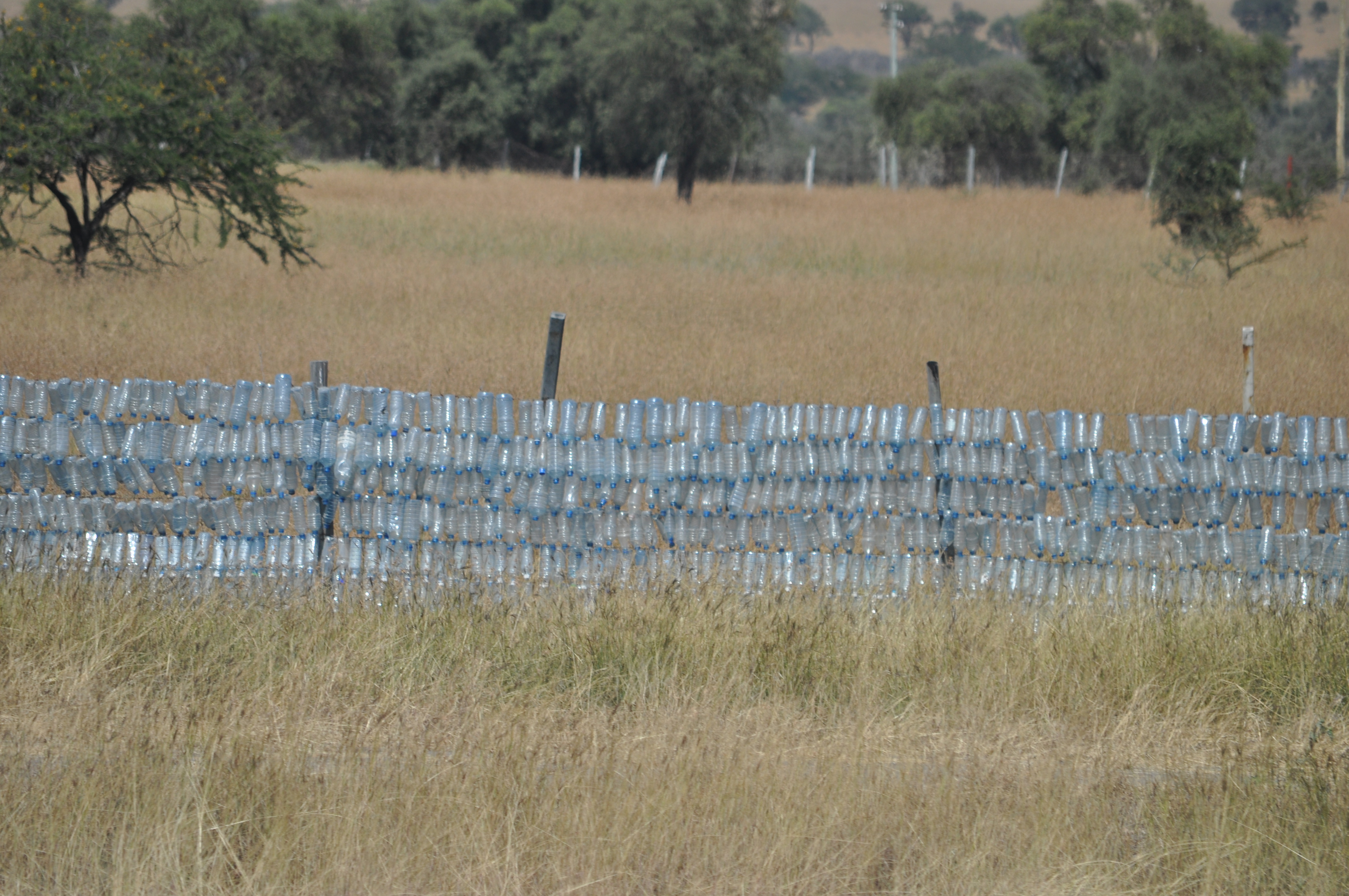
I took this pic in Kenya last summer. Those are discarded water bottle woven into a wire fence. Very creative!

I took this pic in Kenya last summer. Those are discarded water bottles woven into a wire fence. Very creative!

Not long ago one of the pastors at our church mentioned a scene in the movie Amadeus to illustrate a sermon point, and I was gripped by a line he repeated from it: “I am the patron saint of mediocrity.”

The musician Salieri says that at the end of the film. He has made a full confession to a young priest and finishes with that line. “You, too, are, mediocre,” he says in effect to the priest. “I, the patron saint of mediocrity, will speak for you.” He is referring to his musical talent as “mediocre,” but he didn’t always see it that way. As a younger man, he viewed it as a reward from God for his piety and devotion—until he was faced with the genius of Mozart, and realized his own talents paled in comparison. Not only does Salieri grow jealous of the younger composer’s gift, he is angry at God for giving them to such an irreverent man while he, Salieri, labors and toils “to the glory of God” and produces far less stellar work.

In the film (which is based on a legend and not exact truth) Salieri’s jealousy sours him. He stops producing music and fixates on Mozart’s destruction. He allows Mozart’s music to silence his own.

We all have that option. There are few geniuses; most of us muddle about in a state, comparatively, of mediocrity. But that shouldn’t dishearten us. It shouldn’t have disheartened Salieri.

No, he was not talented to the degree Mozart was. But what if Salieri had music only he could create? What if his abdication of his talent resulted in something being left undone that was meant to testify to some particular facet of God’s creativity and beauty? Compared to Mozart’s broader testimony, perhaps Salieri’s would have been but a sliver, but when Salieri abdicated his talents, he failed to redeem a portion of the manifestation of God lost to mankind in the Fall.

I’m extrapolating here in my application, but in trying to imitate someone else’s gift, or in failing to pursue the unique way in which God has gifted us (though it may be far less in scope and greatness than others), we “create” a lack. We “live” out and perpetuate the Fall. No, we in essence say, God is not purposeful and good. He plays favorites, and the amount of His love can be measured based on the ways He has gifted us. The cruel lie comes full circle when we believe we must earn God’s love and can do so only by exercising our talents; therefore, the lesser the talent, the less able we are to please God and “get” His approval and love.

Scripture tells us this is a lie. God honors the widow’s mite; Jesus extols the woman who anoints his feet with her tears and wipes them with her loose hair. He flat out says He chooses the weakest among humanity. The Beatitudes praise those who accept their vulnerabilities. The Gospel “works” only when we admit how greatly we need it, how completely unable we are to earn it.

So press on into your giftedness, no matter what it is. Press into it as part of God’s purpose for you, not as something you deserve, but as something He’s given so you can know and point to Him as the author of all good, of all creativity. Don’t compare your gift with others’ and don’t measure its greatness by how others react to it. Know (and remind yourself often) that since God gave the gift to you, He has purpose for it, and He is pleased when you exercise it. Your gift may not reach millions or even dozens of people. Your gift may be meant to touch only one. But to that person, your gift can be the touch of God.

There is a wonderful by-product to this: when we view and use our gifts in this way, we do not begrudge others theirs. We can rejoice. We can encourage. Salieri hurried down the road to bitter envy. We, instead, can support others in their talents. When we do this, our gifts mingle and grow, and our creativity is not only a testimony to God’s imagination but also to His love.

Early in Amadeus, when Salieri is still honored and praised as a gifted musician, Mozart listens to one of Salieri’s compositions. He immediately sits down, plays the piece from memory, critiques it, and then plays it again with his own vastly improved improvisations. Salieri’s face reveals his heart. He is shamed, and he is jealous. These are our natural reactions. But Romans tells us Christ has set us free from our natural “body of death” to think and live as redeemed people. How different might Salieri’s and Mozart’s stories have been had Salieri rejoiced in providing Mozart with an idea that Mozart was able to bring magically alive. Who knows what their partnership might have produced!

God certainly creates geniuses, people touched to create in seemingly effortless ways—it’s a little glimpse of God’s work! But the rest of us, gifted to one degree or another, in one way or another, are celebrated in Scripture as a body—working in harmony, honoring each other—especially those whose gifts are less celebrated by the world—and together providing a shimmering image of Christ.


They have given me much

They murmur, “Thank you,” as they leave the classroom. But instead of saying, “You’re welcome,” I tell them, “Thank you,” back.

I mean it. They have given me far more than I have given them.

Mondays I serve as an aide at the local World Relief ESL program, supporting Krista, who teaches the Job Class. The refugees in her class are recently arrived (some as “recently” as a week ago) and have only six weeks of preparation before joining the American workforce. Job Class, therefore, doesn’t mess with non-essentials.

Today we are learning the “doctor appointment” conversation:

A: This is Dr. ________’s office. How can I help you?

B. I need to make an appointment. My ________ hurts.

A. I’m sorry. How about _________ at ____:_____?

B. _______ at ____:_____? Yes. Thank you.

A. See you soon.

B. See you.

I teach the dialogue to the majority of the class while Krista works on travel directions with three students who’ve already learned the conversation. Then she and I switch groups. As Krista leads the large group in a fun practice session, I show the small group how to use Google Maps. I zoom in on the map of the world until northern Illinois covers the entire screen. “Where would you like to go?” I ask them. “The grocery? I can show you how to get directions from your apartment to the closest store.”

One of the women—she’s a “take-charge” gal!—has a different idea. She pulls a flyer out of her folder. “Free Computer and Literacy Classes,” it boldly proclaims. She reads the address to me. I type in her apartment address as the starting point and the other as the end point. “Do you have a car?” I ask her. She shakes her head. The two others, who live in the same apartment building as she, shake theirs, too.

I switch the default icon from “car” to “pedestrian,” and the time jumps from six minutes to forty. They laugh.

Soon it is time to work on applications. We fill out applications galore in this class—since, after all, getting hired is the ultimate point. The app they start with has two blanks: one for “name,” one for “country.” It simply determines if they can actually recognize those words. The final one, number 12, is a standard three-page application, with blanks for items like their social security number, their full address (including zip code), and work history.

Job counselors at World Relief help each refugee create a résumé. We use these to fill in addresses and former jobs on the application templates. I help a gentleman write “Family farmer” in the blank for his earliest job and then, in the space for his latest, we write “Kitchen worker,” the job he was able to get when he had to flee home and find temporary shelter in a neighboring country. It is the same for nearly all the refugees from his home. They began as farmers and now live far, far from their land.

I explain to another man that he does not have a maiden name, but his wife does—or perhaps not—names are cultural things, after all.

Back and forth they come and go from the table where I have organized all the applications. “Excuse me, I need help.” “Excuse me, I am finished.” I check their work. I remind some that Americans write on top of the blank line rather than across the middle of it. I refer to their intake sheets to check birthdates—months and days can be tricky. One man and I have the same birth year. We smile at each other with the commonality of age. Another man has circled “yes” next to “children?” and “no” next to “married?” Beneath the “no,” he has penciled in “widow.” I do not change it to “widower.” Should I have? Surely no one will point that out to him.

I find myself noticing their shoes—actually, their socks. It’s been a cold winter, and Monday after Monday I’ve shivered when I noticed women in plastic slides—no socks—and men in dress shoes—no socks. It’s not that World Relief doesn’t provide them with socks. They have them, but many come from homelands where they never before had to wear anything but sandals on their feet.

It must feel strange.

This day, though, I see lots of socks, and, oddly, it makes me glad.

Near the end of class, Krista assigns the homework. A few still linger at my table, wanting me to check their corrections, wanting—ultimately—to learn, to understand, to “make it” in this new, strange country.

Please, God, smooth their paths, I pray. They’ve already traveled such hard, treacherous roads. Bring kind people to them when they need aid. Protect them from prejudice and hate. Let them meet You in gentle eyes, in helping hands, in mouths that share Your Name gracefully, truthfully.

I slide the blank applications into the correct folders, ready for another day of practice, and leave with a strange mix of sorrow and joy and great gratitude.

“Thank you,” I say again to a few who are still waiting in the vestibule for their ride to arrive.

For they have given me much.

When our stories stretch long

genregraphFor years I taught the short story plot graph to middle and high school students. You first encounter the exposition—where you meet everyone and discover the setting. Then a conflict is introduced—things get exciting. The action rises (called “rising action”—surprise!) and culminates in the climax! (Trust me—I know that high school boys get the innuendo.) Then there is falling action and the resolution. Some stories have a denouement (a French term I was never sure I pronounced correctly), which is like an afterward—the “____ years later” addition to stories. (I love denouements).

Last fall my good friend Susanna visited. She’s in her first job, working as a third-shift ER nurse, and we talked about how she often leaves so many “stories” unfinished when her shift ends at 11 in the morning, before the doctors or social workers or psychiatrists see the patients admitted during the wee hours of the morning. “Often, all I’ve done is stabilize them,” she told me. “I never hear what happens with them unless they come in again.”

We talked about what that does to our souls when we continually leave stories (the real ones that people live) unfinished. Susanna doesn’t like doing this with her patients, and the stress of constantly living in the rising action of her patients’ hospital stories often makes her weary and numb.

But we also talked about the human tendency to exit stories before the ending or to dream about entering other, more exciting stories.

Susanna and I both have this tendency. We like traveling to needy places, and we’re constantly intrigued by the thought of going someplace new/doing something new.

Part of that desire is driven by the instinct to live only the more exciting half of the story, to move on when the action is no longer rising, when a climax is not around every turn.

To live out full stories, though—through the falling action, into the resolution, even past the denouement—requires determination and commitment.

I think of child-rearing—particularly when the child has a special need or illness or trauma;

Nursing older parents—especially when the years of diminishing ability or memory stretch long;

Marriage past the honeymoon stage;

Keeping the same job when the promotion offers begin passing us by.

These long-term stories sometimes seem short on excitement and long on the daily grind.

Until trauma hits! Then we remember the daily grind with nostalgia. “Oh, if I could only have that again,” we think. “I wouldn’t complain about …”

But when we are in the doldrums of our long stories, excitement beckons. We get weary. We long for … something. We forget that God has put us right in the middle of these stories for a reason. We forget that every daily grind moment has purpose and how we live these times affects the Story-at-Large. We may never know the hows or the whys or the specific effects, but we can know these times have meaning.

Oh, Lord, help us to remember this.

Practicing Awe

Sorry for the poor photo quality, but I took this on my phone on an early-morning jaunt a couple weeks ago. The sunrise reflected on a patch of ice in a field. Definitely a moment of awe!

Sorry for the poor photo quality, but I took this on my phone on an early-morning jaunt a couple weeks ago. The sunrise reflected on a patch of ice in a field. Definitely a moment of awe!

I continue my “crawl” through the Bible, and a phrase from Jeremiah jumps out at me. It’s from the fifth chapter, in which God is reminding the Israelites they have broken the covenant He made with their ancestor Abraham. Verse 24 is but one piece of His evidence: “They do not say from the heart, ‘Let us live in awe of the Lord our God, for he gives us rain each spring and fall, assuring us of a harvest when the time is right.’”

“Live in awe!”

What an incredible phrase.

They didn’t do that.

Much of the time, I don’t either.

The consequences of their awe-less life were concrete and strong. Verse 25 reads, “Your wickedness has deprived you of these wonderful blessings. Your sin has robbed you of all these good things.”

The consequences for my oft-times awe-less life tend to be more abstract.

I have the concrete “good things”: food to feed my healthy children, a warm, snug house, enjoyable and fruitful work. A lack of awe does not always result in the gifts themselves being taken away, but we do lose some of the blessing and goodness of the gift when we do not see it as such, when we let it become commonplace, something we believe we deserve, or something less than a gift—a burden.

So, this day, I am going to practice “awe” for the gifts surrounding me in the moment. I will journal my practice. Here goes…

+++++

As I write this, I am secreted in my bathroom, the one that has one door that opens into my bedroom and another that opens to the den. Patrick and his friend, Ben, are having a rock concert in my bedroom; Jake and his friend, Josh (Ben’s older brother), are in the den playing on the Wii. I can hear both sides.

They’re. Loud.

Much of the time I forget awe at these amazing gifts: two healthy sons with good friends, toys for them to play with when the weather is such that I can’t simply kick them outside all day, more than one bathroom (that’s HUGE!), a warm house, and bathroom doors that LOCK! Woohoo! I am in awe at these gifts of God in this very moment, and the goodness of this moment is revealed, and I can view the chaos and noise as a blessing.

+++++

It is now ten minutes later, and I am no longer in awe.

I am fixing mac ‘n cheese and dishing up bowls for five children so they can go out and play in the snow with full bellies (and not come back in 15 minutes later because they want snacks). I’m feeling hounded by questions of “Is it ready yet?” “Where are my gloves?” and “Mom, I think I left my snow boots at school. What should I do?”

How quickly I move from awe to frustration. It doesn’t even feel deliberate. I don’t remember making the choice to get frazzled: I just slid right into it.

Choosing awe, on the other hand, requires, well, choice, requires acknowledgment of need and cries for help—and then requires the entire process again only moments later.

Awe is clearly not my natural state!

+++++

It is now three hours later—three loads of laundry finished, three loaves of bread made, children out to play in the snow then back in (with another neighbor friend in tow), the two brothers picked up by their mother, two of mine sent to a friend’s house, one quick run up to the high school to pick up Judy, who is exhausted from all-day play practice, and snacks fed to the only two young children left in my house—and they are busy with non-destructive play—Yay! Someone actually remembered to charge my laptop after they played on it during the three-hour interim, and I am sitting down to write this—because writing is how I meditate on truths God is teaching me.

As much as I would like awe to be a constant state, it simply isn’t, and that really has nothing to do with the chaos of my family. If I lived in a monastery, and everyone around me had taken a vow of silence and peace, something would still cause me to slip from awe.

Perhaps that is actually a good thing—not necessarily the slipping, but the struggle it pushes me into (which reveals my helplessness and ends in my crying out). The battle for awe, for joy, for peace—for God, ultimately—strengthens my desire for Him. I see the contrast between awe and “regular life” more clearly as I wrestle my way back to awe time and time again. Is this what James was suggesting? That my ongoing struggles will build endurance, that patient endurance will open my eyes to see God’s “good and perfect gifts” and see Himself as the Father of lights?

Maybe? Like my struggle for awe today, all my spiritual sight is shadowed and grows clearer only in small increments.

And that is all right.

The Real Battle: followup post

Dear Readers,

I have gotten so much response and information related to the last post that I’m writing a followup post mostly comprised of all the links/books/info I’ve been given through Facebook/blog comments.

First off, some continued reading:

I found an article, “The Super Bowl Could Never Not Be Breeding Grounds for Sexual Exploitation,” written by the Chief of Policy and Planning for NYS’ Unified Court System, Judy Kluger. She is also the Executive Director at Sanctuary for Families, the leading nonprofit in New York State dedicated exclusively to serving domestic violence victims, sex trafficking victims, and their children. She wrote in response to several articles which said the hype about the Super Bowl being a “trafficking magnet” was not only overblown but was also potentially harmful to trafficking victims.

Then a friend suggested reading Half the Sky (the link is to its Amazon page) Without having read it yet (though it is now in my shopping cart at Amazon.com–my friend offered to let me borrow her copy, but I’m thinking I will probably want to mark it all up!), I can tell you that Amazon.com calls it “a passionate call to arms against our era’s most pervasive human rights violation: the oppression of women and girls in the developing world” AND, only moments after my one friend posted the suggestion on Facebook, another friend called the book a “must read.” This friend should know, as she, with several of her friends, started the West Chicagoland Anti-Trafficking Coalition to inform and activate people about the issue right here in our area. While I’m on this topic, here is a link to the Coalition’s Facebook page and another to an article written about it.

And, on that note, more about this issue in my local area, the western suburbs of Chicago:

Over the weekend my husband forwarded to me a prayer email from New Name, a ministry of Parkview Community Church in Glen Ellyn, IL, (that’s my area) that “partners with local churches to reach out to and help walk along side the women who are caught up in these industries.” I prayed my way through the message (heartbreaking stories) and then emailed its sender, asking to be added to the list of people who regularly receive it. I mentioned New Name to my Anti-Trafficking Coalition friend, and she wrote back: “New Name is awesome!” She’s used its videos when she has spoken about trafficking in the West Chicagoland area. If you go to the “New Name” link above, you’ll find more information about it as well as a contact email.

Another friend mentioned A21, which is an official coalition partner with End It, an organization I mentioned in the last post. Both these sites have great information.

I’m also sharing the blog site One Small Voice–which I found through New Name’s prayer email. The blogger says this about the site: “My goal is to post information about global human trafficking issues as well what’s happening right here in the Chicagoland area including strides that are being made by the government regarding this issue.” Right at the top of the site is information about a forum being held this Saturday on this topic.

Lastly, I just want to remind all of us why we should care.

Many years ago, when I was a very young middle-school teacher with no children of my own, I sat in a meeting that involved a student, her father, and our team of teachers. The father was overbearing and belittling to his daughter, and we left the meeting feeling discouraged. One of our team members, the lone male on the team, father to a young daughter himself, was more than discouraged. He was angry. “Any man can be a sperm donor,” he said, “but it takes a real man to be a father, and that girl doesn’t have one.”

Most of the girls involved in trafficking have never had a true father, one who protected them, cherished them, and honored them. God longs to be their Father. He’s angry and sad they’ve never experienced true love, and He’s called us to have His heart for them. He says He “will bring justice to the orphans and the oppressed, so mere people can no longer terrify them” (Psalm 10:18), and He’s called us to enact that justice in the here and now.

Let’s pray for some genuine religion, friends.

And then let’s do it.

Thanks for reading,

Jen