The REAL battle this weekend

NOTE: The topic and the links I’m sharing are not comfortable.

A year and a half ago I wrote an article (it’s on page four of the link) about two American women who provide dignified employment for at-risk women in Bangladesh, a country known for its sex slave industry. At the same time my husband, Dave, was teaching a new class at Wheaton Academy titled Culture and Theology. One of the units in the class was modern-day slavery, so we were both researching the issue and how it impacts every single country, including the U.S., where we live. I read a book titled The White Umbrella about the sex slave trade in the U.S. and about one specific ministry in the Atlanta, Georgia-area that reaches out to girls rescued from it. Dave discovered ministries like End It Movement and Love 146, which fight against human trafficking. At some point in our research, Dave discovered that the Super Bowl creates a huge market for trafficking.

That’s the reason for this particular post at this particular time.

“In 2010, the National Center of Missing and Exploited Children reported that 10,000 women were sold for sex at the Miami Super Bowl.” That quote is from an article published today that calls the Super Bowl a “sex-trafficking magnet.” Here’s a link to the several articles The Huffington Post has recently published on this topic.

Please pray.

Thanks for reading,

Jen

All is not well

My youngest child had academic testing yesterday. He and I arrived at an office in the morning, and I was ushered into a room and handed three inventories to complete. One had 86 questions; one had 275; the last had 160. Needless to say, they were thorough.

I answered “true” or “yes” to quite a few questions, most of them related to high energy levels and difficulty focusing, and there were others about which I thought, “Well, that doesn’t relate to Patrick but it’s true for Jake”—or Maddie—or Emily—or me! I recognized each of my four children—and myself—in some of the items.

But most of the statements brought me both perspective and gratitude. For every “false” or “no” I checked, that was another issue we were not facing.

I texted some of these to Dave, my husband.

“My child has very low self esteem.”

Um, no.

“My child is painfully shy around new people.”

Definitely not.

Then one of the statements simply made me stop.

#53: “I’m afraid my child is going insane.”

True or False.

And I felt a little sick.

Because, obviously, there must be parents who have to mark “true.”

We each have troubles we can talk about, things like frustrations with our children or our parents, illnesses and actual losses.

But there is also a list of unmentionables we generally keep hidden: addiction, mental illness, rage issues, money troubles, marital conflict…

Our voices literally hush, softened with shame, when we speak of those. If we speak of those.

When the testing finished for the day, Patrick and I put on coats, hats, and gloves to brave the deep cold. Our drive home took us past the middle-class suburban neighborhoods I drive through nearly every day. One after another, the homes presented neat, tidy fronts. Trim siding and smoke from the chimneys proclaimed “All is well!” but I wondered about the unmentionable topics hid away inside. If I slipped an inventory under each door, which ones would come back with “true” marked for #53? Which ones would affirm “I’m afraid in my own home,” “My child is a real threat to himself or others,” or “One of the child’s parents continually threatens abandonment”?

No adults shoveled driveways; no children played in the snow. The cold had driven everyone inside.

Where secrets can be kept, and unmentionables are lived out.

All is not well.

Oh come, Lord Jesus, come.

And in the meantime, help your people to see and speak.

Skipping the “A” in the ABCs

Jake! (In the fake mustache, he makes me think of author Agatha Christie's Detective Poirot, famous for his "little grey cells"!

Jake! (In the fake mustache, he makes me think of author Agatha Christie’s Detective Poirot, famous for his “little grey cells”!)

“Pride goes before destruction,” says the King James Version of Proverbs 16:18, “and a haughty spirit before a fall.” Here’s how the Message puts it: “First pride, then the crash—the bigger the ego, the harder the fall.”

Wise words.

The “crash” can range in severity and form. For me today it was an edginess, a tendency to blame everything on someone other than myself. Sarcastic retorts were my first responses, and a couple times I didn’t bite my tongue fast enough to keep them in. I should have worn a sign that read, “Leave me alone—for your own good!” I didn’t know what I wanted. I didn’t know why I felt so terribly grouchy. I couldn’t pinpoint any particular person or event that legitimately could be the cause.

I fought back. This is not me, I told myself. I can control this. I can change this attitude.

I’ll just grit my teeth and smile, smile, smile.

It didn’t work. Well, outwardly it did, sort of. But nothing changed inside.

I went for a walk at the dog park. Cold air, outdoors, the physical effort of breaking a path through nearly knee-height snowfall—those are all things I love.

But that didn’t work either. I still wanted to bite the head off the first person I saw.

Poor person.

At home I continued my battle to snap myself out of it.

Until I sank into it and waved the white flag.

The truth, I finally acknowledged, is that the edgy, grumpy, sarcastic, self-centered person I’d been all day IS me. With all masks and Southern “lady” upbringing stripped aside, the true me is self-righteous, self-focused, and accusatory.

I looked out the window at the bright snow that blanketed the patio. “I’m not feeling too clean right now, Lord,” I prayed. “Feeling pretty stained, pretty dirty.”

The bulletin from the morning church service was next to me. I looked at the Old Testament Scripture reading from Jeremiah 31. God said, “With weeping they shall come, and with pleas for mercy I will lead them back. I will make them walk by brooks of water, in a straight path in which they shall not stumble…” (Jeremiah 31-verse 9).

I’d been doing nothing all day but stumbling, tripping, and falling all over myself in my attempts to be a “nice” person on my own. I sighed with relief. You say You will lead me back, Lord. I don’t have to find the way myself.

I read further: “’(M)y people shall be satisfied with my goodness,’ declares the Lord.” (verse 14)

That was the root of my problem. I’d been satisfied with my own goodness—till I discovered it was anything but good!

Several years ago, when Em was 10, the twins 6, and PJ only 4, Em shared with the entire family the ABCs of salvation she’d learned in Sunday School. “A is Admit you’re a sinner,” she told us. “B is Believe that Jesus paid for your sins. C is Choose to follow Christ.”

“Hmm,” Jake said. “I think I’ll take B and C.”

Funny–but true.

Too often I still want to drop the A. I want to have some personal righteousness to boast about.

But I don’t! And mercy isn’t sweet and grace isn’t beautiful unless I see how desperately I need it.

And I’m not really following Christ unless I’m following Him as my only hope.

From death to life: the blessing of communion

Jumping in leaves at Nana and Papa's house (my in-laws).

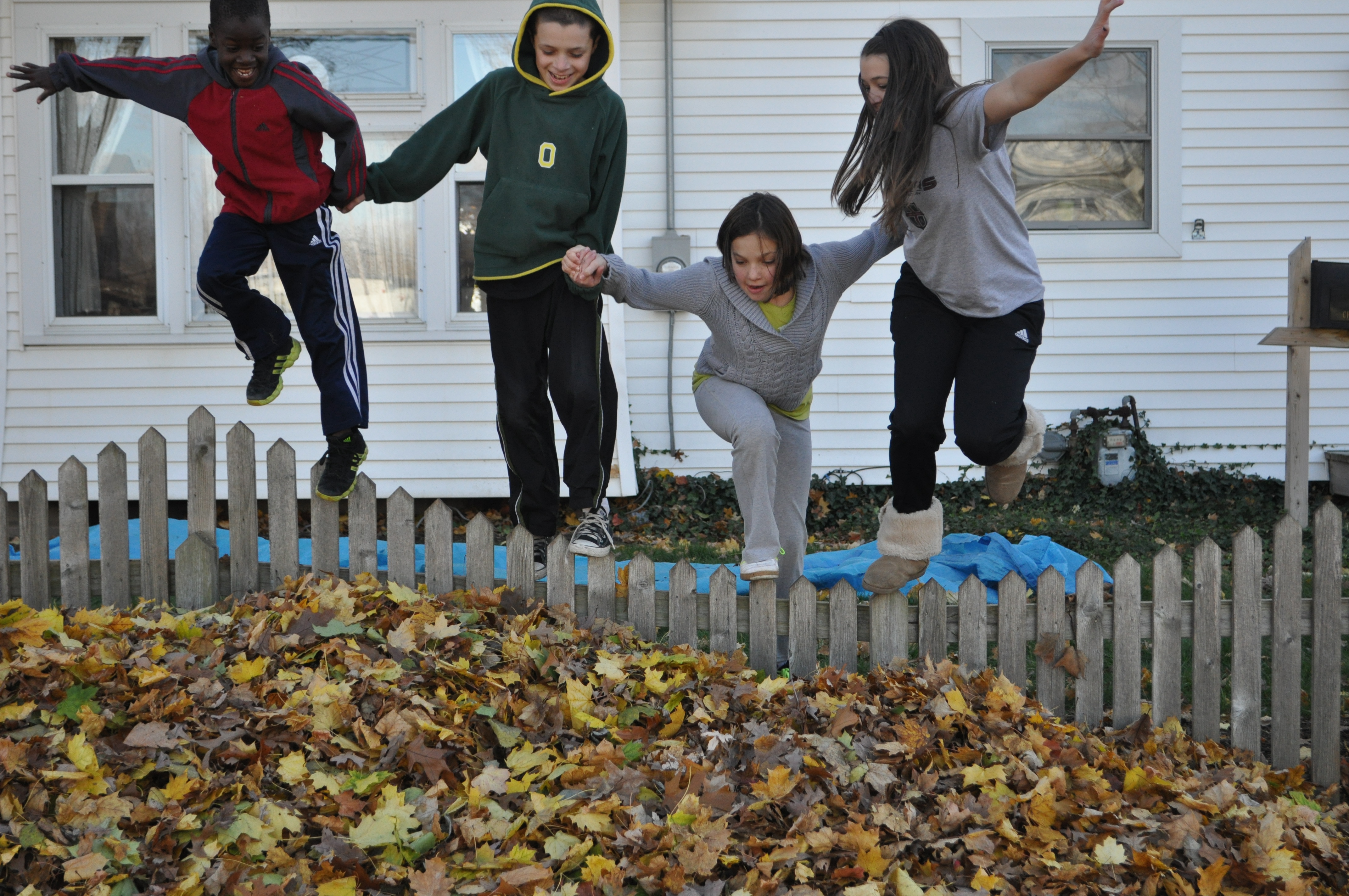
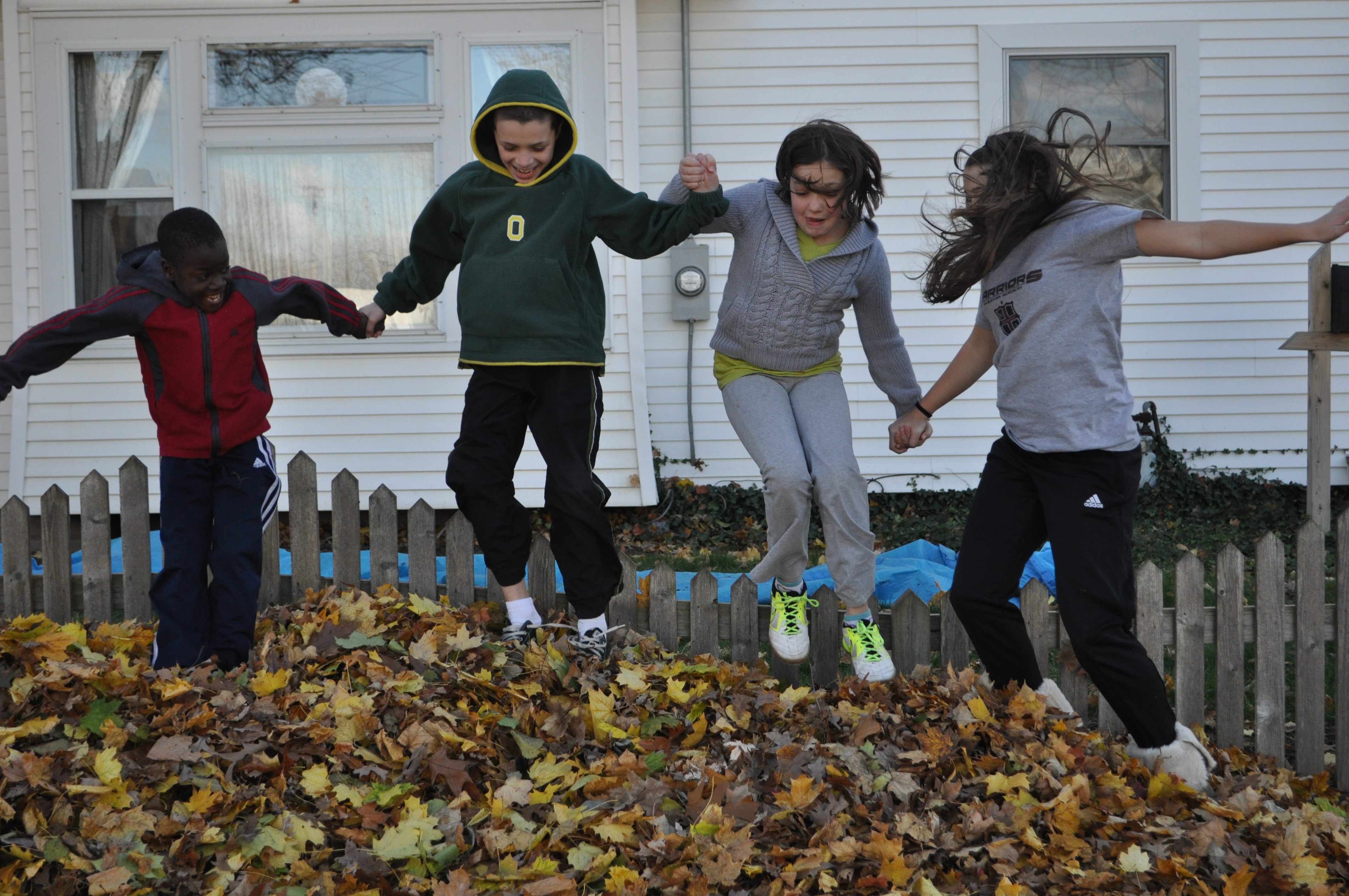
Jumping in leaves at Nana and Papa’s house (my in-laws).

For two mornings I have been disgruntled with my younger children.

Picked at faults, pointed out shortcomings. Ranted about the fact that—though I have made a bulletin board with pictures that “tell” them all they need to accomplish in the mornings before we get in the car (so even my beginning reader can understand)—we have experienced the “we’re going to be late” scrambling rush two days in a row.

After driving to school the second morning, I came home and sat in my sin for a bit. I tried to shut down the excuses and even the premature/slightly false confession and asked the Holy Spirit to help me simply listen.

DSC_0485The Spirit peeled back a few layers and I saw some of the roots of my sin.

Then, more painful, I saw what these sins are doing to my kids: in bearing down on my children with a harsh spirit, I am crushing them; I am cutting off communication with them; I am modeling for them the very things I tell them they shouldn’t do to each other (pointing out faults, not allowing for differences, assuming that everyone should regard their time/likes/dislikes as most important, being inflexible, losing their sense of humor and grace.)

DSC_0486In doing all these, I practice hypocrisy right in front of them.

I was all set to wallow in this (oh, how often I forget the second part of repentance: to turn TO God) when I remembered a conversation I had earlier this fall with my mother-in-law. She shared that one Sunday morning a few weeks before, she’d been disgruntled. She’d snapped at her husband and said harsh words to her granddaughter (who was staying with them at the time). Though she then apologized, she’d gone to church still bruised with guilt. Once there she remembered she was supposed to serve communion. She leaned over to her husband and whispered, “I don’t think I should serve communion this morning.”

DSC_0490When she told me this story, she paused at this point. Then she said, “A few minutes later, Dad passed me a note. He’d written Romans 8:1 out for me to read. “Therefore, there is now no condemnation for those who are in Christ Jesus.”

“I served communion,” she told me.

She served it—and took it—in the exact mindset in which we should always participate in communion: authentic gratitude.

The Holy Spirit brought this conversation to mind because I, too, was being invited into communion. In my state of guilt and hopelessness, my eyes were drawn to Christ, to His broken body and spilt blood that accomplished for me what I have no possibility of accomplishing for myself. I was invited, once again, to move from death to life, to receive grace.

Suddenly, I longed to have my children home from school. I looked forward to the moment when I could pull them close and say, “I’m sorry, truly sorry.”

From death to life, once again.

The blessing of communion.


From phileo to agape

“Would you die for your beliefs?”

That might be an odd question to ask here in the U.S., in an age that promotes “tolerance” above all, but it’s a question I’ve asked myself. When I’ve read about martyrs—in the past or present—or about believers being persecuted for their faith, I’ve wondered, “How devoted am I? If I were going through what that believer is, would I be able to stand strong?”

I tend to think of those believers as “better” Christ-followers than I. One day, as I was leafing through a Voice of the Martyrs magazine (www.persecution.com), I expressed this thought to my husband, Dave.

“I disagree,” he said. First, he argued, what does it mean to be a “better Christian”?

All the answers that popped into my head, I realized, had to do with ME, with what I do or don’t do. They had nothing to do with Christ’s work in and through me.

Second, Dave exposed the root of my guilt. “You feel like a second-rate Christ follower because you’re not enduring really hard things, but in doing this, aren’t you kind of questioning God? He’s the one Who has placed you exactly where you are. When you feel guilt over not being somewhere else, suffering like someone else, you’re not willing to be the person He created you to be in this time and place.”

His third argument is one I’m not sure I agree with. “I think loving God and loving neighbor is in many ways a harder task here in suburban American than it is in violence- and poverty-riddled cultures,” he said. “With so many distractions and such a great emphasis on comfort, it’s harder to focus on what is really important.”

As I thought about all this, I studied Peter’s declaration that he could die for his beliefs, for Christ. After Jesus told the disciples they would “all fall away on account of me,” Peter said, “Even if all fall away on account of you, I never will.”

Jesus disagreed. “Truly I tell you…you will disown me three times.”

Yet Peter was still certain of himself. He protested, “Even if I have to die with you, I will never disown you.” (This story can be found in both Luke 22 and Matthew 26. The above quotes are from the Matthew passage.)

Here’s what strikes me about the passage: Jesus didn’t ask Peter to make a declaration; He wasn’t impressed when he did make it; and He didn’t seem too fazed by Peter’s denial of Him. I’m not saying Peter’s denial wasn’t a big deal (it certainly was for Peter), but I am saying that Peter’s statement of devotion had a lot more to do with himself than with Christ, and Christ knew that.

As part of my study on this, I also looked at the John 21 passage, in which Christ restores Peter. I found it significant that Christ asked Peter three times if he loved Him—the same number of times Peter denied Him—and that Christ ended with telling Peter that he would actually die for Christ. He would eventually have the level of devotion that Peter had wanted and claimed to have before Christ’s death.

But I was still puzzled.

Then, a couple weeks ago, I listened to a sermon in which the pastor pointed out the difference in the Greek verb forms used in the John 21 passage (in the English they are all translated simply as “love.”) I went home and looked it up in my Amplified Bible and was amazed at how that shed light on my understanding of devotion.

When Jesus first asks Peter, “Do you love me?” He uses the Greek verb “agape” for “love,” which the Amplified translates as “reasoning, intentional, spiritual devotion, as one loves the Father).

Peter answers, “Lord, You know that I love you,” but he uses the Greek verb “phileo,” which the Amplified translates as “deep, instinctive, personal affection, as for a close friend.” Jesus asked using a higher form, but Peter, more knowledgeable of his shortcomings at this point, answered with a lesser form.

Jesus accepts Peter’s answer and gives him a charge: “Feed My lambs.”

Then Jesus asks again, “(D)o you love me?” using the agape form.

Peter answers, again, with the phileo.

And Jesus again charges him: “Shepherd My sheep.”

Then a third time Jesus asks Peter, “Do you love me?” but this time He, too, uses the phileo form of the verb.

Peter is “grieved that He should ask him the third time,” and he says, “Lord, You know everything; You know that I (phileo) You.”

Peter now understands his own limitations. He longs to say that he agape-loves Christ, but he knows he cannot produce that kind of love. So he says only what he knows to be true: he does phileo-love Christ.

And that is enough. Christ tells Peter again, “Feed My sheep,” and then He tells Peter something that sounds very, very strange to our modern, Western-world ears. “You will indeed die for me,” He says to Peter, and John, the writer of this gospel, adds, “He said this to indicate by what kind of death Peter would glorify God. And after this, He said to him, ‘Follow Me!’”

That must have been very, very encouraging to Peter. Jesus is telling him, “Peter, I know that you want your love to pure and beautiful and deep, but in reality your love is small, weak, and limited. That’s okay. I am still entrusting you with a great charge: to feed and care for My people. And as you follow Me in this—aware that you must abide in Me to find what you need—I will work transformation in you so that when you are old, your devotion will be such that you will not only not deny me, you will die for Me—and in so doing you will glorify Me.”

Father, I, too, want to love you with my entire heart, soul, mind, and spirit, and I want to love my neighbor as I love myself. But I am learning that my love, like Peter’s, is weak and frail. I am grateful that You understand and accept my weakness. Please help me to accept it, too, for You tell me that Your grace is enough for all my weaknesses. Help me to follow You in what You have set in front of me and to trust that You will transform me.

From dark to light

I took this in Montana a couple summers ago. Amazing!

Daughter Emily took this in Montana a couple summers ago. Amazing!

With the time change, I rise in grey light rather than pitch dark. By the time I hit the trail, I can see the round walnuts, black against the white gravel. My ankles are thankful.

I run due west, and at my halfway point, I turn around and head back, and the sunrise lifts in front of me.

Glorious!

But the payoff for the morning light is early dark. Earlier and earlier dark. It’s creeping in on us, hemming in our days, tighter and tighter.

It feels as if it’s crept into my soul as well.

I’m reading through Isaiah currently, and I just finished Cormac McCarthy’s apocalyptic novel The Road. “Doom and gloom” shrouded my thoughts this last week (hence the break from blogging). In between my times of people-filled activity (parenting/tutoring/teaching/meetings), my thoughts nearly immediately wrestle with the traumas of our trouble-riddled world, and my heart not only aches but wanders, confused and fearful.

At the height of day, with the sunlight brilliant on the lingering yellow leaves, the melancholy recedes a bit, but if I read through major headlines or listened to news talk radio, it returned. From all I can see and hear, we humans are not moving toward peace and goodness and Truth, and we become more and more bent on denying there is a God Who actually determines and is Himself Peace, Goodness, and Truth.

A few days ago I read Isaiah 22, and verse 11 jumped out at me. It summed up all my fears. The prophet Isaiah has told the Israelites that trouble is coming and they will do all in their power to fight against it: fortifying walls, arming themselves, creating a reservoir. “But you never ask for help from the One who did all this,” writes Isaiah. “You never considered the One who planned this long ago” (Is. 22:11b).

That describes us, I thought. We are so bent on finding our own answers to problems. We are so self-reliant and certain of ourselves.

What I missed at first was the irony that I, too, have been doing this.

The verse applies to me in my time-change-induced melancholy.

Though I have not been feeling self-sufficient, I have been trying to discover the “right” view on issues. I have wanted to feel certain and secure, and I have wanted my world to be certain and secure.

My eyes have been on the trouble rather than on the Solution.

What is too big for me to understand and too much for my heart to hold is not too big for HIM.

He is not helplessly wringing His hands over the statistics and news and debates that frighten and confuse me. He does not cry out, “I don’t know what to do!” (or “think” or “believe”)

Last night I drove my girls east to soccer practice. As I turned to head home, dusk kept pace with me. The shrouded sky behind gradually ate up the sunset in front.

But then I noticed that Venus, visible even in the last of daylight, shone even brighter after it was surrounded by night.

I am not left alone in the dark. WE are not left alone in the dark.

The Morning Star still shines, and He will not be overwhelmed.

When I focus my eyes on the Him, my uncertainties and fears shrink in their power. I still have them, but they lose their grip on me. They do not crush me.

So, right now (and again and again in the future), I “ask for help from the One who did all this.” I “consider the One who planned this long ago.” I turn to the Light.

“…Jesus spoke to them, saying, ‘I am the light of the world. Whoever follows me will not walk in darkness but will have the light of life.’”

NOTES: SO many beautiful passages that speak of God bringing light into darkness and Christ being light in the darkness. I’ve listed just a few below.

Psalm 18:28 For it is you who light my lamp; the Lord my God lightens my darkness.

Daniel 2:22 (H)e reveals deep and hidden things;
he knows what is in the darkness,
and the light dwells with him.

Micah 7:8 Rejoice not over me, O my enemy; when I fall, I shall rise; when I sit in darkness, the Lord will be a light to me.

Matthew 4:16 the people dwelling in darkness
have seen a great light,
and for those dwelling in the region and shadow of death,
on them a light has dawned.”

Luke 1:76-79 (Zechariah singing a prophetic song over his son John)

And you, child, will be called the prophet of the Most High;
for you will go before the Lord to prepare his ways,
77 to give knowledge of salvation to his people
in the forgiveness of their sins,
78 because of the tender mercy of our God,
whereby the sunrise shall visit us[h] from on high
79 to give light to those who sit in darkness and in the shadow of death,
to guide our feet into the way of peace.”

John 1:5 The light shines in the darkness, and the darkness has not overcome it.

John 12:46 I have come into the world as light, so that whoever believes in me may not remain in darkness.

I John 1:5 This is the message we have heard from him and proclaim to you, that God is light, and in him is no darkness at all.

Different angle on regrets

Just read a post by Donald Miller at the Storyline Blog. He wrote about two lists he makes each morning before he starts working. Here’s what he writes about the first one:

IF I COULD LIVE TODAY OVER AGAIN I’D

I borrowed this concept from renowned psychologist Viktor Frankl who taught his patients to treat each day as though they were living it for a second time, only this time around to not make the same mistakes. It’s an amazing little mind trick, actually. What it does is cause us to evaluate the decisions we will make that day even before we make them and as such avoid regret. It’s a powerful tool to help us not live in reaction but instead to accept our God-given agency. When I sit and think about what I’d do if I could live today over again, I always write down that I’d spend more time in prayer or invest in close friends. My life becomes much more relational because I make this list.

This made me think of the last post I wrote (about the inevitability of regrets). They’re still inevitable, but I thought this was a great idea and I wanted to share it. It makes me think of the movie Groundhog Day–in which the jerky main character is stuck re-living the same day until he finally gets it “right.” He gains a different view of time and other people and, ultimately, of life through his second (and third and fourth) time through the same day.

If you’d like the read Miller’s entire post, here’s the link: http://storylineblog.com/2013/10/21/two-lists-i-make-every-morning/.

Thanks for reading,

Jen

Everyday Gospel, continued (part 2 of conversation with Jake)

Game pieces? I think so. Why? Not sure. Because he's a nine-year-old boy? Good answer.

Game pieces? I think so. Why? Not sure.                       Because he’s a nine-year-old boy? Yep, that’s probably it.

Sunday night Dave took the crew out for ice cream. Jake decided to stay behind. As soon as everyone left, I found out why.

“Mom, I need to talk to you about something.”

He’d been waiting for just such a quiet moment.

“What’s up, bud?”

“I think I have an idol.”

It took me a moment to process that one. It’s not a phrase a 9-year-old boy often uses.

“Where did you hear…? Never mind. How ‘bout we sit down together.”

After we were snugged into the chair-and-a-half, with Jake’s hand rubbing the back of my hair, I asked, “What do you think your idol is?”

“Legos.”

“Why do you think Legos are an idol?”

“Because I think about them so much. I would rather play with them than read my Bible. I know that reading my Bible is good, and Legos are keeping me from doing as much of it as I should. I think they’re an idol.”

Ah! A repeat of our conversation the week before.

I held my hands up as if they were scales and launched into an explanation of how we can never do enough “good” to earn God’s acceptance. It’s impossible, which is why He made another Way.

But the anguish in Jake’s face stopped me.

I thought of what I’ve learned through spending time with believers from other cultures—how our Western view of salvation as a transaction is not the only way God presents the Gospel in Scripture. It is justification, yes, but it’s also reconciliation and restoration. It’s relationship, made possible through Christ.

“J-man, what do you think your dad would say if you told him, ‘Dad, I know you’re a runner, so I’m gonna’ start running four miles a day to make you love me more’?”

Jake’s face screwed up as if I’d bought him a hot pink shirt. “Mom, Dad already loves me. That’s not gonna’ make him love me more!”

I grinned.

He was quiet, his brain connecting the dots, seeing in them a picture, a constellation of beauty.

We talked more, about how we know someone loves us, then specifically about how we know God loves us. We talked about God’s joy in Jake’s enjoyment of Legos, how Jake’s creativity, imagination, and collaboration please God; they are gifts from God. We talked about how good things CAN turn into idols (and I thought, “Even Bible reading, clearly!”) and what we do about that.

At one point Jake said something truly beautiful. I don’t remember the exact words, but it was something like this: “So God wants me to read my Bible so I can know better that He loves me! It’s NOT so He will love me more! That’s not it at all.”

I laughed aloud in delight.

But part of my heart grieved.

Not at his words, but at this truth: my son, like I, will forget, time and time again, that God loves us simply because HE IS LOVE. Jake, too, will wrestle with guilt over “not doing enough.” He will lose the joy of being loved freely by God. He will equate “doing” with relationship, and he will wonder what he has done–or not done–to feel so far from God. He will assume God has withdrawn in anger and fail to realize that his own efforts and guilt have actually pulled him away from God rather than to Him.

I am grateful, not only for strange but wonderful conversations with Jake but also that God is revealing my own tendencies through my son.

But I still don’t want him to wrestle with my struggles. I want him to feel as sure of God’s love for him as he is of his dad’s (and, boy, am I grateful for that!). I want him to draw near to God with full confidence in His grace and mercy.

I want him to fiercely love God—because he knows God first fiercely loved him. I want him to know that God never, ever stops loving him.

I want for him what I want for myself.

And I can be confident that God, Who is a far better parent than I, wants the same for both of us.

Living in GRACE

We leave for a trip to Africa on July 7. Dave and I will go with 12 girls from his soccer team, our oldest child (Emily), one of his assistant coaches, and two soccer moms to Kenya and Uganda.

Dave gave each girl going on the trip a copy of Kisses from Katie, and he asked me to write devotions for each day of the trip using Scripture and sections from the book.

“I would love to,” I told him.

Well, I still “will love to,” and I probably will post many of them here on the blog, but I have to admit that the book sent me into a spiritual funk for about a week—sorry for the silence.

Kisses from Katie is the story of a young suburban-raised girl who decided to visit Uganda during Christmas break of her senior year in high school. Then she just had to go back after graduation for a gap year before college. (I know, this sounds eerily like the story of Jody—who rescued our PJ). Katie’s “job” for the year was to teach kindergarten, but she soon felt led by God to rent a house, and abandoned children began showing up on her doorstep. She is now in the process of adopting 13 Ugandan girls and lives full-time in Uganda, coming back to the States only for visits and fundraising purposes. Her life is filled with sharing Christ—through words and actions—with the poorest of the poor.

I’m not doing enough. I’m not doing enough. This nasty chorus ran rampant through my mind as I read the book—though I knew that was not Katie’s reason for writing it and I also knew it wasn’t good theology.

What dug my spiritual funk deeper was the fact that I had bought a rug for the living room the day before beginning the book. Like we needed a rug, I thought as I read about Katie raising money to pay school fees for the children in her village. I should have sent the money to World Vision!

(BTW, I felt quite a bit better about the new rug when we spread the old rug out on our grass for the yard sale we had last weekend. Sunlight exposed a LOT more than my living room lamps did. The all-ivory rug may have worked for the empty-nesters we bought the house from, but with our six kids, their friends, our dog—yeesh!)

As I read further, I defaulted to guilt wallowing, and God felt very, very far away.

I know now—and knew then—this kind of guilt is not from God, but I was stuck and digging in deeper. Saturday morning, I woke tired, glum, discouraged already. But this was yard-sale-for-Africa day, filled with opportunities to meet neighbors, make new friends, share life.

Oh God, I prayed, I don’t have the strength for this, and I am so spiritually bankrupt right now. I can’t do this. But rather than drawing me closer to God, my prayer made me more convinced of my failure.

But a beautiful thing happened as the day went on. One of the soccer moms came and helped, and we had genuine fellowship. I met a lovely little woman from Syria who asked me to pray for persecuted believers in her native country. Before she left, she pronounced Christ’s blessings on us and our trip. I met another neighbor, large with her third child, who had moved in just that day down the street. I liked her; Dave hit it off with her husband; Em was ready to babysit. Dave had fun conversation with our next-door neighbor when he asked, “So why are you going to Africa?”

As soon as the yard sale was over, though, the cloud descended again.

All week Dave gave me funny looks when I answered, “Fine,” in response to his, “How are you?” Finally, on our early Sunday morning run (yes, we’re running again, and, oh, I am so sore!), he didn’t let my “Fine” slide by. “No, you’re not,” he pressed. “What’s up?”

“I’m missing God,” I cried. “I just feel like I’m not pleasing Him, that I’m so filled up with self I’m missing Him. I’m trying and trying, but all I can think of is what I’m NOT doing, and then I feel guilty and farther away than ever.”

Dave didn’t let that answer slide by, either. He pushed quite a bit on my faulty theology—and I said, “I know, I know! My head sees it, but what do I do with my heart?”

What ultimately led to a breakthrough was this question he asked: “If you’re so far away from God, then what was going on yesterday at the yard sale?”

That stopped me. I’d gone into the yard sale with dread, with a lack of strength and purpose—with guilt at my attitude.

But somewhere during the day, I’d forgotten ME. I’d forgotten to try so, so hard. I’d let go of guilt and let others minister to me (oh, how Christ works through His body!), and in the process I was able to share myself with them and others. I’d felt joy and peace—and I know where those come from. (Galatians 5:22)

Later on Sunday morning, when I had a few quiet minutes to be still, I wrote in my journal: “If MY doing never truly accomplishes anything—for myself or anyone else, then why do I try so hard? If I really believe that my ‘righteousness is as filthy rags,’ then doing more in my own strength, out of my own guilt, accomplishes no good.”

Not long ago, I listened to a sermon by Rick McKinley, pastor of Imago Dei Church in Portland, about the importance of the Gospel in our lives AFTER salvation. He said something like this: We Christians have little problem seeing our need for complete grace for salvation, but then we act as if we have to accomplish the Christian life on our own. We need the Gospel just as much after salvation as we did before.

In Acts 13, Paul and Barnabus are speaking to people who have just trusted Christ. The two missionaries “urged them to continue to rely on the grace of God.” (emphasis mine)

It’s so, so easy to abandon grace in our daily lives. My tendency is to forget that I have no ability to please God on my own; I feel I must do more, do more, do more to make Him like me. What heresy! And it has such terrible results: guilt, broken sleep, fatigue, a broken spirit.

I wasn’t relying on God to work in me and through me last week. I put far more responsibility on myself than He ever wants me to have. HE guides; HE convicts; HE leads and directs.

I must live in the Gospel:

I need rescuing, every day, often from myself.

And my God is a God who saves.

Morning Glory

Friday morning, before the getting-ready-for-the-last-day-of-school rush, I biked, Chai dog by my side, to the dog park, where I tromped around, fast, trying to avoid the mosquitos. I reviewed the Scripture passage I’m memorizing, but not a whole lot of thinking was going on. As I swung back on my bike, ready to pedal home, I thought, “Oh, I should pray.”

That’s not a bad thing. But there was a hint to it of “I have to do the right thing. I have to go about this the right way. This is what will please the Lord.”

My mind immediately went to confession and prayer for others—because that’s more “godly prayer,” right? That’s what pleases God most—my attempts at being humble and others-centered.

Right?

God was having none of it.

But rather than a thunderbolt from the sky, He got my attention with JOY.

The trees waved their branches at me—hey,

Em likes to make--and then photograph--food creations! Yummy smoothie.

Em likes to make–and then photograph–food creations! Yummy smoothie.

look over here!—and the wind flowed over my collarbone like it was trying to tickle my neck. Happy dog on a leash at my side, green grass on left and right, hum of bike tires, and when I pulled up to my house, two ducks—a mama and a daddy!—perched on our chimney!

The bubble of joy burst and showered me with droplets, and I shut down confession/supplication and let myself BE in God.

Gratitude welled up to meet the joy raining down, and an old hymn rose.

Morning has broken, like the first morning.

Blackbird has spoken, like the first bird.

Praise for the singing, praise for the morning

Praise for the springing fresh from the Word.

Yes! Be in God. Let Him guide heart prayer into His glad fullness, His sheer joyful goodness, His eagerness to share Himself with me.

Romp in the revelation of right righteousness revealed. (Couldn’t resist the alliteration!)

Mine is the sunlight, mine is the morning,

Born of the one light Eden saw play.

Praise with elation, praise every morning;

God’s recreation of the new day.


“Morning Has Broken,” words by Eleanor Farjeon, 1931