
Communion Transformed

DSC_0269Communion terrified me for much of my growing-up years. Not because I believed I was ingesting real flesh and blood—oh, no. My father, a converted Catholic, was quite clear on his teaching against that. But he was also very clear regarding the I Corinthians verses about the Lord’s Supper. I got the message: Communion was NOT to be taken lightly. I was to do some self-examining prior to partaking and my attitude should be serious.

He needn’t have worried. I was SERIOUS!

As the pastor read from either I Corinthians or the Gospels, I would wrench my spirit, examining my life for sin. “Oh, God, please, please show me. I don’t want to do this in an unworthy manner,” I would pray, rolodex-ing through my past few days, looking for sins I had committed.

I don’t remember ever taking the little pill tablet of bread or the small cup of grape juice with joy. It was always with fear—“Did I do okay? Did I find everything to confess?”

Thankfully, that is no longer the case. I take Communion now as a symbol of Christ’s doing what I cannot do: (though I tried to for years on years) to rid myself of sin.

But there is another ironic change. I view sin differently, perhaps, oddly enough, more seriously than I did then.

Because I have realized it goes far deeper in my soul than I once thought it did.

I am “steeped” in sin. I like that description. The Pharisees used it when speaking to the man born blind—since, of course, his blindness proved that either his mother or he must have been more sinful than most—hence the blindness.

The word “steeped” makes me think of tea—the teabag infusing the entire pot—or of a chicken cooked all day in a sauce—till every bite of meat tastes of it. Separated from the goodness of God that I need at my very core, my being instead has steeped in my own selfishness. Hurtful actions, attitudes, and words are merely outpourings of this “steeping.”

I remember a Seinfeld episode in which George decided to do the opposite of all his natural impulses. It worked well for him—because every one of his natural impulses was actually destructive to either himself, others, or to relationship between himself and others.

If my sin issues are deeper than my actions or words, even thoughts… If my sin is actually the belief that I am most important in the universe—more important than any other person and certainly than God… If my sin is an attitude of self-sufficiency, of conviction that I am good and right—and, therefore, that anyone who disagrees with me is wrong…

Then the problem is not what I do, what I say, what I feel.

The problem is me, myself, I.

And I need transformation.

And I need to stop settling for conformation.

Back to communion.

My fears were based on the wrong belief that God wants conformation.

But Communion itself bears witness against this. If God wanted conformation, our sacrament would result in us putting something on, something that could be seen by others, like a perpetual Ash Wednesday.

But the commanded sacrament—“Do THIS in remembrance of Me”—is an ingestion that does not seem to change our outer selves at all. Eat of me, Christ says. Drink of me. Take Me into yourselves. Let Me be the nutrients that change you on the inside.

And “Do” this, present tense and ongoing. Again and again we must remember that Christ came to change the inner first. His work on the cross was complete—I am not saying that He must die again and again, oh, no—but I forget so easily and settle for conformity because I believe I can do that work myself.

So we take communion over and over and are reminded that He is in us, creating new hearts within, that THIS inner transformation is the substance of our faith, and outer change is merely the reflection, the outworking.

I no longer need to be terrified—either of my sin or that God is check-marking my confessions against a list of outward actions. What a wonderful change!

I take the wine: His blood covered and still covers my sin.

I take the bread: He is IN me!

The two together equal communion: friendship between human and GOD!

The terror is gone.

And I celebrate.
The God Who Mourns

It is in times of tragedy that we find that the “God” we have created in our own image simply will not work.

As news continues to break about the killings at Sandy Hook elementary school, I have attempted to follow Romans 12:15, “Rejoice with those who rejoice; mourn with those who mourn” and Hebrews 13:3, “Continue to remember those in prison as if you were together with them in prison, and those who are mistreated as if you yourselves were suffering.”

But I can’t do it.

I’m too fickle.

Right now, after the U.S.’s latest mass killing, I know there are 26 families whose hearts have been crushed. Because of our country’s advanced media, I can know the names and see the pictures.

But I am unable to keep them in my heart.

I pray for them, and I remind myself of them, but then I go about my daily activities. I fix meals and do laundry, I write articles, I carpool and help with homework.

All good, all necessary.

But I also slip into ingratitude. I find myself frustrated with the amount of laundry my family produces and the daily question of “What’s for dinner?” Four kids try to talk over each other at the dinner table, and I think, “I don’t want to deal with this.”

But even as I think that, I know there are 20 families that would love to be dealing with this right now. They long to be making lunches for all their kids, to be doing mundane tasks like writing a grocery list and thinking about Christmas gifts for teachers.

Yet I lose my gratitude over the tiniest, silliest little things.

And I will do this again and again.

For the last several days and for the next week or so we have been and will be faced with these 26 families, but then we will forget.

We are good at forgetting. It’s a survival tactic, a way to pretend that things are okay.

We know they aren’t. Even when we are in the lulls between tragedies—when this summer’s killing in the movie theater faded from front and center and the mass killing in Sandy Hook hadn’t yet happened—things were not right, not here in the U.S. and not all across the world. Injustice is rampant.

I cannot hold all that sorrow.

In the book (and movie) The Secret Life of Bees, there is a character named May who feels others’ sorrows as if they are her own. May’s sisters shield her from the radio and television because a 15-second report of an abuse or death or injustice will make her wail with heartfelt pain.

At the end of the movie May gives up. “I can’t do this anymore,” she writes to her sisters. “I can’t carry any more pain.”

I can’t either. None of us can. So most of us choose not to even try. We don’t continue to pray. We don’t mourn. We distract ourselves with fun or with frustration.

We forget.

But not God.

Tragedies like this remind me that I really, really don’t want a God who is like me.

And this time of year, with nativities all around my home, reminds me that He is not.

The all-powerful, completely just, sovereign God of this universe chose to remember us. He chose to put on flesh. He chose to touch lepers and wander homeless and attend funerals and befriend women and children. He chose to be “a Man of sorrows, acquainted with grief” to show us that God the righteous is also Savior, Redeemer, and Friend.

And He chose to die so that we might actually know this God who never forgets, never forsakes, never loses interest in us.

I will forget.

God will not.

The Nativity Wars

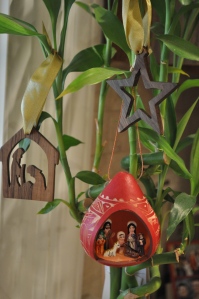
Besides the five nativities with movable figures, I also have several small, fixed nativity ornaments or sets. Here are two of my favorites (plus a star) that I have hanging on my bamboo plant next to my kitchen sink (I haven't managed to kill it yet!). My sister bought the dark wood ornaments for me in Africa, and on a recent trip to Ten Thousand Villages I treated myself to the carved gourd nativity made in Peru. So beautiful!

Besides the five nativities with movable figures, I also have several small, fixed nativity ornaments or sets. Here are two of my favorites (plus a star) that I have hanging on my bamboo plant next to my kitchen sink (I haven’t managed to kill it yet!). My sister bought the dark wood ornaments for me in Africa, and on a recent trip to Ten Thousand Villages I treated myself to the carved gourd nativity made in Peru.

The Sunday after Thanksgiving we decorated the house for Christmas.

Our three youngest were in charge of putting ornaments on the tree, a chaotic process because the youngest, PJ, gets a little over-excited (I told my sister he was like a bunny rabbit on crack, which made her howl with laughter—not because of my description but because she could easily imagine it.) Plus, since none of them is over 4 ½ feet tall, there are a lot of territory skirmishes over the lower half of the tree, and it ends up a little bottom heavy—until the older ones come in and help them rearrange.

While the kids were busy with the tree, I put out the rest of the “stuff,” which includes a lot of Christmas books and five nativity sets: one I received as a child, painted by my Mammaw (yes, I’m from the deep South); three others Dave and I received for our Christmastime wedding more than twenty years ago; and one that the twins’ Sunday School teacher gave them when they were in first grade.

I arrange them just-so, in careful semi-circles so all their faces can be seen…

And then I wait for the nativity wars to begin.

The first attack this year was sneaky. I didn’t even see it happen. I walked through the dining room and noticed a clump, not a semi-circle, of figures on top of the piano.

He’s been at it, I thought.

I checked the others. Two of the remaining four had been rearranged.

I put them back in semi-circles, but just a few hours later they were all huddled together again, a crowd rather than a scene.

Son Jake and I love nativities.

We just like different arrangements.

So every year we do “battle” during the Christmas season.

We start out with sneak attacks, but pretty soon it becomes open warfare.

Last week we had a longtime friend over. She noticed the crowded nativity on the kitchen counter and began to rearrange it. I noticed what she was doing and laughed.

“It won’t stay that way.”
“What?”

“Pretty soon Jake will come in here and push them all together again.”

“Why?”

And, suddenly, it hit me, the why. I couldn’t understand why I’d never seen it before.

“Because he wants them all close to Jesus, that’s why.” I was stating my revelation more than answering her question.

I tested my theory later that day.

“J-man, why do you like all the figures clumped like that? We can’t see their faces when you put them that way.”

His tone made it clear he thought he was answering a pretty dumb question. “But they can’t see Jesus when they’re all spread out.”

Aah!

After all, what’s more important—that we see their faces or that they see Jesus?

It’s a busy, busy season, and we tend to get a little caught up with the celebration of it—and, often, with how others see us celebrate it.

But what’s more important—that they see us or that we see Jesus?

So gather as close as you can, crowd into Him, stretch high on tiptoes, do whatever you need to do to fix your gaze on HIM.

Because not only is that the absolute best for us, it’s also when others get glimpses of Him, too. When we press close to Jesus they want to see what we’re so excited to see. In our wonder and awe, they catch some of the fascination of Christ’s love for us.

It’s a fascinating love, isn’t it!

From glory, He put on flesh—such limitation!—and then “humbled Himself…” to “death on a cross.”

All for love!

All for us!


II Corinthians 8:9 “You know the generous grace of our Lord Jesus Christ. Though he was rich, yet for your sakes he became poor, so that by his poverty he could make you rich.”

F.R.O.G.

My twins’ second-grade teacher Mrs. M gave them the basis for a lifelong theology last year. In a classroom decorated with frogs—ALL kinds of them, even those amazingly brilliant tree frogs that look like they’ve been dipped in paint—with pet frogs in an aquarium in the corner and a teacher who occasionally wore frog-decorated clothing, my kids learned, over and over, an amazing lesson: F.R.O.G. Fully Rely on God.

That’s a powerful lesson, especially when it’s coupled with a teacher who lives it out—as Mrs. M does, in spite of some pretty heavy issues in both her past and present.

I can’t begin to count the number of surgeries Mrs. M has had. She’s also had cancer. Her mother died last year. She taught much of the 2011-12 school year with her arm in a sling; this year she’s had to use a rolling “thingie” to support one knee while she’s taught. She is often in great pain.

She models F.R.O.G.ing, not with fake smiles or a grin-and-bear-it attitude, but with a full acknowledgement that reliance on anything or anyone OTHER than God is a gamble she is not willing to take. The result is a woman marked by quiet persistence who extends honest grace to herself and to others.

The result is a woman who teaches F.R.O.G.ing not only with her words but with her life.

I’m still learning to F.R.O.G. My twins think they “learned it” last year, but they’ll find it’s a lifelong lesson. It’s so easy for us to put our trust in something or someone other than God. This life “seems” to demand it, and even though we know, deep down, that we’re eventually doomed to be disappointed by others or “stuff,” we hope—and sometimes even pray—that we will not be one of the “unlucky” ones who gets cancer, or whose spouse cheats, or whose children get sick or die. We trust in our jobs, assuming that we will not be the one who loses it and becomes homeless.

F.R.O.G.ing requires that we grip things loosely, with an understanding that all things could go “wrong,” but we are still held fast by a God who is not rocked by any circumstances. We cannot genuinely and completely F.R.O.G. here on earth. (I’ve seen people who try to F.R.O.G. in their own strength. They hold back from deep relationship with other people and live in extreme asceticism, but this isn’t true trust and it certainly doesn’t do others any good.) But a genuine desire to fully trust that is borne out of the understanding that we are not capable–not even of trusting–will be answered. God will gently deepen our trust through one trial after another in which He is proven to be, time and again, a faithful, loving, ever-present God.

This morning I read I Peter 5:7 in the Amplified version. In most other versions, it’s such a quick verse that it’s easy to blip over its meaning, but God used the Amplified version to catch my attention today: “Casting the whole of your care [all your anxieties, all your worries, all your concerns, once and for all] on Him, for He cares for you affectionately and cares about you watchfully.” I Peter 5:7

In Isaiah 30, God rebukes His people because they are trusting in an alliance with another nation. They have placed their confidence in the false prophets who told them everything would be “okay.” God reminded them that this was a wrong source of trust: “In returning [to Me] and resting [in Me] you shall be saved; in quietness and in [trusting] confidence shall be your strength. But you would not,”

Today I am grateful for Mrs. M. She is one who lives out returning and resting and trusting confidence.

And in doing so, she has given a lasting gift to many

Emily and Kelly trying out a homemade face mask they made.

Emily and Kelly trying out a homemade face mask they made.

.

It’s like a fact!

I think he took this picture himself using my computer. All I know is that I opened my computer the other day to find this picture as my background–compliments of his older sister, I’m sure! Love it!

The other morning I opened the devotional book Jesus Calling to read it aloud to Dave as he ironed his shirt.

“Oh, I have a hard time believing that most of the time,” I said—before I’d even read the first sentence.

“Believing what?” Dave asked.

“Here’s what it says,” I answered. “’I am pleased with you, My child.’ And listen to this: ‘You don’t have to perform well in order to receive My Love.’ Ouch!”

Forty-five minutes later I was in the middle of my workout when son Jake came down to the basement and did what he always does in the early mornings when none of his other siblings are yet stirring: he went straight to the couch and cuddled with our dog, Chai.

“Oh, Chai,” he said, his voice syrupy sweet. “You’re such a good girl. What a good girl you are!”

Feeling a bit like chopped liver—I hadn’t even rated a “hello”—and in the middle of a huffing, puffing part of my workout, I asked, “What has she done to make her a good girl, Jake? She’s just lying there.”

He looked up, his face surprised. “Mom, I love her. That’s what makes her good!”

Wow!

I love her. That’s what makes her good.

I am pleased with you, My child.

I guess God really wanted to drive the lesson home.

Ephesians 2:8 “For it is by free grace (God’s unmerited favor) that you are saved (delivered from judgment and made partakers of Christ’s salvation) through [your] faith. And this [salvation] is not of yourselves [of your own doing, it came not through your own striving], but it is the gift of God;”

I like how the Amplified version puts it: “not through your own striving.” Oh, I strive. And I beat myself up and assume that God feels the same as I do when all my efforts come up short or are revealed to be what they are—things done to make me feel good about myself.

At bedtime the other night, Patrick said something hurtful about a group of people. He said it without thought, just to be talking, but I didn’t let it slide. “Do you realize how hurtful those words were? Do you realize what you were saying?”

When I explained, he DID understand.

And he felt awful.

When I went into his room to kiss him goodnight, his cheeks were tear-stained and he wouldn’t look at me.

I rubbed his head, and he turned his face to me and asked, “Mommy, do you still love me after what I said?”

Man, when any of your kids say that—but especially your adopted baby—it stops the heart!

“Oh, sweetheart,” I said—when I could say anything, “nothing’s going to change my love for you. I Love You! It’s like a fact.”

He loves me!

He loves you!

It’s like a fact.

Value in/value out–and guilt begone!

I am GOOD at guilt.

I can make myself feel guilty for just about anything: not being a good enough mom/host mom (or wife, not sharing my faith enough, not doing enough for others… My husband and kids actually tease me about this. One night a couple weeks back, Dave asked me, “Now why did you feel you had to be a chaperone for the kindergarten field trip along with volunteering in the school cafeteria today?”

Before I could answer, my 12-year-old did it for me. “Because that’s what ‘good moms’ do, Dad.”

Bam! Right between the eyes. Good moms—and Christians, neighbors, whatever—do “enough,” and “bad” ones run around trying to figure out what the heck “enough” is and drowning in guilt in the meantime.

One of my recurring areas of guilt wallowing is in relation to the “least” of the world. When I am reminded of the number of orphans in the world or refugees in DuPage county (my home county), part of me wants to run away, to not be touched by knowledge that disrupts my comfort. Fortunately, as God softens my heart, I am increasingly led to pray, to actually feel sorrow that draws me closer to the heart of God.

But there’s another part of me that goes straight to the guilt button.

Last week I wrote three posts about the “least” of the world. I didn’t plan it. They all came out of natural events of my week, and it was not my intention to induce guilt—neither in anyone else nor in myself.

But being the guilt expert I am, it was bound to happen.

The I’m not doing enough. I’m not giving enough chorus was ready for the Metropolitan Opera by the end of the week

At the beginning of this week, though, I was reminded that God doesn’t like my guilt wallowing. He doesn’t want a heart that coerces its holder into good deeds. He wants a soft, tender, compassionate heart.

He wants a heart like His.

He didn’t send His Son to die because He felt guilty. He did it because He values us. He loves us not for what WE have done but because that is WHO He is.

He values us not as the world does—for our power, our wealth, or our talents—but because He has stamped His image into each human creation.

You are mine, He breathed into Adam and then sorrowed as, one after another, we turned our back on that truth. He still holds our existence, but He wants our hearts.

Each human being has value because God says so.

God woke me up (literally) from my guilt fest last week. In the middle of the night I startled awake with His Words sounding in my mind: “You are mine. You have value because I love you. When you know THIS, it can flow out of you and you can value others. This will show them that I love them.”

“Do nothing out of selfish ambition or vain conceit. Rather, in humility value others above yourselves.” Philippians 2:3.

My guilt is a twisted form of vain conceit. It is focused on ME, and it assumes that I can somehow fix the problem, that I have enough knowledge to fix it—if I just think hard enough, if I just do enough. Though it can get masked as something wholly good, it is at its core a false humility—conceit in a prettier package.

But the desire to do good that flows out of God, now that happens when I remember that I am valued—loved immensely—and not for anything I am or can do. THIS knowledge allows me to VALUE others, not just “do good” to assuage my self-centered conscience. Then I can pass value on without losing a smidgen of it myself.

This is something I can do this every single day. I don’t have to be working with refugees or working overseas at an orphanage. I can practice this with the clerk at the grocery store, with the hygienist at the dentist office, with the homeless guy holding the sign on the street corner, and the loud, off-center woman who wears sweaters in July and hangs out at the public library. I can even do it with my friends and family.

Philippians 2:4 reminds me how to do this: “Let each of you look not only to his own interests, but also to the interests of others.” I have to stop thinking that my to-do list is more important than people. I must be willing to set it aside. I cannot walk through the grocery store with a preoccupied look on my face, thinking only of what I’m fixing for dinner and putting in lunches. I must be willing to look into each face, see each as a human being valued by God, and engage—a smile, a look, a few words, kindness most of all.

Value in, value out.

And if I practice this in “small” ways, listening for the promptings of God as I move through my everyday life, then God makes “big” ways clear as well. “Eagerly pursue and seek to acquire [this] love [make it your aim, your great quest];” (I Corinthians 14:1a, Amplified).

Value in—I am loved.

Value out—so I can love others.

And guilt begone!

Refugee Joseph

This morning I subbed as an aide for one of the World Relief English-as-a-Second Language (ESL) classes that meet in Wheaton. Refugees from well over a dozen countries come together with a single goal: to improve the language skills that will enable them to assimilate more into U.S. culture. Some want to go to college for the first time. Others hope to validate degrees they earned in their home countries that carry no weight here. Mothers come hoping to be able to communicate with their children’s teachers or even simply to talk with the clerk at the grocery store.

They all have stories; the U.N. doesn’t label just anyone a “refugee,” and it doesn’t relocate most —far from it—across the globe. There have to be reasons, good ones, considering that, if given a viable choice between returning home or going to the United States, almost all of these refugees would choose their homeland. But home—and the family still there—is not a realistic option.

Today, during the small chapel break that splits the class into two halves, several aides acted out the story of Joseph. I stood next to a young mother of two. We chatted before the skit began, and I learned her young boys’ names and ages. Her husband, who was a photographer at home, is now working part-time construction, hoping to get full-time, hoping, somehow, to return to the work he really enjoys.

The skit began and we watched as Joseph was thrown into the well and sold into slavery and his father was given the news of his death. “Joseph had many troubles in Egypt” was used to fast-forward the narrative to his interpretation of Pharoah’s dreams and his promotion to being the second in command. Then his brothers came looking for grain. Joseph had to turn aside to weep, but he did not tell them who he was. Then the brothers came again, this time bringing Benjamin, Joseph’s younger brother, the only other child of Joseph’s beloved mother Rachel. Joseph hugged him and cried. He forgave his other brothers. The audience, filled with the small sounds of tea drinking and softly murmured comments before, was completely still now.

The woman who narrated the story looked out at the audience. “You have all been through hard times. Many of you are going through difficult times now. Remember that there is a God who is good. Hold onto what Joseph said: ‘You meant it for evil, but God meant it for good.’ He is a good God. You can cling to that. He can work good out of what you are going through.”

Next to me I could hear the young mother crying. I’m sure many faces in front of me were wet as well.

I hugged the young mother, and we filed back to classes far more quietly than we had come in. One of the teachers and I made eye contact. “Somehow means a lot more in this context, doesn’t it?” she said.

Yes, it does.

Great numbers of the least

Joseph Stalin reportedly said, “A single death is a tragedy; a million deaths is a statistic,” and there’s a lot of truth to that statement. In the last week I’ve been reminded of a lot of numbers. I’m going to spout a few of them at you in the next couple of paragraphs but please know that the numbers are not the focus.

On Saturday I attended a training seminar at our local World Relief center (http://worldrelief.org/). Did you know there are 43.7 MILLION refugees in the world? Eighty percent of them are women and children.

On the radio last week I listened to an interview with Kathi Macias, an author who has written a fiction series on sex slave trafficking around the globe. More than 27 million slaves live in our world now. Two million of them are children exploited in the sex slave trade. This trade touches nearly every single country in the world and has a very real presence in the United States—not just in cities but in small towns as well (http://www.huffingtonpost.com/corban-addison/modern-slavery_b_1214371.html) (http://kathimacias.com/kathis-books/).

On Saturday night—and again on Sunday—I spent time with Wilfred Rugumba, who is very special to our family. Wilfred is the director of the orphanage where Patrick, our youngest, lived before becoming an Underwood (http://www.mercychildcare.org/). Wilfred reminded me that there are between 143 and 210 million orphans in the world. The number of orphans in sub-Saharan Africa is greater than the total number of children in Denmark, Norway, Ireland, Canada, and Sweden.

Those are overwhelming statistics! Obviously they overlap—a lot. Many of those refugees are also orphans. Many orphans are the ones abducted into the slave trade. But regardless of how you slice and dice it, it adds up to a lot of people. A lot of hurting people.

Sometimes I can forget these numbers. I can go for a few days, a week, maybe two without actively remembering that every minute people are being abused, sold, orphaned, displaced, and widowed. There have been other times in my life, though, when I have felt paralyzed by the thought of the vicious evil being done in any given moment.

It is in those moments when I have been reminded that God NEVER forgets. I CAN forget. I can get wrapped up in my days that are filled with activity. But God never forgets. If He knows the number of hairs on my head, He certainly knows the numbers of those being abused and exploited. He knows exactly how many stomachs are hungry. He knows how many children are wailing or dazed with grief over dead parents. And they are not just numbers to Him. They are faces, hearts, and souls to Him! And He is present in their pain. He is there when the young girl or boy is sold for sex. He is there when the widow watches her child grow listless and blank-eyed because hunger has dulled everything. He sees every village that is marauded for political or ethnic reasons.

He was there during the Armenian massacres, and there during the Holocaust and there during the Rwandan and Cambodian and Bosnian genocides and others we don’t even know about. He is in Darfur today.

And He is not untouched.

My God, what a heart You must have! We cannot blame you for these atrocities—though we try. These are crimes we commit against each other, crimes we allow because we are too concerned with our own safety and status quo to be bothered. But You are bothered. I know that with our present-day, developed-world mentality, we tend to ask questions like, “How could a loving God judge our world? How could a loving God hold us to account when we cannot see Him?” But even if God did not hold us guilty for how we have forgotten and disrespected HIM, we would stand condemned for how we have disrespected and abused and ignored His image that is seen so clearly in the children of the world. In fact, some moments, when I read about atrocities done to children and defenseless women and oppressed people groups, I think, “How do you hold back, God? How do you keep from not just wiping us completely off the face of the earth?” Even with the Western, rights-focused bent that I must fight for the rest of my life, I am more amazed by His mercy in those moments than offended by His judgment.

Yet He has not wiped out. He has given grace. He continues to love His Western, privileged church even when we fail miserably at being His hands and feet to the oppressed. He allows me to approach Him daily, hourly with my comparatively small frustrations and complaints.

I am amazed by this God. I am humbled by this God.

And I pray that these two attitudes—amazement and humility—will lead my heart and my hands and my feet into becoming more and more like His.

Chester and the Galaxies

The tree that dropped these leaves was so beautiful I had to stop the car to take pictures of it. Then I noticed the carpet of leaves on the sidewalk.

About an hour ago I took a break from the article I was writing and went to the kitchen to get a cup of coffee. Scurrying across the linoleum was a bug. Thinking it was a box elder beetle (Jake did a recent science project on these; they’re funny looking bugs), I got down for a closer look. It was a tiny cricket, smaller than Chester in Cricket in Time’s Square (I read this as a kid and then again to my kids last year–great book) but delicate, just as Chester looks in those beautiful drawings by Garth Williams (who also illustrated Charlotte’s Web and Stuart Little).

I pushed a crumb on the floor closer to the cricket, but it jumped. Up, up, up, a good six times higher than its own height, then landing on its feet. Amazing! I did it again. Then I just watched, as the cricket put out its incredibly thin, sensitive feelers to test before it took each step. Somehow its long, folded jumping legs moved in stride with its much shorter front legs, and a few seconds later, it had made its way under the stove and was out of sight. Smart cricket! I don’t remember the last time I swept under there!

“Chester” made me think of a conversation I had on Wednesday with one of the international students I tutor. “What do you want to work on today?” I asked her at the beginning of the session.

Her reply was immediate: “Bible.”

“Hard stuff again?” This would not be the first time we’ve discussed a Bible lesson. She is newer to the English language than many of the other international students in the class, so the discussions move too quickly for her, and on top of that she has no background in Christianity or the Bible.

“I don’t understand what we are talking about, and I have a test tomorrow.”

What they have been talking about is internal and external evidences, the canon, and plenary-verbal inspiration. Many of our non-Christian students WANT this. With educations steeped in the scientific, they want to sift through evidence; they want “proof” outside of experience.

But this student, though raised in the same kind of setting, is asking different questions. “How do YOU know?” she asked me a few weeks back. “What was a time God showed He was real to YOU?”

I’ve shared Patrick’s story; I’ve talked about moving to Japan and moving back. I’ve talked about comfort even in times that started out difficult and stayed difficult.

So this day I skipped the canon and started with general revelation.

And I got a little excited.

“When I took a walk yesterday,” I told her, “I noticed all the colors in the trees. Beautiful. And then I noticed these little plants—someone told me they are called ‘Chinese Lanterns.’ They’re amazing. And when I think that each winter these plants and trees cease operations, huddle into themselves during the cold months, and then are brought to life again in the spring, I am in awe!”

She was nodding, so I went on. I talked about the wonders of the human foot, that so small a base (and only two of them) could hold up a person as tall as the head of our international student program. She grinned.

“When I look at all of that, I think, ‘There must be a designer. This could not have come about by accident, by an explosion.” She’s shaking her head now, though I know she has learned nothing but evolution in her schooling. “I think that this must have come out of the mind of a Being far greater than I, Someone who was able to think of each tiny, tiny detail—down to the atoms and molecules—as well as the hugeness of planets and galaxies and how it all works together.”

I was breathless by now, and her eyes were shining. But I’m not finishing this post by saying that she made a decision that afternoon, though we moved from general revelation to special, from the stars to the Bright and Morning Star who came down for us to view him up close and personal and then died so we could really know Him (not that I used those words! J). No, this very special student is on her own journey, and I want the Holy Spirit of God to move her heart in that personal, beautiful way He has until it is her own decision and not one unduly influenced by me or anyone else.

But I finish this post with amazement at the general revelation He has given—from “Chester” currently hiding out under my stove to the galaxies and planets revealed to our weak eyes through the Hubble and Kepler telescopes. I finish with a sorrow-mixed awe at the power of storms like Sandy and what they tell us about our own incapacity and the mighty strength of the God who created wind patterns and waves that groan and heave with the weight of the Fall.

Take a walk today. Crouch low and notice the details. Look up high and watch the wind bend branches and trees as thick as our bodies. Google images of stars and planets (here’s a Web site I found today: http://www.spacetelescope.org/images/archive/top100/).

Get a bigger picture.

And let’s be amazed, awed, wowed together.

Here are some of those Chinese Lanterns–now I finally know what the red version in my yard is. They’re beautiful.

From grouchy to glorifying

I took this today in our front yard. What an amazing blue sky!

Yesterday’s getting-ready-to-go-to-school was grouchy. Nothing major, just a lot of little things that resulted in rubbed tempers that we carried all the way to the car and on the drive to school. We lacked harmony.

As I drove, Maddie recited her memory verses, Psalms 86:10-13. She had a Bible in her lap, but she wasn’t really looking at it, just reciting, and I was sure she had one of the phrases wrong.

“Look at it, Maddie,” I told her. She repeated the same phrase.

“Are you looking at it?” I asked her.

“I’m saying it, Mom.”

“I know, but is that what it says? You’re still saying the same phrase.”

Repeat above conversation—maybe a couple times.

Then Em jumped in. “Mom, she’s reading it.”

“No, she’s looking at me in the rearview mirror.”

Repeat THAT conversation.

Finally Maddie looked, saw the correct phrase, changed it, and went right on with the rest of the passage.

Being who I am (a little stuck on being RIGHT), I felt I had review what had happened. “Mads, do you see what I meant now? I just wanted you to LOOK at it. It’s not a big deal, but I didn’t want you to memorize it the wrong way.”

She said, “yeah, I do,” and conversation went on in the car, but it all felt “off” to me—the entire morning.

So after I dropped the kids off, I started examining both the morning and my heart. Why didn’t it feel right to me? What, exactly, was wrong? What should I have done differently? I couldn’t even seem to talk to God about it: my prayers felt distant and stiff. What was going on?

As I wrestled, a little chorus in my head got louder and louder until I finally paid attention to it.

It was a phrase from the verses Maddie had been reciting.

“Teach me Your way, Lord, that I may rely on Your faithfulness.” (11a)

Little aha! moment then: His faithfulness, not MINE. Part of my being unsettled was due to my feeling that I didn’t handle the morning well. I’d been relying not on God’s faithfulness but on MINE—yikes!

More revelation: His faithfulness, not my CHILDREN’s. Oh, a very real moment of clarity. Whenever I rely on other people—that they should do the things I think they should do, that my well-being and my state of mind is based on how they act or react to me—my reliance is on THEM and not on Christ. I had not been relying on God’s faithfulness—a solid rock—but on the shifting sand of people’s faithfulness.

Then real prayer came. “Oh, Lord, You alone are faithful. Forgive me for relying on anything or anybody other than You. Forgive me for wanting a smooth morning more than intimacy with You.”

The end of the passage came flooding to mind then. Verse 13: “Great is Your love for me; you have delivered me from the depths.” Yes, once again He had rescued me from my pit of self-sufficiency and self-focus—and He did this because HE LOVES ME! Because He wants fellowship with me! Because He is not willing for me to live a fake, less-than-real life but wants me to have abundant life with HIM!

I was now full circle around to the first verse of the passage. In just a few minutes God had brought supernatural change to my heart—and heart transformation is no small thing! Psalm 86:10 says, “For You are great and do marvelous deeds; You alone are God.”

Yes! Only God can change a heart.

At this point I was able to recite the entire passage—and mean it.

“For you are great and do marvelous deeds; you alone are God.

Teach me your way, Lord, that I may rely on your faithfulness;

Give me an undivided heart, that I may fear your name.

I will praise you, Lord my God, with all my heart; I will glorify your name forever.

For great is Your love toward me; you have delivered me from the depths, from the realm of the dead.”

Amen.