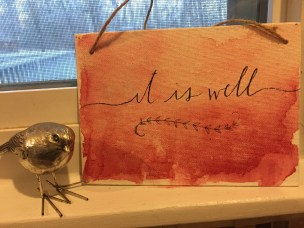
My daughter, Emily, did this piece. If you’d like to see more of her work, visit her Etsy shop, appropriately name Lettering by Em
There were a lot of things that had to be “just so” in my son Jake’s life when he was a toddler. Unfortunately he was a late talker, so he wasn’t usually able to tell me what they were. He simply threw himself on the floor and wailed. I had to figure it out by trial and error—and sometimes I never did!
I remember standing in front of him (more than once), yelling, “What Do You Want Me To Do?”
He couldn’t tell me. Sometimes I’m not sure he knew. Things Just Weren’t Right.
~~~~
Bartimaeus squatted by the side of the dusty road, one hand outstretched. He waggled his fingers when he heard people pass and sometimes felt the weight of a coin dropped into his palm, mostly light ones but every once in a while a heavier piece. One evening, as he sat, his body aching from the hard ground, his arm tired, people gathered around him, jostled him. A parade? Some government official passing by?
He asked.
“Jesus,” someone told him. “The Teacher. Surely you’ve heard of him.”
Bartimaeus had. Word of Jesus had spread among the beggars in the city. They shared tales of lame men whose legs had suddenly grown strong, lepers whose skin had become smooth, and blind men who’d had their sight restored. Jesus had been part of every story, right in the middle of it. What had Isaiah said the Messiah would do? Proclaim good news to the poor, freedom to the prisoners, recovery of sight to the blind.
“Jesus!” It was too crowded for him to stand, but Bartimaus could yell. “Jesus!”
“Jesus, Son of David, have mercy on me!”
“Son of David, have mercy on me!”
“Shush,” those around him said. A few people stepped in front of him. He was smothered by the crowd.
But Bartimaeus yelled louder.
“Son of David, have mercy on me! Have mercy on me!” Someone slapped his head, but Bartimaeus shoved the hand away. “Son of David, have mercy on me!”
Suddenly the people around him stilled. He felt those in front of him move to the sides.
“Call him over.”
Who was that? Who said that?
Voices close to him said, “He’s talking to you! He wants to see you! Get up! Get over there.”
Bartimaeus shoved his cloak off his shoulders and jumped to his feet. Someone gave him a push in the right direction. He stumbled forward.
He stopped. He knew he was close. He could sense the man in front of him. Bartimaeus began trembling. “Son of David,” he whispered, “have mercy on me.”
“What do you want me to do for you?” said the voice.
~~~
What do you want me to do for you?
Jesus, his King, was asking him, a blind beggar, “What do you want me to do for you?”
“Rabbi, I want to see.”
“Go your way,” Jesus told him. “Your faith has healed you.”
But the first thing Bartimaeus saw was Jesus, the Son of David, his King.
And his way was no longer his own.
His way was following Jesus.
~~~
Like Bartimaeus, I cry out, “Lord, have mercy!” Sometimes it is loud and articulate; sometimes little more than a whisper. Sometimes, like my then-toddler son, it is no more than a wail, a sob, a plea. And as he did with Bartimaeus, Jesus, the Son of David, King of the universe, my Lord, asks me, “What do you want me to do for you?” He never says it in frustration, and he doesn’t ask because he doesn’t know. He does know. He knows what I want—what I need!—more than anyone else. He knows it far better than I know it myself.
(Warning: This is not a normal blog post!) Dear readers, as many of you know, I’m living now on the west side of Chicago, where Dave and I feel God has specifically led our family. Dave is teaching at a high school here that serves under-resourced students, and in early January I went on staff with Greenhouse Movement, a church-planting and partnering organization. I was specifically brought on staff to work with Bible Telling here on the west side of Chicago (I’m SO excited about this! I get to write and teach and connect with people–and all of it’s related to the story of God!).
Greenhouse is a missionary organization, so I am in the very faith-stretching process of finding my team of supporters. I know God already knows who they are, and He’s the one who will prompt them to join the team; my job is simply to share the vision of Greenhouse and the specifics of my ministry with as many people as possible! I decided to put this on my blog because I thought there might be some readers who would want to know more and who might, after talking with me, want to join my team. So if you’re reading this, and you would like to hear more about Greenhouse and what I will be doing, PLEASE email me at jenunderwood0629@gmail.com
In To Kill a Mockingbird, one of my favorite books, lawyer Atticus Finch gives his young daughter some advice: “You never really understand a person until you consider things from his point of view…until you climb in his skin and walk around in it.”
…climb in his skin
In the incarnation, Christ did exactly that, didn’t he? He climbed into humanity’s skin, walked around in it, and considered things from humanity’s point of view. He became well acquainted with all the emotions, all the temptations, and all the struggles that come part and parcel with human skin.
But it wasn’t just any old skin he put on. Christ chose a very specific skin, and he walked around in it and considered its very particular point of view for 33 years.
The skin he chose was bundled at birth into whatever cloths happened to be at hand.
Because Christ put on the skin of the poor.
It was nearly skewered when it was still infant soft.
Because Christ put on the skin of the powerless.
It was carried off into a foreign country.
Because Christ put on the skin of the refugee and immigrant.
It was shunned by the religious and those highly reputed.
Because Christ put on the skin of the illegitimate.
It grew rough and callused.
Because Christ put on the skin of the working poor.
It lay itself down on the ground and at times grew tight over ribs.
Because Christ put on the skin of the homeless.
It was bruised and torn by guards.
Because Christ put on the skin of prisoners.
It was naked in the sight of all.
Because Christ put on the skin of all those forced to expose themselves to others.
~~~
“Then the King (Jesus) will say to those at his right, ‘Enter, you who are blessed by my Father: Take what’s coming to you in this kingdom. It’s been ready for you since the world’s foundation. And here’s why:
I was hungry and you fed me,
I was thirsty and you gave me a drink,
I was homeless and you gave me a room,
I was shivering and you gave me clothes,
I was sick and you stopped to visit,
I was in prison and you came to me.’
Then those ‘sheep’ are going to say, ‘Master, what are you talking about? When did we ever see you hungry and feed you, thirsty and give you a drink? And when did we ever see you sick or in prison and come to you?’ Then the King will say, ‘I’m telling you the solemn truth: Whenever you did one of these things to someone overlooked or ignored, that was me—
A homeschooling perk: Em and I took a field trip last week to the Frank Lloyd Wright house in Oak Park (that’s US history, right?). Em took this pic of one of his window designs.
This hymn showed up in my daily prayer app the other day, and I re-read the first stanza several times: “Shepherd me, O God, beyond my wants/beyond my fears/from death into life.” My default wants are safety, security, comfort, acclaim… And why am I so fixated on those? Because I fear that if I am not concerned about them, God will not be either. So I also need shepherding “beyond my fears.” I need God to move me “from death into life.”
I love the shift from prayer to truth-telling in this hymn, with the prayer for shepherding alternating with verses from Psalm 23, reminding the pray-er of God’s faithfulness and goodness. It is because of this goodness that we can confidently ask Jesus to shepherd us. Jesus, the Good Shepherd, knows our true needs, well beyond our wants or what we think will satisfy us. He will lead us through dark valleys of fear and doubt into abiding faith. He will lead us from death (which sometimes looks quite lively and self-satisfying) into true, full life. At the bottom of the post there are two links (to a Youtube audio recording of the song and to the hymn writer’s website) and a verse.
Hymn: Shepherd me, O God
Shepherd me, O God, beyond my wants,
beyond my fears, from death into life.
God is my shepherd, so nothing I shall want,
I rest in the meadows of faithfulness and love,
I walk by the quiet waters of peace.
Shepherd me, O God, beyond my wants,
beyond my fears, from death into life.
Gently you raise me and heal my weary soul,
you lead me by pathways of righteousness and truth,
my spirit shall sing the music of your Name.
Shepherd me, O God, beyond my wants,
beyond my fears, from death into life.
Though I should wander the valley of death,
I fear no evil, for you are at my side,
your rod and your staff, my comfort and my hope.
Shepherd me, O God, beyond my wants,
beyond my fears, from death into life.
You have set me a banquet of love in the face of hatred,
crowning me with love beyond my pow’r to hold.
Shepherd me, O God, beyond my wants,
beyond my fears, from death into life.
Surely your kindness and mercy follow me all the days of my life;
I will dwell in the house of my God forevermore.
Shepherd me, O God, beyond my wants,
beyond my fears, from death into life.
“If God gives such attention to the appearance of wildflowers—most of which are never even seen—don’t you think he’ll attend to you, take pride in you, do his best for you? What I’m trying to do here is to get you to relax, to not be so preoccupied with getting, so you can respond to God’sgiving. People who don’t know God and the way he works fuss over these things, but you know both God and how he works. Steep your life in God-reality, God-initiative, God-provisions. Don’t worry about missing out. You’ll find all your everyday human concerns will be met.
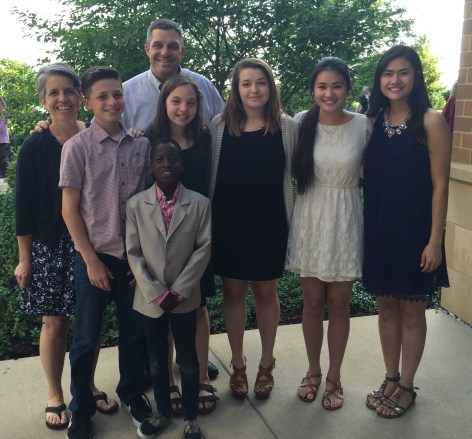
A good family picture, which, for us, is an amazing feat! This was just after Judy’s graduation ceremony. She’s a college freshman now!
When our realtor, a long-time friend, came into our home for our “putting the house on the market” interview, she was complimentary overall, but she also helped us come up with a to-do list for our open house in a couple weeks’ time.
So we did the first “weeding” of the extra stuff we’ve accumulated, and we sold some of it in a yard sale and carted what was left over to the local thrift store, and then realized, as we looked around with critical eyes, there was still much to do
We often have people stay in our house, and I clean in different ways depending on how well I know them. When my sister or in-laws come, I clean mostly so they’ll be comfortable. I don’t go overboard. But when, two summers ago, we told our church pastors they could house some incoming conference attendees at our place while we were out of town, I cleaned like a madwoman. I’d never met these people; their entire impression of us would be based on our house.
I did the same as we prepared our house to go on the market. The dirt at the base of the windows, between the glass and the screen, has never bothered me, but what if it disgusted some potential homebuyer? Two days before the open house, we got a request for a showing. I was still de-cluttering, still cleaning, but we agreed to the showing.
They arrived before we’d even left, didn’t say a word to me, stood outside looking the house over as I piled the kids and dog in the car. Later that evening I got an email telling me their realtor had written an online review of our house. I shouldn’t have looked at it, but I did. “Buyer considered the lack of central AC a negative. House could have shown better.”
Well, the AC was their issue; it was clear on the listing we didn’t have it. But “could have shown better”—those four words haunted me. I went to sleep, late, thinking of more things I needed to clean, more areas to clear out. Suddenly our house—the place where we’ve become family with our international students, the hangout spot for so many of our neighborhood children, our home!—didn’t feel good enough for others.
I woke the next morning still fixated on what I could do to make our house “show better.” I stood in the laundry room, mindlessly folding, while my mind raced from one idea to another. Suddenly I realized I was humming, the same phrase over and over.
“On Christ the solid rock I stand; all other ground is sinking sand. All other ground is sinking sand.”
I hadn’t turned the radio on that morning, hadn’t listened to anything on my phone, hadn’t heard that hymn recently. I wasn’t actively trying to get my gaze back on Christ at all! It was a clear Holy Spirit nudge, and I saw my frantic thoughts for what they were, a sandbar eroding beneath my feet.
And I remembered the words from Psalm 146.
3 Don’t put your confidence in powerful people; there is no help for you there. 4 When they breathe their last, they return to the earth, and all their plans die with them. 5 But joyful are those who have the God of Israel[a] as their helper, whose hope is in the Lord their God. 6 He made heaven and earth, the sea, and everything in them. He keeps every promise forever.
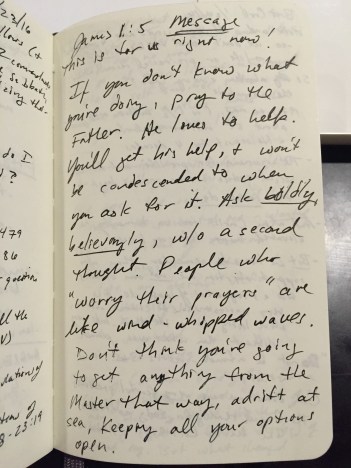
I wrote this in my journal in late January. We’d been quietly praying about direction for months, and this verse came up as the verse of the day on Bible Gateway. I wrote it in my journal and then took a pic of it so I would have it on my phone as well.
With our upcoming move into the city of Chicago, we’re facing lots of questions.
Where will the kids go to school? Don’t know.
Where will we go to church? Ditto.
What ministries will we be able to plug into as a family? Another unknown.
Where will we live? Still in process on that one, too!
But the biggest one of all for me is not one of the “W” questions, but the “H” one. How? How, in all these different, new places and contexts, do we learn how to live out our faith? How do we approach others with sensitivity and get to know them well? How do we make authentic friendships in which Jesus is evident? How do we become good neighbors and trusted members of a neighborhood?
Each time I’ve opened my daily prayer app this spring, I get the answer.
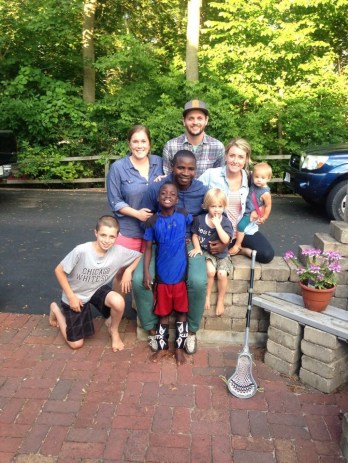
The picture above was taken in spring 2008 in Uganda. See the little guy on the right side? That’s our Patrick. He was being cared for by all the other people in this picture while we, in the States, were in the process of adopting him. That was also a time filled with questions! In the picture below, taken just outside our house in West Chicago, Patrick is front and center, and his brother Jake is kneeling on his right. Four of the other people in the picture above are also in this pic–joined by two of Jody and Aaron’s children.
It is the season of Pentecost in the church calendar, and the opening sentence for this time is Acts 1:8. “You shall receive power when the Holy Ghost has come upon you; and you shall be my witness in Jerusalem and in all Judea, and Samaria, and to the ends of the earth.”
I am reminded: the disciples in “real” Pentecost time experienced some of the same feelings we are experiencing. After three years of following Jesus around, of always knowing who their leader was, of seeing his example of love and faith and care, they lost him to the skies.
They returned to their upper room and huddled together, unsure of where to go, what to do, and how to do any of it.
Yep, same questions.
But the beginning of Acts, written later in retrospect, begins with some of Jesus’ last words to his disciples. “You’ll get the Holy Spirit,” he told them, “And when the Holy Spirit comes on you, you will be able to be my witnesses…”
And where will they be able—enabled—to be his witnesses?
Answer: Everywhere.
Downtown Chicago, therefore, is covered by this promise. It may be new to us, but it’s not new to him.
The “when,” the “what,” the exact “where”–he’ll answer all of these.
Hi everyone, it’s been awhile since I posted. It’s been a little crazier than usual around here, as our family has been praying about and anticipating a move this summer. The decision was just made final this week, and we’ll be heading just about 25 miles to the east to live in the city limits of Chicago. Specifics beyond that aren’t set (well, other than that husband Dave will be teaching at a charter school downtown–that’s a huge answer to prayer!), but we’re waiting to see how God leads.
In the meantime, I’d like to share a teaching that I gave at our women’s Bible study a couple weeks ago. It was written during one of the most uncertain times of this journey of moving (though I know there are more to come!). I’ve done an audio of it as well; it’s about 25 minutes in length and you can find it just below this paragraph. This is far longer than my usual posts, and I apologize for that.
“I AM the Way”
Our teaching topic today is Jesus’ “I Am the Way” statement. I’ve been thinking about that statement for weeks now, so the collect that was prayed at the beginning of the service this past Sunday jumped out at me. I’d like to pray it over us today as we look at Jesus as the Way for us.
Almighty God, whom truly to know is everlasting life: Grant us so perfectly to know your Son Jesus Christ to be the way, the truth, and the life, that we may steadfastly follow his steps in the way that leads to eternal life; through Jesus Christ your Son our Lord, who lives and reigns with you, in the unity of the Holy Spirit, one God, for ever and ever. Amen.
Before we get into talking ABOUT the passage, let’s read it together. This is John 13:31-14:10, some of Jesus’ last words to his disciples before he was betrayed. (Follow the link above to read the passage on Bible Gateway.)
In John 14:6, Jesus said, “I am the way and the truth and the life. No one comes to the Father except through me.” This morning we’re looking at the first noun in Jesus’ statement: “Jesus is the Way,” and exploring what that means for us, both in terms of salvation but also for our daily lives, for the step-by-step journeys we are all on. I’m “preaching” to myself this morning. That is usually the case when I teach—God always makes it very personal, but this is one that has been intensely applicable to me right now, and I’ve been praying that the journey I’m on and what I’m learning of Jesus being the Way for me in it will be of real use to you as well.
For about a year now, my husband and I have felt a pull to move to the inner city, with my husband sensing a specific draw to urban education. We’ve sought discernment about this urge, we’ve gathered people to pray with us, we’ve gotten counsel, and my husband has applied for a couple of jobs in inner-city Chicago schools. I won’t bore you with the process that has followed, but it has been very much a 3-steps-forward, 2-steps-back kind of journey, and both jobs are still possibilities even though it’s now almost May—and in the educational world, that’s getting late! Meanwhile as I’ve sensed the Lord’s leading, I’ve fought fears of “If this happens, what about school for my kids? Won’t they all have closed their enrollment? What about housing? How will we sell our house and find someplace to live in that short of time? What neighborhood?” It’s gotten to the point that I realize that if God actually opens doors and makes this happen, it truly is miraculous because I’ve got no control over it.
So, with all this swirling around in the background of my life, I began to prepare for this teaching. One of the things we do to prepare is to work our way through a set of pre-sermon questions, and one of the questions is this: “How is this passage supposed to make you feel?”
I laughed out loud when I read that question because, honestly, I identified in many ways with the disciples. I’m asking some questions that sound really similar to theirs. “Where are you leading? What is going on? Is your way for us here or there? Can you please just make the way clear?”
So, just like the disciples in the passage, I was feeling confused. I was identifying more with their feelings than with what Jesus was saying. But then I had to look at the question again, because it doesn’t ask, “How does this passage make you feel?” It hadn’t asked me how I actually felt when reading the passage but instead asked how the passage was supposed to make me feel—and that was entirely different, because the intent of this passage is hope! It’s an incredibly hopeful passage, full of eternal belonging and promises of home.
But I, just like the disciples, needed to see it differently. I needed a different perspective on Jesus being the Way. I needed a different understanding of the way.
We, here in 2016, know that verse 31 is speaking of Jesus’ crucifixion and resurrection; he’s speaking of our salvation. Then, in verse 33 he is referring to his ascension and in 34 to the new resurrection life his followers will live. These are huge, eternity-changing events!
And after he says all these monumental things, Peter asks, “Where are you going?”
Peter missed the salvation; he missed the new life of love, and he focused on Jesus leaving. I get that! Peter missed all the other stuff because Jesus just said something that threatened Peter’s imagined way of life. “What? You’re leaving? That can’t happen! We’ve got plans! You’re our leader!” Peter, along with probably all the other disciples, had his sights set on something other than God, something other than God’s purposes. They couldn’t see anything other than their own purposes. Peter was still expecting Jesus to establish an earthly kingdom, to restore Israel to glory, and Peter was wanting a significant part in this restoration. Now please understand I’m not putting Peter down for this. He wanted to be Jesus’ right-hand man, the one known for being completely supportive. He wanted to be the rock that Jesus had called him.
None of these things are bad, but they were what Peter wanted. Peter wasn’t asking what God wanted. He wasn’t looking to the Father, as Jesus always was. In chapter 14 we see the same tendencies in Thomas and Philip. Thomas, in verse 5, said, “We don’t know where you’re going.” He, too, has his eyes somewhere OTHER than God. And that’s when Jesus points him—all of them—back to God, telling him that the way Jesus is going is ALWAYS to the Father and then Jesus makes the I Am statement that He is the complete and only way to the Father,
And before I smack my forehead and say, “C’mon, guys, don’t you get it?” I have to realize I do the same thing. I formulate my own plans, and I get my eyes off the Father. I forget that HE is my ultimate goal, my complete belonging. I, too, form a plan that seems right to me, one in which I know my place and feel settled and secure, and when God does something or says something that upsets my plan—or suggests that’s not His plan, then I’m just like Peter. “What?”
And when I do this, it’s like I’m walking through an open field with my eyes on the ground, making my own way—forgetting my way doesn’t lead to the Father. I forget to look up at the Father and keep looking up, so I also forget that in him I am home.
This looking, this Father-gaze—this Father-fixation, you could say—is only possible through Jesus. He made a Way, the only Way possible, between us and the Father. Through his death and resurrection he wiped out all the sin and evil that was between us so we can see the Father and know his loving face and feel his arms around us. So we can know that in the Father’s love, we are home. We belong. In and through Jesus, we are brought to our true home with him and the Father. That home is our ultimate destination.
And this Destination influences the journey to it, and this is another meaning to Jesus being the Way. He is not only the destination, He is the way of the Father. Jesus perfectly lived this way of the Father. He revealed it to us in both his words and actions. In the Gospels, he said, over and over, in many different ways, that his eyes were on the Father. And that determined how he lived. He wasn’t trying to please others or himself—just the Father. And this is the kind of life, the kind of way to which Jesus is referring in John 13:34-35. He tells his disciples—he tells us—Love one another. As I have loved you, so you must love one another. Earlier in this chapter he’d given them a very concrete example of this when he washed their feet and told them to do the same. Bishop Stewart spoke of this call to love in the sermon this past Sunday. He told us we are called to choose a life of costly love, sacrificial love—that is the Christian life. That is the life Jesus lived, the life that revealed the Father to us, that showed us the Father’s way. And it is also the life we are to live. We are called to service, to other-focused lives.
And here is where I get a little stuck–in a couple of different ways: first, HOW do I do that? I’m selfish by nature. How do I live a life of sacrificial love when I am unable to do that? Second, how do we know exactly which direction this life of sacrificial life should take? For example, in my particular situation right now, we have a lot of good choices, and all of them—including the choice of staying in our current situation—involve costly love and service. I don’t think there’s ONE right choice. I think God could and would use all of them, but we still are faced with a choice, and that can be overwhelming.
I see this in my head kind of like a Google map with the middle part missing. It’s as if I’m looking at the map, and two dots are flashing on it. One dot is the “You are here” dot; it’s our current location. The other dot is the “destination” dot. The map behind the “You are here” dot is filled in, in a lot of detail. We can look back on our journey and see a few of its twists and turns and kind of how it got us to the point we’re at. The other dot, the destination dot, is labeled “eternal home,” “eternal life with the Father,” and around the dot are all these wonderful descriptors like “full satisfaction in Christ,” “freedom from all selfishness,” “completeness,” “wholeness,” “belonging,” “everlasting peace and love.”
So I have the ultimate destination dot and I have the current location dot, but the map in between isn’t filled in. It’s blank, so I don’t know the path between the two dots.
Now, so far I have talked about two “ways” that Jesus is the Way. The first is that Jesus is our destination, our ultimate home with the Father, and the second is Jesus as our example, showing us the Way of the Father—full of sacrificial love.
Those are two wonderful and essential understandings of Jesus being the Way, but I need more! If I only have those two dots—the current location and the ultimate destination—and then the example of Jesus, that still leaves me with big blank space in my map. HOW do I walk your way? I ask. Which direction do I take? How do I know? Am I just supposed to choose the way that looks hardest each time? What if I don’t? What if I choose the easier way and then feel guilty? (Some of us get stuck in that trap, don’t we? You know who you are!) We say, Lord, I’m lost in the in-between place. I’m stuck!
This is where the third understanding of the Way brings hope to my heart. Jesus is the Destination; he is the way of the Father—and he is the way to the Father. He is the path beneath my feet as well as my guide and companion on the journey; He holds my hand as we walk together; he carries me in the difficult parts; he is before me and behind me and beside me. He is in me.
In this passage in John, the disciples couldn’t see this yet. Their vision was still clouded. They didn’t understand; they weren’t saying, “Lord, we get it; You’re completing our eternal salvation with your death and resurrection.” No, they were still looking for an earthly kingdom and still hoping for some recognition and honor in it—but regardless of their clouded perspective, they had this one hugely important thing right: Jesus was their life! They’d walked with him for three years, and they didn’t want that to end. They’d journeyed with him. They’d looked to him for where they were going to go and how they would be fed and where they would sleep at night. And now he was talking about leaving them. I would have asked the same question. I still do!
And Jesus says to me, to us, exactly what he said to them. Please look with me at John 14:16-19, 26-27. (The link will take you to John 14:16-27 in the NIV.)
Jesus didn’t leave the disciples as orphans. He doesn’t leave us either. We are not vainly trying to make our way to the Father, hopelessly striving in our own strength to live as Christ did. No, He gave us His Spirit. “You will see me,” he promised. “You are not alone on the way. I will come to you. Because I live, you also will live.”
So the Spirit guides us through the blank space between the current location dot and the destination dot on the map. This doesn’t mean we get to punch the “list navigation steps” button and see all the twists and turns laid out. No. Often the Spirit reveals only one step in front of us; though at other times the Spirit settles us in a sweet spot for a time. Sometimes the way is full of trouble and hardship. Sometimes we seem stuck—with the way in front covered in fog. We’re not sure where to step.
But no matter what the journey is like, we’re not doing it alone. And that makes all the difference.
As my family has been in this journey of ambiguity—which Pastor Matt calls “a darn good story,” (because he’s not the one living it! J) the Lord keeps reminding me of this truth in a lot of ways. There was the time when Father Kevin stood up after the sermon a few weeks back and said, “I sense there are some here who are in a smog of confusion”—actually, I don’t remember if he said it just like that, but being who he is, I can see him picking words like that—and my husband and I looked at each other and just nodded—and then went and sought prayer. There was the Good Friday service, when I knelt at the cross, full of uncertainty for my children in this possible move, and I heard the Lord say, “I have them. They’re mine.” And then when I shared that moment with my two daughters at the Holy Week reflection service a couple weeks later, my younger daughter’s eyes got wide and she said, “Mom, he told me the same thing when I was at the cross that night. He said, ‘Maddie, I have you.’”
In just the right moments, when my doubts are crowding in, God elbows them out of the way and says, “Look at me instead.” He did this earlier this week when I was meeting with a young mom friend and she said, “God gave me an image while I was praying and I think I’m supposed to share it with you.” And though her vision didn’t give specific direction—it was of a woman lying paralyzed at the feet of Jesus and then being raised by him into courage and strength and service—it encouraged me and renewed my hope. The Lord has done this again and again in this process.
And when I keep my eyes on the Father, when I remember that the Spirit is with and in me, then I also remember I don’t need to worry about the navigation steps. I don’t need to know them. He will reveal what needs to be revealed, when it needs to be revealed. I don’t need to be troubled or afraid. Jesus has made the way for me to be home in the Father, to belong to him. That will be fully realized in eternity, but it’s also a resurrection reality right now. I can live, now, at home in the Father, belonging to him. That is most important—that’s the BIG thing—so I can trust him for everything else, for this journey right now.
You can, too, no matter what your “current location” looks like, no matter what the step in front of you looks like, no matter if you feel paralyzed or overwhelmed or bored or lost or sad or anxious in your “current location.” In these past few months, my husband and I have prayed the prayers for dedication and guidance and quiet confidence over and over. Sometimes we pray them back-to-back, asking for our hearts to be prepared for service, asking for direction and then asking that we would be reminded that our place of belonging is in God. I’ve combined the elements of these prayers into one that I’d like to pray for all of us right now.
Father God, through Jesus we have our home and belonging with you. By the might of your Spirit, lift us, we pray, to your presence, where we may be still and know that through Christ, you are our God, you are our Father. As our Father, please help us to follow the way Christ revealed. Draw our hearts to you, guide our minds, fill our imaginations, and control our wills so that we may be wholly yours, utterly dedicated to you. Then use us, we pray, for your glory and the welfare of your people. And Lord, when we are uncertain of the way, give us the grace to ask you for guidance. May the Spirit save us from all false choices and lead us on your straight path. Through Jesus Christ our Lord. Amen.
I have been thinking about strength lately (which tells you I’ve been needing some 😉 ).
The word brings to mind the Strengthsfinder book I was required to read for work back in the early 2000s. Its premise was that we spend too much time focusing on and improving our weaknesses and not enough on discovering and capitalizing on our strengths. It included a test that identified a person’s top five strengths. I took it and was told to “lean into” the strengths it told me I had.
Not bad advice, though I don’t remember now what my test results were. I do remember thinking that if I really leaned into my strengths and ignored my weaknesses, it would probably result in my losing my job.
That’s not the strength I need right now.
“Strength” also makes me think of the Rocky movies, which my husband introduced our younger children to during our stay-cation spring break. They were hooked by the first one and quickly watched 2, 3, and 4 on consecutive nights (he convinced them #5 was simply too cheesy). I watched bits of them with the crew but was eventually asked not to because I kept cringing at hard blows and delivering lectures about the violence of fighting sports. “Strength” in Rocky is physical, of course, but it is also human determination and grit and perseverance.
Again, not helpful right now.
Then, a couple days ago, I read the prayer “For Quiet Confidence” in the Book of Common Prayer. I’ve prayed it a lot in the past few months, but this time I noticed the theme of strength in it. It speaks of a strength that is available even when we are bone- and soul-tired, when both the Rocky and Strengthsfinder kinds of strength are simply useless, when we’ve come to the hard-but-blessed realization that we must look completely outside ourselves.
The prayer, drawn from Scripture, tells me my strength is found
in returning,
in rest,
in quietness,
in confidence in the God of the universe,
in stillness,
in the presence of the Lord,
in the might of the Spirit,
in knowing who God is and
in knowing his unfailing love for us.
O God of peace, who has taught us that in returning and rest we shall be saved, in quietness and in confidence shall be our strength: By the might of your Spirit lift us, we pray you, to your presence, where we may be still and know that you are God, through Jesus Christ our Lord. Amen.
All my creativity seems to be going into other kinds of writing these days, but that’s okay! The creativity of the Word and of other friends is encouraging me. This morning I read the verse of the day on Bible Gateway (in The Message, which makes it startling–exactly what I want) and then I noticed a friend of mine had just posted something new on her blog. The verse and her post go together perfectly. May you be blessed as I was!
So, chosen by God for this new life of love, dress in the wardrobe God picked out for you: compassion, kindness, humility, quiet strength, discipline. Be even-tempered, content with second place, quick to forgive an offense. Forgive as quickly and completely as the Master forgave you. And regardless of what else you put on, wear love. It’s your basic, all-purpose garment. Never be without it. Colossians 3:12 (the link takes you to the side-by-side translations of the verse in the Message, Amplified, and NIV).
And here’s the link to Joellyn’s post “Life in Death to Self.” And here’s a quote to encourage you to click the link and read the whole thing 🙂
We do not find joy by fulfilling all of our own desires and getting our way. Again, we have to look upside down in this world. Die to self. Lay down your life. Find real life in Jesus. … If I can get to this place of surrender I often enjoy the privilege of seeing His glorious resurrection work in action, and tasting the fruit of it myself.
I delivered this sermon to the women’s gathering at our church last week, so for a blog post, it’s SUPER looong and it sounds more like a “talk” than an essay! If you’d rather listen, I recorded it (about 25 minutes in length). Just click below.
I first read the prayer below in a book I was reading on the Old Testament Law. It’s called the “Prayer to an Unknown God” and was found on a tablet dating from the mid-seventh century BC. The original prayer is from Sumer and probably dates from somewhat earlier. What follows is just a small portion of this prayer:
May the wrath of the heart of my god be pacified!
May the god who is unknown to me be pacified!
The sin which I have committed I know not.
An offense against my god I have unwittingly committed.
The iniquity, which I have done, I know not.
The lord, in the anger of his heart, hath looked upon me.
The god, in the wrath of his heart, hath visited me.
I sought for help, but no one took my hand.
I wept, but no one came to my side.
I am afflicted, I am overcome, I cannot look up.
I kiss the feet of my god and [crawl before him] . . .
How long, known and unknown god, until the anger of thy heart be pacified?
Can you imagine being in that situation? We don’t live in an ancient near eastern culture, so the idea of having to appease an unknown god is pretty strange for us, but this was the norm in that time. When you listen to that prayer—and I only read a very short portion of it—you hear the desperation and you begin to see why people did so many strange and even terrible things to appease these gods they didn’t even know. About a month ago I read a fictional book about a village in ancient times that was oppressed by a demon. This oppression had gone on for decades, so by the time the story takes place, the villagers have made up a religion to try and please this demon. They’ve elected a priestess to serve the demon, and she spends her entire life trying to determine what the demon wants. But things have gotten worse and worse, and they’ve finally begun offering their children to the dragon, a different child each month. They choose the child by lottery and take the child up into the hills and leave it there to be consumed by this demon. The author allows you to get into the mind of the young priestess, and you get to feel her confusion, her dread, her sorrow at the death of children she has known and played with. But she doesn’t know what else to do. She doesn’t know how to please this angry, hungry god. It’s heartbreaking! They give and give and give to meet the demon’s needs, but it’s never enough.
This isn’t just ancient history, is it? That scenario describes so many of the religions or systems that people follow even today. Many of our systems are governed by questions of “Is this enough? Is this what I should be doing?” People who follow them are plagued by feelings of inadequacy and failure and hopelessness.
Does this sound familiar? If we’re honest, we have to admit that WE often put ourselves under those systems—without even realizing it. And then we discover ourselves asking those same questions, feeling those same feelings of inadequacy and failure.
But we don’t have to. We don’t pray to an unknown God. We don’t live with an unknown God. We follow a God who has made Himself known, who has revealed Himself to be a God of goodness, a God of light and love.
And what is more, in complete contrast to every system we’ve created, to every demon that has demanded worship, God doesn’t ask US to figure out an offering for Him. HE OFFERS HIMSELF!
This is unheard of! Unprecedented! It’s so far outside our natural inclination as to be CRAZY!
God gives Himself to us.
Do you see this in the passage we just read, in John 6:25-35? Let’s look at it again.
25 When they found him on the other side of the lake, they asked him, “Rabbi, when did you get here?”
26 Jesus answered, “Very truly I tell you, you are looking for me, not because you saw the signs I performed but because you ate the loaves and had your fill. 27 Do not work for food that spoils, but for food that endures to eternal life, which the Son of Man will give you. For on him God the Father has placed his seal of approval.”
28 Then they asked him, “What must we do to do the works God requires?”
29 Jesus answered, “The work of God is this: to believe in the one he has sent.”
30 So they asked him, “What sign then will you give that we may see it and believe you? What will you do? 31 Our ancestors ate the manna in the wilderness; as it is written: ‘He gave them bread from heaven to eat.’[c]”
32 Jesus said to them, “Very truly I tell you, it is not Moses who has given you the bread from heaven, but it is my Father who gives you the true bread from heaven. 33 For the bread of God is the bread that comes down from heaven and gives life to the world.”
34 “Sir,” they said, “always give us this bread.”
35 Then Jesus declared, “I am the bread of life.Whoever comes to me will never go hungry, and whoever believes in me will never be thirsty.
Now we have to go back before we go forward. In the section just before this one, Jesus fed the 5,000 with five loaves and two small fish. That’s what Jesus is referring to in verse 26.
So he tells these people who have followed him to focus more on eternal life rather than physical food, and they respond with a question, a very typical question, one that is our normal response when we’re told that what we’re doing isn’t quite right, isn’t “enough.” They ask, “What should we do? What is the work God requires?”
Such a normal question! Whenever we’re told—or we even feel that what we’ve done or who we are isn’t enough, isn’t completely right—we do the same. We, too, ask, “What do I do?”
But Jesus’s answer is NOT normal—is SO “not normal.” It’s a shocking, crazy, upside down answer!
“Believe in the one God has sent.”
Believe in the offering of God!
He doesn’t tell them how to fix THEIR offering. He doesn’t give them more specific instructions. He tells them to believe in him.
He goes on to explain that this belief, though, is not just a head decision; it’s not flippant. The Amplified Bible gives several of the meanings inherent in the word and translates “believe” as “adhere to, trust in, rely on, and have faith in.”
Then Jesus takes this further, and equates belief to “eating his flesh and drinking his blood.” Let’s look at verses 47-58:
47 Very truly I tell you, the one who believes has eternal life. 48 I am the bread of life. 49 Your ancestors ate the manna in the wilderness, yet they died. 50 But here is the bread that comes down from heaven, which anyone may eat and not die. 51 I am the living bread that came down from heaven. Whoever eats this bread will live forever. This bread is my flesh, which I will give for the life of the world.”
52 Then the Jews began to argue sharply among themselves, “How can this man give us his flesh to eat?”
53 Jesus said to them, “Very truly I tell you, unless you eat the flesh of the Son of Man and drink his blood,you have no life in you. 54 Whoever eats my flesh and drinks my blood has eternal life, and I will raise them up at the last day. 55 For my flesh is real food and my blood is real drink. 56 Whoever eats my flesh and drinks my blood remains in me, and I in them. 57 Just as the living Father sent me and I live because of the Father, so the one who feeds on me will live because of me. 58 This is the bread that came down from heaven. Your ancestors ate manna and died, but whoever feeds on this bread will live forever.”
Jesus tells us to ingest Him, to eat and drink of Him. Think of all the implications in that: tasting, chewing, swallowing, and then a digesting that spreads his being into every part of our being!
He’s telling us to believe in him to the point that we take him into our own selves—THIS is what will please God!
It sounds a little crazy, doesn’t it! And how, exactly, are we supposed to do that?
Now I want to point out that in this passage John brings up two Old Testament events that “fill out” this command of Jesus and might help us understand this I Am statement. First, John opens chapter 6 by mentioning that the Passover was coming. He just throws it in there like a throwaway statement, but it’s not. The Passover was the celebration of God’s deliverance of the Israelites from the Egyptians; it was His rescue of them from slavery and oppression. So the word Passover was synonymous for the Jews with the word salvation, and John mentioning the Passover is a clue that this entire passage is about Jesus being salvation—that the miracle that opens this chapter and leads into Jesus ‘s statement about his being the Bread of Life is about way more than Jesus just providing physical food.
So when Jesus tells us He is the Bread of Life; he’s telling us He is our salvation, our deliverance. This is central every time we celebrate Eucharist. “This is my body, broken for you. Take this in remembrance of Me.” His flesh, offered for us, brought us deliverance.
That’s amazing! That God was in Christ, reconciling the world to Him—through His own Body. HE made the offering. We don’t have to. All he asks us to do is believe that He actually did this for us—and that it’s enough!
But remember that I said there were two Old Testament events that John brings up in the passage? I think the second one actually helps us to believe the first one. The second one is what moves our belief in Christ from our heads to our hearts. We can SAY, “yes, I believe Jesus is the bread of life for me”—but it’s in the nitty gritty, every day “eating” of him that this belief becomes something real and warm and true inside us!
So let’s look at the second Old Testament event. In verse thirty, right after Jesus tells the people that the work of God is to believe in the one God sent (Jesus!), the people bring up the manna in the wilderness. “What sign then will you give that we may see it and believe you? … Our ancestors ate the manna in the wilderness; as it is written: ‘He gave them bread from heaven to eat.’”
Now just a little backstory. The Israelites wandered in the wilderness AFTER their deliverance—that’s important—and the manna was bread that came from heaven every single day for their sustenance. They’d already been delivered from slavery, but they needed something to carry them through the gap between the deliverance and arrival in the Promised Land.
We, too, need sustenance. Our salvation is one of those “Now and not yet,” things. We have eternal life, but we’re not living in the actuality of it right now.
But hold on! Let’s not just gloss past this, let’s not SETTLE for something less than what Christ offers us. Remember, Christ told us that he came that we might have LIFE—and have that life to the full! He’s still offering us Himself—and He’s holding it out to us every day! He’s saying—that eternal life that I offered myself for—that my death provided for you—I want you to start living it NOW, HERE!
He doesn’t mean that we never struggle; he doesn’t mean that we don’t experience problems; he doesn’t mean that we’ll never have to fight against our sin tendencies.
But He does mean that He is making available to us a life in the here and now that is full of love, joy, peace, patience, kindness, gentleness, self-control, a life that is able to consider others’ interests ahead of our own without resentment or bitterness, a life that is drawn to the noble, beautiful, lovely, and the good!
We know what it’s like to have moments of that eternal life here, don’t we? But we also know a lot about the half-life, the shadowed life, the pseudo=life we usually live in—the life we plod through, always struggling with ourselves, with others, lacking joy, lacking peace. The church father Athanasius described this life as a return to “nothingness.” He described it kind of like being a zombie (okay, the word “zombie” is MY take on Athanasius’s idea!—wandering around, walking dead, grunting and geared toward grumpiness and destruction!)
That’s a little how I’ve felt in the last 30 days. My husband and fifteen-year-old daughter went on a Whole 30 diet about a month ago—for a month—and in sympathy I went on a modified Whole 30 with them (I did NOT give up my afternoon sweet chai ritual or cream in my coffee!). But I did give up bread, which is not terribly difficult for me outside our house, but I MAKE our bread at home, and it’s darn good, whole wheat, incredible toasted with some butter! Mmmm.
I discovered that there was another side effect of giving up bread. One morning I ate some leftover stew for breakfast (you eat weird meals sometimes with Whole 30). I worked for a couple hours and then took the dog for a walk in the woods. It was good—until I just bonked. My energy was gone. The stew—the little bits of meat and lots of veggies—were gone. My legs and arms felt heavy, and every step was hard. I thought, “Oh, if I’d had a slice of bread this morning, I wouldn’t feel this way,” and I longed for a warm slice right then! Instead I had to drag myself the rest of the way out of the woods to the car.
That’s a picture of the half life, and it’s not the full life Christ is offering us.That full life fills us full! It spreads the fruits of the Christ’s Spirit all through us and gives us the power to live like Christ did, energized by the Spirit, motivated by the love of the Father, in fellowship with God and his people.
We KNOW how to live the half-life, the dragging, defaulting-to-self-and-negative-emotions life. That is completely natural to us. But we don’t really want that—not deep down. Deep down we want the full life Christ tells us about—and we SHOULD. C.S. Lewis once said that the problem is not that we desire too much but that we desire too little. The Holy Spirit wants us to recognize that desire for more, that desire to be filled with Christ, to be empowered by his Spirit, to have life to the full.
But how do we do this? (Oh, I’m back to asking what do WE do, am I not?)
Here’s how: we eat Jesus like the Israelites ate manna in the wilderness (which often describes our here and now, doesn’t it!).
That means daily!
We can learn from the Israelites’ wilderness experience here. God sent the manna every day to them, and he told them not to store it up. They tried to—a few of them went out and gathered a whole bunch of it—either because they didn’t want to gather it the next day or because they doubted God would provide it the next day or they were trying to be resourceful—but when they opened up their “stored” manna bread, it had worms in it. It was stinky and rotten.
We do that, don’t we? We try to do life on our own. We follow our own plan. We want to be in control. We want to prove ourselves—that we’re strong and capable. We don’t believe God really means it when he says he wants us to come to him empty handed every day! We don’t believe he’ll love us or want to be with us if we’re too needy.
But we have to believe that he really wants us to come with our bellies empty and our hands empty, empty but ready to receive from him. He doesn’t ask us to gather the wheat or press the oil or grind the salt. He just tells us to come and believe that he is who he says he is—the one who made us and loves us and feeds us. He wants us to believe that like we take bread into our mouths and chew it and swallow it down inside us, filling us.
Our only work in this is to come to him, to cup our hands or, if we’re simply too weary to even do that, to open our mouths and let the Holy Spirit feed us the Bread of Life.
Practically speaking, what does this look like? It looks like us coming out of sleep each morning and saying, “I got nothing. If I try to feed myself with myself—or anything else— today, if I try to function on my reserves, it will be disastrous. I will crash. I will struggle through my day, feeling overwhelmed or weary or struggling with negative attitudes” OR we acknowledge, “I will seem to function just fine but I’ll be charging through without the ability to really care for those around me or to notice God and the gifts He is giving me.” (Those are just a couple of examples of what it is like to live the not-life—you probably have some ideas in your own minds of what it looks like for you.)
But if we eat Jesus as our daily bread, we dwell in Him—who is Life itself!—and Life Itself—Jesus—dwells in us! And THAT is a life worth living. THAT is eternal life NOW!
So how do we eat this daily Bread of Life? I came up with three action steps:
First, we Look at Jesus.
Second, eyes still on him, we Reveal our brokenness and emptiness.
We acknowledge it—to ourselves and to him.
And third, we Accept His fullness for us.
We say, “Oh, I want to really believe in You today. I want You to be my all in all. I want to know and rely on and trust in you—completely! Help me to do this.”
We do these steps at the beginnings of our days, in the middles, at the ends—daily bread might need to be hourly! We probably need to graze on Jesus all day long!
Look at Jesus.
Reveal your brokenness.
And Accept His fullness for you.
May the grace of our Lord Jesus Christ and the love of our God and the fellowship of the Holy Spirit abide with you, now and forever. Amen.



 And where will they be able—enabled—to be his witnesses?
 Hi everyone, it’s been awhile since I posted. It’s been a little crazier than usual around here, as our family has been praying about and anticipating a move this summer. The decision was just made final this week, and we’ll be heading just about 25 miles to the east to live in the city limits of Chicago. Specifics beyond that aren’t set (well, other than that husband Dave will be teaching at a charter school downtown–that’s a huge answer to prayer!), but we’re waiting to see how God leads.
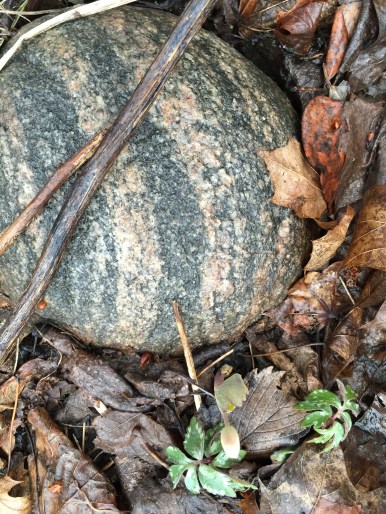 I have been thinking about strength lately (which tells you I’ve been needing some 😉 ).
 probably result in my losing my job.
 I first read the prayer below in a book I was reading on the Old Testament Law. It’s called the “Prayer to an Unknown God” and was found on a tablet dating from the mid-seventh century BC. The original prayer is from Sumer and probably dates from somewhat earlier. What follows is just a small portion of this prayer:
 Jen Underwood