Like we’re loved

*Scroll to the bottom of this post for the audio version.

We puppy-sat Nora, a 14-week-old English Bulldog, last week, and my children, as well as many of the neighborhood kids, were enamored with her.

PJ, Nora, and Chai playing tug of war

PJ, Nora, and Chai playing tug of war

But soon they discovered the not-so-pleasant side of caring for a pup. “She’s like a baby in her judgment but with a lot more mobility,” I reminded them when she chomped a plant in the garden, peed on the living room rug, or left tooth pricks in a Barbie doll’s arm.

“It’s a good thing she’s cute, huh?” I asked them. “Children and puppies. They require a lot of work, but at least they’re adorable.”

Chai was the only one who was happy to see Nora go back to her owners. Of course, the rest of us didn't have a puppy clawing at our face all week either.

Chai was the only one who was happy to see Nora go back to her owners. Of course, the rest of us didn’t have a puppy clawing at our face all week either.

They glared at her squashed face a moment more and then relented.

“Yeah.”

I find I still have that mentality with God.

He loves me because there is something inherently endearing about me.

I would never say it aloud, but the belief is there sometimes.

But the older I get, the more I understand how untrue it is—of myself or anyone, no matter how honorable or upright we seem.

In Lamentations, Jeremiah speaks of “compassionate” women of Jerusalem cooking and eating their own children (4:10). Before the starvation brought about by the siege of Babylon, these same women would have been appalled at the thought, but distress revealed a darkness in their hearts that had been there all along.

It is hard for me, too, to imagine myself capable of the horrific acts I read about in news articles. But I am. Put me in the right (or wrong) circumstances, strip me of comforts and necessities, replace my upbringing with an abusive situation…

“But for the grace of God,” my father used to say.

This truth is actually not discouraging (despite how it makes us feel). Reminders of our incapacity for good help us see that the love of God is certain—no matter what we do or don’t do.

This past season my husband’s soccer team made a poster for their locker room, and they put it right above the doorway they walk through on their way to the field. It read, big and bold, “Play like you’re loved.”

Perfect love casts out fear.

The fear we all have of God (it’s a good and necessary place to start in our relationship with Him) is based on the right belief that we can never measure up. God answered this fear with a love that fully accepts our inability to deserve it. His love has no conditions for us. We cannot earn it, and He has never expected us to.

Yet we still “play to be loved,” and we are always disappointed to find that all our efforts effect no true change in us. We do all kinds of good works and find that the bitterness or envy or self-loathing in our hearts is still there!

How paradoxical that only when we give up the striving to change ourselves can we be changed—by a love that is not dependent on our changing!

In the early pages of The Practice of the Presence of God, written about and by Brother Lawrence, a lay monk in the 17th century, his interviewer shared this about him. “When he sinned, he confessed it to God with these words: ‘I can do nothing better without You. Please keep me from falling and correct the mistakes I make.’ After that he did not feel guilty about the sin.” … “Brother Lawrence was aware of his sins and was not at all surprised by them. ‘That is my nature,’ he would say, ‘the only thing I know how to do.’ He simply confessed his sins to God, without pleading with Him or making excuses. After this, he was able to peacefully resume his regular activity of love and adoration. If Brother Lawrence didn’t sin, he thanked God for it, because only God’s grace could keep him from sinning.”

It is biblical to sorrow over our sin, but when we beat ourselves up over it, it is a reverse kind of pride. We get down on ourselves because we believe we are capable of better.

But we’re not, and it is far more profitable to confess and move on into God’s unconditional love. Confession is simply admitting to God, “I am sinful, and You are not. I acknowledge that great difference and Your perfection, and I am grateful You did something about it.”

He did do something about our inability! He did something incredible! And the result of that amazing sacrifice is that He is in us! We are in Him!

The “Play like you’re loved” poster came from the team’s season verse, John 17:23, in which Christ says, “I in them and you in me—so that they may be brought to complete unity. Then the world will know that you sent me and have loved them even as you have loved me.”

This day, let’s play, live, work, and be like we are loved!

Joy, Resurrected

*The audio link of my reading is at the bottom.

How do you lose joy? She must have failed to hold onto it. Perhaps she’d forgotten it completely, left it in a corner, and it had wandered off, hoping to find a home where it wouldn’t be neglected. “I’ve lost my joy,” she tells her husband, and he nods.

Oh dear, it’s noticeable! she thinks.

Where do you begin looking for joy?

She tries singing as she does the tasks that annoy her most. She hums as she packs the children’s lunches, warbles in the car, belts it out when she de-clutters the living room.

Where are you, joy? she wonders, I can’t sing any louder. Can’t you hear me?

She tries putting on a show of it. Didn’t she hear a pastor say once that the outward action of love can kindle the feeling?

Or was that her college drama director talking about action and emotion?

She’s not sure, but she tries it.

Smile, she tells herself.

Smile bigger!

She shoves grumpiness down. She swats selfish thoughts like pesky gnats.

Joy, come back! Please.

She is sitting, alone at her desk, absorbed in work, when she senses a presence nearby.

Joy? Are you there? I caught a glimpse of you.

Man, I wish my knees still bent like that!

Man, I wish my knees still bent like that!

But when the house bustles again, when children’s squabbles break the quiet—joy recedes.

Oh, she realizes, I am allowing the noise to drive joy away. But joy doesn’t have to have peace and quiet. Joy doesn’t mind chaos, excitement.

I haven’t lost joy.

I’ve sent it away.

I am telling it when it can be present, and when it can’t.

How do I invite joy into my full life—all of it? How do I keep from shutting it out?

Still missing joy, she goes to the Good Friday service.

It is good to reflect, to be with others, all reflecting together.

They sing, they read, they listen.

But she is waiting, though she doesn’t know what she is waiting for.

There is something here for me tonight, she thinks. I’m not sure how I know this, but I do.

The sermon is finished. They have taken communion. Her shoulders slump. It was good, but…

The pastor speaks again. “Some of you have lost your joy,” he says. “You’ve lost the joy of your salvation, your redemption. Come to the cross.”

Her hands tremble.

Her body feels light.

She knows this is for her.

It may be for others as well, but it is clearly for her.

But she will have to get up, cross the room, walk in front of so many sets of eyes.

He is still speaking. “Come. We will pray for you, that here at the cross you will remember your source of joy.”

She gets up, quick.

Her husband, beside her, stands, too.

“Do you want me to come with you?”

She nods.

By the time they reach the cross, there are others.

I am not the only one, she thinks. We have all lost joy.

Pastors pray. She hears only snatches of their words over the music.

But that is all right, because it is the song she needs to hear.

“Behold the man upon the cross,

My sin upon his shoulders;

Ashamed, I hear my mocking voice

Call out among the scoffers.

It was my sin that held him there…”

Somehow, in the second of space before the next line of the song, she experiences guilt, sorrow, despair. I did send you there. It was my sin. It was my selfishness. Oh God, I love You, but I don’t know how to stop hurting You. I am unable to pull my thoughts away from myself, away from what I am feeling or not feeling.

All this in a God-stretched moment.

And then…

“Until it was accomplished;

His dying breath has brought me life—

I know that it is finished.”

Stop, she commands herself. See truth. Christ does not have to die again. He has done it! I AM redeemed. It is not the chaos that is driving joy away; it is my fear that when I sink into moodiness, into selfishness, that I have stepped out of redemption. But that can never be. He finished it.

“I will not boast in anything,

No gifts, no pow’r, no wisdom;

But I will boast in Jesus Christ,

His death and resurrection.

But this I know with all my heart,

His wounds have paid my ransom.”

Paid, accomplished, finished—in a transaction that is outside the scope of time. It is not undone when she grows grumpy yet again, not taken back when she fails or is petty. She looks up at the Christ figure on the cross. Through that finished work, she tellsherself, I am redeemed. My sin does not for one single moment make that untrue. It is present and ongoing, without conditions. Without resting at all on me. I can have joy IN my grumpiness. It is not limited only to when I am feeling peaceful and good but is a reality even when I am fully aware of my own sinful nature.

She feels her husband’s hands on her shoulders. They have been there all along. She just now senses their gentle weight.

“Behold the man upon a cross,

My sin upon His shoulders”

He took it from me—and He abolished it. Why do I try to carry what He has already taken?

The load rolls off.

And joy resurrects.


Take and Eat

NOTE: The audio of my reading of this post is at the bottom. Thanks for reading (or listening).

It is whole, not a tooth mark on it. This is some kind of magic—because I ate from the fruit yesterday—and every day before. Yet it re-appears, beautiful and enticing, just as it was when Eve first considered it.

She ate it to the core. Why is it still here?

And why do I keep eating it?

It is sweet to the taste, that first bite, exploding with flavor in my mouth, but then it sits, acidic and heavy in my gut, and I regret my choice every time.

Yet, like Eve, I daily eat the fruit. The desire to set my own standards, to be MYSELF (separate from God) and for everything to be about ME, to be in control… oh, it lures me in.

It sounds like it’s promising LIFE, doesn’t it?

False advertising. LIFE would not burn so. LIFE would not eat away at my gut, eat away at me.

Yet I cannot stop myself.

I hunger!

I need. I am not complete.

I am empty.

“Eat it. Be like God. See. Know.” The whisper enchants. It flows with the rhythm of my blood. I cannot tell if it is within or without. All I know is my emptiness.

But this fruit fills it full with dark.

“Take, eat.”

Another voice.

Another food.

A morsel of bread, torn, crushed.

It does not delight the eye. It does not entice the taste.

“This is My body, broken for you.”

I recoil. To take this means I admit this lack within me. I allow Another in to witness it, to fill it—with Someone other than me.

But who am I?

I need.

I lack.

“I am the living bread.

I was broken for you.

Eat and live.”

A poem (though I’m NOT a poet!)

Though I did nothing to produce the flame,

I want to “contribute,”

so I pile on “good works,” busy-ness, “rightness”

till the fire nearly smothers.

The result: a smoldering smudge

that burns my eyes, sears my nostrils—

All the “good” doing no Good at all

And my vision is bound by Self.

I “do” more, petition with frantic edges, praise with listless duty

and, deep down, miss the pure flame

utterly outside my power to create.

I arrive weary at Christmas Eve service,

just in time to see the bishop wave the incense,

sending up wisps of white

that fade from sight but waft sweet scent—

even to my row near the back.

“Nothing magical,” the bishop explains.

“Just a symbol of the psalmist’s cry,

‘Let my prayer be set before You as incense.’”

I breathe deep and wonder-

What could transform my smoldering smudge

To this?

I examine the Psalm and find no commands to

do, work, fix.

Instead, verbs requesting action on God’s part,

Not mine.

“Set a guard,” “Do not let…” “Leave me not.”

“I cry out to You,” the songwriter begins.

And ends, “My eyes are upon You.”

Such kind deliverance.

The truth releases me to

Receive,

Listen,

I sense Holy Spirit hovering.

Wing beats unceasing

fan buried flame

lift the wordless wail.

Set free in stillness,

The Hallowed wind sweeps me

To the edge of myself

And I fall

Deep into the intercession of

Pierced-flesh-and-spilt-blood.

Flame–and incense–rise.

NOTES: 1. If anyone reading this is a poet and has suggestions (and would be willing to share them), I would LOVE to hear them. 2. Because I don’t really feel this is “finished,” I didn’t record this one.

The only road to freedom

NOTE: The audio of my reading of this post is at the bottom. Thanks for reading (or listening).

Just for fun--and in case you're feeling the need for some chocolate! (We didn't actually buy the chocolate bar--though the kids would have loved to!)

Just for fun–and in case you’re feeling the need for some chocolate! (We didn’t actually buy the chocolate bar–though the kids would have loved to!)

One day this past week I encountered a grumpy man at the dog park.

He didn’t say anything mean. He was just grumpy.

No big deal, really. In fact, I forgot about it the rest of that day.

But the next morning, it returned. And I couldn’t let it go. I grew frustrated with Grumpy man. Worse, I re-imagined the scene in my head—with a little more grumpiness on his part and some witty rejoinders on mine. It was ridiculous, and I grew even more frustrated with myself than with Grumpy Man. Why am I so caught up in this? I wondered. Why do I even care?

As I prayed about this, I remembered a scene I’d read the night before in The Hiding Place. My daughter is reading it for a class at school, and, though I’ve read it at least a couple times, it was lying around, so…

I was just going to read a few pages in the middle—but I finished it a little after midnight.

Oh, well.

If you haven’t read The Hiding Place, you should. This true story is gripping: a quiet Dutch family becomes active in the underground movement during the Nazi occupation of the Netherlands, assisting some Jews to flee the country and hiding others in the attic of their home. Eventually their work is discovered, and middle-aged daughters Betsie and Corrie Ten Boom, along with their elderly father and several other family members, are arrested. Their father dies after only a few days in prison; most of the other family members are eventually released; but Betsie and Corrie are sent together to Ravensbruck, the notorious concentration camp for women.

Betsie is a saint (I know Scripture calls all of us who believe in Christ “saints,” but I, at least, don’t generally act like one, and Betsie truly did.) For example, here’s how she acted in the scene I remembered this morning: Corrie and Betsie had just witnessed German guards mistreating some prisoners with intellectual disabilities. Corrie said, “Betsie, after the war, we must open a home so we can minister to them. They will have so many emotional wounds.” (I’m paraphrasing.)

Betsie responded, “Oh, yes, Corrie. They will need so much healing.”

It wasn’t until later Corrie realized Betsie had not been referring to the prisoners but to the guards. Even when she was personally mistreated by them, Betsie had compassion on them. She saw them as hurting souls.

Betsie was as free in prison as outside it because she harbored no bitterness. None! This allowed her not only to be an incredible blessing to those around her, but also made her own life—which could be accurately described as miserable, full of physical and emotional hardships 24 hours a day—joyous.

That is freedom, I thought as I reflected. How ironic that a woman in a hellish situation could be so mentally, emotionally, and spiritually free, while often we who are well-fed, well-clothed, and “free” to choose career/family/circumstances, live in bondage—to our own selves—and are therefore miserable and bitter.

Case in point: ME—fixated on Grumpy man.

Lord, I prayed, I want to be like Betsie!

But how?

It would be nice to end it there—as if the desire for change made it actuality.

But though I sure wanted it, it wasn’t the reality I lived in that day. In fact, my frustrations spread: one by one my kids got lumped in with the Grump. Finally, this afternoon, after another kid pushed another button (they were getting more and more easily pushed as the day went on), I escaped for a short run and listened to Tullian Tchividjian preach on the book of Romans. It was only the second sermon in the book series, so he was camping on chapter 1—with its strong emphasis on the complete sinfulness of all mankind.

Not exactly a “fun” listen! But it shut me up. All day I’d wanted to be more like Betsie and failed! And though I would never have said (or even “thought”) this “out loud,” I knew the fault had to be with the people rubbing me the wrong way—

Because it couldn’t be completely with ME!

But Romans 1 doesn’t allow for that shifting of blame, for blindness to personal fault, for portioning out wrong. So as Tchividjian broke down the second half of the chapter, peeling away the ways we lump “sinners” together and somehow remain outside that group ourselves, I had to sink into the truth.

I said it out loud in the quiet woods. “I am broken—to the core.” It suddenly didn’t matter that I figure out the specifics of each little set of frustrations. The ultimate reason I was frustrated was ME!

And then, finally, I was ready to receive.

It would be nice to think Betsie Ten Boom really was a “saint” in the way we think of the word: that she lived joyously and freely in her own power—out of some special personality she had (because then we might be able to achieve it on our own, too).

But Betsie arrived at freedom the same way I have to—through brokenness.

Her sweetness and joy was a result of her being willing, again and again, to admit her own inability, to be “ok” with her neediness, to say “NO” to self-sufficiency—and in that place of vulnerability and humility to drink in the great, ready grace of God.

In brokenness we receive—again and again and again.

It’s the only road to freedom.


*Seriously, if you haven’t read The Hiding Place, do! If you click on the book title, it will take you to the book’s Amazon.com page. If you need a little more convincing, read this review. Wow!

On Inner and Outer Needs

Late last summer I took my children to the dentist for their pre-school-year checkups. One of them had some kind of procedure done, and the usual “thirty minutes before you can eat solid foods” was extended to two hours. So I decided to treat everyone to milkshakes from Scoobys.

On the way there I stopped in at Walgreens to pick up a picture order. The kids began to troop in with me, but a voice behind made us all stop.

“Hi m’am. Hi kids.”

We turned. “M’am, I was hoping to get some lunch at Subway. Do you have something to spare?”

He had big eyes and a mouth that grinned wide.

I pulled a bill from my wallet and handed it over.

He said it before I could. “God bless you, m’am. And your children.”

“God bless you, too,” I told him.

We picked up the photos, got back in the car, and headed to Scoobys. The children talked about the man. “I wonder what he’s ordering at Subway?” one said. “Do you think he has a home?” said another.

No one was in the drive-through at Scoobys, a good thing since my kids suddenly couldn’t make up their minds about flavors. I stopped about a car length from the order board so we could decide.

Suddenly a loud honk interrupted our deciding. A man in a large, shiny SUV, parked in the small lot to our right, was trying to back out, and we were in his way.

We weren’t keeping him from getting out of the lot. His was the only car in it. He could have moved straight back and had clear access to the road. We were in the drive-through lane, exactly where we would have been had another car been in front of us. But he wanted to go where we were.

And he was angry we hadn’t noticed.

Very angry.

Our windows shielded us from deciphering his actual words, but the volume of his scream penetrated the car. His face had turned deep red and his mouth twisted and distorted as he screamed. He jabbed his left hand up, middle finger skyward in a clear gesture.

For a brief second I froze. Then I eased the car forward.

He screeched back and rocketed out of the lot.

Silence.

I tried to bring back the celebratory mood. “So, you guys know what you want now?”

There was no more banter, no more fun in deciding. “Two chocolates, one vanilla, one strawberry,” I told the woman at the window.

The quiet persisted until one of the children softly asked, “Why was he so angry?”

We talked about it then, and Emily eventually cracked a joke that eased the tension.

But my kids haven’t forgotten. The other day I asked Patrick, “Hey, do you remember the man who yelled at us at Scooby’s?”

Patrick’s eyes went wide. “He was scary,” he said.

But he’s forgotten the man who asked for money just minutes before.

I have not.

They were so different—the one with his well-worn clothing and cracked shoes, the other with his giant, shiny car.

Yet they were also alike—with matching inward needs that stretch to the soul.

Would SUV man able to admit this inner need? Subway man admitted to his outward, obvious one. SUV man didn’t have Subway man’s obvious, outer needs, yet his angry outburst was evidence of something broken within him.

As I’ve thought about these two people, I’ve wondered which one would be more open to Christ. If God were holding out His hands to both men, which one would be more likely to grab hold? Could outward vulnerability make people more able to admit to an inner need as well? Could this hint at what Christ meant when he called the poor in spirit “blessed”?

I don’t know, and honestly, it’s not really a valid question as it pertains to those two men. I know nothing of them. I don’t know if Subway man was conning me with charm or if SUV man had just experienced something horrific and was simply overwhelmed with emotion. I’ve never seen either man again.

Will you acknowledge your soul-deep needs and cling to God’s hands?

I don’t need to know their answers to that question.

I need to know mine.

Skipping the “A” in the ABCs

Jake! (In the fake mustache, he makes me think of author Agatha Christie's Detective Poirot, famous for his "little grey cells"!

Jake! (In the fake mustache, he makes me think of author Agatha Christie’s Detective Poirot, famous for his “little grey cells”!)

“Pride goes before destruction,” says the King James Version of Proverbs 16:18, “and a haughty spirit before a fall.” Here’s how the Message puts it: “First pride, then the crash—the bigger the ego, the harder the fall.”

Wise words.

The “crash” can range in severity and form. For me today it was an edginess, a tendency to blame everything on someone other than myself. Sarcastic retorts were my first responses, and a couple times I didn’t bite my tongue fast enough to keep them in. I should have worn a sign that read, “Leave me alone—for your own good!” I didn’t know what I wanted. I didn’t know why I felt so terribly grouchy. I couldn’t pinpoint any particular person or event that legitimately could be the cause.

I fought back. This is not me, I told myself. I can control this. I can change this attitude.

I’ll just grit my teeth and smile, smile, smile.

It didn’t work. Well, outwardly it did, sort of. But nothing changed inside.

I went for a walk at the dog park. Cold air, outdoors, the physical effort of breaking a path through nearly knee-height snowfall—those are all things I love.

But that didn’t work either. I still wanted to bite the head off the first person I saw.

Poor person.

At home I continued my battle to snap myself out of it.

Until I sank into it and waved the white flag.

The truth, I finally acknowledged, is that the edgy, grumpy, sarcastic, self-centered person I’d been all day IS me. With all masks and Southern “lady” upbringing stripped aside, the true me is self-righteous, self-focused, and accusatory.

I looked out the window at the bright snow that blanketed the patio. “I’m not feeling too clean right now, Lord,” I prayed. “Feeling pretty stained, pretty dirty.”

The bulletin from the morning church service was next to me. I looked at the Old Testament Scripture reading from Jeremiah 31. God said, “With weeping they shall come, and with pleas for mercy I will lead them back. I will make them walk by brooks of water, in a straight path in which they shall not stumble…” (Jeremiah 31-verse 9).

I’d been doing nothing all day but stumbling, tripping, and falling all over myself in my attempts to be a “nice” person on my own. I sighed with relief. You say You will lead me back, Lord. I don’t have to find the way myself.

I read further: “’(M)y people shall be satisfied with my goodness,’ declares the Lord.” (verse 14)

That was the root of my problem. I’d been satisfied with my own goodness—till I discovered it was anything but good!

Several years ago, when Em was 10, the twins 6, and PJ only 4, Em shared with the entire family the ABCs of salvation she’d learned in Sunday School. “A is Admit you’re a sinner,” she told us. “B is Believe that Jesus paid for your sins. C is Choose to follow Christ.”

“Hmm,” Jake said. “I think I’ll take B and C.”

Funny–but true.

Too often I still want to drop the A. I want to have some personal righteousness to boast about.

But I don’t! And mercy isn’t sweet and grace isn’t beautiful unless I see how desperately I need it.

And I’m not really following Christ unless I’m following Him as my only hope.

Redeemed. Redeemed…

redeemedThe writing I do in my head is beautiful! As I walk at the dog park or fold laundry in the basement, words, lines, and ideas float through my mind and I am awed at their perfection.

First chance, I grab pen and paper and fix down the words that hang like masterpieces in my brain.

This fixing destroys them, or, rather, it unveils them. What I imagined as a Renoir is nothing more than a child’s cartoon drawing. “What happened?” I wonder. “Did I remember it wrong? Was it not really that beautiful to begin with?”

I am not alone in this, not as a writer, nor even as a person. We all long for perfection. We plan perfect dinners, evenings, vacations, outfits. Those are small imaginings. Bigger are our dreams of ideal families, marriages, lives, homes.

This fascinates me. Why do we have this obsession with perfection when we have never, not ever, experienced it?

And isn’t it ironic that though we long for perfection, our very natures seem bent to ruin any good we do encounter?

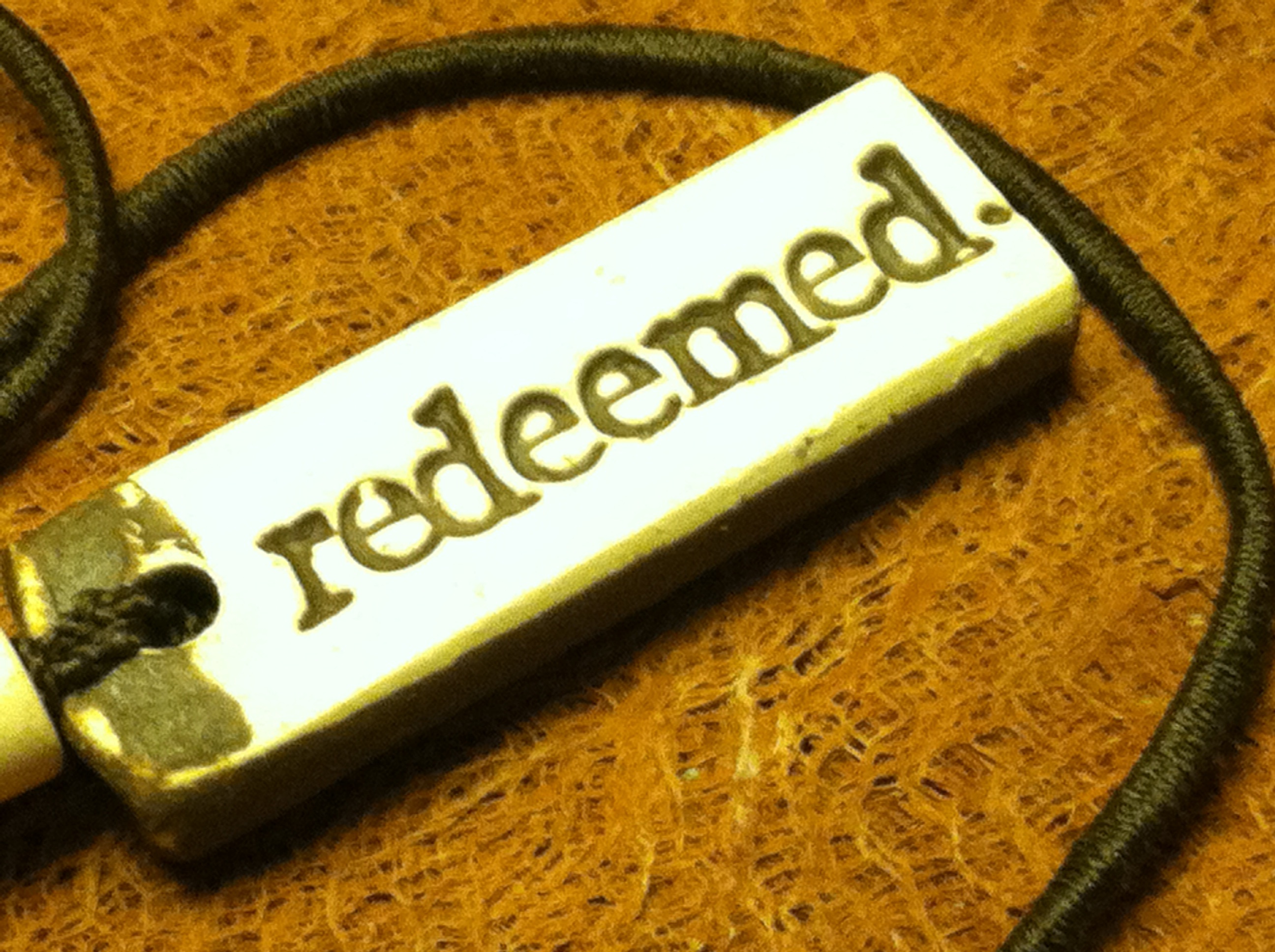
A few days ago I bought myself a new MudLOVE necklace (http://www.mudlove.com/index.htm). It says “Redeemed.” I picked this one over others that read “Blessed,” “Believe,” “Hope.” I picked it even over the “Set Free” necklace, which I bought last year but then gave away to a young man in Africa this past summer.

Redeemed.

MudLOVE does not have a necklace that reads “Perfect” or even “Perfected.”

That’s not surprising. Few of us are that egotistical, at least outwardly.

Perfection implies there is no need for any kind of change, no need for redemption. If something is perfect, it simply is. There are no marks of fixed flaws, no evidence of past issues.

Yet Christ told us to “be perfect, even as the Heavenly Father is perfect.” (http://www.biblegateway.com/passage/?search=Matthew+5:48&version=ESV)

Impossible—which was pretty much the point.

Which brings me back to redemption.

I look at my reference tools and find the definition of “redemption” that fits the Biblical idea of the word: “the buying back of something.” But when I switch to the thesaurus, it’s the synonyms that catch my attention: “recovery, renovation, reclamation (I like that one), restoration, revitalization.”

Yes, I think. This is what I do with my writing. I tinker, trying to reclaim a bit of the perfection the words seemed to have when they floated through my head.

But our perfection is more than a puff of smoke in our Creator’s mind. There once was perfection, when our actuality matched His design. Now, however, there can be no more perfection. We’ve been marred. So there must be “the buying back,” accomplished by the unmarred Christ, whose Perfection stepped in for us. (http://www.biblegateway.com/passage/?search=Hebrews+10:14&version=ESV)

So the positional perfection, the positional redemption has been accomplished. But what about all the synonyms? I don’t continually feel or act restored, recovered, revitalized.

I look at my necklace again. “redeemed.” There is a period after the word.

Hmm.

Bought back—past tense, completed? Yes.

Still being revitalized, reclaimed, restored?

Yes.

Redeemed. AND Redeemed…

When death breaks in

This morning I learned of the death of a former student.

Sudden, unexpected death.

Now, in this season of life, when we read verses like Zechariah’s pronouncement about Christ’s birth: “…the morning light from heaven is about to break upon us,” death has again triumphed, and a family is weeping. Christmas will forever be changed for them. Even when the great waves of grief have passed, every year, in the midst of celebration, there will be a tinge of sorrow.

Death has broken in.

My soul rages when I hear news like this. Somewhere deep down in me is the knowledge that this is wrong. It should not be like this. We learn to live with dysfunctional families, fallen bodies, mental illness–all the “subtle” reminders of a broken system. But then death breaks in and hauls us up short. We turn the corner from “life is hard but endurable–even good at times” to find that the passage before us is gone. It has dropped off and all we see is darkness.

“This is unacceptable,” I want to say.

But I have no power to change it. In fact, in my own small way, I, too, will wreak death as I walk through my days: wounding those I love most, including my own self.

I don’t always notice this, but then a life that intersects with my own is snuffed out, and capital-D Death makes me wail with a specific-yet-vague knowing of the shadow that hovers over our planet and in our very hearts.

At times like this I get a glimpse into what God must have felt when His beloved image-bearers made that irrevocable choice that doomed all of creation to groaning and travailing in a bondage of corruption.

God sorrowed–far more than we because He could see the great contrast between what was planned and what we chose.

But then He did more! The Lion of the tribe of Judah roared.

We thought it was simply a whimper–an insignificant birth, a controversial life, an ignominious death.

But no! It was a roar! “It is finished!” was a victory cry. His death had swallowed up death itself.

We are in the night of sorrow.

But morning will come.


The Teller and Star of the Best Story Ever

DSC_0743The “Prodigal Son” is one of the best-known stories in the world: a rebellious child runs away from a loving father; the father mourns; the child returns; the father welcomes; the sibling struggles with the restoration. (Luke 15:11-32)

Now I know the story speaks of “sons,” but because I am a woman and because many who read this blog are women, I want to remind us that we can fully identify with these two sons. We know we can do this because of how Jesus treated women and because of Paul’s words later in the New Testament. So even though I’m going to refer to the two characters as “sons” simply because I think it might be confusing if I didn’t, we can substitute “daughters” if it helps us to identify more easily.

The first “character” in this story is this wonderful Father figure. He loves His children. He longs for them to have fullness of life with Him. There’s no hidden story or sin. He is what we see: the beautiful, perfect Dad.

This Father has two children. (There’s actually a third one, but we’ll get to Him later.)

One of his kids is called the prodigal.

It’s an accurate title. This kid thumbs his nose at all his dad stands for. He is rude and disrespectful to him. We Westerners can’t quite get the full cultural ramifications of what he does in this story, but he is basically saying, “You’re standing in my way, old man. I don’t want to wait until you’re dead to do what I want to do. So fork over now what’s going to be mine when you kick the bucket, and I’m outa’ here. I don’t care about your way. I think all this love and peace stuff is boring and stupid. I want some excitement, and I want it MY way.”

He’s an obvious prodigal. Obvious. Some of us identify with this prodigal. We think, “Yes, that’s me!”

But some of us identify more with the other son. He’s the one working out in his dad’s business. He’s the one who looks like he’s his dad’s right-hand man. This guy appears pretty good, squeaky clean in fact. He’s very focused on pleasing his Dad, and he wants the other brother and everyone else to see that he’s the “good child.”

Somehow we see that as “better” than the prodigal’s attitude.

It’s really not, though.

Because deep down, this son is just as self-serving as the prodigal.

He doesn’t really “get” the Father’s way of living either. He doesn’t think it’s measurable enough, so he adds rules of his own. He wants the Father to look at him and say, “Good job! You’ve come up with such a great system. Why didn’t I think of that? This, yes, this, is how I should measure people’s rightness.”

This child is a legalist.

Not long ago I read a fantastic quote by Max Lucado. “Legalism,” Lucado wrote, “is the search for innocence—not forgiveness.”

The legalist child doesn’t want God to be bigger than he is. He wants to think that his level of “goodness” is better than God’s, so that God has to declare him INNOCENT.

He’s not seeking forgiveness. That would mean he was WRONG!

But he is.

He’s missing the mark just like the prodigal is! Neither of their ways—the lawlessNESS or the nit-picky rule-keeping—is anything like the beautiful GOODNESS of the Father.

The prodigal is at least honest about his waywardness. He leaves.

But the hypocrisy of the “good son” becomes very evident when the prodigal returns and the father’s will and desire are drastically different from the “good son’s.”

The father wants to forgive and restore and love and celebrate and move forward.

Not the “good child.” He wants to hold grudges and remember wrongdoing and use the “rules” to condemn the prodigal and exalt himself. His “goodness” is revealed to be self-serving, bitter, and proud.

They are BOTH prodigals.

WE are prodigals. All of us. Like one or the other of the two kids in this story—or somewhere in between them.

The Father is holding out His arms to all the prodigals. “Come to me!” He calls. “I’m looking for you. I want to hold you in my arms and heal your heart wounds and draw you into right, real relationship with ME! Come into the house and celebrate with me.”

Somewhere inside us we want this—but we also don’t want it. We’re not capable of choosing it for ourselves because we’re not good—and true, unselfish goodness is alien to our core nature.

If we stopped right here—with the Father’s open arms and our inability to be in His embrace—this story would be a tragedy.

And if some regular human were telling the story, it would be nothing more than a fairytale, a story told to entertain for a few minutes before we have to return to “real life.”

But the storyteller, Jesus, is not a regular human being. And he didn’t tell the story as mere entertainment. He told it because He has the power to make it come true—for each of us—and He wants it to become true.

Though He is the narrator of the story, He is also IN it. He’s the Son of the Father’s heart, the perfect representation and exact image of Him. He reveals to us in the flesh the beauty of the Father and the Father’s way. When we look at Him, we see our need for something bigger and better than ourselves.

In the story, the prodigal did both of these in the far country. In the pigpen he realized how lost he was. Then he thought about his Father and saw clearly the Father’s goodness. He went home because he knew the Father would extend mercy. (Little did he know how MUCH mercy the Father would extend.)

At this point, we still have a problem. Jesus awakens in us the realization of the Father’s perfection. In Him we clearly recognize that WE are not perfect. But if He simply told the story, and then didn’t DO anything more, we would still be in the far country like the prodigal or laboring in the fields with bitter hearts like the legalist.

We are simply not capable of true, eternal heart change.

But the Storyteller did more.

He died.

And through his death, He became the Way to the Father’s embrace.

He made the story Truth rather than fiction.

He delivered real Life that does not disappoint—unlike any fairytale we can imagine.

He accomplished LIFE through horrific death. That vertical line of His cross created a way for relationship between God and humanity. Clothed in the perfection of Christ, the Father can pull us close to His perfect heart. You and I both know that we couldn’t be there on our own.

Now here’s another wonderful thing about the cross of Christ. Its horizontal line created relationship between humans. When we’re gathered together at the foot of the cross, awed by the Christ and the Father’s perfection and goodness, all our own personal differences fade into nothing. The prodigal and the legalist can have relationship with each other because coming to the Father requires a stripping away of the outer to find we are all the same underneath. Put us in the light of eternity and in the presence of the holy, wholly good God, and those outward differences are GONE! Then we can relate—in reality, in truth and honesty, without pretense and masks, without competition.

Jesus is the Teller of the Best Story, in which He stars as our Way, our Truth, our Life.

NOTE: This is the script of a Gospel presentation I recently prepared, so it may sound more like a “talk” than a blog post in some spots.