Thank you, Horatius Bonar

Horatius Bonar! That’s a name you won’t forget! Mr. Bonar was a Scottish churchman and poet in the 1800s (1808-1889). He was one of eleven children (two of his brothers were John James and Andrew; who knows why Horatius got the far more interesting handle!). He was a supporter of the Scottish revival and wrote biographical sketches of many of the revivalists. He was also a pastor, an author of several books, a hymnwriter (he wrote hundreds of them!), a poet, and an evangelist. He was almost 80 when he preached for the last time in his church.

BIG things, a great resume, but what brought Mr. Bonar to my attention was a hymn that he wrote about small things, about praise filling “every part,” even the “common things” of life, so that fellowship with Christ makes all “duties and deeds” sacred and turns each “fear, fret, and care” into a song.

I like to be able to sing my hymns, and the original tune for this, though very pretty, is not well known. However, it can also be sung to the tune of Isaac Watts’ “I Sing the Mighty Power of God,” with two stanzas of the hymn below combined for each verse. Hope you enjoy.

Fill thou my life, O Lord my God,
in every part with praise,
that my whole being may proclaim
thy being and thy ways.

Not for the lip of praise alone,
nor e’en the praising heart
I ask, but for a life made up
of praise in every part!

Praise in the common things of life,
its goings out and in;
praise in each duty and deed,
however small and mean.

Fill every part of me with praise;
let all my being speak
of thee and of thy love, O Lord,
poor though I be, and weak.

So shalt thou, Lord, from me, e’en me,
receive the glory due;
and so shall I begin on earth
the song forever new.

So shall each fear, each fret, each care
be turned into a song,
and every winding of the way
the echo shall prolong;

So shall no part of day or night
from sacredness be free;
but all my life, in every step
be fellowship with thee.

Thank you, Horatius Bonar, for using your God-given talents to bless me with these words.

Note: If you would like to read more about Mr. Bonar, a Google search reveals several sites about him and lists his other hymns as well as his books. His personal life was just as busy as his “professional” life of pastoring and writing. He and his wife, Jane, also a hymnwriter, had nine children, but five of them died very young. Later one of their daughters was widowed, and she returned, with her five children, to live with her parents. Jane died when Horatius was in his early 60s, and he suffered with illness for the last couple years of his life.

Oddly enough, though he wrote more than 600 hymns, his church did not sing hymns during the worship service! Late in his life, he began to sing one of his hymns in a worship service, and two of the elders walked out.


From grouchy to glorifying

I took this today in our front yard. What an amazing blue sky!

Yesterday’s getting-ready-to-go-to-school was grouchy. Nothing major, just a lot of little things that resulted in rubbed tempers that we carried all the way to the car and on the drive to school. We lacked harmony.

As I drove, Maddie recited her memory verses, Psalms 86:10-13. She had a Bible in her lap, but she wasn’t really looking at it, just reciting, and I was sure she had one of the phrases wrong.

“Look at it, Maddie,” I told her. She repeated the same phrase.

“Are you looking at it?” I asked her.

“I’m saying it, Mom.”

“I know, but is that what it says? You’re still saying the same phrase.”

Repeat above conversation—maybe a couple times.

Then Em jumped in. “Mom, she’s reading it.”

“No, she’s looking at me in the rearview mirror.”

Repeat THAT conversation.

Finally Maddie looked, saw the correct phrase, changed it, and went right on with the rest of the passage.

Being who I am (a little stuck on being RIGHT), I felt I had review what had happened. “Mads, do you see what I meant now? I just wanted you to LOOK at it. It’s not a big deal, but I didn’t want you to memorize it the wrong way.”

She said, “yeah, I do,” and conversation went on in the car, but it all felt “off” to me—the entire morning.

So after I dropped the kids off, I started examining both the morning and my heart. Why didn’t it feel right to me? What, exactly, was wrong? What should I have done differently? I couldn’t even seem to talk to God about it: my prayers felt distant and stiff. What was going on?

As I wrestled, a little chorus in my head got louder and louder until I finally paid attention to it.

It was a phrase from the verses Maddie had been reciting.

“Teach me Your way, Lord, that I may rely on Your faithfulness.” (11a)

Little aha! moment then: His faithfulness, not MINE. Part of my being unsettled was due to my feeling that I didn’t handle the morning well. I’d been relying not on God’s faithfulness but on MINE—yikes!

More revelation: His faithfulness, not my CHILDREN’s. Oh, a very real moment of clarity. Whenever I rely on other people—that they should do the things I think they should do, that my well-being and my state of mind is based on how they act or react to me—my reliance is on THEM and not on Christ. I had not been relying on God’s faithfulness—a solid rock—but on the shifting sand of people’s faithfulness.

Then real prayer came. “Oh, Lord, You alone are faithful. Forgive me for relying on anything or anybody other than You. Forgive me for wanting a smooth morning more than intimacy with You.”

The end of the passage came flooding to mind then. Verse 13: “Great is Your love for me; you have delivered me from the depths.” Yes, once again He had rescued me from my pit of self-sufficiency and self-focus—and He did this because HE LOVES ME! Because He wants fellowship with me! Because He is not willing for me to live a fake, less-than-real life but wants me to have abundant life with HIM!

I was now full circle around to the first verse of the passage. In just a few minutes God had brought supernatural change to my heart—and heart transformation is no small thing! Psalm 86:10 says, “For You are great and do marvelous deeds; You alone are God.”

Yes! Only God can change a heart.

At this point I was able to recite the entire passage—and mean it.

“For you are great and do marvelous deeds; you alone are God.

Teach me your way, Lord, that I may rely on your faithfulness;

Give me an undivided heart, that I may fear your name.

I will praise you, Lord my God, with all my heart; I will glorify your name forever.

For great is Your love toward me; you have delivered me from the depths, from the realm of the dead.”

Amen.

opportunities

Philip from Uganda preached in church yesterday. His message beautifully translated across cultures and accents. At the end of it, Judy, the older of our international students, turned to me and said, “I really liked that. I understood it.”

His focus was all about how our salvation does not, cannot rest in our works but only in our faith in the work of Christ.

Ironically, though, I left a little discouraged.

Philip is an evangelist. That’s his gifting. I’ve known that for a long time, ever since I walked streets in Uganda with him when I was working on Patrick’s adoption. I watched conversations between him and others go straight to Gospel without the other person feeling coerced. During his sermon yesterday, Philip told of how he is using this gift on Chicago’s transit systems. He prays for opportunities, he sits next to people on the Metra or El, and pretty soon he has their history with God (or lack of it) and he’s sharing about Christ.

After the main service, I talked with Ray, one of my oldest friends in our church—really, he’s in his late eighties, with grandchildren almost my age. He shared some of his latest conversations with me. Ray’s always had a “gift for gab” (as my mom says it), and in retirement he began walking the Prairie Path every day and stopping total strangers to ask if he could pray for them. In all the years he’s done this, only two have ever told him no. More often people tell him their struggles or their life stories and thank him for praying.

I left church knowing that Philip was headed to the train station and Ray to the Prairie Path—and probably both would have Gospel conversations with a total stranger before the day was out.

I left knowing that I probably would NOT have one of them.

I grew up always feeling vaguely guilty about not enjoying sharing the Gospel on street corners or with salespersons. I used to beg God for boldness, for opportunities. I reviewed conversations I’d had with acquaintances or unbelieving friends, trying to find spots at which I could have turned the conversation toward God, beating myself up for “failing” to witness.

About seven years ago I joined an ongoing writing workshop class. Almost none of my classmates would have called themselves “followers of Jesus.” I watched and listened a lot the first couple of classes, and then my guilt set in. I began praying for boldness and opportunities as I drove to class. I didn’t hold back when people asked about me—answered with “Christian school teacher, husband teaches Bible,” but no “opportunities” opened up, though I had plenty of conversations. Then, one day on the way to class, the Holy Spirit interrupted my frantic praying. “Be quiet. Wait. Listen. RELAX!”

Really? I couldn’t believe what I was hearing. But I tried it, began to listen more than talk, began to learn about people’s lives. I focused on giving really good critique and willingly took the advice of others about my writing. I worked on excellence in my writing and humility in my attitude.

A year or so into the workshop I considered many of the other members to be friends. One night, as we chatted late after class, one of them said, “You talk about God so naturally, Jen.”

What?

“I do?” I asked her.

“Yeah. You’re always talking about the things you’re learning, what He’s teaching you.” She saw the look on my face and hurried to say, “No, it’s okay. That’s what I mean. It doesn’t seem forced. It’s just part of you.”

Thankfully I was grateful rather than proud—amazed more than anything. I didn’t realize that had happened! God had made me comfortable with these people, had knitted friendship between us. He’d put love in my heart for them. He had done the work; I had just listened. So though I still prayed for them on my drives to class, it was no longer forced but natural, with concern, specific to their needs. God did that, not me. Even now, though it has been years since I’ve seen many of them, I still pray for them, not out of duty but out of love.

God brought all this to my mind in the middle of my guilt yesterday, in the middle of my comparing myself with Philip and Ray. It was a good reminder. I DO want to pray for boldness and for opportunities, but I need to do so with rest, with confident trust that He will provide both, and that the opportunities He has picked out for me are especially chosen to use the ways He’s gifted me. My opportunities may not make for great stories, but they still testify of His Gospel work and His redemption—both in other people AND in me.

And speaking of my different kinds of opportunities, at one point yesterday afternoon, I realized that, somehow, Judy and I were home alone together (Dave had carted the younger ones along to Em’s soccer practice and Kelly was still at the b-day party). I sat down next to her at the dining room table (aka the “homework table”) and asked, “How are you?” We talked without a single interruption for thirty minutes, about relationships, adjusting to four siblings, all the “new” that she and Kelly have encountered in the last seven weeks, small ways we can accommodate and care for each other better. “You know,” I told her, suddenly seeing truth in that moment, “this is grace! We have eight very different people all lumped into a house together. It’s God’s grace that we actually desire to grow in relationship with each other, that we want to love each other well.”

Oh, I have opportunities all right. They may look different from Philip’s and Ray’s, but that’s okay.

I just need to see them for what they are.

And I need to celebrate the work God is doing in and through me.

absolutely no connection with the blog topic–but I liked how the light shone through the glass.


six little words

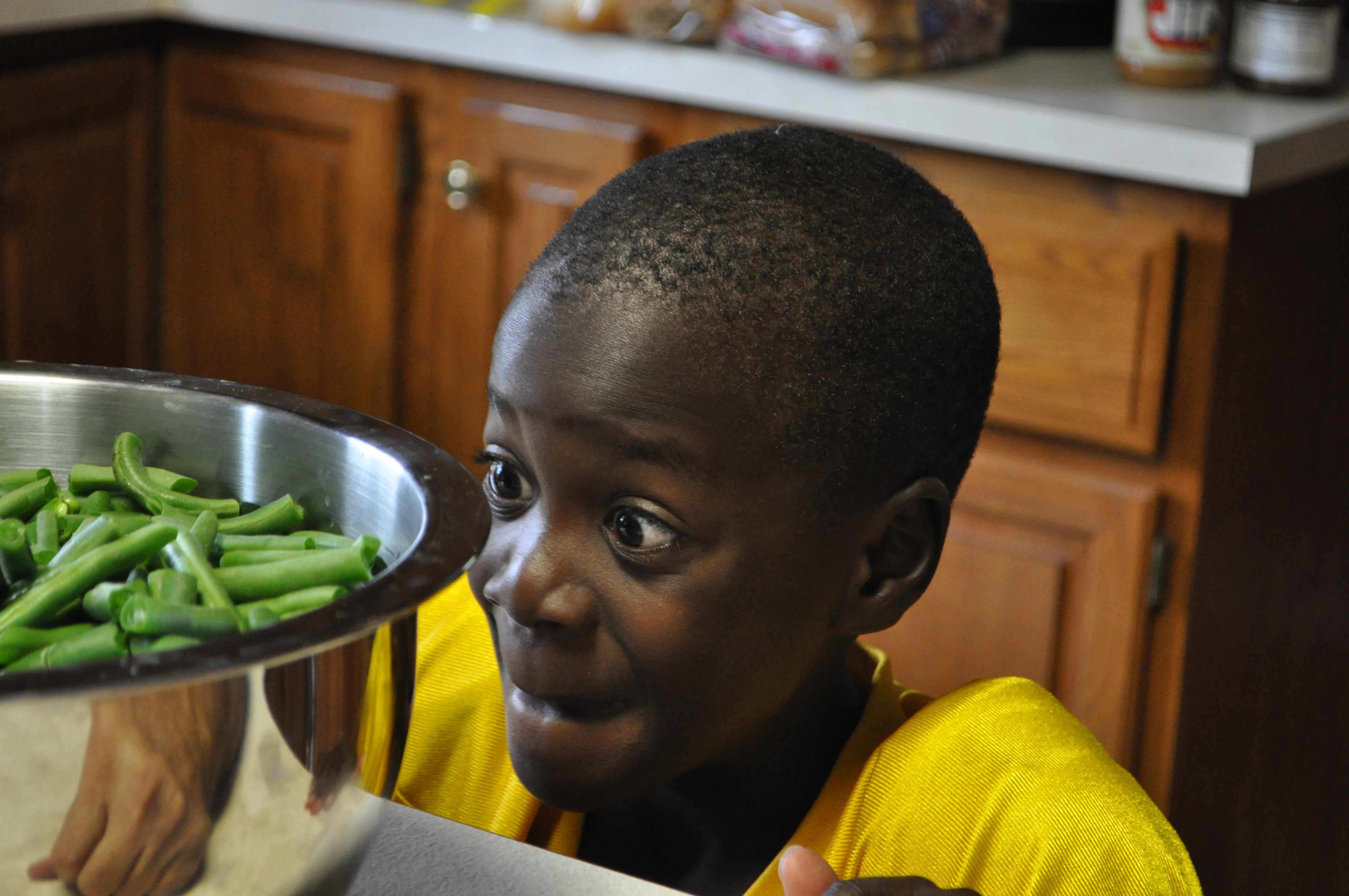
He does like green beans, but he’s more excited about the distorted reflection of his face on the side of the metal bowl! PJ’s six word memoir (according to me) would be “exuberant: finding the beat of joy.”

A few years back Smith Magazine (an online storytelling mag) issued its readers a challenge: write your life in 6 words.

Six little words.

The idea was based on the legend that Hemingway once wrote a story in six words: “For sale, baby shoes, never worn,” but SMITH took it further and asked readers to write their own stories. “Six-Word Memoirs” became a project, a “global phenomenon“ (I’m borrowing words from SMITH’s own Web site: http://www.smithmag.net/sixwordbook/about/, which has lots of great 6-word memoirs!), and a best-selling book series.

Somehow I didn’t hear about the “global phenomenon” until this past spring, but when I did, I wrote my own (more on that later).

When Dave began teaching Culture and Theology to high school seniors just a few weeks ago, he came home with this dilemma: “Many of them don’t seem excited about the Gospel. How are they going to get excited about how it can work in our culture?”

They can’t. Truthfully, none of us can get excited about the Gospel until we see it at work in our own lives. Only then will we be awed and fascinated by the ways God uses it to transform others.

So Dave backtracked in his class. “How has the Gospel impacted YOU?” he asked them. Not simply with initial salvation or coming to Christ (though he did some unpacking about the enormity of that), but what about since?

He showed them an online video ( http://gospeljourney.com/) that features spoken word artist Jason Petty. Borrowing from SMITH, it tells the Gospel in six words: “God. Our. Sins. Paying. Everyone. Life.” Dave combined the two ideas: Write your own Gospel story, he told his class. Yes, the Gospel at its core is the same: God has set us free for an abundant life made possible by the perfect death of His Son, but make it personal: what is He setting you free from? What is He setting you free TO?

I loved the idea and, of course, tried a few more of my own. My first one had to do with the fatigue of that day: “motherhood—overwhelming role. Who am I?” But then I began looking at my big-picture issues (people-pleasing, guilt, martyrdom, pride, etc.—there’s a lot) and I tried several others. When I compared these with the one I wrote last spring, they were similar.

Here’s my latest draft: “Recovering perfectionist, learning I am ‘Be-loved.’”

What’s yours?

Manna and character

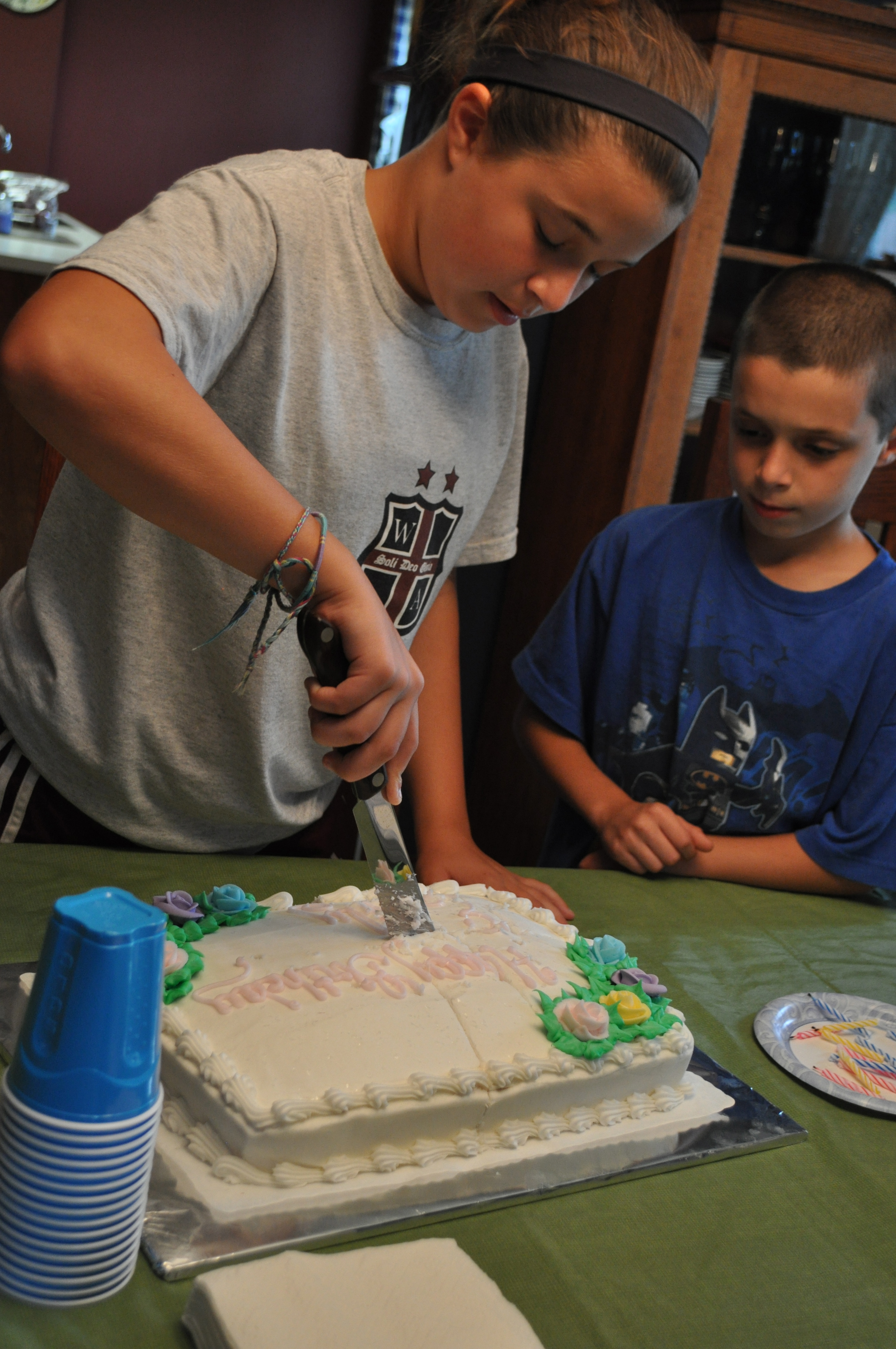
My oldest is now 12!!! I can’t believe it. Here she is cutting her cake while a very anxious Jake looks on.

Some roles and jobs/careers are so much a part of our lives that we have a hard time knowing what we would be like without them. Would we be different people? Yesterday I wondered what I would be like if I’d never had my children. (I have to admit that I sometimes ask this question and think, “I’d be more peaceful!”)

Maybe I would be more peaceful, but I think I would also be less flexible, more uptight, more serious in a not-good way. I’d be less aware of my own faults, less willing to seize joy in the unexpected, and less willing to expose my messiness (literal and figurative) to others.

God has given me an amazing gift for my character in the form of my children.

In any role that is so much a part of us that we can’t imagine life without it, it can be easy to forget that this role is a gift, not just a gift for others or a gift that brings enjoyment to US, but a gift that is meant to shape us and remind us.

When the Israelites were in the wilderness, gathering manna morning after morning (except on the Sabbath), they forgot that the manna was a gift. They forgot that it was the very thing that kept them alive. They forgot that the manna was teaching them some incredibly important principles:

  1. To trust God in the moment. He was already providing direction with the pillar of cloud/fire. Now He was taking it to an even deeper level and reminding them that even their daily food was a gift from His hand. Without Him, they would not survive, but He had promised to provide for them—and that promise applied to even the food they ate.
  2. To believe that God will continue to provide. The Israelites tried to do what we ALL do when we’re given a gift: they tried to hold onto it, to hoard it. They thought of it as THEIRS. But hoarding the manna didn’t work. The extra had worms the very next morning. It stunk!
  3. To be grateful, to remember it’s a gift and not take it for granted—or worse, to complain about it. God told Moses to preserve some manna in a jar. “’Let … it be kept throughout your generations, so that they may see the bread with which I fed you in the wilderness, when I brought you out of the land of Egypt.’” Ex. 16:32.
  4.  To be creative with what God gave them. He told them they could bake or boil, even shape it into cakes. Maybe some of the Israelite men even figured out how to grill it! God knows our tastebuds. (In Deuteronomy 14:26 God talks about celebrating the tithe to the Lord. He tells the people to enjoy “whatever [their] appetite craves.”) The manna was good to the taste already, but God gave them freedom to create other flavors with it.

That certainly isn’t an exhaustive list, but I can learn a lot from just these four things. After gathering manna for years upon years, the Israelites got pretty used to it. They thought of it simply as a job they had to do every day. It gave them food. It had to be done, blah, blah, blah.

Sometimes I have the same attitude toward my roles—my gifts. Being a wife, mother, writer, tutor, friend, neighbor… These are GIFTS to me, and with each gift come lessons that are meant to make me more and more like Christ.

Lord, help me to trust You in each moment for all my roles. Help me to trust that You will never leave me on my own to accomplish the work that You’ve called me to do. Help me to be grateful for it, and help me, please, to be creative in it, to take great JOY in it. And, finally, Lord, may I be shaped through it to look more like You.

“Thank You,” and, “help, please”

End of day. I climb into Em’s loft for our almost-nightly time of talk and prayer. She scoots over her pillow, and my head sinks next to hers. We are both quiet. My eyelids droop. Sleep beckons. I fight back.

“Want me to pray?”

“M-hm.”

“Lord…”

I am usually a long pray-er, but tonight words seem heavy. My tired brain struggles to use them well enough to express the thoughts swirling in my mind. Thinking them is enough work for this moment late in the day.

Finally I say, “Thank You.”

And then, “Help, please.”

Em is not asleep, but she seems content.

And I am, too.

Because my wise God knows my thoughts and intercedes for me, and, though we clearly need the eloquence of phrases and clauses (there are 150 Psalms, after all), sometimes just a few words will do.

And tonight, “thank you” and “help, please” are enough.

Lessons in the journey

Yes, those are pigs racing. On my birthday, we went to hamburger joint in a tiny town near Red Lodge, Montana (we were on vacation there), that had pig races, one every fifteen minutes starting at 7 p.m. The kids absolutely loved it! I rooted for every little black pig, but not a one of them ever one. I think black pigs are CUTE!

NOTE: I wrote this a couple weeks ago, but am just now getting around to posting it.

I am 42 today. I woke without remembering this fact and had just about decided to slip out of bed without waking Dave when he whispered, “Happy Birthday, hon.” Since then I’ve been reminded of it often, since my children came up with the idea of singing “Happy Birthday” to me 42 times. They’re up to 12 by now, but I’m hoping they run out of steam.

I don’t mind the 40s, don’t mind getting older, but my birthday has reminded me of my “to be accomplished by 40” list. Actually, it was first a “by 30” list, but when it didn’t happen then, I just moved it, first to 35, then to 40.

The list only has one item:

Get a book accepted by a publisher.

It didn’t happen by 40, still hasn’t, but I’ve decided against a “by 45” list.

It’s not that I’ve given up. I’m still writing, still working on book proposals, still sending them out to be rejected and returned.

And, boy, am I still learning.

Still learning to write, more and more with every year, every assignment, every blog posting, every review one of my editor friends so graciously gives me—for free!

But I’m also learning about patience and faith. I’m learning about humility and peeling fingers off of brittle dreams and opening arms to the unknown.

It’s been an interesting journey.

About nine years ago, just before I learned I was pregnant with the twins, I decided my research/submit/rejection system wasn’t working, so I took a correspondence writing course. It started with baby steps: “Write an announcement for your church bulletin” and “Draft a help wanted ad.”

Two months in, it seemed to have barely moved forward. “Seek out opportunities to write for your church’s newsletter or for any small, local papers.”

“That isn’t the kind of writing I want to do,” I thought. “I want to write children’s and young adult stories. I want to write books.” I didn’t take the followup course, and the next spring I began attending a local writing class, where I shared the progression of my young adult novel, five pages a week.

Several from that class became good friends, and most of these have had some writing success. One has found a niche in genre literary journals; another works as a corporate freelance writer and is currently shopping around a novel; and the leader of the group is one of those professional editing friends who gives me the phenomenal advice I mentioned earlier.

But my journey has been more roundabout, as if God had some extra lessons for me that had nothing to do with the ability to write sizzling dialogue or attention-grabbing introductions.

In hindsight I can see His wonderful irony. For instance, my first “published” piece in those years was—aha!—a piece in our church’s newsletter. The second was the same.  Then we moved to Sterling, Kansas, primarily for Dave to coach the men’s soccer team at the college there but also so I could have more time to write, to finish the young adult novel and shop it around.

But I “fell” into a job almost right away, writing and editing copy for the college’s marketing department. I wrote brochures and letters, and worked my way into tracking down news releases, doing interviews, writing news stories for small-town newspapers, and, eventually, creating pretty much all the articles for the college’s alumni magazine.

It was exactly the kind of writing I had not been interested in a few years before.

But I learned so much! And I enjoyed it. In a tiny town in the middle of Kansas, I learned to value the “small stories” that, looked at with perspective, fit together into God’s BIG story.

And I began to value the “little” writing assignments I was getting to do as well.

Still, when Dave suggested that I write the story of Patrick’s adoption, I resisted—for lots of reasons, but in part because it’s just “one” adoption. I’ve met families who have adopted two, three, four children, others who took in kids with special needs. I’ve read about and known people who pursued orphans with a passion that makes mine look puny.

I’m writing it, though. I think I’m supposed to.

But I’m letting go of the dream of getting it published. Because maybe that’s not supposed to happen. Or maybe I’m supposed to swallow my pride and self-publish it.

Maybe this book—and every other bit of writing I do—isn’t supposed to be about me at all.

That, I think, is the biggest lesson of all.

A beautiful sunset we watched from the cabin’s back porch. We quoted “The heavens declare the glory of God!” a lot that week.

Practicing contentment


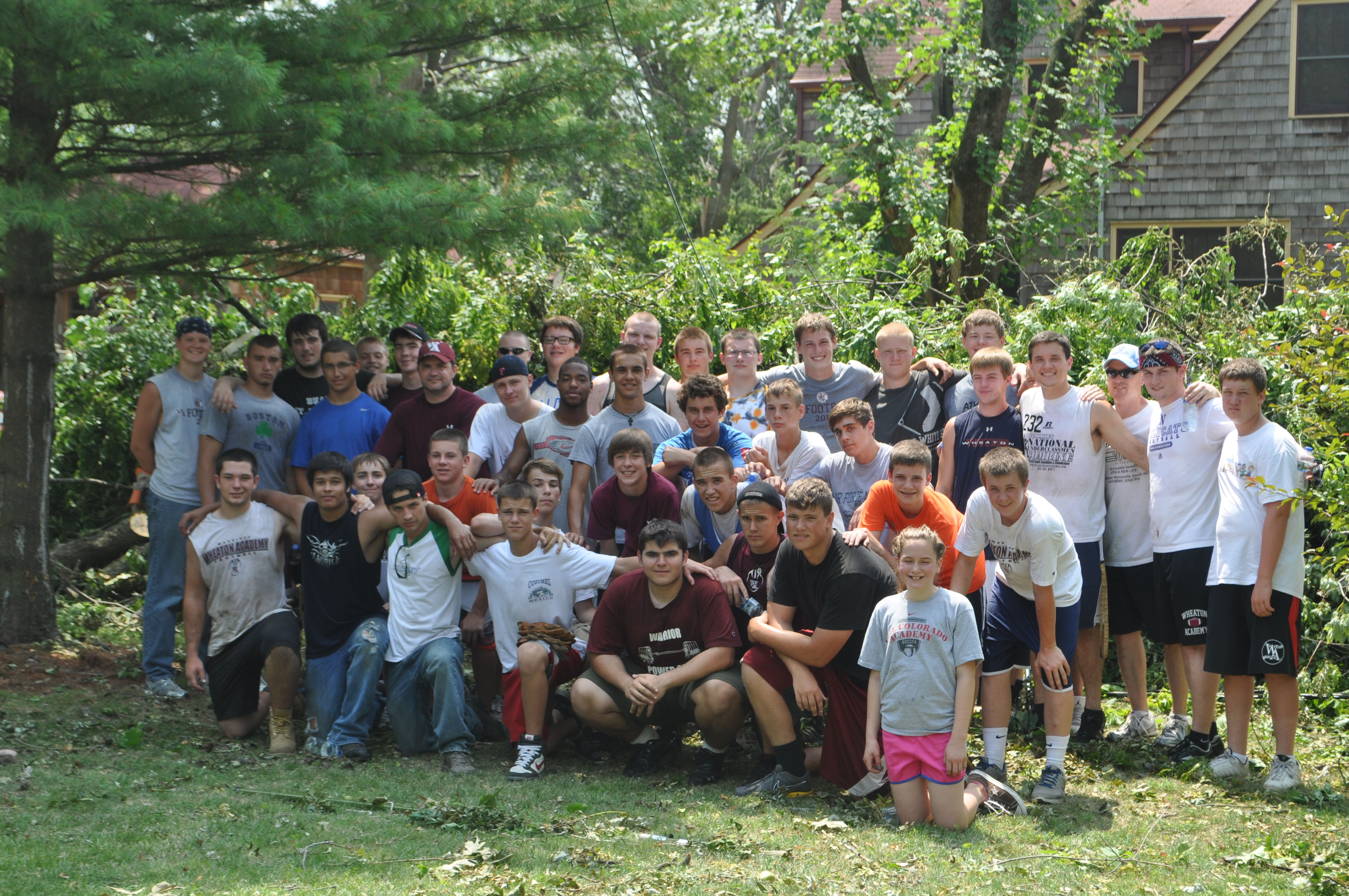
Here are the WA football players standing in front of the “hedge” they “built” in front of our house with all the tree debris they gathered from our yard on Tuesday. They were SUCH a blessing and encouragement to us.

After nearly five days without power, our street’s electricity was restored Thursday evening, so we moved out of the home of our very generous friends and back into our own. When we got there, the kids walked around and examined the house. Finally Jake said, “Well, it doesn’t look THAT different.”

Em and Maddie were shocked. “Jake, look at the yard. Half the trees are gone. There’s a hole where the pear tree used to be.”

“Yeah,” said Jake. “But look at the house without all the trees on it. It’s not that different. It’s good.”

What a great reminder. Because on the first day of this “experience,” it was pretty easy to realize that it could be a lot worse and not too difficult to focus on and pray for others’ needs and difficulties—but in the following days, when the power lines stayed down in the yard and the 6 ft. “hedge” of cleared brush grew brown and the insurance guy still hadn’t come out to give a quote so we could finally get the tree cleared off the back porch and I couldn’t get anything done…

I began to get a little grumpy.

Paul said he had to “learn” contentment. Well, it certainly doesn’t come naturally for me either!

I tried urging myself to “just be content,” but that didn’t work very well, and then I remembered Ann Voskamp’s words in One Thousand Gifts about voids. Paraphrase: You can’t replace sin with NOTHING. You can’t just try NOT to sin. Instead you have to “put off-put on,” a Biblical pattern (Voskamp does a beautiful job with this—and goes far deeper; I highly recommend her book.) My frustration/lack of contentment cannot be countered or replaced with nothing. Instead I have to fight it and replace it with its opposite (more accurately, I have to cry out for help to do this).

So what is the opposite of “discontent”? Voskamp suggests that “gratitude” is.

Ah, that evasive friend, gratitude!

When I practice gratitude, in all situations, I learn contentment.

I’ve prayed a lot about this (I’ve written about it a lot, too. “Looking for poop” is an earlier blog entry about this same topic), and I’ve discovered that the practice of consistent gratitude is linked to my focus. Contentment doesn’t happen when I go through life primarily noticing the negative. Contentment actually happens when I practice looking at all things, “good” and “bad,” as blessings from God.

THEN, my gratitude builds and my contentment grows.

This past week I had to practice a lot. I’d had plans to finish getting the house settled after we got back from vacation in Montana this past Sunday. I wanted to go through all my e-mails and lesson plans before heading off to teach at a month-long international student camp on July 7. But my to-do list had to be set aside. And I don’t handle that very well.

But God kept reminding me to practice this different way of looking that transforms frustrations into blessings.

I tried to see “days getting ‘nothing’ accomplished” as “unhurried hours building relationship with my children and my friend.” And when we moved back into our house on Thursday night, I refused to look at the box of still-packed “stuff” in Em’s room or the unhung pictures leaned up against walls—or even at the things completely out of my control, like the green tarp covering the empty dining room window frame.

Instead I focused on the organized kitchen and the naturally cool basement. I enjoyed turning lights ON and listening to the steady hum of the window air conditioners.

I read to my children before bedtime and then watched their peaceful sleep.

I had to practice again the next day, and I will have to tomorrow as well. And then again the day after.

Perhaps, someday, I will be able to say, with Paul, that “I have learned in whatever situation I am to be content.”

Based on my track record, though, that probably won’t happen till I’m 95.

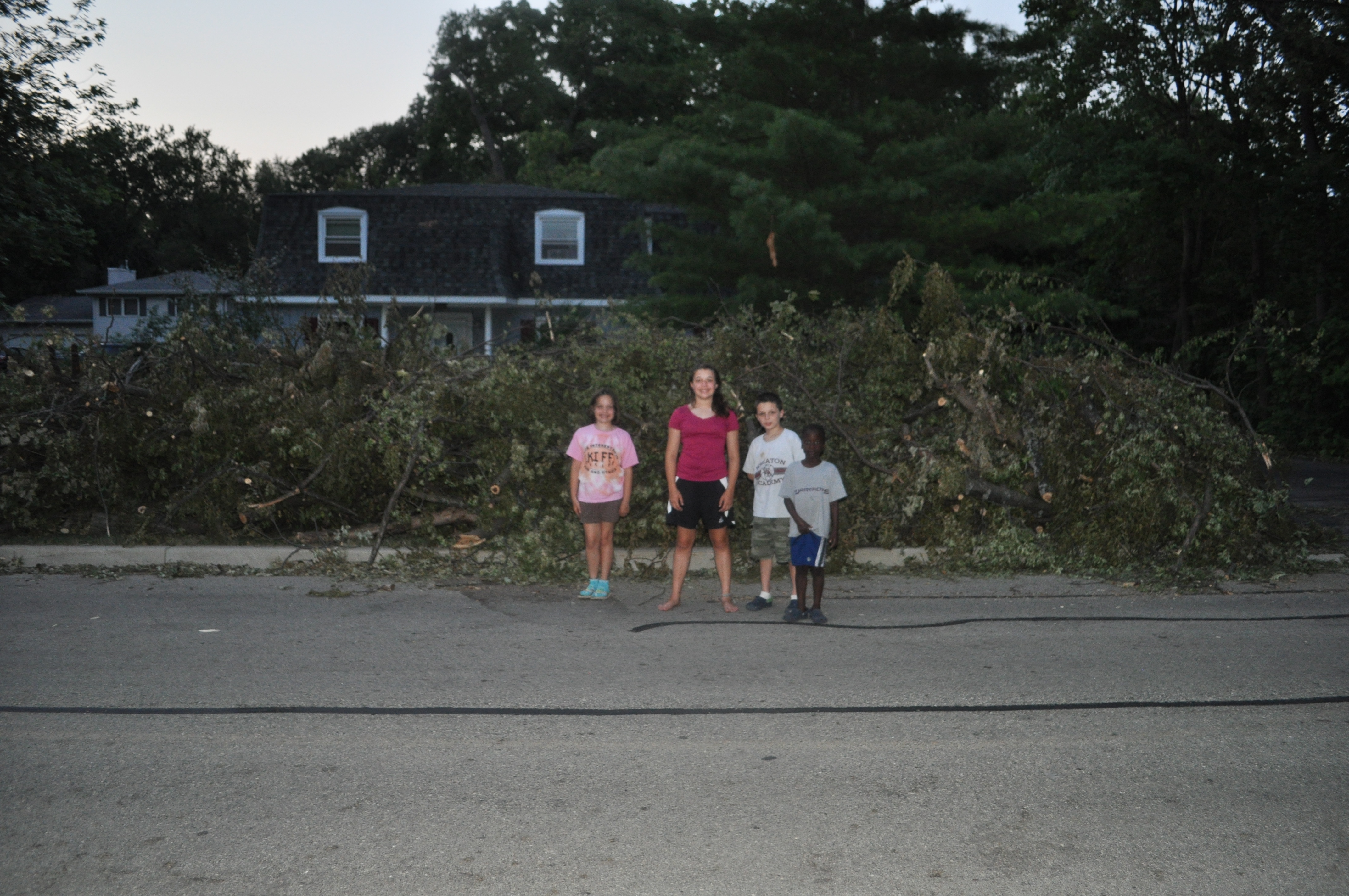
And here are our kids standing on the street side of “the hedge” on Thursday night. Kudos to the town of West Chicago and all the people who worked (and are still working) on the clean-up. Our hedge is gone now, and everyone has power restored.

damage to the temporal

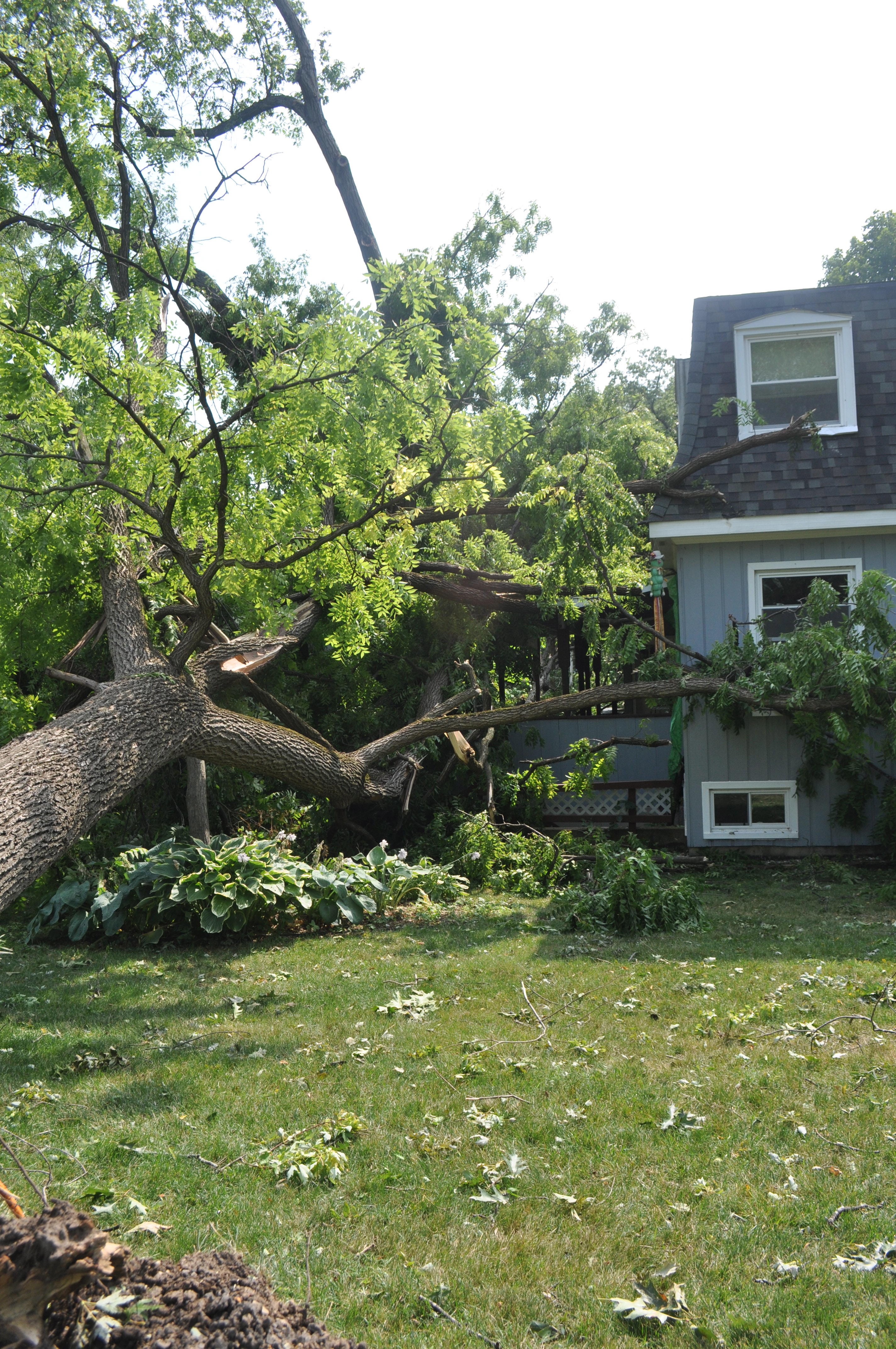
I took this picture standing in the neighbor’s yard, facing the west side of our house. The tree was pulled up by its roots (leaving a 6-foot crater underneath them–you can see just the edge of the roots in the bottom left of the photo). All three windows in this picture are fine. It’s the one on the back of the house that was smashed. And our back porch is under the tree. Kudos to the former owner who built the back porch. It would have been completely obliterated if he hadn’t done such a good job.

When we left for vacation in Montana a week and a half ago (the reason I haven’t posted in awhile), I was just at the point of feeling somewhat organized in our new home. “We’ll even come back to a clean kitchen,” I told Dave as we drove away from West Chicago. “But I didn’t get to the dining room. I really wanted to sweep under the table.”

This morning, as I swept the dining room, putting window glass broken by Sunday’s storm into a plastic bucket, I remembered saying that–and I laughed.

When I told Dave, he laughed, too. “And to think that I thought I HAD to mow the back lawn so the neighbors wouldn’t be appalled by the height of the grass.”

We were driving back home, still in the middle of Minnesota, when my friend Kristine called. “Jen, there’s been a bad storm. I’m going to check out your house in a few minutes. Mine’s fine, just no power.”

A few minutes later a neighbor called Dave and shared the news: several trees down in our yard; one window completely broken by a limb; the back porch roof smushed; maybe some roof damage; no power–and that was probably out for several days.

The good news: our kind neighbors had already pulled the tree limb from the window and tarped it in case more storms were coming.

We drove into West Chicago about eight that night. The park down the street from our house looked like someone had bombed the trees. Later we learned that about 80 trees were split or downed.

Our front yard didn’t look a whole lot different. “I was trying to imagine the worst,” said Dave, “but this is crazy!”

When we walked around the corner of the house, we saw the huge tree from our neighbor’s yard lying on our back porch roof–just a few feet from the corner of the house. If the wind had been from a slightly different direction or twisted the tree just a little differently… “This could have been so much worse,” we told each other.

We’ve had so many things to be thankful for during the past couple of days, and it’s a joy to share them:

-within two hours of being back in West Chicago, we were comfortably settled in our friends’ air-conditioned, lighted home. Thank you, Vishanoffs.

-we’ve met and talked with one neighbor after another in the past couple of days. We’re praying for genuine conversations, open doors, and deepening friendships.

-this morning 39 Wheaton Academy football players showed up and cleared amazing amounts of debris. I was inside sweeping glass from the dining room when Dave came in, choked up with tears. “Have you SEEN how much they’ve done, Jen? It’s amazing!” Not only were we blessed and encouraged, our neighbors noticed.

-and God has continued to provide joy and perspective: we have several people in our neighborhood who have tarps fastened over large holes in their roofs–and yesterday morning I happened to look at a National Geographic article about the perennially flooded people of Bangladesh, who accept what we consider tragedy as normal life. That puts our temporary inconvenience–to what is only temporal

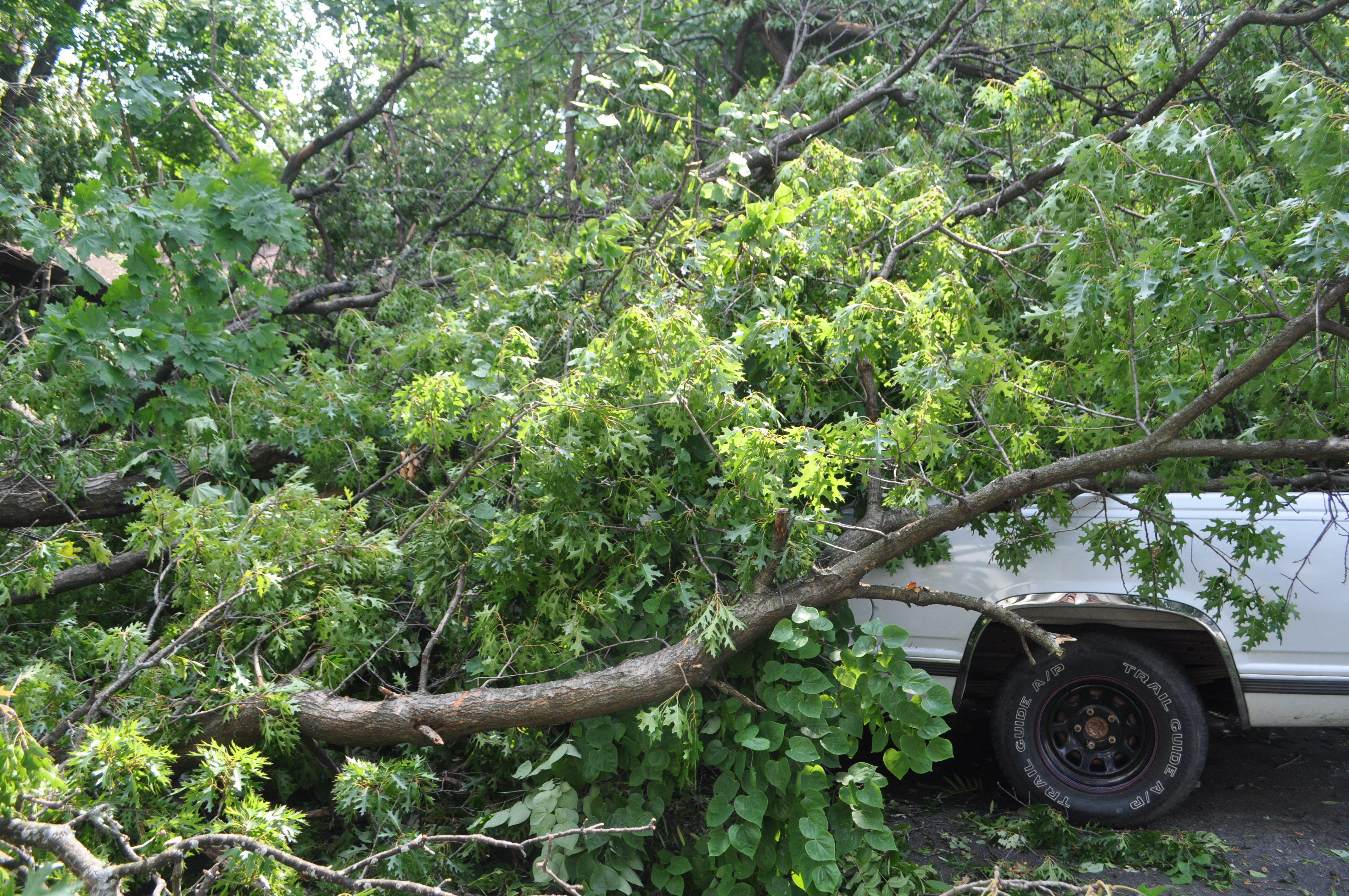
Is there a truck under there? Yes! Dave’s 1994 Chevy (which we called “Big Whitey”) got smashed. Since he’s been hoping to get a newer truck anyway (one that gets more than 10 miles to the gallon), he wasn’t exactly upset.

anyway–in great perspective.

I’ll write more about the trip to Montana later this week.

Thanks for reading.

Jen


a cycle of gratitude

No! Not ours! Em and Maddie oohing and aahing over baby Silas, son of Aaron and Jody. He’s very adorable.

Last week my kids attended a Backyard Bible Club. On the last day, as we parents came early to listen to the kids sing the songs they had learned during the week, I overheard a young mom behind me say to another mom, “Oh, yes, I have four children, ages 5, 4, 2, and 7 months. And we’re trying for a fifth. I just want another one, you know. They’re so precious.”

My shoulders slumped. That’s not my sentiment at the best of times, and it certainly wasn’t last week, as I was focused on unpacking my house. At one point in the week, I told Dave, “You know, it’s real easy to forget that one of the major reasons I’m getting this house organized is to make a home for our kids.  It’s ironic that much of the time I just want them out of the way so I can get it done.”

In church yesterday, as I took notes on the sermon, I also wrote this in my journal: “Help! I don’t want to be a mom right now. I want to be a child, YOUR child, Lord. I’m tired of the responsibility, the constant need to do so much and be so much to these four children. I can’t do it. Please, Lord, hold me like a little child, pull me close to your chest and help me to rest. To do this job of being a mom, I need to be Your little child.”

The sermon yesterday was on the first part of Colossians 4, in which Paul tells the church at Colosse (and us) to “Devote yourselves to prayer, being watchful and thankful.” Our pastor had a lot to say about this and the verses that followed (check out his blog at craigsturm.wordpress.com), but he said this about the “thankful” part of that verse: we should be thankful for the very privilege of prayer itself.

I connected that to the prayer I was writing in my journal. What an amazing thing that I can cry out to the almighty God of the Universe with a prayer like that! I have His attention. He bends His ear to my helpless, self-centered appeals.

Today I read the hymn “All for Jesus, All for Jesus,” in which the hymnwriter Mary D. James (1810-1883) takes this idea a step further. Here’s the last stanza:

Oh, what wonder! How amazing!

Jesus, glorious King of kings,

Deigns to call me His beloved,

Lets me rest beneath His wings.

All for Jesus! All for Jesus!

Resting now beneath His wings;

All for Jesus! All for Jesus!

Resting now beneath His wings.

I love that line: “(He) deigns to call me His beloved(.)” I can be thankful that, as His beloved, I can pray to Him about everything.

And I can be thankful that my prayers for help are answered, that in being His helpless, needy child, I can parent more and more in the way He wants me to.

Gratitude for the privilege of prayer itself. Gratitude for the deeper relationship it draws me into.

Prayer: a cycle of gratitude.