Mother’s Day–and the other 364 days

*Audio is at end of post.

On Mother’s Day, my motherhood is all clean and shiny; I get cards that tell me I’m very much appreciated for all the things I often feel go unnoticed, and my mom-failures don’t get mentioned.

But during the 364 other days in the year, I often feel like my motherhood needs some spit and elbow-grease polishing.

So, with the assumption that almost all other mothers feel the same, I’d like to share with you part of a message I listened to this past week. Dr. Crawford Loritts was speaking on Psalm 23, and his comments on one phrase in verse 6 spoke directly into my mothering.

“Surely goodness and mercy will follow me all the days of my life”.

“Why ‘follow’?” Loritts asked. “Why not ‘go ahead of’?”

He then shared how he and his wife, Karen, love it when their seven grandkids visit, but with all of them aged 8 and under, it doesn’t take long before the house looks like a disaster zone. Each night, though, after the children have gone to bed, Karen gets out the vacuum and the Magic Eraser sponge. And she cleans up after the kids.

“God does the same for us, following us with His goodness and mercy,” Loritts suggested.

I know this applies to every area of/relationship in our lives, but my mind jumped immediately to relationship with my kids. So many times I’ve prayed, “God, I just blew it with them. Please undo my damage. Heal any wounds. Establish them in You. Restore our relationship.” In situations when I’m not even sure if I’m messing up or not, I pray, “God, I have no idea if how I’m handling this situation is good or bad, wise or foolish. Please work good out of it in their lives.”

Vacuum cleaner and Magic Eraser.

But WAY better.

Goodness and Mercy!

God’s goodness to flood over the wounds I have inflicted and will inflict. God’s goodness to fill in the gaps I’m missing, that I’m blind to.

And God’s mercy, defined as lovingkindness and compassion, as the character quality of God that urges Him to form and pursue and repair relationships with those who not only don’t deserve it but sometimes don’t even want it.

His goodness and mercy have come behind me again and again with my kids. I’ve witnessed it in their supernatural capacity to forgive me. I’ve experienced it when the aftermath of my wrong and subsequent confession is a deeper, truer relationship. I’ve benefitted when they are more willing to admit their faults to me because I have been vulnerable with them.

And it will come behind when I experience heartache with my kids beyond anything we’ve gone through yet.

That’s one to hold onto.

Surely goodness and mercy shall follow us all the days of our lives…

Even when Mother’s Day seems very far away.


A poem (though I’m NOT a poet!)

Though I did nothing to produce the flame,

I want to “contribute,”

so I pile on “good works,” busy-ness, “rightness”

till the fire nearly smothers.

The result: a smoldering smudge

that burns my eyes, sears my nostrils—

All the “good” doing no Good at all

And my vision is bound by Self.

I “do” more, petition with frantic edges, praise with listless duty

and, deep down, miss the pure flame

utterly outside my power to create.

I arrive weary at Christmas Eve service,

just in time to see the bishop wave the incense,

sending up wisps of white

that fade from sight but waft sweet scent—

even to my row near the back.

“Nothing magical,” the bishop explains.

“Just a symbol of the psalmist’s cry,

‘Let my prayer be set before You as incense.’”

I breathe deep and wonder-

What could transform my smoldering smudge

To this?

I examine the Psalm and find no commands to

do, work, fix.

Instead, verbs requesting action on God’s part,

Not mine.

“Set a guard,” “Do not let…” “Leave me not.”

“I cry out to You,” the songwriter begins.

And ends, “My eyes are upon You.”

Such kind deliverance.

The truth releases me to

Receive,

Listen,

I sense Holy Spirit hovering.

Wing beats unceasing

fan buried flame

lift the wordless wail.

Set free in stillness,

The Hallowed wind sweeps me

To the edge of myself

And I fall

Deep into the intercession of

Pierced-flesh-and-spilt-blood.

Flame–and incense–rise.

NOTES: 1. If anyone reading this is a poet and has suggestions (and would be willing to share them), I would LOVE to hear them. 2. Because I don’t really feel this is “finished,” I didn’t record this one.

Celebrating our slivers

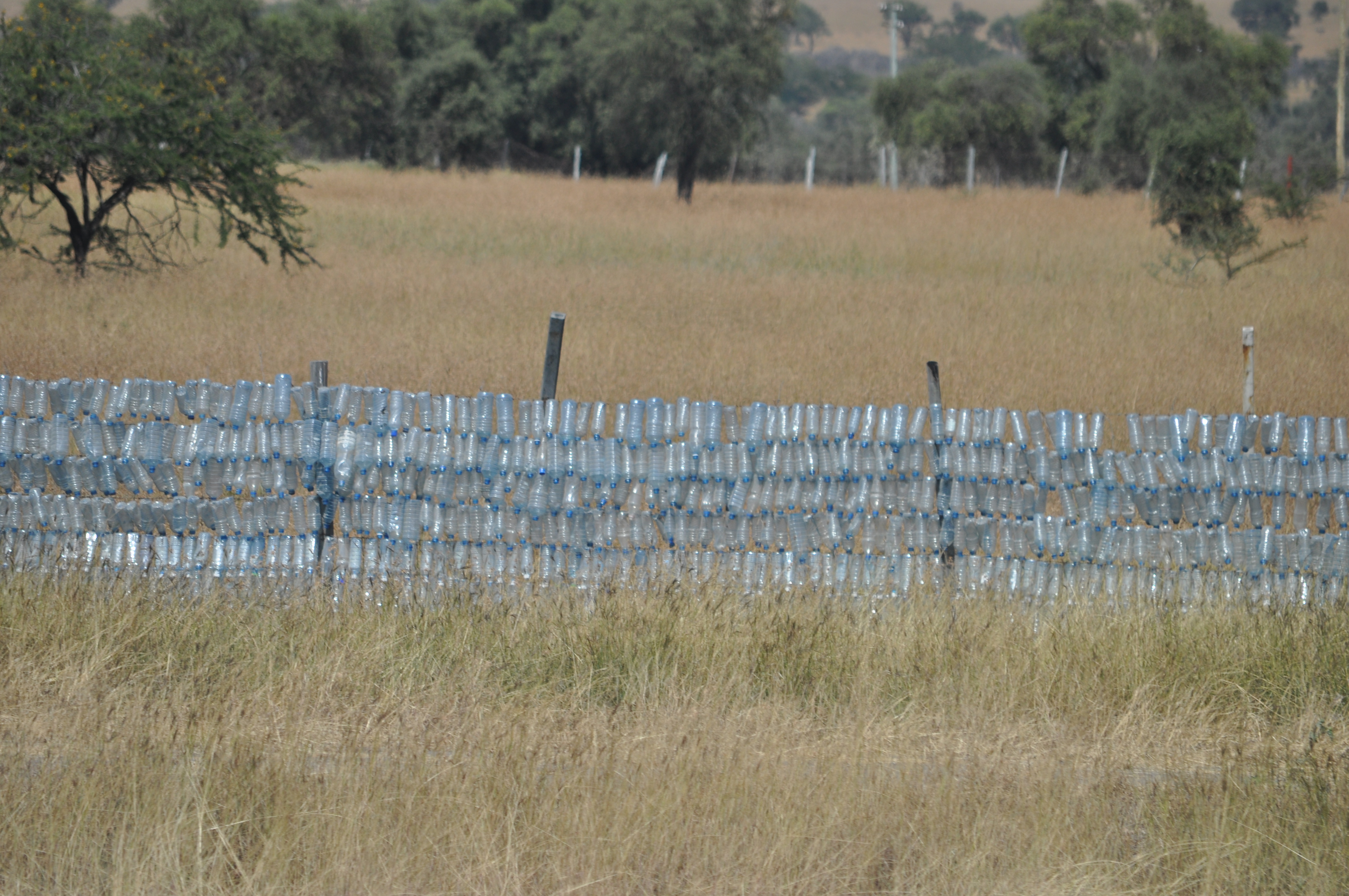
I took this pic in Kenya last summer. Those are discarded water bottle woven into a wire fence. Very creative!

I took this pic in Kenya last summer. Those are discarded water bottles woven into a wire fence. Very creative!

Not long ago one of the pastors at our church mentioned a scene in the movie Amadeus to illustrate a sermon point, and I was gripped by a line he repeated from it: “I am the patron saint of mediocrity.”

The musician Salieri says that at the end of the film. He has made a full confession to a young priest and finishes with that line. “You, too, are, mediocre,” he says in effect to the priest. “I, the patron saint of mediocrity, will speak for you.” He is referring to his musical talent as “mediocre,” but he didn’t always see it that way. As a younger man, he viewed it as a reward from God for his piety and devotion—until he was faced with the genius of Mozart, and realized his own talents paled in comparison. Not only does Salieri grow jealous of the younger composer’s gift, he is angry at God for giving them to such an irreverent man while he, Salieri, labors and toils “to the glory of God” and produces far less stellar work.

In the film (which is based on a legend and not exact truth) Salieri’s jealousy sours him. He stops producing music and fixates on Mozart’s destruction. He allows Mozart’s music to silence his own.

We all have that option. There are few geniuses; most of us muddle about in a state, comparatively, of mediocrity. But that shouldn’t dishearten us. It shouldn’t have disheartened Salieri.

No, he was not talented to the degree Mozart was. But what if Salieri had music only he could create? What if his abdication of his talent resulted in something being left undone that was meant to testify to some particular facet of God’s creativity and beauty? Compared to Mozart’s broader testimony, perhaps Salieri’s would have been but a sliver, but when Salieri abdicated his talents, he failed to redeem a portion of the manifestation of God lost to mankind in the Fall.

I’m extrapolating here in my application, but in trying to imitate someone else’s gift, or in failing to pursue the unique way in which God has gifted us (though it may be far less in scope and greatness than others), we “create” a lack. We “live” out and perpetuate the Fall. No, we in essence say, God is not purposeful and good. He plays favorites, and the amount of His love can be measured based on the ways He has gifted us. The cruel lie comes full circle when we believe we must earn God’s love and can do so only by exercising our talents; therefore, the lesser the talent, the less able we are to please God and “get” His approval and love.

Scripture tells us this is a lie. God honors the widow’s mite; Jesus extols the woman who anoints his feet with her tears and wipes them with her loose hair. He flat out says He chooses the weakest among humanity. The Beatitudes praise those who accept their vulnerabilities. The Gospel “works” only when we admit how greatly we need it, how completely unable we are to earn it.

So press on into your giftedness, no matter what it is. Press into it as part of God’s purpose for you, not as something you deserve, but as something He’s given so you can know and point to Him as the author of all good, of all creativity. Don’t compare your gift with others’ and don’t measure its greatness by how others react to it. Know (and remind yourself often) that since God gave the gift to you, He has purpose for it, and He is pleased when you exercise it. Your gift may not reach millions or even dozens of people. Your gift may be meant to touch only one. But to that person, your gift can be the touch of God.

There is a wonderful by-product to this: when we view and use our gifts in this way, we do not begrudge others theirs. We can rejoice. We can encourage. Salieri hurried down the road to bitter envy. We, instead, can support others in their talents. When we do this, our gifts mingle and grow, and our creativity is not only a testimony to God’s imagination but also to His love.

Early in Amadeus, when Salieri is still honored and praised as a gifted musician, Mozart listens to one of Salieri’s compositions. He immediately sits down, plays the piece from memory, critiques it, and then plays it again with his own vastly improved improvisations. Salieri’s face reveals his heart. He is shamed, and he is jealous. These are our natural reactions. But Romans tells us Christ has set us free from our natural “body of death” to think and live as redeemed people. How different might Salieri’s and Mozart’s stories have been had Salieri rejoiced in providing Mozart with an idea that Mozart was able to bring magically alive. Who knows what their partnership might have produced!

God certainly creates geniuses, people touched to create in seemingly effortless ways—it’s a little glimpse of God’s work! But the rest of us, gifted to one degree or another, in one way or another, are celebrated in Scripture as a body—working in harmony, honoring each other—especially those whose gifts are less celebrated by the world—and together providing a shimmering image of Christ.


I ramble with a purpose

At one of Wheaton Academy's bball games not long ago, the students brought glow-in-the-dark bracelets/necklaces. After the game, PJ gathered as many as he could, and we had a light show/photo shoot that night at home. Here he is twirling a handful of them.

At one of Wheaton Academy’s bball games not long ago, the students brought glow-in-the-dark bracelets/necklaces. After the game, PJ gathered as many as he could, and we had a light show/photo shoot that night at home. Here he is twirling a handful of them.

I like cool blog titles. Here are a few of my favorites: Everyday Epiphanies, Still Point in a Turning World, Logic and Imagination, A Place of Abundance, Writing from the Margins, The Middle: Encouragement for the Journey Through, A Holy Experience

(I think very highly of all these blogs as well as their titles, which is why I provided links).

I used to have a blog title.

But it wasn’t very cool.

Journey to Jen—how’s that for catchy!?

My husband, Dave, hated it, from the very beginning. I won’t tell you what he said it sounded like, but I will tell you I laughed and was also a little horrified. “It wasn’t the title I wanted,” I told him, “but ‘Jen’s Journey’ was already taken.”

I wanted “Jen’s Journey” because that’s all my blog was supposed to be: a reflection of my journey, what I’m learning, how I’m growing. I write to process, and the blog is my outlet.

Plus, I love the word “journey.” I also love the word “pilgrimage,” which is the word that led me to “journey” because, when I suggested “pilgrimage” as my blog title, Dave said that sounded weird.

(And if you don’t know my husband and are thinking right now he seems a little grumpy, he’s really, really not. In fact, he’s my greatest encourager and he makes me laugh.

A lot!

Anyway, back to my blog title. I finally bought my domain (at the urging of Dave) and simply named it “Jen Underwood.”

As in, “Here’s me—and my journey.”

Come to think of it, “journey” was a bit of a misnomer, unless you think of a journey as a meandering path that sometimes goes in circles and follows rabbit trails and then comes back to another circle, much like one of the previously traveled ones, and at this point you’re all turned around and have no idea which direction you’re facing or, for that matter, where exactly this path is taking you.

That is the kind of “journey” mine seems to be. Every once in awhile I look back at my blog entries of the last few weeks and think, “It’s ramblings! Just ramblings. I’ve been all over the place, thinking about all kinds of things. There’s nothing linear about it at all.”

And sometimes I get discouraged about this, because the erratic nature of my blog is a reflection of the erratic nature of my spiritual growth. I share this with God. “Lord, I have this vague idea of the godly woman I want to become,” I tell Him, “and I have, really, no idea how to get there. In fact, I’m not even sure what this ‘godly woman’ looks like, but every time I try to plan out a ‘point A to point B’ sort of journey that I think might lead me closer to her, You rip up my map!”

“Come to think of it, God,” I tell him. “’Ramblings’ could be a good title for my blog, for my LIFE.”

But when I look further back than just a few weeks ago—when I read blog entries of a year, two years ago, when I pull out one of the notebooks I’ve been writing in for two decades—I see growth. I recognize that true good was formed out of disappointments and “rabbit trails.” I understand that each time I followed a circular path, it was a little bigger and a little deeper. I realize that I may not “look” more godly, but I’ve been drawn into a deeper faith in God.

I see a very masterful hand at work.

All my ramblings have had purpose! I just didn’t know it!

God knows very specifically how to draw me closer to Him so that I trust Him in and for everything.

Therefore, I am not responsible for planning my spiritual growth, just for following Him into it, one step after another.

And though that is frightening in one way, it is incredibly reassuring and hopeful in another!

I ramble with a purpose.

His.

And His purpose is sure.


VERSES TO PONDER (in the Amplified version today)

Ephesians 2:10 For we are God’s [own] handiwork (His workmanship), [a]recreated in Christ Jesus, [born anew] that we may do those good works which God predestined (planned beforehand) for us [taking paths which He prepared ahead of time], that we should walk in them [living the good life which He prearranged and made ready for us to live].

Psalm 57: 1-2 Be merciful and gracious to me, O God, be merciful and gracious to me, for my soul takes refuge and finds shelter and confidence in You; yes, in the shadow of Your wings will I take refuge and be confident until calamities and destructive storms are passed. 2 I will cry to God Most High, Who performs on my behalf and rewards me [Who brings to pass His purposes for me and surely completes them]!

Exodus 40:37-38 But if the cloud was not taken up, they did not journey on till the day that it was taken up. 38 For throughout all their journeys the cloud of the Lord was upon the tabernacle by day, and fire was in it by night, in the sight of all the house of Israel.

Isaiah 25:1 O Lord, You are my God; I will exalt You, I will praise Your name, for You have done wonderful things, even purposes planned of old [and fulfilled] in faithfulness and truth.

They have given me much

They murmur, “Thank you,” as they leave the classroom. But instead of saying, “You’re welcome,” I tell them, “Thank you,” back.

I mean it. They have given me far more than I have given them.

Mondays I serve as an aide at the local World Relief ESL program, supporting Krista, who teaches the Job Class. The refugees in her class are recently arrived (some as “recently” as a week ago) and have only six weeks of preparation before joining the American workforce. Job Class, therefore, doesn’t mess with non-essentials.

Today we are learning the “doctor appointment” conversation:

A: This is Dr. ________’s office. How can I help you?

B. I need to make an appointment. My ________ hurts.

A. I’m sorry. How about _________ at ____:_____?

B. _______ at ____:_____? Yes. Thank you.

A. See you soon.

B. See you.

I teach the dialogue to the majority of the class while Krista works on travel directions with three students who’ve already learned the conversation. Then she and I switch groups. As Krista leads the large group in a fun practice session, I show the small group how to use Google Maps. I zoom in on the map of the world until northern Illinois covers the entire screen. “Where would you like to go?” I ask them. “The grocery? I can show you how to get directions from your apartment to the closest store.”

One of the women—she’s a “take-charge” gal!—has a different idea. She pulls a flyer out of her folder. “Free Computer and Literacy Classes,” it boldly proclaims. She reads the address to me. I type in her apartment address as the starting point and the other as the end point. “Do you have a car?” I ask her. She shakes her head. The two others, who live in the same apartment building as she, shake theirs, too.

I switch the default icon from “car” to “pedestrian,” and the time jumps from six minutes to forty. They laugh.

Soon it is time to work on applications. We fill out applications galore in this class—since, after all, getting hired is the ultimate point. The app they start with has two blanks: one for “name,” one for “country.” It simply determines if they can actually recognize those words. The final one, number 12, is a standard three-page application, with blanks for items like their social security number, their full address (including zip code), and work history.

Job counselors at World Relief help each refugee create a résumé. We use these to fill in addresses and former jobs on the application templates. I help a gentleman write “Family farmer” in the blank for his earliest job and then, in the space for his latest, we write “Kitchen worker,” the job he was able to get when he had to flee home and find temporary shelter in a neighboring country. It is the same for nearly all the refugees from his home. They began as farmers and now live far, far from their land.

I explain to another man that he does not have a maiden name, but his wife does—or perhaps not—names are cultural things, after all.

Back and forth they come and go from the table where I have organized all the applications. “Excuse me, I need help.” “Excuse me, I am finished.” I check their work. I remind some that Americans write on top of the blank line rather than across the middle of it. I refer to their intake sheets to check birthdates—months and days can be tricky. One man and I have the same birth year. We smile at each other with the commonality of age. Another man has circled “yes” next to “children?” and “no” next to “married?” Beneath the “no,” he has penciled in “widow.” I do not change it to “widower.” Should I have? Surely no one will point that out to him.

I find myself noticing their shoes—actually, their socks. It’s been a cold winter, and Monday after Monday I’ve shivered when I noticed women in plastic slides—no socks—and men in dress shoes—no socks. It’s not that World Relief doesn’t provide them with socks. They have them, but many come from homelands where they never before had to wear anything but sandals on their feet.

It must feel strange.

This day, though, I see lots of socks, and, oddly, it makes me glad.

Near the end of class, Krista assigns the homework. A few still linger at my table, wanting me to check their corrections, wanting—ultimately—to learn, to understand, to “make it” in this new, strange country.

Please, God, smooth their paths, I pray. They’ve already traveled such hard, treacherous roads. Bring kind people to them when they need aid. Protect them from prejudice and hate. Let them meet You in gentle eyes, in helping hands, in mouths that share Your Name gracefully, truthfully.

I slide the blank applications into the correct folders, ready for another day of practice, and leave with a strange mix of sorrow and joy and great gratitude.

“Thank you,” I say again to a few who are still waiting in the vestibule for their ride to arrive.

For they have given me much.

It’s the little things…

DSC_0697Dave was watching football while grading papers (a common Sunday afternoon for him). I stopped as I walked by because a commercial caught my eye.

Scene: a man sits at the foot of his immaculate bed at the end of his day. He slips off his work shoes and then his socks. He sits there, socks dangling from one hand. Voice over says, “Just as Phil is about to drop his socks on the floor, as he does every evening, something occurs to him for the very first time: The clothes hamper is only four feet away, straight across from him.” Phil then leans forward and tosses the socks in the hamper. The camera pans to a woman just about to walk into the bedroom. Voice over: “Proving to Phil’s wife that miracles really can happen.” Her jaw falls slack, the shot holds for another beat and then fades to an Illinois State Lottery logo.

I howled with laughter.

Howled.

Dave raised his eyebrows at me, with a look that said, “Please tell me you don’t identify with that woman because I am NOT a slob, and if you tell me I am, I will have to remind you that I—yes, I—cleaned up after YOU in the early days of our marriage.”

When I finally stopped laughing, I said, “It’s not because it’s the husband. I mean, they could easily do it from the opposite point of view, wife for husband. Plus, for me, this is not really about you. Just think of all the things the kids do that could have been used for this commercial. I mean, if I went in the kitchen and found that someone had actually put the clean pots and pans away, I would think our house had been broken into by someone who was trying to stock their kitchen!”

He laughed then, too, and we brainstormed a couple together, but I decided to journal a longer list that, were they to change, I might just consider that a miracle:

  1. I open the cereal cupboard to find not one but two (and sometimes three) open boxes of the same exact cereal. When I look into them, I see why. There’s a little bit of cereal at the bottom of one bag. Rather than finish it off and have to actually deal with the empty box, “whoever” just opened a new box.
  2. Use #1 above and apply it to the last bit of leftovers in the fridge, the final slosh of milk in the bottom of the gallon, etc.
  3. I open the under-sink cupboard to put trash in the kitchen can and find it is overflowing. No one besides my husband and I seem to ever think of actually emptying the overflowing kitchen trash can—or at least pushing down the debris. Rather they all try to balance trash on top so they don’t have to “touch it—eww!”
  4. Apply #3 to the recycling bin.
  5. I find empty toilet paper tubes on the holder—with a new roll half-unrolled on the floor next to the toilet. (To be honest, they’re getting better about this.)
  6. “Mo-om, where’s my…?” I walk into the room and discover it’s three feet to their left.
  7. I change the kids’ sheets (confession: I don’t do that very often!) and learn the bed has become a dresser. Missing socks underneath the covers, t-shirts between the pillow and headboard, jeans stuffed behind the mattress.
  8. The top rack of the dishwasher is stuffed full—while the bottom is nearly empty, EXCEPT for the first compartment in the silverware container—which is bristling with forks, spoons, and knives stuffed in all directions! Reason: it’s more effort to actually bend over to put things in the bottom rack, and—in the case of silverware, which obviously can’t go in the top—it’s easier to pull out the bottom rack just a little bit.
  9. In the transition time from summer to fall, when the temperature outside is suddenly colder than inside, I find open doors, open doors, open doors. “Close the door!” Don’t know how many times I holler that.
  10. 10. Clothes on the floor. Doesn’t matter how often I make my boys clean them up (and I fuss the whole time), they STILL simply drop their clothes onto the floor when they change.
  11. 11. I KNOW I did this when I was a kid (and I have to remind myself of this often), but why is it that kids can take something out of its accustomed spot and never, ever, ever think of putting it back there when they are finished with said item. Then, when they need it again, they go back to the accustomed spot and assume that it will be there. (What do they think it is, magic?)
  12. 12. Question: “Mom, where are my shoes?” Answer: “Where you left them.” Question: “Where did I leave them?” Answer: “How on earth would I know?” (But I usually do L).
  13. 13. Soggy cereal in the sink. Don’t know why—but a pet peeve and one of the few things that gross me out.
  14. 14. “What’s for dinner?” I think this question should be banned for anyone who isn’t planning on contributing in some way to the dinner.

Oh, kids! Gotta’ love ‘em! And we gotta’ laugh, right?

Got any of your own? Let’s share a chuckle!

Resting Place

No connection to today's post--I just like the look of joy on Mad's face!

No connection to today’s post–I just like the look of joy on Mad’s face.

I went to a women’s service at our church yesterday. For two days I’d wrestled with a strange melancholy. I’d tried and tried to understand it, but couldn’t. I’d searched my soul, confessed the self-focus I saw, and asked the Holy Spirit to reveal other issues. I’d looked at the level of my mommy martyrdom—yes, there was some, but it wasn’t high enough to explain my strange sadness. I thought of things going on around me: my renewed research on sex trafficking, a friend going through a very difficult time, the transition to being a mom of a teenager…

Nothing jumped forward as a principal cause.

I tried reminding myself that others were dealing with horrible losses and troubles. They had real reason to be sad. I did not.

That didn’t help.

Is it all right to sometimes not know the reasons for our lows? Is it all right to simply be sad sometimes without clear cause?

I think it might be, if only because of the ways the Lord ministered to me yesterday morning without my ever learning the why and what of my mood.

The speaker for our service had chosen II Chronicles 20 as the text. King Jehoshaphat and the people of Judah knew a great enemy was coming against them. They chose not to trust in their own might or in the might of allies. Instead, they turned to God. They fasted and prayed and cried, and finally Jehoshaphat stood in front of his people and said, “Oh, Lord, we do not know what to do, but our eyes are on you” (vs. 12b).

Well, I’m not really faced with a decision right now, but the not-knowing certainly fits me right now, I thought.

At the close of the service, we sang “I Heard the Voice of Jesus Say” by Horatius Bonar, one of my favorite hymn writers.

I heard the voice of Jesus say

Come unto Me and rest

Lay down thy weary one

Lay down thy head upon My breast

I came to Jesus as I was

Weary, worn, and sad

I found in Him a resting place

And He has made me glad.

It was as if the Holy Spirit whispered the words to my heart. Weary?—yes. Worn and sad?—yes, yes. I didn’t know why (still don’t) and that’s all right.

Because, finally, when I rested and simply said, “I’m sad, Lord. I don’t know why. Here’s my sorrow,” He gave rest to my soul.

And He made me glad.

*The second and third stanzas of the hymn are truly beautiful as well. Here’s the link. And if you’d like to hear/sing it, here’s a Youtube video with words and music.

Practicing Awe

Sorry for the poor photo quality, but I took this on my phone on an early-morning jaunt a couple weeks ago. The sunrise reflected on a patch of ice in a field. Definitely a moment of awe!

Sorry for the poor photo quality, but I took this on my phone on an early-morning jaunt a couple weeks ago. The sunrise reflected on a patch of ice in a field. Definitely a moment of awe!

I continue my “crawl” through the Bible, and a phrase from Jeremiah jumps out at me. It’s from the fifth chapter, in which God is reminding the Israelites they have broken the covenant He made with their ancestor Abraham. Verse 24 is but one piece of His evidence: “They do not say from the heart, ‘Let us live in awe of the Lord our God, for he gives us rain each spring and fall, assuring us of a harvest when the time is right.’”

“Live in awe!”

What an incredible phrase.

They didn’t do that.

Much of the time, I don’t either.

The consequences of their awe-less life were concrete and strong. Verse 25 reads, “Your wickedness has deprived you of these wonderful blessings. Your sin has robbed you of all these good things.”

The consequences for my oft-times awe-less life tend to be more abstract.

I have the concrete “good things”: food to feed my healthy children, a warm, snug house, enjoyable and fruitful work. A lack of awe does not always result in the gifts themselves being taken away, but we do lose some of the blessing and goodness of the gift when we do not see it as such, when we let it become commonplace, something we believe we deserve, or something less than a gift—a burden.

So, this day, I am going to practice “awe” for the gifts surrounding me in the moment. I will journal my practice. Here goes…

+++++

As I write this, I am secreted in my bathroom, the one that has one door that opens into my bedroom and another that opens to the den. Patrick and his friend, Ben, are having a rock concert in my bedroom; Jake and his friend, Josh (Ben’s older brother), are in the den playing on the Wii. I can hear both sides.

They’re. Loud.

Much of the time I forget awe at these amazing gifts: two healthy sons with good friends, toys for them to play with when the weather is such that I can’t simply kick them outside all day, more than one bathroom (that’s HUGE!), a warm house, and bathroom doors that LOCK! Woohoo! I am in awe at these gifts of God in this very moment, and the goodness of this moment is revealed, and I can view the chaos and noise as a blessing.

+++++

It is now ten minutes later, and I am no longer in awe.

I am fixing mac ‘n cheese and dishing up bowls for five children so they can go out and play in the snow with full bellies (and not come back in 15 minutes later because they want snacks). I’m feeling hounded by questions of “Is it ready yet?” “Where are my gloves?” and “Mom, I think I left my snow boots at school. What should I do?”

How quickly I move from awe to frustration. It doesn’t even feel deliberate. I don’t remember making the choice to get frazzled: I just slid right into it.

Choosing awe, on the other hand, requires, well, choice, requires acknowledgment of need and cries for help—and then requires the entire process again only moments later.

Awe is clearly not my natural state!

+++++

It is now three hours later—three loads of laundry finished, three loaves of bread made, children out to play in the snow then back in (with another neighbor friend in tow), the two brothers picked up by their mother, two of mine sent to a friend’s house, one quick run up to the high school to pick up Judy, who is exhausted from all-day play practice, and snacks fed to the only two young children left in my house—and they are busy with non-destructive play—Yay! Someone actually remembered to charge my laptop after they played on it during the three-hour interim, and I am sitting down to write this—because writing is how I meditate on truths God is teaching me.

As much as I would like awe to be a constant state, it simply isn’t, and that really has nothing to do with the chaos of my family. If I lived in a monastery, and everyone around me had taken a vow of silence and peace, something would still cause me to slip from awe.

Perhaps that is actually a good thing—not necessarily the slipping, but the struggle it pushes me into (which reveals my helplessness and ends in my crying out). The battle for awe, for joy, for peace—for God, ultimately—strengthens my desire for Him. I see the contrast between awe and “regular life” more clearly as I wrestle my way back to awe time and time again. Is this what James was suggesting? That my ongoing struggles will build endurance, that patient endurance will open my eyes to see God’s “good and perfect gifts” and see Himself as the Father of lights?

Maybe? Like my struggle for awe today, all my spiritual sight is shadowed and grows clearer only in small increments.

And that is all right.

All is not well

My youngest child had academic testing yesterday. He and I arrived at an office in the morning, and I was ushered into a room and handed three inventories to complete. One had 86 questions; one had 275; the last had 160. Needless to say, they were thorough.

I answered “true” or “yes” to quite a few questions, most of them related to high energy levels and difficulty focusing, and there were others about which I thought, “Well, that doesn’t relate to Patrick but it’s true for Jake”—or Maddie—or Emily—or me! I recognized each of my four children—and myself—in some of the items.

But most of the statements brought me both perspective and gratitude. For every “false” or “no” I checked, that was another issue we were not facing.

I texted some of these to Dave, my husband.

“My child has very low self esteem.”

Um, no.

“My child is painfully shy around new people.”

Definitely not.

Then one of the statements simply made me stop.

#53: “I’m afraid my child is going insane.”

True or False.

And I felt a little sick.

Because, obviously, there must be parents who have to mark “true.”

We each have troubles we can talk about, things like frustrations with our children or our parents, illnesses and actual losses.

But there is also a list of unmentionables we generally keep hidden: addiction, mental illness, rage issues, money troubles, marital conflict…

Our voices literally hush, softened with shame, when we speak of those. If we speak of those.

When the testing finished for the day, Patrick and I put on coats, hats, and gloves to brave the deep cold. Our drive home took us past the middle-class suburban neighborhoods I drive through nearly every day. One after another, the homes presented neat, tidy fronts. Trim siding and smoke from the chimneys proclaimed “All is well!” but I wondered about the unmentionable topics hid away inside. If I slipped an inventory under each door, which ones would come back with “true” marked for #53? Which ones would affirm “I’m afraid in my own home,” “My child is a real threat to himself or others,” or “One of the child’s parents continually threatens abandonment”?

No adults shoveled driveways; no children played in the snow. The cold had driven everyone inside.

Where secrets can be kept, and unmentionables are lived out.

All is not well.

Oh come, Lord Jesus, come.

And in the meantime, help your people to see and speak.

‘Tis more blessed…

If “‘Tis more blessed to give than to receive” is true–and I believe it is–then on Saturday night I was doubly blessed.

It seemed unfair to use the Christmas gift I gave him before he had a chance to even try it out…

But I did.

Up early and gone all day for one child’s wrestling meet, driving to and from the girls’ soccer practice in the late afternoon, I lost daylight time for my run with the dog.

So I strapped on the headlamp I’d given Dave so he could run in the early-morning dark…

and drove myself and Chai to the dog park so I could try it out in the late.

Snow glittered before me. I ran on fairy dust. In the light of the headlamp, the dog’s eyes glowed weirdly–orange from the side, green head-on, and red when she was close. Pleased with her first off-leash run since before Christmas day, Chai sprinted past me. For a moment, as snow fell in front of me, spotlit in the lamp’s circle, I thought the forecaster’s prediction of next-day flurries had come early and sudden. But when it stopped just as quickly and then happened again when Chai did another fly by, I realized she was kicking it up with her paws.

A siren wailed in the distance, and deep in the woods, the coyotes echoed. Ahead of me, Chai paused to listen. Then–they must have been too far away to awaken either concern or longing–she bent her head and chomped up some packed snow, the canine version of shaved ice, flavored with who-knows-what.

The trees’ tops were lost to the night, but in my peripheral vision, their trunks floated like gray stripes on a dark suit. Hit with the direct light of the headlamp, though, they appeared almost white, bleached of color.

I felt no fear, except that my rule-keeping mind expected a policeman any moment to remind me that the dog park closed at dusk, and it was well past.

When Dave got home from cleaning up after the wrestling meet, I told him I tried out his present. “Thank you,” I said.

“How did it work?” he asked.

“Great!” I told him how beautiful the run had been. “It worked wonderfully. You’ll love using it.”

“Well, then, thank you,” he told me.

‘Tis better to give than to receive.

True.

But perhaps giving and receiving, when done wholeheartedly, are more connected than I’d realized.