the truth that keeps me out of the cave of despair

My body returned from Scotland last Thursday night. It has taken my mind longer to return. It was ready right away to be with my kids, to celebrate PJ’s 9th birthday (how is it possible that my YOUNGEST is in his last year of single digits?), and ease back into the cycle of cooking/washing/straightening. My grey matter was clearly not up for all the other parts of my normal life—i.e. meetings/appointments/a packed schedule—because I didn’t even realize I’d missed a significant meeting at church on Monday evening till I checked my email later that night and saw a note from the team leader wondering about my absence.
My mind moved—in one short minute—from gradual re-entry to high alert.
And into guilt, too, of course.
How? How could I have so completely forgotten a meeting I’d been very excited about only a month before? How could I have gone an entire weekend without checking my full schedule for this week?
So complete was my plunge into alert mode that I was unable to sleep. At 2 a.m. I finally slipped from bed to read in the bathroom, hoping my mind would shut off. It didn’t work. I returned to bed, but no sleep came. I prayed, working my way through the phrases of the Lord’s Prayer, but I kept circling around to guilt and then to the busy-ness of the week ahead.
“Oh, Lord, help me to get past this and rest,” I asked, and my understanding of my guilt and frustration began to shift. I realized what was really eating at me was concern for how I would be perceived by the other members of the team, was embarrassment, was shame at having to admit I’d simply forgotten. This self-preservation and focus was what was keeping me awake.
Still, even though I could name my issue, sleep never came. I finally got up, went upstairs, and found my younger three already awake in the living room. “Can you pray for me?” I asked them. I explained my missing the meeting, my lack of sleep.
“Of course,” they said. Maddie prayed that I would have peace and strength for the day; Jake—who is quite familiar with guilt—prayed I would not be “down in the dumps, would not live in the cave of despair.” (I’m not being imaginative; those were his exact words!)
It was such a good wake-up call (pardon the pun!). As the day went on, I found myself grateful for two seemingly paradoxical reminders: 1. I am NOT as free as I sometimes think I am from guilt, perfectionism, and people pleasing. I am still in the process of being set free and that’s okay; and 2. In Christ, I AM free. He accomplished my freedom, and He is at work in me—and HE is greater than my sin! He will triumph!
I am grateful the second truth is far deeper.
“And I am convinced and sure of this very thing, that He Who began a good work in you will continue until the day of Jesus Christ [right up to the time of His return], developing [that good work] and perfecting and bringing it to full completion in you. Philippians 1:6, Amplified Bible

Finding, part 1

Two weekends ago, seven of the eight of us (Kelly was at a game with a friend) went downtown for the evening with Dave’s brother who was visiting. We wandered up and down the Magnificent Mile enjoying the lights and then trekked west to the Portillo’s on Ontario. Before eating, Judy (our older international “daughter”) went to the restroom, took out her retainers (a recent expenditure—they’re not cheap!), and wrapped them in a white paper towel from the restroom (some of you already know where this is going!). She set them next to her plate while she ate.

Near the end of our meal, a Portillo’s employee kept buzzing around picking up trash. She was so quick and quiet doing this, we almost didn’t notice her! When we completely finished, we continued the cleanup (you bus your own tables at Portillo’s), and Judy suddenly realized her retainers were not next to her plate.

Quiet panic. I assumed one of us had thrown them away, so I turned to the trashcan where we’d put everything we cleared. A man in a Portillo’s uniform with a nametag reading “Sherman” was just about to empty the trash. We explained the situation to him, and he helped me look through BOTH of the side-by-side cans. In fact, he stopped me a couple times when I was about to pick up a particularly soggy something and lifted it with his own gloved hand. “I should have gotten you a pair of gloves,” he remarked.

No retainers in the first can. Judy was rigid at this point. Dave had already helped her go through every pocket in her coat and every compartment in her purse. Em had checked under and around the table.

We reached the bottom of the second can. I saw something pink shining through a white paper. I grabbed it.

Not retainers.

I looked up and met Sherman’s very, very sympathetic eyes. “Thank you,” I told him. He nodded. I turned to Dave. “I’m going to go wash my hands before we leave.”

On my way up the stairs, I prayed. “Please, God, by some miracle let those retainers be in the bathroom. I know she brought them down to the table, but if You want to just re-locate them right now and have them on the counter when I walk in, that would be truly incredible. She is never going to stop beating herself up about this! Please, God, a miracle!”

No retainers on the counter.

As I came back down the steps I saw my brother-in-law, Scott, had an arm around Judy. All the other kids were gathered around them. My heart sank. She’s crying, I thought. I made it all the way up to the group before they noticed me. I reached out a hand to Judy when Scott saw me. “He found them,” he said. “Sherman found them!”

Judy was crying, but they were tears of joy!

I turned to Dave, and he gestured to Sherman, who was several feet away, emptying a different set of trash containers, these farther from our table. “He decided to look through those, too,” Dave said. “He thought the Portillo’s lady might have taken them for trash and put them there, so he looked before he emptied the cans.”

I went over to Sherman. His grin was broad, but he was a little embarrassed. “Thank you,” I told him. “You are an answer to prayer! I was praying for a miracle!”

“Me, too,” said Scott.

Sherman raised his pointer finger up. “Wasn’t me,” he said. “That was God.”

I was crying by this point. Dave followed Sherman to thank him again. He tried to give him a gift to thank him, but Sherman refused. Dave found a manager and told him what Sherman had done. A few days later I visited Portillo’s website and filed a formal statement of gratitude.

As we left Portillo’s that night, one of my fifth-grade twins said, “Hey, that was a God sighting!”

“Yeah,” said the other twin. “I’m going to write it in my notebook at school! This week I won’t have to think and think to remember one.”

“They happen every day!” I reminded them. “We just don’t always have our ‘eyes’ open enough to see them.”

I hung back to where Judy was walking with Emily. I hugged her. “Don’t beat yourself up,” I said. “You didn’t do anything wrong, and God just gave you and all of us a miracle. Give yourself over to it and rejoice!”

She nodded, tears still in her eyes.

Thank you, Sherman! Thank You, God, for having him in exactly the right spot at exactly the right time so he could be a testimony of Your faithfulness and greatness to us.

odds and ends

In this post you will find 1. an addition to the 2014 “Gift that Gives Back” post; 2. a Guatemalan church using clothes to draw children and families to Christ and His Body; 3. a few pictures; 4. a couple funny Underwood kid stories, and 5. a link to a story I wrote for Wheaton Academy that is such an inspiring and beautiful story I wanted to share it here, too.

1. As an addition to the 2014 “Gifts that Gives Back” post, one reader suggested Trades of Hope, a business that empowers women out of poverty. They work with women from ten different countries, including the U.S., and produce jewelry, scarves, home decor, handbags, and stationery.

2. My sister-in-law also sent me a wonderful ministry I want to pass on. Both her older daughters have lived for extended periods in Guatemala, working with a fantastic church and ministry there. They have started a Christmas initiative called Una Noche Buena, which provides a full set of new clothes to underserved children in the community, and they do it in a way that fosters relationship not only with the child but with the child’s family. It’s a wonderful ministry, and I’d love for you to check it out. Visit the link above and then click on “English” in the top right corner (unless, of course, you’re fluent in Spanish). Great stories–and you can pray for the ministry–and contact the pastor if you would like more information.

3. It’s hard to believe on a day like today, when the temperature climbed out-0f-season to

first snowman 2014

nearly 50 degrees, but a few weeks ago we had two snowfalls. The first was really light, but enough snow fell for the kids to make their first snowman. I put a glove next to it so you can see how small it actually was–but it was cute!

Soon after, we had a little more snow–but still not that much, so I was quite impressed when I saw the snowman the kids made from it on the back deck.

Then, just a few days later, the snow all melted. I looked out the back window and
second snowman 2014noticed a pile of twigs and leaves. “Jake, Maddie, Patrick,” I called out, “who dumped that mess on the back deck?” Maddie came to the window and looked out. She seemed puzzled, but then said, “Oh, that was the center of our snowman!”

melted snowman

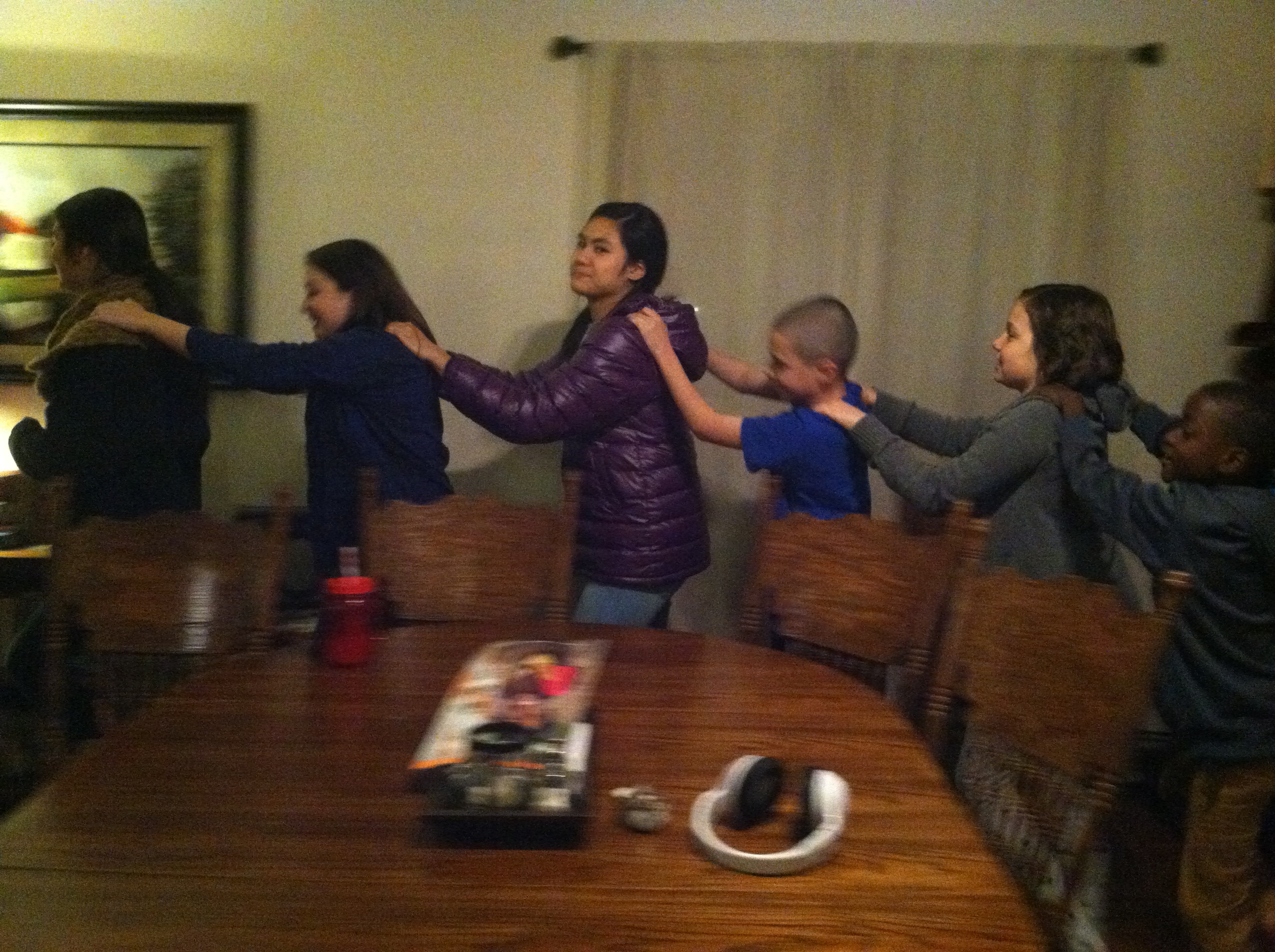
rosatis conga lineI took this last picture on a Friday night a few weeks ago. Exhausted from the week, when the inevitable “What’s for dinner?” question was posed, I wailed, “I don’t know!”

“We should get Rosati’s,” someone suggested, referring to our local pizza joint. Within a minute, they’d formed a line and wound their way through the main floor, chanting, “Rosati’s! Rosati’s!” It was effective. Forty minutes later we enjoyed pizza that I didn’t make. Yay!

4a. Jake was reading the nutritional information on the Corn Chex (or whatever the off-brand version we get is called). “Mom, does too much fiber make you poop?”

Me: “Not too much, just fiber.”

J: “Then how is it bad?”

M: “Fiber isn’t bad. You need it to poop. It’s good.”

Jake looked at the box again. “Awesome! This cereal has fiber and it’s glutton-free!” (He meant “gluten.”)

4b. PJ had to dress up as a book character for school. Jake was coming up with suggestions for him. Jake’s final one: “Too bad Mom’s not finished writing your adoption story. You could just go as yourself.”

4c. It was pajama day at school for Maddie and she was concerned with her clothes matching. “Mads,” I said, “it’s pajama day. Who cares if they match? Look at me.” I was wearing my very old threadbare blue sweats, one of Dave’s running shirts, and my late Pappaw’s rust-colored button-up fleece shirt–with the running shirt hanging out the bottom.

Maddie looked at me for a long moment. Then she looked at Dave. “Dad, when I grow up, do I have to be awkward like Mom?”

5. WA Boys Soccer Team Inspired by Eight-Year-Old Superfan–follow the link to read a story about an eight-year-old with an undiagnosed illness who befriends and is befriended by a high school boys soccer team. The relationship that develops is beautiful.

Discontent disguised as “spiritual” longing

A few weeks ago “Do not grow weary in well doing” literally jumped into my mind. It was unexpected, both out of place and time. I was NOT engaged in what I thought of as “well doing” at that moment. Nor was I in a particularly “spiritual” frame of mind. In fact, after the verse jumped in—surprising me—I retorted back at, I assumed, the Holy Spirit. “What if I’m just simply ‘weary’ without there being any ‘well doing’ going on at all? That’s rather depressing, don’t you think? It means I am weary simply spinning my wheels, simply being ‘busy’ with suburban mom ‘stuff.’”
I waited for a moment, wondering if another verse would “pop up.” Nothing came, but I was left with a slightly unsettled feeling, as if the conversation were not yet finished.
A week later it continued, this time a bit more forcefully. I was driving (no surprise there–a literal spinning of the wheels), vaguely longing for “otherness”—a more focused ministry that involved our entire family (or at least my husband and I together), a centralized location that would involve much less “in the car” time for me…
This time it wasn’t a verse, just three words, but they cut across my mind, stark, black on a white background.
“You are discontent.”
What? Discontent? That didn’t describe me! I was simply longing for something “better,” right? A more spiritual life, one that stood out as “different.” One that could serve as a good example for others…
Ooh—pride as well as discontent.
Yuck!
Really, Lord? I asked. This—what I so often see as a “small” life—is what You want for me? This here? This now?
Yes.
It was confirmed by a conversation with my mother-in-law. “Let me tell you what I’ve been praying for you lately,” she said. (What a blessing to have not one but two sets of parents who pray for me!) “I’m praying that you will see the goodness and purpose in all the running around, the cooking, the organizing of schedules, the ‘mothering stage’ you are now in, with kids who need you in very different ways than they did when they were younger. I’m praying that you will understand that all this, though it seems small, is BIG. In all this, you are loving your children. This is your good work.”
Good work. Well doing.
Oh, Lord, I prayed, help me to see this—to keep on seeing this.
And help me not to grow weary.
*Here’s a link to a Tim Keller sermon titled “Everyone with a Gift” in which he talks about this very kind of discontent. I’ve listened to it twice now–and I probably need to listen to it again.

Abiding–even in traffic

This is the slightest bit fuzzy, but I couldn't resist blowing this up a bit to see this beautiful bird's detail. He was hanging out in my yard last week, and I managed to get a couple shots of him.

This is the slightest bit fuzzy, but I couldn’t resist blowing this up a bit to see this beautiful bird’s detail. He was hanging out in my yard last week, and I managed to get a couple shots of him.

It was mid-morning on a Saturday. I’d already taken the boys to their soccer games and returned home. The afternoon had been claimed by the three teens, who needed to shop for school spirit week items. I was their transportation. After that, I would fix dinner, run a younger child to-from a party, and finally collapse.

It was going to be a long day, much of it filled with shopping crowds–always a stressor for my introverted side–and I knew I needed a space of solitude before I plunged into the second part of it. I shut myself in the downstairs bathroom and tried to quiet my mind, to stop the responsibilities and concerns that shout so loud, that so often drown out the Spirit’s whispers.

Into the stillness came a verse, each word in it distinct, like the notes in a simple melody.

I realized it was a melody, was the Scripture I’d set to a tune so I could sing it over my younger daughter each night. “May the grace of our Lord Jesus Christ and the love of our God, and the fellowship of His Holy Spirit abide with you, now and forever. Amen.”*

That was my prayer, my gift for that time, for the day ahead.

Again I prayed it. Again, focusing on phrases: Grace of Christ, love of God, fellowship of the Holy Spirit. Forever.

And then on the one word: abide.

May grace, love, and fellowship abide in me…

as I abide in God.

Abide.

Help me to abide, I prayed, and an image appeared now in my mind: a life-giving Vine, its clinging branch strong and vibrant.

“Mom, when are we leaving?”

The quiet was broken, and the next, crazy phase of the day began. It was full of traffic, of driving, of crowds, of noise.

Yet Abide ruled the day, inserting itself again and again…

And this led to miracles

Calm in the thrift store. I get jumpy so easily when I have to shop, when I’m in crowds, when I see no end in sight to the shopping. Abide, I heard. And I enjoyed time with the three older girls as we hunted for crazy items for spirit week: tutu skirts, Hawaiian leis, “mom jeans,” ugly sweaters. I even found myself some jeans—ones Em approved of, definitely not “mom jeans”—and didn’t go nuts in the process.

Miracles.

Twelve hours after praying in the bathroom, I was close to sleep. I readied my computer for shutdown, clearing all my screens and then closing my Web pages one at a time. The final page to close: Bible Gateway. The previous day’s verse-of-the-day was still on the screen. On a sudden whim, I refreshed the site to read the verse for the current day, less than one hour before it would change to the next day’s Scripture.

“May the grace of the Lord Jesus Christ, and the love of God, and the fellowship of His Holy Spirit be with you all.”

No way!

But yes!

God had worked miracles as I’d shopped in crowded stores and while my car guzzled gasoline and I was stuck behind its wheel. Why was I surprised that the last one of the day was delivered via technology?!

May the grace of the Lord Jesus Christ, the love of our God, and the fellowship of His Holy Spirit ABIDE with us, now and forever!

So be it.

*I made the song with the word “abide” in it, but I can’t find a Scripture version that actually includes that word (I have no idea why I began singing it with “abide” included).  BUT the morning I prayed that verse, it came to my mind with the word “abide,” which then led to my envisioning the vine and branches and thinking about Christ’s words about abiding in Him. SO, I’m using the word “abide” in the song version, but not, of course, in Bible Gateway’s verse of the day. That link includes a couple parallel versions.

What not to say to an adopted child: my list

Finally a good picture of all of us. This is Dave and I with Judy and Kelly (our international student "daughters"--their real mom and dad live in Hong Kong and love them very, very much), Emily, the twins Jake and Maddie, and PJ. Honestly, it's usually the boys who mess up family shots. (Stand still for a picture if I'm not posing as a professional soccer player or bodybuilder? What's up with that?)

Finally a good picture of all of us. This is Dave and I with Judy and Kelly (our international student “daughters”–their real mom and dad live in Hong Kong and love them very, very much), Emily, the twins Jake and Maddie, and PJ (Patrick).

Not long ago, one of our elementary school principals sent a letter to every adoptive family in the school. “We want to meet your child’s and family’s needs,” he wrote. “Can you let us know any ways we are not doing that as well as ways we can do that better?”

I appreciated the question, though nothing came to mind right away. The school is filled with caring teachers and administrators who celebrate adoption and try to integrate multi-cultural literature and projects. They’re not committing any of the obvious insensitivities. But then I thought of a couple of less obvious things, and as I wrote them down, my heart began to pound. These are more important to me than I realized, I thought.

I know every adoptive family and every adopted child have their own particular struggles, so what I wrote to our principal will not apply to all adoptive situations, but I’m sharing because many of you know or will know a family who adopts or fosters, and this may give you an inside look at some of their less obvious struggles.

  1. We’re really open to talking about PJ’s background with him. It’s clear he’s adopted, so we don’t avoid that topic when he brings it up (sometimes we even initiate it). When he asks about his birth parents and brothers, we speak openly and positively about them, and we allow him to talk about them, even when he’s going through a stage (which has happened a couple times) of kind of wishing that he were with his birth dad (who has AIDS; PJ’s mom died of AIDS when he was just an infant). We don’t say anything like, “Hey, we’re your parents. We’re the ones raising you. We’re your REAL mom and dad.” We don’t want teachers and others to say that either. It’s both okay and normal for PJ to wrestle with that, and even though I think most people’s natural instinct is to say, “But look at the family you have now, the mom and dad you have now–they’re your real family,” I don’t think that helps the kid to process the fact that he’s not with the family he was born into, that for one reason or another, his family life (and his entire culture) is different. If someone is not really, really, really close with an adoptive child and his/her family, then I think there is no place for saying something like, “You need to be grateful for the family you have.” Even if that’s a mostly true statement, chances are that the adoptive child is wrestling with a lot more than simply an ungrateful spirit.
  2. We don’t think of what we did—adopting—as anything special or heroic. For us, it was a really clear call from God and it would have been disobedience for us NOT to do it. Patrick is an incredible gift to US, not the other way around. I’ve had people say to me, “What a wonderful thing you did for him,” and, honestly, it makes me angry because I can’t imagine how that would feel if my son ever heard someone say that to me, like I loved him because he was a charity case. The truth is that God showed us PJ was meant to be ours. He planted him in our hearts as our child, and we adopted him simply to make that official. He’s ours; therefore, we love him. I don’t want Patrick to be presented with the idea that he is privileged to be our son. The truth is, we are privileged to be his parents, just as we are privileged to be the parents of all our kids.
  3. I KNOW adoption is a beautiful picture of God bringing us into full “son-ship,” with the same status as a biological child—and that’s absolutely incredible—but the analogy on an individual level can, like in my second note, send the message to the adopted child that he/she was being done a favor. It also emphasizes the differences between biological children in a family and adopted children in a family. I think an adopted child needs to be a certain age or of a certain understanding to be able to see this on a spiritual level without correlating it to his/her own situation.
  4. Anything that emphasizes that difference between the adopted child and biological children should be avoided. Examples would be talking with an adopted child (or talking with someone in the family in front of the adopted child) about how much their siblings look like each other or how one of their siblings looks like mom or dad. (Several years ago when Em was 8, the twins 5, and Patrick 4, we were all together, and I mentioned that someone at church had commented on how much Em and Jake (one of the twins) look alike while the twins look nothing like each other. Oddly enough, if was the other twin, Maddie, who was bothered by this. “Well,” she said, “I look like somebody, too. Patrick and I look just alike. Don’t we, Patrick?” He was really small then and just nodded, but I realized that if Maddie minded being told she didn’t look much like her siblings, then that could really be an issue for PJ.)

*If you are reading this as an adoptive parent or adopted child, and you have an idea to share, I would really love to read your response. Please, please leave a comment below. It will not be posted on the blog; I’ll receive it as an email.

Go back

Your message has been sent

Warning
Warning
Warning

Warning.

Needing and finding

Speaking of Chai (she's mentioned late in this post), here's a shot of her lounging on the only piece of furniture she's "supposed" to get on.

Speaking of Chai (she’s mentioned late in this post), here’s a shot of her lounging on the only piece of furniture she’s “supposed” to get on.

This morning* I crushed the spirit of one my children.

At least that’s what it felt like.

It was over an organizational issue we’ve been wrestling with ever since school started (well, actually, for years). It’s also an issue that this child refuses to really face as a problem. I hear “I’ve got this” and “No big deal” often enough that it makes me want to scream.

And this morning I did.

“When are you going to see this as a problem?”

“When are you going to admit you need help?”

“When are you going to stop telling me ‘I got this’ and start listening to what I and so many others are telling you?”

Oh, there was more—though God, in His grace, stopped me from saying at least some of the destructive things that were on the tip of my tongue.

But I went on and on. Not a dripping faucet, oh, no, a full-open tap.

And my child cried.

And I felt like, pardon my French, shit.

During it, following it, twinges of it even now.

After the tears, after my anger, I pulled my child aside in the kitchen, held this precious one close and said, “I can’t let you go to school without you understanding that my frustration doesn’t mean I don’t love you just the way you are.”

(And at the same time I said that, I thought, but that’s not what my earlier words and anger communicated!)

I affirmed this child’s wonderful qualities of kindness and generosity and oblivion to differences in other people and unawareness of standards that others set. This child is individual and easygoing and full of so much love.

“But you’re running into some things that are showing you that you have some areas of weakness, too—just like we all do—and until you admit them, you can’t grow in these areas. Do you understand that?” I asked.

My child nodded.

“I’m so sorry for the way I said it, though. There may have been things that needed to be said, but they shouldn’t have been said in anger, and I know I blew it and hurt you. I was wrong.”

My child nodded—but I knew that my apology, which also included “something to work on,“ was a lot for a kid to process.

We got lunches packed. We drove to school.

This child was the last to get out of the car “It’s really okay for you to be mad at me,” I said. “I did you wrong this morning.”

My child paused. Then said, “I love you, Mom.”

I was thankful there wasn’t an immediate statement of forgiveness. I was thankful this child was taking the time and the right to process.

But I barely made it down the carpool lane and around the corner before I began sobbing.

Oh, God, please heal the hurt I caused, I cried. Please come behind me with love and grace and mercy.

Heart churning, I tried to remember all I’d said, tried to sort out the good, the bad, the ugly. Some things felt as if they needed to be said—but in that way?

Then I simply quit, stopped my sorting and picking. “You’ll have to show me, Holy Spirit,” I whispered. “Reveal to me what You want me to see, help me to simply acknowledge my wrong, and then show me how to communicate that to my child. And, please, oh, please, draw this child close to Your heart.”

Home again, I cried more, on my knees, next to my bed.

It wasn’t completely about this morning any more. I’d just had a glimpse of how very fragile we all are, how easily relationships are damaged, how easily I could have said (and maybe did) something my child will carry through the rest of life.

And here's a much better pic of her, taken, of course, by my daughter Em

And here’s a much better pic of her, taken, of course, by my daughter Em

The dog heard me and came into my room. She pushed her way between me and the side of the bed and nuzzled my ear, and I was grateful for this warm-bodied creature sent by God Himself to comfort.

I found myself suddenly singing, the song itself a gift:

Lord, I come, I confess,

Bowing here, I find my rest

Without You, I fall apart

You’re the One that guides my heart.

Lord, I need you, oh, I need You,

Every hour I need you.

My one defense, my righteousness,

Oh God, how I need You.

What followed was a day of living into that song, cycling through needing and finding again and again.

Finding rest and rightness with God, and later, blessed reconciliation with my child.

And then, at the close of the day, another gift.

From the bathroom, where my child was getting ready for bed, I heard singing.

When the door opened, I heard it clear.

“Lord, I need You, oh, I need You/Every hour I need You.”

“Hon, why are you singing that song?” I asked.

A smile. A shrug. “Don’t know. Just came to mind.”

We have a Lord who guides—and heals—our hearts.

Oh God, how we need You.

*I wrote this yesterday–about yesterday.

Not so “ordinary”

There is no such thing as ordinary.
The daily grind, whatever it is for each of us, becomes “ordinary,” but it is anything but. In reality, what we consider “ordinary” is supernatural, filled with the common grace of God.
I remember an idea from a Tim Keller sermon (he’s been a favorite of late): Does someone in your life love you? Is there someone to hold your hand? Does someone ask you how your day is going and sometimes even listen when it’s not going so well?
Grace—it’s all grace. You didn’t do anything to deserve any of that, and without Grace, you wouldn’t experience any of it.
I remember a comment I heard a family counselor make on a radio show. “We humans are not hard-wired for real relationship. Deep down, if we are truthful, we have a “what’s in it for me?” expectation about every single relationship we are in—even the parent-to-child relationship. The only reason I can see for any human relationship retaining even a trace of goodness is completely the grace of God.”
Thinking of these two comments, I try to imagine “ordinary” with all common grace removed. The first images that pop up are from Cormac McCarthy’s post-apocalyptic book The Road, in which lawlessness prevails; the strong prey upon any weaker than they, with no pity; and no “human decency” remains. The one relationship readers would call “normal”—that of a father and son who care for each other—is in stark contrast to everyone else. For the sake of food and shelter, people will do anything, even kill and eat their own children.
For those who have not read The Road, just imagine “ordinary” without common grace as the worst moments of the Holocaust or the Rwandan genocide, as the inside of a brothel; as the continual torture inflicted upon prisoners of war.
In this kind of “ordinary,” there is no such thing as a mother’s and father’s natural love for children, no sense of morality or “right,” no conscience at all. There is no such thing as respect and concern for one’s fellow man.
This is hard to fathom in my “ordinary” world. Common grace is so, well, common. But if God withdrew His active goodness–which is present in this world without us giving Him a single reason to give it—the result would be hellish, brutal.
This should transform my idea of “ordinary”—which I far too often think of as a burden. It should enable me to see my ordinary—with its daily grind and up-and-down relationships and disappointments and boredom and longing for “something more”—as truly a miracle.
When I think of my family and friends as miraculous gifts, then all the daily grind related to relationship with them can be transformed as well: meal prep, grocery shopping, carpooling, laundry, maybe even cleaning (though I’m not sure if that one fits in my “ordinary” category—extraordinary perhaps?).
We humans often want a change IN our ordinary. We often covet the “ordinary” of other people. “If only…” we think. But, in truth, a change in mindset, not a change in circumstances, is what transforms our ordinary.
And that, God reminds us, is a job the He is eager to do for and with us.
Hallelujah!
Verses for study:
Romans 12:2– The Amplified has so much richness, but the New Living lays it out plain and clear. The link above takes you to a page with both translations side by side.
Romans 8:6– This link, too, takes you to both the Amp and the NLT side by side.

Being “Mom”

*An audio recording of this piece is at the bottom of the post.

Weariness is an unavoidable byproduct of motherhood—no matter how committed you are to it.

A few weeks ago, at the check-in desk for Women’s Bible Study at church, I filled out my nametag next to a young mom with a preschooler perched on her hip. She pressed the tag onto her sweater. “Mommy,” her little girl said, pointing a forefinger at it.

“Well, I’m also ‘Julie,’” her mother told her.

“No, no ‘Julie,’” the preschooler protested. She jabbed the nametag again. “Mommy.”

Her mother smiled, a tired smile.

And I wondered if she felt, in that moment, as if she’d lost any identity other than “Mommy.” But then I thought that perhaps I was projecting my own sometimes fear that my children will lock me into the “mom box” and throw away the key. I remembered a recent conversation with them. Someone had been complaining about having to go to school, and I decided not to say, yet again, “Remember that in many countries, children would jump at the chance to go to school.”

Instead I said, “I would love to go back to school.”

Their looks condemned me to the loony bin. “I would!” I told them. “I keep looking at these two programs of study and thinking about applying.”

They didn’t even consider it.

“You can’t go back to school,” one of them said. “You’re our mom!”

Yet God does something supernatural in our hearts when we become mother to a child.

I was volunteering at a World Relief job class for immediately-arrived refugees. A young woman approached me, a mock application in her hands. She pointed to the question at the bottom of the form. “Children? Yes or No.” I put my hand, palm-down, a couple feet from the floor. “Little ones. Children. Do you have children?” She nodded. “Yes, I have.” She cradled her arms and rocked them back and forth. “A baby?” I asked. She nodded again. Then, “In my country. Baby there.” Her friend, from the same country but even younger, stepped forward. “She is mother there. Not mother here.”

I nodded and kept my face smooth, but my heart cried out in protest. No! I thought. We carry our children in our hearts. She is a mother here and everywhere. It is a gift of God, but when our children are lost or hurt or rebellious, it rips our hearts apart.

We forget at times the greatness of this gift, but moments of ferocious love remind us.

As I made my way down the hall of my children’s elementary school, a first grader walking past said, “Hey, you’re PJ’s step-mom.”

Something flared up, red and hot, in my chest. I blocked it from rising up my throat, from coloring my voice. “No-o-o, I’m not.”

“Oh, yeah,” the little guy continued, “not step-mom, adoption mom, right?”

I was well past him by then, so he didn’t hear my response.

“Just ‘Mom,’” I whispered. “I’m his mom.”

Let the Mom Wars…Stop

One year ago, as the mom of a 7th grader, I was on the games committee for the 7th and 8th grade gala at my daughter’s school. I chose that committee because I assumed it wouldn’t involve decorating and because, during the actual event, my only responsibility would be to run a game and hang out with kids. But on set-up day, after I’d put together an indoor basketball hoop (which I enjoyed doing), I was asked to hang some fancy paper on the walls. Other moms were busily—and seemingly happily—doing similar jobs, but with each passing minute, I wanted more and more to escape to a quiet corner, pull out my laptop, and write.

The parents of 8th graders have virtually no responsibilities for the gala, so this year, after taking a few pictures of Em and friends in fancy attire, I went out to eat with a few other 8th grade moms. At some point one mom asked, “So what does everyone want to accomplish this summer?”

One mom said she wanted to paint her kitchen. Another wanted to work on memory books for her child moving on to high school. I didn’t voice the writing goals which jumped up immediately, waving their hands—because they had nothing to do with running my household or mothering my kids. I cast about for a less self-absorbed goal: plant a garden? (I’ve thought briefly about it!), clean the attic?… and decided to say nothing.

A few years ago my daughter was dealing with some girl drama at school. It involved an “in group” and an “out group” and those who were somewhere in between.

When she asked me for advice, I said, “Just give it time. It gets better as you get older. Women are more sure of who they are and less worried about what group they fit into.”

I don’t think I meant to outright lie. I must have been feeling fairly self confident in that second, and maybe there is a little truth to it; she was in fifth grade, after all.

But I don’t think we’ve outgrown this.

Deep down we are afraid that others’ callings or gifts or interests have more significance than our own. So we compare to convince ourselves that our own interests/gifts/callings (i/g/c) matter—and since sin always takes a good thing (in this case, significance) and twists it—we cannot simply accept our own i/g/c as valuable but must de-value others’ differences in order to feel better in comparison.

My family has recently begun attending a church that strongly emphasizes the unity of the Body, so I’ve been doing much thinking about differences and gifts in the context of the church.

But it applies to my mom-world as well.

To look down on someone else’s i/g/c—be it paid or volunteer—is to denigrate the body of Christ (whether it is represented by a church family or a group of moms pulling off a school event). A single human—or mom—cannot do all the different tasks and assignments God is weaving together into one great whole. Therefore, each person’s unique contribution is needed. Crayola doesn’t produce nearly enough shades to accomplish God’s varied and beautiful masterpiece: one mom must color with her chartreuse; I with my burnt umber; another with cerulean blue:.

So some moms like to volunteer a lot in their kid’s school; some don’t. Some enjoy working outside the home; others don’t. Some like crafts and scrapbooking and recording life events in beautiful, handmade books; others—like me—hate that. Some are convinced that motherhood is the best phase of their lives; others of us are still wondering how it happened.

When we compare differences instead of celebrating them, we harm God’s work. Comparison keeps us from relationship with those who have varied interests or passions; it strips from us enjoyment and appreciation of another’s i/g/c (and therefore we don’t encourage others to use their gifts); ultimately, comparison robs us of joy in our own work.

I’ve thought a lot about valuing those who are down-and-out, who have a different ethnicity than mine, who feel “other.”

But what about valuing those who, from the outside, look so much like me?

Yesterday morning I attended the final session of the spring women’s Bible study at my church. With my contribution in hand (a plastic bag of bagels and cream cheese still in its container), I looked for the food drop-off area before heading to the chapel. I found a table laden with wonderful food, beautifully staged with lovely fabrics and antique pieces. Each of the eating tables nearby had sprays from a bridal veil bush artfully arranged in pots and jars.

I couldn’t do that if I had step-by-step instructions with a kit provided.

I wouldn’t even think of doing that.

And in spiteful moments, I might even look down on that gift as less necessary or valuable than the gifts of the women about to minister to me with their teaching and music and administration.

But—God be thanked—spite was absent.

Instead I noticed. I valued. I enjoyed.