What do you want me to do for you?


My daughter, Emily, did this piece. If you’d like to see more of her work, visit her Etsy shop, appropriately name Lettering by Em

There were a lot of things that had to be “just so” in my son Jake’s life when he was a toddler. Unfortunately he was a late talker, so he wasn’t usually able to tell me what they were. He simply threw himself on the floor and wailed. I had to figure it out by trial and error—and sometimes I never did!


I remember standing in front of him (more than once), yelling, “What Do You Want Me To Do?”

He couldn’t tell me. Sometimes I’m not sure he knew. Things Just Weren’t Right.

~~~~

Bartimaeus squatted by the side of the dusty road, one hand outstretched. He waggled his fingers when he heard people pass and sometimes felt the weight of a coin dropped into his palm, mostly light ones but every once in a while a heavier piece. One evening, as he sat, his body aching from the hard ground, his arm tired, people gathered around him, jostled him. A parade? Some government official passing by?

He asked.

“Jesus,” someone told him. “The Teacher. Surely you’ve heard of him.”

Bartimaeus had. Word of Jesus had spread among the beggars in the city. They shared tales of lame men whose legs had suddenly grown strong, lepers whose skin had become smooth, and blind men who’d had their sight restored. Jesus had been part of every story, right in the middle of it. What had Isaiah said the Messiah would do? Proclaim good news to the poor, freedom to the prisoners, recovery of sight to the blind.

“Jesus!” It was too crowded for him to stand, but Bartimaus could yell. “Jesus!”

“Jesus, Son of David, have mercy on me!”

“Son of David, have mercy on me!”

“Shush,” those around him said. A few people stepped in front of him. He was smothered by the crowd.

But Bartimaeus yelled louder.

“Son of David, have mercy on me! Have mercy on me!” Someone slapped his head, but Bartimaeus shoved the hand away. “Son of David, have mercy on me!”

Suddenly the people around him stilled. He felt those in front of him move to the sides.

“Call him over.”

Who was that? Who said that?

Voices close to him said, “He’s talking to you! He wants to see you! Get up! Get over there.”

Bartimaeus shoved his cloak off his shoulders and jumped to his feet. Someone gave him a push in the right direction. He stumbled forward.

He stopped. He knew he was close. He could sense the man in front of him. Bartimaeus began trembling. “Son of David,” he whispered, “have mercy on me.”

“What do you want me to do for you?” said the voice.

~~~

What do you want me to do for you?

Jesus, his King, was asking him, a blind beggar, “What do you want me to do for you?”

“Rabbi, I want to see.”

“Go your way,” Jesus told him. “Your faith has healed you.”

But the first thing Bartimaeus saw was Jesus, the Son of David, his King.

And his way was no longer his own.

His way was following Jesus.

~~~

Like Bartimaeus, I cry out, “Lord, have mercy!” Sometimes it is loud and articulate; sometimes little more than a whisper. Sometimes, like my then-toddler son, it is no more than a wail, a sob, a plea. And as he did with Bartimaeus, Jesus, the Son of David, King of the universe, my Lord, asks me, “What do you want me to do for you?” He never says it in frustration, and he doesn’t ask because he doesn’t know. He does know. He knows what I want—what I need!—more than anyone else. He knows it far better than I know it myself.

What do you want me to do for you?

I want to see you, Jesus. I want to see you.

 

a request

(Warning: This is not a normal blog post!) Dear readers, as many of you know, I’m living now on the west side of Chicago, where Dave and I feel God has specifically led our family. Dave is teaching at a high school here that serves under-resourced students, and in early January I went on staff with Greenhouse Movement, a church-planting and partnering organization. I was specifically brought on staff to work with Bible Telling here on the west side of Chicago (I’m SO excited about this! I get to write and teach and connect with people–and all of it’s related to the story of God!).

Greenhouse is a missionary organization, so I am in the very faith-stretching process of finding my team of supporters. I know God already knows who they are, and He’s the one who will prompt them to join the team; my job is simply to share the vision of Greenhouse and the specifics of my ministry with as many people as possible! I decided to put this on my blog because I thought there might be some readers who would want to know more and who might, after talking with me, want to join my team. So if you’re reading this, and you would like to hear more about Greenhouse and what I will be doing, PLEASE email me at jenunderwood0629@gmail.com

I would love to talk with you!

Thanks!

~Jen~


The good work of waiting

traffic pic

This is not quite the “waiting” I had in mind in this post, but I do a lot of this kind of waiting, too, these days. Good thing I have my 16-year-old chauffeur, plenty of portable writing work–and, sometimes, beautiful sunsets!

Most stories related in Scripture are quick—we rush through years in just a few verses. As a result, the emotions we experience as we read these stories don’t follow those of the people within them. We move straight from the “oh no” of the problem to the rejoicing of the climax: with Joseph over his success as the Pharaoh’s right-hand man; with the Israelites over their exodus from Egypt; with Hannah over the birth of Samuel; with Sarah and Abraham over the birth of Isaac; …

And in doing so we often glide right through the waiting period. We don’t recognize and sit in the grief, fear, doubt, and even anger of the loooong limbo that came before the climax.

I think we need to pay more attention to the waiting in the Bible—there’s quite a bit of it! The descendants of Jacob were enslaved for generations before the dramatic plagues that resulted in their rescue. Joseph, imprisoned after his double betrayal, must have eventually accepted his lot—until the cupbearer promised he would try to get him released. Joseph’s heart surely soared—and then descended to the depths when he realized the cupbearer failed him. The waiting years that followed must have been filled with some bitterness and wrestling—and lots of questions. Sarah chose against patient waiting; she worked and connived to get the fulfillment of God’s promise, but when she realized the folly and futility of her own way, she settled, opting for the numb loss of hope rather than the pain of expectant waiting. Hannah endured years of taunting by her husband’s other wife (who probably felt unloved by their husband) while Hannah prayed and cried for a son.

We read these stories and move from problem to answer in words and phrases. From the perspective of those living in the story, though, the climaxes did not come quickly. And often, when a climax did come, it was followed by more waiting.

Much, if not most, of our lives is spent waiting.

And waiting is hard.

A book that is on my summer reading list is The Patient Ferment of the Early Church. In it Alan Kreider argues that the early church saw patient waiting as one of its primary works. After all, the Church then saw itself as being in the already-and-not-yet time between Christ’s inauguration of the Kingdom and its complete fulfillment. We are in the same time! Waiting is an integral part of our lives as believers; it is, in a sense, one of the defining marks of our Christian faith.

Kreider believes the early Church grew and thrived through its focus on and development of patience; patience, he says, was a huge topic among the early church writers. They emphasized the use of prayer, catechesis*, and worship to help the church develop patient reflexes. And they saw that patience not only was work; it did work: good work.

We can and should develop expectant patience in the same ways; and some of our study should focus on God’s story as it wove through Israel’s history, was fulfilled in Christ, and is continuing to weave through the history of the Church. When we do this we realize, as the early church did, that our waiting is not new; waiting has always been required; and waiting does good work in those who accept it with patient expectation in God.

How do we do this? We can reflect on stories that had long lag times between the conflict and the resolution. Rather than gliding over the waiting verses, we can press into them; we can emphasize the in-between period more; we can wonder what sustained the biblical characters during this time.

We can also tell stories of our own waiting more often. Too often we only tell our fulfilled stories, our stories of answered prayer. Maybe we need to share our stories even while we are still in the waiting time; maybe we need to share the prayers we pray that are as yet unfulfilled. And we definitely need to affirm the good work all this waiting does in us; we need to examine it in ourselves and point out the growth waiting has accomplished/is accomplishing in others.

I waited and waited and waited for God. At last he looked; finally he listened. He lifted me out of the ditch, pulled me from deep mud. He stood me up on a solid rock to make sure I wouldn’t slip. He taught me how to sing the latest God-song, a praise-song to our God. More and more people are seeing this: they enter the mystery, abandoning themselves to God. Psalm 40:1-3, the Message (the link takes you to this verse side by side in Message and NIV)

Wait on the Lord; his day is near.Wait on the Lord; be strong, take heart.  (These are the words to a Taize song that I often sing to myself when the waiting [for whatever] seems long and hard. The link is to a beautiful rendition of it on Youtube.)

*instruction given to a person in preparation for Christian baptism or confirmation—basically, the teaching of the faith.

Climb in his skin

In To Kill a Mockingbird, one of my favorite books, lawyer Atticus Finch gives his young daughter some advice: “You never really understand a person until you consider things from his point of view…until you climb in his skin and walk around in it.”

climb in his skin

In the incarnation, Christ did exactly that, didn’t he? He climbed into humanity’s skin, walked around in it, and considered things from humanity’s point of view. He became well acquainted with all the emotions, all the temptations, and all the struggles that come part and parcel with human skin.

But it wasn’t just any old skin he put on. Christ chose a very specific skin, and he walked around in it and considered its very particular point of view for 33 years.

The skin he chose was bundled at birth into whatever cloths happened to be at hand.

Because Christ put on the skin of the poor.

It was nearly skewered when it was still infant soft.

Because Christ put on the skin of the powerless.

It was carried off into a foreign country.

Because Christ put on the skin of the refugee and immigrant.

It was shunned by the religious and those highly reputed.

Because Christ put on the skin of the illegitimate.

It grew rough and callused.

Because Christ put on the skin of the working poor.

It lay itself down on the ground and at times grew tight over ribs.

Because Christ put on the skin of the homeless.

It was bruised and torn by guards.

Because Christ put on the skin of prisoners.

It was naked in the sight of all.

Because Christ put on the skin of all those forced to expose themselves to others.

~~~

“Then the King (Jesus) will say to those at his right, ‘Enter, you who are blessed by my Father: Take what’s coming to you in this kingdom. It’s been ready for you since the world’s foundation. And here’s why:

I was hungry and you fed me,

I was thirsty and you gave me a drink,

I was homeless and you gave me a room,

I was shivering and you gave me clothes,

I was sick and you stopped to visit,

I was in prison and you came to me.’

Then those ‘sheep’ are going to say, ‘Master, what are you talking about? When did we ever see you hungry and feed you, thirsty and give you a drink? And when did we ever see you sick or in prison and come to you?’ Then the King will say, ‘I’m telling you the solemn truth: Whenever you did one of these things to someone overlooked or ignored, that was me—

you did it to me.’

Matthew 25:34-40

Two tables

Pete was trying to learn how to talk with them, but it was difficult even to understand their different ways of eating, their strange foods. He still had to mask his shudders at what he sometimes found on his plate, had to bite his tongue at the questions that rose instantly to his mind. He still thought of them as smelling odd; the scents that rose from their clothing and skin were unfamiliar.

Most of all, though, he just had to get over the fact that he was sitting arm by arm with them. Was this really the way it was supposed to be? His mind still circled round and round the barriers that had always existed between his people and these people—were they supposed to sit at the same table? Share meals together? Come together in complete equality—not as the “haves” and “have-nots”—but as the equally grace-given? As brothers? As family?

He often watched his friend interact with them. How did he seem so natural? Was he not struggling with the same thoughts? His friend had adopted some of their mannerisms; he seemed to enjoy their food; he laughed at jokes that were not quite kosher. He accepted their hugs; he hugged them back.

He seemed comfortable in ways Pete could not understand. For Pete, the questions still circled. He fought the impulse to sit apart, to surround himself with those who felt familiar to him, who shared a common tradition, culture, codes—both written and unwritten. Yet he kept being surprised by joy. In the midst of meals and gatherings that felt awkward and fumbling, he felt sudden flashes of joy, a joy beyond and above the sense of belonging he’d always had with his own people. It was a joy outside himself, and the joy didn’t bring ease and comfort. Even in the moments of greatest joy he felt himself longing for conversation in which he knew the right things to say, in which the other person knew the right things as well. He longed to have a meal with people who shared his cultural codes. He ached for an evening of storytelling that made sense to him, an evening in which he understood each person’s point of view, an evening in which any differences were simple ones, arising out of a shared culture.

Here, with this group of mixed backgrounds, he had to watch his quick tongue; he had to swallow his pride and ask pardon—often—when he unknowingly stepped on toes; he had to learn to see from others’ perspectives. His sense of humor felt squashed; they didn’t understand his jokes. He didn’t understand theirs. He often felt as if he were stumbling around in the dark. It was hard—it was work! And he wondered if it wouldn’t be best to just keep some separation, just a little?

But again, that Joy, that unmistakable Joy! Could this really be what God wanted? This uncomfortable mixing?

This night one of the men was in the middle of telling a story—a story of his growing up years. Pete had to smooth his face to hide the shock at what the man was describing. Such shameful actions, so much profanity! So different from his own carefully guided upbringing! Did this man have no understanding of decency? Was there no order to the relationships in his family?

Suddenly the door opened.

Pete felt the blood rush to his face. He sprang to his feet and stepped away from the table. He slowed his breathing and calmed his features and then looked at the men who had just entered the room. He took in their clothing and read their faces.

They recognized him. They knew his name. Pete took another step away from the table.

Pete watched as the men’s gazes slid across the table, the food on it, the men and women around it. The men nodded and smiled at several people, but Pete knew what they were thinking. There was such a mix of emotion in his own heart—sorrow, frustration, shame—but there was also relief. He knew what they were thinking. He could identify with them. They spoke the same unspoken language.

A woman at the table asked if they all wanted to squeeze in. “We can make room,” she said, but one of the men shook his head. “There are too many of us. We would crowd you too much.” Pete saw the face of the one who’d offered space, and he swallowed. He could read that face, too, now.

The men were now looking at him. Pete felt himself slide away from the table even further, till he was almost against the wall. He stepped toward the men. “Come this way,” he told them. “We’ll find a quiet table where we can talk.”

~~~~

It wasn’t what he’d hoped for. Oh, the food was familiar and the conversation was comfortable and easy. He knew what to say and what to do.

But something wasn’t right.

He pushed this knowledge down, tried to pull up the sense of belonging he should be feeling. He reminded himself that these were his people. This was what he’d been missing.

And then the door of this room, too, opened.

Paul stood in the doorway, his eyes wide.

“What are you doing here? Why aren’t you out there with the others? This is not right!”

Paul was in Peter’s face now, his finger nearly touching Peter’s nose. “You know, Peter. You know! This—” Paul waved his arm, gesturing toward the large room where Peter had been sitting not so long before and then back to the table where Peter now sat. “—this is not where you should be! We are one family now; one body; one people; one Church! You are wrong to separate yourself from them.”

           adapted from Galatians 2:11-14 

          For commentary on this passage, read “The Conflict at Antioch” on Bible Gateway.

O God the Father of our Lord Jesus Christ, our only Savior, the Prince of Peace: Give us grace seriously to lay to heart the great dangers we are in by our unhappy divisions; take away all hatred and prejudice, and whatever else may hinder us from godly union and concord; that, as there is but one Body and one Spirit, one hope of our calling, one Lord, one Faith, one Baptism, one God and Father of us all, so we may be all of one heart and of one soul, united in one holy bond of truth and peace, of faith and charity, and may with one mind and one mouth glorify thee; through Jesus Christ our Lord. Amen. A Prayer for the Unity of the Church (the Book of Common Prayer)

Shepherd me, O God~a hymn share

flw house 2.JPG

A homeschooling perk: Em and I took a field trip last week to the Frank Lloyd Wright house in Oak Park (that’s US history, right?). Em took this pic of one of his window designs.

This hymn showed up in my daily prayer app the other day, and I re-read the first stanza several times: “Shepherd me, O God, beyond my wants/beyond my fears/from death into life.” My default wants are safety, security, comfort, acclaim… And why am I so fixated on those? Because I fear that if I am not concerned about them, God will not be either. So I also need shepherding “beyond my fears.” I need God to move me “from death into life.”

I love the shift from prayer to truth-telling in this hymn, with the prayer for shepherding alternating with verses from Psalm 23, reminding the pray-er of God’s faithfulness and goodness. It is because of this goodness that we can confidently ask Jesus to shepherd us. Jesus, the Good Shepherd, knows our true needs, well beyond our wants or what we think will satisfy us. He will lead us through dark valleys of fear and doubt into abiding faith. He will lead us from death (which sometimes looks quite lively and self-satisfying) into true, full life. At the bottom of the post there are two links (to a Youtube audio recording of the song and to the hymn writer’s website) and a verse.

Hymn: Shepherd me, O God

Shepherd me, O God, beyond my wants,
beyond my fears, from death into life.

God is my shepherd, so nothing I shall want,
I rest in the meadows of faithfulness and love,
I walk by the quiet waters of peace.

Shepherd me, O God, beyond my wants,
beyond my fears, from death into life.

Gently you raise me and heal my weary soul,
you lead me by pathways of righteousness and truth,
my spirit shall sing the music of your Name.

Shepherd me, O God, beyond my wants,
beyond my fears, from death into life.

Though I should wander the valley of death,
I fear no evil, for you are at my side,
your rod and your staff, my comfort and my hope.

Shepherd me, O God, beyond my wants,
beyond my fears, from death into life.

You have set me a banquet of love in the face of hatred,
crowning me with love beyond my pow’r to hold.

Shepherd me, O God, beyond my wants,
beyond my fears, from death into life.

Surely your kindness and mercy follow me all the days of my life;
I will dwell in the house of my God forevermore.

Shepherd me, O God, beyond my wants,
beyond my fears, from death into life.

Words and Music: Marty Haugen

To hear the music, follow this link.

Visit Marty Haugen’s website for more of his music.

“If God gives such attention to the appearance of wildflowers—most of which are never even seen—don’t you think he’ll attend to you, take pride in you, do his best for you? What I’m trying to do here is to get you to relax, to not be so preoccupied with getting, so you can respond to God’sgiving. People who don’t know God and the way he works fuss over these things, but you know both God and how he works. Steep your life in God-reality, God-initiative, God-provisions. Don’t worry about missing out. You’ll find all your everyday human concerns will be met.

Matthew 6:33 MSG

Suggested Read

My sister just sent me a commentary on Matthew 6 that she found on Bible Gateway. She
called it “challenging.” She wasn’t kidding! It’s incredible–and, in my view, very, very necessary for American Christians. PLEASE read! It’s titled “Do Not Value Possessions Enough to Seek Them.”

max looking out to sea

I think the way of living described in the commentary might feel like a lonely choice AT FIRST. So I picked this picture to go with the post. But Max–the guy standing out on the rock while I stayed on the dry ground and took the picture–would have no regrets about his choice to venture out.


To open the heart

sunset in woods

the woods at sunset

…He knew all people… He knew what was in man [in their hearts—in the very core of their being}.

I was drawn back to that verse from John 2 again and again last week when I was still in Scotland. I assumed it was related to the ministry we were involved in, but I also felt there was something in it for me personally—something significant for me. But I didn’t know what.

We returned to the States, and I plunged back into my normal life, which is oh, so good but can also feel oh, so scattered.

And my transition back was rough.

Our normally chaotic but happy household felt a little edgy, and I couldn’t figure out why. I felt edgy myself and walked through each day tense, just waiting for the next small trigger. I tried to “fix” it, but the grumpiness—which was largely my grumpiness—got deeper with each passing day.

Thursday morning I planned to go to my church’s women’s Gathering. I looked forward to some forced reflection time.

Margie taught on the phrase “I am the Alpha and the Omega,” focusing on the completion God works in each of our lives as well as the completion He will work in all of His creation. Following the teaching, she instructed us to get in small groups and share a gap we were trying to fill by ourselves. I looked at my group members and said, “I’m trying to make it all work right in my household. I’ve taken on the responsibility for everyone’s happiness and I’m trying to make everyone get along.”

I grimaced. “It’s not working.”

PJ and Chai

my youngest and the dog on the frozen pond

Another woman shared that she had a loved one she was unable to forgive, and the third woman in our group shared that she was struggling with shame over past sin. As we prayed for each other, the word “heart” came up again and again.

We stumble around in the dark in the cluttered mess of our hearts.

The roots of our bitterness and brokenness and shame are hidden in the depths of our hearts, and we can’t discover them.

But to You, Lord, nothing is hidden. Your light shines in our hearts, and You see all. You don’t deal only with the symptoms of our sin and brokenness; You go right to the source.

I remembered the verse from John 2, and with it another image came to my mind, of a heart locked tight, barred and shut with complex mechanisms and powerful deadbolts.

It was my heart.

It seemed strange to me that I could return from a time of focused ministry and sweet dependence on God and almost immediately shut up my heart, but it’s what I’d done. It was as if I’d said, “Lord, I needed your help for all that, but for this, my normal, ordinary life—I got it!”

Slam.

And now that I’d shut the door and shot the bolts and twirled the combination lock—and then realized I’d been very, very wrong—I couldn’t figure out how to undo it all.

Behold, I stand at the door and knock. If anyone hears my voice and opens the door, I will come in…

But the opening was beyond me. I needed the Lord not only to knock but even to unlock my heart.

Come in, Lord! Come in!

No door stands in his way when we cry out.

I will come in and eat with (you),

and (you) will eat with Me.

His promises are good.

And they are sure.

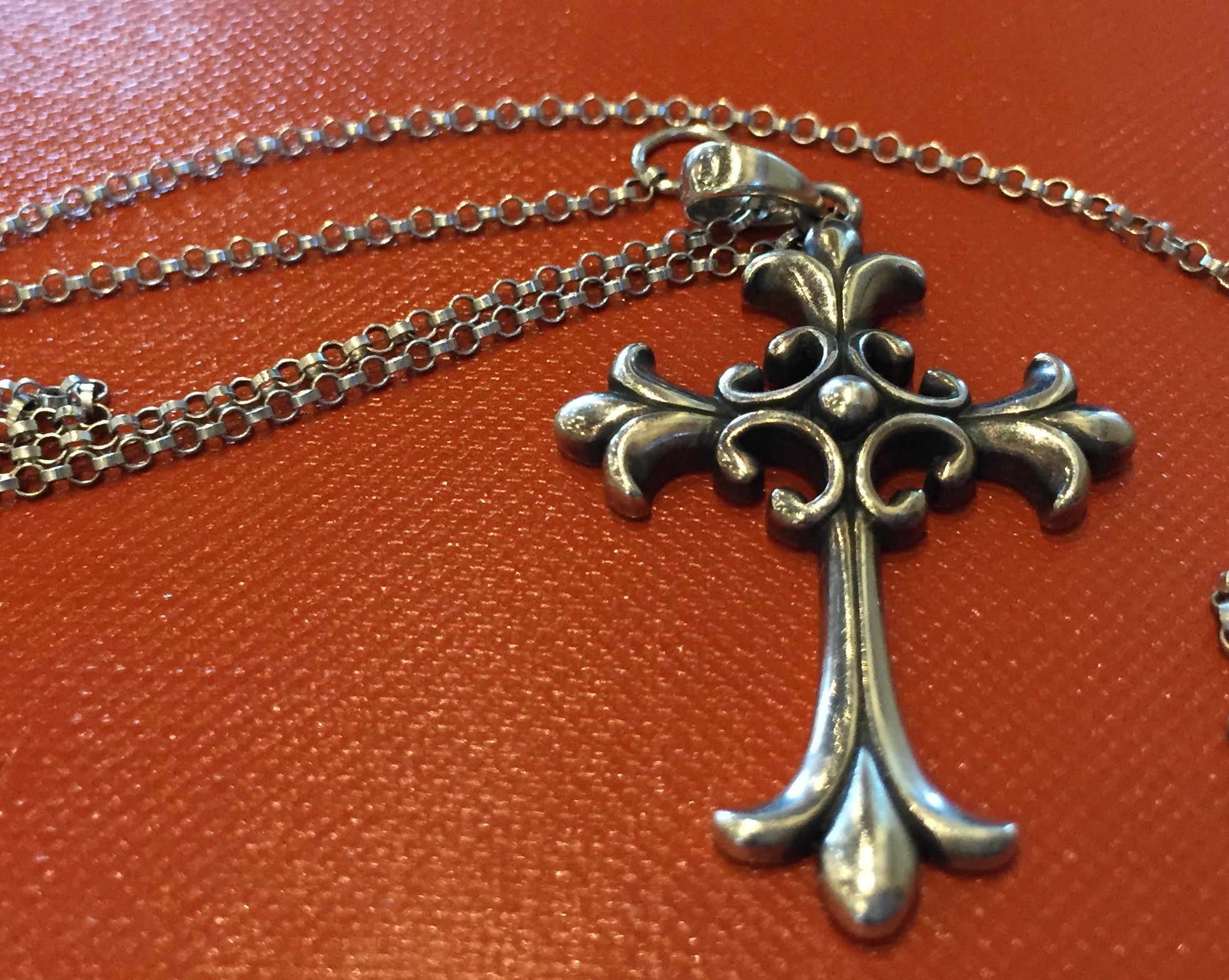
Named and Naming

cross picI can still see in my mind one picture from my very first children’s Bible. There’s Adam, his back facing me, a plant strategically covering his butt. Both arms are by his sides, but one hand is lifted slightly. The pose seems to say, “I’m thinking. The right name will come to me, and it will be perfect.”

In front of Adam is a vast line of animals, stretching off into the horizon. I remember a few of them: the lion, his mane-surrounded face looking wise and calm, a giraffe just behind, its neck and head arching toward Adam, and a gazelle-like creature, poised as if standing still was an extreme effort.

I’ve always been fascinated with this story, with humans having the privilege of naming. Naming, I feel, is a small act of creating, a small act that opens the door to vast possibility.

We humans love to name—our children, our pets, our businesses, even inanimate personal belongings. We seem to think that when we name, we hold a bit of interest in that person. We feel we’ve set them on a path because names carry connotation for us. Some names are strong; others are beautiful or quirky or unique. When we name, we confer not only possibility, but a hoped-for direction or purpose.

Could this love for naming be a longing for the privilege we had pre-Fall?

We lost so much at the Fall, relationship with God paramount, so perhaps the loss of our naming privilege does not seem very big, but I wonder about that. I think it must have been fairly significant: names are a big deal in Scripture. In historical accounts, the naming of children or places is often included. God changed people’s names several times, and in each instance the name change carried weight. It signified a new direction, a new identity, and a different relationship with God.

I’ve learned that the very fact we have names is important. I’m reading a book on Genesis* right now, and in the section about the serpent/Satan in Genesis 3, the author made this statement: “What is interesting is that in all but one of these … occurrences (of the name ‘Satan’), ‘satan’ has attached to it the definite article, ‘the satan.’ This indicates ‘the satan’ is a title, not a personal name. Satan is not who he is, but what he is. He does not merit a name, and in antiquity, not to have a name was to be reduced to virtual nonexistence.” (emphasis mine)

I often tell my children Satan is not capable of creating. He can only twist toward evil what God created for good, and this quote expanded my thinking: Satan un-named himself when he turned away from the Creator, and in so doing, he separated himself from any participation in creation. In a way, he undid himself. He made himself nothing, incapable of doing anything true.

In the Fall, we, too, un-named ourselves. We spurned “beloved” and “image-bearer” and put on false names like “self-sufficient” and “independent.”

But God snatched up the true names we cast off so flippantly. God kept them safe, and through the magnificent work of Immanuel, God restores them to us. Truly named ourselves, we can once again join God in the creative work of naming others.

I’ve been pondering this idea for a long time, particularly in my context as a mother. Each day I contribute to the naming of my children. With the attitudes, actions, and words I direct toward them (and in the absence of those as well), I shape their concept of themselves. I can name them “beloved” and “valuable” and “growing.” But I can also twist their concept of their name: “You are a bother.” “You are incapable.” “You are not worth my time right now.” I can reinforce their un-naming.

This is not only true for parents. We all have people we are called to nurture in one way or another, and we can be a part of naming them as God wants them named: valuable, unique, and beloved.

We can name even the people we simply pass on the street. When we make eye contact with a person, we “say,” “I see you. I acknowledge you as a fellow human being.” That is naming.

And when we avert our eyes, what then?

In I Peter, we are told we are “chosen (to be) God’s instruments to do his work and speak out for him, to tell others of the night-and-day difference he made for (us)—from nothing to something, from rejected to accepted.” **

And in this “telling,” we get to name others—with the names God has for them. He says, “I’ll call nobodies and make them somebodies; I’ll call the unloved and make them beloved. In the place where they yelled out, “You’re nobody!” they’re calling you “God’s living children.” **

We name: You are Somebody. You are Beloved. You are God’s living child!

What incredible work!

*Handbook on the Pentateuch by Victor P. Hamilton, published by Baker Book House, 1982. The quote I reference is on page 43 in this edition of the book. The link in the book title takes you to its page at Christianbook.com’s site, where you can buy the 2005 edition.

**The Scripture links take you to Bible Gateway, to that Scripture in three versions (The Message, the Amplified, and the NIV) side by side. It’s awesome to look at them in this way!

The freedom of being a small character

flower close upI just finished Still by Lauren Winner, an author who rises higher on my favorite list every time I read another of her books. (Follow the link above to her Amazon page to see all of them.) Still is about what she calls a mid-faith crisis–the doubting, dull doldrums–and what still keeps her in the faith and allows her, ultimately, to remain still in it.

One of my freelance assignments right now is a week of devotions on the “walk humbly” portion of Micah 6:8, and I’ve been simmering in that phrase before I begin the actual writing. Perhaps that is why the quote below from Still caught my eye. Whatever the reason for my first attraction, I have returned to it several times since, and I want to share it with you. If you are wondering this day about the specific purpose of your life; if you have thought “What am I doing?”; if you’re struggling with your significance/success–or seeming lack of it; if you’re shamed by failure, this one’s for you.

“It turns out the Christian story is a good story in which to learn to fail. As the ethicist *Samuel Wells has written, some stories feature heroes and some stories feature saints and the difference between them matters: ‘Stories…told with…heroes at the centre of them…are told to laud the virtues of the heroes–for if the hero failed, all would be lost. By contrast, a saint can fail in a way that the hero can’t, because the failure of the saint reveals the forgiveness and the new possibilities made in God, and the saint is just a small character in a story that’s always fundamentally about God.'”**

That last line (emphasis mine) keeps grabbing me. A load rolls off when I sit with it. I sigh with relief and gratitude. Yes! I breathe, yes!

white flowersFather, you are the Playwright of the greatest story ever, and you’ve given me a role in it, a small but somehow still important role. This story is about You; it’s for you; it’s by You. I come to you now and ask that You would simply show me what You have for me today in this story. Help me to release the big story to You, to let Your capable pen write it. Help me to live into the part you have for me, one small scene at a time. Give me great joy in doing my best for You. Remind me that You empower me to live out my role. May my bit part–and all our parts collectively–glorify You.

Just on a whim, I did a search on the word “story” on Bible Gateway. I specifically chose The Message to search from because I thought it might use the word “story” in a symbolic sense as well as in a literal one. I wasn’t looking for anything in particular, but I found some beautiful, arresting passages. I’ve included some of them below.

“You’re hopeless, you religion scholars and Pharisees! Frauds! You keep meticulous account books, tithing on every nickel and dime you get, but on the meat of God’s Law, things like fairness and compassion and commitment—the absolute basics!—you carelessly take it or leave it. Careful bookkeeping is commendable, but the basics are required. Do you have any idea how silly you look, writing a life story that’s wrong from start to finish, nitpicking over commas and semicolons? ***Matthew 23:23-24

[ Trusting God ] So how do we fit what we know of Abraham, our first father in the faith, into this new way of looking at things? If Abraham, by what he did for God, got God to approve him, he could certainly have taken credit for it. But the story we’re given is a God-story, not an Abraham-story. What we read in Scripture is, “Abraham entered into what God was doing for him, and that was the turning point. He trusted God to set him right instead of trying to be right on his own.” ***Romans 4:1-3

I’ve preached you to the whole congregation,
    I’ve kept back nothing, God—you know that.
I didn’t keep the news of your ways
    a secret, didn’t keep it to myself.
I told it all, how dependable you are, how thorough.
    I didn’t hold back pieces of love and truth
For myself alone. I told it all,
    let the congregation know the whole story. ***Psalm 40:9-10

*The Samuel Wells link leads to a piece he wrote for The Christian Century about Bonhoeffer. It doesn’t link specifically to this topic, but it’s a really good read and what he wrote near the end of the article about Bonhoeffer’s assumptions about his own life’s “success” really do flesh out the quote above (which is not from that article).

**The quote is linked to the specific page it can be found on in the book God’s Advocates: Christian Thinkers in Conversation. It’s a Google book, so the entire thing is available for reading on that page.

***The Scripture links lead to a parallel versions (Message, NIV, Amplified) of that passage, allowing you to see other translations alongside Peterson’s work.