God’s ONE “language of apology”

I recently listened to a radio interview with co-authors Gary Chapman and Jennifer Thomas about their book, The Five Languages of Apology (http://www.amazon.com/The-Five-Languages-Apology-Relationships/dp/1881273792). Basically, the gist of the book is that we humans have different languages of apology. Chapman and Thomas say that we need to learn the language of the person to whom we are apologizing: for some it may be expressing regret; for others it’s accepting responsibility; for others it’s making restitution; for others…

As I listened, I thought about how difficult our human relationships are. Each of us sees only part of the big picture—and we see even that part dimly, from the narrow corner of our own perspective—and we relate with fellow humans who do the same. Even when we apologize and “make right” the wrongs we do—in ways that are accepted by the other person—there is restitution to be made and a period of re-connecting and re-establishing relationship and trust. Sometimes this can take a really long time, and sometimes relationships never completely recover. I’ve often thought it’s pure grace for us humans to have any kind of good relationship at all. With our selfish human natures, the odds against that are stacked incredibly high.

The odds are stacked even higher—higher than we could ever reach—in our relationship with God. R.C. Sproul says this about the wrong we have done to God: “No traitor to any king or nation has even approached the wickedness of our treason before God.”*

We have greatly wronged God, and no amount of apologizing will fix it, no matter what language of apology we use.

But Christ fixed it.

He accepted responsibility for wrongs He didn’t commit; He made restitution with His body and blood; He made it right.

NOW we can have peace with God through Christ, through His apology for us.

And here’s the beautiful thing—as if that wasn’t gorgeous enough!: Christ continually grants us peace with God.

I still wrong God daily. I break our fellowship.

But to restore it, I don’t have to worry about figuring out His language of apology. I don’t have to say it just right or do the right amount of penance or wallow in guilt for a certain amount of time.

I’ve certainly tried all those things. I’ve beat myself up and tried to make myself feel “sorry enough” for my failings, but those are not only NOT God’s language of apology; they are counter-productive. They pull me away from Christ rather than to Him. They let me think I can do something to make God like me more.

I can’t.

The only thing I can do is come to God and say, “I blew it. I was wrong. I can’t make it right. But I can do this: I can cling to Christ and what He—and You—did for me!”

And when I simply come to God with sorrow over my sin (even when my repentance is tainted with self-focus, as it always WILL be this side of heaven), He draws me immediately to Himself. He tells me He “blots out and cancels my transgressions,” that He “will not remember them” (Is. 43:25, Jer. 31:34, Heb.8:12 AMP). He promises that His mercies are new every morning (Lam. 3:22-23), and His forgiveness does not come with strings attached. There is no waiting period before I am restored to fellowship with Him. He tells me to “forget what is behind” and “press on” (Philippians 3: 13); He tells me I will not be “confounded or depressed” and I can “forget the shame” (Is. 54:4 AMP).

This is the only relationship in which complete restoration and a fresh new start are possible each and every day, in which I do not have to carry the baggage of my failures and sins.

Instead God encourages me to walk in the freedom of His one language of apology.

In CHRIST!


*Sproul, R.C. The Holiness of God. Tyndale Publishers, 1985. Quoted from chapter 6, “Holy Justice,” page 151


the mess that’s me

Dog and husband hanging out in our new bedroom/my office. Yes! After 9 months of moving our bed from laundry room to old playroom to new playroom--as our great contractor Ben remodeled our basement. Our new bedroom has a door! A door! Woohoo!

Dog and husband hanging out in our new bedroom/my office. Yes! After 9 months of moving our bed from laundry room to old playroom to new playroom–as our great contractor Ben remodeled our basement. Our new bedroom has a door! A door! Woohoo!

It’s summer—but the pool’s not yet open, so my kids have been home a LOT! Every time I enter a room, be it their bedroom or a family area, I discover a new mess. We’ve already had the conversation about Mom not being a personal slave, about how my job in regards to their cleanliness is not to pick up after them so they can continue to be slobs for the rest of their lives but to prepare them to be good roommates (perhaps even spouses) and employees who notice and take care of their own messes. (There was a lot more, but I’ll spare you! I probably should have spared them!)

Ah, that word “notice,” as used in “notice their own messes.” It’s key for any sort of progress. Yesterday I sent the boys off to clean their room. They returned in three minutes. “Done,” they announced.

No way. I’d seen it that morning—and hours had passed since then, enough time for unheard-of chaos to happen.

I was right—shirts dripping out of drawers, dirty underwear peeking from under the dresser, a pile of clothes that looked like PJ had worn them in a mud wrestling event, granola bar wrappers on the floor, Legos in various stages of construction on every surface…

But here’s the thing: THEY thought it was clean.

I John 1 metaphorically fleshed out.

“If we claim we have no sin, we are only fooling ourselves and not living in the truth. But if we confess our sins to him, he is faithful and just to forgive us our sins and to cleanse us from all wickedness.” NLV

The Amplified expands that first phrase to “(If we) refuse to admit that we are sinners.”

Sinners: unlike God, missing His mark of perfection, incomplete in strength and knowledge and will.

Here’s my version of that first phrase: “If I refuse to admit that I am messy.”

Messy: not perfect, prone to do/say/feel the wrong things, carrying baggage (some of it unknown), unable to truly know and follow the “right way.”

This past weekend—graduation weekend—I had a conversation with one of the international students that went something like this:

International Student (IS): I don’t know what’s wrong with me. I don’t think I’m doing a good job saying goodbye with my friends, and there’s so much to do, and I know I’m not spending enough time with God, and that makes me feel worse and…” (She’s crying now.)

Me: What do you mean by “not spending enough time with God”?

IS: I’m not having devotions or praying. I can’t seem to get it all together so that I can.

Me: You don’t have to. Actually, you CAN’T. And He doesn’t want you to try. He wants you to come IN your mess, IN your humanity, and He wants you to cry out to Him. Right now you feel like God’s withdrawn because you’re so confused. He hasn’t; you’ve just built a wall between you and Him. He knows your mess and your inability. He died for it! Now let Him come into it and comfort you.

Lots of tears then, lots of hugging. So much better.

And as the old perfectionist (that’s me J) shared advice with the young perfectionist, I was preaching to myself.

I often don’t acknowledge my own messiness to God. I often try to deal with it in my way—which is the equivalent of my boys shoving clothes under beds, cramming overstuffed drawers halfway closed, and brushing litter into a pile in a corner.

In doing this, I cut myself off from the Gospel that God wants to work out in my life every day. I hold back from redemption.

If I’m going to embrace God’s redemption, I must also embrace an acknowledgement of my messiness.

He loves to cleanse.

And I need it…

‘Cause I am messy!

More and Less: the Usefulness of an Impure Pen

“He must become more.

I must become less.”

John the Baptist’s followers were amazed by their leader’s statement about Christ’s increasing popularity and John’s decreasing fame. “What’s wrong with him?” they wondered. “Doesn’t he realize this is bad for him?”

Deep down, their concern was about themselves, not John. “What about us?” they might have been thinking. “This is not good for US. We were disciples of the popular guy. We were up and coming, well-known. But this guy is cornering in on our market, and our résumés are suffering.”

Confession: I am so very guilty of this. Every time I submit a magazine/Web article or post a blog, there is at least a hint of selfishness. Underneath the good desires (I hope others are encouraged by my journey; I hope my work honors God) are seedier ones. Will people like it? Will this make me better known? Will this lead to bigger writing assignments and opportunities?

Ugh!

I long for completely pure motives, but I know that on earth I’m simply not capable of them. My old nature will always taint my motives, and I have to constantly face this truth. I recognize the selfish motive, acknowledge it to God in confession, ask for His help, and move on–until selfishness creeps in again. It’s a never-ending battle.

At times I get tired of it, sometimes so tired I want to give up: I want to stop submitting, stop posting.

But I feel called to persist, and John the Baptist’s words encourage me to keep fighting. John said, “He must increase, but I must decrease.” He didn’t say, “He’s great; I’m not. That’s it.” A process is implied in his statement. The Amplified version adds these words: “He must grow more prominent; I must grow less so.”

Now I know John the Baptist was a prophet. I know there is a prophetic sense to these words: they are referring to Jesus being lifted up as the Savior of the world and of John being seen as Christ’s servant, His herald. Perhaps John wasn’t speaking about a heart process at all but merely the actual events that were about to take place. He may very well have been so in tune with God’s plan that he wasn’t referring to his own selfishness at all.

But when I say them, that’s exactly what I’m referring to. I’m a lot more like John’s followers than I am like John. Though I know and understand more and more the overwhelming majesty and greatness of Christ, the reality is that I lose that viewpoint all the time; I feel that I should be the center of attention. THAT’S my battle, and the process hinted at in John’s statement encourages me to keep fighting it: “Christ must grow more prominent. I must grow less so.”

So I can GROW in decreasing (that’s a cool paradox). Exalting Christ can become greater and greater in my motivations. I can become less and less. Like Paul learned contentment, I can learn this.

I have a personal teacher who helps me with this very difficult lesson. In Colossians 1, Paul tells the believers at Colossae he continually prays that God will fill them with the knowledge of His will through the wisdom and understanding the Spirit gives so (they) may live lives worthy of the Lord, please Him in every way, and bear fruit.

I know God’s will for me as a writer; it is for HIM to be exalted through my writing.

And the Spirit, my teacher, is not only able to sanctify my motives, the Spirit is also fully capable of using my writing to exalt God at the same time!

The Spirit will enable me to please God with my pen and keyboard, to bear fruit through my words,

Kelly and Em at the junior high gala last night. Two beautiful girls! I must admit, though, my thought all night was, "But how did the time go so fast?"

Kelly and Em at the junior high gala last night. Two beautiful girls! I must admit, though, my thought all night was, “But how did the time go so fast?”

AND to “live worthy” as a writer.

Now THAT is Good News!


*Here are a couple of stanzas from the hymn “Holy Spirit, Truth Divine” by Samuel Longfellow (brother of the famous Henry Wadsworth Longfellow) that perfectly express the ideas in this post (and in far fewer words—oh, to be a poet).

Holy Spirit, Truth divine,

Dawn upon this soul of mine;

Word of God and inward light,

Wake my spirit, clear my sight.


Holy Spirit, Love divine,

Glow within this heart of mine;

Kindle every high desire;

Perish self in thy pure fire.

Let my words be few

The plan--hatched between PJ and Dad--was for him to pick red--for the Chicago Bulls, of course. But PJ saw the BRIGHT orange and was hooked.  So Dave drew a Bears symbol on instead!

The plan–hatched between PJ and Dad–was for him to pick red–for the Chicago Bulls, of course. But PJ saw the BRIGHT orange and was hooked.
So Dave drew a Bears symbol on instead!

I was lecturing–again. I don’t even remember which child it was, but behind him or her, Dave was signaling “STOP”: running his forefinger cutthroat along his neck; then putting his hands up, palms facing me; finally using the choir director’s sign for “and end.”

I got the hint, finally, and said, “Okay, I’m done.” I looked at the child. “Do you understand? Really?” Dave began the cycle of motions again.

The child left, and my shoulders sagged. “Suggestions?” I asked Dave. “I feel like I say the same things over and over and over.”

“And you say them well,” he said. “Too well. You say it, and then you add an illustration, and then you think of another way to say it, and then their eyes are glazing over. Must be the writer in you. Try fewer words.”

Funny how my mouth hasn’t caught up with the lessons my fingers have had to learn.

I used to hate writing word counts. I remember the first time an editor told me a piece had to be drastically reduced in length. There’s no way, I thought. That will ruin it!

It didn’t. In fact, it made it tighter, cleaner. Now I consider word counts a challenge and, eventually–when the cutting is complete, a real blessing to the overall piece.

It’s harder with the words we say, though. With writing, I can let it all out and then cut it before anyone else reads it. We can’t, however, rewind the words we say. Any revision, editing, or cutting has to be done BEFORE they leave our mouths.

“Let your words be few,” Solomon says in Ecclesiastes 5:2. He’s referring to prayer, but I think it’s a good mantra for us whenever we find ourselves with a runaway tongue. 

So many sins are related to what we say–and it’s usually because we talk too MUCH, not too little. Sometimes we have diarrhea of the mouth–completely unfiltered and unchecked (this makes me think of the illustration in James 3 of the tongue as a raging fire). Sometimes we are like a dripping faucet, nagging incessantly. Other times we may not be guilty of unkindness with our words, but we certainly can’t be accused of thoughtfulness either. Like a shallow stream our words gush on and on without much substance.

Proverbs 18:4 says, “Wise words are like deep waters; wisdom flows from the wise like a bubbling brook.” This contrasts what Job said about his very talkative friends. “You’re like unseasonable brooks that dry up in hot weather,” he told them.

Our words should come from a well of wisdom dug by the Holy Spirit. They should come forth, not in a gush but in a gentle flow. I get the impression that deep thought has taken place in the well BEFORE there is any output. The result is that the words are refreshing and helpful. Even reproof comes out of this wisdom, and encouragement is its underlying motivation.

Thought before speech; a gentle flow rather than a flood.

In other words, I need to think about my word count in my speech just as I do in my writing.

This makes sense, doesn’t it! How on earth will my children remember a lesson expressed in a torrent of words, no matter how well it is expressed. But simple directives or statements–like the Proverbs–have a better chance of sticking.

Our household rule for words is pretty simple: “If it won’t do good, don’t say it. If it WILL, DO.” I say this rule to my kids often enough that they tend to recite it with me when I start it. Sometimes THEY start it.

It’s a good rule for me to follow too.

Except I need to add “And then STOP!” at the end of it!


A few more verses about words:

Set a guard, O LORD, over my mouth; Keep watch over the door of my lips. Psalm 141:3

In the multitude of words sin is not lacking, But he who restrains his lips is wise. Proverbs 10:19

A word aptly spoken is like apples of gold in settings of silver. Proverbs 25:11

Whoever has no rule over his own spirit is like a city broken down, without walls. Proverbs 25:28

When she speaks, her words are wise, and she gives instructions with kindness. Proverbs 31:26

May the words of my mouth and the meditation of my heart be pleasing in your sight, O LORD, my Rock and my Redeemer. Psalm 19:41

Then Judas and Silas, both being prophets, spoke at length to the believers, encouraging and strengthening their faith. Acts 15:32

Even a fool is counted wise when he holds his peace; When he shuts his lips, he is considered perceptive.  Proverbs 17:28


The Lists We Make

“So how was your week?”

Absolutely crazy!

Dave coached three away games and had an evening meeting.

Em and Kelly’s junior high team had five games.

Em had a choir concert.

Judy and I had three dress rehearsals and two performances of the international student production.

And on Wednesday, Patrick broke his arm!

So–how was your week?

++++

I had that conversation several times this past weekend, and it made me think about the “lists” we make. I would call the above list a “suburban mom” list. There’s a little bit of an undercurrent of, “So how busy are you—in comparison with me?”

Ugh!

That’s not the only kind of list we make. Our lists change depending on the people we’re with. It’s a little bit like small kids talking about their dads: “My dad can run faster than a car.” “Well, my dad can run faster than a rocket!”

We can have academic lists, job lists, travel lists, sports lists—even spiritual lists.

I’ve certainly been guilty of using a list to make myself seem higher than the person I’m talking to—or at least to feel myself equal to that person.

What a nasty thing to do.

What a dangerous thing to do.

These lists separate us from other people. They deceive us into thinking that we have more differences between us than commonalities. They make us forget that we are all fellow creations, that we are all sinners, that we are all loved by God. We are all so much lower than the God who created us that our individual differences count for nothing. After all, a flea with an impressive list of accomplishments is still, well—just a flea!

And that brings me to the second dangerous thing about these lists: they separate us from God. Aren’t all of these lists ultimately ways to identify ourselves as worthwhile? Don’t we use them to convince others—and often ourselves—that we have purpose and value?

Purpose and value apart from simply being a creation of God. From simply being a flea, if you’ll pardon the extended metaphor. A flea among fleas, but each one uniquely created.

Paul had lists, too. In the context of church-planting, his were pretty impressive. In Philippians 3, he talked about his credentials as a Jew of Jews: circumcised on the 8th day; full-blooded Israelite; tribe of Benjamin; a Pharisee; strictly obedient to Jewish law—without fault! And zealous to boot! In II Corinthians he feels he must make a list simply to point out the Corinthians’ wrong way of thinking. You want to judge me the way the world does? he asks. Well, my list is better: beaten, imprisoned, shipwrecked, stoned, hungry, thirsty, cold, naked…

But Paul says this about his list-making: In this self-confident boasting I am not talking as the Lord would, but as a fool (2 Cor. 11:17). I once thought these things were valuable, but now I consider them worthless because of what Christ has done. Yes, everything else is worthless when compared with the infinite value of knowing Christ Jesus my Lord. For his sake I have discarded everything else, counting it all as garbage, so that I could gain Christ and become one with him (Phil. 3:7-9a).

That’s the choice we face: we can hold onto our lists—the things that, according to the world, give us value—or let them all go and gain Christ!

When we gain Christ, we no longer have to carry around our value-less lists. Like Paul, we have other things to boast about it: (For the Lord) “said to me, ‘My grace is sufficient for you, for my power is made perfect in weakness.’ Therefore I will boast all the more gladly about my weaknesses, so that Christ’s power may rest on me.  That is why, for Christ’s sake, I delight in weaknesses, in insults, in hardships, in persecutions, in difficulties. For when I am weak, then I am strong” (2 Cor. 12:9-10).

For when we are weak, then we are strong! Because HE is strong in us.

What a difference it would make if we boasted in these kinds of lists! When we share our weaknesses and how God meets them, it unifies us; it reveals common ground; it encourages and gives hope to others. It creates real, authentic, ultimately beautiful relationships.

Let’s start making a different kind of list!

Behind the scenes

“You learned it from Epaphras”

My quest to memorize Colossians is slow, slow, slow. But last week I got to that phrase: “You learned it from Epaphras…”

PJ in his bunny costume for last week's kindergarten Mother's Day program. You can barely see his sling under the costume. His teacher said, "Good thing he wasn't a bird! They have to flap their wings!"

PJ in his bunny costume for last week’s kindergarten Mother’s Day program. You can barely see his sling under the costume. His teacher said, “Good thing he wasn’t a bird! They have to flap their wings!”

and it jumped out at me.

That little pronoun “it” packs a lot in this case. Paul has already praised the Colossians for their faith in Christ, their love for God’s people, the hope they have in their heavenly home, and the fruit the Gospel is bearing in their lives.

Then Paul says this: “You learned (all this) from Epaphras…”

Good job, Epaphras! Scripture tells me very little about you. You’re clearly not a “major player” like Paul. You get less mention than Barnabus or Silas.

But Paul thought highly of you. After “You learned it from Epaphras,” Paul calls you a “dear fellow servant” and “a faithful minister.” He says that you work on the behalf of others—not for glory for yourself. He says you love to brag on the believers at Colossae. You take joy in praising them.

The Colossians learned a lot from you, the kind of learning people don’t get from lectures or sermons. I’m guessing your life was one people could follow, one that “showed” the Gospel, fleshed it out in an imitation of Christ. I’m betting you were pretty approachable, that people felt comfortable talking with you, even ordinary, everyday people.

And Maddie and Jake had Pioneer Day last week, too. Costumes galore!

And Maddie and Jake had Pioneer Day last week, too. Costumes galore!

Epaphras, you remind me of a lot of behind-the-scenes Christ-followers I know. They are doing their darndest to live out their faith—but they’re not front-and-center types, and sometimes they wonder if what they are doing is “doing” any good. They pray more than they speak; they help and follow more than they lead; they may live much of their days and lives in the company of just a few people. They sense that God had called them to exactly what they are doing, but sometimes it just doesn’t seem enough.

The lesson I gain from you, Epaphrus, is this: “Take heart! Don’t get sidetracked. Remember the goal: to ‘teach’ Christ through your lives. God has somebody watching.

And they’re learning Christ from you.”

DSC_1146

Lived-out lies

About two months ago the drama director at Wheaton Academy asked if I would direct a one-act play for the first-ever International Student production at WA. She sweetened the pot by hiring people to organize props, costumes, and the set. She hired someone to do sound and lights. She gave me a student director. All I had to do was direct.

Spring is by far the craziest season in our family’s year, but I couldn’t turn that down. So for the past five weeks, I’ve made our schedules even crazier with the addition of play practices. Our first performance is this Thursday, so I wrote my intro to the play yesterday. It felt a little like a blog entry, so I’m including it here, with a few revisions.

First, a little about the play. The Lie is a one-act based on a short story by Kurt Vonnegut. The Remenzel family has three members: Dr. Eli Remenzel, a man from a long line of wealth; his wife, Sylvia, who is from a poor background; and their 14-year-old son, also named Eli. When the play opens the Remenzels are on their way to Opening Day at Whitehill School, a prestigious boys’ prep school that was founded by the Remenzel family in the 18th century and has been generously supported by them ever since. Whitehill believes in equality; it takes only young men who pass its entrance examination and it accepts them regardless of their family’s ability to pay. Dr. Remenzel is very, very proud of this and he is excited that his son is carrying on the Remenzel tradition of attending Whitehill.

What Dr. Remenzel does not know is that his son failed the entrance examination for Whitehill. He has been refused admission but is afraid to tell his father this. Eventually, of course, this comes out, but as the young Eli and his parents deal with the consequences of his lie, a bigger lie surfaces. It’s a lie that’s being lived, not just told, by his father. The play ends with young Eli asking his mother, “Does he know?”

“Know what?” she asks.

“That he’s a bigger lier than me.”

Oh! It’s a killer ending.

Despite the play being rather sad, directing it has been a blast. The actors and my student director are incredible. But a play like this makes you think. On opening night, Thursday, I will introduce the play with some of the lessons I’ve learned:

I’ve decided that we are prone to “living lies” a lot more than we think we are. Possibly we do more of this kind of lying than the simple “telling” kind. We live lies every day: when we SAY that something is important to us but our daily lives don’t reflect a striving toward that; when we say we love Jesus but we don’t really study what He says and change our lives to fit His teaching; when we say we love people but we’re willing to gossip about them or ignore them; when we’re willing to adjust our identity based on the people we want to impress.

There’s a verse in I John 1 that talks about this kind of deceit: “So we are lying if we say we have fellowship with God but go on living in spiritual darkness. We are not practicing the truth.” Practicing the truth is the opposite of living a lie. My natural bent is to live the lie, to do whatever feels most convenient or profitable for me. Living in truth requires practice, and it’s hard.

But we hurt ourselves when we live lies instead of practicing truth. This play shows this so clearly. Every time I’ve watched it, I’ve felt sad because that family is being damaged by this lived-out lie. It’s keeping them from really honest, true relationship with each other.

And sometimes I feel that way—sad and a little hopeless—about myself, too. Half the time I don’t even know I’m living a lie. I don’t even see the ways I hurt people until I’ve already done it. I don’t recognize that I’ve worn a mask to please people.

I’m not alone in this. The psalmist David said, “How can I know all the sins lurking in my heart?” This makes me think of another verse in I John 1: “If we claim we have no sin, we are only fooling ourselves and not living in the truth” (verse 8). Another version says, “we are deceiving ourselves.”

Summary: Sin lurks in my heart, and my natural bent is to pretend it’s not happening! That’s discouraging!

But unlike the family in The Lie, who seem stuck in this place of deceit and brokenness, I have hope—THE hope: Truth himself.

Just after David wailed, “How can I know?” he asked God to “cleanse him from his hidden faults.” John said that God is faithful to reveal and then forgive and then cleanse us from our sins—from the lies we live. God tells us to come into His light and He will expose our darkness. That’s an uncomfortable idea. I’m usually a lot happier when I think I’m doing okay.

But I don’t want to live like the family in The Lie. I want what God promises, that if we live in His light, we can have this incredible fellowship with each other, we can be continually cleansed and made true by Christ’s blood.

Hallelujah!

Pondering Philippians 1:6, part 2

Just a fun picture of PJ and Chai. She is so patient! One of the girls--I think Kelly--took this picture.

Just a fun picture of PJ and Chai. She is so patient! One of the girls–I think Kelly–took this picture.

One day last week, I threw the ingredients for bread into the mixing bowl of my bread machine and hit the start button for the dough cycle. Two hours later the machine finished its work and I lifted the lid, ready to punch down the risen dough and form it for its second rise.

But I’d forgotten to add yeast. The dough, flat and sodden, lay at the bottom of the mixing bowl.
I am often like that dough, struggling to rise but lacking the power. I am full of desires to do more and be more, but when I try to figure out the “what” or “how” on my own, I either slip into despair at my inability and failures OR I get puffed up over my itty-bitty accomplishments (until I eventually I fail and then fall into despair.)
But all was not lost for the sodden dough in my bread machine. I added the yeast and started the machine again. Two hours later the top of it bounced when I touched it, and an hour after that, light, fluffy rolls made my kitchen smell wonderful!
And all is not lost for me! When I strive-and-fail, strive-and-fail, I forget this truth: I was NEVER meant to provide the power for my growth; the Holy Spirit is my yeast! The Spirit provides the power to rise!
Jude verse 24 is another verse that reminds me that GOD is the one who holds me. I chose to use the Amplified version of Jude 24 for this blog entry because it uses the word “falling” (it’s in bold—my emphasis) and that seemed appropriate:
“Now to Him Who is able to keep you without stumbling  or slipping or falling, and to present [you] unblemished (blameless and faultless) before the presence of His glory in triumphant joy and exultation [with unspeakable, ecstatic delight]—
25 To the one only God, our Savior through Jesus Christ our Lord, be glory (splendor), majesty, might  and dominion, and power and authority, before all time and now and forever (unto all the ages of eternity). Amen (so be it).”
Isn’t that awesome! My own desires to be more/do more–there is no way they can compare with Christ’s goals for me! He says he want to present me before the Father faultless and in ecstatic delight! And He reminds me that He is ABLE to do just that.
HE is able! Not me!
His Spirit–the Comforter–is with me (John 14:16, 26).
And THAT is why I can be confident that God will complete the work He has begun in me (Philippians 1:6).

Pondering Philippians 1:6, part 1

As young people—in our teens and even twenties—possibilities often seem endless. I remember thinking I could be a doctor like my dad and help lots of people with their health issues—maybe on the mission field. I could write the next great children’s novel—and be like Madeleine L’Engle. I could open an orphanage. I could…

Now life feels more limited–and a lot more complex. I understand that opening one door means closing another. I see so many needs and often feel helpless to assist. I know children are starving around the globe and I look at my comfortable lifestyle and wonder what biblical living means for those of us who stay in the suburbs. I struggle with the differences between needs and wants. I wonder if all the “little” things I do each day are really making a difference. Is THIS what I’m supposed to be doing? I sometimes wonder.

The Christian life no longer seems like endless possibilities; it seems wrapped up in—perhaps even restricted by—“small” choices within everyday life.

But in the midst of my questions, my wondering, I’m learning to cling to the promise of Philippians 1:6—“…being confident of this, that He who began a good work in (me) will carry it on to completion until the day of Christ Jesus.”

And lately God has given me the privilege of seeing that verse “fleshed out” in the lives of some older believers.

Because of the writing assignments I do for Wheaton Academy, I often get to interview believers much older than myself. They tell me their stories and about what has happened with them since they left Wheaton Academy. In their 70s and 80s, they don’t focus on the “small stuff” that unfortunately controls much of my early-40s, mom-to-6-kids, suburban life. But I know they DID experience these things; I’m not always talking to people who lived their entire lives on the mission field. Like me, most of the people I interview have children. They, too, bought homes and “settled” and lived in American culture. They, too, worked and had to bring home a paycheck to feed and clothe and pay sports fees and activity fees and for the cleats and shinguards and guitars to take to the sports and activities.

But they have something I don’t, a vantage point that I usually lack. They have a long view. One of them recently said this to me: I look back on all my career, all the jobs and changes and successes, and on our family life, and I see God purposefully preparing me and my circumstances for what I am doing now, in my golden years.

This bird was hanging out in a tree in our backyard a week or so ago. Hawk? Falcon? Anybody know? Whatever it was, it was big and fun to watch.

This bird was hanging out in a tree in our backyard a week or so ago. Hawk? Falcon? Anybody know? Whatever it was, it was big and fun to watch.

This man didn’t orchestrate things; he just did what came next—which is what I feel like I do most days, wondering if it’s what I’m supposed to be doing, wondering if it’s of any eternal purpose. This man didn’t have the long view IN the moment, in the journey. He just put one step in front of another and NOW he can look back and catch a glimpse of the pattern. He sees how all the “little” was part of the BIG, and that helps him to trust that there is an even bigger, even deeper pattern beyond and beneath what he is able to see right now.

And his long view helps ME to be “convinced and sure of this very thing, that He Who began a good work in (me) will continue until the day of Jesus Christ [right up to the time of His return], developing [that good work] and perfecting and bringing it to full completion in (me.)” Phil. 1:6 Amplified version.

wallow

Em took this picture. Love on every page.

Em took this picture. Love on every page.

When I was a kid, one of my favorite books was about a pig that had a special wallowing hole. The farmer’s wife thought the pig’s mudhole was messy, though, so she cleaned it up (vacuumed it up–I loved that picture), and the pig ran away in search of a new wallowing hole. He hitched a ride on a passing truck and ended up in the city. When he saw some fresh cement, he thought it looked like mud and dove right in. Of course, pretty soon, it hardened, and he was stuck. Being a children’s book, though, the farmer’s wife realized the error of her ways and went looking for the pig. She and the farmer broke him out of the cement and took him home to his restored mudhole.

And the pig lived happily ever after.

I thought of that book today because I was pondering the word “wallow.” In my last post, I confessed that I often wallow in guilt—sometimes shame, other times pride, insecurity, jealousy… We humans wallow in all kinds of things that end up holding us prisoner—like the pig in the cement.

But what if we wallowed in God’s love? It’s big enough. Scripture speaks of it having vast height and depth and width and length. We are told to be rooted deep and grounded in love. God’s love is called great and wonderful and intense (Eph. 2:4 and 3:17-19, Amplified). Whenever I read the verse about the height/depth/width/length, I think of the Olympic-sized swimming pool I took lessons at when I was a kid. I was little, so it seemed HUGE! I could go down, down, down till my ears popped, I could twirl in the water, I could splash and jump. I could float, buoyed by water molecules. I could dive in and not hit bottom. I could try as hard as anything to swim underwater from one end to the other on one breath and not ever succeed (that changed as I grew older).

Wallowing is essential for pigs. They can’t sweat, and the coating of mud keeps them from overheating.

God’s love is not only essential for me, too, but keeps me from “overheating as well.” When I am busy “wallowing” in His love for me, discovering greater depths and breadths of it, “exultingly glorying” in it (that’s from the Amplified version of Romans 5:11), it keeps me from getting “overheated” by stress or anxiety or troubles. It also decreases my desire to “wallow” in anything else.

I wondered if there were any other reasons pigs wallowed, so I Googled the question: “Why do pigs wallow in mud?” Of course, I got multiple answers about their lack of sweating, but some scientists suggest that they do it in part because they enjoy it. It makes them happy!

This is true for us in relation to God’s love: what is GOOD and necessary for us is also enjoyable!

So, applying this to God’s love, I could paraphrase Paul’s words in Ephesians: Dive into the mudbath of God’s love. Let it get all over you, head to toe, soothing any sores. Let it seep into your heart, filling every crack and crevice, every wounded part. Don’t clean it off. Give each other messy hugs, so that your mudbath spreads to someone else—and theirs spreads to you. Roll around in it regularly; don’t let it grow dry and hard. Better yet, stay in it!

Wallow!

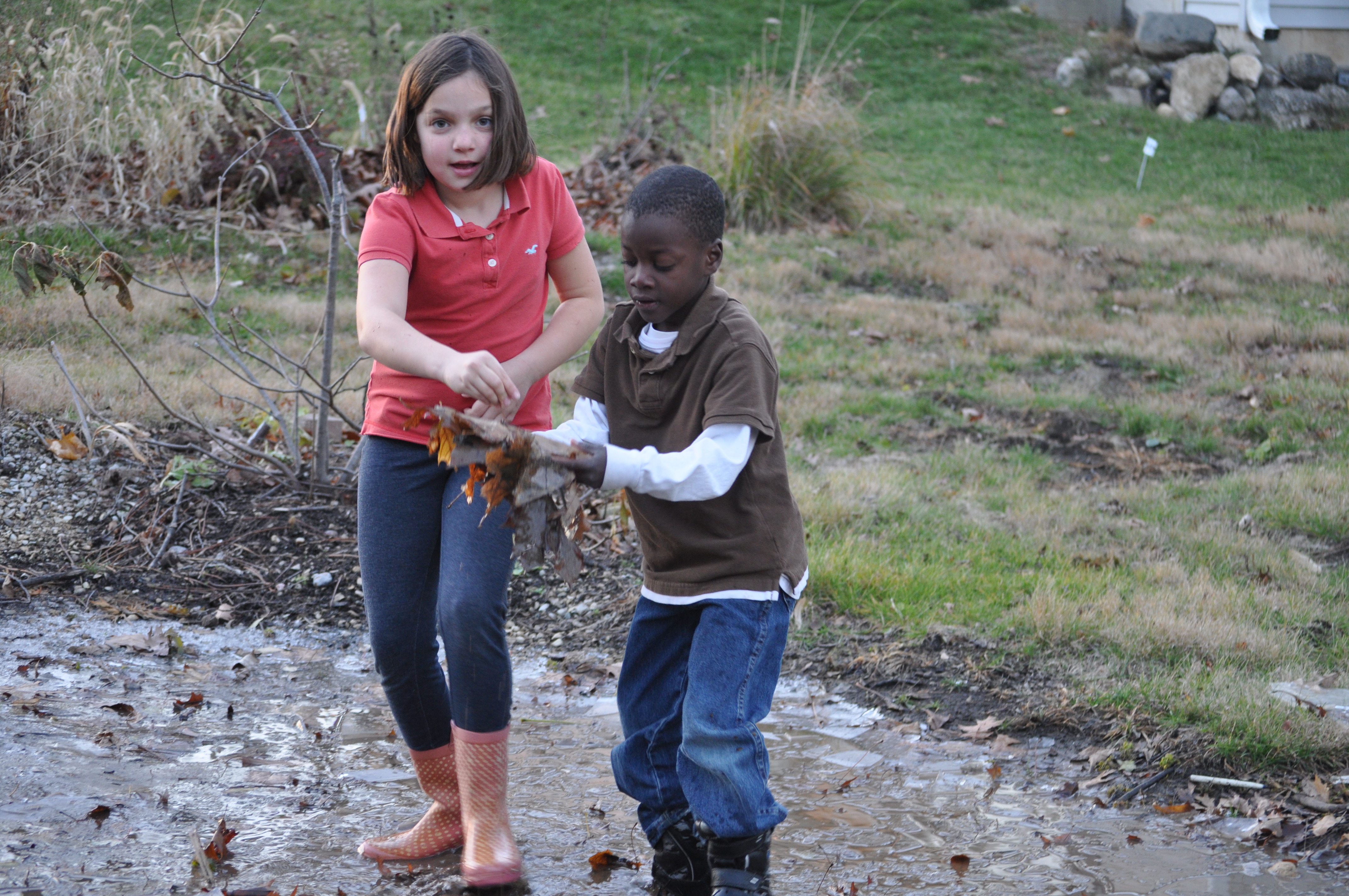
I thought a pic of my mud buddies was appropriate for this post!

I thought a pic of my mud buddies was appropriate for this post!