Communion

We had communion this past Sunday. I love taking communion, its reminder of the very core of our redemption. If I were a poet, I would write something beautiful about how the bread sits on my tongue a moment longer than it needs to. I postpone sliding it between my teeth, hesitate before biting down on it. “My body, broken for you.” My inner ear hears the small wafer break; my jaw feels the crunch and the release, and I see and feel in a different way Christ’s body being smacked about by the huge, meaty hands of Roman soldiers, His flesh being torn and ripped by the multi-barbed whip, pierced by heavy nails. “My body, broken for you.” I am glad for the time our pastor gives before he prompts us to take up the plastic cup, filled with juice in my church. “My blood, shed for you.” I pour the grape juice into my mouth. It gathers bits of the cracker as it makes its way to the back of my throat and then down, down into my stomach. So much blood–shed in great beads of sweat, in flying droplets of red rain, in a head-to-toe-covering slick, and finally, in a gushing torrent, blood and water mixed, the elements of redemption and purification finally, ultimately provided from a pure, single source. “My blood, shed for you.”

So that we do not bite and devour each other, and ourselves, He was devoured. So that we do not bleed to death from the wounds of our sin, He bled.

Broken body, shed blood.

Amazing redemption.

Bodily Functions

The kids after their last soccer practice in spring 2011.

“Jake, Patrick!” Maddie yells. “It’s time for another ‘Poopface.’”

“What’s this?” I ask.

“Oh, we’re making a video.”

I need a little more.

“You’re making a video (they often use my iPad from work to record their plays and “music concerts”) named ‘Poopface’?”

“Yeah. We already have a couple. They’re really good.”

I decide to do some observation—from another room.

“Okay, places, people. PJ, you’re by the door. Jake, sit on the chair.” Maddie is DEFINITELY preparing for some kind of leadership position.

“And, ACTION!” she yells.

“Poopface, play with me.” That’s Jake, his voice fake-booming.

Hmm.

Now PJ’s voice, in an accented whine. “But I don’t want to. I don’t want to do anything with you.”

“But you have to, Poopface. You’re my buddy.”

I step into the room. “Wait a minute. PJ’s ‘Poopface’?”

Maddie sighs, then yells, “CUT!”

I say it again. “PJ is ‘Poopface’?”

I’m getting the did-we-do-something? look from all three of them.

Then PJ says, “Yeah” and shrugs.

“PJ, you cannot be ‘Poopface.”

“Why not?”

“Because your face is brown and theirs…” I point to Jake and Maddie. “…are not.”

Now they’re looking at each other. Mom’s-gone-psycho!

I try a different tack and turn to the twins. “Sweethearts, people will think you’re making fun of your brother. Poopface is not exactly a compliment, you know.”

Still no lit lightbulbs. “Okay,” I say in my firm voice. “No more ‘Poopface’ videos.”

NOW the blank looks are gone. “But Mom, they’re good. We were going to put them on Youtube!”

Oh, my word!

“Absolutely not. People will think you’re making fun of your brother. They will think you’re saying that his face is the color of poop!” I’m waving my arms by now.

Nothing.

“Aren’t you calling him ‘Poopface’ because his face—(I look at PJ) your face—is dark?”

“Well, yeah,” says Maddie. I begin to nod, thinking I’ve gotten somewhere, but then she goes on.

“But Jake’s ‘Pee-face.’”

Legalism and heartbeat

I’m a recovering legalist—with lots and lots of lapses. My determination to pull everything together in one neat little bundle (I see it all the time in my blog and journal entries—I like tidy endings) is my attempt to find answers and figure things out. I hold onto this hope that at some point I’ll “get” it, I’ll “arrive.” I run around like I’m in a funhouse mirror maze, looking for the reflection of the “me I’m supposed to be,” but all I find are distorted images, and my heart races from the stress and the disappointment.

I’ve been trying to focus on a different image lately, that of Christ as the Lamb of God. It’s less elusive than the “me” image I can’t find, but it’s still puzzling because HUMANS are described as sheep in Scripture, and the implication isn’t a compliment. Sheep are generalized as dumb, easily duped, following whoever promises the shiniest deal of the moment, unable to distinguish what is best, rushing headlong, hearts racing and straining, into destruction. Not able to defend, attack or run away, not able to do much of anything. Just dumb, helpless beasts VERY, VERY much in need of a shepherd, but unwilling to submit to one.

And Christ became a sheep like us—like me. He put on limitations and weakness; He became defenseless, open to temptation.

But He is also a sheep UNlike my kind of sheep, because He accepted His Shepherd as His Shepherd. He drew near to Him like a beloved lamb.

This reminds me of the lamb in the story Nathan the prophet told David after David stole Bathsheeba. “And he (the owner of the one lamb) brought it up, and it grew up with him and with his children. It used to eat of his morsel and drink from his cup and lie in his arms, and it was like a daughter to him” (II Sam. 12:3). Is that how Christ grew up with God? Like THIS lamb? Not going astray or reaching outside his limitations (self-imposed in His case), just resting in the arms of His father, growing up with Him, waiting, following and trusting like a small child.

That’s hard for THIS poor, stupid sheep. It’s not only hard to DO, it’s hard to see, even though God’s given me four very immediate examples. My little sheep don’t spend hours worrying about how to please me. They don’t look over their shoulders constantly wondering if I’m going to disapprove. In part this is because they KNOW me—because they’ve spent a lot of time with me. It’s also because they are free-er than I am. They know there is restoration, there is love. When they “mess up” (or when I do), we get it all sorted out, end with hugs, and move on—knowing better and better what really DOES please and honor each other. This brings to mind the statement Christ made: If you humans know how to give good gifts to your children, how much more the Father in heaven. If our flawed human family (with me, Mrs. Legalism, as its mom) has somehow bumbled into some good knowledge of what love really looks like, then can’t I trust that God knows, that God loves?

I spend more time trying to figure out how to please God than I do just getting to KNOW Him. One of my friends pointed out that there is a huge difference between seeking God’s will and seeking GOD. The object is very important.

I’d like to be the little lamb in Nathan’s story, curled up next to God’s chest, listening to His heart beat its steady thump, thump, thump, its neverending message of love. “Stay here, stay, stay, stay,” is the message in the beat of His heart  Bit by bit, my own heart’s racing, skipping arrhythmia gets overwhelmed, smoothed out, settled. Bit by bit, I’m no longer consumed with some image of myself because my heart is becoming more like God’s—which, as I know from another time in King David’s life, is not concerned with appearances.

I am a little lamb, being brought and grown up along with God’s other children. I am eating from His morsel and drinking from His cup. I am lying in His arms. I am His daughter.

May my heart beat like His.

Ugandan girl

NOTE: This piece fits with my continued focus on gratitude–and this week being Thanksgiving. It’s a possible chapter in my book on Patrick’s adoption.  The muzungu in the piece is me. The young Ugandan man is Philip, one of the pastors at Light the World church, currently a student at Moody Bible Institute. 

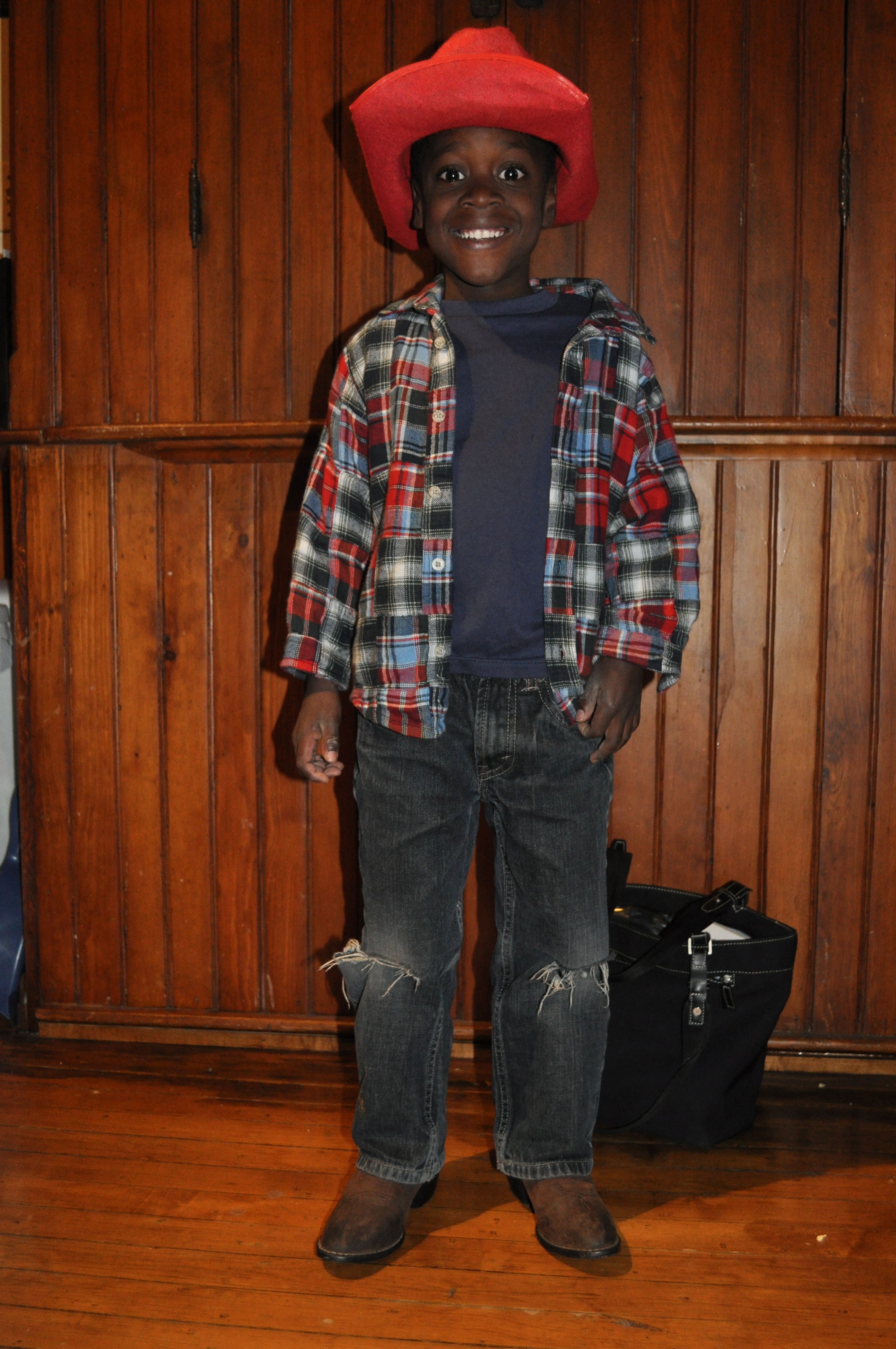
Here's my little Ugandan cowboy.

In the shade, the air settles on skin like hot, damp cloth. In the open the sun blasts like a blowtorch. Women passing carry umbrellas, open them to block the heat rays. Men wet handkerchiefs to spread over their heads or tuck inside their collars. As matatus swerve into bus stops, the scent of sweat drifts toward those waiting to board. Women holding chickens in small wire cages or bundles of bananas argue with the conductor to hold them on their laps. “No, you cannot tie them to the roof today.” They are afraid they will find cooked meat and shriveled fruit at the end of their journeys.

People sit under awnings, seek out the cool of open-front bars. Those who have to walk the sides of the road scurry from the shelter of one scrawny tree to the next or stride with purpose, the sooner to get out of the sun. They skirt around the girl sitting listless on this busy corner. They edge away from her hopelessness. A square of cardboard lies next to her. She lifts it to shield her head from the heat, but her arm grows tired, and she lets it drop. It takes up no more space than she does on the small ragged cloth she sits on. One leg, skinny like a chicken’s, is tucked beneath her. She pulls the other to her chest, tucking the skirt of her worn, color-faded dress around her leg so she is not exposed. One outstretched arm rests on the top of her lifted knee. She turns her palm up, fingers curved to catch the coins that no one drops.

Eleven? Nine? It is hard to tell. Her face has lost any impish qualities of childhood, any softness. It is angles and planes, and the dark eyes in the face have no light to them. She stares at the ground, uninterested in what passes, but when people come near, she lifts her face so they see her, so, perhaps, they notice her. It is an appeal the “guardians” teach their street children, one the children, in turn, teach each other. “Hold up your face, look sad, some kind uncle or auntie may take pity and give you a coin. Maybe a muzungu. Sometimes they give more.”

But no one pauses to drop coins into her cupped palm. Though she follows the rule, turns her face up, she does not give the right face, the face that draws pity, sympathy. She is past “sad.” She is blank. If she is on her own, she will not eat today unless she steals or finds some scrap unwanted by anyone else. If she has a guardian, she will be beaten. She will be told to sell her body if her begging does not bring coins.

The wind swirls grit from the packed dirt walkway, and she closes her eyes, brings her other hand, bony, long-fingered, up to shield them. Her knees and elbows are dusty,  with wrinkles like the joints of an elephant. The skin of her legs and arms is chapped; gray shadows hover on her dull brown skin.

She lifts her face again. No passerby this time, but the spicy scent of pilau, floating out of the restaurant behind her. Her face still does not change, but she breathes in deep the onion, the chicken, the rice. Her chest rises high and falls. Repeats.

Inside the restaurant, tucked beyond the awning, near the coolness of the concrete walls, a muzungu woman and a Ugandan man wait. The waitress brings out food. She slides a tray of meat and potatoes in front of the young man, then adds a bowl of broth, a small side of vegetables. He smooths his spotless white buttoned shirt and rubs his hands together. The pilau is placed in front of the woman, a missionary or aid worker by the looks of her, with her long, dark split skirt and wrinkled t-shirt. Short dark hair sprinkled with gray frizzes around large-lensed glasses. Her nose shows pink from the sun. She leans toward the young Ugandan, asking a question. His eyes glint and he smiles, showing strong white teeth. He talks between mouthfuls of meat, leaning down to pull strips from the bones, gesturing gracefully with his long, slender fingers. The woman finishes her pilau and sits back, listening to the man talk. She motions to the waitress, who brings another plate of meat to the man and swings her hips as she walks away, hoping the handsome young friend of muzungus will notice her, but his close-cropped head doesn’t turn her direction.

It does tilt, though, toward the front of the restaurant, at the girl sitting on the ragged cloth. He looks back at the muzungu, keeps talking, but he is distracted, and she notices, turns in her seat to look behind her, sees the street child. They stop talking, stare at the girl. She does not notice, her head still tucked to her chest, her neck bent level with its weight.

The muzungu turns back to the man, asks him something again, her eyebrows pulled together, a deep line separating them. The man shakes his head, his shoulders slump, but then he speaks again, his arms waving, his food forgotten. His voice rises, phrases puff up into the damp, hot air. “Thousands of them.” “Government has no plan.” “Police round them up, put them out of the city whenever an official visits.” “Eventually drift back.”

“More every year.” “Girls pregnant.” “First sexual encounters as children.”

“Some find guardians, more like pimps.” “Beaten if they don’t bring home money.” “Prostitution.” “Not enough homes.”

The muzungu puts her elbows on the table, her chin in her hands.

The man winds down, sits back in his chair. They are quiet together. They sit like the girl, still, slumped, their words finished.

The woman pushes up from the table, goes to the counter and talks with the waitress. She returns, and the man looks up. She speaks. He nods.

They go to the counter together. The waitress hands the muzungu a platter piled high with food. She passes it to the man, and he carries it out into the sunlight, the blazing rays making his brown skin glow like polished wood. He sets the food down and kneels beside the girl, puts a hand on her shoulder, speaks, his Lugandan words a gentle murmur.

The muzungu hitches her bag higher on her shoulder, tucks it tight against her side, and moves a little way down the street to wait for her Ugandan friend.

My Enough

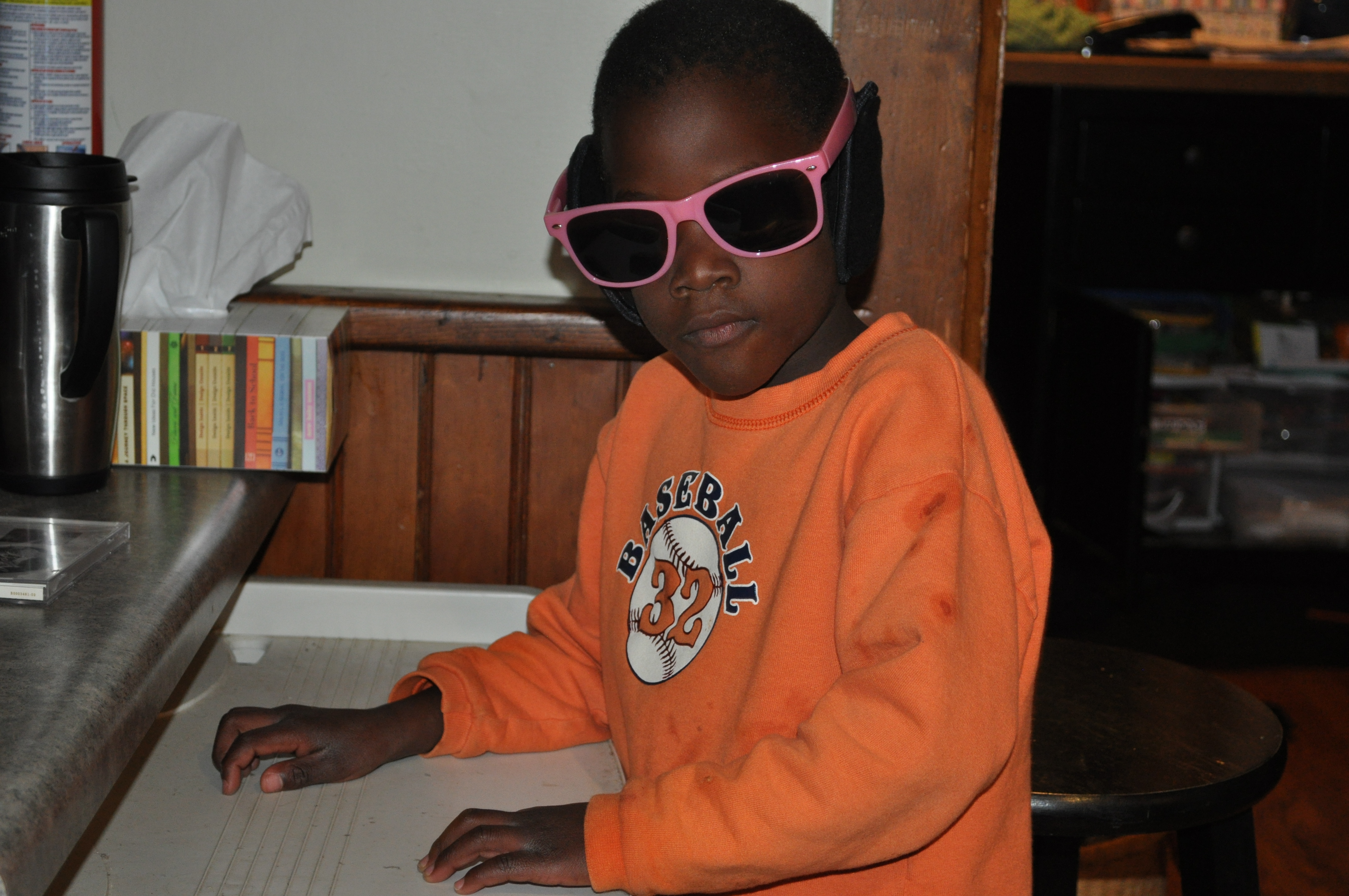
The earmuffs are headphones, the pink shades are, well, shades," and the little man is pretending he is a disc jockey playing some tunes. One of our many "jam" sessions.

11/10/11  I yelled at Maddie this morning. No words, just a primal scream of frustration, eyes wild and wide (I was facing the bathroom mirror and saw myself). It was a “scream or throw something” moment. It was–horrific realization–a moment when I could imagine smacking her, hard. The scream scraped my throat. My ab muscles ached when it was done. Maddie, already in tears before it started, was, of course, in bigger tears when it finished.

I can make excuses: Dave’s out of town; I’m running ragged trying to get all six kids to the three different schools they attend; Maddie had another of her wailing, sobbing mornings because her pants actually touch her body and then the toothpaste stung her lip; I’m battling a cold that makes my head feel like toilet paper is scratching the inside of my ears. But. I. Screamed. At. My. Child.

There is no excuse for that.

I told Maddie I was sorry, I told everybody I was sorry (after all, they’d all heard it), we moved on, we eventually got out the door (though not without more grumbling on my part about hurrying and putting shoes on and getting out to the car), and we made it to our carpool location on time. But the morning felt ruined.

Before they got out of the car, I asked them if I could pray. “Oh, Lord, I blew it this morning,” I said. “Please heal my children’s hearts from the damage I caused. Please heal me. Thank You that You do not lose patience.”

“It’s okay, Mom,” Em said, and I thanked her, though I also said it wasn’t really ok. I held Maddie in a long hug before sending them off to the other van. I took Patrick to school, came home, and lay flat on my face on the library rug.

It took awhile to shut off my tumbling thoughts, to stop the battle going on in my head between penance and excuses. It took the Holy Spirit’s gentle “Shut up” for me to be still, to listen.

“You’re weary and burdened. Come to me.”

“You’ve confessed your sin. I am faithful. I will forgive and cleanse and change you.”

“You’re a new creature. You let the old, dead one rise up like a shrieking zombie this morning, and you sure didn’t seek Me in the midst of the trial, but I am still making you new. I will complete what I have begun in you.”

“Beating yourself up will not pay for your wrongdoing. I paid for it, and I will take care of it now.”

“How can you help Maddie with her clothing issues? Talk with Me about that.”

“I can and will make good from this. Learn more about Me. That will renew you.”

I lay on the rug for several more minutes, feeling limp but cleaned out, able to see more clearly what led to my zombie shriek.

I had gotten all my gears oiled and ready, scheduled this morning down to the minute, and thought of my children like cogs in a machine and myself as the master mechanic.

I’d begun to think, “Yeah, I can do this! A little issue here, little issue here. I’ve got it. I can handle it.”

Uh, obviously, no, I couldn’t. My system rested on ME, and I broke down this morning. Sooner or later I always will, so any plan that rests on my ability or character fails because I fail. I’m human.

Definition of human: “messed up.”

This would all be utterly hopeless if I did not have someone other than a human to rely on, Someone SUPER human, Someone good through and through, perfect to the core.

My God is the only one who does not fail. Therefore, He is the only reliable source of hope.

Only one source of hope. Not a whole bunch of systems and backup plans and “go-to” components.

It sounds a little like a pipe dream, like a machine that looks magnificent but doesn’t function. It sounds unreliable. It’s not enough to rely on.

But it IS—because the source of the hope is enough. Hope in God does not disappoint because HE does not disappoint.

Christ in me, the hope of glory. Christ in me, my All in All.

Christ in me, my ENOUGH.

Note: This was from last week. This morning I realized, with great gratitude, that we have had no tears about clothes for three straight morning!

MEF

Em on the tire swing Dave recently hung for the kids in the back yard.

The carpool kids and I have jokingly created a new phrase: “MEF,” standing for Major Epic Fail. We use it only in fun, and I monitor that closely because I know that it hurts to feel that you have really, truly failed.

I’ve felt a bit of a MEF lately. Nothing’s going horribly, but I’m not hitting anything out of the park either: Teaching, hmm, so-so; House upkeep/family organization, um… ; Mothering, well, you know how you feel when you recognize something is incredibly important, but it just makes you weary? Yeah.

And finally, what’s rubbing deepest of all this week: my dream of being a published writer—of that being my primary outside-of-mothering job—feels further and further away from ever being a possibility.

I have issues with this dream. The desire for publication has never been comfortable for me. I struggle with the apparent selfishness of it, with my “need” to be recognized for my writing ability and my ideas. At the same time, I can’t stop writing. It’s a compulsion. More than that, it’s a gift, and I feel I’m supposed to do something with it.

And that’s the thing: nothing is coming of it. I post on my blog; I take five pages to a writing group each week; every once in awhile I submit to an agent or publisher—and get another rejection slip—and I still have this cursed dream.

About a month ago I realized I was fixated on my blog (actually with the number of people viewing it—or NOT viewing it), so I took the visitors’ statistics off my dashboard. I have no idea how many people don’t visit it (haha!), and that’s been good. It doesn’t take away the desire to be read, though, and my sense of failure whenever I hear of someone else who has “succeeded” where I’ve not.

At the beginning of the school year our school nurse (I taught a couple of her daughters a few years back) handed me a book. “Jen, I think you’ll like this. My sister-in-law wrote it about her adoption, and it just came out.” NOTE: I think our school nurse is a WONDERFUL person and mom; I am in awe of the way she and her husband have taken in short-term foster kids for years; I think her sister’s-in-law book is really, really good; and I am thrilled that more people are learning about international adoption through it. BUT, when I took it home and set it on my bedside table, I wanted to cry. “That should be my book,” I thought, and then I hated myself for thinking that. This morning as I listened to a radio program in the car, the host announced, “Today we have with us Jennifer Grant, author of “Love You More,” the story of her adoption from Guatemala. Same lady.

I felt like a MEF. Major Epic Failure.

At the same time, though, I wanted to beat myself up, as I always do when I succumb to self pity. “Seriously, Jen, there are so many women dealing with such bigger issues than an unrealized dream. You’ve been given so much. You have so much ministry in your very home. You really do love teaching. Don’t you see how selfish this is, how myopic (love that word) your focus is?”

But my self-beating doesn’t get rid of the niggling, wriggling discontent OR the feeling that I still AM supposed to keep writing, keep pursuing it, keep putting it out there. Oh, if my desires could just be stripped clean! If the selfishness could be ripped away so that what is left is only the desire for my writing—and, ultimately, my entire life—to be used for God’s glory, in whatever way He chooses. Then I could rest content in how I already see He IS using it: with my writing group on Thursday nights (where my story of Patrick’s adoption and God’s faithfulness is, well, very different from most of the other submissions) and with the few people who do read my blog and identify (I hope) with my own struggles laid bare.

But I’m still in the process of sanctification, still in the muddy, mixed state that IS life here on earth, and this is part of my redemption. So it takes a few turns in this cycle of discontent and penance before I end where I should begin, with a wail of desperation to God. “I can’t figure anything out, not even myself.”

It’s a cry for clarity, but He doesn’t give me the answers I think I want. Instead He tells me to trust, to turn to praise and thanks. He draws my eyes to Him again.

And somehow, eventually, though I am still without answers, I move from grumbling to peace, that peace that “passes understanding,” perhaps even that comes WITHOUT understanding, for I have no greater knowledge than I did before.

Yet I do, for I am reminded that my hope doesn’t rest in anything as uncertain as a book deal or a growing reader volume. My hope isn’t ultimately set on anything in this earthly side of my life. It’s set on Christ, on Who He is, on what He has done and is doing. It’s set on the promise He gives me in Phil. 1:6, that He has begun a work in me and He won’t quit. He has this end result in mind for me, and, by golly, it WILL happen (which is not anything I can ever say), though it may not look like any of my self-imaginings.

It reminds me of that old Christianese bumper sticker: “Let Go and Let God.” I never particularly liked that one—more from a generally unsettled feeling about Christian bumper stickers and slogans than from a specific dislike of that one—but I see some wisdom in it.

Let go, again and again. Let go, let go, let go.

And then, Let God.

P.S. My jealousy aside, Jennifer Grant’s book, Love You More, is really good. If you know of anyone thinking about international adoption, suggest it to him/her. It’s her story but also a lot of really helpful information about the process of international adoption and the emotions people experience as they think about it and go through it.

Gratitude Attitude

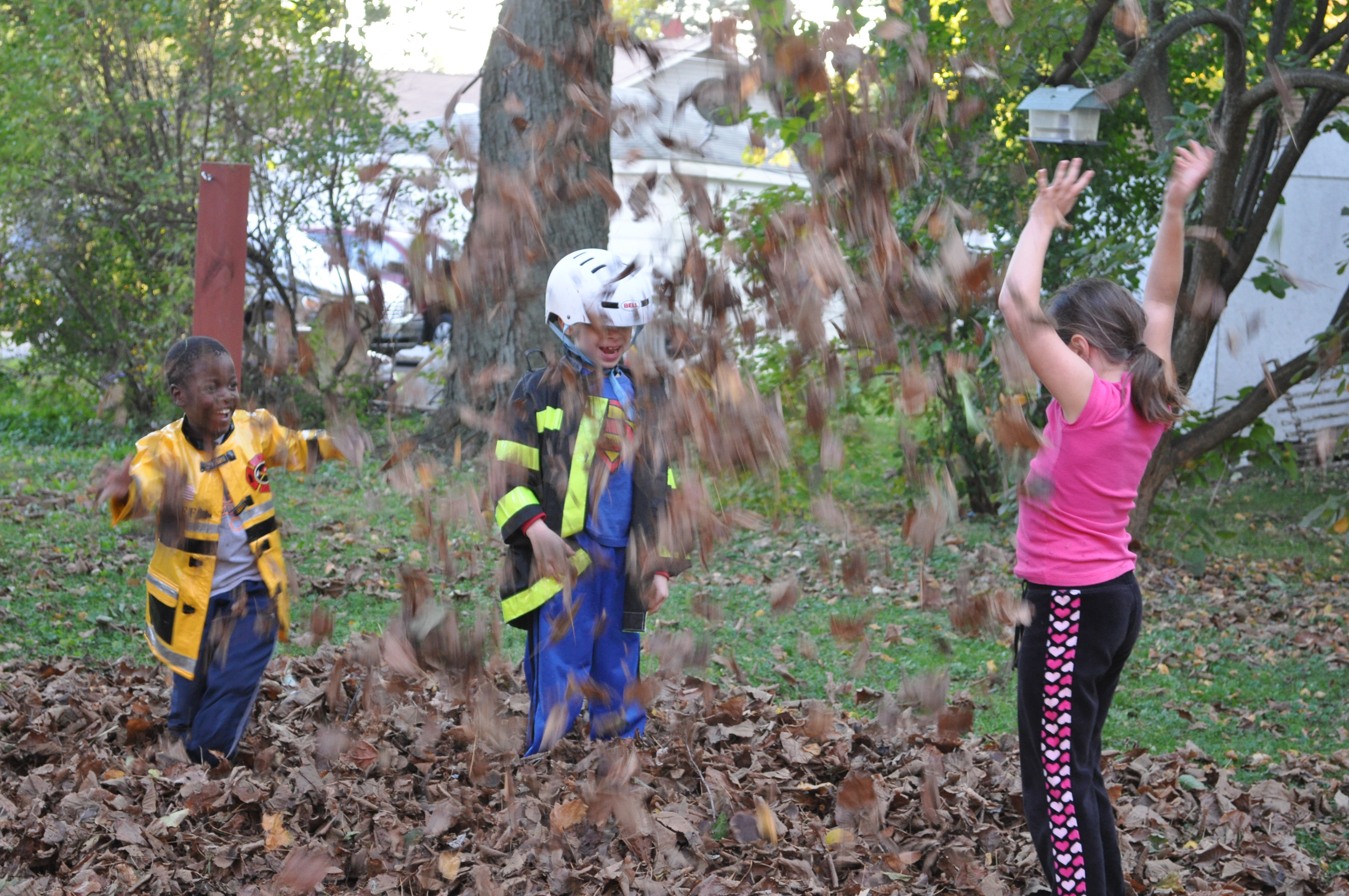
Lots of joy! Yes, Jake IS wearing a bike helmet.

I’ve been grousing lately. Ironically, some of it has been on the subject of cultural ingratitude. “We move from the ‘gimme’ of Halloween to the ‘gimme’ of Christmas, with Thanksgiving squashed to nothing in between,” I told Emily when we walked past the clearance Halloween candy at the entrance of Target and saw the Christmas decorations already up just beyond. It’s easy to comment on general ingratitude, but God keeps reminding me of the personal component. I’ve listened to Colossians 1 probably 10+ times in the past month, and verse 11b-12a, “May you be filled with joy, always thanking the Father” (NLV) jumps out at me. (There’s a bigger context going on in those verses, but I think the link of joy with gratitude is still a valid interpretation.) Joy doesn’t always characterize my life nor the lives of many other Western believers. That’s not good in terms of quality of life nor of sharing our faith. Who wants a dour faith? a dour life? I don’t. So this morning I took a few minutes to see what other people have said about gratitude. I’m sharing some of the quotes I found.

If the only prayer you said in your whole life was, “thank you,” that would suffice.
— Meister Eckhart (1260-1329)

Gratitude is not only the greatest of virtues, but the parent of all the others.
— Marcus Tullius Cicero (106 BC-43 BC), Pro Plancio (54 BC)

Prayer is the fruit of joy and thankfulness.
— Evagrios the Solitary (345-399 AD), On Prayer: 153 Texts, 15

Thou has given so much to me… Give me one thing more— a grateful heart.
— George Herbert (1593-1633)

From David learn to give thanks for everything. Every furrow
in the book of Psalms is sown with the seeds of thanksgiving.
— Jeremy Taylor (1613-1667)

Thanksgiving is good but thanks-living is better.
— Matthew Henry (1662-1714)

“THANKS-LIVING is better!” That’s awesome!

I choose gratitude. I choose joy. (And I ask God for help with both of them!)

Ch. 6, Journey to Patrick

NOTE: Since I am back in my Chicago writing class, my book proposal on Patrick’s adoption is going through yet another set of revisions. The other day I actually got onto Facebook !!!! and connected with dear Angel, whom I lived with during the Ugandan part of Patrick’s adoption. She asked, “What have you done with that book you were working on in Uganda?” Well, here’s a little bit. This is chapter 6, which tells about my second trip to Uganda, the one I took to bring Patrick home. Heads up–it’s LONG!

With the other passengers I climb down portable metal steps to the ground. Even this late at night, the air is warm and a little sticky, but fresh, a welcome change from the canned air on the plane. Inside I breathe in the scent that all the developing-country airports I’ve been in seem to have, that mix of bodies, spices, and cultures un-sterilized by air conditioning. The bland colors on the walls and floors always seem to be at odds with the rich smells. Returning Ugandans, about half the flight, form lines on the right side of the room we enter, while the rest of us wait on the left to pay 55 U.S. dollars to get our entry visas. Most of the people around me are too tired to show much emotion, but excitement—and fear—makes my eyes roam the room, my feet tap.

At baggage claim I watch the luggage go round and round without any sight of my bags. “Wichita,” I growl and head towards the lost luggage office, where I fill out sheet after sheet of paperwork and spell my name a half dozen times for the man hen-pecking my information into an ancient computer.

It takes so long I begin to worry that Wilfred will think I missed my flight and leave me, but when I finally step into the waiting area, a small group is still there. Wilfred waves. I recognize him and Philip from last year, but the two women are unfamiliar.

The little boy held in Wilfred’s arms, though, is unmistakably Patrick. Wilfred ducks his head to him, whispering in his ear as I approach. Patrick’s face lights up. He smiles at me. I want to run straight to him and hug him tight. I have spent a year falling in love with this little boy, and I want to begin knowing him this very second.

But first come introductions. The small woman with the kerchief over her hair is Wilfred’s wife, Vena. The only time I saw her last year was at her wedding, resplendent in full makeup, a tall hairdo and a dress with a train. Now she is obviously pregnant. I hope she isn’t offended that I didn’t recognize her. The other woman is taller, with darker skin and eyes that flash with energy. When she says, “I’m Florence,” I remember a conversation Jody and I had a few months before. “I hope you can work with Florence,” Jody had said. “That would be good for her.”

I shake hands and hug. Then Wilfred holds Patrick out to me. I feel shaky. Will he come? He does. He is so light compared to the twins, even skinny Jake, and I press one hand gently on his back. He still seems fragile. I drop a kiss on his rough, tight curls. I breathe in his little-boy scent and the soap in his hair. I want to rub my hands down his beautiful chocolate arms, count his fingers, look at his face for a long time, but I resist. Now is not the time, but longing for it overwhelms me.

Someone hands me an international phone. “What’s this?” I ask.

Wilfred explains. It is the phone Aaron used in Uganda last year. Another of his and Jody’s housemates, Tyler Sjostrom (who was one of my 9th grade students a long time past), borrowed it when he came to Uganda a few weeks ago. Aaron told him to leave it here for me to use.

“We brought Tyler to the airport earlier tonight,” Wilfred tells me. “You just missed him. He was trying to wait and see you before he had to leave, but you were held up too long.”

I am touched by the loan of the phone and wish I’d been able to see Tyler. Despite the welcoming party, I feel very alone at this moment. Aaron’s surprise gift reminds me I have a host of people praying for me at home. I wish one of them was with me.

Wilfred leads the way to a small, four-door Toyota. It is on loan from his father. Florence, Vena, Patrick and I cram into the back seat of the car. Patrick perches on my lap. The drive from the Entebbe Airport to their house is dark and disorienting, and I struggle with the thread of conversation. The others slip into Lugandan every few sentences. Not only do I lack general context, every time they return to English, I feel I have dropped the thread. I rub circles on Patrick’s back, probably more to comfort myself than him.

For the first time I think about how tricky my living situation here may be. When Wilfred offered for me to stay with him, I thought mostly of his generosity—and, honestly, the money that would save us. I also thought it would be a good thing for me to get to know Patrick in surroundings comfortable for him. But right now I want to go to a guesthouse with him, just the two of us. That would be the most comfortable for me.

Instead I face a completely unknown situation, and I am afraid. Will I fit in with these women? Will I be able to work with Wilfred? Can I become Patrick’s mother without stepping on the toes of these people who have cared for him the past seven months? What am I doing here?

I am slipping into desperation. My body tingles and I rub my arms as if I can stop the tiny bugs from crawling under my skin. “Oh, God,” I silently pray, “I need to know You are right here with me, that Your promise to never leave me is really true.”

We draw near to the lights of Kampala and then turn away from them. All I can see from my spot in the middle of the back seat are roadside market stands, lit by strands of naked bulbs, and people, everywhere, gathered in groups, walking along the sides of the road, carrying loads on their heads or backs. When Wilfred makes a sharp turn and begins driving downhill on a very uneven road, the lights and traffic stop. Though I can tell buildings hover close by on either side, I cannot see much of them. Wilfred stops the car, and Philip gets out and opens a gate. We drive through and park in a courtyard surrounded on three sides by one-story concrete buildings.

Lights are still on in the building to the left of the gate. Vena knocks on the door. Someone on the other side fumbles with the lock and then opens it. Vena introduces me to Angel, a girl in her early twenties. She smiles at me sleepily and then heads back to bed.

Vena crosses the living room and turns left into a short hall with three doors leading off it: bathroom on the right, Vena and Wilfred’s room to the left, second bedroom straight ahead. Vena takes Patrick from me and carries him into her room, where he sleeps in a portacrib. Florence pushes past me into the bedroom straight ahead and turns on the light. It is a small, concrete cube. Most of the space is taken up by a metal bunk bed with a double mattress on the bottom and a single on top. Florence explains that Angel is sleeping on the top bunk with Florence’s baby daughter, Precious. Florence and I will share the bottom bunk.

I am thankful my toiletries are in my carryon backpack. I take my toothbrush into the dark bathroom—no light, evidently— and brush my teeth at the sink. I am thankful, too, to find a toilet as well. Enough light filters in through the high window for me to use it without falling in.

I climb into bed next to Florence. We chat for a few minutes, but jet lag is crashing down on me. I slip into unconsciousness somehow knowing that I dropped off mid-sentence.

I wake in the dark. My pillow smells of sour milk, and I guess that it’s one either Patrick or Precious used. I slip it out from under my head and then lie still, fearful of waking Florence, who breathes deep and slow next to me. The last time I replaced my running watch, I was too cheap to buy one with a light. I regret that now. I have no idea if it is near dawn or not. I pray and pray, pushing away my fears of the unknown, fighting against the slight edge of panic that sets in when I remember that I don’t know when I am going home.

The sky lightens, turning the room gray. When Angel slides over the edge of the top bunk and heads to the kitchen, I get up and slip into the bathroom. Last night Wilfred told me he and I would head out early this morning, and I don’t know what “early” means. I can see the bathroom now. There is no mirror. An empty light socket hangs above the sink. Next to the toilet is a sunken, tiled area for bathing. The rest of the floors in the house are gray concrete. Both the sink and bathing area have hot and cold knobs but only the cold produces water. The bathing area has a lower spigot, which works, and an upper showerhead, which does not. I run water into a round, pink, plastic basin about the size of a kitty litter pan and give myself a bucket bath with a wet wipe. I shiver in the cool morning air, but it still feels good to freshen up—until I pull on the same cargo pants and t-shirt I put on at home three days before. I put in my contacts, though my eyes already feel gritty. I brought my early 1990s glasses with me, but I hope I don’t have to resort to them.

I am surprised to see a refrigerator in the kitchen, but it doesn’t really work. It is so warm ants live in it. Vena uses it simply to keep boiled water and juices slightly below room temperature. The outside wall of the kitchen has a door and a sink to the right of it. A barred window just above the sink looks out on the tall concrete wall that surrounds this small apartment complex. I notice broken glass bottles top the wall. The door is open. I step through it onto the back stoop and find Angel squatting next to a charcoal fire in a small, legged, metal pot. She smiles up at me. Her eyes are still sleepy.

“The water will be boiled for tea soon,” she says.

I smile back. “I’m in no hurry, but thank you.” I step back inside and see Wilfred heading into the bathroom. I sneak into the bedroom and quietly pack a small bag for the day. I am not sure what to do with all my hundred dollar bills. I put one in my daypack and shove the others into a notebook inside the bag I will leave here. I feel nervous with so much cash.

Angel has carried a tray with bread, Blue Band (the bright yellow African equivalent of margarine), and tea fixings into the front room, which functions as both living and dining room. With the gray concrete floors, whitewashed walls, and ivory couch cushions, the only spots of color are the wedding pictures of Wilfred and beautiful, resplendent Vena that hang on the walls. Wilfred joins me in a few minutes. We greet each other and then have nothing else to say. Finally I ask, “Is $100 enough for today or should I get more?”

He stares into the air above his head, then nods. “Today let’s exchange only a hundred.”

We eat quietly for a few more minutes, and then Wilfred abruptly stands up, rubbing his long, thin hands together. “We must go. There is much to do.”

I slurp down the last of my tea and grab my bag. I don’t get the glimpse of Patrick I was hoping for. I don’t even see Angel.

Outside I open the metal gate for Wilfred to drive the car through. In the daylight I see their apartment is near the bottom of a valley between two hills. Downhill, the land is green and vibrant. Uphill is very different. The few trees are surrounded by corrugated tin roofs so close together they resemble a scuffed-silver quilt. We drive straight up on a red dirt lane divided with ruts so deep Wilfred has to weave the car to make his way uphill. Houses and small shops made from handmade red bricks crowd the road. Some, like Wilfred and Vena’s apartment, have a skim of concrete over the bricks. Near the top of the hill, there are more shops and fewer houses. I see a barber already at work and women selling fruits, vegetables and hardboiled eggs, all stacked in pyramids. I sniff the oily smell of chappatis before I see them, sizzling on a griddle at a shop we pass. At one food stand a woman sells milk in thin plastic bags, like the ones I put my produce in at grocery stores in the States.

A main road, mostly paved, runs along the top of the hill. More things to buy here. Chickens in cages. Pigs in stick corrals. Piles of couches and chairs—the men who made them are hard at work on another one, stretching padding and cloth over a wooden frame. A metalworker flattens the end of a red-hot poker before attaching it to a section of iron fence. I saw all this during my trip last year, but it amazes me again. All these industries right here in the open for everyone to see, and all made by hand, not a piece of complex machinery in sight.

Wilfred turns right, and soon we are in the countryside. Shops and houses still line the road, but rolling fields, some planted with crops, others filled with scrubby grass and dotted with trees, stretch beyond them. I have been busy watching the scenery, but now the silence seems to stretch between us. I have no idea where we are going, who we are meeting, nothing. I ask, “What are we doing today?”

He tells me we have to get such-and-such form from one particular official, another kind of form from a different official; the list goes on. He tells me the names of the forms and the titles of the officials, and I say, “Ok,” even though I don’t really understand. We enter a town and Wilfred pulls off the road. “This is where I bank,” he tells me, gesturing at a two-story building covered in uniform white tiles. It stands out, more modern than the other buildings on the street.

I hand him the hundred-dollar bill and wait in the car while he exchanges it. The street is still quiet. Few people are out. Is Patrick even up yet? He was out so late the night before, he is certain to be tired. What is he like when he’s tired?

When Wilfred returns, he gives me a wad of Ugandan shillings and tells me to check it. The exchange rate is in favor of the dollar right now. Even changed at a rural bank branch, my hundred-dollar bill is worth more than 200,000 shillings.

A few miles outside of the town, we pull onto a dusty dirt road, follow it until it ends at a small, red-brick building (these bricks, too, were made by hand, uniform, but not perfect) surrounded by people. Wilfred parks underneath a tall, spreading tree a distance from the building, and I begin to get out. “No,” he says. “You stay here.” He steps out, then sticks his head back in. “I will need some money for this.”

“Okay.” I pull out the wad of cash. A look crosses his face and I lower my hands so they cannot be seen through the windshield. He nods in approval. “How much?” I ask.

He looks up for a moment, then back at me. “Forty thousand should do it.” I peel off two 20,000 notes and hand them over. He tucks them into his front pocket.

He winds through the colorful mix of people squatting in the shady area near the building and stops in front of a tall, solid man wearing a dress shirt and slacks who stands in the open doorway. I cannot hear what they are saying, but Wilfred’s gestures look as if he is trying to convince the man of something. Finally they step inside.

The building has another door farther down, and a policeman steps out of this one. He is dressed in the standard creased khaki uniform and shiny black combat boots. He carries an AK-47 in his hand. He motions behind him for someone to follow, and a line of men shuffles into view, each one holding his hands together. Tied? Handcuffs? I cannot tell from this distance. They wear loose shirts and pants, like hospital scrubs or prison garb, but gray, like the color has been worn out from wash upon wash. He orders them to stop; then he stalks up and down their line, waving his AK-47 in the air and shouting. The men hang their heads. The people squatting in the shade don’t seem concerned by the policeman or line of men, but that doesn’t reassure me. They might be still simply so they don’t draw attention to themselves. My muscles tighten as I watch the big gun slash back and forth in the policeman’s hand.

I don’t even notice Wilfred coming back to the car until he opens the door. I jump.

He is smiling. “Okay, let’s go.” He turns the car around. A cloud of dust rises behind us.

“Did you get what you needed?” I ask him. I want to ask about the prisoners but am uncertain. The line between curiosity and judgment is so, so thin.

He nods and holds up a piece of paper.

“Oh, was there a fee for the document?”

His eyebrows wrinkle. “Hmm,” he says and then pauses. “Well, we call it ’appreciation.’”

“Like a bribe?”

He shakes his head. “No, no. It is not really a bribe.” He explains that this is an accepted practice. “These officials don’t make very much in their positions, so the ‘appreciation’ is almost like part of their salary.” I understand, but my inner Western-world voice shouts, “That’s wrong!” I shut it down. It is so easy—though still wrong—for Westerners to feel superior in developing countries. Lord, please, please make me aware of this.

Wilfred tells me to stay in the car at the next stop, too. “If they see you, a muzungu, they will expect more appreciation.” I hand over another 20,000 and wish my skin were darker, though that is not really the issue. I’ve heard Ugandans refer to an African-American as a muzungu.

As we drive to yet another “meeting,” I ask Wilfred, “So we need all these documents for the adoption?”

A funny expression crosses his face, and he doesn’t answer right away. “Well, they are for Mercy. If Mercy’s papers are not in order, it makes the adoption harder.” It is not really an answer. It is more of a question.

I nod. “That makes sense. In a way, these are for the adoption.”

His shoulders relax.

I am thankful for his honesty. Is this why he has seemed so distant? Was he afraid I would be angered that these things weren’t taken care of already? Afraid I would question how the money we have been sending him has been spent?

At the next stop Wilfred parks as far from the building as he can. He turns to me. “Stay down.” I recline my seat and lie back. “I will need 60,000 this time,” he says. I raise my eyebrows, and he nods solemnly. This first hundred dollars is not going very far. Will all these “meetings” work? Did I bring enough money? God, I want to take Patrick home. Soon.

Peering over the edge of the window, I watch Wilfred saunter to the building. I close my eyes and try to sleep but can’t. My eyes pop open just in time to see Wilfred walk out of the building, followed by a small, stocky woman dressed in a khaki skirt and jacket whose hands are on her hips. She wags one index finger at Wilfred. Then she turns and marches away.
Wilfred comes back to the car. I stay down until he pulls into the street. “Well?” I ask.

He shakes his head and shows me the document he wanted the lady to sign. “She doesn’t like this wording.” He points to one line on the page. “She said if I get it fixed, she will sign it, but it won’t be free.”

The document must be official, but there is no seal, letterhead or signature. You’re in Africa, I tell myself. Improvise. Go for it. “Can’t I just retype it?” I ask him. “You have your laptop here.”

Wilfred shakes his head. “I don’t have a way to save it so I can print it.”

I have a flash drive in my daypack and tell him this. His face brightens. “Can you type fast?”

I nod. He parks and hands me his laptop, a present from another of his U.S. friends. I follow the format of the original document—it seems to state that Mercy is fulfilling its mission—and type until I get to the problematic wording, something about Mercy House’s system for accepting children. “What should it say?”

We play around with several options until we land on one Wilfred thinks will work. It is less specific than the original language. I wonder if the woman official—I see from the document her title is Family and Child Services Agent—wants this changed so she is less responsible. I save the document to my flash and give it to Wilfred. He drives to a stationary shop—just a tiny room with an old computer, printer and copier—and prints the document. When he returns, he hands me the flash drive. I have two with me on this trip. When we get back to the house, I will clear one of them and give it to him.

This time Wilfred is able to complete the deal. As we drive out of town, he suddenly swings the car off the road. “Lunch!” he declares. “You must be hungry.”

Regular meals are a much lower priority here, but Wilfred also strikes me as one who forgets to eat when he’s busy. I had forgotten, too, but when he says “lunch,” I realize it’s been nearly nine hours since we’ve eaten. I wonder how much longer it will be before I can go “home” and see Patrick. Wilfred reaches behind our seats and finds two empty glass bottles (in most stores in Uganda, you have to return a glass bottle for each one you purchase), and I hand him a bill. A couple minutes later he returns with chappatis (they resemble a fried pancake but are not sweet) and soft drinks. He hands me the Fanta orange, and I suck on the straw. It tastes so good. Wilfred pulls back onto the road and eats as he drives.

At a large two-story building in the middle of nowhere, Wilfred gets out and waves at a big man and a small woman. They wave back. Then Wilfred sticks his head back into the car. “You can get out here.” No bribe must be involved. I am glad to get out of the car, glad to meet new people, but my heart beats faster than usual. I have no idea who this man and woman are, if I am supposed to impressing them or not. I shake hands with them, but the woman pulls me in for a hug. “This is Liz,” says Wilfred. “She is the chief information officer for our district, and she is on the board for Mercy.” He is clearly proud of the association. Wilfred steps away with the man, and Liz asks me how I am doing. She is a small woman, maybe even a couple inches shorter than I am, but she is wearing business clothes, heels, a navy skirt, a nice blouse and she carries herself with a kind of confidence I have seen in few other African women. I am very conscious of my green cargo pants, my rumpled shirt. “I am so sorry for my appearance. My bags did not make it.”

She waves it off, and we chat about the adoption and Mercy House. “I want Mercy to be recognized by the government,” she says. “They are doing good work there, but everything is not in order.”

It makes me want to visit an orphanage that does have everything in order. Do they turn children away when they have no more beds? Wilfred will not do that, a wonderful thing, but also a difficulty. Too many children means Mercy is unable to follow guidelines about the separation of children into age group sleeping areas and caregiver/child ratios. Though How do I get Patrick home? sits at the base of my skull like a dull headache, never quite going away, I find Liz’s work with orphanages fascinating, and I am distracted for a few minutes.

Wilfred and the man return. The man says, “Liz, she looks like you, the way she stands and talks!” Wilfred agrees, and both Liz and I laugh, for she is dark as fine chocolate, and I am Kansas-winter white. The man and Liz have to leave, but Liz grabs my hands and tells Wilfred to stop by her house this evening. She and Wilfred need to talk about the probation officer’s report for the adoption, and she wants me to see her garden. I feel like I have made a friend.

We make two more stops before going to Liz’s house, so I have no idea if she lives close to where she works or not. The wall surrounding her house and yard is tall, clearly meant to keep intruders out, but the gate is plain and wooden, not metal. Her home, too, is made of the same red bricks, but it is bigger than most in her neighborhood and shows signs of constant care. Still in her business attire, Liz welcomes us at the door of the home she shares with two girls about 12 and 13 years of age. The introductions are so quick I do not catch the details. One of them may be a niece, the other her daughter. She does not mention a husband. We chat in the living room for a few minutes. The walls and floors have not been skimmed with concrete, so dust coats the bricks, and the ceilings are open to the corrugated tin roof that rises above. But it is a spacious home and obviously a work in progress. Liz tells me some of her plans for the house and leads me to her pride and joy, the garden, which covers most of the large yard and flourishes with vegetables and herbs. She gives me cabbage, some corn, a pumpkin, and fresh thyme to take back to Vena. Then we return to the living room, where she and Wilfred get down to business, lapsing into Lugandan after a few minutes.

I watch them as they talk. Wilfred obviously respects Liz’s guidance, and she carries herself with authority, reminding me of an American businesswoman, even as she sits in her living room in bare feet. It is nearly impossible for a woman to rise to a position of real influence in Uganda, and I want to know Liz’s story.

It is late by the time we get home, and I am surprised but glad to find Patrick still up. He is bright eyed and energetic, but I only have a few minutes with him. Vena, Florence, and Angel have held dinner for us, and they shoo Patrick and Precious to the corner where the two of them share their food out of a common bowl. We eat a delicious vegetable broth over potatoes (they call them “Irish” here) and drink boiled water. Then it is straight to bed for everyone. Wilfred and I have another early start in the morning.

I Choose Gratitude

I'm using an iPad for work and recently the kids and I took a picture of the rain on the sunroof of the car with it. It turned out very cool! So I'm sharing!

We had two meltdowns this morning—before 7:30! I was getting PJ out of bed when I heard Jake wailing from directly below in the kitchen.

NOTE: The boys’ room is a converted attic above the kitchen. It has no heat source, so whoever converted it simply cut a hole in the floor and stuck vent covers on the top and bottom of the hole so warm air from the kitchen can rise through the floor. It works well, especially when I need one of the boys to come downstairs or I want to fuss at them without climbing the stairs. When they are wrestling or having a jam session, it’s not so helpful.

So now you understand that when I knelt down by the vent, I was able to yell directly into the kitchen. “Jake, what are you crying about? Is everything ok?”

“I canneatsheerios cause thereall gone!”

Not a clue.

“What?”

More of the same.

“Jake, come under the vent, stop crying,” (he obviously wasn’t hurt) “and tell me what is wrong.”

Finally I deciphered. “The honey-nut Cheerios” (okay, really “honey nut scooters” or some kind of off brand) “are all gone.”

This is serious in Jake’s world.

I did what I always tend toward in these situations.

I lectured. I did go downstairs first, put my hands on Jake’s skinny little shoulders, and kneel in front of him. Then I laid out the spiel: There are children whose mothers cannot feed them breakfast today. I have met some of them. That is heartbreaking. There are children who are only getting one meal today—or none at all. Do you really think that having to eat some off brand of Corn Chex rather than your beloved Honey Nut whatevers is a big deal?

He shook his head no, and I sent him off to my office to talk to God about it. When he was ready to eat Corn Squares (I just looked at the box for the right name) with a grateful spirit, he could come back.

It didn’t take too long.

Next was Maddie’s meltdown. Clothes. It’s always clothes with Maddie, has been since she was barely walking. “They’re too tight.” “They pull on me here.” (She points to her bottom.) “You HAVE to stretch them out.” The girl would prefer to wear footy pajamas all day in the winter (who wouldn’t?) and a tent dress in the summer. She didn’t wear socks for two whole years (including Chicago winters) because she didn’t like the way the seam rubbed along the top of her toes.

This morning the jeans that felt just fine yesterday no longer fit. “Seriously, Maddie? You did NOT grow a size bigger during the night.” (I tell myself all the time that talking logic with a seven-year-old is about like getting Tweedle Dum and Tweedle Dee to agree, but I keep doing it anyway.)

She got another variation of the same message I delivered to Jake.

And, as always, God spoke it to me as well. “Are you grateful for this morning? Are you glad for the opportunity to feed your children, to share this part of the day with them? Are you rejoicing that this is a brand new day, planned and designed by Me—and you get to be involved in it? Are you thankful that I have given your entire family health today? Aren’t you privileged to have a job that you love? Have you remembered today that, no matter how stressful your life seems to be, your standard of living is above 98% of the world’s population? Have you reminded yourself that there are infertile women—or women who have lost children—who would LOVE to be in your situation?”

Am I thankful? In everything?

I’m convinced that a spirit of gratitude primes my heart to accept the bigness of God, opens my eyes to see His goodness, and settles my spirit to trust in Him no matter the circumstances I find myself in.

I’m convinced that it’s really, really important.

But I allow discontent to fester. I pretend it’s something other than it really is. (“I’m just venting.” “You wouldn’t believe how frustrating today was!“ “I think the kids said, ‘Mom!’ about a million times today.”)

Because of Christ, though, I have a choice. I CAN choose to be grateful. Over and over I MUST choose to be grateful. The alternative is not a pretty option..

“May you be filled with joy, always thanking the Father.” (Col. 1:11b, 12a). There’s a link, isn’t there?

Feathers

Emily, on the right, with her good friend, Bekah, on a recent camping trip with Bekah's family. This is also the family of Ben (see the post about the red M&Ms)

Today Em got one of those “happenin'” new feathers in her hair. I admired it–properly, I think–and then she began playing with my hair.

“Mom, you should get a feather.”

“Nah, I’m too old to have a feather standing out in my hair.”

“Come on,” she wheedled. “You could get one that matches the color of your hair.”

“Then what’s the point?”

She played with a strand right on top of my head. “Yeah, you could get a gray one, put it right here.”

Dave hooted, and I tried to swat her, but she jumped away, protesting. “I didn’t mean it that way. I just meant because gray is your favorite color!”

Yeah, right!