Reading with a Magic Eye

This is the second post in a series about increasing empathy through reading. The first post is here: https://jenunderwood.org/2025/05/03/empathy-through-reading-take-my-hand/

When I was in my early 20s, the Magic Eye posters* came out. They were hung in shopping malls (at least that’s where I encountered them), and people would gather around, stepping forward and backward, squinting and tilting their heads and torsos this way and that as they tried to see the image among the swirls and dots. Someone would cry out, “I got it! I see it!” followed by others asking, “How?” and then advice from the ones with the “sight.” Those left out of the “seeing” were told to look to the side, focus on a corner, not look directly at it…

Some of the books that have grown and informed my empathy have done so in a very similar way as the Magic Eye posters. I would be reading, enjoying the story simply as a story, or getting worked up about the plight of certain characters in the story, when suddenly I would have a realization that there was a correlation between the fictional story and flesh-and-blood people in the world I inhabited. 

As a middle and high school English teacher, I read a lot of young adult literature, both to suggest book titles to my students and also simply because I like YA lit. I thoroughly enjoyed Jeanne DePrau’s The City of Ember, with its post-apocalyptic tale of an underground city built to withstand an Earth-altering event and filled with orphaned babies too young to remember life on the Earth’s surface who are sent to the underground city with elderly caretakers who have taken an oath never to tell the children about a world other than their gloomy city. At the book’s beginning, it is 200 years and several generations later; the city’s resources and utilities are failing; and no one living in Ember has any idea that an outside world exists. Someone has to take a risk of finding a way to the surface before the lights go out forever.

It’s a fun story with interesting characters. And then I read the sequel, The People of Sparks. I remember early on thinking it wasn’t quite as engaging or original as the first book. But I was already invested in the characters, who had found a way out of their deteriorating underground city and onto the earth’s surface. I wanted them to make it, but it looks pretty hopeless at first. Then they find a small town inhabited by the descendants of those who survived the apocalypse on the earth’s surface. These people have figured out how to eke a living from the damaged soil and are finally producing enough that they can begin to plan for the future. They have named their town Sparks and have recently built a storehouse which they are filling with provisions for the lean winter months. They have worked hard, and they feel like they are finally making it.

And then the people of Ember, hungry and with absolutely no knowledge or skills that will aid them in this new world, arrive in their town. 

You can imagine what happens next. There is tension; there is the question of how much help is enough help; there is the dilemma of providing equal provision to persons whose lack of ability means they do not equally contribute.

The experience of reading this book was for me like looking at a Magic Eye poster. As I read this fantastical story, there was a moment when something shifted, and I could see something emerging in my real life. I’d been focused on the book, but it was as if my actual world was right behind it and I could see it differently. A Truth had emerged.

There’s a parable Jesus tells in the Gospels in which a landowner goes to the town square to hire people to work in his fields. He goes in the morning–hires some people; he goes at noon–hires some people; he goes in the mid-afternoon–hires some people. At the end of the day, he first gives pay to the last ones hired. He gives them a full day’s wage. Whoa, the others think, if they got a full day’s wage, I wonder how much WE’RE going to get? 

Psyche! They also get the full day’s wage. 

They complain: Hold on, this isn’t fair, we worked longer than they did; we should get more! They didn’t show up at the same time as we did! We were at the town square in the early morning and we worked all day long! 

The landowner responds: I told you that you would get a full day’s wage, and you did. There is no discrepancy. It is my choice to provide the same for the others. 

The People of Sparks was a story that shifted something in me that, once seen, could not be unseen. I’m still, even now, trying to live into the Truth—hinted at in Jesus’ parable—that was made clearer to me in my reading of that young adult novel series**. 

And finally, one other book recommendation that also had, for me, the Magic Eye effect: Little Bee by Chris Cleave*** (released as The Other Hand in Great Britain). It is about issues in Great Britain that are also issues in the U.S., and I found that little bit of distance helpful in shaping my thinking on issues in my own country. It is a fantastic, beautiful book—just a quick heads up that there are some violent scenes that are heart wrenching (but they are not gratuitous). 

*https://eyeondesign.aiga.org/the-hidden-history-of-magic-eye-the-optical-illusion-that-briefly-took-over-the-world/ 

**https://www.jeanneduprau.com/ 
***https://parnassusbooks.net/book/9781416589648 (link to an independent bookseller that sells Little Bee)

Compassion for the body

Today is my spouse’s 55th birthday. I turn 55 in about 6 weeks. I’ve always enjoyed that little gap, when he is in “stated age” a year older than I am. So in the next six weeks, I’ll probably remind him he’s got a year on me and ask him how it feels to be over the hill. 

Last night, as I stood in the card aisle at the pharmacy, I didn’t see any specifically for the 55th birthday, but there were many for 50, and I thought, “What happened to his 50th birthday? I don’t really remember it.” Then I recalled that it occurred during 2020, and we had other things on our minds that year. 

All that led to my thinking about the change that has occurred in my relationship with my own body over the last five years. Like the vast majority of women in my culture, I have had a complicated relationship with my own body: how it feels, how it looks to me and others, how it compares to other bodies, how it functions… Just this week my sister and I were talking about how we were subtly taught to think of our bodies in our growing-up home: you fed it the right foods, you exercised it, you didn’t let “unhealthy” things near it (this included alcohol, drugs, and the body parts of anyone other than a spouse) and then it was supposed to function well. There were expectations of a certain level of functioning.

It was a bit like a contract. 

The change for me began when my foot pain flared. It wasn’t the first time; I’d had plantar fasciitis in my late thirties. But this time I couldn’t shake it. I’d begun working in a hospital. Hard floors, lots and lots of steps. Foot pain became the norm. 

At first my questions were curative: what will help this go away? And searching led me to the barefoot movement. (That’s not the focus of this post, but if you’re at all interested, I’ll refer you to Anya, whose website helped me tons along the way: https://anyasreviews.com/barefoot-resources/ )

But then my journey turned inward. How did I want to see/think-about my feet? How did I want to interact with my feet? (If that seems like a strange question, hang on.) I began to wonder if there was a way to think of my feet with some gratitude, with some sympathy, and with some encouragement. I wondered if there was a way to work with my feet rather than work on my feet like they were, yep, a machine. 

I began talking to them. I was working overnight shifts at that time, and after a stretch of sitting, I would get a page, and I would prepare to stand and walk. The first step after prolonged sitting is the worst when you have plantar fasciitis. “You’ve got this,” I would tell my feet. “It’s going to hurt, but I know you can do it, and after you get warmed up, it will hurt a bit less.” When I had to walk a longer distance, across the suspended walkways connecting the buildings (some on different city blocks), I would congratulate my feet, “Good job! Look at you!” 

Then came some gratitude. I found myself thanking my feet, acknowledging the miles upon miles they had carried me, often in shoes that, in hindsight, were harming them. “Oh, the place you’ve taken me,” I told them, getting a mental image of Dr. Seuss’s book.* I apologized for the times I’d mentally berated them for their pain. 

Without particularly trying to, this intention to work and be with my feet with kindness, gratitude, and acceptance began to spread to the whole of my body. I had already begun doing yoga, thinking that, yeah, it was probably time to move away from high-impact exercise. Yoga’s pace forced me to slow and actually feel sensations in my body, to listen to its messages to me. I began seeing pain and discomfort in an entirely new way, as my body’s only way to let me know that it was having an issue that needed a response—either to back off on too intense of a movement, to get more rest, to slow my pace, to massage or stretch, to drink more water, to eat differently… My body was letting me know what it needed.

And it needed, beyond attentive care, some acceptance and gratitude. My lower belly wanted to be acknowledged and thanked for carrying children (two of them at once, even) rather than berated for being soft and squishy. My knees deserved accolades for the years of playing high school volleyball (not very gracefully—landing on said knees far too often) and even more years of running in not-great shoes. My heart and lungs—wow, I thought, how had I never fully realized what those amazing organs have been doing every single moment of every single day of my (almost) 55 years? 

We humans tend to experience burnout less when we know our work is seen and appreciated. I did a Google search with that phrase and discovered that, just as I suspected, research supports that idea.** I know this may seem weird, but what if the same were true of my knees, my heart, my body? What if my appreciation of and gentle concern for my tricky right knee actually helps it to function better? Could my heart muscle warm a bit and settle in its rhythm when I thank it for its continual service? Does my body stand a little taller when I remember that it—the body—is what allows me to interact with the world, hug and hold my loved ones, smile at strangers, walk in the woods, pet my dogs, chop vegetables, hold a book…? 

Or maybe I (the whole of me, body, mind, spirit) am just happier, and so it feels like my heart is happier, my body is more peaceful. I don’t know, but it’s working for me. It’s making me gentler with myself—and not just my body. I am speaking more kindly to my own mind, thanking it for its seemingly crazy thoughts that, I’m pretty sure, are meant to protect me. I am more aware of and more tender with my emotions. 

Quite a few years ago now, a friend shared a quote with me, “If your compassion does not include yourself it is not complete.” She didn’t just say it to me once; it came up often. She included it in a card she made me that is now stuck to the bulletin board next to my desk at work. 

Self compassion for my body means I have empathy for my body. I acknowledge what it has been through and the possible “why”s behind its pain. In a way, I try on the perspective of my feet, my right knee, my gut. This practice has not made me less compassionate for the vulnerable bodies of the patients I see every day in the hospital and the bodies of my fellow city dwellers; it has made me more compassionate. That’s how self-compassion works. It softens the heart and reminds us that compassion is a valued commodity with enough for everyone.

* https://www.penguinrandomhouse.com/books/43092/oh-the-places-youll-go-by-dr-seuss

** https://www.forbes.com/sites/rachelmontanez/2019/10/30/heres-how-smart-companies-tackle-burnout-using-employee-appreciation/

** https://www.workhuman.com/blog/how-recognition-can-help-reduce-stress-and-burnout/

Empathy through Reading: Take My Hand

As one of the 5% white persons in a neighborhood that is 19% Latino/a and 73% African American (based on a 2022 community data snapshot (https://www.cmap.illinois.gov/wp-content/uploads/dlm_uploads/Austin.pdf ), I regularly connect with neighbors who have a significantly different experience from my own. My work as a chaplain/spiritual care provider in a large hospital in downtown Chicago provides me with even more intense connections with people whose experiences are significantly different from mine. Each day I meet with people in vulnerable times in their lives, and I am the member of their team asking how they are doing emotionally and spiritually in the midst of it. I am the one asking what in their lives gives them strength and hope and can it be used in this present moment. I meet with persons who name themselves as agnostic, Jewish, Muslim, Hindu, Catholic, Buddhist, Protestant, Pagan, Evangelical, atheist, spiritual-but-not-religious…, who come from many different ethnic and cultural backgrounds and varying socioeconomic statuses, and who may bear a number of identities that are different than my own. 

Each interaction gives me a little glimpse into the heart and the story of the individual in front of me. I know it is not anything close to their full story, but it is an important glimpse they are granting me. I bear deep gratitude and responsibility for the ways in which they trust me.  

My work in these interactions is that of practicing informed, embodied empathy. There is more to it, of course, but that idea of “informed, embodied empathy” is foundational to my view of chaplaincy, which I see as not only a vocation but also as a way of living. I want empathy to inform my entire be-ing, how I view and interact with my family, my friends, my community, my world, and myself. Though I know that, due to my personality type and my past work, I may have come to the work of chaplaincy with a fairly high level of empathy, I have also come to see empathy as a skill that can be fostered in a variety of ways. I now see my empathy less as a character trait and more as an active mindset that I can engage with. It takes work, and it always will. 

When I look back at my childhood, I see a fairly shy, introverted child who could be quite happy spending entire days reading (one of my favorite Christmas memories was when my mother gave me an entire box of books with a bag of York peppermint patties tucked in at the top and full permission to spend the two days after Christmas reading for hours on end). 

How did that child begin to learn empathy for others? 

In large part she learned it through those books. Not all of them, of course. Some of them were formulaic, supporting a single way of looking at the world as the “right way” rather than simply one particular way among many others. Some, though good stories and less rigid, were not very broad in their scope of characters and places. 

But others introduced her to characters outside her narrow world (or in her world but wearing a different skin or living in a different neighborhood). These books taught her about universal emotions, about the difficulties faced when people either feel or are made to feel different or lesser than those around them. These books allowed her a glimpse into others’ worlds and a chance to feel their emotions. They expanded her ability to imagine what it might feel like to have a different life, to experience both the joys and the challenges of it. 

Those books were a part of her empathy education, which stood her/me in good stead as a teacher and certainly now as a hospital chaplain. 

As I wrote above, I continue to build my empathy through every encounter with every other person—and I also continue to foster it through my reading. Some of my reading is purely professional and some is just for brain break, but much of the time, I challenge myself to read books (both fiction and nonfiction) by and about people who have significantly different stories, backgrounds, and identities than my own. 

So I’ve decided that I am occasionally going to post here about books that have stretched and informed my empathy and that continue to do so. Some will be books I read in the past; others will be more recent. 

Take My Hand is a book I read very recently. I want to highlight and amplify the voices of the authors, so here is the link to the website of Dolen Perkins-Valdez, who wrote Take My Hand: https://dolenperkinsvaldez.com/books/take-my-hand/ 

This book made me want to read others by the same author. I appreciate that she presents the nuances of people’s emotions and views. I appreciate that she explores the desire to “help others” and when that “helping” minimizes or even obstructs the choice of the person being “helped.” One of my core values in chaplaincy is the upholding of the autonomy and choices of the person I am meeting with, and Perkins-Valdez lays out the complicated nature of this as well as several other challenging topics. 

I don’t want to say more; I hope you check out the website above and possibly read the book. I listened to the audio version through my local library (and I highly recommend the audio version).

Empathy begins with understanding life from another person’s perspective. Nobody has an objective experience of reality. It’s all through our own individual prisms. ~Sterling K. Brown

Revolutions

When self-discouragement scolds, 

“Didn’t you learn this already?”

I am growing more apt to look Beyond—

where cycles abound: days, lunar phases, seasons—

And from this Whole, so learn-ed in patterns of revolution, 

I ask for wisdom.

In stillness, in watching, I hear:

Yes, same lesson, but also new.

The image of a whirlpool arises, 

Myself held in the current, with 

Each rounding of the pool

Taking me deeper and closer to the 

Center. 

Ever more to learn,

Ever greater depths.

Looking back, I learn from my past 

even as I circle in my present. 

Ahead holds greater growth,

Moving ever deeper, ever closer

To that Center, 

Where, I realize,

With both awe and unease,

There will be some kind of 

Disappearing—

Like the leaf, pulled into a suckhole on a stream,

Round, round, then 

Gone from sight,

Pulled fully into the vortex. 

Then what? 

I do not know.

The Center is Mystery. 

Yet again, this revolution-ary wisdom 

Seems to be pointing

At something that is not to be known—

As in certainty—

But rather to be trusted: 

The leaf does emerge,

Sometime,

Somewhere 

Still part of the Entire

Still and always

transforming.

Son & Mom

PJ has joined me for my morning commute. It is his first day of cross country practice at the high school where he will be a first-year student in the fall.

So he joins his dad and me on our normal walk with the dogs up to the green line train, where we say goodbye to the dogs–and his dad–and get on together.

We are both a bit nervous: new school, new friend possibilities, new commute–downtown Chicago, in the Loop, no less. We look at the mapped route on his phone, discuss how he will get himself home after practice after I’ve headed to work in the north Loop. When we just sit, our shoulders bumping gently against each other as the train starts and stops, starts and stops.

Just before our stop, a man walks down the aisle, shaking coins in a cup, his money-ask a sing-song, sounding like an advertisement jingle. He’s got style, this man, turning grab-bag items from shelter bin into a personality statement. His dark sweatpants are tucked into cowboy-style boots, transforming them into something a bit more fashionable, his layered shirt, vest, jacket are arranged and colorful. A jaunty hat perches at an angle atop his grey hair. His walk, heel-toe, heel-toe, adds to his rhythm. I nod at him, and he nods back before sitting down across from us.

I have just tipped my head toward PJ to say something when the man speaks, not to me but to PJ.

“That your counselor?” he asks.

We both look at him, confused.

“That your social worker? You a foster kid?”

I am too startled to respond at first. But PJ is not. “She’s my mom.”

“Foster mom?” I sense an undercurrent of anger, but I’m not sure.

“No, my mom.”

I find my voice. “He’s my son.” He’s looking hard at me; obviously waiting for an explanation to connect this Black teenager and white woman.

I nod again. “My son.”

Now the emotion is clear. Sadness droops across his face like a clown mask, and his chin drops. “I was a foster kid. I got no one.”

He shakes his head. “No one. I’m all alone, always been all alone.”

It is our stop. I nod at him as we stand and leave the car. Once on the street, I say to PJ, “A lot of pain there, a lot going on.”

He nods at me but doesn’t say anything. As a Black kid with a white mom, he’s got his own “lot going on.” My thoughts are here, with what he is carrying, with what the man we just left on the train carries, has carried his entire life.

But PJ’s “lot going on” is surpassed in this moment by what is directly ahead of him. “I remember that restaurant,” he says, pointing to a sign ahead and referring to the one and only time we have visited his school before in this crazy COVID year.

And, again, we are who we are,

looking for a school entrance,

nervous and hopeful about all the new ahead of him,

son and mom.

Glow

I practice stillness

to know I am not God.

Mornings, as I wait at the end of the train platform,

I face the sun, shut my eyes, and

see the glowing orb through the scrim of my closed lids.

Light inscribes wisdom there for my inner sight:

gleaming lines, thin as spider silk, stretch out

from the center, more, more, more,

till a flaming web is all I see.

Countless points of light,

connected in, through, to

The Glory.

I lift my eyelids, but the web, for a moment, stays in my sight,

overlaying my view of the platform, my neighborhood, the city skyline beyond.

The train rumbles up next to me.

I step in to a car filled with people,

and each one glows.

“From one ancestor[I]he (God) made all nations to inhabit the whole earth, and he allotted the times of their existence and the boundaries of the places where they would live, 27 so that they would search for God[j] and perhaps grope for him and find him—though indeed he is not far from each one of us. 28 For ‘In him we live and move and have our being’; as even some of your own poets have said,

‘For we too are his offspring.’”

from Acts chapter 17, from a speech Paul made in front of the gathered Athenians

Valentine’s night

It is Valentine’s night, and I am on overnight shift as the on-call chaplain.

I print out kids’ jokes to give to staff as I make my rounds, sheer silliness to lighten the night.

What do you call a boomerang that doesn’t come back? A stick!

What kind of shorts do clouds wear? Thunderpants!

One technician tells me he will share the joke with his patients as he wakes them to check vital signs.

As I walk off one floor, the nurses at the station are already sharing theirs with one another, giggling at the corniness.

A smile is on my lips when a trauma code beeps on my pager.

Suicide. Family not present. No chaplain support needed

–not yet at least.

As I read, my hand clutches the jokes in my pocket, each one printed on a strip of paper,

flimsy and thin, perhaps irreverent, in this moment.

And yet…

I grip them tighter and head to another unit.

I will share laughter for at least a few more minutes,

not to make light of tragedy, nor to ignore it,

but to remember that just as we partake together in joy

so we can also do joint journey through sorrow,

and it is more bearable borne together.

“I Want to Live”–Dreams Deferred

At noon yesterday I was part of a small protest held in remembrance of George Floyd and to protest police brutality. It was local, in the neighborhood next to mine, in the  heart of the Westside of Chicago, at the corner of Pulaski and Jackson, where nearly every household (if not every single one) has either a personal or a family experience of police harassment or brutality.*

At our small gathering the young people in our midst–all of them from the Westside–led the protest, shouting “No justice/no peace,” “I can’t breathe” and “Mama, help me.” Passersby in cars (and one CTA bus driver) honked in solidarity and people walking by raised fists to show support. Out of the corner of my eye I saw a man and woman walk by with their two children. Each child wore two pieces of poster paper sandwich-board style, with words written on the poster paper. I was only able to read one sign before they were gone, hidden by the crowd.

“I want to live.”

Those parents had dressed their children in the most fundamental and basic of the dreams that parents have for their children. I know they’re also dreaming of their children thriving, of their actually being seen for who they are, of the unique giftedness each has being equally valued and fostered… But there are also days when the only dream that can be held onto is that of sheer survival. They don’t want to see their children die. They don’t want to outlive them. They don’t want to get word of their violent death or see it splashed across the news. They don’t want them to get degrees, get jobs, move into neighborhoods less riddled by violence, only to see them harassed and possibly killed by an altercation with a white person or police.

On August 28, 1963 Martin Luther King, Jr. expressed his dreams for his own children and all African American children.

Nearly sixty years after that speech–sixty years–and parents in my neighborhood are still dreaming simply that their children will survive. The other dreams–those bigger ones that are supposed to be “normal” for parents to dream for their children in this country–those dreams have been deferred, again and again.

I have been thinking about Martin Luther King, Jr.’s dreams a lot in the last month. Probably the parents of those two children I saw today have been thinking about them as well.

But poet Langston Hughes also talked about dreams, and in the last few days it’s his words that have been echoing in my mind, over and over.

What happens to a dream deferred?
      Does it dry up
      like a raisin in the sun?
      Or fester like a sore—
      And then run?
      Does it stink like rotten meat?
      Or crust and sugar over—
      like a syrupy sweet?
      Maybe it just sags
      like a heavy load.
      Or does it explode?


To read all of Martin Luther King, Jr.’s “I Have a Dream” speech, click on this link: https://kinginstitute.stanford.edu/king-papers/documents/i-have-dream-address-delivered-march-washington-jobs-and-freedom 

The poem by Langston Hughes is “Harlem” from The Collected Works of Langston Hughes. Copyright © 2002 by Langston Hughes. Reprinted by permission of Harold Ober Associates, Inc. It was copied from https://www.poetryfoundation.org/poems/46548/harlem

*One Sunday a couple years back when I was visiting a local church, the pastor asked the congregation how many either had a personal or family experience of police harassment/brutality. Only two people did not raise their hands; those people were my husband and I, the only two white people present. The pastor raised his hand as well.

if breath be prayer, a Tanka poem

If breath be prayer—

inhale, exhale, in-out-in…

embracing Life Source,

dispossessing false control

—each in-and-out deepens trust

*Tanka is a Japanese poetic form with five lines with a set number of syllables for each line (5/7/5/7/7). Each line should carry its own bit of meaning, with each line contributing to a larger whole. I made a slightly different version below because I can’t decide which I like better 🙂

If breath be prayer—

inhalation an acceptance

of Life Source; exhales

dispossessing false control

—each in-and-out deepens trust


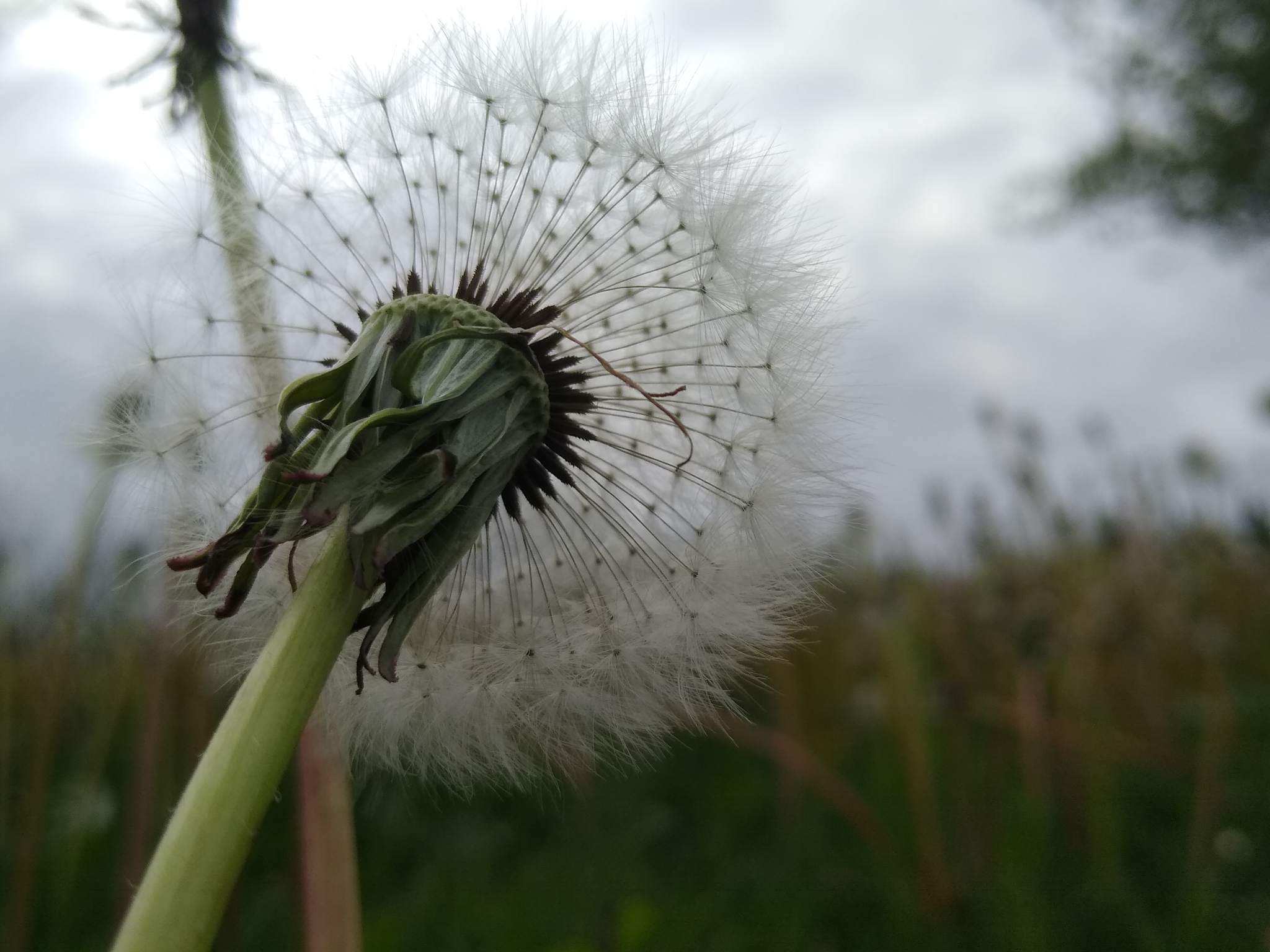
Dandelion moment

Single dandelion seed

catches on my sweater,

tethering its breeze-bobbing fluff

at the end of a hair-thin stalk.

I admire its delicate elegance,

then reach for my phone to capture the image.

But it will not be detained.

In my moment of inattention, it departs.

Featherweight parasol floating away.


*This is a collaborative piece. My friend and housemate, Susanna Frusti, took these pictures the other day. When she showed them to me, I said, “I just wrote a little poem about a dandelion seed!” So we decided to pair them as a post.

IMG_20200513_155806919