WDJD (part of the Empathy through Reading series)

When I was a teen, I found a paperback copy of In His Steps: What Would Jesus Do? tucked away in our basement. Within a few pages, I knew to read it on the sly, aware that it supported a “social gospel” that was frowned upon by the fundamental theology I grew up with. I only read it once, but it stuck with me in some important ways. The story itself felt old–it was written in 1896, after all–and unrelated to the social, racial, and justice issues in my hometown of Birmingham, Alabama, in the 1980s–but its basic premise lodged deep: What WOULD Jesus do?

This question–the very theme of Shelden’s book–was THE wedge that created and widened the gap between my “stated” theology and my “lived” theology. With every encounter, every person, there was the question: What would Jesus do? What would Jesus say? How would Jesus act? This meant, of course, that I had to look at what Jesus DID and SAID to have an idea of what he would do in my circumstances. So to the Gospels I went.

The clearest teaching I found Jesus giving in the Gospels was “Love your neighbor as yourself,” and it was a teaching that got “fleshed out” again and again and again, through both the stories Jesus told and the stories he lived. (He also said, “Love your enemy,” because some of us REALLY need it spelled out, I guess.)

There is one story that is specifically linked to the “Love your neighbor” statement. In case you’ve never read it or it’s been awhile, here’s a recap: Some religious guy is trying to test Jesus, so he asks Jesus, “What do I have to do to have life eternal?” Jesus turns the question back to the guy–after all, this guy is an Expert in religious law–and asks him what he finds in Scripture. Expert answers, “You shall love the Lord your God with all your heart, and with all your soul, and with all your strength, and with all your mind; and your neighbor as yourself.” Jesus says, “Good answer–do this and you’ll live.” Then Expert–who is clearly not Mr. Rogers–asks, “So, who is my neighbor?” Jesus then tells a story to illustrate: a guy is traveling from one city to another when he gets jumped by some robbers who beat him so bad he’s left lying on the side of the road, “half dead.” First a priest walks by, but he ignores the victim. Then another person in the religious in-crowd walks by, also ignoring the victim (this is starting to sound like “a priest walks into a bar” joke). The third person who walks by is someone that the first two people would despise (and supposedly the victim would as well–were he actually able to express an opinion). This Third person is an outcast, an outsider, someone who doesn’t belong in the majority culture, who would get the side-eye were he to actually walk into a religious establishment or move into a middle- or upper-class neighborhood.

It’s Third, though, who actually sees and helps the victim. He cleans him up, bandages his wounds, puts him on his own animal (meaning, I’m assuming, that Third himself has to walk and slow down his pace), takes him to an inn, and pays for the innkeeper to keep taking care of him.

Jesus ends the story by asking, “Which of these three, do you think, was a neighbor to the man who fell into the hands of the robbers?” (Now that I’m thinking about it, this actually might be THE original “___________ walks into a bar” joke.)

I took this story to mean that not only was everyone my neighbor, I also had a responsibility to actively be a neighbor to everyone. So there was my life mantra: this neighbor, that neighbor, that one…–no matter how crazy different from me they were or I was from them, how ridiculously different our views were/are–love them. I’ve been very fortunate to encounter, through both my work and the places I’ve lived–lots of neighbors whose backgrounds and stories were so different we could have stood in for the two main characters in the story Jesus told, so lots of practice.

So I was building empathy through reading the stories of Jesus. There are quite a few of them, and they became helpful when I would encounter someone outside my framework. I could ask, “What did Jesus say?” and “What did Jesus do?” and let that guide me.

These days I feel like Jesus–the Jesus who said “Love your neighbor” and “Love your enemies”–has gotten forgotten in the rhetoric. I find myself wishing there were a whole lot more Jesus in the thinking of everyone who calls themselves a Christian. Not in the form of just slapping on a WWJD bracelet, but some actual searching out and discovery of what Jesus DID do.

This post has already gotten a little too long, so just one more bit. One of the first things Jesus DID do was this: he emigrated. He and his parents became immigrants. I don’t think they had the proper paperwork to go to Egypt, but they went anyway. I don’t think they felt they had much choice in the matter. They felt threatened and unsafe in their hometown.

The Gospels don’t include any stories from those years in Egypt. Knowing what I know about prejudice and drawing upon my years of experience as a middle- and high-school teacher, I am pretty sure that Jesus and his parents encountered a lot of people who rejected and bullied them, who told them they didn’t belong, who told them to go back where they came from. These encounters probably happened fairly often.

But I have hope that this immigrant family also had a few stories of kindness from this time in their lives. Stories of people who saw them, who loved them, who accepted them as neighbors.

Maybe Jesus had some of these stories in his mind when he told the parable of the guy who was beaten up and left on the side of the road. Maybe he had them in mind when he asked the Expert, “Which one do you think was a neighbor to him?”

The Expert answered, “The one who had mercy on him,” and Jesus said, “Go and do likewise.”

Whump, drop the mike. There you have it, Jesus people.

And this Jesus person (guess I can still call myself that) is going to keep asking how Jesus’ words/actions should impact my own views, attitudes, and actions toward immigrants in this country to which my own WOP (WithOut Papers) grandparents immigrated.

Not sealing, HEALING

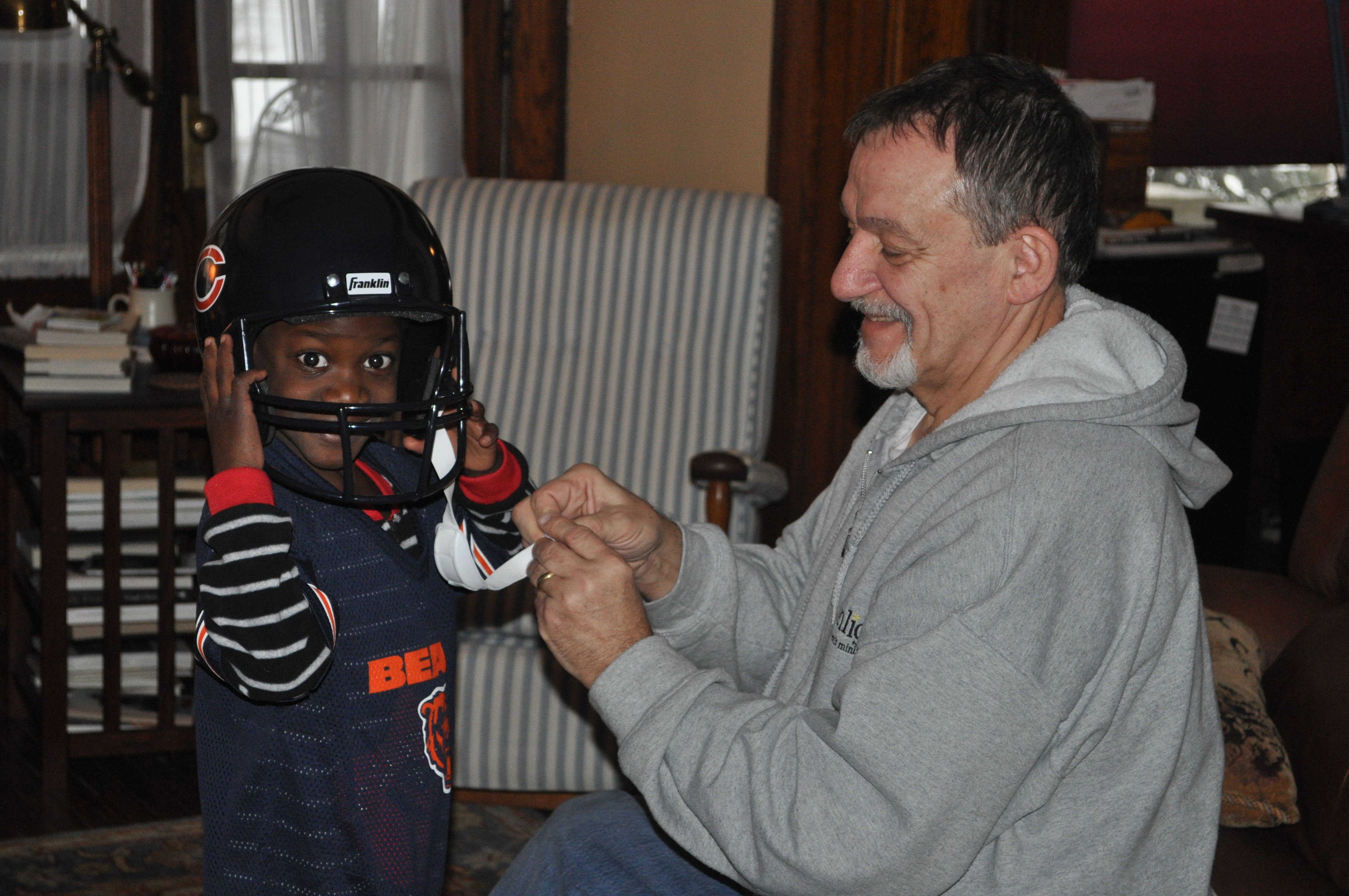
For PJ's recent birthday, Dave's parents gave him a Bears helmet and jersey (and he and Jake have been running plays in the living room ever since :)). This is Dave's dad adjusting the chin strap before a "game."

“Take my heart, Lord, take and seal it, seal it for Thy courts above.”

I “get” the hymn writer’s meaning. I’ve read a bit of his background. He was a man who struggled with doubts. He eventually lost his faith.

So, in that sense, I, too, pray that God seals my heart.

But yesterday I sang that song and I got a vivid picture of myself holding my heart out to God. “Here, Lord, keep it safe.”

And then, like the camera had zoomed in, I got a look at the object in my hands. Deep fissures cut through its surface. Rather than a healthy red, it was mottled with blue, green, and a white that looked like congealed fat. Swollen and puffy, it made me think of rotting chicken breasts.

It was unhealthy, incapable, and sick.

Sin is, according to a couple of the Greek definitions, a “missing the mark,” a “falling short.” My own riddled-with-sin heart is sinful because it is too diseased to “hit the mark”: to be true like God, to do good like God, to love like God.

And the heart I saw in my mental picture wasn’t just a little sickly. It was diseased through and through. “Oh, with THAT heart, God, how do I love anyone? How do I keep from slipping into despair?”

Paul asked something very like this: “Wretched man that I am! Who will deliver me from this body of death?”

But he also had an answer: “Thanks be to God through Jesus Christ our Lord!”

I sang the hymn again, but I changed a key word. I don’t want my heart sealed like THAT! I actually want a NEW heart, one infused with health, able to love and LIVE, to hope and rejoice.

“Take my heart, oh, take and HEAL it, heal it for Thy courts above”

Who will deliver me, both for eternity AND for this here-and-now life?

Thanks be to GOD, for He has and He WILL. He is the donor and the surgeon. He performed the initial transplant, giving me His own heart, and He is vigilant about follow-up care, making sure I do not reject the very thing that gives me life.

Ezekiel 36:26: “A new heart also will I give you, and a new spirit will I put within you: and I will take away the stony heart out of your flesh, and I will give you an heart of flesh.” (KJV)

Psalm 73:26: “My flesh and my heart faileth: but God is the strength of my heart, and my portion for ever.” (KJV) (emphasis mine).

No wonder He is called the Great Physician.


Spade Work

We spent Thanksgiving with my side of the family at my sister's place in North Carolina. Here's Seth (my sister Lynda's fourth child) throwing our PJ up in the air. What an awesome image of trust!

At this morning’s first church service, I read the Scripture passage for the Advent: “John 10: 10-18, ‘The thief comes only to steal and kill and destroy.’” Man, I have a good reading voice. “’I came that they may have life and have it abundantly.’” I wonder if anyone out there is thinking, “What a nice reading voice she has?”

Seriously, it happened. Maybe a bit more subtly than the way I wrote it above, but it happened. Darts of pride and self-awareness were shooting at me—and not from outside—from within! I had suddenly become the enemy.

I used to watch middle-aged-and-up women (and oh-my-word, I’m one of them now) in church and think: They have it! By it, I meant that they had “arrived,” that they had conquered sin habits and lived in a state of constant peace and faithfulness.

Well, if my own journey is anything to gauge it by, that’s not the way it works. I heard a preacher say recently (Rick McKinley at Imago Dei Church in Seattle) that Christians in their twenties haven’t yet discovered how truly sinful they are.

It’s true! In my twenties (and a little beyond) I remember taking stock of my sin problems and thinking it was only a matter of time and maturity before I had them licked—with God’s help, of course! I would add.

That makes me laugh now! With every passing year I discover more darkness within my own heart. The image I get is of roots going deep into the ground. I dig and dig—and find more and more, tiny tendrils (or not so tiny!) shooting out in all directions, growing faster than I can chop them off, going down into depths I can’t even see.

But I’ve made another discovery lately, this one far more hopeful: every sin root I find is an evidence of—and an opportunity for—GRACE!

I am often shocked by my sin. Seriously! I didn’t just think THAT! Maybe Satan planted that idea in my head; maybe I saw something that triggered it. That couldn’t come out of ME!

But it does, and God’s reaction to my sin is very different than my own. He is not surprised by it. He also doesn’t have my false levels of what is ok and what is not. He does NOT say what I sometimes imagine He does: You did what, Jen? That may be the last straw for you. That’s a new low!

No, He’s not shocked. In fact, He knew about it all along and is revealing it to me at just the right time. Last year a good friend told me, “I’ve learned to thank God when I recognize a sinful pattern in myself because it’s an area where He is leading me into growth. I can’t grow if I don’t see anything wrong or lacking.”

He knew about it all along (so it’s evidence of His great grace—loving me even though I’m far worse than I ever thought I was), AND He wants to use this new recognition I have of my sinfulness to help me to grow, i.e. OPPORTUNITY!

I limit and demean God’s grace when I am shocked by my sin AND when I try to deal with it on my own, wielding my trowels, shovels, even pickaxes in self-powered attempts to dig out the new roots I’ve discovered. Contrary to that, there’s great freedom in saying, as God gave me grace to do this morning, “Wow, Lord, You can see what I am wrestling with here. I confess that I’m struggling with some pretty nasty pride. I confess that it comes from me because I’m just as human as anybody else, and this is who I am in my human state. I’m so grateful You’re not blindsided by this, and I admit I need Your help to chop this root out. I know this won’t be accomplished immediately or even quickly—because it goes a lot deeper than I can see—but I ask for Your help in turning to You again and again when it pops up.”

This allows me to keep going (in this morning’s case, to keep reading) because I realize that my guilt-wallowing doesn’t accomplish my sanctification. I’m NOT saying I shouldn’t acknowledge my sin OR that I am not responsible for turning from it. Scripture uses strong language regarding sin in the lives of believers; “Put them to death,” it says”(Col. 3:5-8). But when I wallow in guilt, I resurrect the sins. I do the same when I try to pull the roots in my own power (oh, that awful “I got this” mentality). I choose either guilt or independence because it feels like I’m doing something, but both are counterproductive. I’m actually giving life to those sin roots.

So how do I pull them out/separate them from a power source? Well, God didn’t say to “put them to death” by myself. He wants me to cry out to Him. He WANTS to help me. And I have to acknowledge that I CAN’T to do that.

The battle is really a constant “setting aside” of self-sufficiency, a “putting on” of dependency that involves a deeper and deeper knowledge of who I really am without Christ.

Again, it’s paradoxical. Growth does not necessarily mean I struggle with sin LESS; it means I see more of it and I bring it to Christ again and again. As I do this, I grow more aware of my inability to deal with sin on my own.

And I also understand more deeply how God loves me—just as I am AND with a commitment to my growth.

“6And I am convinced and sure of this very thing, that He Who began a good work in you will continue until the day of Jesus Christ [right up to the time of His return], developing [that good work] and perfecting and bringing it to full completion in you” Philippians 1:6 (Amplified).