Catechesis

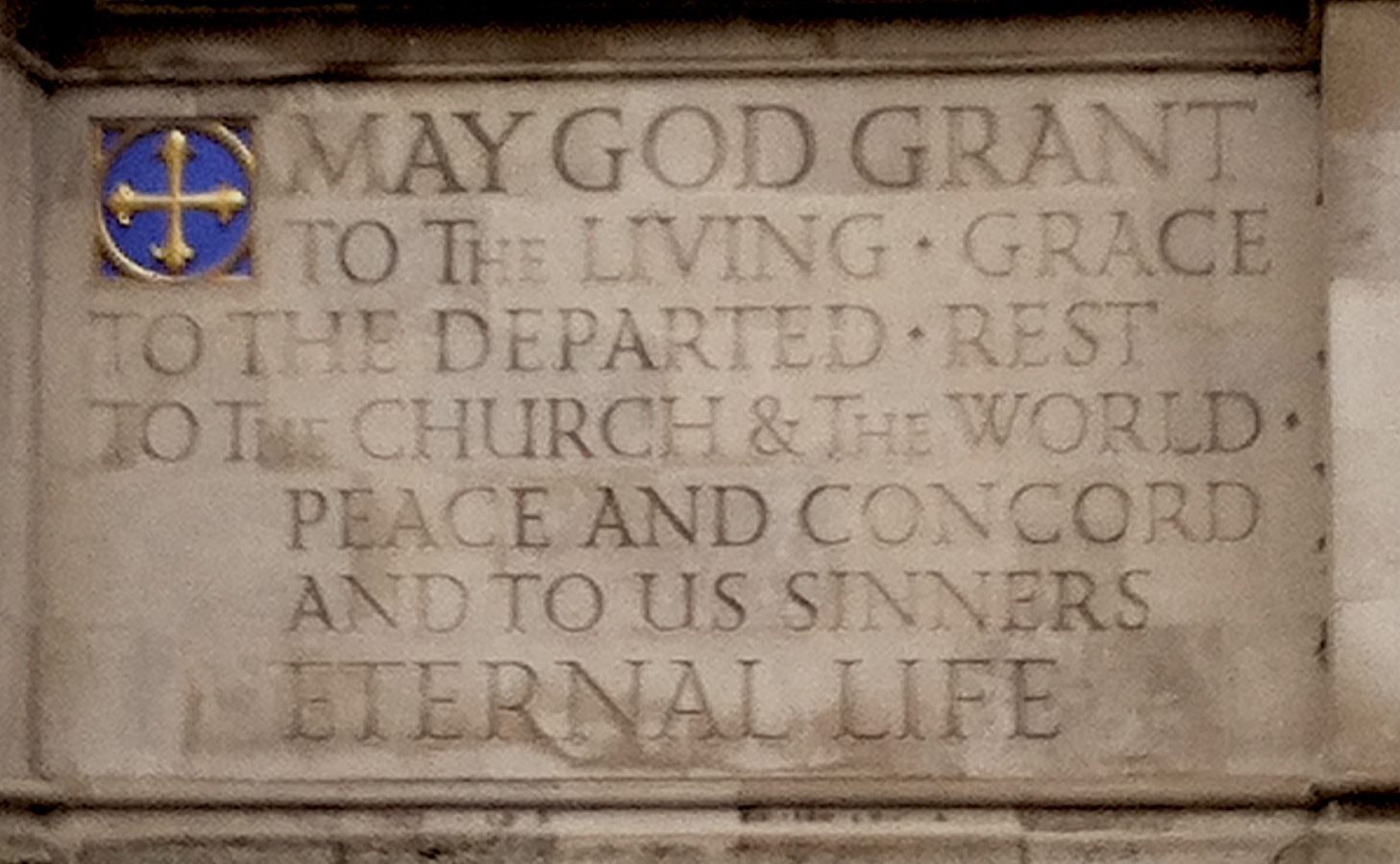
I took this picture when I was at Westminster Abbey in January--this is etched on the outside of the entrance.

I took this picture when I was at Westminster Abbey in January–this is etched on the outside of the entrance.

Q: What is the chief end of man?

A: To glorify God, and to enjoy Him forever.

When one of my Bible teachers at the small Christian school I attended as a child introduced me and my classmates to the Westminster shorter catechism, I knew none of its history. I remember, even then, being a little surprised. I thought of catechism as a “Catholic thing,” something from my father’s Italian, Bogota, New Jersey childhood, and it was unexpected at my fundamental, non-denominational school in the deep South in the late 70s.

But there it was.

I don’t remember how long we studied it, but that first question-and-answer set stuck with me. “What is the chief end of man? To glorify God, and to enjoy Him forever.” I don’t know that I thought much about its meaning in childhood, but when I was an adult, and the phrases jumped into my head one day, I was shocked by the second part of the answer. My upbringing completely supported the idea that my supreme goal in life should be to glorify God…

But to enjoy Him?!

I didn’t have the first idea how to go about that, but still–memorized in youth–the phrase stayed and popped up again in surprising moments.

That’s what catechism and liturgy are supposed to do (well, one of the things); they’re supposed to stick. Even when they have become rote, they do not lose their power; they are just hidden, waiting for the time when you are ready to receive the meaning and the Lord’s work.

Several years ago, while working for the marketing department at a small college, I wrote a news release about one of the Bible professor’s recent publications, an article on the Puritan pastor Richard Baxter’s use of catechism to ground young people in the faith. I thought it was fascinating, and I remembered that article when I recently ran across an archived piece at Christianity Today by J.I. Packer and Gary A. Parrett titled “The Lost Art of Catechesis,” It gives a great history of catechesis and some wonderful arguments for using it more intentionally now.

So, if you are interested in exploring some catechisms for yourself, I’ve included some options below.

To Be a Christian: An Anglican Catechism

A Baptist Catechism

Westminster Shorter Catechism

New City Catechism (adapted by Tim Keller and Sam Shammas from the Reformation Catechisms

Harmony restored

I chose this picture (taken recently at the dog park early in the morning) because it's beautiful for one thing and it also gives me a visual of unity. All the lines of the web meet and lead to the center.

I chose this picture (taken recently at the dog park early in the morning) because it’s beautiful and because it also gives me a visual of unity. All the lines of the web lead to the center. Not one tries to move off in its own direction.

It wasn’t major, simply one of those fairly normal interactions that often happen when families are trying to get out the door in the morning. She wasn’t happy with this. She wasn’t happy with that. She made a face at one thing and groaned at another.

And when we got in the car and she made one more slightly snarky comment, I shot back.

I regretted it the minute the words left my mouth.

Actually, it was one word in particular I regretted… Oh, I thought, that could sting.

I wanted to apologize, but that very second, the car door opened, and the rest of the crew tumbled in.

I prayed the entire way to church. Lord, give me a chance alone with her to say I’m sorry, to say I was wrong. And, somehow, please, restore this break I created in our relationship.

I dropped everyone off at the door and parked, still praying for an opportunity before church began. I couldn’t sit through an entire service with that rift between us.

But they were still in a clump when I entered, and I had to check one into children’s church. Then another asked me a question as we walked toward the sanctuary. We were getting closer, closer; our group was straggling into a line. I fell into step next to her.

Finally, right outside the doors, it was just the two of us. “I need to talk to you,” I told her, and we stepped aside.

I apologized, and then–what grace–she did, too.

We walked into our sanctuary with our rift repaired and our bond re-affirmed. The opening notes of “Behold Our God” accompanied us to our seats, and I sang with gratitude about the majesty of a God who is great enough to hold the oceans in his hands, whose voice makes nations tremble, who needs no counsel from anyone…

Who, despite being incredibly magnificent and powerful, so obviously cares about my relationship with my daughter. In the same moment that He dealt with world powers and stars and universal affairs, He also thought it a priority to heal a relationship between two individuals.

Amazing! I shook my head at the wonder of it.

We sang the “Gloria” next, the beautiful song we sing many Sundays that honors the Father and the Son and then ends with the unity of the three-in-one. As we sang, “Jesus Christ, with the Holy Spirit, in the glory of God the Father,” awe of the Trinity washed over me anew. THIS is why God cares about the harmony not only of the vast universe but also of our families. The Trinity is why God cares about each and every relationship we have. This is why He longs for unity in the Church and peace on earth.

O God, you made us in your own image and redeemed us through Jesus your Son: Look with compassion on the whole human family; take away the arrogance and hatred which infect our hearts; break down the walls that separate us; unite us in bonds of love; and work through our struggle and confusion to accomplish your purposes on earth; that, in your good time, all nations and races may serve you in harmony around your heavenly throne; through Jesus Christ our Lord. Amen. (the Book of Common Prayer, “For the Human Family”)

God is Good-Elizabeth Brown Bogart

God is good—all the time. All the time—God is good.

I’ll be honest, this phrase generally sounds a little rote and, well, hokey, to me, especially when it’s proceeding from the mouth of someone not particularly touched by suffering in that moment.

But when a suffering woman says it, over and over, during cancer treatment, after one negative prognosis after another, when she’s been diagnosed with yet-another life-threatening disease that renders her unable to breathe on her own, and then, then, as she sinks closer and closer to death…

When THAT woman keeps saying the phrase—it’s incredible.

Truly awesome.

And it makes me believe even more strongly in the God Elizabeth Brown Bogart served because she would not have been able to say it again and again this past year and even as her heart beat its last slow thumps, if it wasn’t true.

He is Good—

All the suffering, loving, hoping, despairing, mourning, dying time.

I haven’t seen Liz since high school, but we were Facebook friends, and when I learned of her cancer diagnosis a year ago, I subscribed to receive her Caring Bridge updates. She was older and wiser but the same true Liz I’d known nearly thirty years ago, with a wit and blunt-edged sarcasm that could discern the hilarity in nearly every situation. I cried and laughed through many of her journal posts, and I cheered for her just a little over a month ago when it seemed like she would be able to enter a drug trial that would target the particularly twisted kind of cancer cell she harbored in her body. I groaned a couple weeks later when I learned her lungs and heart were failing.

And I’m mourning now, both with and for the friends and family who know her far, far better than I do.

All the stories shared on Facebook in the last 24 hours remember a spunky, sassy woman who lived and loved till she dropped—and then some. A few days ago she said something like this: I’m not sad for myself. I’ll be okay. But I am sad for all of you. Because—let’s face it—I’m pretty awesome. I laughed through my tears when I read that one.

This morning I prayed for Liz’s husband and her two small children and her family and friends and coworkers—all those people who will have a very real gap—a gaping hole—in their world, who will count the coming days, months, and even years with the phrase “since Liz died.” Then I turned on my computer and opened up Bible Gateway.

This was the verse of the day:

If we live, we live for the Lord; and if we die, we die for the Lord. So, whether we live or die, we belong to the Lord.

Liz is living in that full belonging now.

God is Good.

More on “Rest”

NOTE: A few weeks ago, I posted this piece about the word “rest” in the book of Ruth. In the last week, I’ve encountered two things that have really resonated with me regarding that topic: 1. a quote from Thomas à Kempis (1380-1471); and 2. a song from church this past Sunday. Hope these are encouraging. ~Jen

  1. If you are constantly in search of this or that, wanting to be anywhere but where you are, believing that you will be happier having more or being somewhere else, you will never know peace, never be free of care. In everything and every place you will find something lacking. Adding things to your life, multiplying them, will not bring you peace. Only be cutting back and breaking their control over your life will you find peace. This applies not only to money and riches, but to the desire for honor, for praise, and for an undemanding life. Don’t desire what you do not have. And do not cling to anything which stands in the way of your freedom in God. Thomas à Kempis
  2. “Restless” by Audrey Assad and Matt Maher. Click on the title below to listen to Assad sing this song. The lines that spoke most to me are these: “I’m restless ’til I rest in you” and “Without you I am hopeless, tell me who you are/You are the keeper of my heart.”

RESTLESS

You dwell in the songs that we are singing

Rising to the Heavens, rising to your heart, your heart

Our praises filling up the spaces

In between our frailty and everything you are

You are the keeper of my heart

And I’m restless, I’m restless

‘Til I rest in you, ’til I rest in you

I’m restless, I’m restless

‘Til I rest in you, ’til I rest in you

Oh God, I wanna rest in you

Oh, speak now for my soul is listening

Say that you have saved me, whisper in the dark

‘Cause I know you’re more than my salvation

Without you I am hopeless, tell me who you are

You are the keeper of my heart

You are the keeper of my heart

Still my heart, hold me close

Let me hear a still small voice

Let it grow, let it rise

Into a shout, into a cry

“Restless” words and music by Audrey Assad and Matt Maher, © 2010 River Oaks Music Company, Thankyou Music, Valley Of Songs Music

Confession from the foot of the Cross

NOTE: For those readers who’ve read the confessional living series I wrote earlier in the year, this may feel a bit repetitive. It’s an essay I wrote for a recent contest, and it summarizes and builds on that series. 

The electrical pole in the foreground reminded me of the Cross. I took this last week during our vacation in Michigan--what a great time!

The electrical pole in the foreground reminded me of the Cross. I took this last week during our vacation in Michigan–what a great time!

“Liturgical prayer” was an oxymoron in the churches in which I grew up. I’d barely even heard of the Book of Common Prayer, much less seen one, until I was 43.

That was when, by choice, I visited a church where the bulletin was more like a small book, and the congregation recited, all together, the Apostles’ Creed, the Nicene Creed, the Lord’s Prayer…

And the Confession of Sin.

When the kneelers were pulled out, almost simultaneously, my inner cynic stood up. I thought, “This will be rote, a mere formality.” But then I spoke the words: “…we have sinned against you in thought, word, and deed, by what we have done …and left undone. We have not loved you with our whole heart; …not loved our neighbors as ourselves.”

I spoke them not alone, but in chorus, for my own lack of love and for the lack we all share.

From that morning forward, this prayer of confession began changing me. I gained a fuller sense of sin; I understood corporate sin in a way I never had before; I began to ask more regularly for hidden sin to be revealed in myself and in the Church so we might “delight in (God’s) will and walk in (His) ways to the glory of (His) Name.”

A year into my journey with this prayer, I went to a party. I, like everyone else there, had been invited to the hostess’s house to buy jewelry made by women rescued from sex trafficking.

Finished with shopping, I joined a group of chatting women. I knew all of them, knew the churches they attended. These women would be considered core members of churches described as “solid, Bible-believing, sound.”

One woman mentioned a Bible study she’d recently led. “We studied James, and the most surprising part of it for me was the emphasis on confession,” she shared. “We don’t do much of that as churches now. I don’t do a lot of confessing personally. I mean, I do when I’ve said something sharp to one of my kids or my husband, but other than sins like that, I’m not sure what to confess.”

I’m not sure what to confess. We don’t do much confessing in our evangelical churches now.

Why is this? Scripture lists many sins specifically, and American evangelical Christianity clearly has its finger on sexual and violent sins. Beyond this, books abound today reminding us of a wide range of ills caused by our common and individual sins. Pastor-writer Jerry Bridges pulled the rug on “respectable” sins such as gossip, selfishness, pride, and anger; Ron Sider exposed the sin of materialism in a world where devastating poverty and injustice abound, with organizations like World Vision and the IJM making that poverty and injustice very visible; and activists like Shane Claiborne, Dr. John Perkins, and Eugene Cho decry the American church’s historic and current lack of involvement in racial and social injustice.

Yet this kind of specific-sin confession, though necessary, is not enough, and often, at least for myself, I’ve found specific-sin confession alone leads to attempts at self-justification and to pride. If it’s an item on a list, then I can “work” on it till it’s crossed off, and if I whittle that list down, I’m getting “better.” This viewpoint naturally leads to a superficial view of sin. Did I make it through my day without raising my voice? Then anger’s off the list! Yes!

This is not the case when I confess my sinfulness rather than simply the sins I see, when I acknowledge that I live in violation of the greatest commandment—loving God with my entirety and my neighbor as myself. In this kind of confession I am reminded I am incapable of that kind of love, and I see God as Other, as Holy, as Good.

As my understanding of this grows, I realize anew that only at the foot of the cross is my great need met. I put down roots in the bloodstained earth, and regular, genuine confession of my sinfulness helps me stay there. Washed by the flow from above and drawing from the infinite depths beneath, my heart is softened for the Spirit’s work of conviction, for the revelation of specific sins, even those hidden from myself.

At the foot of the cross, distinctions of all kinds fade away, and I pray not as the Pharisee did in Luke 18 but as the tax collector, for I see myself on even ground, made equal with all humanity by the most-important, common sin of a lack of love for God and neighbor. This leads to my understanding the confessions of the Old Testament prophets, who often repented in the first person plural: “We have sinned; we have acted unjustly; we have not loved You.” The Holy Spirit enables me to acknowledge my complicity in sins of national and global injustice, to see how my own materialism, selfishness, and silence contribute to them.

So confession leads to a deeper understanding of our sinfulness, but its greater purpose is to lead us beyond that as well. The cross is where mercy and grace triumph over our sin, where the same Holy Spirit who convicts also compels us to share the abundant love we’ve received. The Confession of Sin ends with these words: “For the sake of your Son Jesus Christ, have mercy on us and forgive us; that we may delight in your will, and walk in your ways, to the glory of your Name. Amen.”

I long for “(God’s) will and ways” for the churches in my area: I pray for greater racial reconciliation and harmony; less materialism; more significant roles for women in the church; deep, life-impacting passions for all kinds of injustice…

Yet efforts for these are shortsighted, selfish, and temporary unless they begin at the foot of the cross.

Authentic confession takes and keeps us there.