More on “Rest”

NOTE: A few weeks ago, I posted this piece about the word “rest” in the book of Ruth. In the last week, I’ve encountered two things that have really resonated with me regarding that topic: 1. a quote from Thomas à Kempis (1380-1471); and 2. a song from church this past Sunday. Hope these are encouraging. ~Jen

  1. If you are constantly in search of this or that, wanting to be anywhere but where you are, believing that you will be happier having more or being somewhere else, you will never know peace, never be free of care. In everything and every place you will find something lacking. Adding things to your life, multiplying them, will not bring you peace. Only be cutting back and breaking their control over your life will you find peace. This applies not only to money and riches, but to the desire for honor, for praise, and for an undemanding life. Don’t desire what you do not have. And do not cling to anything which stands in the way of your freedom in God. Thomas à Kempis
  2. “Restless” by Audrey Assad and Matt Maher. Click on the title below to listen to Assad sing this song. The lines that spoke most to me are these: “I’m restless ’til I rest in you” and “Without you I am hopeless, tell me who you are/You are the keeper of my heart.”

RESTLESS

You dwell in the songs that we are singing

Rising to the Heavens, rising to your heart, your heart

Our praises filling up the spaces

In between our frailty and everything you are

You are the keeper of my heart

And I’m restless, I’m restless

‘Til I rest in you, ’til I rest in you

I’m restless, I’m restless

‘Til I rest in you, ’til I rest in you

Oh God, I wanna rest in you

Oh, speak now for my soul is listening

Say that you have saved me, whisper in the dark

‘Cause I know you’re more than my salvation

Without you I am hopeless, tell me who you are

You are the keeper of my heart

You are the keeper of my heart

Still my heart, hold me close

Let me hear a still small voice

Let it grow, let it rise

Into a shout, into a cry

“Restless” words and music by Audrey Assad and Matt Maher, © 2010 River Oaks Music Company, Thankyou Music, Valley Of Songs Music

Confession from the foot of the Cross

NOTE: For those readers who’ve read the confessional living series I wrote earlier in the year, this may feel a bit repetitive. It’s an essay I wrote for a recent contest, and it summarizes and builds on that series. 
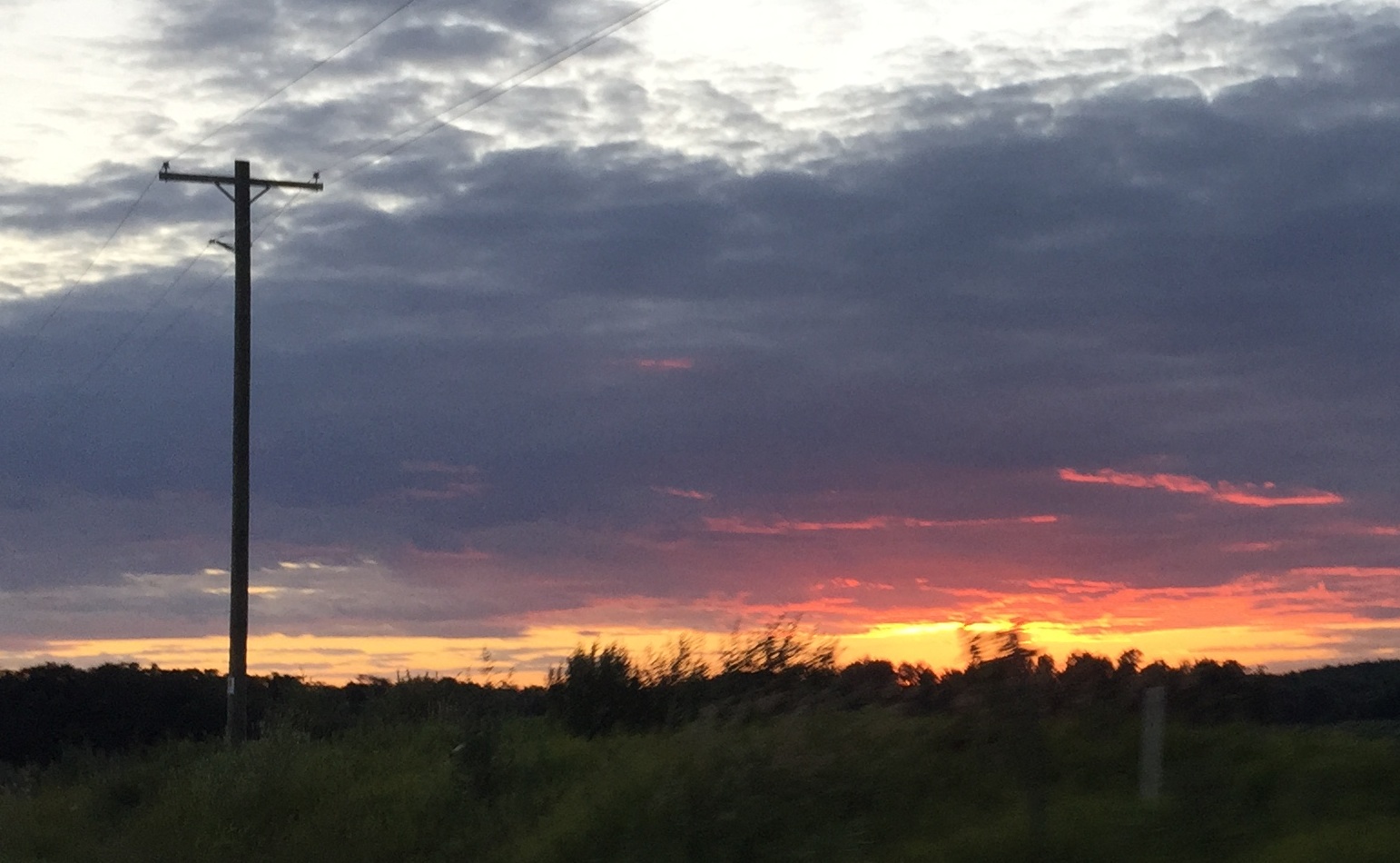
The electrical pole in the foreground reminded me of the Cross. I took this last week during our vacation in Michigan--what a great time!

The electrical pole in the foreground reminded me of the Cross. I took this last week during our vacation in Michigan–what a great time!

“Liturgical prayer” was an oxymoron in the churches in which I grew up. I’d barely even heard of the Book of Common Prayer, much less seen one, until I was 43.

That was when, by choice, I visited a church where the bulletin was more like a small book, and the congregation recited, all together, the Apostles’ Creed, the Nicene Creed, the Lord’s Prayer…

And the Confession of Sin.

When the kneelers were pulled out, almost simultaneously, my inner cynic stood up. I thought, “This will be rote, a mere formality.” But then I spoke the words: “…we have sinned against you in thought, word, and deed, by what we have done …and left undone. We have not loved you with our whole heart; …not loved our neighbors as ourselves.”

I spoke them not alone, but in chorus, for my own lack of love and for the lack we all share.

From that morning forward, this prayer of confession began changing me. I gained a fuller sense of sin; I understood corporate sin in a way I never had before; I began to ask more regularly for hidden sin to be revealed in myself and in the Church so we might “delight in (God’s) will and walk in (His) ways to the glory of (His) Name.”

A year into my journey with this prayer, I went to a party. I, like everyone else there, had been invited to the hostess’s house to buy jewelry made by women rescued from sex trafficking.

Finished with shopping, I joined a group of chatting women. I knew all of them, knew the churches they attended. These women would be considered core members of churches described as “solid, Bible-believing, sound.”

One woman mentioned a Bible study she’d recently led. “We studied James, and the most surprising part of it for me was the emphasis on confession,” she shared. “We don’t do much of that as churches now. I don’t do a lot of confessing personally. I mean, I do when I’ve said something sharp to one of my kids or my husband, but other than sins like that, I’m not sure what to confess.”

I’m not sure what to confess. We don’t do much confessing in our evangelical churches now.

Why is this? Scripture lists many sins specifically, and American evangelical Christianity clearly has its finger on sexual and violent sins. Beyond this, books abound today reminding us of a wide range of ills caused by our common and individual sins. Pastor-writer Jerry Bridges pulled the rug on “respectable” sins such as gossip, selfishness, pride, and anger; Ron Sider exposed the sin of materialism in a world where devastating poverty and injustice abound, with organizations like World Vision and the IJM making that poverty and injustice very visible; and activists like Shane Claiborne, Dr. John Perkins, and Eugene Cho decry the American church’s historic and current lack of involvement in racial and social injustice.

Yet this kind of specific-sin confession, though necessary, is not enough, and often, at least for myself, I’ve found specific-sin confession alone leads to attempts at self-justification and to pride. If it’s an item on a list, then I can “work” on it till it’s crossed off, and if I whittle that list down, I’m getting “better.” This viewpoint naturally leads to a superficial view of sin. Did I make it through my day without raising my voice? Then anger’s off the list! Yes!

This is not the case when I confess my sinfulness rather than simply the sins I see, when I acknowledge that I live in violation of the greatest commandment—loving God with my entirety and my neighbor as myself. In this kind of confession I am reminded I am incapable of that kind of love, and I see God as Other, as Holy, as Good.

As my understanding of this grows, I realize anew that only at the foot of the cross is my great need met. I put down roots in the bloodstained earth, and regular, genuine confession of my sinfulness helps me stay there. Washed by the flow from above and drawing from the infinite depths beneath, my heart is softened for the Spirit’s work of conviction, for the revelation of specific sins, even those hidden from myself.

At the foot of the cross, distinctions of all kinds fade away, and I pray not as the Pharisee did in Luke 18 but as the tax collector, for I see myself on even ground, made equal with all humanity by the most-important, common sin of a lack of love for God and neighbor. This leads to my understanding the confessions of the Old Testament prophets, who often repented in the first person plural: “We have sinned; we have acted unjustly; we have not loved You.” The Holy Spirit enables me to acknowledge my complicity in sins of national and global injustice, to see how my own materialism, selfishness, and silence contribute to them.

So confession leads to a deeper understanding of our sinfulness, but its greater purpose is to lead us beyond that as well. The cross is where mercy and grace triumph over our sin, where the same Holy Spirit who convicts also compels us to share the abundant love we’ve received. The Confession of Sin ends with these words: “For the sake of your Son Jesus Christ, have mercy on us and forgive us; that we may delight in your will, and walk in your ways, to the glory of your Name. Amen.”

I long for “(God’s) will and ways” for the churches in my area: I pray for greater racial reconciliation and harmony; less materialism; more significant roles for women in the church; deep, life-impacting passions for all kinds of injustice…

Yet efforts for these are shortsighted, selfish, and temporary unless they begin at the foot of the cross.

Authentic confession takes and keeps us there.
An excerpt from The Healing Presence

soli deo gloriaI’ve mentioned in an earlier post that I am crawling my way through The Healing Presence by Leanne Payne. I read it with my Bible open on one side and my journal on the other, and a pen ready for underlining or commenting (mostly underlining!). Today I simply want to share a great quote from this book and what I prayed after reading it. The unitalicized words in parentheses are my notes.

As we practice the Presence of Christ (clearly the entire book is about this topic; in a pithy nutshell, Payne means we step into the new life Christ has made ready for us AND we invite Him into ourselves), we make every thought ‘our prisoner, captured to be brought into obedience to Christ.’ Our entire being is thus consecrated to God, wholly committed, given over to Him. We become channels of His life; we carry the cross. (Payne’s definition of ‘carrying the cross’ is included in this sentence; it is ‘being a channel of Christ’s life to others.’)

This life manifests itself as both fruit and gift of the Spirit. As fruit of the Spirit, the character and the nature of Jesus is shown–kindness, faith, humility, love, joy, peace, patience, gentleness, discipline. As the gifts of the Holy Spirit, this life manifests itself as the power to say, to do, and to know. Such are the tools with which we work the works of Christ. The fruits are the way of love, that most excellent way in which all the gifts are to operate.

Father, this is the life I want to live, filled with the Spirit’s fruit–the very character of Jesus–and carried out in the Spirit’s power. I cannot do it on my own–I confess I too often try. Christ promised the Spirit would abide with us forever and said we would know and recognize this Spirit, for the Spirit will live with us and in us. I want to know and recognize the Spirit more and more–beginning right this very moment. Thank You.

Lyn Lusi

In research for an article today, I stumbled on the Heal Africa website and “met” Lyn Lusi, who left her native England to go to Congo in 1971 to teach. She married Congolese Dr. “Jo” Lusi, an orthopedic surgeon, and the two created HEAL Africa, a hospital which became famous for treating nearly 5,000 women with genital fistulas, the vast majority of which were caused by rape by militiamen.

The Economist ran a beautiful obituary on Lyn Lusi after she died in 2012 from cancer. It’s worth reading. I would also strongly suggest this video on the HEAL Africa site of Lyn accepting the Opus Prize in November 2011, just a few months before her death. She calls all listening to rise from “low living” and step into the calling God has for each of us.

REST

flowers on asphaltA few years ago, the pastor at the church we were then attending preached through the book of Ruth, and I got fixated on one word.

REST

I studied the word; read commentary on the Biblical passages where it appeared; and talked one of my friend’s ears off about it during our morning walks.

Let me review the context of that word in the story. Naomi, the mother-in-law, has lost her husband and both her grown sons while she is living in a foreign country. She tells her foreign daughters-in-law she is returning to her homeland, Judah, and instructs them to stay in their own country, where she hopes and prays they will each experience rest in the home of a new husband. One daughter-in-law, Ruth, refuses to let Naomi return to Judah alone and joins her. Back in Judah, the two women struggle to survive until Ruth catches the eye and heart of a wealthy landowner named Boaz who “just happens” to be one of Naomi’s relatives. Naomi then tells Ruth, “My daughter, shall I not seek rest or a home for you, that you may prosper?”

Naomi, sure Boaz will say yes, sends Ruth to propose to Boaz, and the two are married, giving both Ruth and Naomi the rest Naomi prayed for.

The commentary I read on “rest” in Ruth focused on either the rest we find in relationship with Christ (because the story is a beautiful picture of the Gospel) or the rest/security God wants husbands and wives to find in marriage.

All beautiful stuff, but somehow it felt incomplete for me, as if there was something more I had to learn.

Yesterday all my wonderings on “rest” came rushing back. I was reading The Healing Presence by Leanne Payne. Chapter 12 discusses the idea that when we are able to truly believe in God as REAL and all He says He is, we are also truly able to live as His creations. We let go of the idea that we can create or figure out our own selves, and we are set free to focus on God and on others—to turn our gaze outward rather than inward. Payne says we are then “free to be.” The phrase that popped into my mind was this: we are free to REST.

One paragraph in particular made me think specifically of Ruth and Naomi:

To be is to experience life firsthand, to live in the present moment. The person who has the disease of introspection, who thinks painfully, constantly, and in circles about life, lives always in the painful past and for the future. In this way, he squanders his present by trying to figure out a more secure or less painful future. The future, of course, never arrives, for it is in the present moment that we “live and move and have our being.” (p. 192) 

Rest, I thought, is freedom from what Payne described. Rest is being secure not in the moment/circumstances but in the One who holds the moment and circumstances. This is true rest.

Oddly enough, though Naomi prayed for rest for Ruth, the person who really needed it was Naomi herself. Ruth seemed to be one of those rare people who have the gift of “being/resting” even in painful circumstances. When we read her story, we see evidence that Ruth was at rest even in the pain of her widowhood, even in the pain of living and journeying with a sorrowful, broken Naomi, even in the uncertainty of living as a vulnerable foreigner in a strange land. She lived fully right in her present moment.

Naomi, though, was living in her painful past, as described in Leanne Payne’s paragraph above. She was focused on creating a different future because the present was unbearable. She even changed her name to reflect this. When she returned to Judah, her former friends were shocked by the change in her appearance. “Naomi?” they asked, making sure it was still the same woman they’d known so many years before.

“Don’t call me that,” she said. “Call me Mara.” “Mara” means “bitter.” Who can blame her? She’d lost her husband and both her sons. I cannot even imagine that kind of pain. My heart breaks for Naomi. So much had been taken from her.

But in the midst of her loss, God shone the light on an incredible gift she’d already been given: Ruth.

Ruth helped Naomi walk into rest, into grasping neither the past nor the future but in being in her present time and circumstances. I’m sure Naomi never returned to being the woman she’d been before she lost her husband and sons–she wasn’t meant to–but she was no longer held captive by her sorrow. She was able to rest in the present, experiencing its joys, knowing its gifts, “living, moving, and being” in her timeless Creator.

With just 2 clicks, YOU can make a difference for a woman in refuge!

Renew Project

Re:new is one of my favorite non-profits! This small shop in the western suburbs of Chicago employs local refugee women to make beautiful items from cloth and leather. (Visit renewproject.org to learn more of the story and, hmm, maybe do a little give-back shopping!)

Re:new is eligible right now to win a $25,000 award from Wells Fargo Bank through Wells Fargo’s Works Project Contest. Among thousands of qualified entrants, Re:new made it through the first round of the contest. In the second round, supporters vote for the applicants of their choice, and those receiving the highest number of votes will advance to final judging by a private panel from within Wells Fargo.

Public voting closes Sunday, July 19. Follow this LINK to vote for Re:new. You can vote several times a day–please do! Share the link and/or this post with others on social media and through email to drum up more support.

One more time: here’s the LINK so you can vote.

Thank you!

Jen

p.s. The vast majority of refugees being settled in the western suburbs of Chicago are served by World Relief. I’ve worked with our local World Relief ESL program for three years now and think it is a fantastic ministry. Read more about it at the link above. If you think this is something you would like to be involved in, click HERE to check out the locations of their U.S. offices. You may have one near you.

Queen Margaret post up on Judy Douglass’s blog

I have a guest post up on writer/missionary/speaker Judy Douglass’s blog today as a part of her Kingdom Women series. I first learned of Queen Margaret when I was in Scotland in January, and I am still fascinated by her. Please follow the link above to read the post on Judy’s blog.

No true risk

“Jesus is greater than we have yet learned, more able than we have yet seen, more willing than we have yet dreamed, and infinitely worthier than we have yet risked.”

The above quote is from “Unrolling the Scroll of Freedom” by Beth Moore, published in the March 2015 issue of Christianity Today. (The entire article is a valuable read; the link above is to the one-page, reader-friendly version of it).

One particular part of that quote is leaping, arms waving, for my attention. “Jesus…is infinitely worthier than we have yet risked.” It makes me ask myself, What areas of comfort or safety or self-control am I holding onto because I’m not willing to completely trust that Jesus is worthy and great and able and willing?

Isaiah 30 is a message to the people of Israel about their trust in Egypt. They consulted and counseled each other and made a plan, but God tells them their plans are not His. They looked to Egypt to be their strength and protection and didn’t listen to the Spirit of God. In verse 20, God tells them they have experienced adversity and trouble because they have not trusted in Him, but He longs to reveal Himself to them.

Verse 21 reads, “…your Teacher will not hide Himself any more, but your eyes will constantly behold your Teacher. And your ears will hear a word behind you, saying, ‘This is the way; walk in it, when you turn to the right hand and when you turn to the left.'”

And what is the result of this close listening, this devoted obedience?

“Then you will defile your carved images overlaid with silver and your molten images plated with gold; you will cast them away as a filthy bloodstained cloth, and you will say to them, ‘Be gone!'”

The Israelites would see the comfort, safety, security, and self-control as worthless compared to intimate relationship with their Teacher.

“Jesus is greater than we have yet learned, more able than we have yet seen, more willing than we have yet dreamed, and infinitely worthier than we have yet risked.”

Holy Spirit, be my Teacher. I want to learn more of the greatness of Jesus; I want to see His ability more clearly; I want to understand and dream about His willingness to work in and through me; I want to know He is infinitely worthy, and I want to throw away all else I am holding onto for security, comfort, or safety. I want to walk, wholeheartedly, in His ways. 

There is no true risk in trusting Jesus.

Reading Psalm 3 with new eyes

I wish there were a tie-in to today's post, but I simply thought these grasses were gorgeous.

I wish there were a tie-in to today’s post, but I simply thought these grasses were gorgeous.

Psalm 3 is an affliction psalm, with some vindication thrown in. It’s not one I readily identify with. I don’t have hordes of human adversaries rising up against me (verse 1) nor are multitudes plotting to overthrow me (verse 6). These things were literal for King David when he wrote this psalm, so his plea, “O my God; surely, you will strike all my enemies across the face, you will break the teeth of the wicked,” seems understandable.

But for me, a middle-class mom working part-time from home in a safe neighborhood, it doesn’t seem to fit.
Or does it?
Today, as I read the first verse of Psalm 3, an image rose in my head. I was under attack, not by human enemies but by the many, many things that want to drag and keep my attention off the Lord. Fatigue, materialism, pride, doubt, self-focus, hard-heartedness, security/safety, comfort, control, fear. Some of these enemies were directly in front of me; a few hovered around my head like giant bees; some lurked in the shadows.
grasses with backgroundIn the first chapter of James, sin is described like this kind of enemy; verse 14 speaks of sin enticing me, dragging me away, killing me. In I Peter, Satan is also described as an enemy—specifically, a lion—who longs to devour me, a wily antagonist who uses all those other forces and sins against me in some very creative ways.
Suddenly the image in my head wasn’t so far off from the psalm!
Psalm 3
*Lord, how many adversaries I have! How many there are who rise up against me! My selfishness and hard heart keep me from loving You and others. My fear keeps me from believing You are working in and through me. My sin attacks me from all sides. It never gives up.
So it is understandable that Satan tempts me with doubt and says to me, “There is no help for (you) in (your) God.”
But I refuse to believe that lie because you, O Lord, are a shield about me; you are my glory, the one who lifts my head.
This gives me the confidence to call aloud upon the Lord, and You answer me… I lie down and go to sleep; I wake again, because (You) sustain me.
I do not fear the multitudes … who set themselves against me all around. No matter what sin attacks me, whether it is from within or without, I do not have to fear.
Rise up, O LORD; set me free, O my God; surely You will strike all my enemies across the face, you will break the teeth of the wicked. Yes! This is what I need. You tell me to lay aside the sin that so easily ensnares me. You tell me to put it to death, but YOU then provide the power and will and weapons to do that.
Deliverance belongs to the Lord. Your blessing be upon your people. Bless us now, Lord, to stay strong in this battle, covered in Your armor. And thank You for this sure knowledge: we will not have to battle sin for eternity. You will break the teeth of the roaring lion. You will stomp Your heel on the sharp-toothed head of the enemy. You will deliver!
Amen!
*The italicized phrases are from Psalm 3. Every verse is included.

Charleston

As we grieve the nine men and women who were killed–and grieve so much else as well–I have a few links to share. They’re not directly related to this horrific hate crime, but our reaction to this shouldn’t be only a reaction to THIS but to a much bigger issue.

The first two links are to articles by Christena Cleveland. The first is an easier read. The second is to an excerpt from her book Disunity in Christ and is a more academic read. Both are excellent.

“Three Reasons Why I Hate Diversity”

“How Divisions Are Killing Us and Why We Should Care”

This link is to an article by a fellow member of the Redbud Writers Guild, Jenny Rae Armstrong. It’s titled “I’m Stupid about Racism. Are You?”

And here’s one more by another fellow Redbud, Bronwyn Lea. It’s titled “A Letter from a White South African to White Americans.”