Spade Work

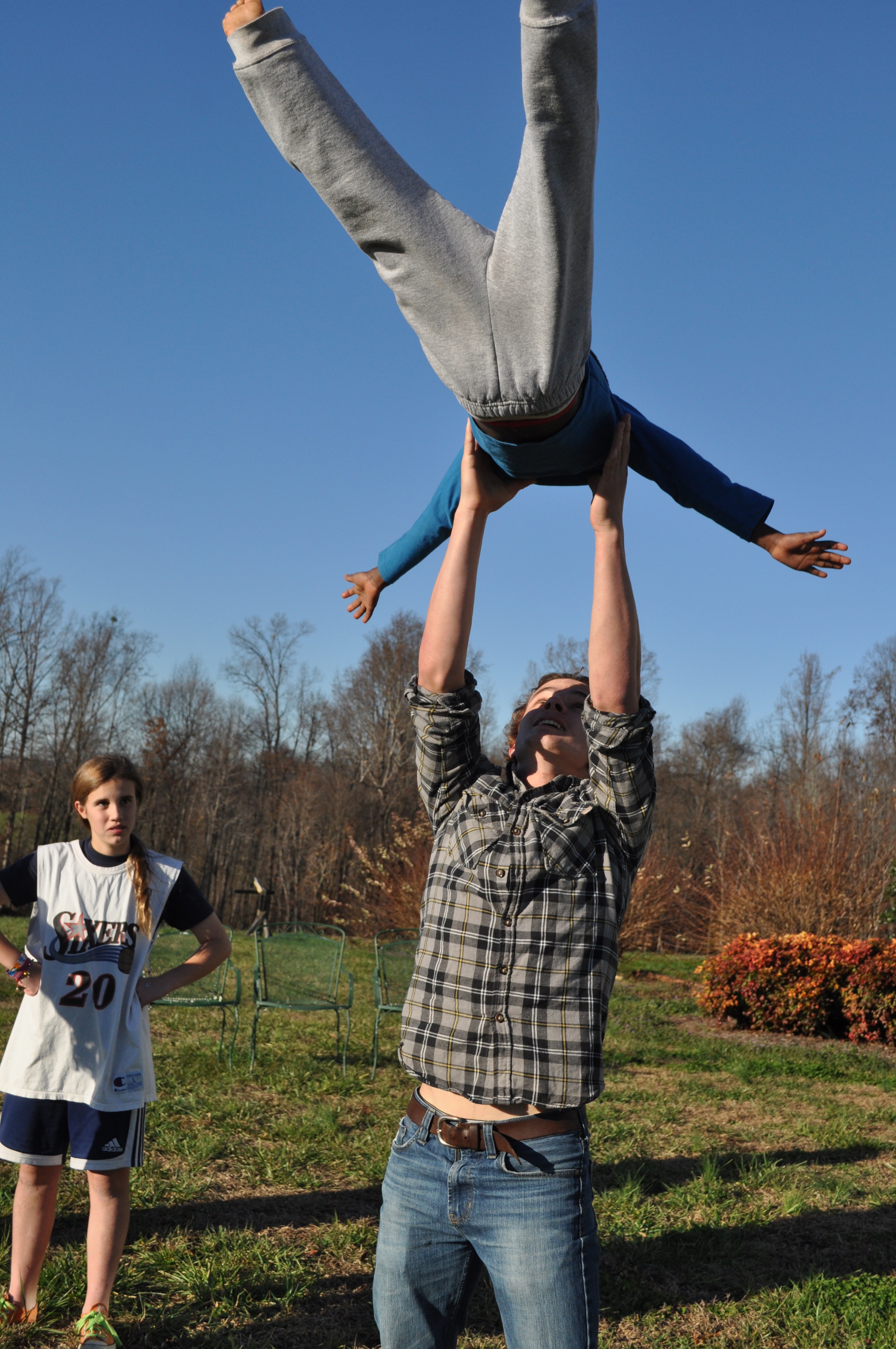
We spent Thanksgiving with my side of the family at my sister's place in North Carolina. Here's Seth (my sister Lynda's fourth child) throwing our PJ up in the air. What an awesome image of trust!

At this morning’s first church service, I read the Scripture passage for the Advent: “John 10: 10-18, ‘The thief comes only to steal and kill and destroy.’” Man, I have a good reading voice. “’I came that they may have life and have it abundantly.’” I wonder if anyone out there is thinking, “What a nice reading voice she has?”

Seriously, it happened. Maybe a bit more subtly than the way I wrote it above, but it happened. Darts of pride and self-awareness were shooting at me—and not from outside—from within! I had suddenly become the enemy.

I used to watch middle-aged-and-up women (and oh-my-word, I’m one of them now) in church and think: They have it! By it, I meant that they had “arrived,” that they had conquered sin habits and lived in a state of constant peace and faithfulness.

Well, if my own journey is anything to gauge it by, that’s not the way it works. I heard a preacher say recently (Rick McKinley at Imago Dei Church in Seattle) that Christians in their twenties haven’t yet discovered how truly sinful they are.

It’s true! In my twenties (and a little beyond) I remember taking stock of my sin problems and thinking it was only a matter of time and maturity before I had them licked—with God’s help, of course! I would add.

That makes me laugh now! With every passing year I discover more darkness within my own heart. The image I get is of roots going deep into the ground. I dig and dig—and find more and more, tiny tendrils (or not so tiny!) shooting out in all directions, growing faster than I can chop them off, going down into depths I can’t even see.

But I’ve made another discovery lately, this one far more hopeful: every sin root I find is an evidence of—and an opportunity for—GRACE!

I am often shocked by my sin. Seriously! I didn’t just think THAT! Maybe Satan planted that idea in my head; maybe I saw something that triggered it. That couldn’t come out of ME!

But it does, and God’s reaction to my sin is very different than my own. He is not surprised by it. He also doesn’t have my false levels of what is ok and what is not. He does NOT say what I sometimes imagine He does: You did what, Jen? That may be the last straw for you. That’s a new low!

No, He’s not shocked. In fact, He knew about it all along and is revealing it to me at just the right time. Last year a good friend told me, “I’ve learned to thank God when I recognize a sinful pattern in myself because it’s an area where He is leading me into growth. I can’t grow if I don’t see anything wrong or lacking.”

He knew about it all along (so it’s evidence of His great grace—loving me even though I’m far worse than I ever thought I was), AND He wants to use this new recognition I have of my sinfulness to help me to grow, i.e. OPPORTUNITY!

I limit and demean God’s grace when I am shocked by my sin AND when I try to deal with it on my own, wielding my trowels, shovels, even pickaxes in self-powered attempts to dig out the new roots I’ve discovered. Contrary to that, there’s great freedom in saying, as God gave me grace to do this morning, “Wow, Lord, You can see what I am wrestling with here. I confess that I’m struggling with some pretty nasty pride. I confess that it comes from me because I’m just as human as anybody else, and this is who I am in my human state. I’m so grateful You’re not blindsided by this, and I admit I need Your help to chop this root out. I know this won’t be accomplished immediately or even quickly—because it goes a lot deeper than I can see—but I ask for Your help in turning to You again and again when it pops up.”

This allows me to keep going (in this morning’s case, to keep reading) because I realize that my guilt-wallowing doesn’t accomplish my sanctification. I’m NOT saying I shouldn’t acknowledge my sin OR that I am not responsible for turning from it. Scripture uses strong language regarding sin in the lives of believers; “Put them to death,” it says”(Col. 3:5-8). But when I wallow in guilt, I resurrect the sins. I do the same when I try to pull the roots in my own power (oh, that awful “I got this” mentality). I choose either guilt or independence because it feels like I’m doing something, but both are counterproductive. I’m actually giving life to those sin roots.

So how do I pull them out/separate them from a power source? Well, God didn’t say to “put them to death” by myself. He wants me to cry out to Him. He WANTS to help me. And I have to acknowledge that I CAN’T to do that.

The battle is really a constant “setting aside” of self-sufficiency, a “putting on” of dependency that involves a deeper and deeper knowledge of who I really am without Christ.

Again, it’s paradoxical. Growth does not necessarily mean I struggle with sin LESS; it means I see more of it and I bring it to Christ again and again. As I do this, I grow more aware of my inability to deal with sin on my own.

And I also understand more deeply how God loves me—just as I am AND with a commitment to my growth.

“6And I am convinced and sure of this very thing, that He Who began a good work in you will continue until the day of Jesus Christ [right up to the time of His return], developing [that good work] and perfecting and bringing it to full completion in you” Philippians 1:6 (Amplified).

Time of Need

This morning I apologized to God. “Oh, Lord, I’m sorry, but I need You again. That’s all I do, just need You, need You, need You. I never have it all together.”

And then I laughed.

Because I really was serious when I said it, but then God allowed me to see the absolute absurdity of my statement.

What, exactly, could I provide for God?

What do I have besides my very neediness?

When I think I have something—anything—I’m delusional. I belong in the spiritual nuthouse.

How interesting that I am most sane when I am at my most needy, when I see that I am a complete mess. And I am most INsane when I feel like I have some control, like I have things together.

The prophet Isaiah, when he was transported to heaven, said, “I am undone.” In the presence of the holy, holy God, Isaiah recognized his own true state of inability and lack. Our self-help culture would say this is an unhealthy mental state, that Isaiah needs to buck up, pull it together, and think positively. And yet God orchestrated this. He wanted Isaiah to feel (as other translations say it) “ruined.” It was only after this that He led Isaiah into a bold, powerful ministry. Isaiah’s un-doing allowed him to see that his source of strength really was God, that Isaiah was powerless on his own.

I want to see—more frequently and more deeply—the holy God.

These true visions will undo me, they will ruin me; but this holy God is also merciful. He tells me to call on Him in time of need.

And my “time of need” is ALL the time.

Jackfruit

NOTE: It’s been finals week–ugh!–which is why I haven’t blogged lately. This post is the piece I wrote for my final writing class assignment (also this week). It’s about my time in Uganda but probably won’t fit into  the book about Patrick’s adoption.

“Jackfruit”

The pimply jackfruit sits on Vena’s knees like a second pregnant belly, the size of a basketball but misshapen, yellow-brown. The stink of rotten onions fills the small car—Vena picked it well—and Wilfred puts the windows down.

The look, smell—the dense weight—it would never sell in a U.S. grocery store, the muzungu thinks. But machete through the ugly rind and what a treasure. Pineapple-banana scent, warm yellow color, exotic tulip-shaped fruits nestled, jewel-like, in a yellow velvet pulp.

The muzungu peers her neck to catch fragments of the sky between the shacks, leaning buildings, trash heaps that crowd the narrow alleys and streets crisscrossing this hill-mountain. She shifts Patrick on her lap so he can see their upward climb. He points and jabbers, waves at children. Wilfred turns this way, that way—a fun maze without the fun.

At the very top is a flat space, with a large concrete building that looks as if a wrecking ball swung through it a few times but then gave up. Wilfred crunches to a stop on the rubble that is working its way out from the structure. Men, young and old, squat on the ground, sit on chunks of cement and in blown-out window ledges, stand around in small groups. It is a Sunday, but, judging by the looks of the area, this may be the scene every day of the week. Two young men approach as they get from the car, and Wilfred huddles with them, slips them some cash.

Vena hands Wilfred the jackfruit and leads, picking her way carefully in her Sunday shoes. Just over the crest of the hill, they see the slum, spilling down the side. Cast-off building materials poured from a giant dump truck, heaped up haphazardly into “homes.”

Vena nods at the women cooking over open charcoal fires, sitting on doorsteps feeding babies, hanging laundry. The muzungu follows her, clutching Patrick to her side as if he will somehow transform her white skin, her other-ness. She nods, too. Some women dip their heads, a couple even smile, but the men’s eyes are hard. The rare muzungu who comes here bears judgment or pity, neither of which builds a father’s sense of manhood.

I’m Alice, going deeper and deeper into the rabbit hole.

No, that’s not quite intense enough.

The red dirt paths between the homes form channels for run-off from above. They are walking on the slick, smooth bank of a stream. The smell of waste grows stronger when the water pools, covers the vegetable scent from cooking pots. She copies Vena’s flat-footed, splayed-out steps, leans on buildings at tricky spots. If she had her arms free she could touch fingertips to the walls on both sides, elbow-to-elbow in some spots.

Down, down, down. The maze driving up the hill was nothing compared to this. How does Vena know where to go?

Then Vena stops.

“Uncle? Uncle?” she calls.

She ducks her head inside a doorway.

Excited chatter. A woman steps out, near the same age as Vena but looking older with her hair in a kerchief and her chest sloping like a soft hill all the way to her waist. She hugs Vena, pats one large, strong hand on Vena’s belly. Wilfred, who came down the hill behind the muzungu, stands by, holding the jackfruit, smiling.

Vena turns to the muzungu. “This is my cousin. We grew up together.”

The cousin tucks her head, but the muzungu reaches out for one of her hands, shakes it. The cousin’s head comes up, her eyes brighten.

“This is Jennifer. She is adopting Patrick,” Vena tells her. “She is living with us for awhile.”

The cousin motions them in. Their eyes adjust to the sudden dark. One room, no windows, though light filters in through a jagged hole high up in the wall, covered with a piece of cloth. One small, upholstered chair sits next to the door. Across from it two others are stacked, with a small coffee table perched on top. Vena takes the jackfruit from Wilfred, puts it on a shelf that holds a bag of rice, a bag of beans, and says something to him, tipping her head toward the chairs. Wilfred sets the coffee table in the center of the room and places the chairs around it.

“Jennifer, sit there.” Obediently the muzungu sits. Her knees touch the table. Patrick slides from her lap and stomps his feet, glad to be down. He beats his hands on the table.

There is a rustle just above the muzungu’s head. Halfway up the wall, the bricks jut in, forming a wide, deep alcove. A man sits up inside this, swings his legs over the side.

“Uncle!” Vena says. He slips down, one hand clutching his loose pants, the other holding his buttonless cardigan closed over his bare brown chest. He blinks but then recognizes Vena and begins chattering in Lugandan. The muzungu pulls up her feet so he can shuffle between the table and the chairs. Vena hugs him gently.

“Jennifer, this is my uncle.”

He turns to the muzungu, a smile splitting his wrinkled face. Cracked brown teeth fill the gap. Beside him Vena’s white teeth gleam. A picture perfect for toothpaste advertising.

Vena told the muzungu once that she, Vena, had such nice teeth because she had no sugar as a child. “We were lucky to get one meal a day,” she said. “No money for sweets.”

“So if a person has nice teeth, they were probably poor growing up?”

Vena shook her head. “They were poor AND their mamas cared about their teeth. The ones with teeth like…?” She pointed at her gums and looked at the muzungu.

“Stumps? Decayed?”

“Yes. Their mamas gave them sugar cane as babies. Cheap. Keeps them from fussing. Easier for the mama, but bad for the teeth.”

The uncle settles in his chair, the one near the door. Wilfred stands, uncertain, until the young cousin pulls a wooden stool out from against the wall. She and Vena hold a hushed conference, and the cousin slips past the door cloth.

They talk, the voices up and down, laughter tinging. Patrick moves down the table, wiggles his way between the uncle’s knees. The uncle asks Patrick questions. More laughter.

The muzungu does not understand, but she smiles, watches, tries to look at the room without showing that she is. Labels—the plastic ones from 2-liter soda bottles—have been fastened to the wall. Coca-Cola, Fanta, Mountain Dew, Sundrop; a red, orange, purple, green, yellow patchwork. She watches the uncle’s hand rub Patrick’s head, answers the questions he asks her through Vena.

The cousin comes back with soft drinks, lukewarm in glass bottles, small cakes in cellophane packages. The muzungu hopes Vena gave the cousin money for this.

Is her reluctance to take—masked as guilt for their spending money on her—a way to separate? She remembers the story of the three Southern pastors, firm in their conviction that drinking alcohol was a sin, being offered beer by a pastor at an overseas conference. Two refused, one accepted. When the two later said, “How could you?” the other answered, “I thought one of us should act like a Christian.”

Translation: not separate, not better. Seeing past the outside, looking in.

The cousin pulls aside the doorcloth and sits on the stoop so she can talk to Vena and still greet passersby. A few stop to chat. A few try English with the muzungu. More laughter. The bright patchwork on the wall fades as the light changes. The cousin’s shadow stretches behind her.

Vena stands.

“No, Uncle, do not get up.” She leans down to hug him.

The muzungu steps over the table, stands near the uncle. “Good-bye,” he tells her. The cousin reaches for the muzungu’s hand, holds it for a moment before Vena leads them out.

Out to where sewage smell drifts up from the water in the path.

Just like jackfruit.

Leash Lessons

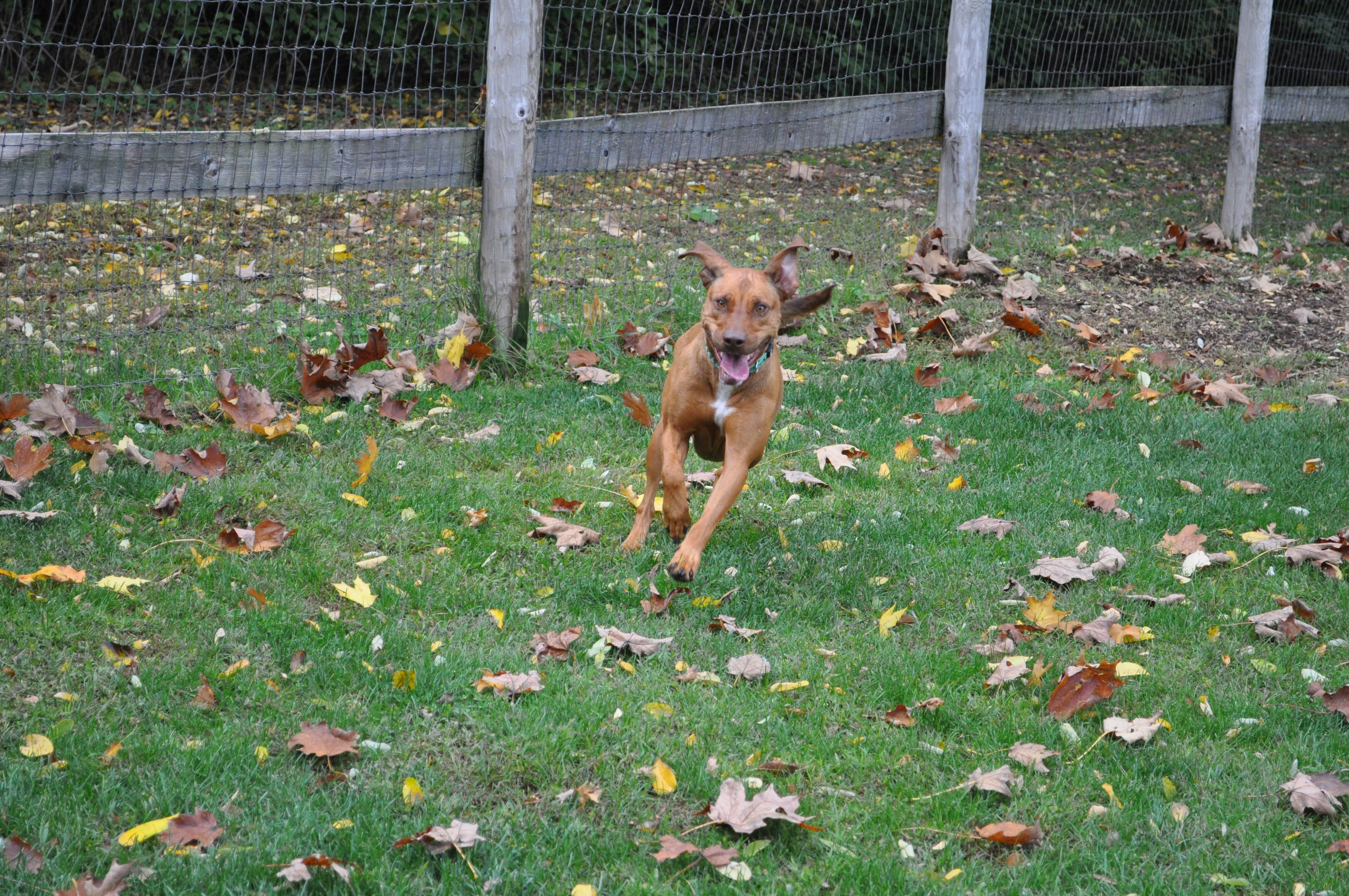
Chai running at the dog park

Our dog Chai was found a year and a half ago running around the farmlands surrounding our then-hometown Sterling, Kansas. We knew this when we got her from the animal shelter, and this knowledge of a wild side helped us in choosing her name.

“Pumpkin?” (the name given to her by the folks at the shelter.) Nah, too orange.

“Penny?” Right color, cute name—like her—but, too… tame. Her golden eyes have a James Dean look. She’s spunky and a bit…

“Spicy,” said Em.

“Like chai,” said one of us (probably me, since it’s my all-time favorite drink, but I don’t remember, so I can’t claim it.)

“Yeah, she’s a mix of sweet and spicy.”

She seemed to leave all the spice behind after we adopted her, but when we left on a trip and asked two neighbor boys to take care of the dogs while we were gone, we found out that without the constant activity of our family, Chai’s spice was alive and well.

“She found every possible hole in your fence,” one of the boys told us when we returned. He’d ”fixed” them with bungee cords he found in the garage. “Then she realized that with a running start, she could jump the fence. I finally had to tie her in the middle of the yard, and even then she figured out she could wiggle backwards out of her collar.”

For a week after we returned, neighbors would tell us how Chai had come visiting. They’d all just taken her back inside the fence—only to have her visit again.

The wild side had returned, and it didn’t want to leave. She began jumping the fence at every opportunity, running through town, then discovering the forest on the west side of it. She had a couple of all-nighters, not returning till the next morning, trailing a leash on one of those occasions. Finally we gave up training her—and worked on the kids: don’t let her out except on a leash. Don’t put the leash DOWN. Know that if she sees a squirrel or rabbit, you hold on tight.

Then we moved back to West Chicago. We joked about taking Chai—and PJ, for good measure—to the local police station that first week. “See this little boy and this dog,” we would say. “If you see either of them running around, they should be at ____________. Please bring them home.”

But after a few “excursions” (fortunately PJ’s was just around the block—though I scolded him like he’d crossed a major highway), they both seemed to settle in. We could even let Chai wander free around the back yard—as long as we were out there with her.

But lately the wild streak has come back. I blame the squirrels, who seem to be holding a tribal reunion in our town.

But maybe it’s the crisp weather.

Or the moon, as one of my Sterling neighbors used to say. “Full moons bring out the wild in dogs.” She said it happened with her dog, another rescue found running in the wild.

Regardless of the cause, Chai’s back on the leash whenever we set foot outside the house. I’m thankful for the local dog park.

I just came back in from taking her out to do her duty—on the leash.

And it made me think of myself.

I’m on a leash, and I’m really, really thankful God has the other end of it.

I’m not saying there isn’t freedom in following Christ—oh, there is—so much abundance, so much joy—but ironically, the abundance and joy and freedom are only found when I’m close to Him, the leash slack and easy, my closeness born of my desire to be with Him, born of my understanding that being with HIM is not “better,” it’s BEST, BEST, BEST.

But I’m like Chai, constantly pulling to the end of the leash (though my temptations are mirages of “orderliness” [legalism, guilt, self-righteousness, martyrdom) rather than the lures of entertainment and adventure).

And He pulls me back.

He lets me stick my nose in poop or step on a thorn or get briars in my coat, but He pulls me back, even while He knows that this is my bent, this is what is natural for my humanity. He knows that I will do it again and again and again. And every time He pulls me close, pulls me near.

He never lets go. Never gets so tired with my tugging that He says, “Ok, go, leave, if that’s what you want.”

Never. Not ever.

He HOLDS ON to me.

Communion

We had communion this past Sunday. I love taking communion, its reminder of the very core of our redemption. If I were a poet, I would write something beautiful about how the bread sits on my tongue a moment longer than it needs to. I postpone sliding it between my teeth, hesitate before biting down on it. “My body, broken for you.” My inner ear hears the small wafer break; my jaw feels the crunch and the release, and I see and feel in a different way Christ’s body being smacked about by the huge, meaty hands of Roman soldiers, His flesh being torn and ripped by the multi-barbed whip, pierced by heavy nails. “My body, broken for you.” I am glad for the time our pastor gives before he prompts us to take up the plastic cup, filled with juice in my church. “My blood, shed for you.” I pour the grape juice into my mouth. It gathers bits of the cracker as it makes its way to the back of my throat and then down, down into my stomach. So much blood–shed in great beads of sweat, in flying droplets of red rain, in a head-to-toe-covering slick, and finally, in a gushing torrent, blood and water mixed, the elements of redemption and purification finally, ultimately provided from a pure, single source. “My blood, shed for you.”

So that we do not bite and devour each other, and ourselves, He was devoured. So that we do not bleed to death from the wounds of our sin, He bled.

Broken body, shed blood.

Amazing redemption.

Bodily Functions

The kids after their last soccer practice in spring 2011.

“Jake, Patrick!” Maddie yells. “It’s time for another ‘Poopface.’”

“What’s this?” I ask.

“Oh, we’re making a video.”

I need a little more.

“You’re making a video (they often use my iPad from work to record their plays and “music concerts”) named ‘Poopface’?”

“Yeah. We already have a couple. They’re really good.”

I decide to do some observation—from another room.

“Okay, places, people. PJ, you’re by the door. Jake, sit on the chair.” Maddie is DEFINITELY preparing for some kind of leadership position.

“And, ACTION!” she yells.

“Poopface, play with me.” That’s Jake, his voice fake-booming.

Hmm.

Now PJ’s voice, in an accented whine. “But I don’t want to. I don’t want to do anything with you.”

“But you have to, Poopface. You’re my buddy.”

I step into the room. “Wait a minute. PJ’s ‘Poopface’?”

Maddie sighs, then yells, “CUT!”

I say it again. “PJ is ‘Poopface’?”

I’m getting the did-we-do-something? look from all three of them.

Then PJ says, “Yeah” and shrugs.

“PJ, you cannot be ‘Poopface.”

“Why not?”

“Because your face is brown and theirs…” I point to Jake and Maddie. “…are not.”

Now they’re looking at each other. Mom’s-gone-psycho!

I try a different tack and turn to the twins. “Sweethearts, people will think you’re making fun of your brother. Poopface is not exactly a compliment, you know.”

Still no lit lightbulbs. “Okay,” I say in my firm voice. “No more ‘Poopface’ videos.”

NOW the blank looks are gone. “But Mom, they’re good. We were going to put them on Youtube!”

Oh, my word!

“Absolutely not. People will think you’re making fun of your brother. They will think you’re saying that his face is the color of poop!” I’m waving my arms by now.

Nothing.

“Aren’t you calling him ‘Poopface’ because his face—(I look at PJ) your face—is dark?”

“Well, yeah,” says Maddie. I begin to nod, thinking I’ve gotten somewhere, but then she goes on.

“But Jake’s ‘Pee-face.’”

Legalism and heartbeat

I’m a recovering legalist—with lots and lots of lapses. My determination to pull everything together in one neat little bundle (I see it all the time in my blog and journal entries—I like tidy endings) is my attempt to find answers and figure things out. I hold onto this hope that at some point I’ll “get” it, I’ll “arrive.” I run around like I’m in a funhouse mirror maze, looking for the reflection of the “me I’m supposed to be,” but all I find are distorted images, and my heart races from the stress and the disappointment.

I’ve been trying to focus on a different image lately, that of Christ as the Lamb of God. It’s less elusive than the “me” image I can’t find, but it’s still puzzling because HUMANS are described as sheep in Scripture, and the implication isn’t a compliment. Sheep are generalized as dumb, easily duped, following whoever promises the shiniest deal of the moment, unable to distinguish what is best, rushing headlong, hearts racing and straining, into destruction. Not able to defend, attack or run away, not able to do much of anything. Just dumb, helpless beasts VERY, VERY much in need of a shepherd, but unwilling to submit to one.

And Christ became a sheep like us—like me. He put on limitations and weakness; He became defenseless, open to temptation.

But He is also a sheep UNlike my kind of sheep, because He accepted His Shepherd as His Shepherd. He drew near to Him like a beloved lamb.

This reminds me of the lamb in the story Nathan the prophet told David after David stole Bathsheeba. “And he (the owner of the one lamb) brought it up, and it grew up with him and with his children. It used to eat of his morsel and drink from his cup and lie in his arms, and it was like a daughter to him” (II Sam. 12:3). Is that how Christ grew up with God? Like THIS lamb? Not going astray or reaching outside his limitations (self-imposed in His case), just resting in the arms of His father, growing up with Him, waiting, following and trusting like a small child.

That’s hard for THIS poor, stupid sheep. It’s not only hard to DO, it’s hard to see, even though God’s given me four very immediate examples. My little sheep don’t spend hours worrying about how to please me. They don’t look over their shoulders constantly wondering if I’m going to disapprove. In part this is because they KNOW me—because they’ve spent a lot of time with me. It’s also because they are free-er than I am. They know there is restoration, there is love. When they “mess up” (or when I do), we get it all sorted out, end with hugs, and move on—knowing better and better what really DOES please and honor each other. This brings to mind the statement Christ made: If you humans know how to give good gifts to your children, how much more the Father in heaven. If our flawed human family (with me, Mrs. Legalism, as its mom) has somehow bumbled into some good knowledge of what love really looks like, then can’t I trust that God knows, that God loves?

I spend more time trying to figure out how to please God than I do just getting to KNOW Him. One of my friends pointed out that there is a huge difference between seeking God’s will and seeking GOD. The object is very important.

I’d like to be the little lamb in Nathan’s story, curled up next to God’s chest, listening to His heart beat its steady thump, thump, thump, its neverending message of love. “Stay here, stay, stay, stay,” is the message in the beat of His heart  Bit by bit, my own heart’s racing, skipping arrhythmia gets overwhelmed, smoothed out, settled. Bit by bit, I’m no longer consumed with some image of myself because my heart is becoming more like God’s—which, as I know from another time in King David’s life, is not concerned with appearances.

I am a little lamb, being brought and grown up along with God’s other children. I am eating from His morsel and drinking from His cup. I am lying in His arms. I am His daughter.

May my heart beat like His.

Ugandan girl

NOTE: This piece fits with my continued focus on gratitude–and this week being Thanksgiving. It’s a possible chapter in my book on Patrick’s adoption.  The muzungu in the piece is me. The young Ugandan man is Philip, one of the pastors at Light the World church, currently a student at Moody Bible Institute. 

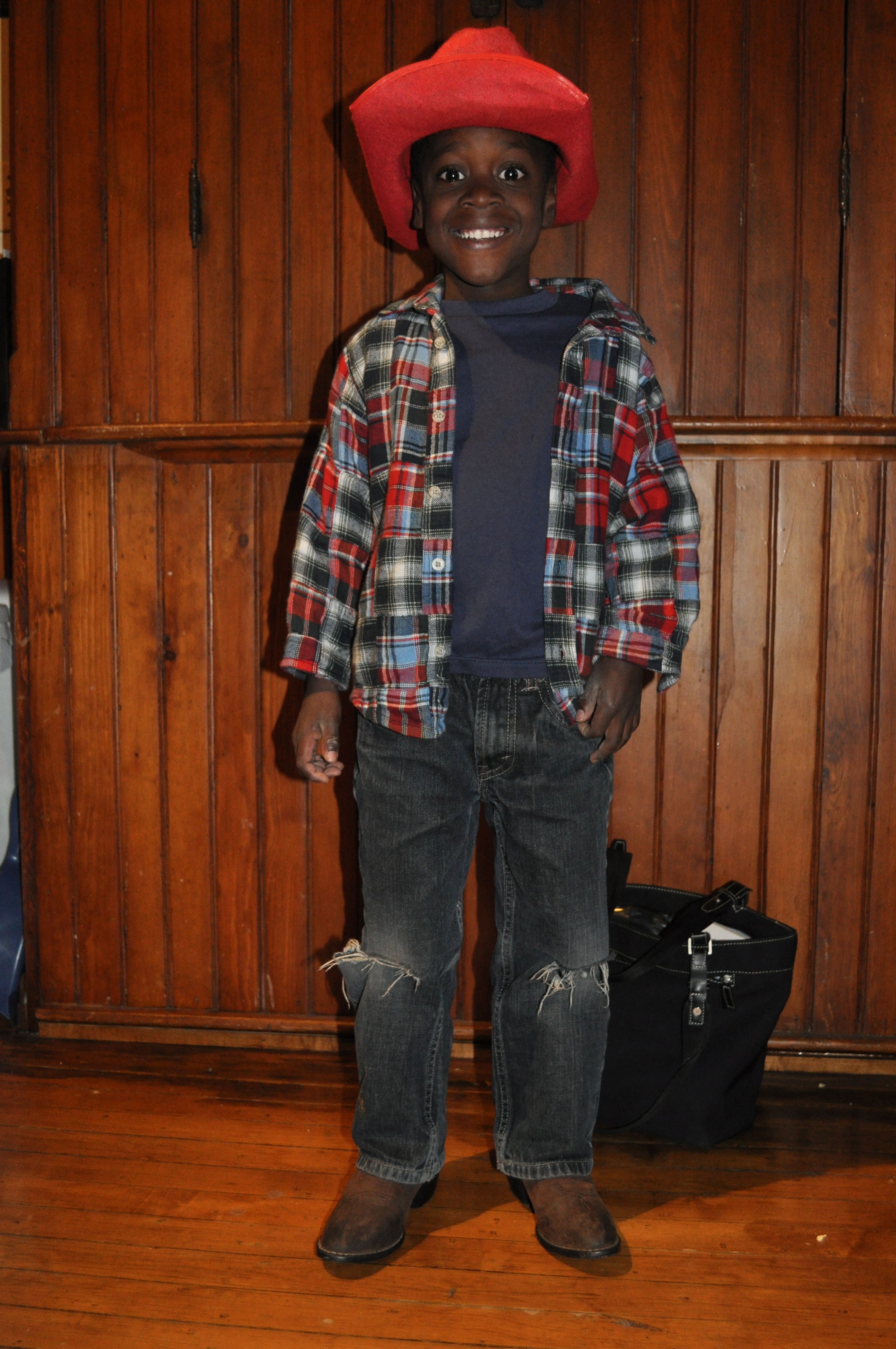
Here's my little Ugandan cowboy.

In the shade, the air settles on skin like hot, damp cloth. In the open the sun blasts like a blowtorch. Women passing carry umbrellas, open them to block the heat rays. Men wet handkerchiefs to spread over their heads or tuck inside their collars. As matatus swerve into bus stops, the scent of sweat drifts toward those waiting to board. Women holding chickens in small wire cages or bundles of bananas argue with the conductor to hold them on their laps. “No, you cannot tie them to the roof today.” They are afraid they will find cooked meat and shriveled fruit at the end of their journeys.

People sit under awnings, seek out the cool of open-front bars. Those who have to walk the sides of the road scurry from the shelter of one scrawny tree to the next or stride with purpose, the sooner to get out of the sun. They skirt around the girl sitting listless on this busy corner. They edge away from her hopelessness. A square of cardboard lies next to her. She lifts it to shield her head from the heat, but her arm grows tired, and she lets it drop. It takes up no more space than she does on the small ragged cloth she sits on. One leg, skinny like a chicken’s, is tucked beneath her. She pulls the other to her chest, tucking the skirt of her worn, color-faded dress around her leg so she is not exposed. One outstretched arm rests on the top of her lifted knee. She turns her palm up, fingers curved to catch the coins that no one drops.

Eleven? Nine? It is hard to tell. Her face has lost any impish qualities of childhood, any softness. It is angles and planes, and the dark eyes in the face have no light to them. She stares at the ground, uninterested in what passes, but when people come near, she lifts her face so they see her, so, perhaps, they notice her. It is an appeal the “guardians” teach their street children, one the children, in turn, teach each other. “Hold up your face, look sad, some kind uncle or auntie may take pity and give you a coin. Maybe a muzungu. Sometimes they give more.”

But no one pauses to drop coins into her cupped palm. Though she follows the rule, turns her face up, she does not give the right face, the face that draws pity, sympathy. She is past “sad.” She is blank. If she is on her own, she will not eat today unless she steals or finds some scrap unwanted by anyone else. If she has a guardian, she will be beaten. She will be told to sell her body if her begging does not bring coins.

The wind swirls grit from the packed dirt walkway, and she closes her eyes, brings her other hand, bony, long-fingered, up to shield them. Her knees and elbows are dusty,  with wrinkles like the joints of an elephant. The skin of her legs and arms is chapped; gray shadows hover on her dull brown skin.

She lifts her face again. No passerby this time, but the spicy scent of pilau, floating out of the restaurant behind her. Her face still does not change, but she breathes in deep the onion, the chicken, the rice. Her chest rises high and falls. Repeats.

Inside the restaurant, tucked beyond the awning, near the coolness of the concrete walls, a muzungu woman and a Ugandan man wait. The waitress brings out food. She slides a tray of meat and potatoes in front of the young man, then adds a bowl of broth, a small side of vegetables. He smooths his spotless white buttoned shirt and rubs his hands together. The pilau is placed in front of the woman, a missionary or aid worker by the looks of her, with her long, dark split skirt and wrinkled t-shirt. Short dark hair sprinkled with gray frizzes around large-lensed glasses. Her nose shows pink from the sun. She leans toward the young Ugandan, asking a question. His eyes glint and he smiles, showing strong white teeth. He talks between mouthfuls of meat, leaning down to pull strips from the bones, gesturing gracefully with his long, slender fingers. The woman finishes her pilau and sits back, listening to the man talk. She motions to the waitress, who brings another plate of meat to the man and swings her hips as she walks away, hoping the handsome young friend of muzungus will notice her, but his close-cropped head doesn’t turn her direction.

It does tilt, though, toward the front of the restaurant, at the girl sitting on the ragged cloth. He looks back at the muzungu, keeps talking, but he is distracted, and she notices, turns in her seat to look behind her, sees the street child. They stop talking, stare at the girl. She does not notice, her head still tucked to her chest, her neck bent level with its weight.

The muzungu turns back to the man, asks him something again, her eyebrows pulled together, a deep line separating them. The man shakes his head, his shoulders slump, but then he speaks again, his arms waving, his food forgotten. His voice rises, phrases puff up into the damp, hot air. “Thousands of them.” “Government has no plan.” “Police round them up, put them out of the city whenever an official visits.” “Eventually drift back.”

“More every year.” “Girls pregnant.” “First sexual encounters as children.”

“Some find guardians, more like pimps.” “Beaten if they don’t bring home money.” “Prostitution.” “Not enough homes.”

The muzungu puts her elbows on the table, her chin in her hands.

The man winds down, sits back in his chair. They are quiet together. They sit like the girl, still, slumped, their words finished.

The woman pushes up from the table, goes to the counter and talks with the waitress. She returns, and the man looks up. She speaks. He nods.

They go to the counter together. The waitress hands the muzungu a platter piled high with food. She passes it to the man, and he carries it out into the sunlight, the blazing rays making his brown skin glow like polished wood. He sets the food down and kneels beside the girl, puts a hand on her shoulder, speaks, his Lugandan words a gentle murmur.

The muzungu hitches her bag higher on her shoulder, tucks it tight against her side, and moves a little way down the street to wait for her Ugandan friend.

My Enough

The earmuffs are headphones, the pink shades are, well, shades," and the little man is pretending he is a disc jockey playing some tunes. One of our many "jam" sessions.

11/10/11  I yelled at Maddie this morning. No words, just a primal scream of frustration, eyes wild and wide (I was facing the bathroom mirror and saw myself). It was a “scream or throw something” moment. It was–horrific realization–a moment when I could imagine smacking her, hard. The scream scraped my throat. My ab muscles ached when it was done. Maddie, already in tears before it started, was, of course, in bigger tears when it finished.

I can make excuses: Dave’s out of town; I’m running ragged trying to get all six kids to the three different schools they attend; Maddie had another of her wailing, sobbing mornings because her pants actually touch her body and then the toothpaste stung her lip; I’m battling a cold that makes my head feel like toilet paper is scratching the inside of my ears. But. I. Screamed. At. My. Child.

There is no excuse for that.

I told Maddie I was sorry, I told everybody I was sorry (after all, they’d all heard it), we moved on, we eventually got out the door (though not without more grumbling on my part about hurrying and putting shoes on and getting out to the car), and we made it to our carpool location on time. But the morning felt ruined.

Before they got out of the car, I asked them if I could pray. “Oh, Lord, I blew it this morning,” I said. “Please heal my children’s hearts from the damage I caused. Please heal me. Thank You that You do not lose patience.”

“It’s okay, Mom,” Em said, and I thanked her, though I also said it wasn’t really ok. I held Maddie in a long hug before sending them off to the other van. I took Patrick to school, came home, and lay flat on my face on the library rug.

It took awhile to shut off my tumbling thoughts, to stop the battle going on in my head between penance and excuses. It took the Holy Spirit’s gentle “Shut up” for me to be still, to listen.

“You’re weary and burdened. Come to me.”

“You’ve confessed your sin. I am faithful. I will forgive and cleanse and change you.”

“You’re a new creature. You let the old, dead one rise up like a shrieking zombie this morning, and you sure didn’t seek Me in the midst of the trial, but I am still making you new. I will complete what I have begun in you.”

“Beating yourself up will not pay for your wrongdoing. I paid for it, and I will take care of it now.”

“How can you help Maddie with her clothing issues? Talk with Me about that.”

“I can and will make good from this. Learn more about Me. That will renew you.”

I lay on the rug for several more minutes, feeling limp but cleaned out, able to see more clearly what led to my zombie shriek.

I had gotten all my gears oiled and ready, scheduled this morning down to the minute, and thought of my children like cogs in a machine and myself as the master mechanic.

I’d begun to think, “Yeah, I can do this! A little issue here, little issue here. I’ve got it. I can handle it.”

Uh, obviously, no, I couldn’t. My system rested on ME, and I broke down this morning. Sooner or later I always will, so any plan that rests on my ability or character fails because I fail. I’m human.

Definition of human: “messed up.”

This would all be utterly hopeless if I did not have someone other than a human to rely on, Someone SUPER human, Someone good through and through, perfect to the core.

My God is the only one who does not fail. Therefore, He is the only reliable source of hope.

Only one source of hope. Not a whole bunch of systems and backup plans and “go-to” components.

It sounds a little like a pipe dream, like a machine that looks magnificent but doesn’t function. It sounds unreliable. It’s not enough to rely on.

But it IS—because the source of the hope is enough. Hope in God does not disappoint because HE does not disappoint.

Christ in me, the hope of glory. Christ in me, my All in All.

Christ in me, my ENOUGH.

Note: This was from last week. This morning I realized, with great gratitude, that we have had no tears about clothes for three straight morning!

MEF

Em on the tire swing Dave recently hung for the kids in the back yard.

The carpool kids and I have jokingly created a new phrase: “MEF,” standing for Major Epic Fail. We use it only in fun, and I monitor that closely because I know that it hurts to feel that you have really, truly failed.

I’ve felt a bit of a MEF lately. Nothing’s going horribly, but I’m not hitting anything out of the park either: Teaching, hmm, so-so; House upkeep/family organization, um… ; Mothering, well, you know how you feel when you recognize something is incredibly important, but it just makes you weary? Yeah.

And finally, what’s rubbing deepest of all this week: my dream of being a published writer—of that being my primary outside-of-mothering job—feels further and further away from ever being a possibility.

I have issues with this dream. The desire for publication has never been comfortable for me. I struggle with the apparent selfishness of it, with my “need” to be recognized for my writing ability and my ideas. At the same time, I can’t stop writing. It’s a compulsion. More than that, it’s a gift, and I feel I’m supposed to do something with it.

And that’s the thing: nothing is coming of it. I post on my blog; I take five pages to a writing group each week; every once in awhile I submit to an agent or publisher—and get another rejection slip—and I still have this cursed dream.

About a month ago I realized I was fixated on my blog (actually with the number of people viewing it—or NOT viewing it), so I took the visitors’ statistics off my dashboard. I have no idea how many people don’t visit it (haha!), and that’s been good. It doesn’t take away the desire to be read, though, and my sense of failure whenever I hear of someone else who has “succeeded” where I’ve not.

At the beginning of the school year our school nurse (I taught a couple of her daughters a few years back) handed me a book. “Jen, I think you’ll like this. My sister-in-law wrote it about her adoption, and it just came out.” NOTE: I think our school nurse is a WONDERFUL person and mom; I am in awe of the way she and her husband have taken in short-term foster kids for years; I think her sister’s-in-law book is really, really good; and I am thrilled that more people are learning about international adoption through it. BUT, when I took it home and set it on my bedside table, I wanted to cry. “That should be my book,” I thought, and then I hated myself for thinking that. This morning as I listened to a radio program in the car, the host announced, “Today we have with us Jennifer Grant, author of “Love You More,” the story of her adoption from Guatemala. Same lady.

I felt like a MEF. Major Epic Failure.

At the same time, though, I wanted to beat myself up, as I always do when I succumb to self pity. “Seriously, Jen, there are so many women dealing with such bigger issues than an unrealized dream. You’ve been given so much. You have so much ministry in your very home. You really do love teaching. Don’t you see how selfish this is, how myopic (love that word) your focus is?”

But my self-beating doesn’t get rid of the niggling, wriggling discontent OR the feeling that I still AM supposed to keep writing, keep pursuing it, keep putting it out there. Oh, if my desires could just be stripped clean! If the selfishness could be ripped away so that what is left is only the desire for my writing—and, ultimately, my entire life—to be used for God’s glory, in whatever way He chooses. Then I could rest content in how I already see He IS using it: with my writing group on Thursday nights (where my story of Patrick’s adoption and God’s faithfulness is, well, very different from most of the other submissions) and with the few people who do read my blog and identify (I hope) with my own struggles laid bare.

But I’m still in the process of sanctification, still in the muddy, mixed state that IS life here on earth, and this is part of my redemption. So it takes a few turns in this cycle of discontent and penance before I end where I should begin, with a wail of desperation to God. “I can’t figure anything out, not even myself.”

It’s a cry for clarity, but He doesn’t give me the answers I think I want. Instead He tells me to trust, to turn to praise and thanks. He draws my eyes to Him again.

And somehow, eventually, though I am still without answers, I move from grumbling to peace, that peace that “passes understanding,” perhaps even that comes WITHOUT understanding, for I have no greater knowledge than I did before.

Yet I do, for I am reminded that my hope doesn’t rest in anything as uncertain as a book deal or a growing reader volume. My hope isn’t ultimately set on anything in this earthly side of my life. It’s set on Christ, on Who He is, on what He has done and is doing. It’s set on the promise He gives me in Phil. 1:6, that He has begun a work in me and He won’t quit. He has this end result in mind for me, and, by golly, it WILL happen (which is not anything I can ever say), though it may not look like any of my self-imaginings.

It reminds me of that old Christianese bumper sticker: “Let Go and Let God.” I never particularly liked that one—more from a generally unsettled feeling about Christian bumper stickers and slogans than from a specific dislike of that one—but I see some wisdom in it.

Let go, again and again. Let go, let go, let go.

And then, Let God.

P.S. My jealousy aside, Jennifer Grant’s book, Love You More, is really good. If you know of anyone thinking about international adoption, suggest it to him/her. It’s her story but also a lot of really helpful information about the process of international adoption and the emotions people experience as they think about it and go through it.