Wisdom

“Homecoming is special because we’re all home-going—and this allows us to check in along the way.”

We just finished homecoming week at Wheaton Academy, and that quote (said by Greg Cox) summed this one up for me. For the first time I experienced the Academy’s homecoming as a writer rather than as a teacher. I still chaperoned at the square dance/hoedown Saturday night (fun), but I also interviewed a 1947 grad who spoke on bioet

Photo by Judy Wen

hics in the advanced biology class; I talked for more than an hour with the two alumni of the year; and I met, face-to-face, all the former teachers I interviewed this summer while preparing for a different article. I also had the privilege of going to the alumni worship service Sunday morning. While some of the alum there were around my age, most graduated in the 40s and 50s. I could have listened to them talk all day long.

One former teacher (I actually taught with her) told me about her struggles following retirement. “I felt like I’d lost purpose. I asked myself, ‘What am I doing?’ Then I learned this truth: I still have the same job, to serve Jesus. That didn’t change. The only thing that changed was how I did it.”

I met a woman who cares for a very ill husband. Her days are spent dispensing medicines and aiding him in getting around. But she had a smile on her face. The hardest thing, she says, “is watching him suffer,” but she’s seeing how God is being glorified through it, and that helps.

Another former teacher (I taught with her as well) just had to place her husband in assisted living. But rather than talk about that, she wanted to spend our time together encouraging me.

They’re going home. They’re not there yet—this is not it. That recognition changes everything. It gives them purpose. These are forward-gazing people. They have looked back and seen the hand of God in their lives. Through heart attacks and strokes, through lost loved ones and errant children, through financial highs and very low lows, they have learned that God is a constant companion. He never fails, He never forsakes. He always keeps His promises.

And when they “check in” with each other on their home-going way, these are the things they remind each other of. These are the things they reminded ME of. “Hang on. He’s faithful. Call out to Him. He’s there. We’ve seen it. We’ve lived it.”

“Even to your old age I am He, and even to hair white with age will I carry you. I have made, and I will bear; yes, I will carry and will save you.” Isaiah 46:4 (Amplified)

Soli deo Gloria!

Remember, remember, remember

Another guest photo! Since Judy is taking a media arts class, she’s been using the camera to take some very fun shots, like this one of our kids plus a couple extra enjoying the trampoline.

The entire Old Testament can be summed up as a recurring cycle of creation, fall, redemption. It starts with the capital-C Creation: the first, tragic fall, and then the redemption promised by God in chapter 3. The cycle is repeated on big levels—the creation of the nation Israel, its refusal to enter the Promised Land, God’s raising up Joshua as a triumphant leader—and on individual levels–Abraham receives the promise of a son, he lacks trust and has Ishmael by Hagar, Isaac is miraculously conceived and born.

When you read large chunks of the OT at a time, you get the feel that God is constantly having to remind His people of His faithfulness. He recounts their history to them time and time again, through songs, through the speeches of prophets, through annual celebrations and feasts, through rituals and sacrifices. Over and over they are reminded that they failed, God disciplined, they cried out, and God redeemed. The message is this: trust Him so the cycle does not repeat.

Things change in the New Testament, as the biggest redemption story of all is told. Through Christ’s work on the cross, those trusting Him are redeemed for all time. No further sacrifice is needed.

Yet, on a smale scale, I still see the OT cycle in my own life. God creates new work in me, yet I become complacent or proud or angry or distant, and God must draw me near again.

Just like the Old Testament Israelites, I need constant reminders of God’s faithfulness so I don’t continue to repeat this cycle. Recently I read Psalm 78, one of those lo-o-o-ng reminder Psalms that reviews Israel’s history from Jacob to David, and it gave me the idea of reviewing my own history with God. I don’t have as much to look back on as the Israelites—or as much as the 70 and 80-something saints I’ve been interviewing lately for Wheaton Academy publications—but at age 42 I’ve had a good 25-plus years of walking with God, and He’s revealed Himself to me again and again.

So here’s the beginning of my own Psalm 78, starting when I was 16:

-When I was 16 I led a kids’ Sunday School class in a downtown federal housing project. One of the older kids from the project—his name was Peanut—was my guide, taking me safely through the project, telling me which sections not to enter as I gathered children each week. I remember praying as I walked, for my own safety and for the wellbeing of the kids who lived there. I knew the presence of God as I walked there.

-I was 17 when I first experienced a time when the Lord gave direct leading. I just knew I was supposed to go to Grace College, 11 hours from home, sight unseen, without knowing a single other person going there.

-Near the end of my junior year in college, Dave and I, engaged at the time, broke up after dating for 2 ½ years. I set my ring aside, spent a lot of time alone (he did, too), and came to a point at which I could truly say, “Lord, I love You first. To marry this guy or stay single—I’m waiting to hear from You.” Though that was a difficult time, it was truly a sweet time—maybe the first time I can remember losing a sense of time and place with the joy of fellowshipping with God.

-My first teaching job at a public middle school in Warsaw, Indiana, the tiny, misfit youth group Dave and I started during those years, the mission trip we took together to Argentina—there are so many ways I remember God leading and directing and teaching me during these years.

-In 1998 we knew we were supposed to go—somewhere. I remember filling out the application for overseas teaching and looking at this question: Are you willing to go anywhere God wants you to go? Well, what do you say to that? I originally wanted to go to a Spanish-speaking country, but God made it very clear we were supposed to go to Okinawa, Japan.

-When I went to the doctor in Okinawa to confirm my first pregnancy, he looked at the ultrasound and counseled Dave and I to expect a miscarriage. Separately we were both given the same verse to hold onto—“You keep him in perfect peace whose mind is stayed on you, because he trusts you”—and we went back to the next doctor visit sure that, no matter what the outcome of the visit, God would give us peace and comfort. Emily is the result of that pregnancy!

-We returned in 2000 and went through a difficult time of doubting that we were supposed to be back in the States. God reassured me so abundantly of His love during that time that I began to rethink how I viewed God, comparing my thoughts of Him with the way He is revealed throughout Scripture and in the person of Christ, learning to think “rightly” of Him.

I’ll pause here so the blog entry doesn’t run too long—maybe part two will be my next entry. Writing this has been a wonderful reminder to me that God has revealed Himself to me over and over—and these are just the “big” ways; there are too many small things to include in between all the “big.” Maybe you want to write your own Psalm 78—or if you don’t feel that you can, ask God to help you see the ways He is working in your life.

Thanks for reading—hope it was helpful.

Jen

Unmindful

I’m thankful for Patrick, who rejoices so easily in the gift of life. I’m thankful, too, for Judy, who took this great picture.

Late one night last week I read an article by Thomas Lake in Sports Illustrated:“The Boy They Couldn’t Kill.” It tells of a grandmother, Saundra, caring for her daughter’s son, Chancellor. Chancellor has cerebral palsy because his father, a former NFL football player, shot his mother when she was pregnant with him. The baby lived; the mother died.

You can see why I stayed up to read it.

Both Chancellor and his grandmother have heroic forgiveness and courage because Saudra has lived out for Chancellor the faith she learned as a young child. Writer Thomas Lake describes how she was taught to trust (be prepared; it’s beautiful writing): “What she learned… was an overwhelming sense of gratitude for life. The sense that you don’t wake up unless God opens your eyes, don’t see the rising sun unless God pulls it from the horizon, don’t put food in your mouth unless God helps you hold the fork. And you do all these things and you rejoice.”

I fully suggest reading the entire article (publication info follows this entry), but I want to focus on that quote, because it brought to mind a verse I’ve been thinking about for weeks, ever since I finished Deuteronomy. Moses is speaking his last words—and a lot of them—to the Israelites. He sings a song that reviews their history as God’s people: how God has always been faithful and they have often strayed. He says this: “You were unmindful of the Rock that bore you, and you forgot the God who gave you birth.” (Deut. 32:18)

Unmindful.

What a word! It’s the opposite of Saundra Brown’s attitude. That convicts me! How often do I wake up unmindful? How often do I walk through a day unmindful?

“In Him we live and move and have our being.” Paul said this to the Athenians, introducing them to the God who was far more personal and near than the ones their own poets wrote about.

I lose sight of this, that without Him I have no existence. My very be-ing—and my self-awareness of it—is a gift from a Creator who is big enough to give me, His creation, a sense of autonomy and the choice to either live in acknowledgement of Him or pretend I am responsible for it myself. That’s HUGE—to allow the creations over which He has ultimate and complete control to turn their backs on Him. That’s unfathomable to humans because we’re not big enough to do that.

So I have this choice to be unmindful (though that choice alone should give me greater awe for Him), yet there are consequences to unmindful-ness. Yes, the air is still available, and the lungs take it in, and the heart beats its exactly right number of beats per minute, and the oxygen-bearing blood flows through veins and capillaries to pinky toes and brain cells alike and then, at just the right time, back through arteries to the heart. But even though all these miracles happen—and they happen even in unmindful-ness—this is not true life. This is not what Christ called “life eternal,” meaning the life which does not end with the dying of brain cells or the stagnation of blood, meaning the life that goes on and becomes even more glorious when the body dies.

In unmindful-ness we are, in effect, walking corpses. Years ago, on a mission trip, I asked a pastor friend to describe his fervor for the street evangelism I found so difficult. “I see dead people,” he answered—long before Sixth Sense hit the big screen. When life is not linked to the One who gave it, when it is not lived in gratitude to Him, with ever-increasing knowledge and acknowledgment of Him, we’re not alive. Zombies, that’s what we are.

The Amplified version of John 17:3 says it well: “And this is eternal life:  [it means] to know (to perceive, recognize, become acquainted with, and understand) You, the only true and real God, and [likewise] to know Him, Jesus [as the] Christ (the Anointed One, the Messiah), Whom You have sent.

Amen.


“The Boy They Couldn’t Kill” Thomas Lake, Sports Illustrated, September 17, 2012 issue

Image really IS everything

*I’m spending the month of July at Indiana Wesleyan University teaching at an English-immersion camp for international students. Mondays through Fridays I’m staying in a townhouse-dorm with two other teachers and eating my meals in the cafeteria with our international students (primarily from China) and whatever other groups happen to be on campus. This week that included an FCA (Fellowship of Christian Athletes) group and the FCC (Fellowship of Christian Cheerleaders). The following story REALLY happened the other night.

Isn’t this an awesome picture! I can say that b/c I did NOT take it. Christi Dithrich, a former student, is starting her own photography business and took some shots of our family. If you’re in the Chicagoland area and looking for a photographer who’s all about getting relaxed, fun, REAL shots of your family–and giving you a good time in the process–you should check her out on Facebook at “Christi Lee’s Photography”: http://www.facebook.com/media/set/?set=a.3740296663377.2150041.1154970204&type=1

I had just dropped my bags at the table and was about to cross the cafeteria to get a tray when an entire group of middle school cheerleaders sitting nearby stood in unison and began to clap and chant. “Beaver one, beaver all; let’s all do the beaver crawl!” they shouted, following it up with an awful “anh, anh, anh, anh” chorus that was supposed to—I guess—sound like beaver teeth chainsawing through wood.

The faces of the college students in front of me—most of them athletes—were priceless, and I had to fight back giggles as I made my way behind the bow-topped, pony-tailed crew still chanting: “Beaver four, beaver five, let’s all do the beaver jive!”

I was just past their table when I saw the cafeteria manager coming, fast, down the aisle toward me. He stopped directly in front, blocking my way. “We’ve had this conversation,” he said. “They are not allowed to do this in the cafeteria. The other diners don’t like it.”

At first I was so confused I thought he was apologizing to me, like “so sorry, I’ve already talked to them, but they obviously don’t get it. What a nuisance.”

But no!

“Seriously, they are not allowed to do this when other people are eating.”

I “got” it then.

“Um, I’m not with them!”

Instant change! “Oh, I’m so sorry. I thought you were in charge of…”

“It’s okay. Really, it’s okay.”

I went on to get my food, and he hunted down the REAL cheerleading chaperone. I had just filled my plate when he found me again. “I’m really sorry,” he said again.
I laughed. “No problem.”

But THEN he continued, “You can understand why I would think that, right?. I mean, you fit the profile. You know. Expressive face,” Then he waved his hand toward my shoulder, “and your…” His voice trailed off then, either because he was about to say something he probably shouldn’t or because my “expressive face” was sending him a pretty clear message.

I got the face under control, reassured him, chuckled (when what I wanted to do was burst into laughter) and then went back to my table and told the other teachers what had happened.

They did plenty of laughing for me.

Then—I’m being honest—we had a conversation about the gigantic bows that many cheerleaders are currently wearing. When big bows died at the end of the 80s, I thought they should never, ever come back. But they have, bigger than ever. Even college cheerleaders are sporting huge loops of ribbon on their heads.

It wasn’t the kindest conversation, and it finally ended when one teacher accused another (not me) of being “cheerleader phobic.”

And I’ve been thinking about that ever since.

Not about being phobic of cheerleaders, though I can still remember being teased as a 3rd grader by a cheerleader-type girl. I sported waterfall-long ponytails in those days, and for some reason my mother positioned them just above my ears and pulled them so tight they stuck straight out like handles—which is probably why the boys grabbed them so much. I look incredibly unhappy in my 3rd grade school picture, and it’s probably a combination of those ponytails, the boys, and little Suzy cheerleader (not her real name 🙂 ) who told me that her “rah-rah” shoes were much cooler than the sturdy, “well made” Buster Browns and Kangaroo shoes that my mother bought me. The “rah-rah” shoes WERE cooler—and Suzy Cheerleader’s cute, single, blonde ponytail was, too, and I knew, somehow, all of that and what it meant regarding my “place” in Suzy’s view of the world.

But, “all that” aside, I haven’t been thinking about cheerleaders or childhood hurts, but instead about my “image” now, and the ridiculous fixation that I STILL have on it.

This topic is really the title and heart of my blog: Who is the real me? And why am I concerned with trying to “be” a particular someone in order to please other people—or to feel good about myself.

Usually my identity struggle is that I’m so busy doing the jobs of mom and wife and teacher that I think of myself as a sum of actions—as in, “well, I do this and this and this, so that’s who I am,” but the struggle is a little different right now.

It’s kind of like I’ve gone off to summer camp, and I’m trying to “find my place.”

Okay, that’s an exaggeration. I’m living with two incredibly grounded, godly—and funny—women, and I don’t even think about my image with them.

But in regards to the camp as a whole, in my interactions with the students and the staff, there is a little bit of the old “rank and file” going on. My thoughts start with, “Where do I fit in? What is my role?” and move eventually to “Oh, my word, I feel OLD! A teacher past her time of relevance! No longer ‘cool,’ no longer ‘hip’!”

Okay, I never was, but at least I was one of the YOUNG teachers.

Not now! Our teaching team includes two professionals young enough to be my children! Six of the teaching assistants—whom we address as “Mr. Aulie” and “Ms. Pivarones—are former students of mine. They’re energetic and full of plans—while

I’m just trying to make it through the month without crashing. Even the students seem younger than ever. When little Phoebe gets six inches from my face because she’s fascinated with my blue eyes, all I can think of is how clearly she’s seeing my crow’s feet and mouth wrinkles!

These are silly, ridiculous thoughts. Worthless thoughts.

God’s made that pretty clear to me as I’ve been studying the life of Jacob yet again this year (that’s what happens when you get too behind on your “read through the Bible in a year” plan and decide to start over; “Hello again, Genesis!”)

Jacob, like me, was a guy who had a hard time figuring out who he was! And every time it seemed like he had learned his lesson, he forgot and relapsed into self-centered, self-promoting ways of acting and thinking.

And I might be tempted to say, “Jacob, that’s ridiculous; you just experienced God’s amazing power—and now you’re doing what?” except that I see the exact same tendency in my life.

So when I read about God’s patience with Jacob’s identity struggles, I am reassured for myself.

Because of Jacob’s story and other promises in Scripture, I can know God will always guide me—even if that involves some wrestling—to a continually clearer, brighter knowledge of who I am IN HIM!

And He WON’T quit on my in this journey! I will become freer and freer from the lies that my value is determined by what I do or what others think of me. I will care less and less about how I “fit in.” I won’t be consumed with any “image” other than that of Christ, and the beauty of thatwill overshadow all else.

Here’s another one by Christi. Love this!


Unraveled but held

My daughter Em told me that I should try to make my pictures fit my blog entries more, so I took this beautiful yarn (which I bought on our 20th anniversary trip to Vermont) and set it on the windowsill and, voila, my amateur attempts at something artistic in the photo realm. Next time, though, the kids. I have some fun shots of them running through the sprinkler this past weekend.

Yesterday on my iPad I found a journal entry I wrote last fall, during a time when I felt unsettled and scattered. Reading old journal entries can sometimes feel like meeting a different version of myself, particularly when I’m no longer in the situation or mood I was in when I wrote. So, even though this is not recent, I’m posting it today as a blog entry, for a couple of reasons:

First, because I find great comfort and value in looking back and seeing, in hindsight, how messy I was (and still am) and yet how faithful, creative, and gracious God was in and through it. Continual reflection of this kind builds my faith, since every backward look reveals more of my messiness AND more of His never-failing faithfulness.

And second, because, though I’m not currently feeling anywhere near as scattered and unsettled, I may be tomorrow or the next day. Or maybe what I was feeling in that time is something someone else reading is feeling right now (if you are, I’d love to hear from you). What I wrote then is still true.

December 2011: This week I got an e-mail from a writing-class friend. He was critiquing a piece I’d read in class the week before. He said that my writing was as “strung tight” as his was “loosey goosey.”

Then today, as Dave and I finally had time to talk on a long car trip, he told me I was full of tension and seemed borderline annoyed much of the time–and that this was a trait I’d displayed for several weeks.  

I’ve reflected on these two comments, and I think they’re both right–and wrong. I’m actually feeling unraveled, ready to fall apart like a loose skein of yarn several times a week–and so I’m holding tight because one snag and I’m nothing more than strands of scattered color on the floor ready to be swept up. So, yeah, I am tense (and my current writing is probably pretty tight, too, technically correct but careful).

A few weeks ago I was driving to school after dropping the kids off, and I found myself catching my breath like it was a floating thread about to get away, like I had to suck it back in or it would be lost. Just then I passed a Thanksgiving greeting tied to a mailbox. “Count your blessings.”

Dutifully, I accepted this reminder and said, “Yes, I have so many blessings.” I was about to start listing some when I heard the Holy Spirit’s “Shush.”

In that moment I suddenly knew I was held–not because of my constant striving to be the good daughter of God–and, consequently, the good mom, the good homemaker, the good wife, the good host mom, the good teacher, the good writer.

Not held because of anything I do or feel.

But held because that is what God’s arms long to do. 

“Oh!” My lungs expanded to take in a full, deep breath, and I let go of my loose strands. I let it all fall apart for a few moments.

“You hold me, You pursue me, You never let go. That is my greatest blessing.” 

Later I read Psalm 27:1b “The Lord is the refuge of my life.” 

It says “stronghold” in the ESV, but a footnote says it can also be “refuge.”  

That’s what I need right now. A place to let go, stop holding on so tight and be held. 

I need a refuge.

And He is one.

Blinding Glory, Truer Sight

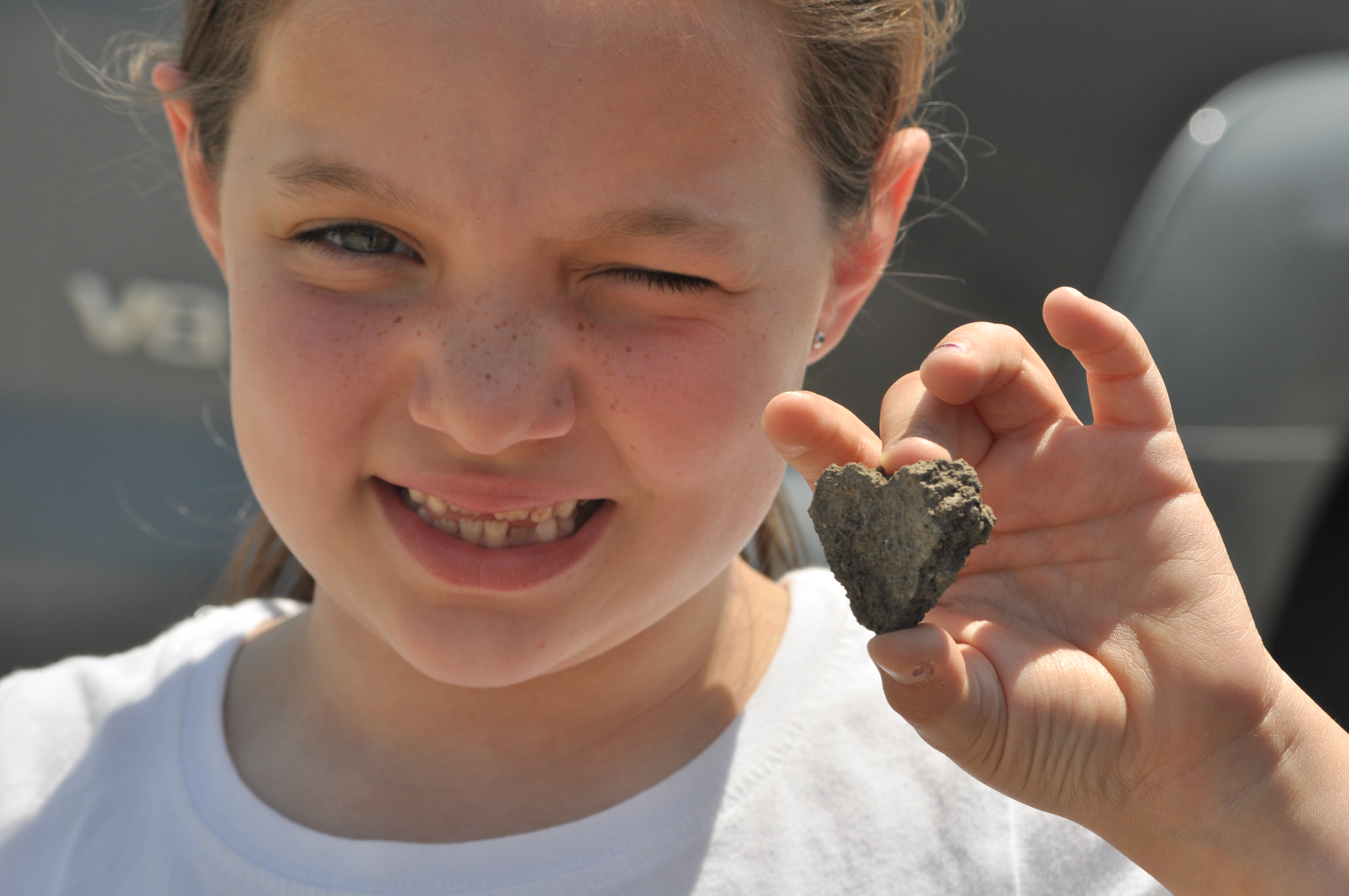
Maddie, blinded by the sunlight from behind me, holding up a dirt clod she found in the shape of a heart.

One morning last week I ran early enough that the sun barely peeked over the horizon. I headed south and felt the warmth rise to my shoulders. Then I turned east. The sun shone through a clump of trees ahead of me. I blinked a little at the sudden light, just at eye level. Then suddenly, unexpectedly, there was a break in the tree branches, and the rays hit me full on. I had to close my eyes against them, but they still pierced through my lids. For a moment I was blinded to everything but the glow.

Later that week I listened to the entire book of Revelation at one sitting (we were driving to Kansas for a wedding) and then today I finally got through the bulk of Job and listened to the final chapters, where God speaks.

The audio version of Revelation was, though word-for-word, read by various actors and accompanied by stirring music. My heart thumped, as if I were listening to Lord of the Rings. My mind pictured the woman and the dragon, the angels and elders round the throne, the Lamb slain, and the Warrior triumphant. For an hour and a half I lost sight of the details of my life and was blinded by the glory of the Magnificent and His story.

And today, as I listened to Job, I found myself silenced, just as he was. When he said, “Surely I spoke of things I did not understand, things too wonderful for me to know,” I echoed it. Job saw the smallness of his own complaints and of himself; he saw a bit of the BIG picture, and I caught a glimpse of it, too.

A.W. Tozer says that the most important thing about a person is how he or she sees God. My view of God needs to be expanded to accept His blinding attributes as well as His more, well, comfortable ones. The Lamb that was slain is also the snow-white haired, blazing-faced God-man with a sword in His mouth. Job repented “in dust and ashes” before this God; Isaiah knew his unworthiness so well he said he was “lost”; and John fell at his feet as “though dead.”

This kind of knowledge is not comfortable or easy. But it is good. Job, Isaiah, and John went on to live with a greater knowledge of God, and they anticipated an eternity of being fully aware of and fully satisfied in this blinding Glory.

From Blinding Glory to Truer sight.

“Holy, holy, holy is the Lord God Almighty.”

Waste not

Even things like common grasses are not wasted. So much beauty even in the individual stalks!

I hate waste. I’m actually a little weird about it. Wasted time, wasted food, wasted money, I hate them all. I almost never throw leftovers away. They get turned into second meals or fed to the dog (good thing she’s skinny). I started knitting so I could “do” something in those odd, spare moments. Rather than buy something, I’m always tempted to “jerry-rig” an alternative.

A week ago, I talked to a friend who was considering applying for a job she would enjoy very much. She told me it was a long shot and wondered if she should even bother. I told her: “You know, even if you don’t get the job, God will still use the experience. He doesn’t waste anything.”

Then I said, “Wow, that just came out, but I like it. I’d never thought of that idea in those exact words.”

If God is sovereign, nothing is wasted.

Nothing. If my friend does not get this job, He will use the disappointment to draw her closer to Him, and He will use it in other ways she will not be able to see. His powers of orchestration are amazing. Not a bit of the process will be without value.

What an awesome truth: that God can use, DOES use, things we consider a waste. Dry times, disappointments, failed endeavors, even seasons when the “mundane” seems to occupy so much of our time—these will be used. Even if we are not able to see HOW, we can trust in a God who is incredibly creative, always purposeful, and all-powerful.

Hallelujah!

Emily recently taught the twins how to run “suicides.”