Our Passover

We are in the process of converting the 1970s cowboy-themed basement family room into Dave's and my bedroom (with office space for me!). When Dave painted all the rough wood, this crack-- in the shape of a cross--emerged!

We are in the process of converting the 1970s cowboy-themed basement family room into Dave’s and my bedroom (with office space for me!). When Dave painted all the rough wood, this crack– in the shape of a cross–emerged.

Younger daughter Maddie was looking at the calendar this morning. “Mom,” she asked, “why don’t we celebrate Passover?”

“Oh, we do, hon,” I answered. “We celebrate the biggest Passover of all.”

“We do? But Passover is today. It says so on the calendar.”

“EASTER is our Passover, sweetheart—Good Friday and Easter together. It’s the ultimate Passover. The very first Passover and all the celebrations after were pointing to THE Passover, when God allowed His firstborn to die so that we might live.”

God allowed His firstborn to die—so that we might live.

I am sitting across the table from my firstborn right now. She is eating her cereal; I am drinking my coffee. We have just had a conversation about how great I think she is, about how glad I am to be her mom (she really is a pretty cool kid).

And I am reminded of how God felt about His Firstborn:

“This is my beloved Son, in Whom I am well pleased.”

Can you imagine the gladness that enveloped the Trinity in that moment? The Spirit-Dove descending, the great voice shaking the sky, the Son letting the blessing of love and favor fall upon Him!

My heart is full as I write these words. My God knew full well what was going to happen to His Beloved when He spoke that blessing.

But for the sake of me and my firstborn and all my other children—and you and your beloveds, too—He suffered, as Father and as Sacrifice—that we might be set free to LIVE in HIM.

That He might whisper in our ears, “You are Mine! And I love you.”

Thank You, Passover Lamb.

Thank You, Father God.

wallow

Em took this picture. Love on every page.

Em took this picture. Love on every page.

When I was a kid, one of my favorite books was about a pig that had a special wallowing hole. The farmer’s wife thought the pig’s mudhole was messy, though, so she cleaned it up (vacuumed it up–I loved that picture), and the pig ran away in search of a new wallowing hole. He hitched a ride on a passing truck and ended up in the city. When he saw some fresh cement, he thought it looked like mud and dove right in. Of course, pretty soon, it hardened, and he was stuck. Being a children’s book, though, the farmer’s wife realized the error of her ways and went looking for the pig. She and the farmer broke him out of the cement and took him home to his restored mudhole.

And the pig lived happily ever after.

I thought of that book today because I was pondering the word “wallow.” In my last post, I confessed that I often wallow in guilt—sometimes shame, other times pride, insecurity, jealousy… We humans wallow in all kinds of things that end up holding us prisoner—like the pig in the cement.

But what if we wallowed in God’s love? It’s big enough. Scripture speaks of it having vast height and depth and width and length. We are told to be rooted deep and grounded in love. God’s love is called great and wonderful and intense (Eph. 2:4 and 3:17-19, Amplified). Whenever I read the verse about the height/depth/width/length, I think of the Olympic-sized swimming pool I took lessons at when I was a kid. I was little, so it seemed HUGE! I could go down, down, down till my ears popped, I could twirl in the water, I could splash and jump. I could float, buoyed by water molecules. I could dive in and not hit bottom. I could try as hard as anything to swim underwater from one end to the other on one breath and not ever succeed (that changed as I grew older).

Wallowing is essential for pigs. They can’t sweat, and the coating of mud keeps them from overheating.

God’s love is not only essential for me, too, but keeps me from “overheating as well.” When I am busy “wallowing” in His love for me, discovering greater depths and breadths of it, “exultingly glorying” in it (that’s from the Amplified version of Romans 5:11), it keeps me from getting “overheated” by stress or anxiety or troubles. It also decreases my desire to “wallow” in anything else.

I wondered if there were any other reasons pigs wallowed, so I Googled the question: “Why do pigs wallow in mud?” Of course, I got multiple answers about their lack of sweating, but some scientists suggest that they do it in part because they enjoy it. It makes them happy!

This is true for us in relation to God’s love: what is GOOD and necessary for us is also enjoyable!

So, applying this to God’s love, I could paraphrase Paul’s words in Ephesians: Dive into the mudbath of God’s love. Let it get all over you, head to toe, soothing any sores. Let it seep into your heart, filling every crack and crevice, every wounded part. Don’t clean it off. Give each other messy hugs, so that your mudbath spreads to someone else—and theirs spreads to you. Roll around in it regularly; don’t let it grow dry and hard. Better yet, stay in it!

Wallow!

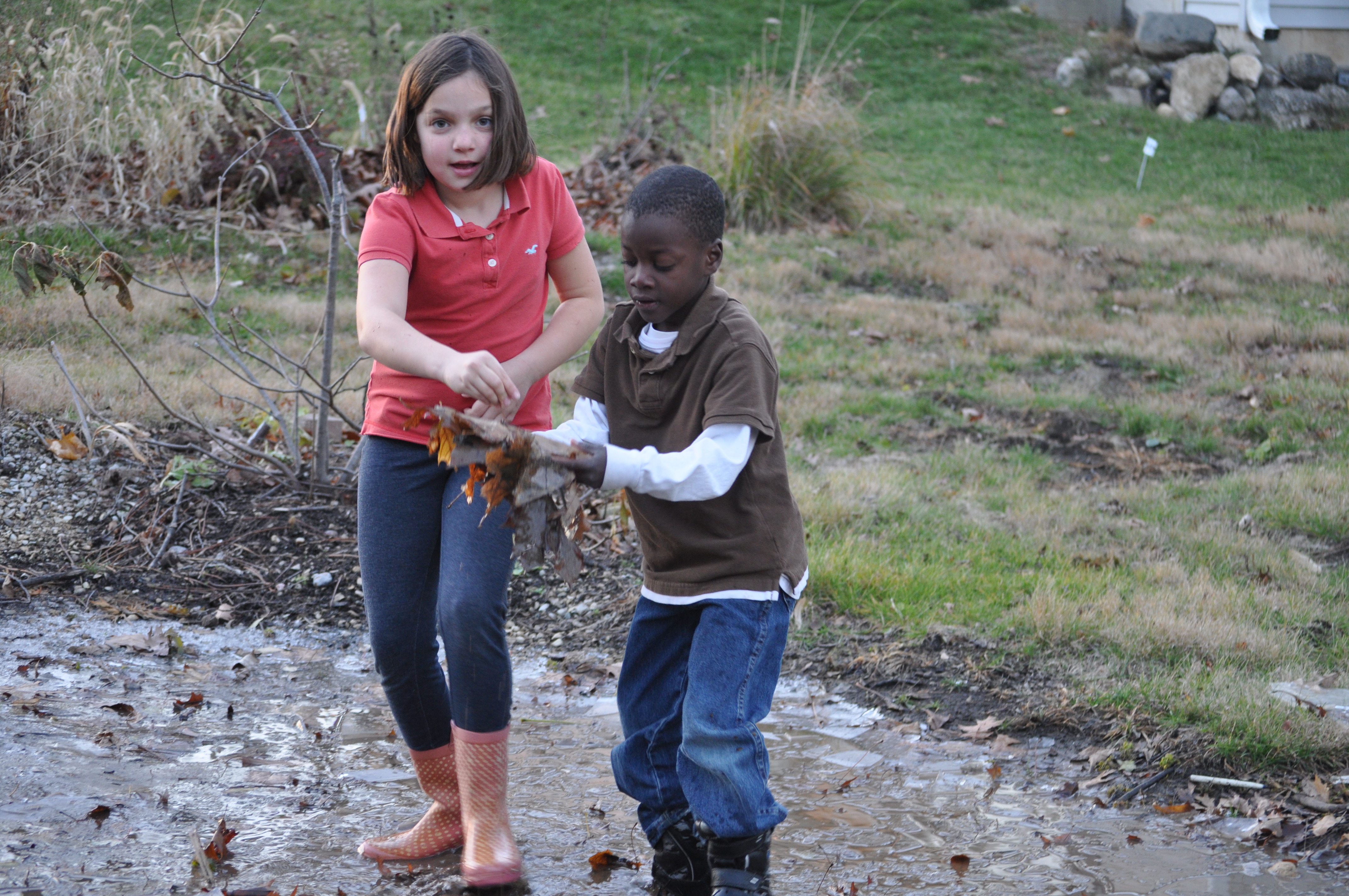
I thought a pic of my mud buddies was appropriate for this post!

I thought a pic of my mud buddies was appropriate for this post!

Great Eternal Father

Sometimes my praying is scattered. Some days my thoughts seem to jump and prayer gets lost. Not long ago I had one of those times. I was even using a verse to pray, thinking that would help, but I couldn’t get past the first line: “Great and eternal Father.”
I was about to go down my familiar road of beating myself up for being unable to focus on more, when I understood that “great and eternal Father” was more than enough. Those words—standing for the God they symbolize—gave me all I needed, both that day and forever. So I stuck with them and pinpointed my focus on my GREAT ETERNAL FATHER.
He is GREAT—all-powerful and all-good. My doubts don’t change God’s greatness. I can get hung up on questions or balk sometimes at “hard” passages of Scripture or cry, “Why? I don’t understand!” about injustices and pain, but all these problems—as I will see very, very clearly when my sight is enlightened by Glory—are with my perspective, not with God’s actions or character. Bottom line, He is great and good. No exceptions.
He is eternal. E-TER-NAL. I am fickle. My moods are upset by a headache; my values changed by circumstances; my commitments by my feelings.
He never changes.
He never will.
He is the same yesterday, today and forever. ETERNAL!
FATHER! How amazing that the GREAT, ETERNAL GOD has taken on the role of Father. He calls Himself “father to the fatherless.” He uses the picture of a mother hen who gathers her chicks under her wings to give us insight into Himself. He tells us He sings over us and holds us by the hand. He is immeasurably better than the best earthly father and so different from the worst that the word “father” is a travesty when applied to the human version. He even adds “Abba” (“Daddy”) to his title and gives us the incredible, unbelievable privilege of approaching him as a small child does a good father. In Christ He made the ultimate sacrifice so we could come to Him in this way.
GREAT and ETERNAL FATHER—that is a bedrock for my wavering soul.
DSC_0300

Happy birthday, twins! I can't believe they are 9! As they reminded me, this is their last year in the single digits. NOOOO!

Happy birthday, Jake and Maddie! I can’t believe they are 9! As they reminded me, this is their last year in the single digits. NOOOO!

MORE from the MOST

I want more today. Not superficial, “getting through the day” more. Not more “stuff” or money or even time. I want the 24 hours, the 1.440 minutes, the 86,400 seconds I have been gifted with to be filled with MORE. I want to be more aware that I spend each of those seconds with my hand held by my Abba Father. I want to walk each step as a redeemed person, made new and whole. I want x-ray vision to see into the hearts of people instead of getting hung up on their outsides. I want more of the eternal, the true and the truly good. I want to be so overwhelmed, so wonderfilled by my relationship with my Redeemer that it shines from my face like it did from Moses’s. And I DON’T want to wear a veil.
I want more from each minute I spend with loved ones today. Heck, I want more from each minute I spend with any fellow God-creation today.
I want more from each minute, period! This minute I am eating an orange (and typing, of course). I want to get more out of this orange. I want to savor the burst of juice in my mouth and appreciate that amazing mix of tart and sweet. I want to be awed by a God who thought up such an incredible treat, packaged just right—and who likes me to enjoy it.
HE wants more for me! He didn’t sacrifice so I could meander through life and relationships and work and get nothing more out of them than an unredeemed person can.
He wants the MOST for me.
He wants Himself, the MOST High God, for me—in every minute. Now and forever! Here and for eternity.
So. I. want. more.
More of the ONE
who is the MOST of all.

Wrestling (The guilt of simply being human, continued)

And speaking of fighting/wrestling, here are the two boys doing just that--one of their favorite activities.

And speaking of fighting/wrestling, here are the two boys doing just that–one of their favorite activities.

Jacob wrestled with God.

If you grew up on Bible stories, that statement has lost the impact it should have.

Jacob—a human—wrestled—up close and personal—with GOD!

And here’s another thing to ponder: GOD initiated the wrestling.

This blog entry is a follow-up to “The Guilt of Simply Being Human” (2/28/13, just below this one). After I finished my snow walk, I studied Jacob’s story and realized that God invites me to wrestle, too; that, in fact, wrestling is often necessary before I can enjoy the kind of peaceful fellowship described as “dining with Christ” or “being led beside still waters.” This blog entry is simply the way I unpacked the Jacob-wrestling-God story (influenced by Matthew Henry’s Concise Commentary [which, by the way, is available for free viewing at BibleGateway.com and Biblos.com]).

Up until this time of wrestling, Jacob had habitually done things his own way. He was an I’ll pray for God’s blessing, but then do it my own way sort of person.

How do I know this? His whole story tells me this. His name (which means “trickster”) tells me this.

But Jacob was facing a BIG situation; and he knew that all his wonderful trickery could not save him. Oh, he still connived, still planned, but then he cried out to God.

And God came and wrestled with him. And Jacob wouldn’t let go or give up. So God damaged Jacob’s hip and blessed him.

What? To be honest, it seems like a strange story.

I’ve heard people telling this story say things like this: God had to damage Jacob’s hip because Jacob was so strong.

Oh, no!

Jacob was wrestling with a God infinitely stronger than he (Jacob). God had the power to crush Jacob, to annihilate him.

But Jacob was also wrestling with an infinitely good God.

Jacob was not going to say, “Uncle! I give up. I acknowledge that I am human and You? YOU are God! I thought I was pretty good, pretty capable, but then I saw YOU and realized truth.”  Jacob, like so many of us, was far, far, far from recognizing this essential truth.

So God wrestled with him. He held back from using the full extent of His limitless power. He even let Jacob have the upper hand. I don’t fully understand why, but my suspicion is that this was best for Jacob. Perhaps this was the only way that Jacob would learn who God is. This wrestling was specifically chosen because of Jacob’s past and his personality type.

It seems to backfire at first because Jacob thinks he is winning.

But then God tweaked his hip—with a touch!

That was a wake-up call.

God has given us humans a lot of autonomy, and we think we’re doing okay. We think we’re capable.

But it doesn’t take much to remind us of the limitations of our humanity.

Suddenly Jacob realizes, “Oh, no, He let me have the upper hand. This is way bigger than I ever imagined. I’ve been playing with God, and He is too great to play with.”

But even though Jacob wrestled out of limited knowledge, Scripture actually commends him for wrestling with God. It commends him for not letting go.

It commends him because Jacob learned SO much when he wrestled with God.

When Jacob demands a blessing from God, Jacob learns instead who he himself is. God asks him a simple question: “What is your name?”

When Jacob answers, he realizes his own nature, because when he says “Jacob,” he is essentially admitting, “I am a trickster, a schemer, a swindler.”

But Jacob still has more to learn. Ever the comparer, always wanting to assess the situation and see how he stands, he then asks, “What is YOUR name?”

But God simply said, “Why is it that you ask my name?” In other words, do you really need to ask? Don’t you ‘get it’?

Jacob must have; he didn’t say anything else, and when God blessed him, Jacob accepted it. The GREATER always blesses the lesser in Scripture. So by accepting the blessing, Jacob was finally saying, “I give myself to You. You are God, and I am not. I am nothing like You, and I need you.”

THAT was what God wanted to Jacob to learn. So, finally, after a full night of wrestling, Jacob is ready to face the situation that had so terrified him the night before. Jacob names that place Peniel: “the face of God,” and he went on his way knowing that he carried the blessing of God with him: he now knew through experience that the all-powerful God would never fail him.

And here's how it ends (usually)--collapsed in laughter!

And here’s how it ends (usually)–collapsed in laughter!

Man, I wish I were less like Jacob. I wish I didn’t need to wrestle, again and again, to come to knowledge. But God not only knows what I need to learn, He also knows the best way for me to learn it.

And He is willing to even wrestle with me, if that is what it takes.

God wrestling with a human! AMAZING!

The guilt of simply being human

I'm so thankful for the view out my kitchen window! Beautiful!

I’m so thankful for the view out my kitchen window! Beautiful!

Yesterday, after reading a Facebook message from someone I had unintentionally hurt, my stomach was in knots.

When I shared both the Facebook message and my guilt with my husband, he looked at me in surprise. “Jen, why do you feel guilty? You simply weren’t able to do what he needed. It wasn’t possible.”

But I still wrestled with the feeling of guilt.

The guilt of being merely human.

The guilt of thinking I should be able to do it ALL (in other words, of thinking I am like God [the oldest sin of all]).

The guilt of forgetting that I am completely incapable.

To deal with this kind of guilt, I needed a broader definition of sin than the one that defines it as intentional actions, thoughts, and words that “break the rules.” That is a very limited—and unbiblical—definition of “sin,” and it didn’t help me deal with my Facebook situation.

The New Living Translation of Romans 3:23 defines sin as “(falling) short of God’s glorious standard.”

I fell short with my friend—not because I wanted to, not even because I had another choice, but simply because I had no capability to meet his expectations. I’ve “fallen short” in some other areas as well lately, and, for reasons only God knows, He has made me sit for awhile in the discomfort of my own inadequacy, my own “falling short.” I have tried to mute the message, tried to distract myself with writing and meal prep and people and the radio, but uneasiness has burrowed into my soul, and my thoughts circle constantly around my feeling of guilt.

So this morning I took a long walk in the thick snow at the dog park. Two women were there when I arrived, but they soon left, and I was alone—with my thoughts.

Still wrestling.

Round I walked, breaking through the snow crust, doing battle in my mind, swinging like a pendulum from excuses to accusations.

On the third lap, I stopped. “God,” I said, “I want to prove myself right in this situation. I want to ‘feel’ right. And I have been doing a whole lot of talking in my own head trying to figure this out. But I can’t–because I’m not capable. I fall short—both of a complete understanding of this situation AND of any ability to fix it. I am only human. Help me to see myself—and then see YOU—as I should.”

“Please, God, I need You!”

Then, finally, rest came. I could admit my own inability, my own “falling short.” And I could glory in the fact that the God who loves me has NO limitations. He is not bound by time. His strength is unlimited. He does not run out of energy or patience or goodness. He never forgets, not ever. He never fails—not at anything He does.

He IS the glorious standard.

And He is fully aware that there is no way I can reach His standard. In fact, I think He gets tired of my thinking I can.

So when I let go of trying to reach His standard on my own, I see HIM and His grace far better.

And I am awed by the Glory!

I continued my walk, joyous now, rejoicing in the beauty, and just before I left I did what I could not have imagined doing twenty minutes earlier.

I fell back into an untouched patch of snow, gazed up at the tops of the trees, and made a snow angel!

Crimson berries, white snow

I took this today in our front yard. What an amazing blue sky!

I took this last fall. (It’s the same picture, just uncropped, that I used as my new header)

On the tree in the front yard hang the leftover berries from last fall. They were bright before frost, but now they look almost black against the snow. It brings to mind Isaiah 1:18. God says to the Israelites, “Though your sins are like scarlet, I will make them as white as snow. Though they are red like crimson, I will make them as white as wool.”

I think of scarlet and crimson as beautiful colors—like the berries before the frost—but God spends 16 verses describing the crimson and scarlet of the His peoples’ sins, and it’s ugly! “You’re rebellious,” He tells them. “I’ve loved you and cared for you, but you have rejected and ignored Me. All your ‘churchiness’ is nothing but show. You’re hypocrites, following an outward religion that has no goodness to it. In fact, you offer sacrifices to Me and then go out and live without love for others, abusing and neglecting the helpless” (my paraphrased summary)

“Do you think that’s what I, the GOOD GOD, want?”

The scarlet and crimson of verse 18, then, are NOT beautiful. These people are as far from the purity of white as they could be. The crimson and scarlet have set into the fabric of their souls, and they are irreparably stained.

We must remind ourselves that we are no different. OUR sins–collectively and individually–are scarlet and crimson. We, too, are irreparably stained.

This takes on deeper meaning when we see the terms “white as snow” and “white as wool” applied to Christ: Daniel 7:9 says, “…the Ancient One sat down to judge. His clothing was as white as snow, his hair like purest wool.” Revelation 1:14 describes Christ’s head and hair as “white like wool, as white as snow.”

Our crimson stains and Christ’s white purity are as unalike as possible. We drip with sin, as if we have been dipped in a vat of it, formed in it (Ps. 51:5). Now let’s look at what is in the vat. It is not simply liquid color—a straightforward red dye. No! To understand how God sees this crimson sin, we must go to another verse in Isaiah: “We have all become like one who is unclean, and all our righteous deeds are like a polluted garment” (Isaiah 64:6). The polluted garment is–to be as graphic as Scripture is–like the underclothes a woman would wear during her menstrual cycle. They would be permeated with a bodily fluid that stunk and stained.

THAT is the crimson, the scarlet.

God the Pure One cannot condone and “coexist” with our stench. He would cease to be perfect, sinless God if He said that our disregard for Him and our injustice toward our fellow man was “okay.” Though He longs to hold us in His arms, that is not possible as long as we are stained and dripping with this crimson.

We have tried, over and over through the centuries, to fix this problem ourselves. All religions are simply our efforts to make ourselves fit for communion with God, worthy of his approval. But we cannot do this, though we claim to. But any “god” we can reach through our own efforts must be a god of our own making–and therefore not truly Divine.

So we must be changed, somehow made pure. Some outside agent must be applied to go over our stain. That’s exactly what God did in Christ. Christ, unstained and pure, took on our human flesh, a body that was stained with the effects of sin, that would suffer and age, that had the same bodily functions ours do, with emotions and frailties. He was “in all points like we are…”

“Yet without sin.” That needs an exclamation mark! He had no inner stain and He kept Himself unstained!!! THAT enabled Him to do an amazing thing for us. His death allowed us to be covered with new garments–HIS complete, utter goodness, white as snow.

“Though your sins are like scarlet”–permeating to our very core, as much a part of us as dye becomes part of a garment when the garment is dipped in it–“I will make them as white as snow.”

With the covering of Christ’s purity, our stains—past, present and future (God is not bound by time)—are overwhelmed, and God the Good can draw us near to Himself. His Spirit enters our hearts like a bleaching agent, and begins transforming us from the inside out, a process that will end (oh, Heaven!) with us being LIKE Christ. Selfishness and pride will never again seep from our hearts. We will be pure not only in standing (with Christ’s covering) but in practical actuality.

I am thankful I opened my curtains yesterday and noticed the shriveled, darkened berries and the gleam of snow behind them. I am thankful for this reminder because my gratitude is in direct proportion to my realization of my need for Christ.

Same berries after the frost

Same bush after the frost

“For our sake He made Him to be sin who knew no sin, so that in Him we might become the righteousness of God” (2 Corinthians 5:21 ESV).

lovin’ like he loved

All the kids--and a couple cousins--at the grandparents over Christmas break

All the kids–and a couple cousins–at the grandparents’ over Christmas break. You can tell there are several people taking this picture: the kids are looking about three different directions!

Each Sunday during my senior year of high school, I drove from the southern suburbs of Birmingham, Alabama, where I lived, into the roughest housing project in the city. I picked up ten-year-old “Peanut” from his apartment and together we canvassed his neighborhood on foot, collecting children from the streets and other apartments. As the only white person in sight, I got strange looks from the men leaning against streetlights. Each week I stood in the open doors of some of the worst of the worst apartments, those with bare, pockmarked concrete floors and walls, those that reeked with the smells of drugs, unwashed bodies, and neglect. I passed by the streets Peanut told me not to enter—they were the ”drug streets,” and not even the children who followed me would go down them. We ended up eventually at Peanut’s house, where his mother welcomed me and the little gang we’d collected into her living room. I taught a Bible lesson that those kids drank like Coca-Cola, and we bellowed songs like “Jesus Loves Me” and “Father Abraham.”

And then I left. Three hours, start to finish.

Not long ago I listened to a podcast on John 13:34-35: “… Love each other. Just as I have loved you, you should love each other. Your love for one another will prove to the world that you are my disciples.”

The speaker’s point was this: Jesus didn’t say, “Love each other as I have loved the little girl I raised from the dead.” Or, “as I have loved the leprous guys I healed.” Or, “as I have loved the people I fed with those few loaves and fishes.”

He didn’t tell them to love in a “Here I’ve come to save the day,” “in-and-out,” “mission accomplished” sort of way.

His love example was the relationship He’d modeled with the twelve disciples: you know, those twelve guys He lived with day-in-and-day-out for three years; those self-centered, complaining, power-hungry, often-childish, squabbling-like-siblings disciples. They may have been on their best behavior for the first couple months, but I’m guessing it didn’t take long for that to wear thin. The Gospels give us one example after another of the disciples’ issues. Jesus lived with all of it, put up with all of it, and loved through all of it.

And that’s the kind of love He tells us to love with.

It’s not that difficult for me to tutor refugees and international students each week. It’s kind of exciting. I leave grateful.

Aha—I leave.

But I come home to the six children who present the biggest love challenge I have: to love in the daily grind, through all their imperfections—and mine!, with all those fruits of the Spirit that I don’t naturally have. (Just last night I told my husband, “I’m too selfish to be a mom. What was God thinking?”)

This is “I Corinthians 13” love fleshed out.

I must admit, I prefer the in-and-out kind of loving. Two to three hours, a day, maybe a week or two—then I can say, “Whew, that’s over.”

But that’s not the love God’s called us to.

We are not called to a “quick fix,” easy kind of love. That’s not truly love. It’s described in I Corinthians 13:1-3 as “nothing.”

True love requires SO much of us.

It is patient and kind because it HAS to be.

It is not jealous or proud or rude or irritable even when there is certainly reason to be all those things.

It doesn’t demand its own way—even when no one else seems to be considering it.

It keeps no record of wrong.

It doesn’t rejoice about injustice.

It rejoices whenever the truth wins out.)

It never gives up, never loses faith, is always hopeful, and endures through every circumstance.

The disciples saw this kind of love firsthand, as Christ loved them even when they were petty and childish, even when they deserted Him.

After Christ left earth, the disciples had some difficult lives. But I am certain there was not a single time when they could honestly say, “This is way more difficult than what Christ did for us.”

That’s the kind of love I have to practice at home: the kind that takes practice, that often does not feel glorious or fun or exciting. Ultimately, it’s the kind that drops me to my knees with cries of “I can’t do this. I NEED YOU!”

This is also the kind of love that I have to learn to give to others outside my home. James echoes I Corinthians 13: 1-3 when he writes: “Suppose you see a brother or sister who has no food or clothing, and you say, ‘Goodbye and have a good day; stay warm and eat well’—but then you don’t give that person any food or clothing. What good does that do?”

My love for the “neighbors” God puts in my path and on my heart is meant to be like the love I practice with my family. It should cost something. It should be something I can’t do in my own strength.

This is not easy stuff. Christ’s command seems so simple, especially compared to all the rules we create with our religions.

But it’s a command that reduces us to the realization that we CANNOT do it.

What a good place to be.

Because the more difficult the loving, the greater the testimony to the God who is loving through us, the God who loves the least loveable—all of us—with a perfect, never-ending love.

“Just as I have loved you, you should love each other.

Your love for one another will prove to the world that you are my disciples.”

Discomfort and the white umbrella

Isn't it beautiful! It was a complete surprise on Christmas morning to get this. This is a kantha blanket, made from used saris by women at risk in Bangladesh. The company that sells these blankets is Hand and Cloth (handandcloth.org). Through making blankets for Hand and Cloth, these women can support themselves and their families with dignified work and they also hear the Word of God that tells them they have value simply because they are creations of God.

Isn’t it beautiful! It was a complete surprise on Christmas morning to get this. This is a kantha blanket, made from used saris by women at risk in Bangladesh. The company that sells these blankets is Hand and Cloth (handandcloth.org). Through making blankets for Hand and Cloth, these women can support themselves and their families with dignified work and they also hear the Word of God that tells them they have value simply because they are creations of God.

I have been hearing about the White Umbrella Campaign for over a week now, and I just decided to order the book. It’s about human trafficking here in the U.S. With a magazine article I began researching last fall (and just finished writing last week), I’ve been doing much reading on human trafficking statistics worldwide, and I have been staggered by the numbers here in the States.

Though I ordered the book, I’m not really looking forward to the reading of it. It will be, at best, UNcomfortable and quite probably heartbreaking. But I’m learning, more and more, that God is not all that concerned with my comfort. It’s not really good for my character or my heart. Comfortable hearts and settled lives have negative tendencies: being closed off, quick to judge, unwilling to stretch.

I will let you know what I think of the book. I have a few others I’ve read recently that I would also like to post about.

And, tomorrow, hopefully (my husband is overseas at the moment, and I’m holding down the fort with the six kids, teaching a two-week bread-making course, and trying to finish up a few writing deadlines), I’ll post a sweet, funny story about PJ, Jake, and a marble. And, then, of course, I also plan to write and post “Marriage advice, part 2”!

our second Advent

Here are the four beautiful girls Dave and I took to The Nutcracker in downtown Chicago (with the Joliffe Ballet--woohoo!) last Friday. It was a much-anticipated event, and it did not disappoint. Best part for Dave and me: watching the girls' faces as they watched the ballet!

Here are the four beautiful girls Dave and I took to The Nutcracker in downtown Chicago (with the Joliffe Ballet–woohoo!) last Friday. It was a much-anticipated event, and it did not disappoint. Best part for Dave and me: watching the girls’ faces as they watched the ballet! The boys spent the night with friends–which they said was the better deal! 

Just past 7 on Christmas morning Jake came into our bedroom—we’d said the digital clock could not have a 6 at the front—to announce that he, Patrick, and Maddie were awake.

As Dave and I sloshed mouthwash, Jake chattered, mostly about presents. Then, in the middle of his ramble, he announced, ““Christmas and Easter are the BEST! They’re God’s plan of redemption.”

Well put and true, though we still laughed at the way he said it.

It is now two days after Christmas, our celebration of the Savior’s birth. We anticipated Christmas through Advent, and then we will expect Good Friday and Easter through Lent. As Jake said: The whole picture of God’s capital-R Redemptive Plan.

Advent means “the arrival of a notable person, thing, or event.” Lent is a “season of penitence and fasting in preparation for Easter.” The only reason we are able to anticipate or prepare is because we know the outcome. We know the full scope of the story. So even our Lent preparation is tinged with hope, with expectancy of joy at the end.

But the Redemption begun at Christmas, finished on Good Friday, confirmed at Easter, still has a final chapter. This final chapter will end all tears, all injustice, all war. It will dethrone evil and establish God as the visible King of Kings and Christ as the Prince of Peace.

It will make us individually and collectively right and unbroken.

But this second Advent, second arrival, has not yet happened.

We still wait for it.

It is a waiting sustained by a sure hope, but this is often hard to remember.

For though the hope is certain, we know very little about the details. How could all that we see in the world around us, in our very lives—how could we ourselves, broken and flawed as we are—be part of this final Redemption?

Paul calls it “seeing through a glass, darkly.”

We are in many ways like the people of Israel during the first Advent, unable to see that the promises of old were about to unfold in tiny little Bethlehem—unable to see that Roman occupation, a travel edict, a young girl, a loving, faithful carpenter—and a slew of other details and people we know nothing of—could be used to usher in the Incarnation.

Perhaps the details of our lives are such that we, too, wonder if we are of any purpose in the Majestic Plan. Perhaps we, too, have tried to silence our soul-whispers of grand desire and settled for “the best we can make of life.” Perhaps we are going through heartache that makes us moan and cry out “Why?”

That is the reality of our earth-life. Uncertain at best, wailing at worst—waiting, waiting—because there must, must be more.

We must cling to the promise that there is. That the Promise Himself will return and shed light on this world so that the purposes of all that went before will be revealed. We will be amazed at how all of our lives, even the smallest details, was being used in God’s Plan.

Let’s not be like the sleepers in Bethlehem. As Christ was born yards from their beds, they slumbered and then woke the next morning with no difference in perspective.

They missed the Miracle.

If we fail to cling to God’s sovereign goodness (such a beautiful mystery—that in God “sovereign” and “goodness” are inseparably linked), we, too, will miss miracles, particularly the everyday ones of relationship and personal growth. We will lose sight of Purpose.

Anna and Simeon waited for years for the first Advent. There must have been times when they felt they waited in vain, when it was lonely and painful and hard.

But at the end of it, the Purpose they held in their arms shed light on the purposes of every one of their past moments.

So in this long period of the second Advent, let us wait and endure with the understanding that God’s Plan incorporates even our heartache, even our daily grind. Though we are in the dark involving the purposes, He is not.

For now we see through a glass, darkly; but then face to face: now I know in part; but then shall I know even as also I am known. I Corinthians 13:12, KJV

Glory and Goodness: a sure hope.