A sermon and thoughts on Generosity

Two days after my sister sent me the Matthew 6 commentary on generosity and giving that I shared in my last post, I opened up my podcast library on my phone to listen to the latest Tim Keller Sermon and found that it is titled “Blessed Are the Poor.” It so closely relates to the Matthew 6 commentary that I am blown away. Clearly this is something the Lord wants me to meditate on and pray about more–and, of course, DO! Click on the link above to listen to this sermon via Podbay. Keller doesn’t pull any punches, but he ends by drawing our attention back to grace. He reminds us that “generosity” that is based on guilt is simply religion; it’s not founded in the Gospel.

One image from the Matthew 6 commentary that I keep thinking about is the “single eye.” Here’s a quote from that section: Jesus’ illustration about the “single” (NIV good) eye and the evil eye would immediately make sense to his hearers: a “good” eye was literally a healthy eye, but figuratively also an eye that looked on others generously (Sirach 32:8). In the Greek text of the Gospels, Jesus literally calls the eye a “single” eye, which is a wordplay: the Greek version of the Hebrew Bible also uses this word for “single” to translate the Hebrew term for “perfect”-thus “single-minded” devotion to God, with one’s heart set on God alone. An “evil eye,” conversely, was a stingy, jealous or greedy eye; yet it also signifies here a bad eye (Mt 6:23), one that cannot see properly. Jesus uses the “single” eye as a transition to his next point, for the “single” eye is literally undivided, having the whole picture: thus one is not divided between two masters, as the text goes on to explain (v. 24).

mads eye

I’ve posted this picture (shot by my older daughter [the subject is my younger daughter]) before, but I felt it was very appropriate for this post.

I want the generous, single eye Jesus speaks of. I want to see more and more clearly God’s great, incredible, beautiful love for me–until my eye is filled up with Love-Light so that my view of every other person is filtered with Love. This morning I was reminded that this not only applies to those in physical or social need when I realized I was viewing an interaction with a neighbor without a bit of Love in my gaze. There was no generosity in my view of her. I was thinking of her only in relation to myself, of how she had inconvenienced me. God had to remind me that the generosity He calls us to is a way of life that impacts how we see EVERYONE!

This prayer is adapted from the Message version of Matthew 6.

Lord, help us to open our eyes wide in wonder at your amazing love. Help us to believe and trust that you love us more than we can ever understand. Fill up our eyes with the light of your love so that we don’t squint our eyes in greed and distrust but look instead with generosity on others. May we deny and abandon the self-worship we are so drawn to and worship you alone. This single worship will fill our entire lives with Light!


What I need

mads eye

This is daughter Em’s work–she took this shot of her younger sister’s eye as part of her digital photo final exam. No relation to this post–just wanted to share.

I dabbled in studying the Trinity this past fall. I learned much, but learned more than anything that I’d merely left the shore to sit in a rowboat on the ocean’s surface in order to peer into the depths. I was able to see further into the water from the boat than I had on land but was also able to see that beneath me were fathoms upon fathoms of mystery and beauty.

I realized I could spend my life studying the Trinity and still be snorkeling in the shallows.

Yet even the shallows are amazingly wonderful! The very idea of a three-in-one God, a God who is three persons distinct yet sharing the same essence, so full of love for one another that this love overflows into and onto creation…

Is incredible, simply incredible.

As I read about and marveled at the Trinity, a conversation from a couple years ago kept coming back to me. I’d never forgotten this conversation because it made me uncomfortable. I left it feeling I’d said the wrong thing, but my studies of the Trinity gave me insight into why I said what I did.

My doorbell rang one day while the kids were at school, and I opened my door to find two women who wanted to tell me about their faith. They were both older than I, and even though I didn’t invite them in because they seemed a little nervous of the dog, I found myself wanting to fetch a chair for the older of the two, a woman older than my mother. We began with what we agreed on, and our talk was cordial. But then I asked them about Jesus. “What do you believe about him?”

Distress built in me as the older woman talked about a mere human who’d simply been so incredibly good that he was, so to speak, “adopted” by God. God’s son? Yes. But was he God’s eternal Son, ONE with the Father and the Spirit, of the same essence? No.

I am not “good” in these situations. Scripture references, logic, and reasoning—all these flee, chased out by passion and fear. My brain scrambles to put together a clear plan, or to follow one of several I thought of after previous conversations like this one, but all I can do is send up a plea for help.

So, with these two beautiful women standing in front of me, brushing aside every question I had about Jesus being one with the Father, about Jesus being the Word that was in the beginning with God, I prayed. Holy Spirit, please come.

What came was not what I’d hoped for—a list of Scripture references clearly laid out. No, what came was sorrow. These women were unnecessarily trapped; they’d placed their hope in a lie. If Jesus was human only, if his death was accepted only because he’d lived a perfect life before it…

…then his sacrifice would have only made the way clear for himself, not for me, nor for these women. He would be no more than an example—“Look at him; do it exactly this way!”—an example we are incapable of duplicating.

I asked more questions, but the distress grew until it burst out of me: “But if Jesus wasn’t God, He couldn’t help me! I don’t want a human savior; what good would that do? I need God Himself to save me! No one else could!”

The rest of the conversation was still cordial, but they didn’t stay long after my comment. I told them I would love for them to come back, but I haven’t seen them again.

This is the conversation I kept remembering as I read about the Trinity this fall. I realized the longing I’d felt was not simply for a divine Savior. It was bigger, wider, deeper. It was for a Triune God who has such an excess of love within the Father, Son, and Spirit relationship that this love cannot help but overflow. It was a longing for a God who also longs for me; who deeply desires to restore the broken relationship with his creation and did this very thing through the Son; who draws us by the Spirit into true relationship with God, with neighbor.

May the grace of our Lord Jesus Christ, the love of our God, and the fellowship of the Holy Spirit abide with us, now and forever.

Named and Naming

cross picI can still see in my mind one picture from my very first children’s Bible. There’s Adam, his back facing me, a plant strategically covering his butt. Both arms are by his sides, but one hand is lifted slightly. The pose seems to say, “I’m thinking. The right name will come to me, and it will be perfect.”

In front of Adam is a vast line of animals, stretching off into the horizon. I remember a few of them: the lion, his mane-surrounded face looking wise and calm, a giraffe just behind, its neck and head arching toward Adam, and a gazelle-like creature, poised as if standing still was an extreme effort.

I’ve always been fascinated with this story, with humans having the privilege of naming. Naming, I feel, is a small act of creating, a small act that opens the door to vast possibility.

We humans love to name—our children, our pets, our businesses, even inanimate personal belongings. We seem to think that when we name, we hold a bit of interest in that person. We feel we’ve set them on a path because names carry connotation for us. Some names are strong; others are beautiful or quirky or unique. When we name, we confer not only possibility, but a hoped-for direction or purpose.

Could this love for naming be a longing for the privilege we had pre-Fall?

We lost so much at the Fall, relationship with God paramount, so perhaps the loss of our naming privilege does not seem very big, but I wonder about that. I think it must have been fairly significant: names are a big deal in Scripture. In historical accounts, the naming of children or places is often included. God changed people’s names several times, and in each instance the name change carried weight. It signified a new direction, a new identity, and a different relationship with God.

I’ve learned that the very fact we have names is important. I’m reading a book on Genesis* right now, and in the section about the serpent/Satan in Genesis 3, the author made this statement: “What is interesting is that in all but one of these … occurrences (of the name ‘Satan’), ‘satan’ has attached to it the definite article, ‘the satan.’ This indicates ‘the satan’ is a title, not a personal name. Satan is not who he is, but what he is. He does not merit a name, and in antiquity, not to have a name was to be reduced to virtual nonexistence.” (emphasis mine)

I often tell my children Satan is not capable of creating. He can only twist toward evil what God created for good, and this quote expanded my thinking: Satan un-named himself when he turned away from the Creator, and in so doing, he separated himself from any participation in creation. In a way, he undid himself. He made himself nothing, incapable of doing anything true.

In the Fall, we, too, un-named ourselves. We spurned “beloved” and “image-bearer” and put on false names like “self-sufficient” and “independent.”

But God snatched up the true names we cast off so flippantly. God kept them safe, and through the magnificent work of Immanuel, God restores them to us. Truly named ourselves, we can once again join God in the creative work of naming others.

I’ve been pondering this idea for a long time, particularly in my context as a mother. Each day I contribute to the naming of my children. With the attitudes, actions, and words I direct toward them (and in the absence of those as well), I shape their concept of themselves. I can name them “beloved” and “valuable” and “growing.” But I can also twist their concept of their name: “You are a bother.” “You are incapable.” “You are not worth my time right now.” I can reinforce their un-naming.

This is not only true for parents. We all have people we are called to nurture in one way or another, and we can be a part of naming them as God wants them named: valuable, unique, and beloved.

We can name even the people we simply pass on the street. When we make eye contact with a person, we “say,” “I see you. I acknowledge you as a fellow human being.” That is naming.

And when we avert our eyes, what then?

In I Peter, we are told we are “chosen (to be) God’s instruments to do his work and speak out for him, to tell others of the night-and-day difference he made for (us)—from nothing to something, from rejected to accepted.” **

And in this “telling,” we get to name others—with the names God has for them. He says, “I’ll call nobodies and make them somebodies; I’ll call the unloved and make them beloved. In the place where they yelled out, “You’re nobody!” they’re calling you “God’s living children.” **

We name: You are Somebody. You are Beloved. You are God’s living child!

What incredible work!

*Handbook on the Pentateuch by Victor P. Hamilton, published by Baker Book House, 1982. The quote I reference is on page 43 in this edition of the book. The link in the book title takes you to its page at Christianbook.com’s site, where you can buy the 2005 edition.

**The Scripture links take you to Bible Gateway, to that Scripture in three versions (The Message, the Amplified, and the NIV) side by side. It’s awesome to look at them in this way!

Let me let you

dry flower 5Normal morning, but my boys’ running around/picking at each other/roughhousing scraped my nerves way more than usual, and I shot sparks like a cat whose fur has been rubbed backwards. “Can’t you take it outside?” I grumped. They subdued—momentarily. Then it all repeated, and I hollered, and they finally settled—sort of.
But my nerves were still prickling, and I could tell it wasn’t going to take much to set me off again, so after rough pecks on my boys’ cheeks and gruff reminders: “I still love you even when you’re driving me crazy, even when I fuss,” I pulled out Jesus Calling (the kids’ version) and read it aloud to all of us.
I could have stopped after the verse: “Then I will ask the Father to send you the Holy Spirit who will help you and always be with you,” but the second paragraph amped up the lesson with this: “…you may be tempted to go it alone. But that is when you are in the greatest danger. The evil one is waiting for you to let your guard down, to step away from My protection. Ask My Spirit to help you every step of the way—during hard times and easy
times.”
The kids’ ride pulled up as I read the last sentence, and they rushed out the door, and I turned to all the tasks that must get done this morning before I can sit and read and write—the other tasks that must get done before I pick up dry flower 2the kids from school and another sort of tasks begin.
I’d forgotten the lesson already. I hadn’t given it even a second to soak in, to penetrate my mood and my heart.
I zoomed from fridge to stove to sink, moving quickly, my thoughts zooming as well till I suddenly realized where my thoughts had gone.
I was bringing up little ways I felt slighted by people in my life. I was revving up to have a good old pity party, a time of “woe is me” while my physical movements would only get faster and I’d be left feeling worn out but also itchy.
Does anyone else do that?
The Spirit brought me up short—I know it sure wasn’t me—and I recognized what I was doing. Still I resisted.
Then this phrase jumped into my mind. “Let me let you rest.”
“Let me let you”?
dry flower 4The phrase stopped me. I got the first part: “Let me…” Yes, I was being stubborn. I needed to stop and let the Holy Spirit do Spirit work in my soul.
But the second part? “…let you”?
I left the kitchen, looked up “let,” and found these definitions:allow to, permit to, give permission to, give leave to, authorize to, sanction to, grant the right to, license to, empower to,enable to, entitle to.”
I bolded the ones above that made my shoulders and my will relax.
Let me let you rest.
The tasks still await me. But though my hands may be busy, my heart can be still.
I have been allowed, permitted, granted the right, empowered, enabled, and entitled to rest in the Presence of Christ.

Good works prepared: Faith Willard and Sarah Aulie

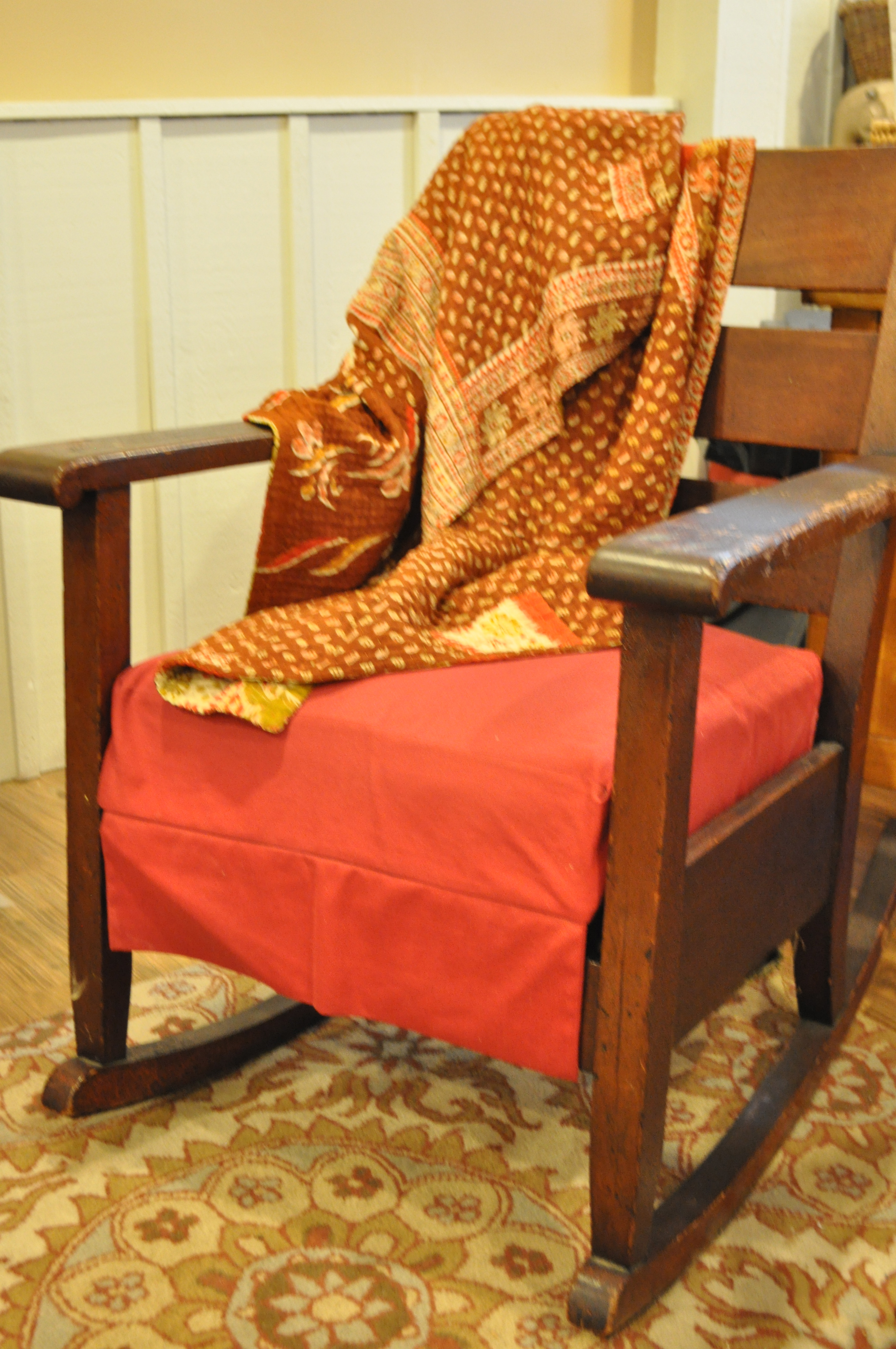
One of Hand and Cloth's beautiful blankets draped across a chair in my bedroom. They truly are lovely and would make great Christmas presents!

One of Hand and Cloth’s beautiful blankets draped across a chair in my bedroom. They truly are lovely and would make great Christmas presents!

This morning I had the opportunity to listen to Sarah Aulie (founder of Hand and Cloth, which I’ve written about before; click on the link to read about it) and Faith Willard speak at Wheaton Academy’s alumni recognition chapel. Both graduated from the Academy (50 years apart!), and Sarah, a 2000 grad, considers Faith, a 1950 grad, to be her mentor. It’s a beautiful story.

In 2007 Sarah was at a crossroads. She knew the Lord was calling her to do some sort of overseas work that would provide at-risk women with a livelihood, but she didn’t know any specifics. She asked her mother to pray for her, and her mother brought the request to the prayer group she led at Wheaton Academy. The prayer request spread to the administrative assistant of the Head of School, who maintained connections with WA alum all around the world, including Faith Willard, who’d been working in Bangladesh for more than 30 years by then. The admin assistant connected Sarah with Faith.

In 2007 Sarah flew to Bangladesh and saw firsthand the work of The Widow’s Friend, the organization Faith started in 1975 that now runs medical clinics, an orphanage, a high school, a mission/job skills training center for for widows, a school for the deaf, and a hostel for unmarried working women. Through Faith’s widespread work and connections, Sarah got a big-picture view of the needs in Bangladesh, and she became particularly interested in women who were unprotected by husbands or families. These women are often trafficked or forced to work in prostitution because they have no other options for supporting themselves and their children.

Sarah wanted to provide dignified work for these women, and when she discovered the kantha, a traditional blanket made from used sari cloth, she had an idea. She formed Hand and Cloth, a U.S.-based non-profit, to sell kantha blankets in the U.S., and partnered with House of Hope, a business in Bangladesh, to employ women to stitch the blankets.

I wrote a full article on these two women in the fall of 2012. Though I was able to interview Sarah Aulie in person, I had to talk on the phone with Faith Willard. It was a joy to meet her in person this morning and hear her words of wisdom to the students. She told them wonderful stories of God’s providence and how he has led her, time and time again, in the 65 years since she left high school. She, too, had many times when she didn’t know what she was supposed to do; she simply had an urge and a desire. She quoted Ephesians 2:10. “For we are God’s handiwork, created in Christ Jesus to do good works, which God prepared in advance for us to do” NIV (the link has NIV, Amplified, and Message versions of it alongside each other).

“He’s already gone ahead and made preparation,” Faith reminded the students–and me. “If you just have a heart to honor the Lord, that’s all he needs. He’ll go before you and prepare the way. He’s always doing that. You’ll find He’s provided all you need.”

As I listened, I reflected on how that message has continued to be true for Sarah. Sarah is now married to a Greek man and is living in Athens, which–not coincidentally–is a real hotbed for trafficking. Sarah is already looking into ways Hand and Cloth can expand its scope and provide dignified work to some of the women trapped in Greece’s prostitution trade. Just as Faith said, God has once again gone before Sarah and prepared a good work for her to do.

Sometimes it’s a lot easier to see how God is making a way for others than it is to see how He’s going ahead of us in our own lives. Faith’s message was exactly what I needed to hear this morning, and I’m passing it along in case it’s what you need to hear, too.

The freedom of being a small character

flower close upI just finished Still by Lauren Winner, an author who rises higher on my favorite list every time I read another of her books. (Follow the link above to her Amazon page to see all of them.) Still is about what she calls a mid-faith crisis–the doubting, dull doldrums–and what still keeps her in the faith and allows her, ultimately, to remain still in it.

One of my freelance assignments right now is a week of devotions on the “walk humbly” portion of Micah 6:8, and I’ve been simmering in that phrase before I begin the actual writing. Perhaps that is why the quote below from Still caught my eye. Whatever the reason for my first attraction, I have returned to it several times since, and I want to share it with you. If you are wondering this day about the specific purpose of your life; if you have thought “What am I doing?”; if you’re struggling with your significance/success–or seeming lack of it; if you’re shamed by failure, this one’s for you.

“It turns out the Christian story is a good story in which to learn to fail. As the ethicist *Samuel Wells has written, some stories feature heroes and some stories feature saints and the difference between them matters: ‘Stories…told with…heroes at the centre of them…are told to laud the virtues of the heroes–for if the hero failed, all would be lost. By contrast, a saint can fail in a way that the hero can’t, because the failure of the saint reveals the forgiveness and the new possibilities made in God, and the saint is just a small character in a story that’s always fundamentally about God.'”**

That last line (emphasis mine) keeps grabbing me. A load rolls off when I sit with it. I sigh with relief and gratitude. Yes! I breathe, yes!

white flowersFather, you are the Playwright of the greatest story ever, and you’ve given me a role in it, a small but somehow still important role. This story is about You; it’s for you; it’s by You. I come to you now and ask that You would simply show me what You have for me today in this story. Help me to release the big story to You, to let Your capable pen write it. Help me to live into the part you have for me, one small scene at a time. Give me great joy in doing my best for You. Remind me that You empower me to live out my role. May my bit part–and all our parts collectively–glorify You.

Just on a whim, I did a search on the word “story” on Bible Gateway. I specifically chose The Message to search from because I thought it might use the word “story” in a symbolic sense as well as in a literal one. I wasn’t looking for anything in particular, but I found some beautiful, arresting passages. I’ve included some of them below.

“You’re hopeless, you religion scholars and Pharisees! Frauds! You keep meticulous account books, tithing on every nickel and dime you get, but on the meat of God’s Law, things like fairness and compassion and commitment—the absolute basics!—you carelessly take it or leave it. Careful bookkeeping is commendable, but the basics are required. Do you have any idea how silly you look, writing a life story that’s wrong from start to finish, nitpicking over commas and semicolons? ***Matthew 23:23-24

[ Trusting God ] So how do we fit what we know of Abraham, our first father in the faith, into this new way of looking at things? If Abraham, by what he did for God, got God to approve him, he could certainly have taken credit for it. But the story we’re given is a God-story, not an Abraham-story. What we read in Scripture is, “Abraham entered into what God was doing for him, and that was the turning point. He trusted God to set him right instead of trying to be right on his own.” ***Romans 4:1-3

I’ve preached you to the whole congregation,
    I’ve kept back nothing, God—you know that.
I didn’t keep the news of your ways
    a secret, didn’t keep it to myself.
I told it all, how dependable you are, how thorough.
    I didn’t hold back pieces of love and truth
For myself alone. I told it all,
    let the congregation know the whole story. ***Psalm 40:9-10

*The Samuel Wells link leads to a piece he wrote for The Christian Century about Bonhoeffer. It doesn’t link specifically to this topic, but it’s a really good read and what he wrote near the end of the article about Bonhoeffer’s assumptions about his own life’s “success” really do flesh out the quote above (which is not from that article).

**The quote is linked to the specific page it can be found on in the book God’s Advocates: Christian Thinkers in Conversation. It’s a Google book, so the entire thing is available for reading on that page.

***The Scripture links lead to a parallel versions (Message, NIV, Amplified) of that passage, allowing you to see other translations alongside Peterson’s work.

A Full Physical Life

On my walk this morning, I looked for evidence of death and life, side by side. I'm inserting a few of the examples I found.

On my walk this morning, I looked for evidence of death and life, side by side. I’m inserting a few of the examples I found.

The verse-of-the-day on Bible Gateway yesterday was Isaiah 46:4. “I will be your God throughout your lifetime— until your hair is white with age. I made you, and I will care for you. I will carry you along and save you” (NLT).

The phrase about white hair made it feel personal, since mine is moving progressively from pepper-and-salt to salt-and-pepper. Every time I get it cut, there are more white trimmings on the floor, reminding me that time, marching on, isn’t just changing my children’s bodies, it’s changing mine. Through my 20s and 30s I was generally able to ignore the truth that I live in a body that is decaying, a body that will eventually give up its hold on life, but now? Not so much. The knees ache when I walk down leaves near treestairs; the belly has firmly decided it likes curves better than straight planes; my head still wants to look over my shoulder, but my stiff neck vetoes the idea nearly every time. I tell my children that I exercise so I can keep up with them, but I know the time is very soon coming when their growing strength will far outstrip my failing energy.
dew on leavesThat’s, honestly, a little sobering. My husband, parents, siblings, friends–we’re all on the downhill side of life’s timeline. Diet and exercise can only do so much, can’t actually stave off the inevitable (no matter what Tony Horton says). But God remains the same. Yesterday, today, forever, 50 years ago, next week, a millennium hence–no change. The Amplified translates Isaiah 46:4 this way: “Even to your old age I am He, And even to your advanced old age I will carry you!  I have made you, and I will carry youBe assured I will carry you and I will save you.”
ok--this one doesn't exactly fit what I was looking for--but these blossoms were so intricate!

ok–this one doesn’t exactly fit what I was looking for–but these blossoms were so intricate!

The spiritual meaning of that verse is beautiful and truer than its physical meaning. But yet I take great comfort in knowing that when I am reduced to hobbling, to sitting, to a curled-up lying on a bed–He will carry me. He will be with me. He will continue the work He has begun in me and through me. I will not be useless–because of Him.

I take great comfort, too, in the assurance that He will save us from these decaying bodies. Near the end of summer I learned of the deaths of a high school friend and a former student at the school where I work. In the midst of grieving, we take comfort in knowing they are spiritually and emotionally alive with a fullness we cannot conceive.
It is an incredible comfort to know they are physically alive as well. They left behind their old byellow on brownodies–bodies that were gradually dying. With Liz‘s cancer battle, this was obvious, but even though an accident took Chase’s life in the full prime of young womanhood, both were dying well before the cancer diagnosis and the accident drastically sped up the process. But NOW they are in fully alive bodies that don’t contain even a hint of death. When their loved ones are reunited with them, they will recognize them physically!

I came that you might have life,” Christ told us–tells us. Spiritual life–yes! But also physical–in bodies that will be continually renewed–that will LIVE in ways we’ve never experienced.  No aches, no pains, no fear of sickness or illness or death. No slowing down, no shortness of breath, no enhanced sense of gravity! Just life, pure, abundant, full, never ending, always flowing.
He is and will be our God–carrying and saving us through this lifetime. He is and will be our God, our source of life, for all eternity.
                                                                                      Here’s to LIFE.

No true risk

“Jesus is greater than we have yet learned, more able than we have yet seen, more willing than we have yet dreamed, and infinitely worthier than we have yet risked.”

The above quote is from “Unrolling the Scroll of Freedom” by Beth Moore, published in the March 2015 issue of Christianity Today. (The entire article is a valuable read; the link above is to the one-page, reader-friendly version of it).

One particular part of that quote is leaping, arms waving, for my attention. “Jesus…is infinitely worthier than we have yet risked.” It makes me ask myself, What areas of comfort or safety or self-control am I holding onto because I’m not willing to completely trust that Jesus is worthy and great and able and willing?

Isaiah 30 is a message to the people of Israel about their trust in Egypt. They consulted and counseled each other and made a plan, but God tells them their plans are not His. They looked to Egypt to be their strength and protection and didn’t listen to the Spirit of God. In verse 20, God tells them they have experienced adversity and trouble because they have not trusted in Him, but He longs to reveal Himself to them.

Verse 21 reads, “…your Teacher will not hide Himself any more, but your eyes will constantly behold your Teacher. And your ears will hear a word behind you, saying, ‘This is the way; walk in it, when you turn to the right hand and when you turn to the left.'”

And what is the result of this close listening, this devoted obedience?

“Then you will defile your carved images overlaid with silver and your molten images plated with gold; you will cast them away as a filthy bloodstained cloth, and you will say to them, ‘Be gone!'”

The Israelites would see the comfort, safety, security, and self-control as worthless compared to intimate relationship with their Teacher.

“Jesus is greater than we have yet learned, more able than we have yet seen, more willing than we have yet dreamed, and infinitely worthier than we have yet risked.”

Holy Spirit, be my Teacher. I want to learn more of the greatness of Jesus; I want to see His ability more clearly; I want to understand and dream about His willingness to work in and through me; I want to know He is infinitely worthy, and I want to throw away all else I am holding onto for security, comfort, or safety. I want to walk, wholeheartedly, in His ways. 

There is no true risk in trusting Jesus.

Ephesians 3:14-21

I have long loved the prayer found in the third chapter of Ephesians. Either I have never read it in the Amplified version or it bloomed with new meaning for me today (such a wonderful aspect of the living nature of Scripture!). Either way, I wanted to share it with you. It spoke to me today in terms of identity: the living God desires to fill and flood me with Himself–how do I get fooled into thinking that a self-determined identity (and is there really such a thing?) could be better than THAT? This passage is long in this version, and there is so MUCH in here, but my prayer is that you find a particular verse or even a phrase that speaks to your soul.

wild violets“For this reason [seeing the greatness of this plan by which you are built together in Christ], I bow my knees before the Father of our Lord Jesus Christ, … May he grant you out of the rich treasury of His glory to be strengthened and reinforced with mighty power in the inner man by the [Holy] Spirit [Himself indwelling your innermost being and personality].

May Christ through your faith [actually] dwell (settle down, abide, make His permanent home) in your hearts! May you be rooted deep in love and founded securely on love, That you may have the power and be strong to apprehend and grasp with all the saints [God’s devoted people, the experience of that love] what is the breadth and length and height and depth [of it]; [That you may really come] to know [practically, through experience for yourselves] the love of Christ, which far surpasses mere knowledge [without experience]; that you may be filled [through all your being] unto all the fullness of God [may have the richest measure of the divine Presence, and become a body wholly filled and flooded with God Himself]!

Now to Him Who, by (in consequence of0 the [action of His] power that is at work within us, is able to [carry out His purpose and] do superabundantly, far over and above all that we [dare] ask or think [infinitely beyond our highest prayers, desires, thoughts, hopes, or dreams]–To Him be glory in the church and in Christ Jesus throughout all generations forever and ever. Amen (so be it).”

Want to read this passage in a different version? Click here to see this passage with the AMP, NLT, and the NIV side by side.