That’s more like it

“Mommy, your skin is so soft right here.” It was bedtime and I was lying down next to Maddie, one of my eight-year old twins. She was rubbing the skin between my collarbones with her forefinger. “It’s all wrinkly.” She moved her finger up to my face. “And there are wrinkles here.. and here…”

Eight is an interesting age. They’re savvy enough to “get” much of what the older kids and Dave and I say, but they have very little sophistication about what to say–or not say–themselves. The other day Jake told Maddie that her face was “chubby.” It took Judy, Kelly, and Emily to explain to him why Maddie didn’t like that. “Don’t ever say anything negative to a girl about how she looks,” Judy told him. “You could scar her for life,” Kelly added. And I told him that my face was chubby when I was eight, too.

Dave and the boys with Papa, Dave’s dad. What a cute bunch of guys!

Emily just punched him.

“Ow,” Jake said and then defended his comments.”But I like her face. I wasn’t trying to be mean.”

“And it is chubby,” he added.

Jake is our early riser. On school mornings he comes down to the basement, where I am working out, and he curls up on the couch and reads. Every once in awhile he glances up to see what I’m doing. Last week he told me, “Mom, you’re not lifting your knees nearly as high as the people on the video.”

“Do you want to get out here and show me how it’s done?” I immediately regretted my sarcasm, but it was okay because it was lost on Jake. He paused and then said, “No,” before looking back at his book.

Doggone it, I was trying my hardest NOT to lift my knees higher after that, but I must have caved into the pressure because, a few minutes later, when I was back into the high knee part of the cycle, he looked up again and said, “That’s more like it, Mom.”

reminded of the family

This morning I read an article titled “7 Worst International Aid Ideas” (http://matadornetwork.com/change/7-worst-international-aid-ideas/). I was catching up on the blog of a friend who lives and works in Uganda (http://grassyroadwanderingfeet.tumblr.com/), and she had it linked. The title hooked me.

Though I don’t wholeheartedly agree with all the author says, it’s a worthwhile read, and it reminded me of a book my husband read recently, When Helping Hurts (which has a Christian take on this issue).

Just after reading the article, I opened my computer journal and scrolled down to the bottom of it to begin writing. My cursor landed instead on something I wrote last October about creating family with our two international students (see below). For me, somehow, it connects with my swirling, always-developing thoughts about aid and service. I have  no expertise on international aid, but I’ve learned from experience that if giving ever feels easy, if it doesn’t touch and even skewer my heart some, then it’s probably been done wrong. It has probably done some hurt—if not to the receiver, then to the giver.

10/2/11

Take our family—with four children ranging in age from 5 to 11—and add two international girls, ages 15 and 17. Did I ever think it would be easy? No, not even once; in fact, at a host family meeting early this fall when they told us the that the “honeymoon phase” would last between 1-3 weeks, I thought, “I’m pretty sure I skipped that phase.”

But at that time I was thinking mostly of the extra work it would cause for me: more food (and kinds of food) to shop for, more mouths to feed, more schedules to keep track of, more, more, more. Okay, yes, I also knew from experience that if you don’t bond with people, it can make living with them in your house really awkward, but I was focused on the added load.

I didn’t really expect the emotional upheaval. It’s not easy helping two girls who are used to quiet, one- or two-child homes adjust to having three, loud, much younger “siblings.” It’s not easy explaining to those younger children that just because someone is afraid of dogs doesn’t mean that she hates our well-loved Chai. It’s not easy negotiating reconciliation between people whose definitions of “forgiveness” are literally worlds apart.

And it’s really easy to slip into withdrawal. We’ll just get by; we’ll co-exist; we’ll let them hang out in their room—a lot.

But then God intervenes. We hear more of their stories. Our hearts stretch. Okay, that’s enough, we think, but then God does it again. We care more; we want more; we think, “Maybe we can actually feel like a unit, a group that gets along.” Then God brings more tension, more involvement, more stretching of the hearts—a better way to put it would be that He’s actually adding new material. Suddenly we find ourselves saying, “We want you to feel like you are a real part of us. We want you to learn that we can get mad at each other, we can have conflict, we can mess up. It’s all right. We talk about these things; we share our frustrations; we ask for God’s help with the supernatural task of forgiveness and we move on. That’s what families do.”

Even as I write this, I gasp at the audacity of this: that a ragtag group of people could learn to act like a real family. But isn’t that what God calls His ragtag group of followers—drawn from every nation, every tribe, every socioeconomic group, and every level of “ability”? He calls us a family.

And I believe He is in the business of doing it on the very small level as well.

“A father to the fatherless, a defender of widows,
is God in his holy dwelling.
6 God sets the lonely in families,[c]
he leads out the prisoners with singing;” Psalm

Cloudy–that’s how I usually feel about things like international aid. Not only do I not know or understand enough, my heart’s pretty cloudy, too. I don’t really want to give of myself or “my” possessions. But thankfully, I don’t have to provide the light that breaks through the clouds. I took this pic in Montana. It makes me think of 2 Cor. 4:6: “For God, who said, ‘Let light shine out of darkness,’ made his light shine in our hearts to give us the light of the knowledge of the glory of God in the face of Christ.” I’m very thankful for that promise.

68

Free at last–into a free FALL

I should be overjoyed. After a crazy summer, today is the first full school day for my kids—ALL my kids, even Patrick, our perennial preschooler.

I am home with no one but the dog.

And, with my husband’s full blessing, I am not working regularly this fall. No teaching, no weekly newspaper deadlines, no set work schedule other than the few hours of tutoring I’m doing each week.

But though I should be chanting, “Free at last, thank God almighty I’m free at last,” I’m singing instead, “I’m free, free-falling.” I’m strangely adrift without my old supports.

A month ago I was looking forward to this planned quiet without reservations, but in this first day of the plan’s reality, well… I’m struggling. None of this work brings in a regular paycheck, I’m thinking. When someone asks me, “So what do you DO?” I can’t say “I teach” or even “I write,” since I have no guarantee most of it will get published. “I’m a mom,” I’ll answer, and…

I know that being a mother is a calling, a capital-“C” calling (and feeding a family of eight is in itself a full-time job-aah!). But I’ve always been “mom AND…” And right now, in this day, I’m missing the “and.” I miss teaching. I miss the students and the classroom and fellow teachers. I even miss deadlines and editors and colleagues and an actual office where a listening ear is only on the other side of the wall.

I miss community.

That might be it more than anything.

I’m looking ahead to a semester of writing—a blessed gift from my God and my husband—but writing is solitary and in-my-head, and no one’s going to be around at 11 in the morning to tell me that, yes, that sentence I just re-wrote ten times IS good, and that what I’m doing IS worthwhile and valuable and I’m not just chasing a selfish and impossible dream.

This morning I dropped off the kids at school and ran errands: to the farmer’s market to get MORE food for this crew; to a hair-cutting friend for a trim; to the dollar store for last-minute school supplies for our high-schooler. All good things, but it felt a little off since I wasn’t rushing to my classroom to teach second period. In the in-and-out of the car I caught a snippet of a radio program. The woman being interviewed works with domestic violence victims and has founded a group called “FOCUS.” She explained that the acronym stands for “Focus On Christ for Ultimate Satisfaction.”

I laughed when I heard that. Not because I thought it was funny or silly. Definitely not. But it was THE answer for me in my moment of instability, and it reminded me of the Sunday School saying: If you don’t know the answer to a question, just say “Jesus.” He’s always the right answer.

“Focus on Christ for Ultimate Satisfaction”

Always the right answer! And my silly, instable heart, always wanting what it doesn’t have, afraid of the gifts of THIS moment, needed reminding that HE is THE answer. CHRIST, not community or vocation, is my source of true satisfaction and purpose.

Later in the day I read Psalm 43 (It’s the  43rd day of my Bible-in-a-year program). The first two verses are about enemies, and I was reminded that my own mind and Satan the deceiver functioned quite well in that capacity today: they coaxed me into a free fall. But the last three verses reminded me again of that Ultimate Satisfier, the One who guides all my steps, even when they are leaps into the unknown.

Psalm 43:3-5

“Send out your light and your truth;

Let them lead me;

Let them bring me to your holy hill

And to Your dwelling!

Then I will go the altar of God,

To God my exceeding joy,

And I will praise you with the lyre,

O God, my God.

Why are you cast down, O my soul,

And why are you in turmoil within me?

Hope in God; for I shall again praise Him,

My salvation and my God.”

I haven’t taken a whole lot of pictures lately; this is another one that Christi Dithrich took (see the posts from July for more by her). I don’t know if I’ve ever posted a picture of our entire family (minus our host daughters). I’ll take and post a picture of all six kids soon.

Grace in, grace out

Three more days, and I will make my last trip home from SEI (Summer English Institute: an English-language immersion camp for international students). Though it has been a wonderful month of teaching and ministry, I am so ready to be full-time, 7 days a week, with my family again. This is a pic I took of the crew on an incredibly windy day during our vacation in Montana.

About eight weeks ago one of my friends had surgery on her hand. It didn’t heal well; in fact, the doctor had to open the wound again because a nasty infection had set in under her skin, creating a pocket of swollen tissue under what looked like healthy new flesh. Every day for two weeks after the doctor re-opened the wound, my friend had to go to physical rehab, where therapists pushed and squeezed the flesh below her thumb in efforts to get the infection out. One day during the first week I went with her so I could learn how to do this wound care over the weekend, when the rehab center was closed. As we walked in, several therapists greeted my friend, asking how her hand was, asking how SHE was.

The lead therapist, though, didn’t seem quite as friendly. She stopped by the table where another therapist was working on my friend’s hand. “You have to squeeze really hard,” she said. “Work her thumb back and forth.” When the woman left, I looked at my friend. She nodded in answer to my unspoken question. This, then, was the therapist she had told me about, the woman who had squeezed her hand so hard during therapy that she had been in tears the entire time–the woman who had seemed to be without sympathy for her pain.

That day’s therapist, gently pressing and rubbing, interrupted my thoughts. “She’s right. She’s just that way about it because her brother died not too long ago. But she’s really good at what she does. And she really is concerned that your wound heals, no matter how much it hurts.”

There are quite a few spiritual lessons in that experience, but the one that is standing out to me right now is related to what my friend said when we were back in her car.

“That’s such a good reminder to always give grace. You just don’t know what’s going on in people’s lives.”

Giving the gift of grace.

I haven’t been doing a very good job of giving grace lately. It’s been too easy to categorize, to see others as different—and to see those differences as bigger than the common humanity underneath.

In my last blog entry (so long ago—sorry!) I wrote about my tendency of the last few weeks to focus on my own image.

I’m realizing my recent lack of “giving grace” is related to that tendency.

Here I am, this month, in a new environment, doing a different job, working with mostly unknown colleagues and students, living with new roommates in a sterile townhouse—just about “everything” is new—and my impulse has been to figure out what feels most comfortable and then to snuggle in.

And when I can look “out” from that spot of perceived safety and see people who are not “in” my new little world, who are different from those of us in it, well, all the better for me. The differences don’t even need to be significant—in fact, they’re often silly—because I’m only noticing them to make myself feel safer.

So, cheerleaders with their big ‘ol bows: out. (There’s more on this in the blog entry posted before this one.)

The completely white, almost-no-diversity group: out.

The all-male, don’t-know-what-they-do-but-they-get-special-lunches-in-a-special-room group: out.

This week’s clowns with their face paint and bags of balloons (it’s a Christian clown convention; I’m completely serious): clearly out!

Okay, I’m exaggerating a bit (about my feelings, not about the groups), but I’m also being true.

And it’s all related—again—to how I view myself.

About a year ago, Maddie had a time when she was flat-out mean to everyone in our family. We talked to her time and time again, but it didn’t get any better. Finally, one night as I put her to bed, the Holy Spirit nudged me to say, “Maddie sweetheart, do you know HOW much I love you? You are loved so, so much!”

She looked at me, surprise making her eyes even rounder than usual. “You do?”

It was my turn to be surprised. “Don’t you know that?”

“I thought you loved the others more than me!”

“How could you think that?”

She couldn’t really answer (it probably had something to do with being a middle child), but over the next couple of days, as Dave and I reassured her of our love and as Em plastered her room with notes that declared her love as well, Maddie’s outlook toward all of us changed.

My lack of grace-gifting is no different. It’s the smooth, closed-off cover over a wound of insecurity. When I allow my circumstances to cause me to forget that I am always a beloved child of God, I act just as Maddie did. I point out differences instead of seeing common humanity and the image of God. I focus on outward appearances rather than looking into eyes and getting glimpses of hearts. I separate from others rather than seeing them, too, as beloved children.

I WANT to give grace. I want to love and see others as Christ did and does. That’s a good, good desire, because when we, the body of Christ, give gifts of grace, it is a tangible gesture of the God-who-sees-us, the God-with-us.

But grace-gifting is NOT possible if I pretend my painful insecurity doesn’t exist. The healing skin on my friend’s hand hid the infected tissue beneath. In a sense, it was almost as if the infected skin NEEDED that healthy top layer to protect it from pain. But that top layer also kept the infection from being detected, kept it from being healed. My human infection of insecurity and people-pleasing does the same. It causes me to seek out a smooth outer skin of belonging and group conformity. That allows me to hide my insecurities. And this hiding keeps me separated from others, even, truly, from the group I’ve attached myself to.

I have to receive the gift of grace—revealing grace—before I am ever able to give it. Then grace continues its work in my heart, cleansing the revealed wound, healing it.

Inner grace–revealing, cleansing, healing–results in outer grace.

Grace in, grace out.
Praying

I learned the news of the killings in Aurora, Colorado, early this morning. I stepped on the elliptical machine in the fitness center here at Indiana Wesleyan University (where I am teaching for the month) at 6 a.m. Fox News was just starting on the television mounted on the wall, and this was the lead story. I have been praying off and on ever since.

But life has “gone on” for me, despite my feeling that knowledge of a pain as great as this should affect me more. My students are taking a test today, and I am planning for classes next week and making a to-do list of all I have to accomplish before I head home this afternoon. Sometimes I wish I were more like May, the character in The Secret Life of Bees who felt other people’s sorrows, even those from far away, as if they were her own. It’s not a very practical or worldly way to be, but ever since I read that book, I’ve thought there was some beauty to her heart, and it’s given me some insight into how the Holy Spirit intercedes for us (Romans 8:25-27).

Grateful for this God who groans for us and knows the deep needs of all hearts, I have been praying Scripture today. After all, these are the Words written by the One who feels and knows all pain and calls Himself “the Comforter” (Jeremiah 8:18).

“The LORD is close to the brokenhearted; he rescues those who are crushed in spirit.”  Psalm 34:18

Father God, “crushed in spirit” is a good way to describe what these friends and family are feeling. Rescue them, Lord. Help them to KNOW that You are close to them. Draw them into a knowledge of You as the Savior and the Lover of their souls.

Amen

Quick update

This is PJ jumping in an ice-cold, snow-melt lake in Montana, where we vacationed a couple weeks ago. Seriously, my ankles HURT after standing in the water just a few seconds, and my crazy guy literally jumped in it–and then huddled on the sun-warm pebbles shaking from the cold just a few minutes later.

Hi all, I haven’t written anything in the last week, and I’m a little too brain-fried to do anything right now, but just wanted to update on the past couple of weeks. On July 6 I began teaching at a month-long international-student English camp at Indiana Wesleyan University. Each day I interact with about 65 students (most of them from China, with a few from Korea, and one from Vietnam–yes, that would be my girl Jane, for those of you who have followed my blog for awhile). I’m teaching one reading and vocab class and two study skills classes. These kids are smart and funny, and it’s a joy to help them improve in their English skills.

My being in Indiana for the month means Dave is taking care of the four kids alone (except on weekends, when I travel back home). I’m grateful for his willingness to do this, and I’m glad to be able to have this different kind of teaching opportunity.

Thanks for reading,

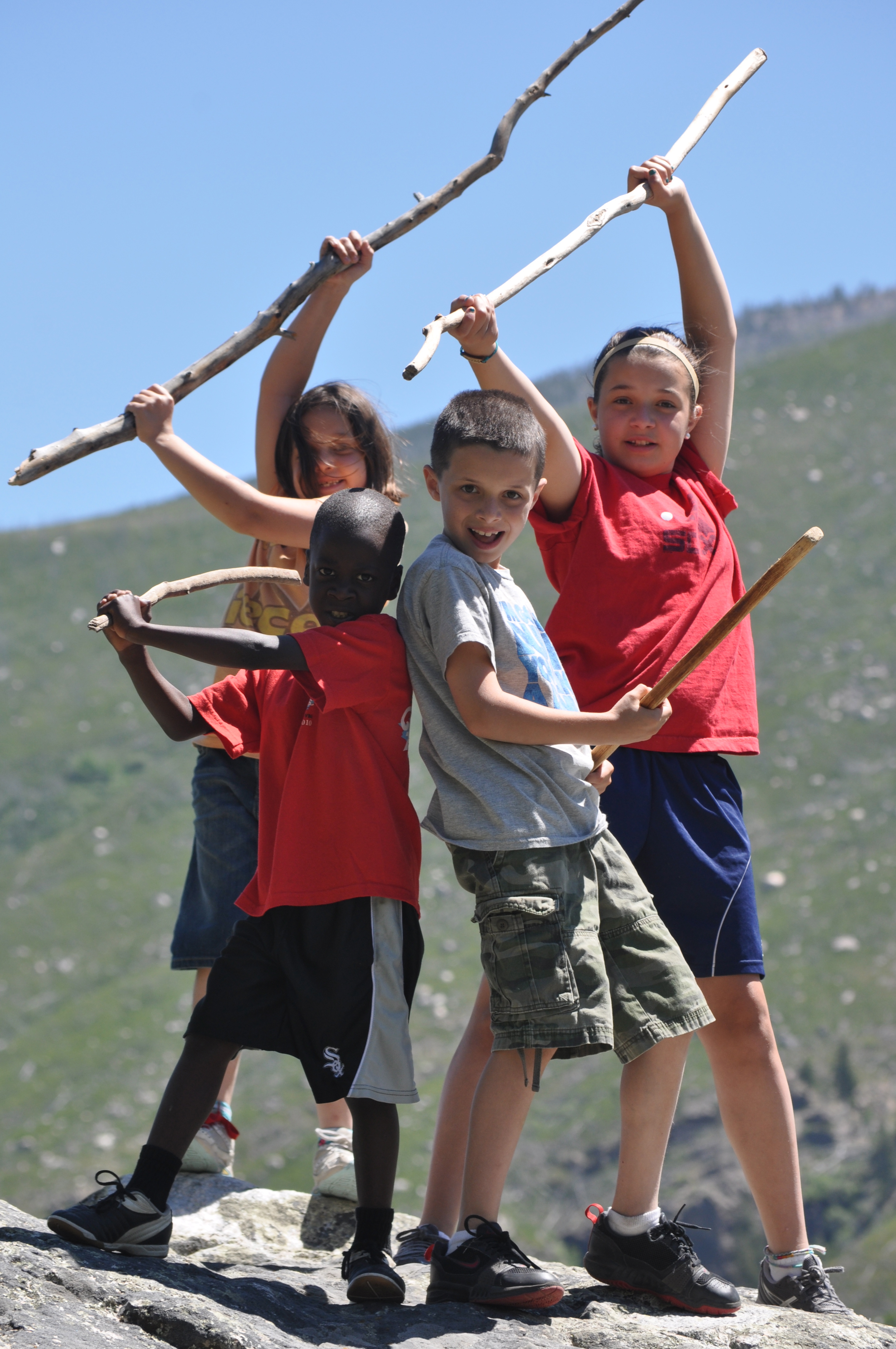
The four Underwood warriors brandishing their walking sticks before a hike in Custer National Park in Montana.

Jen

From the rising of the sun

I read yesterday’s “verse for the day” again before I flip the page: “From the rising of the sun to the going down of the same, the Lord’s name is to be praised.”

“I want to do that this morning,” I pray. “I want it to be a GOOD morning. Not a morning without problems—those are inevitable—but a morning when I keep my eyes on You, not on the problems, when I praise You with my attitude.”

But the question is HOW to do that. Because it’s not like this is a new desire. I start almost every morning listening to Scripture or a sermon, asking God to work in the day ahead.

But carrying it out—oh, yes, how to carry it out.

I suddenly remember a conversation I had with a musician friend recently about how she uses classical music to settle her young children (younger than mine) during the pre-dinner grumpies. And I get an idea: I need music this morning for ME, not for my children, for ME.

So I pull up Gungor’s latest album on my iPad so I can carry it around while we all get clothes on, fill cereal bowls, brush teeth. The kids sing along with me.

“Open your eyes, and wake up!”

Yes, wake up to the GOOD of the mundane, the gifts from God’s hands. Give Him thanks and praise for all of this.

Emily cannot find one shoe. No, she cannot find two, one each from two different pairs. “I remember taking them off in my room last night, but one of them’s not anywhere in there,” she says. I rush up to her room and find the missing shoe in under thirty seconds. My perspective falters. “You know if you’d put these in the basket where they belong, this wouldn’t happen.”

“Come back, my love. My love, come back.” It’s the song “Ezekiel,” God’s plea to wandering Israel to return to the One who rescued her from sin and shame.

It’s His plea to me as well.

I come back.

Out the door, no tempers lost, peace prevailing. I drop off the kids and drive to my school…

And remember it’s Grandparents’ Day.

I have to park way off campus.

I have on a straight skirt.

I have my bag full of papers, laptop, books.

And the real kicker: I have on heels.

I clunk down the sidewalk, cross the street, begin the long walk alongside the soccer field. My iPad still plays in my bag: “Love, love, love of mine. You have caused the sun to shine on us. Music fills our ears, Flavors kiss our lips with love divine.”

Another choice.

I lift my face to the blue sky, feel the breeze tingle my scalp. The green grass of the soccer field, just cut for the game this afternoon, beckons. I slip off my heels and head across it, the soft blades cool on my bare feet.

“Maker of it all,

You provide it all,

In You we live,

In You we move,

In You we have our being.

You’re glorious”

Yes, He is.

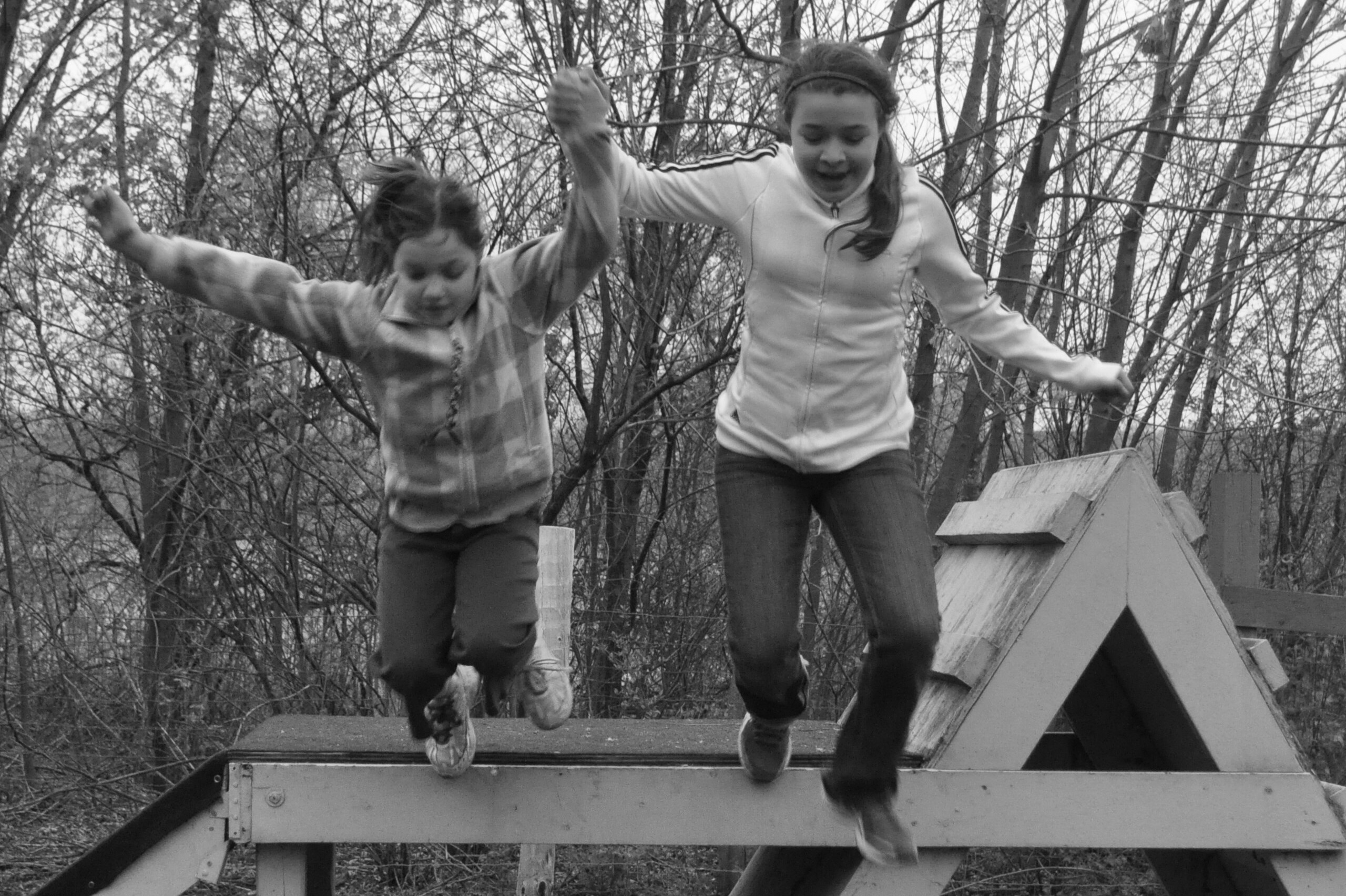
Maddie (left) and Em jumping off an obstacle at the dog park.

Chosen Impotence

NOTE: Inspired by the beautiful Easter hymns I’ve been reading this week, I revised a “poem” I wrote a couple years ago. Just think of it as word-dabbling, not real poetry. I wrote this at Christmas time after I saw my first blown-up nylon Nativity scene.

Another lawn-nativity,

This one inflated,

Blown air shaping colored cloth

Into Mary and Joseph, the wise men, the shepherds.

Hmm,

I am reminded of the Michelin Man or Pillsbury Doughboy.

But distaste aside,

The smallest blob of puffed nylon,

Decked with a curved-line smile and dots for eyes,

Is still meant to represent

My Christ.

My Christ,

How incredibly helpless He chose to be,

in the form of a baby’s helpless body,

A feeble cry the only tool He had

To summon needs and desires.

How UN-omnipotent he seems.


Winter gives way to new spring.

A different icon dots church fronts, some yards,

Fewer places than the last.

And, generally, of sturdier material.

No nylon certainly.

Yet the central subject is the same,

But isn’t.

The infant flesh is grown, and

Covers a man’s sinews, bones and muscles

Carpenter-strong.

This Christ, though, is also frail, with

Only a thin line between Him and destruction.

He dangles from punctured wrists,

Pushes on destroyed ankles to get breath,

Bleeds from head and back and side.


Another image of impotence:

He cries,

He suffers,

He dies,


The Babe and the Crucified One,

These two,

Celebrated every year.

Is this what God desires?

Could He want monuments to His vulnerability?

These are not the statues human rulers would covet,

No depictions of parade glory and iron-fisted might.

These are moments when the fallen one

Must have breathed victory in the air,

Must have thought himself powerful in comparison.

Could God, with ways higher—and deeper—

Than our own

Be unconcerned with this display of humility?

Be willing to leave us to wonder and seek

This paradox God,

His strength perfected in weakness,

His justice satisfied with the sacrifice of Himself,

His revolution accomplished by love—

With no destruction other than

the single, willing life of its leader

And the symbolic ripping of a temple cloth?


A birth, a life, a death—

A chosen impotence

Accomplishing

The redemption of mankind.

This Way, His Way

The four beautiful Del Vecchio women: from left, niece Anna, sister-in-law Cindy, niece Sarah, and niece Grace. Not pictured from their family are my brother Mike and nephew Luke. We visited them this past week for spring break and had a great time. Thank you, Del Vecchios, for hosting our crazy family.

I give the “five minutes till we need to be out the door” call, but four of us are still together in the bathroom. I stretch over Maddie, brushing her teeth at one corner of the sink, so I can lean against the mirror and dab mascara on my lashes. Beside Maddie, PJ shoves for space to spit. Behind us Em scrabbles in the “hair stuff” drawer to find a rubber band for her braid. Then Jake wanders in. I glance at his feet.

“Where are your shoes?”

His eyes go wide.

Shoes? His look says to me. Did you mention shoes?

“Jake, I’ve already asked you three times to put on your shoes!”

“Oh, okay.” He turns to go.

“But don’t you need to brush your teeth?”

He turns back. “Yeah, but you just said to get my shoes.”

“Well you might as well brush your teeth while you’re in here. Patrick, stop wiping your mouth on your sleeve. That’s gross.”

Maddie interrupts. “Mom, what’s today?”

“What?”

“What day is today?”

“Why does THAT matter right now?”

“I want to read the verse for today, and I don’t know if you’ve already flipped it.”

I hadn’t.

I’d been too rushed.

I look at my watch and tell her the date. She reads the verse aloud, “Psalm 25:4. Make me to know your ways, O LORD; teach me your paths.”

And in the fussing of Jake getting to the sink and Patrick and Maddie away from it, of Emily reaching between to wet a hairbrush, I hear the Holy Spirit’s clear whisper: “This is not My Way.”

This: the hustle-bustle that I in large part created with my impatient spirit.

This: the grasping of minutes only as vehicles to “being on time for the ‘bigger’ thing” rather than as gifts in themselves.

This: moments lived without remembrance of the Giver, without heeding what He wants me to see and learn

Suddenly they are gone and I am alone in the bathroom. I lean over the sink, finally still.

Why do I have to learn this lesson over and over? I wonder, but I look again at the verse: Make me to know your ways, O LORD; teach me your paths.

I’d read Psalm 25 recently. I know what it teaches about “His Way.”

“To you, O LORD, I lift up my soul. O my God, in you I trust… Lead me in your truth and teach me, for you are the God of my salvation; for You I wait all the day long.”

Not rushing.

Waiting.

Even in busy moments, waiting—to see God’s gifts, to see HIM. I often think of waiting as inactive, but couldn’t “waiting” be “expectation”? Couldn’t I live each moment expecting that I will see Him in it? That I will learn more about Him in it?

The psalmist did. He wrote, “For You I wait all the day long.”

All the day long!

Every minute lived in expectation that God will be in it!

THAT kind of expecting would affect far more than my rushed moments. It would cause me to “lift up my soul”—my whole being— to God. It would cause me to trust in Him as my complete salvation, my full purpose. It would lead, eventually, to what the psalmist calls friendship (also translated as “secret counsel”) with God (verse 14) and a deep understanding of God’s way—so, so different from ours.

Am I going to live this way—in the hurry-scurry of my middle-class suburbia, this way that leads so easily to a life that’s self-focused and blinded to others’ needs?

Or am I going to live His way?

One small step at a time, one moment leading to the next, listening closely and expectantly to the Holy Spirit’s whisper, trusting that all the moments—the small steps—add up to the everlasting path, the Way of Life.

His Way.

Show me Your ways, my Lord, teach me Your paths.

And then, please, help me to walk, step by step, in Your Way.

The AMEN!

“In Jesus’ name, Amen.”

I took this picture last fall, but spring is a'coming! The trees are blossoming, and there are enough shades of green outside right now they could fill a crayon box.

I’ve never thought much about that one word: Amen. It means “so be it,” and that makes sense at the end of prayer, especially prayers of praise—which is where “Amen” is most often found in Scripture. But this week I read two verses that made me want to study it more. The first is Revelation 3:14, which calls Christ THE Amen and also refers to Him as the faithful and true witness.

The second is II Corinthians 1:19-20, which says that Christ “…is always Yes. For all the promises of God find their Yes in him. That is why it is through him that we utter our Amen to God for his glory.”

So Christ is the “Yes” of God, the “So be it” of all His promises.

I get that, at least on an elemental level, knowing that there is far more to it, far more to study. Christ said, “So be it” to the entire will of God. He said, “I seek not my own will, but the will of Him who sent me.” He continually turned people’s attention to the Heavenly Father. He did not seek self glory. And in the garden and on the cross, He uttered the hardest “so be it” of all, the willingness to endure incredible agony so the Father’s will, his eternal, all-encompassing will, would “be”:

-So it would “be” here on earth like it is in heaven—that’s the prayer He taught US to pray.

-So we, too, can utter the Amen, the taking on of God’s will and the letting go of our own. II Cor. 1:20 says we can do that, that through Christ “we utter our Amen to God for his glory.”

That’s an amazing thought: we can contribute to the Father’s will being done on earth as it is in heaven simply by saying “so be it” with our tongues and our lives to HIS glory and not our own.

I write “simply by saying,” though I know there is nothing simple about it. I wrestle with laying down my desire for self-glory every day. I’ve been thinking about it for years and writing about it for months, and I will continue to do so. It’s not a “one and done,” “got that one licked” kind of sin issue. (Are any?) The desire for self glory and self control twists itself into every area of our lives and morphs into a different monster as soon as we recognize it in one form.

But there is great hope in that verse: through Christ we CAN utter the Amen. We can accept, even embrace, ALL as the will of a good God. What was impossible has become possible “through Christ who gives (us) strength.”

I got so excited about this I wrote a poem—okay, I wrote a poem because I was coaxing my sophomores to write poetry, and it seemed only fair that I should, too, but, still, this was the idea I wanted to write one about. It is an idea full of glory and worth the efforts of someone who truly is a poet (which I am not). Still, here is my scribbling on the subject:

The “Amen” chorus of

The Angels and Elders,

All of heaven

Was—oh, how glorious—

First sung by the Son.

His life of

“Thy will be done”

And death of “It is finished”

Accomplishing redemption,

Freeing fallen humans

To speak the “So be it” themselves,

To live the “Amen.”

And though mine may falter,

Hiccup,

Sometimes cease altogether,

Oh God, please

Kindle the Christ-placed urge burning deep

In my oxygen-starved cells,

Blow the Spirit breath strong

Till my lungs inflate and

Gather air for

The words,

And the life,

That speaks the truth:

So be it,

Thy will be done,

Amen.