Let me let you

dry flower 5Normal morning, but my boys’ running around/picking at each other/roughhousing scraped my nerves way more than usual, and I shot sparks like a cat whose fur has been rubbed backwards. “Can’t you take it outside?” I grumped. They subdued—momentarily. Then it all repeated, and I hollered, and they finally settled—sort of.
But my nerves were still prickling, and I could tell it wasn’t going to take much to set me off again, so after rough pecks on my boys’ cheeks and gruff reminders: “I still love you even when you’re driving me crazy, even when I fuss,” I pulled out Jesus Calling (the kids’ version) and read it aloud to all of us.
I could have stopped after the verse: “Then I will ask the Father to send you the Holy Spirit who will help you and always be with you,” but the second paragraph amped up the lesson with this: “…you may be tempted to go it alone. But that is when you are in the greatest danger. The evil one is waiting for you to let your guard down, to step away from My protection. Ask My Spirit to help you every step of the way—during hard times and easy
times.”
The kids’ ride pulled up as I read the last sentence, and they rushed out the door, and I turned to all the tasks that must get done this morning before I can sit and read and write—the other tasks that must get done before I pick up dry flower 2the kids from school and another sort of tasks begin.
I’d forgotten the lesson already. I hadn’t given it even a second to soak in, to penetrate my mood and my heart.
I zoomed from fridge to stove to sink, moving quickly, my thoughts zooming as well till I suddenly realized where my thoughts had gone.
I was bringing up little ways I felt slighted by people in my life. I was revving up to have a good old pity party, a time of “woe is me” while my physical movements would only get faster and I’d be left feeling worn out but also itchy.
Does anyone else do that?
The Spirit brought me up short—I know it sure wasn’t me—and I recognized what I was doing. Still I resisted.
Then this phrase jumped into my mind. “Let me let you rest.”
“Let me let you”?
dry flower 4The phrase stopped me. I got the first part: “Let me…” Yes, I was being stubborn. I needed to stop and let the Holy Spirit do Spirit work in my soul.
But the second part? “…let you”?
I left the kitchen, looked up “let,” and found these definitions:allow to, permit to, give permission to, give leave to, authorize to, sanction to, grant the right to, license to, empower to,enable to, entitle to.”
I bolded the ones above that made my shoulders and my will relax.
Let me let you rest.
The tasks still await me. But though my hands may be busy, my heart can be still.
I have been allowed, permitted, granted the right, empowered, enabled, and entitled to rest in the Presence of Christ.

Good works prepared: Faith Willard and Sarah Aulie

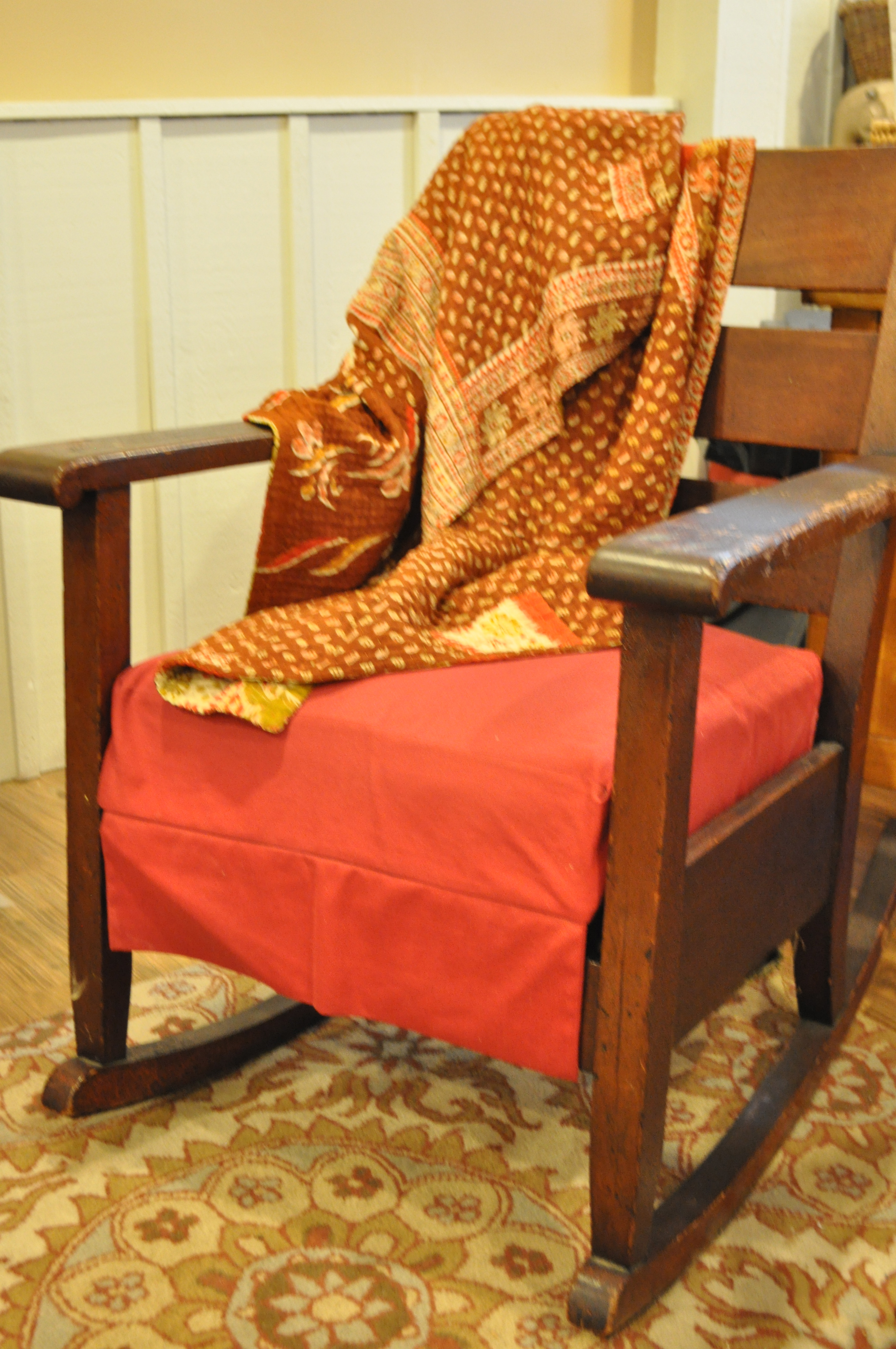
One of Hand and Cloth's beautiful blankets draped across a chair in my bedroom. They truly are lovely and would make great Christmas presents!

One of Hand and Cloth’s beautiful blankets draped across a chair in my bedroom. They truly are lovely and would make great Christmas presents!

This morning I had the opportunity to listen to Sarah Aulie (founder of Hand and Cloth, which I’ve written about before; click on the link to read about it) and Faith Willard speak at Wheaton Academy’s alumni recognition chapel. Both graduated from the Academy (50 years apart!), and Sarah, a 2000 grad, considers Faith, a 1950 grad, to be her mentor. It’s a beautiful story.

In 2007 Sarah was at a crossroads. She knew the Lord was calling her to do some sort of overseas work that would provide at-risk women with a livelihood, but she didn’t know any specifics. She asked her mother to pray for her, and her mother brought the request to the prayer group she led at Wheaton Academy. The prayer request spread to the administrative assistant of the Head of School, who maintained connections with WA alum all around the world, including Faith Willard, who’d been working in Bangladesh for more than 30 years by then. The admin assistant connected Sarah with Faith.

In 2007 Sarah flew to Bangladesh and saw firsthand the work of The Widow’s Friend, the organization Faith started in 1975 that now runs medical clinics, an orphanage, a high school, a mission/job skills training center for for widows, a school for the deaf, and a hostel for unmarried working women. Through Faith’s widespread work and connections, Sarah got a big-picture view of the needs in Bangladesh, and she became particularly interested in women who were unprotected by husbands or families. These women are often trafficked or forced to work in prostitution because they have no other options for supporting themselves and their children.

Sarah wanted to provide dignified work for these women, and when she discovered the kantha, a traditional blanket made from used sari cloth, she had an idea. She formed Hand and Cloth, a U.S.-based non-profit, to sell kantha blankets in the U.S., and partnered with House of Hope, a business in Bangladesh, to employ women to stitch the blankets.

I wrote a full article on these two women in the fall of 2012. Though I was able to interview Sarah Aulie in person, I had to talk on the phone with Faith Willard. It was a joy to meet her in person this morning and hear her words of wisdom to the students. She told them wonderful stories of God’s providence and how he has led her, time and time again, in the 65 years since she left high school. She, too, had many times when she didn’t know what she was supposed to do; she simply had an urge and a desire. She quoted Ephesians 2:10. “For we are God’s handiwork, created in Christ Jesus to do good works, which God prepared in advance for us to do” NIV (the link has NIV, Amplified, and Message versions of it alongside each other).

“He’s already gone ahead and made preparation,” Faith reminded the students–and me. “If you just have a heart to honor the Lord, that’s all he needs. He’ll go before you and prepare the way. He’s always doing that. You’ll find He’s provided all you need.”

As I listened, I reflected on how that message has continued to be true for Sarah. Sarah is now married to a Greek man and is living in Athens, which–not coincidentally–is a real hotbed for trafficking. Sarah is already looking into ways Hand and Cloth can expand its scope and provide dignified work to some of the women trapped in Greece’s prostitution trade. Just as Faith said, God has once again gone before Sarah and prepared a good work for her to do.

Sometimes it’s a lot easier to see how God is making a way for others than it is to see how He’s going ahead of us in our own lives. Faith’s message was exactly what I needed to hear this morning, and I’m passing it along in case it’s what you need to hear, too.

“Just like me”–seeking greater understanding, unity, and love

Sometimes you've got to get really close to see the beauty.

Up close, you get to see incredible beauty.

Someone recently told me about a young member of our military who shared with his mother some of the trauma he’d experienced on deployment. One time he was told to clear a building. He entered a room and discovered a man with a gun. The man moved to shoot, but the soldier was faster, and the man was killed. “We found his wife and children hiding in another room,” the young soldier told his mother.

She saw his distress and tried to reassure him, “Sweetheart, you didn’t want to kill him. It was kill or be killed. You’re not at fault.”
But he didn’t want to debate fault. “Mom, he was just like me. His wife and kids, just like me. They’re not any different.”
I don’t share that story to make any judgment on our armed forces or its members. (I’m not even making a statement on our police forces and their members, other than to say this: all our police need to have the same attitude as that young man; it should rank as a requirement well above a person’s ability to handle a weapon. I’m very thankful for the many police officers who DO have that attitude, who treat people—no matter the color of their skin or their background—with dignity and respect, but we cannot excuse those who do not).
I share that story to make this personal: I need that attitude. I need it with those in my neighborhood who look different than I or parent differently or work different kinds of jobs; I need it with the wealthy moms at my kids’ private school; I need it with the members of my own household.
But I need it, too, with those whose lives or perspectives seem so different as to be polar opposite mine.
butterflyI work with an organization that reaches out to women involved in the adult entertainment industry. Some of these women have been trafficked, but not all. The leader of our organization is adamant that we don’t make a distinction. Here’s her point: We know—through both statistics and stories—that the vast majority of the women we reach out to have really good reasons for doing what they do. When we look at their backgrounds, we think, “Yes, I can see why this looks like a viable option to them—or their only option.”
But what if that’s not the issue? What if a woman is simply involved in adult entertainment because she makes more at it than she would at another job? Does that mean I’m allowed to say, “That’s some messed-up, sinful thinking!” and write that woman off?
I don’t think so. In fact, I’m beginning to see that it’s not my right to know why a woman is in the life; it’s her decision to tell me or not, and if she does, it’s not my business to form any sort of judgment based on what she tells me. I can’t even say, “But for the grace of God, that could be me” because that still sets me apart. It makes me different. It implies they didn’t receive grace; that there was some reason I “got grace” and they didn’t. It sets up and subtly reinforces a difference between us.
I need to see and know—deep, deep down—that woman is just like me in all the ways that really matter. I’m human; she’s human. I’m broken and bent by sin; so is she. I need a Savior; she does, too.
When I talk and text with women who are in a life that looks so very different from mine, this is what I want to remember. This is what I want them to know: you and me, we’re alike in all the ways that matter.
I’ve found it interesting that the more I work with the issue of adult entertainment, the less inclined I am to write about it. Every statistic, every story, every generalization is becoming more personal for me. The women our team members talk with, text with, hang out with, pray with, eat with—they’re not statistics; they’re women.
I rarely write in-depth about my family members on this blog, and when I do, I generally don’t use their names. I don’t want them to become an example or a generalization or even simply a character. I want to protect them; I want to maintain their dignity. I want them to own the rights to their own stories.
That’s how I’m beginning to feel—and not just think—about the women I meet who are in the industry. I need to maintain their dignity as people, and they need to tell their own stories.
I’m winding through several points in this blog post to get to a final one: though I don’t write much here on the impact of the adult entertainment industry on women and on our culture or on the issue of racial reconciliation (one that is very personal for my family), that doesn’t mean I don’t care passionately about them. I’ve felt convicted of late that I don’t share this passion enough through my blog. So, even though right now I don’t plan to do more personal writing on these issues, I would like each week or so to share something I’ve encountered about these and/or other issues. The perspectives of the authors/speakers may be very different than mine or yours, but I am praying that as we read and listen, we will be able to let go of our fears of “different”; that we will empathize and step into the shoes of others; that we will be drawn into greater understanding, greater unity, and greater love.

The freedom of being a small character

flower close upI just finished Still by Lauren Winner, an author who rises higher on my favorite list every time I read another of her books. (Follow the link above to her Amazon page to see all of them.) Still is about what she calls a mid-faith crisis–the doubting, dull doldrums–and what still keeps her in the faith and allows her, ultimately, to remain still in it.

One of my freelance assignments right now is a week of devotions on the “walk humbly” portion of Micah 6:8, and I’ve been simmering in that phrase before I begin the actual writing. Perhaps that is why the quote below from Still caught my eye. Whatever the reason for my first attraction, I have returned to it several times since, and I want to share it with you. If you are wondering this day about the specific purpose of your life; if you have thought “What am I doing?”; if you’re struggling with your significance/success–or seeming lack of it; if you’re shamed by failure, this one’s for you.

“It turns out the Christian story is a good story in which to learn to fail. As the ethicist *Samuel Wells has written, some stories feature heroes and some stories feature saints and the difference between them matters: ‘Stories…told with…heroes at the centre of them…are told to laud the virtues of the heroes–for if the hero failed, all would be lost. By contrast, a saint can fail in a way that the hero can’t, because the failure of the saint reveals the forgiveness and the new possibilities made in God, and the saint is just a small character in a story that’s always fundamentally about God.'”**

That last line (emphasis mine) keeps grabbing me. A load rolls off when I sit with it. I sigh with relief and gratitude. Yes! I breathe, yes!

white flowersFather, you are the Playwright of the greatest story ever, and you’ve given me a role in it, a small but somehow still important role. This story is about You; it’s for you; it’s by You. I come to you now and ask that You would simply show me what You have for me today in this story. Help me to release the big story to You, to let Your capable pen write it. Help me to live into the part you have for me, one small scene at a time. Give me great joy in doing my best for You. Remind me that You empower me to live out my role. May my bit part–and all our parts collectively–glorify You.

Just on a whim, I did a search on the word “story” on Bible Gateway. I specifically chose The Message to search from because I thought it might use the word “story” in a symbolic sense as well as in a literal one. I wasn’t looking for anything in particular, but I found some beautiful, arresting passages. I’ve included some of them below.

“You’re hopeless, you religion scholars and Pharisees! Frauds! You keep meticulous account books, tithing on every nickel and dime you get, but on the meat of God’s Law, things like fairness and compassion and commitment—the absolute basics!—you carelessly take it or leave it. Careful bookkeeping is commendable, but the basics are required. Do you have any idea how silly you look, writing a life story that’s wrong from start to finish, nitpicking over commas and semicolons? ***Matthew 23:23-24

[ Trusting God ] So how do we fit what we know of Abraham, our first father in the faith, into this new way of looking at things? If Abraham, by what he did for God, got God to approve him, he could certainly have taken credit for it. But the story we’re given is a God-story, not an Abraham-story. What we read in Scripture is, “Abraham entered into what God was doing for him, and that was the turning point. He trusted God to set him right instead of trying to be right on his own.” ***Romans 4:1-3

I’ve preached you to the whole congregation,
    I’ve kept back nothing, God—you know that.
I didn’t keep the news of your ways
    a secret, didn’t keep it to myself.
I told it all, how dependable you are, how thorough.
    I didn’t hold back pieces of love and truth
For myself alone. I told it all,
    let the congregation know the whole story. ***Psalm 40:9-10

*The Samuel Wells link leads to a piece he wrote for The Christian Century about Bonhoeffer. It doesn’t link specifically to this topic, but it’s a really good read and what he wrote near the end of the article about Bonhoeffer’s assumptions about his own life’s “success” really do flesh out the quote above (which is not from that article).

**The quote is linked to the specific page it can be found on in the book God’s Advocates: Christian Thinkers in Conversation. It’s a Google book, so the entire thing is available for reading on that page.

***The Scripture links lead to a parallel versions (Message, NIV, Amplified) of that passage, allowing you to see other translations alongside Peterson’s work.

A Full Physical Life

On my walk this morning, I looked for evidence of death and life, side by side. I'm inserting a few of the examples I found.

On my walk this morning, I looked for evidence of death and life, side by side. I’m inserting a few of the examples I found.

The verse-of-the-day on Bible Gateway yesterday was Isaiah 46:4. “I will be your God throughout your lifetime— until your hair is white with age. I made you, and I will care for you. I will carry you along and save you” (NLT).

The phrase about white hair made it feel personal, since mine is moving progressively from pepper-and-salt to salt-and-pepper. Every time I get it cut, there are more white trimmings on the floor, reminding me that time, marching on, isn’t just changing my children’s bodies, it’s changing mine. Through my 20s and 30s I was generally able to ignore the truth that I live in a body that is decaying, a body that will eventually give up its hold on life, but now? Not so much. The knees ache when I walk down leaves near treestairs; the belly has firmly decided it likes curves better than straight planes; my head still wants to look over my shoulder, but my stiff neck vetoes the idea nearly every time. I tell my children that I exercise so I can keep up with them, but I know the time is very soon coming when their growing strength will far outstrip my failing energy.
dew on leavesThat’s, honestly, a little sobering. My husband, parents, siblings, friends–we’re all on the downhill side of life’s timeline. Diet and exercise can only do so much, can’t actually stave off the inevitable (no matter what Tony Horton says). But God remains the same. Yesterday, today, forever, 50 years ago, next week, a millennium hence–no change. The Amplified translates Isaiah 46:4 this way: “Even to your old age I am He, And even to your advanced old age I will carry you!  I have made you, and I will carry youBe assured I will carry you and I will save you.”
ok--this one doesn't exactly fit what I was looking for--but these blossoms were so intricate!

ok–this one doesn’t exactly fit what I was looking for–but these blossoms were so intricate!

The spiritual meaning of that verse is beautiful and truer than its physical meaning. But yet I take great comfort in knowing that when I am reduced to hobbling, to sitting, to a curled-up lying on a bed–He will carry me. He will be with me. He will continue the work He has begun in me and through me. I will not be useless–because of Him.

I take great comfort, too, in the assurance that He will save us from these decaying bodies. Near the end of summer I learned of the deaths of a high school friend and a former student at the school where I work. In the midst of grieving, we take comfort in knowing they are spiritually and emotionally alive with a fullness we cannot conceive.
It is an incredible comfort to know they are physically alive as well. They left behind their old byellow on brownodies–bodies that were gradually dying. With Liz‘s cancer battle, this was obvious, but even though an accident took Chase’s life in the full prime of young womanhood, both were dying well before the cancer diagnosis and the accident drastically sped up the process. But NOW they are in fully alive bodies that don’t contain even a hint of death. When their loved ones are reunited with them, they will recognize them physically!
I came that you might have life,” Christ told us–tells us. Spiritual life–yes! But also physical–in bodies that will be continually renewed–that will LIVE in ways we’ve never experienced.  No aches, no pains, no fear of sickness or illness or death. No slowing down, no shortness of breath, no enhanced sense of gravity! Just life, pure, abundant, full, never ending, always flowing.
He is and will be our God–carrying and saving us through this lifetime. He is and will be our God, our source of life, for all eternity.
                                                                                      Here’s to LIFE.

I’ve got a post up on the Redbud blog

flower closeupI’ve got a post up on the Redbud blog today. “The Myth of Mediocrity” appeared on this blog a while back, so it may sound familiar if you’re a longtime follower.

While you’re at the Redbud blog, you may want to check out some of the other posts, all written by my fellow Redbud writers. There’s some really amazing and encouraging stuff there–and if you’re a writer, helpful writing advice as well.

Thanks for reading–I’m praying today for all those who read this blog. This very day may you see the Lord more clearly, love Him more dearly, and follow Him more nearly.

Grace and peace,

~Jen

Going on a supernatural carpet ride–Psalm 95

All the life--on one dead log!

All the life–on one dead log!

I’ve been reading Psalm 95 regularly these last few weeks. I’m not sure how I landed on that particular psalm. It’s not one that has special connection with my current life events, and it’s not a really well-known psalm (other than its phrases about being “the sheep of his hand”). But I’ve still been drawn to it, to reading it at the starts and ends of my days. It’s a divided psalm, beginning with praise for God’s care and creativity and then abruptly shifting to warning.

All the life--inside one dead log!

All the life–inside one dead log!

I read it really late last night, when I was very tired, and I imagined myself kneeling on a prayer carpet, doing exactly what the psalm says–praying, thanking, and praising God–making the “joyful noise” it refers to. As I read the next verses, which give the image of our great King holding the deep places in his hands, forming the dry lands…, I imagined the prayer carpet rising in the air (hmm–a supernatural prayer carpet!) and visiting these places the psalmist mentioned. First it took me to the “deep places,” to caves filled with glowing stalactites and flashing jewels. Then it swooped up, up, up to the highest mountains, to peaks covered in snow and massive rocks, balanced one on top of another. Then it was down, down, down again, through the waves of the sea, swimming alongside great creatures of the deep. It then rose to the shallows, swooping in and out of beautiful coral beds. Finally, breaking through the surface, the carpet swept inland, to where the great hand of God was forming hills and valleys, scooping out canyons and sweeping flat the plains.

After “seeing” all that, I was in awe and so ready to shout the next verse: “Oh come, let us worship and bow down, let us kneel before the Lord our Maker.”

The carpet moved again, taking me over a gentle valley, where contented sheep grazed and lambs played, all under the watchful eye of a wise, careful Shepherd. I read, “We are the people of His pasture, the sheep of His hand.” The God who created the massive, sweeping universe I’d “seen” on my carpet ride cares specially for us, the small, the weak, the foolish. The same hand that scooped out valleys and fashioned the tallest peaks clasps our heads to His chest, holds us close, carries us next to His heart.

The carpet jerked then, unsettling me from my imagination. It dropped to the ground with a thump, and the next words came strong and firm. “If only you would listen to his voice today! The Lord says, “Don’t harden your hearts as Israel did at Meribah, as they did at Massah in the wilderness. For there your ancestors tested and tried my patience, even though they saw everything I did. For forty years I was angry with them, and I said, ‘They are a people whose hearts turn away from me. They refuse to do what I tell them.’ So in my anger I took an oath: ‘They will never enter my place of rest.’”

The carpet was gone. I was left to ponder this warning that did not seem to fit with what I’d seen and read before. And then I understood–at least part of it. The Israelites, too, were given a supernatural carpet ride. In the ride of my imagination, the laws of gravity and my lungs’ need for oxygen were suspended, but the Israelites truly experienced the supernatural. Through all the plagues in Egypt, the pillar of fire in the wilderness, the Red Sea crossing–God had made Himself and His power known. They’d seen, felt, and experienced the reality of God.

Yet they still hardened their hearts.

The warning–coming directly on the heals of praise–is necessary because I, too, am fully capable of hardening my heart, even after I’ve experienced a “supernatural carpet ride” kind of time. I’ve had quite a few of those times when God has broken into my life in extraordinary ways, going before me, leading me as a cloud by day, a pillar of fire by night. He has opened up my way at times so it is as if I have walked through a sea on dry ground, the walls of water piled up on either side.

Yet I still doubt.

“Listen to my voice today! Don’t harden your heart!”

I must remember the awe and wonder. I must stay there.

I must return, if need be,

And experience the rest of the pasture.

p.s. I used the Amplified version of Psalm 95 in some spots above and the NLT in others. The link at the very top of the post takes you to a side-by-side of those two translations.

Catechesis

I took this picture when I was at Westminster Abbey in January--this is etched on the outside of the entrance.

I took this picture when I was at Westminster Abbey in January–this is etched on the outside of the entrance.

Q: What is the chief end of man?

A: To glorify God, and to enjoy Him forever.

When one of my Bible teachers at the small Christian school I attended as a child introduced me and my classmates to the Westminster shorter catechism, I knew none of its history. I remember, even then, being a little surprised. I thought of catechism as a “Catholic thing,” something from my father’s Italian, Bogota, New Jersey childhood, and it was unexpected at my fundamental, non-denominational school in the deep South in the late 70s.

But there it was.

I don’t remember how long we studied it, but that first question-and-answer set stuck with me. “What is the chief end of man? To glorify God, and to enjoy Him forever.” I don’t know that I thought much about its meaning in childhood, but when I was an adult, and the phrases jumped into my head one day, I was shocked by the second part of the answer. My upbringing completely supported the idea that my supreme goal in life should be to glorify God…

But to enjoy Him?!

I didn’t have the first idea how to go about that, but still–memorized in youth–the phrase stayed and popped up again in surprising moments.

That’s what catechism and liturgy are supposed to do (well, one of the things); they’re supposed to stick. Even when they have become rote, they do not lose their power; they are just hidden, waiting for the time when you are ready to receive the meaning and the Lord’s work.

Several years ago, while working for the marketing department at a small college, I wrote a news release about one of the Bible professor’s recent publications, an article on the Puritan pastor Richard Baxter’s use of catechism to ground young people in the faith. I thought it was fascinating, and I remembered that article when I recently ran across an archived piece at Christianity Today by J.I. Packer and Gary A. Parrett titled “The Lost Art of Catechesis,” It gives a great history of catechesis and some wonderful arguments for using it more intentionally now.

So, if you are interested in exploring some catechisms for yourself, I’ve included some options below.

To Be a Christian: An Anglican Catechism

A Baptist Catechism

Westminster Shorter Catechism

New City Catechism (adapted by Tim Keller and Sam Shammas from the Reformation Catechisms

Harmony restored

I chose this picture (taken recently at the dog park early in the morning) because it's beautiful for one thing and it also gives me a visual of unity. All the lines of the web meet and lead to the center.

I chose this picture (taken recently at the dog park early in the morning) because it’s beautiful and because it also gives me a visual of unity. All the lines of the web lead to the center. Not one tries to move off in its own direction.

It wasn’t major, simply one of those fairly normal interactions that often happen when families are trying to get out the door in the morning. She wasn’t happy with this. She wasn’t happy with that. She made a face at one thing and groaned at another.

And when we got in the car and she made one more slightly snarky comment, I shot back.

I regretted it the minute the words left my mouth.

Actually, it was one word in particular I regretted… Oh, I thought, that could sting.

I wanted to apologize, but that very second, the car door opened, and the rest of the crew tumbled in.

I prayed the entire way to church. Lord, give me a chance alone with her to say I’m sorry, to say I was wrong. And, somehow, please, restore this break I created in our relationship.

I dropped everyone off at the door and parked, still praying for an opportunity before church began. I couldn’t sit through an entire service with that rift between us.

But they were still in a clump when I entered, and I had to check one into children’s church. Then another asked me a question as we walked toward the sanctuary. We were getting closer, closer; our group was straggling into a line. I fell into step next to her.

Finally, right outside the doors, it was just the two of us. “I need to talk to you,” I told her, and we stepped aside.

I apologized, and then–what grace–she did, too.

We walked into our sanctuary with our rift repaired and our bond re-affirmed. The opening notes of “Behold Our God” accompanied us to our seats, and I sang with gratitude about the majesty of a God who is great enough to hold the oceans in his hands, whose voice makes nations tremble, who needs no counsel from anyone…

Who, despite being incredibly magnificent and powerful, so obviously cares about my relationship with my daughter. In the same moment that He dealt with world powers and stars and universal affairs, He also thought it a priority to heal a relationship between two individuals.

Amazing! I shook my head at the wonder of it.

We sang the “Gloria” next, the beautiful song we sing many Sundays that honors the Father and the Son and then ends with the unity of the three-in-one. As we sang, “Jesus Christ, with the Holy Spirit, in the glory of God the Father,” awe of the Trinity washed over me anew. THIS is why God cares about the harmony not only of the vast universe but also of our families. The Trinity is why God cares about each and every relationship we have. This is why He longs for unity in the Church and peace on earth.

O God, you made us in your own image and redeemed us through Jesus your Son: Look with compassion on the whole human family; take away the arrogance and hatred which infect our hearts; break down the walls that separate us; unite us in bonds of love; and work through our struggle and confusion to accomplish your purposes on earth; that, in your good time, all nations and races may serve you in harmony around your heavenly throne; through Jesus Christ our Lord. Amen. (the Book of Common Prayer, “For the Human Family”)

God is Good-Elizabeth Brown Bogart

God is good—all the time. All the time—God is good.

I’ll be honest, this phrase generally sounds a little rote and, well, hokey, to me, especially when it’s proceeding from the mouth of someone not particularly touched by suffering in that moment.

But when a suffering woman says it, over and over, during cancer treatment, after one negative prognosis after another, when she’s been diagnosed with yet-another life-threatening disease that renders her unable to breathe on her own, and then, then, as she sinks closer and closer to death…

When THAT woman keeps saying the phrase—it’s incredible.

Truly awesome.

And it makes me believe even more strongly in the God Elizabeth Brown Bogart served because she would not have been able to say it again and again this past year and even as her heart beat its last slow thumps, if it wasn’t true.

He is Good—

All the suffering, loving, hoping, despairing, mourning, dying time.

I haven’t seen Liz since high school, but we were Facebook friends, and when I learned of her cancer diagnosis a year ago, I subscribed to receive her Caring Bridge updates. She was older and wiser but the same true Liz I’d known nearly thirty years ago, with a wit and blunt-edged sarcasm that could discern the hilarity in nearly every situation. I cried and laughed through many of her journal posts, and I cheered for her just a little over a month ago when it seemed like she would be able to enter a drug trial that would target the particularly twisted kind of cancer cell she harbored in her body. I groaned a couple weeks later when I learned her lungs and heart were failing.

And I’m mourning now, both with and for the friends and family who know her far, far better than I do.

All the stories shared on Facebook in the last 24 hours remember a spunky, sassy woman who lived and loved till she dropped—and then some. A few days ago she said something like this: I’m not sad for myself. I’ll be okay. But I am sad for all of you. Because—let’s face it—I’m pretty awesome. I laughed through my tears when I read that one.

This morning I prayed for Liz’s husband and her two small children and her family and friends and coworkers—all those people who will have a very real gap—a gaping hole—in their world, who will count the coming days, months, and even years with the phrase “since Liz died.” Then I turned on my computer and opened up Bible Gateway.

This was the verse of the day:

If we live, we live for the Lord; and if we die, we die for the Lord. So, whether we live or die, we belong to the Lord.

Liz is living in that full belonging now.

God is Good.