Remember, remember, remember

Another guest photo! Since Judy is taking a media arts class, she’s been using the camera to take some very fun shots, like this one of our kids plus a couple extra enjoying the trampoline.

The entire Old Testament can be summed up as a recurring cycle of creation, fall, redemption. It starts with the capital-C Creation: the first, tragic fall, and then the redemption promised by God in chapter 3. The cycle is repeated on big levels—the creation of the nation Israel, its refusal to enter the Promised Land, God’s raising up Joshua as a triumphant leader—and on individual levels–Abraham receives the promise of a son, he lacks trust and has Ishmael by Hagar, Isaac is miraculously conceived and born.

When you read large chunks of the OT at a time, you get the feel that God is constantly having to remind His people of His faithfulness. He recounts their history to them time and time again, through songs, through the speeches of prophets, through annual celebrations and feasts, through rituals and sacrifices. Over and over they are reminded that they failed, God disciplined, they cried out, and God redeemed. The message is this: trust Him so the cycle does not repeat.

Things change in the New Testament, as the biggest redemption story of all is told. Through Christ’s work on the cross, those trusting Him are redeemed for all time. No further sacrifice is needed.

Yet, on a smale scale, I still see the OT cycle in my own life. God creates new work in me, yet I become complacent or proud or angry or distant, and God must draw me near again.

Just like the Old Testament Israelites, I need constant reminders of God’s faithfulness so I don’t continue to repeat this cycle. Recently I read Psalm 78, one of those lo-o-o-ng reminder Psalms that reviews Israel’s history from Jacob to David, and it gave me the idea of reviewing my own history with God. I don’t have as much to look back on as the Israelites—or as much as the 70 and 80-something saints I’ve been interviewing lately for Wheaton Academy publications—but at age 42 I’ve had a good 25-plus years of walking with God, and He’s revealed Himself to me again and again.

So here’s the beginning of my own Psalm 78, starting when I was 16:

-When I was 16 I led a kids’ Sunday School class in a downtown federal housing project. One of the older kids from the project—his name was Peanut—was my guide, taking me safely through the project, telling me which sections not to enter as I gathered children each week. I remember praying as I walked, for my own safety and for the wellbeing of the kids who lived there. I knew the presence of God as I walked there.

-I was 17 when I first experienced a time when the Lord gave direct leading. I just knew I was supposed to go to Grace College, 11 hours from home, sight unseen, without knowing a single other person going there.

-Near the end of my junior year in college, Dave and I, engaged at the time, broke up after dating for 2 ½ years. I set my ring aside, spent a lot of time alone (he did, too), and came to a point at which I could truly say, “Lord, I love You first. To marry this guy or stay single—I’m waiting to hear from You.” Though that was a difficult time, it was truly a sweet time—maybe the first time I can remember losing a sense of time and place with the joy of fellowshipping with God.

-My first teaching job at a public middle school in Warsaw, Indiana, the tiny, misfit youth group Dave and I started during those years, the mission trip we took together to Argentina—there are so many ways I remember God leading and directing and teaching me during these years.

-In 1998 we knew we were supposed to go—somewhere. I remember filling out the application for overseas teaching and looking at this question: Are you willing to go anywhere God wants you to go? Well, what do you say to that? I originally wanted to go to a Spanish-speaking country, but God made it very clear we were supposed to go to Okinawa, Japan.

-When I went to the doctor in Okinawa to confirm my first pregnancy, he looked at the ultrasound and counseled Dave and I to expect a miscarriage. Separately we were both given the same verse to hold onto—“You keep him in perfect peace whose mind is stayed on you, because he trusts you”—and we went back to the next doctor visit sure that, no matter what the outcome of the visit, God would give us peace and comfort. Emily is the result of that pregnancy!

-We returned in 2000 and went through a difficult time of doubting that we were supposed to be back in the States. God reassured me so abundantly of His love during that time that I began to rethink how I viewed God, comparing my thoughts of Him with the way He is revealed throughout Scripture and in the person of Christ, learning to think “rightly” of Him.

I’ll pause here so the blog entry doesn’t run too long—maybe part two will be my next entry. Writing this has been a wonderful reminder to me that God has revealed Himself to me over and over—and these are just the “big” ways; there are too many small things to include in between all the “big.” Maybe you want to write your own Psalm 78—or if you don’t feel that you can, ask God to help you see the ways He is working in your life.

Thanks for reading—hope it was helpful.

Jen

opportunities

Philip from Uganda preached in church yesterday. His message beautifully translated across cultures and accents. At the end of it, Judy, the older of our international students, turned to me and said, “I really liked that. I understood it.”

His focus was all about how our salvation does not, cannot rest in our works but only in our faith in the work of Christ.

Ironically, though, I left a little discouraged.

Philip is an evangelist. That’s his gifting. I’ve known that for a long time, ever since I walked streets in Uganda with him when I was working on Patrick’s adoption. I watched conversations between him and others go straight to Gospel without the other person feeling coerced. During his sermon yesterday, Philip told of how he is using this gift on Chicago’s transit systems. He prays for opportunities, he sits next to people on the Metra or El, and pretty soon he has their history with God (or lack of it) and he’s sharing about Christ.

After the main service, I talked with Ray, one of my oldest friends in our church—really, he’s in his late eighties, with grandchildren almost my age. He shared some of his latest conversations with me. Ray’s always had a “gift for gab” (as my mom says it), and in retirement he began walking the Prairie Path every day and stopping total strangers to ask if he could pray for them. In all the years he’s done this, only two have ever told him no. More often people tell him their struggles or their life stories and thank him for praying.

I left church knowing that Philip was headed to the train station and Ray to the Prairie Path—and probably both would have Gospel conversations with a total stranger before the day was out.

I left knowing that I probably would NOT have one of them.

I grew up always feeling vaguely guilty about not enjoying sharing the Gospel on street corners or with salespersons. I used to beg God for boldness, for opportunities. I reviewed conversations I’d had with acquaintances or unbelieving friends, trying to find spots at which I could have turned the conversation toward God, beating myself up for “failing” to witness.

About seven years ago I joined an ongoing writing workshop class. Almost none of my classmates would have called themselves “followers of Jesus.” I watched and listened a lot the first couple of classes, and then my guilt set in. I began praying for boldness and opportunities as I drove to class. I didn’t hold back when people asked about me—answered with “Christian school teacher, husband teaches Bible,” but no “opportunities” opened up, though I had plenty of conversations. Then, one day on the way to class, the Holy Spirit interrupted my frantic praying. “Be quiet. Wait. Listen. RELAX!”

Really? I couldn’t believe what I was hearing. But I tried it, began to listen more than talk, began to learn about people’s lives. I focused on giving really good critique and willingly took the advice of others about my writing. I worked on excellence in my writing and humility in my attitude.

A year or so into the workshop I considered many of the other members to be friends. One night, as we chatted late after class, one of them said, “You talk about God so naturally, Jen.”

What?

“I do?” I asked her.

“Yeah. You’re always talking about the things you’re learning, what He’s teaching you.” She saw the look on my face and hurried to say, “No, it’s okay. That’s what I mean. It doesn’t seem forced. It’s just part of you.”

Thankfully I was grateful rather than proud—amazed more than anything. I didn’t realize that had happened! God had made me comfortable with these people, had knitted friendship between us. He’d put love in my heart for them. He had done the work; I had just listened. So though I still prayed for them on my drives to class, it was no longer forced but natural, with concern, specific to their needs. God did that, not me. Even now, though it has been years since I’ve seen many of them, I still pray for them, not out of duty but out of love.

God brought all this to my mind in the middle of my guilt yesterday, in the middle of my comparing myself with Philip and Ray. It was a good reminder. I DO want to pray for boldness and for opportunities, but I need to do so with rest, with confident trust that He will provide both, and that the opportunities He has picked out for me are especially chosen to use the ways He’s gifted me. My opportunities may not make for great stories, but they still testify of His Gospel work and His redemption—both in other people AND in me.

And speaking of my different kinds of opportunities, at one point yesterday afternoon, I realized that, somehow, Judy and I were home alone together (Dave had carted the younger ones along to Em’s soccer practice and Kelly was still at the b-day party). I sat down next to her at the dining room table (aka the “homework table”) and asked, “How are you?” We talked without a single interruption for thirty minutes, about relationships, adjusting to four siblings, all the “new” that she and Kelly have encountered in the last seven weeks, small ways we can accommodate and care for each other better. “You know,” I told her, suddenly seeing truth in that moment, “this is grace! We have eight very different people all lumped into a house together. It’s God’s grace that we actually desire to grow in relationship with each other, that we want to love each other well.”

Oh, I have opportunities all right. They may look different from Philip’s and Ray’s, but that’s okay.

I just need to see them for what they are.

And I need to celebrate the work God is doing in and through me.

absolutely no connection with the blog topic–but I liked how the light shone through the glass.


“blankets handmade by women. women handmade by God.”

“Blankets handmade by women. Women handmade by God” is a phrase used by HandandCloth.org to describe the kantha blankets they sell and the  Bengali women who make them. These women would otherwise be in very at-risk environments but have been rescued and given the opportunity to make a healthy living, hear the Gospel, and grow in faith in Christ.

These are some of the prayer cards that Sarah gave me today. Twenty-six women work at Basha (the company in Bangladesh), and one is featured on each card with her prayer requests.

I had the privilege today of hearing Sarah Aulie, a Wheaton Academy alum, describe this work and how she came to be doing it–a wonderful journey that seemed winding at the time but now, on looking back, was extremely purposeful. She showed us one of the beautiful kantha blankets she sells and shared the stories of four of the women who make them at their business in Bangladesh. If you would like to learn more about this wonderful ministry (or “business as mission,” as Sarah describes it) that offers “work and Word,” “livelihood and Life,” visit the web site at http://www.handandcloth.org. And if you want to get a jumpstart on Christmas presents, the blankets are each one of a kind and beautiful.

That’s more like it

“Mommy, your skin is so soft right here.” It was bedtime and I was lying down next to Maddie, one of my eight-year old twins. She was rubbing the skin between my collarbones with her forefinger. “It’s all wrinkly.” She moved her finger up to my face. “And there are wrinkles here.. and here…”

Eight is an interesting age. They’re savvy enough to “get” much of what the older kids and Dave and I say, but they have very little sophistication about what to say–or not say–themselves. The other day Jake told Maddie that her face was “chubby.” It took Judy, Kelly, and Emily to explain to him why Maddie didn’t like that. “Don’t ever say anything negative to a girl about how she looks,” Judy told him. “You could scar her for life,” Kelly added. And I told him that my face was chubby when I was eight, too.

Dave and the boys with Papa, Dave’s dad. What a cute bunch of guys!

Emily just punched him.

“Ow,” Jake said and then defended his comments.”But I like her face. I wasn’t trying to be mean.”

“And it is chubby,” he added.

Jake is our early riser. On school mornings he comes down to the basement, where I am working out, and he curls up on the couch and reads. Every once in awhile he glances up to see what I’m doing. Last week he told me, “Mom, you’re not lifting your knees nearly as high as the people on the video.”

“Do you want to get out here and show me how it’s done?” I immediately regretted my sarcasm, but it was okay because it was lost on Jake. He paused and then said, “No,” before looking back at his book.

Doggone it, I was trying my hardest NOT to lift my knees higher after that, but I must have caved into the pressure because, a few minutes later, when I was back into the high knee part of the cycle, he looked up again and said, “That’s more like it, Mom.”

Unmindful

I’m thankful for Patrick, who rejoices so easily in the gift of life. I’m thankful, too, for Judy, who took this great picture.

Late one night last week I read an article by Thomas Lake in Sports Illustrated:“The Boy They Couldn’t Kill.” It tells of a grandmother, Saundra, caring for her daughter’s son, Chancellor. Chancellor has cerebral palsy because his father, a former NFL football player, shot his mother when she was pregnant with him. The baby lived; the mother died.

You can see why I stayed up to read it.

Both Chancellor and his grandmother have heroic forgiveness and courage because Saudra has lived out for Chancellor the faith she learned as a young child. Writer Thomas Lake describes how she was taught to trust (be prepared; it’s beautiful writing): “What she learned… was an overwhelming sense of gratitude for life. The sense that you don’t wake up unless God opens your eyes, don’t see the rising sun unless God pulls it from the horizon, don’t put food in your mouth unless God helps you hold the fork. And you do all these things and you rejoice.”

I fully suggest reading the entire article (publication info follows this entry), but I want to focus on that quote, because it brought to mind a verse I’ve been thinking about for weeks, ever since I finished Deuteronomy. Moses is speaking his last words—and a lot of them—to the Israelites. He sings a song that reviews their history as God’s people: how God has always been faithful and they have often strayed. He says this: “You were unmindful of the Rock that bore you, and you forgot the God who gave you birth.” (Deut. 32:18)

Unmindful.

What a word! It’s the opposite of Saundra Brown’s attitude. That convicts me! How often do I wake up unmindful? How often do I walk through a day unmindful?

“In Him we live and move and have our being.” Paul said this to the Athenians, introducing them to the God who was far more personal and near than the ones their own poets wrote about.

I lose sight of this, that without Him I have no existence. My very be-ing—and my self-awareness of it—is a gift from a Creator who is big enough to give me, His creation, a sense of autonomy and the choice to either live in acknowledgement of Him or pretend I am responsible for it myself. That’s HUGE—to allow the creations over which He has ultimate and complete control to turn their backs on Him. That’s unfathomable to humans because we’re not big enough to do that.

So I have this choice to be unmindful (though that choice alone should give me greater awe for Him), yet there are consequences to unmindful-ness. Yes, the air is still available, and the lungs take it in, and the heart beats its exactly right number of beats per minute, and the oxygen-bearing blood flows through veins and capillaries to pinky toes and brain cells alike and then, at just the right time, back through arteries to the heart. But even though all these miracles happen—and they happen even in unmindful-ness—this is not true life. This is not what Christ called “life eternal,” meaning the life which does not end with the dying of brain cells or the stagnation of blood, meaning the life that goes on and becomes even more glorious when the body dies.

In unmindful-ness we are, in effect, walking corpses. Years ago, on a mission trip, I asked a pastor friend to describe his fervor for the street evangelism I found so difficult. “I see dead people,” he answered—long before Sixth Sense hit the big screen. When life is not linked to the One who gave it, when it is not lived in gratitude to Him, with ever-increasing knowledge and acknowledgment of Him, we’re not alive. Zombies, that’s what we are.

The Amplified version of John 17:3 says it well: “And this is eternal life:  [it means] to know (to perceive, recognize, become acquainted with, and understand) You, the only true and real God, and [likewise] to know Him, Jesus [as the] Christ (the Anointed One, the Messiah), Whom You have sent.

Amen.


“The Boy They Couldn’t Kill” Thomas Lake, Sports Illustrated, September 17, 2012 issue

‘Tis so sweet

Confession: I am a bathroom reader. It’s a combination of my love for reading, my desire to redeem all the little minutes :), and the discovery I made as a young mother that the bathroom can be a RETREAT! I rotate books in the bathrooms. As I finish one, another takes its place, but one book has taken up almost permanent status. It’s the One Year Book of Hymns, which features hymn lyrics each day and either the background story of the hymn or a devotional based on it. It’s a great book that I read just about every day (at the bottom of this post you’ll find two links: the FB link is to a page that posts the lyrics/devotional each day as well as a performance of the hymn; and the Amazon link is just in case you want to buy it!).

Every once in a while, I get intrigued enough by the background that goes with the hymn that I do more research on it, and the story usually ends up on my blog. If I begin blogging more regularly–one of my goals–this might become a weekly feature. Today’s story is about Louisa Stead and her hymn, “‘Tis So Sweet to Trust in Jesus.”

Born around 1850 in England, Louisa moved to the United States when she was 21. She attended a revival meeting and felt the Lord was calling her to mission work, but her health kept her from China, where she wanted to go. She married, and a year later the couple had a daughter, Lily. When Lily was four years old, the family went to the seashore for the day. As they picnicked on the beach, they heard a young boy calling for help out in the water. Louisa’s husband swam out to help, but the boy pulled him under and Mr. Stead drowned (some accounts say the boy died as well).

Louisa was left not just as a grieving widow, but as a poor mother with no family in the States to lean on. One morning, with no money left and no food in the house, she opened her front door and found both food and money on the doorstep. That day she wrote the words to “‘Tis so Sweet to Trust in Jesus.”

  1. ’Tis so sweet to trust in Jesus,
    Just to take Him at His Word;
    Just to rest upon His promise,
    And to know, “Thus saith the Lord!”

    • Refrain:
      Jesus, Jesus, how I trust Him!
      How I’ve proved Him o’er and o’er;
      Jesus, Jesus, precious Jesus!
      Oh, for grace to trust Him more!
  2. Oh, how sweet to trust in Jesus,
    Just to trust His cleansing blood;
    And in simple faith to plunge me
    ’Neath the healing, cleansing flood!
  3. Yes, ’tis sweet to trust in Jesus,
    Just from sin and self to cease;
    Just from Jesus simply taking
    Life and rest, and joy and peace.
  4. I’m so glad I learned to trust Thee,
    Precious Jesus, Savior, Friend;
    And I know that Thou art with me,
    Wilt be with me to the end.

Louisa’s trust in Jesus continued to grow. With her health improved, she moved with Lily to South Africa, where she served as a missionary and met and married Robert Wodehouse. When Louisa had more health problems, they returned to the States for some years, during which Wodehouse pastored a church. When Louisa was better, they went to Rhodesia, where they served until 1911, when Louisa’s health forced her to retire from active work. She lived in Rhodesia until her death in 1917. Her fellow missionaries wrote this about her:

We miss her very much, but her influence goes on as our five thousand native Christians continually sing this hymn in their native language.

She trusted Jesus’ promises “to the end,” and she passed on this faith to her daughter, Lily Stead Carson, who, with her husband, also served as a missionary in Rhodesia.

LINKS:

http://www.facebook.com/The.One.Year.Book.Of.Hyms.Daily.Devotional

http://www.amazon.com/s/?ie=UTF8&keywords=one+year+book+of+hymns&tag=googhydr-20&index=stripbooks&hvadid=2768348161&hvpos=1t1&hvexid

6 word gospel memoirs, continued

I have this beautiful “flower” (I don’t really know what it is) in my yard. It looks a little like a heart, which makes me think of another 6-word memoir: God’s heart for me revealed: Christ.

Earlier this week (September 17) I wrote about 6-word memoirs and how they can show the gospel at work in our lives. Here are a couple of 6-word memoirs that readers sent in: “Saved by grace, continuing the journey” and “God found me. I am alive.”

The following quotes aren’t limited to six words, but they are great statements about the gospel. I kept finding more and more I liked, so I got a little carried away with the number I pasted in. Hope you enjoy them, too!

“There are only two ways that God’s justice can be satisfied with respect to your sin. Either you satisfy it or Christ satisfies it. You can satisfy it by being banished from God’s presence forever. Or you can accept the satisfaction that Jesus Christ has made.”
― R.C. Sproul, Choosing My Religion

“The gospel is not a doctrine of the tongue, but of life. It cannot be grasped by reason and memory only, but it is fully understood when it possesses the whole soul and penetrates to the inner recesses of the heart.”
― John Calvin, Golden Booklet of the True Christian Life

“The Law saith, Where is thy righteousness, goodness, and satisfaction? The Gospel saith, Christ is thy righteousness, goodness, and satisfaction.”
― Patrick Hamilton

“If the gospel is old news to you, it will be dull news to everyone else.”
― Kevin DeYoung

“Salvation is not a reward for the righteous, it is a gift for the guilty.”
― Steven Lawson

The gospel is this: We are more sinful and flawed in ourselves than we ever dared believe, yet at the very same time we are more loved and accepted in Jesus Christ than we ever dared hope.”
― Timothy Keller

“Never be content with your current grasp of the gospel. The gospel is the life-permeating, world-altering, universe-changing truth. It has more facets than a diamond. It’s depths man will never exhaust.”
― C.J. Mahaney

the value of a hank

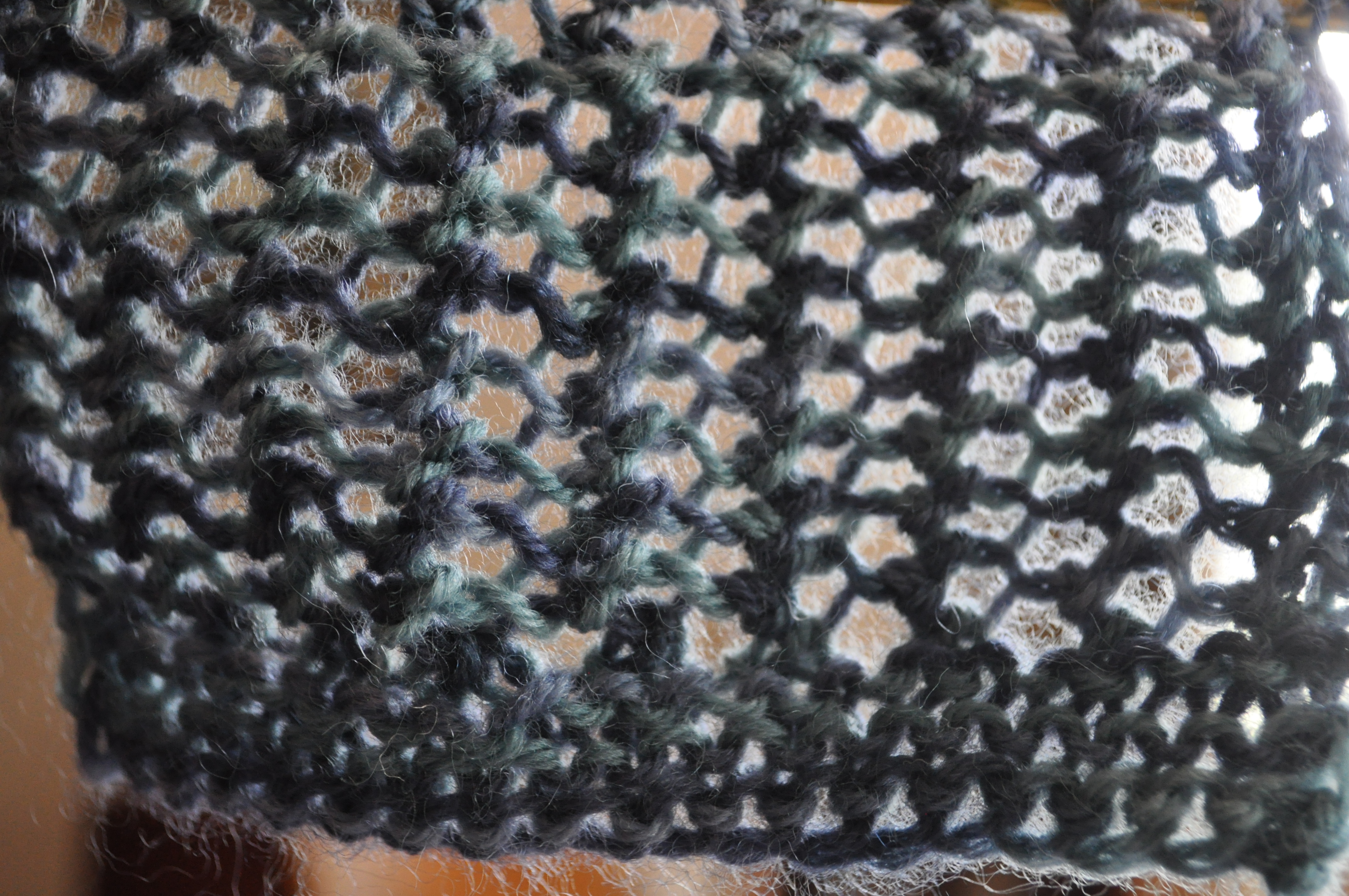
I spotted the beautiful blue and green variegated yarn on the sales table at a local yarn shop a few weeks ago. One hundred percent Andes wool, the loosely wound hank of yarn lay twisted in a figure-eight pattern. I couldn’t resist.

Yesterday, tired and feeling frustrated by writer’s block, I opted to knit rather than walk or work while I hung out at the younger three’s soccer practice. I pulled out the hank of wool, removed the small pieces of yarn tied to keep it in its figure eight, and unwound it into a large loop.

But I still couldn’t knit from it. The wool stuck to itself and tangled.  Every time I pulled, it snarled.

I remembered the last sentences from my devotions that morning: “You inhabit a fallen, disjointed world, where things are constantly unraveling around the edges. Only a vibrant relationship with Me can keep you from being unraveled too” (Sarah Young, Jesus Calling).

I continued unwinding the yarn, thinking about that quote as I formed the end into a tiny wad and wrapped round and round it, rotating the emerging ball so it stayed balanced. Still the hank resisted my efforts. Eventually I hung it around my neck and lifted it one loop at a time as I wound.

I could identify with what Young wrote about unraveling. It has been a consistent prayer during my motherhood/teaching years. Last year, when we first took in two international students and with PJ still home part-time, it progressed at times to a fear. I am coming undone, I would cry, and then I would see, time and again, God holding me together.

But He is unraveling me now. The kids are all in full-day school, and I am not teaching. Though I have writing deadlines, I have large chunks of alone time in which to manage them. I am not frantically rushing from one school to another. I have quiet hours in which I don’t hear “Mom” or “Mrs. Underwood” at all. It is an oddly unsettling feeling. It is strangely lonely.

Late one night last week, Dave prayed—in what I think was Holy-Spirit-guided words—that I would find my value only in Christ.

Sometimes God must do some unraveling to make us see ourselves first and foremost as His. We have our roles set; we are comfortable in them (oddly enough, we CAN get comfortable with frantic schedules and too-long to-do lists!); we find our value in them; we may even brag about them. We have reputations. And God says, “I can’t knit with that hank of wool you have arranged just so. I have a finished product in mind for you, and you will have to be unwound for Me to work with you.”

There are some drastic examples of this in Scripture: Joseph: goodbye, pretty coat and favored-son status; Moses: adios, palace; Esther: hello, palace; Abraham: welcome to the tent of wandering! God unmakes in order to create and fashion and teach.

It took me a long time to wind that ball of yarn, but when I was finished with it, it seemed small—compressed, not as pretty. I wouldn’t have bought it if it had looked like that, I thought.

But its value now is not in how it looks at all.

Its value is that it can be used.

And the end result will be beautiful!

Philippians 1:6 “…I am sure of this, that he who began a good work in you will bring it to completion at the day of Jesus Christ.”

Guest Writer!

Today I’m featuring the writing of Grace DelVecchio, my brother Mike’s youngest child. She is in 7th grade now, but when she was in 2nd grade, one of her assignments was to write a story—about anything she wanted—that showed her knowledge of dinosaurs. Grace wrote “The Family that I Love.” Her teacher had it bound in book form, and all of us in the family got copies. It’s a very special book (if you read it below, you’ll see why), and we pull it out every few months and read it again. I hope you enjoy it as much as we do. I selected a few pictures of book pages to share as well, but the full text follows.

“The Family that I Love” by Grace Del Vecchio, 2nd grade, 2007-2008

Hi! I’m Grace and I’m here to tell you about my family. We are the DelVecchiosaurus herd.

My dad is the king of the herd. He is a T-Rex.

My mom is an Allosaurus. She is the Queen.

Anna is half T-Rex and half Allosaurus, but she acts like a Stracasaurus. It seems like she is always charging into me. She is the teenage dinosaur.

Sarah is also half T-Rex and half Allosaurus, but she is sweet like the Psittacosaurus.

I also have a brother dinosaur. His name is Luke. He is like the Janenschia. It is difficult to describe him because there is not much known about him. He has Autism. I’ve loved him ever since I was a little dinosaur and that will never change.

Some of my friends think he’s weird and that makes me sad. If they make fun of him, I defend him.

I am Grace, half T-Rex and half Allosaurus.

When they make fun of Luke, I feel like a Velociraptor. I use my sharp teeth to defend him. Luke doesn’t seem to get what his sharp teeth are for some reason.

He is still a lot of fun to be with. We like to go to the playground together.

We like to eat the plants and run around. He is the best brother dinosaur in the world.

I hoped you liked meeting my family. The End.

This book is dedicated to my brother Luke. It is a true story of our family (except we are not really dinosaurs). Luke may not be able to do the things we can do, but he is still a lot of fun to be with. I love him because he is my brother. God has a special plan for him in his life.

*MY note: By the way, though then-7-year-old Grace may have seen then-teenager Anna as “charging,” she, like Sarah and Grace herself, is WONDERFUL and has grown into a remarkable young lady (you, too, Sarah!).

six little words

He does like green beans, but he’s more excited about the distorted reflection of his face on the side of the metal bowl! PJ’s six word memoir (according to me) would be “exuberant: finding the beat of joy.”

A few years back Smith Magazine (an online storytelling mag) issued its readers a challenge: write your life in 6 words.

Six little words.

The idea was based on the legend that Hemingway once wrote a story in six words: “For sale, baby shoes, never worn,” but SMITH took it further and asked readers to write their own stories. “Six-Word Memoirs” became a project, a “global phenomenon“ (I’m borrowing words from SMITH’s own Web site: http://www.smithmag.net/sixwordbook/about/, which has lots of great 6-word memoirs!), and a best-selling book series.

Somehow I didn’t hear about the “global phenomenon” until this past spring, but when I did, I wrote my own (more on that later).

When Dave began teaching Culture and Theology to high school seniors just a few weeks ago, he came home with this dilemma: “Many of them don’t seem excited about the Gospel. How are they going to get excited about how it can work in our culture?”

They can’t. Truthfully, none of us can get excited about the Gospel until we see it at work in our own lives. Only then will we be awed and fascinated by the ways God uses it to transform others.

So Dave backtracked in his class. “How has the Gospel impacted YOU?” he asked them. Not simply with initial salvation or coming to Christ (though he did some unpacking about the enormity of that), but what about since?

He showed them an online video ( http://gospeljourney.com/) that features spoken word artist Jason Petty. Borrowing from SMITH, it tells the Gospel in six words: “God. Our. Sins. Paying. Everyone. Life.” Dave combined the two ideas: Write your own Gospel story, he told his class. Yes, the Gospel at its core is the same: God has set us free for an abundant life made possible by the perfect death of His Son, but make it personal: what is He setting you free from? What is He setting you free TO?

I loved the idea and, of course, tried a few more of my own. My first one had to do with the fatigue of that day: “motherhood—overwhelming role. Who am I?” But then I began looking at my big-picture issues (people-pleasing, guilt, martyrdom, pride, etc.—there’s a lot) and I tried several others. When I compared these with the one I wrote last spring, they were similar.

Here’s my latest draft: “Recovering perfectionist, learning I am ‘Be-loved.’”

What’s yours?