Not sealing, HEALING

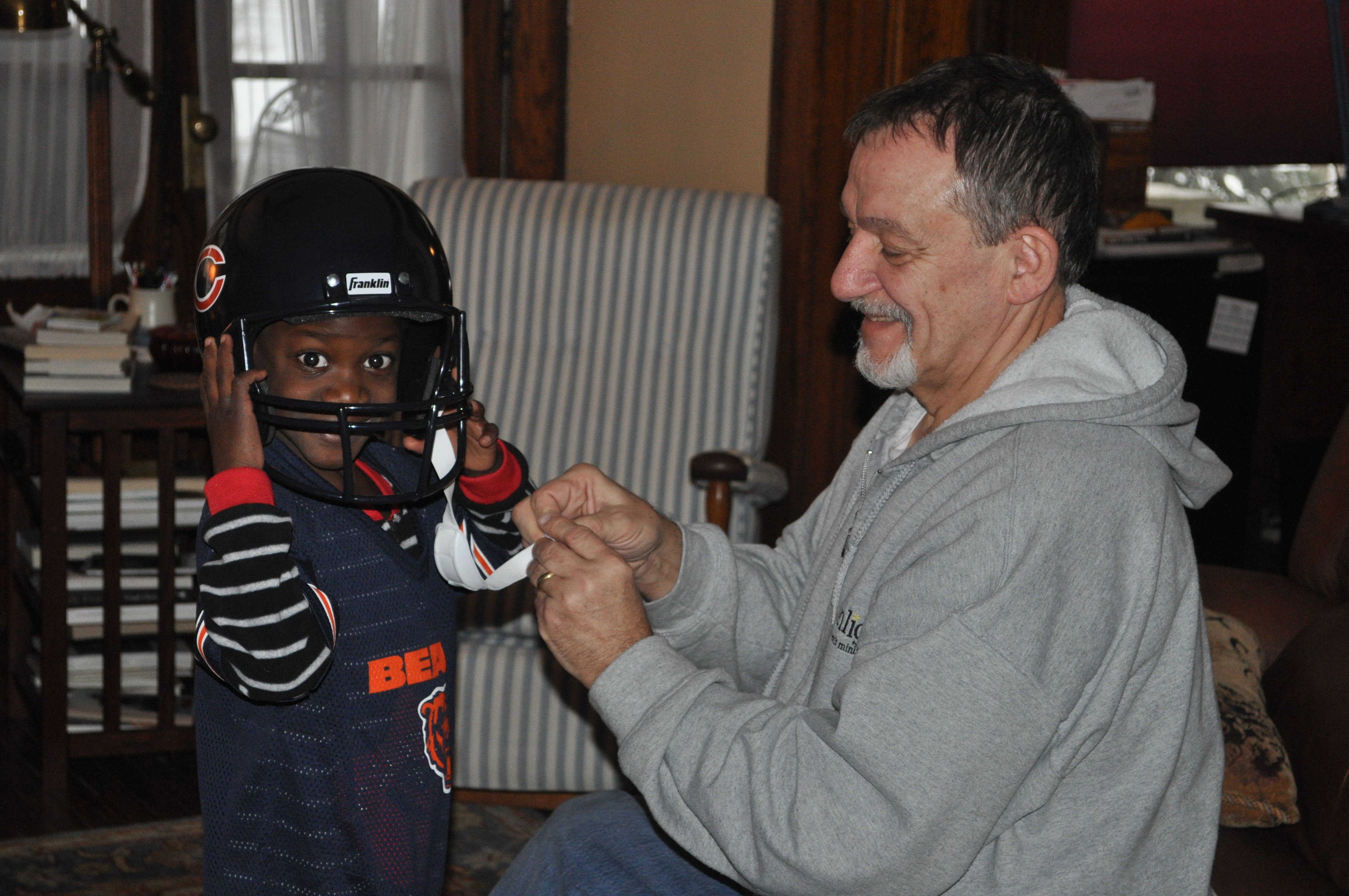
For PJ's recent birthday, Dave's parents gave him a Bears helmet and jersey (and he and Jake have been running plays in the living room ever since :)). This is Dave's dad adjusting the chin strap before a "game."

“Take my heart, Lord, take and seal it, seal it for Thy courts above.”

I “get” the hymn writer’s meaning. I’ve read a bit of his background. He was a man who struggled with doubts. He eventually lost his faith.

So, in that sense, I, too, pray that God seals my heart.

But yesterday I sang that song and I got a vivid picture of myself holding my heart out to God. “Here, Lord, keep it safe.”

And then, like the camera had zoomed in, I got a look at the object in my hands. Deep fissures cut through its surface. Rather than a healthy red, it was mottled with blue, green, and a white that looked like congealed fat. Swollen and puffy, it made me think of rotting chicken breasts.

It was unhealthy, incapable, and sick.

Sin is, according to a couple of the Greek definitions, a “missing the mark,” a “falling short.” My own riddled-with-sin heart is sinful because it is too diseased to “hit the mark”: to be true like God, to do good like God, to love like God.

And the heart I saw in my mental picture wasn’t just a little sickly. It was diseased through and through. “Oh, with THAT heart, God, how do I love anyone? How do I keep from slipping into despair?”

Paul asked something very like this: “Wretched man that I am! Who will deliver me from this body of death?”

But he also had an answer: “Thanks be to God through Jesus Christ our Lord!”

I sang the hymn again, but I changed a key word. I don’t want my heart sealed like THAT! I actually want a NEW heart, one infused with health, able to love and LIVE, to hope and rejoice.

“Take my heart, oh, take and HEAL it, heal it for Thy courts above”

Who will deliver me, both for eternity AND for this here-and-now life?

Thanks be to GOD, for He has and He WILL. He is the donor and the surgeon. He performed the initial transplant, giving me His own heart, and He is vigilant about follow-up care, making sure I do not reject the very thing that gives me life.

Ezekiel 36:26: “A new heart also will I give you, and a new spirit will I put within you: and I will take away the stony heart out of your flesh, and I will give you an heart of flesh.” (KJV)

Psalm 73:26: “My flesh and my heart faileth: but God is the strength of my heart, and my portion for ever.” (KJV) (emphasis mine).

No wonder He is called the Great Physician.


Lost in Translation

We celebrated Christmas early with Nina and Jane, our international student "daughters," because they both went home for the break (Nina to China; Jane to Vietnam). This is a Christmas morning picture. One of our traditions is that each person (except me, for some reason--probably because I buy it generally) gets to pick and get (I wrap them!) a personal box of cereal (and it can EVEN be a sugary kind). Guess what we have for Christmas morning breakfast! So, really, I guess there's a present in there for me, too!

Last week I fixed an African rice pilau for dinner. Jane’s friends, Faith and Joy, sisters who are originally from Zambia, were spending the night, and I thought they might enjoy it. They went out to dinner before coming over, though, and so weren’t hungry, and all the younger kids turned up their noses at it and ate leftovers instead (and so it often goes when you have to feed eight people from three different countries who range in age from 6 to 41).

Jane, Dave, and I DID eat the pilau, but Nina, THE pickiest person in the house (which she willingly admits), sniffed it and said, “Smells like medicine.”

Hmm. I let that soak in for a minute before answering. (Oh, the wisdom of James 1:18-20: “…be quick to listen, slow to speak, and slow to get angry).

Finally, “Um, is that meant to be a compliment?”

“Oh, yes.”

“Really?”

Her eyes were round and serious as she nodded. “You know, like Chinese medicine.”

“Chinese medicine?”

She crossed the room to point at the spice rack with its pictures of cinnamon, cloves, and garlic (all of which were in the pilau). “Like these.”

“Ah! Spices,” I said.

“Mmhmm. Chinese medicine.”

So, yes, actually a compliment!

But she still fixed herself potstickers for dinner.

Sugar-free coffee–yuck

I am on day four of drinking my coffee without sugar!

I miss the sugar.

A lot!

I add cinnamon.

It’s not the same.

Not at all.

But if I’m going to kick (or, in Biblical terms, “put to death”) my addiction to sugar, I think it needs to start with the biggest culprit of all.

Have I mentioned that I add a LOT of sugar to my coffee?

So much so that close friends joke, “So, are you going to have coffee with your sugar?”

My husband calls it my “kid-coffee.”

And they’re right.

I told my mother-in-law about my decision, and she—knowing I generally disdain the little sugar packets she uses in her coffee, knowing I go for the scooper and the five-pound bag she keeps tucked way back in the cupboard—she suggested I wean myself gradually.

I’ve tried that.

I cheat.

Three level teaspoons, rounded teaspoons, heaping teaspoons…hmm, what’s the real difference? Maybe I should go for four—or five! It’s just a few extra calories.

Somehow cold turkey feels right.

Well, not exactly “right.”

It feels necessary.

Yeah.

A hymn to share

I’m sharing a stanza from a hymn today. The hymn “The Love of God” was written by Frederick Lehman in 1917, but he wrote it based on a poem found pencilled on the wall of an insane asylum. The man who stayed in the room was said to be demented. The lines were discovered after he died. As a writer I find these lines amazing–and true! I’m finding I could write about the love of God and His miraculous Gospel every day and never run out of ideas.

Could we with ink the ocean fill,

And were the skies of parchment made,

Were every stalk on earth a quill,

And every man a scribe by trade,

To write the love of God above,

Would drain the ocean dry.

Nor could the scroll contain the whole,

Though stretched from sky to sky.

Cleaning Confession

Dave took me to Vermont over Christmas break to celebrate our 20th anniversary. On one of our hikes, I found this natural "cross" on a tree.

In high school, I would leave nearly empty glasses of sweet tea in my room. When my mother discovered the green-fuzzed results, I told her they were science experiments. I regularly lost library books only to discover them, weeks overdue, under my carpet of clothes. In college I roomed with another self-proclaimed slob, and we posted a sign that said “Enter at your own risk.” (We really didn’t but we might as well have. No one dared come in.)
I didn’t get much better after I married. Dave shuffled my piles of books around, and once I stashed three days worth of dirty dishes in the bottom of the microwave cart because I’d invited people over for dinner and had more mess than time to clean.
When we moved overseas, though, I changed. The knowledge that people could drop into our apartment at any time (and they did) made me aware of how our home looked. I cleaned thoroughly every weekend, and I straightened messes daily. When we returned to the States and had our first child, I became a little obsessive. I hand-mopped the kitchen floor twice a week, wiped behind the clawed feet on the ancient tub, and freaked out over stray hairs in the sink. Dave suggested I get a part-time job before I drove us both crazy. I did—but I still liked cleaning.
Now, though, I hate it.
HATE it!
With six kids and their friends and the dog running through our house, cleaning is a constant battle that’s lost before it’s even begun. Why mop the floor when four sets of feet are going to cross it before it’s dried? Plus, it’s a thankless job. My kids NOTICE when dinner’s late (actually, they start asking about it at four in the afternoon), but I could put up a flashing neon sign announcing that I dusted, and they wouldn’t see it!
A few months ago I realized that every time I cleaned, I griped. “I could be doing a lot of other things.” “What’s the point of this?” “It’s not going to last.”
And if I got through the griping and did real cleaning, I turned into a bear! “Don’t you spill anything on that stovetop! I used 409 on that thing!” “Why are there crumbs on the coffee table? Can’t you see that I CLEANED!?”
Something didn’t seem right. I began to wonder if a clean house was worth having kids that twitched when they smelled PineSol because they knew it meant I would start hollering about one mess or another.
So I stopped.
Not the hollering—I still do that sometimes about other things.
No, I stopped cleaning.
Seriously.
I. no. longer. clean.
Well, not to the point that I FEEL like I’ve cleaned.
I may straighten. I may tidy. I may “neaten things up.”
I may even “organize.”
But I don’t CLEAN.
I don’t sweep an entire floor; I pick up the dust bunnies in the corners. I don’t scrub an entire bathroom; I grab a baby wipe and go after the yellow spots (those of you with boys know what I mean.) I don’t mop; I give Patrick a wet rag and tell him to paint pictures with it on the floor. I figure I can live with the “blank” areas of the canvas. When my girls dust, I don’t go behind and find the spots they missed.
I don’t clean.
And I think my kids appreciate that.
I hope.
Because there is a definite flaw to my system: my house isn’t really CLEAN, not even for three minutes every month.
But I’m learning to live with this. I’m still practicing hospitality. I figure I’m providing a self-esteem boost for my friends. They can walk in my back door and think: “Well, I guess my house doesn’t look so bad after all!”
I remind myself there IS an end in sight. In five years my youngest will be eleven. No more Legos on the stairs (ouch); no more Barbies on the dinner table; no more toy fire helmets on the couch; fewer spilled cups (I hope).
Five more years!
Maybe I’ll clean then.

Be the Dough

Emily is becoming our master cake maker! This is the angry bird cake she made for Patrick's sixth birthday (1/17/12). She made cake pops for the birds and pigs, colored almond bark to coat them, and then made a marshmallow fondant ("It tastes better than regular fondant," she told me.) for the details like eyes, noses, and beaks! It turned out so, so well.

Proof the yeast, add the flour, mix and knead, knead some more, let it rise, punch it down, shape the dough, let it rise…
And,
Finally,
Bake.
It’s a long process, a restful process.
Or a frustrating one.
It all depends on the perspective.
For most of the high school sophomores in the Bread of Life class I taught the first two weeks of January, frustration won over rest.
“Why does the yeast need to proof? And what does that mean?”
“Have I kneaded enough? No? Really? How much longer?”
“It’s still not ready?”
“It has to rise again?”
“When will it be done?”
We made yeast bread six times during the course, and some of them were still asking the same questions on day six.
I ask the same questions of God.
How long? When will this be over? Haven’t I been in this situation long enough? Isn’t there anything I can DO? Just WAIT?
Breadmaking is a complicated process–and a little magical, too. The yeast—captured as a living organism and then dehydrated (“put to sleep” in a sense)—is “waked up” by the warm liquid. It bubbles and pops on the surface, letting you know, “Yes, I’m alive! I will work.” You add flour (and a few other things) and begin to knead. As you shove at the dough, hit it, smack it, even toss it back and forth (if you have a couple people), the protein in the four (called “gluten”) begins to stretch; it becomes elastic and flexible.
Then you let it rest. While it rests, it rises, and you wait, peeking every so often to see it fill up the bowl. Finally (this is a long rise period), you punch it down, knock all the extra air out. It deflates when you do this, like a balloon gently popped. You form it then, into loaves or rolls or whatever shape you fancy, and it rises again, smoothing out the surface, becoming beautiful. Another wait, another rest.
And, finally, it bakes. And it rises a little more with the extreme heat that would have killed the yeast at any time prior in the process.
It’s a lot like spiritual growth. “Magic” is involved: the Living Water brings to life what was dead within us; the Holy Spirit allows us to stretch and grow beyond our natural limits. A Master Baker (like the Potter) knows the complicated process: how long we need (sorry, unintentional play on words) trials and troubles; when waiting periods will help us grow; the right time to knock us down a little, to let failure reveal sin areas in our lives; what shape is the perfect one for us and most useful for the Baker’s grand plan.
I know so little of the recipe and the plan for me. But God says, “I know the thoughts and plans that I have for you… thoughts and plans for welfare and peace and not for evil, to give you hope in your final outcome” (Jeremiah 29:11, Amplified version).
I don’t know why it’s so hard to remember that I don’t know what I’m doing, but it seems I have to tell myself again and again to “be the dough,” to let go of the desire to control.
And let God, my Master Baker, work.

Drink, Eat, and Abide

NOTE: This is something I wrote to myself, not to/for anyone else. Writing it out was helpful for me; I share it hoping it is helpful to another. This came out of my recent study of Christ as the Bread of Life.

Eat Him, drink Him, ingest Him, with the full trust that without Him, you can do nothing, be nothing. This is true abiding, and it can happen no matter where you are (the car, work, the laundry room, the kitchen) and no matter what you are doing. Take a moment and tell Him you cannot do it. Then open wide your soul. Make yourself trust. Make yourself vulnerable. Do this with the expectation that He will fill you up, that He WANTS to fill you up. This is His desire. He does NOT want you to try to gut it out and do it on your own. No! He wants you to come to Him, open up your aching, tired, frustrated heart, and allow Him to fill it.

Eat the body broken for you. Drink the blood spilt for you. You did it many years past with that initial, so-important decision. Do it again and again and again. “Anyone who eats my flesh and drinks my blood remains in me, and I in him.” Be open to Him and others about your need

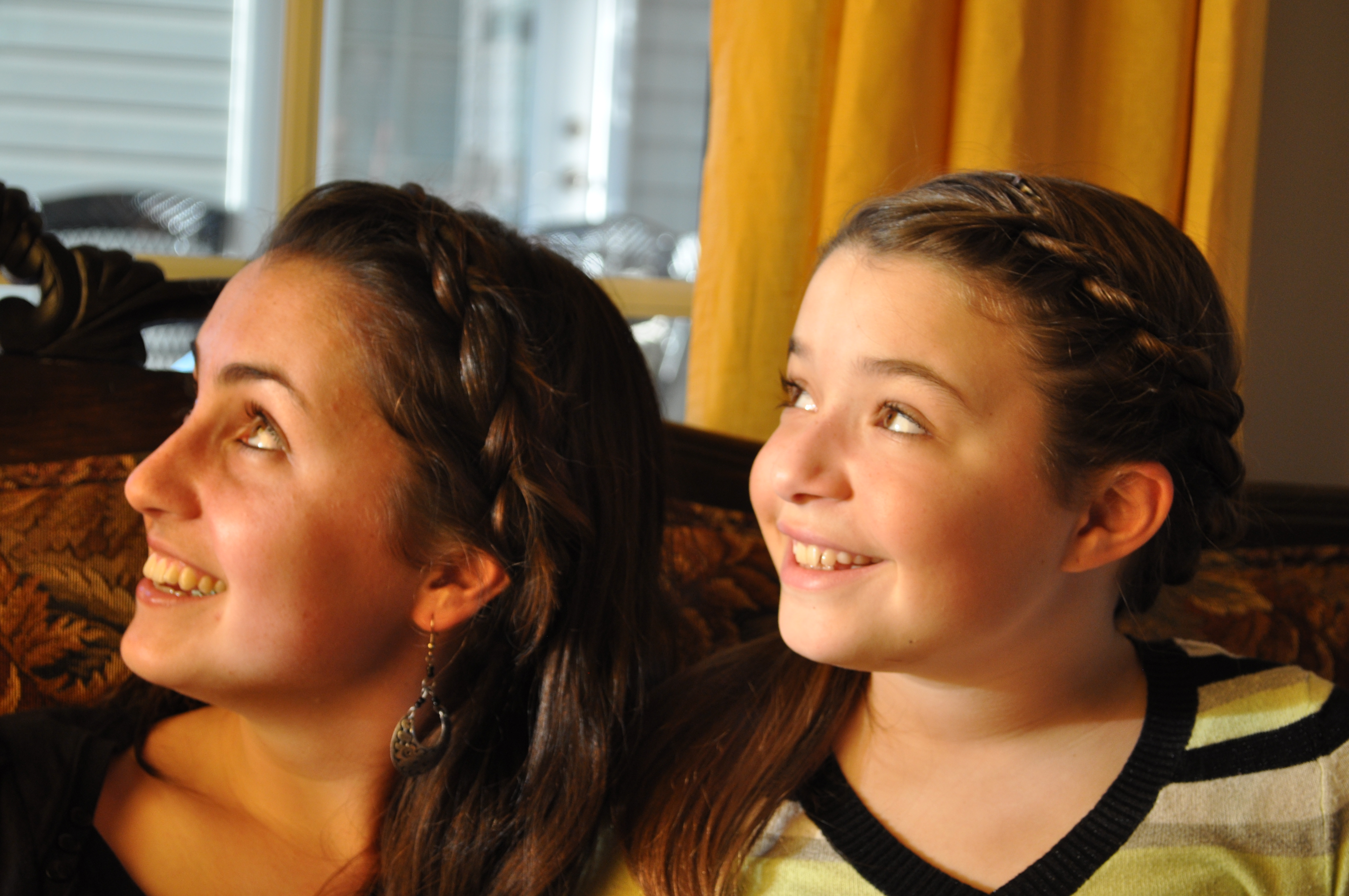
My niece Lucy and my daughter Emily braided each other's hair when we got together with Lucy's family at Thanksgiving.

iness. Don’t pretend—to others or yourself—that you have it all together. You don’t. You need Him every day as the Israelites needed the manna in the wilderness.

Christ said, “I live because of the living Father who sent me; in the same way, anyone who feeds on me will live because of me.”

It’s all about trust—in someone else rather than yourself, in the only One who never fails.

Eat, Drink, Abide.

Down-up-down-up-aah!

Janie (our younger international student) is reading Francis Chan’s

Maddie with her cousin Anna. Two beautiful girls!

for one of her winterim classes (a short January term we have at Wheaton Academy). This means, of course, that I’ve been reading some of it, too. Last night we discussed Chan’s chapter about heroes of the faith, how they were people just like us–but passionate about loving God. I told Jane, “That’s encouraging. They were regular, ordinary people.” But, my words aside, I still have doubts about whether that’s really true. The heroes were just like me? Really? I don’t think so. For instance, did they struggle with the “down–up–down–up–aah!” cycle I follow many days–sometimes accomplishing an entire rotation in a single hour? Were they mixed up, too?
YES! Or at least David was. This morning I talked with my winterim class (Bread of Life; it’s a combination of breadbaking and a Bible study on Christ as the Bread of Life) about avoiding the self-righteousness of the Pharisees. “Find some Scriptures that can help you pray honestly with God, verses that reveal your neediness.”
My search turned up Psalm 40.
Down-up-down-up-Aah! David’s cycle mirrored mine–or I could say that mine mirrors his!
Tight spot–God rescues–David thanks Him.
Praise! David commits to service.
Oh no! Troubles surround him. He focuses on those and loses heart.
Oh no! He understands more and more of his sinfulness!
“I can’t see!” he cries.
HELP!
Bad people–trying to bring him down.
“May you be brought to disgrace,” he cries.
And finally, “Oh, Lord, think of me. You are my help.
Do not delay.”
That’s awesome!
That’s ME!
And that’s encouraging!

House Hunt

I took this picture in N. Carolina at my family's Thanksgiving gathering. This beautiful sunset was a gift, as was the entire trip.

We’re in full house hunt mode right now—and I’m becoming consumed by it in my own particular “weird” way. I get obsessed with the “spiritual” aspect of these kinds of decisions. “Which house does God want us to have?” “Is this house a better action of our stewardship?” “What if He doesn’t want us to spend that much money?” “What if we pick the wrong house?” “What if He doesn’t want us to buy at all?”

I slip back into seeing God as someone other than what my studies and experience have shown me He actually is.
I worry over the house hunt as if it is a test with poor directions and He is some vague, distant teacher who will slash red all over it if I mess up.

I pray over our choice nervously, like he is a game show host presenting me with three doors that all look the same. “Which one are you going to pick? Only ONE is the right choice. The others are all wrong, wrong, WRONG!”

This morning I was doing more obsessive praying/answer-seeking when He turned the tables on me—and asked ME a question.

It was right out of the catechism I memorized in my childhood.

“What is the chief end of man?”

Answer: “To glorify God and enjoy Him forever.”

Ah!

In my quest to learn the seemingly illusive “will of God” regarding a house, I’ve lost sight of God Himself.

So it’s back to the basics I have to learn again and again. The question “How are You guiding us in regards to housing?” is not best answered by continually praying about THAT, but by spending time focusing on HIM, praising Him, ENJOYING Him. When my view of HIM becomes clearer, so do the answers to other questions.

Or, maybe, I can stop seeing the questions and see Him, my guide; I can stop seeking little answers and be satisfied with the biggest answer of all.

*Oh, Lord, help me to see YOU more clearly, may THAT be my aim—so that I may love You more dearly and, as a natural progression, follow You more nearly in all I do—including—ha!—decisions about housing that are not nearly as big as I make them out to be. Help me to make the Big decision each day, over and over: to seek You.

*St. Richard Chichester, a saint from the 13th century, wrote the original form of this prayer; it was also used in “Day by Day,” a song in the 70s musical Godspell. This is the original form:
Dearest Lord Jesus,
Savior and Friend,
Three things I pray: to
See thee more clearly, to
Love thee more dearly, to
Follow thee more nearly,
Day by Day.
Amen.

Rogaine’s new spokesman

Our kids recently spent a week at their grandparents’ house. They have television. We don’t, though we do use the Internet and Netflix to watch shows. The major difference: commercials.

Commercials was one of the main reasons we stopped a steady diet of television. Not only did we get tired of telling the kids, “Close your eyes,” when horror and action film previews came on during prime time, we also got tired of the constant “Can I get that?” requests prompted by the advertising gimmicks.

But our kids must be suffering withdrawal because they seemed to notice the commercials more than ever. We discovered how closely they watched them when Jake got a clear look at the top of his uncle’s head on our last day there and said, “You know, Uncle Scott, if you call the Hair Club for Men, they’ll guarantee some growth up there in about four weeks!”