Cleaning Confession

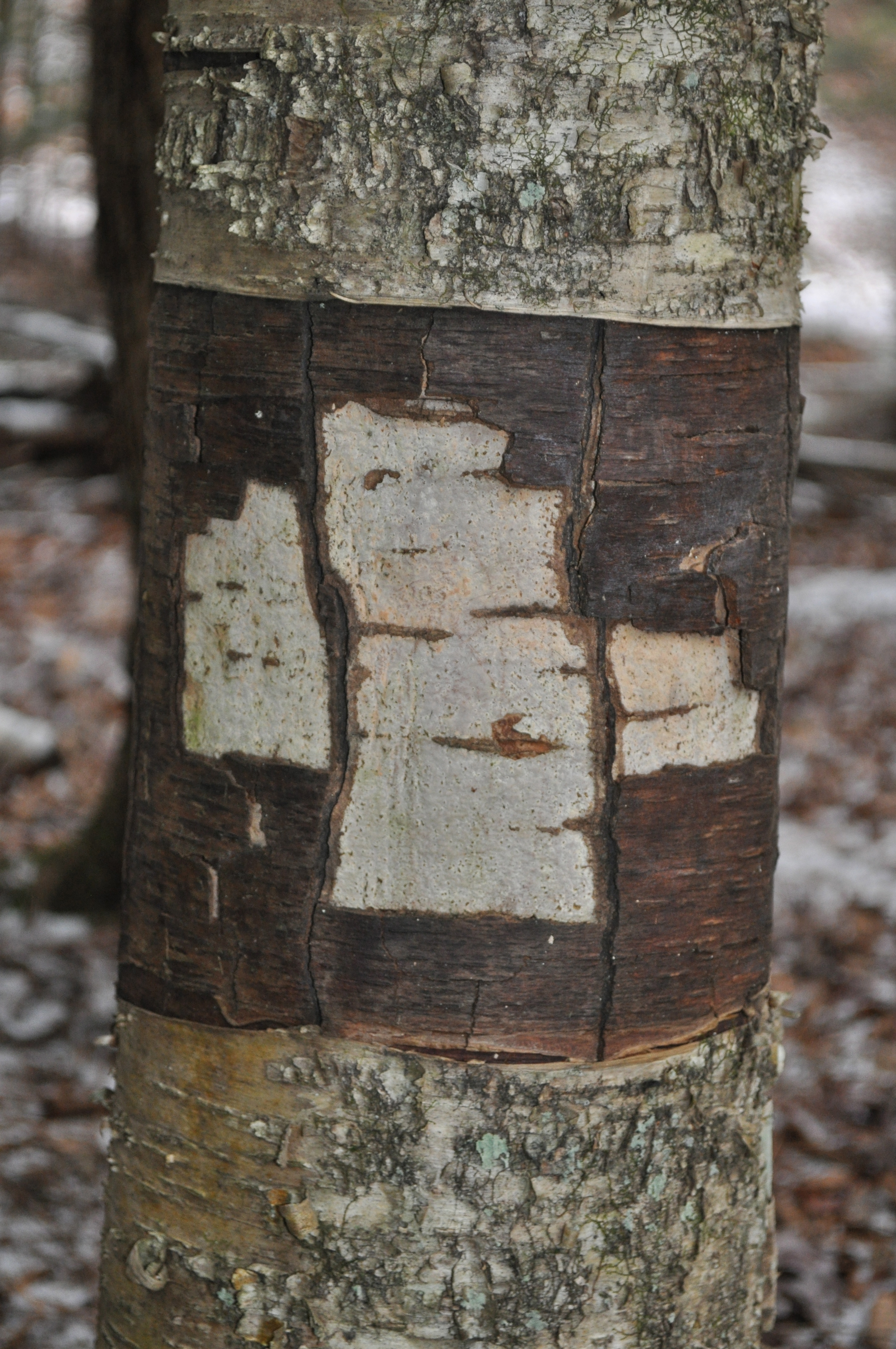
Dave took me to Vermont over Christmas break to celebrate our 20th anniversary. On one of our hikes, I found this natural "cross" on a tree.

In high school, I would leave nearly empty glasses of sweet tea in my room. When my mother discovered the green-fuzzed results, I told her they were science experiments. I regularly lost library books only to discover them, weeks overdue, under my carpet of clothes. In college I roomed with another self-proclaimed slob, and we posted a sign that said “Enter at your own risk.” (We really didn’t but we might as well have. No one dared come in.)
I didn’t get much better after I married. Dave shuffled my piles of books around, and once I stashed three days worth of dirty dishes in the bottom of the microwave cart because I’d invited people over for dinner and had more mess than time to clean.
When we moved overseas, though, I changed. The knowledge that people could drop into our apartment at any time (and they did) made me aware of how our home looked. I cleaned thoroughly every weekend, and I straightened messes daily. When we returned to the States and had our first child, I became a little obsessive. I hand-mopped the kitchen floor twice a week, wiped behind the clawed feet on the ancient tub, and freaked out over stray hairs in the sink. Dave suggested I get a part-time job before I drove us both crazy. I did—but I still liked cleaning.
Now, though, I hate it.
HATE it!
With six kids and their friends and the dog running through our house, cleaning is a constant battle that’s lost before it’s even begun. Why mop the floor when four sets of feet are going to cross it before it’s dried? Plus, it’s a thankless job. My kids NOTICE when dinner’s late (actually, they start asking about it at four in the afternoon), but I could put up a flashing neon sign announcing that I dusted, and they wouldn’t see it!
A few months ago I realized that every time I cleaned, I griped. “I could be doing a lot of other things.” “What’s the point of this?” “It’s not going to last.”
And if I got through the griping and did real cleaning, I turned into a bear! “Don’t you spill anything on that stovetop! I used 409 on that thing!” “Why are there crumbs on the coffee table? Can’t you see that I CLEANED!?”
Something didn’t seem right. I began to wonder if a clean house was worth having kids that twitched when they smelled PineSol because they knew it meant I would start hollering about one mess or another.
So I stopped.
Not the hollering—I still do that sometimes about other things.
No, I stopped cleaning.
Seriously.
I. no. longer. clean.
Well, not to the point that I FEEL like I’ve cleaned.
I may straighten. I may tidy. I may “neaten things up.”
I may even “organize.”
But I don’t CLEAN.
I don’t sweep an entire floor; I pick up the dust bunnies in the corners. I don’t scrub an entire bathroom; I grab a baby wipe and go after the yellow spots (those of you with boys know what I mean.) I don’t mop; I give Patrick a wet rag and tell him to paint pictures with it on the floor. I figure I can live with the “blank” areas of the canvas. When my girls dust, I don’t go behind and find the spots they missed.
I don’t clean.
And I think my kids appreciate that.
I hope.
Because there is a definite flaw to my system: my house isn’t really CLEAN, not even for three minutes every month.
But I’m learning to live with this. I’m still practicing hospitality. I figure I’m providing a self-esteem boost for my friends. They can walk in my back door and think: “Well, I guess my house doesn’t look so bad after all!”
I remind myself there IS an end in sight. In five years my youngest will be eleven. No more Legos on the stairs (ouch); no more Barbies on the dinner table; no more toy fire helmets on the couch; fewer spilled cups (I hope).
Five more years!
Maybe I’ll clean then.

Be the Dough

Emily is becoming our master cake maker! This is the angry bird cake she made for Patrick's sixth birthday (1/17/12). She made cake pops for the birds and pigs, colored almond bark to coat them, and then made a marshmallow fondant ("It tastes better than regular fondant," she told me.) for the details like eyes, noses, and beaks! It turned out so, so well.

Proof the yeast, add the flour, mix and knead, knead some more, let it rise, punch it down, shape the dough, let it rise…
And,
Finally,
Bake.
It’s a long process, a restful process.
Or a frustrating one.
It all depends on the perspective.
For most of the high school sophomores in the Bread of Life class I taught the first two weeks of January, frustration won over rest.
“Why does the yeast need to proof? And what does that mean?”
“Have I kneaded enough? No? Really? How much longer?”
“It’s still not ready?”
“It has to rise again?”
“When will it be done?”
We made yeast bread six times during the course, and some of them were still asking the same questions on day six.
I ask the same questions of God.
How long? When will this be over? Haven’t I been in this situation long enough? Isn’t there anything I can DO? Just WAIT?
Breadmaking is a complicated process–and a little magical, too. The yeast—captured as a living organism and then dehydrated (“put to sleep” in a sense)—is “waked up” by the warm liquid. It bubbles and pops on the surface, letting you know, “Yes, I’m alive! I will work.” You add flour (and a few other things) and begin to knead. As you shove at the dough, hit it, smack it, even toss it back and forth (if you have a couple people), the protein in the four (called “gluten”) begins to stretch; it becomes elastic and flexible.
Then you let it rest. While it rests, it rises, and you wait, peeking every so often to see it fill up the bowl. Finally (this is a long rise period), you punch it down, knock all the extra air out. It deflates when you do this, like a balloon gently popped. You form it then, into loaves or rolls or whatever shape you fancy, and it rises again, smoothing out the surface, becoming beautiful. Another wait, another rest.
And, finally, it bakes. And it rises a little more with the extreme heat that would have killed the yeast at any time prior in the process.
It’s a lot like spiritual growth. “Magic” is involved: the Living Water brings to life what was dead within us; the Holy Spirit allows us to stretch and grow beyond our natural limits. A Master Baker (like the Potter) knows the complicated process: how long we need (sorry, unintentional play on words) trials and troubles; when waiting periods will help us grow; the right time to knock us down a little, to let failure reveal sin areas in our lives; what shape is the perfect one for us and most useful for the Baker’s grand plan.
I know so little of the recipe and the plan for me. But God says, “I know the thoughts and plans that I have for you… thoughts and plans for welfare and peace and not for evil, to give you hope in your final outcome” (Jeremiah 29:11, Amplified version).
I don’t know why it’s so hard to remember that I don’t know what I’m doing, but it seems I have to tell myself again and again to “be the dough,” to let go of the desire to control.
And let God, my Master Baker, work.

Drink, Eat, and Abide

NOTE: This is something I wrote to myself, not to/for anyone else. Writing it out was helpful for me; I share it hoping it is helpful to another. This came out of my recent study of Christ as the Bread of Life.

Eat Him, drink Him, ingest Him, with the full trust that without Him, you can do nothing, be nothing. This is true abiding, and it can happen no matter where you are (the car, work, the laundry room, the kitchen) and no matter what you are doing. Take a moment and tell Him you cannot do it. Then open wide your soul. Make yourself trust. Make yourself vulnerable. Do this with the expectation that He will fill you up, that He WANTS to fill you up. This is His desire. He does NOT want you to try to gut it out and do it on your own. No! He wants you to come to Him, open up your aching, tired, frustrated heart, and allow Him to fill it.

Eat the body broken for you. Drink the blood spilt for you. You did it many years past with that initial, so-important decision. Do it again and again and again. “Anyone who eats my flesh and drinks my blood remains in me, and I in him.” Be open to Him and others about your need

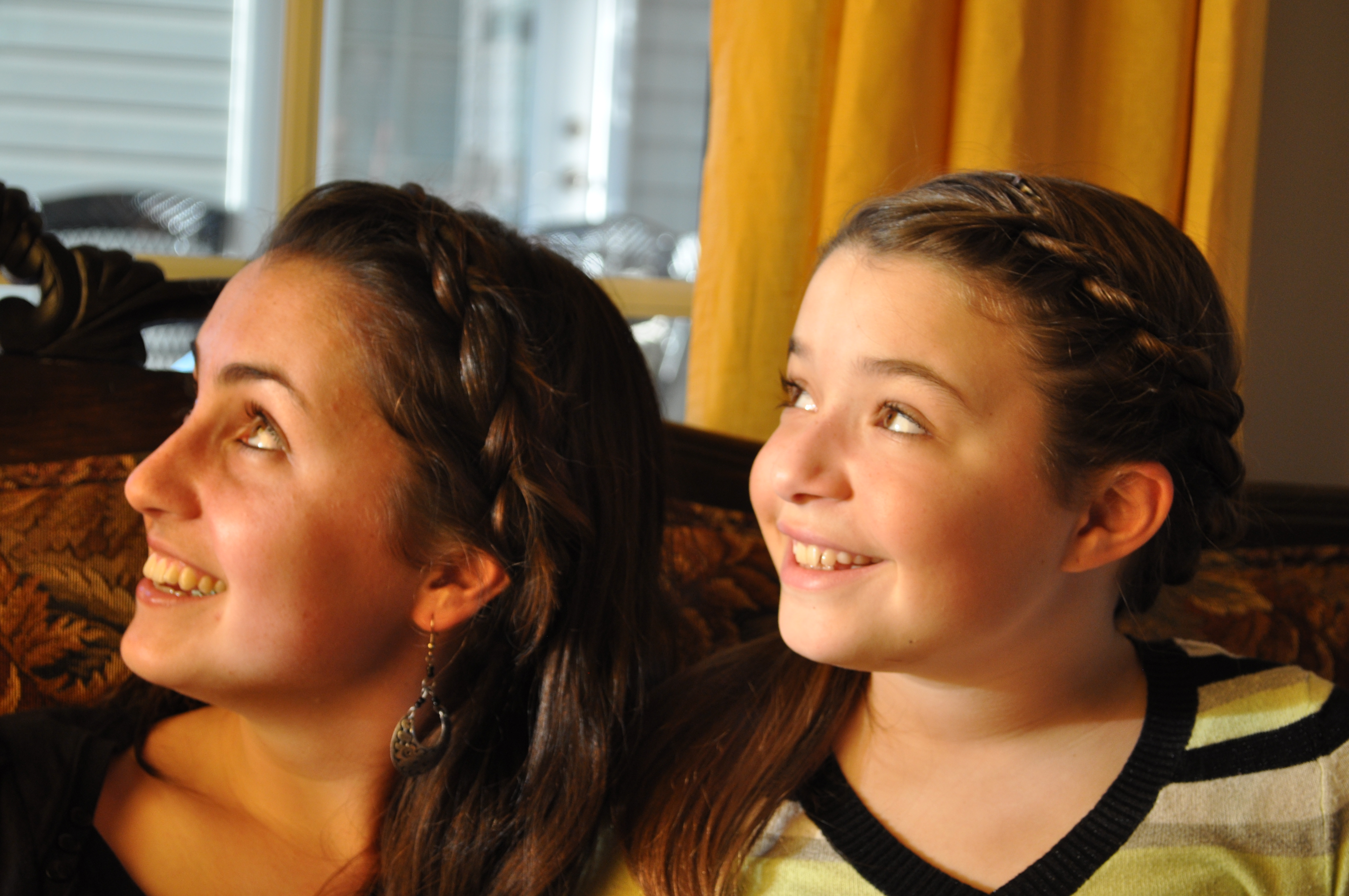
My niece Lucy and my daughter Emily braided each other's hair when we got together with Lucy's family at Thanksgiving.

iness. Don’t pretend—to others or yourself—that you have it all together. You don’t. You need Him every day as the Israelites needed the manna in the wilderness.

Christ said, “I live because of the living Father who sent me; in the same way, anyone who feeds on me will live because of me.”

It’s all about trust—in someone else rather than yourself, in the only One who never fails.

Eat, Drink, Abide.

Down-up-down-up-aah!

Janie (our younger international student) is reading Francis Chan’s

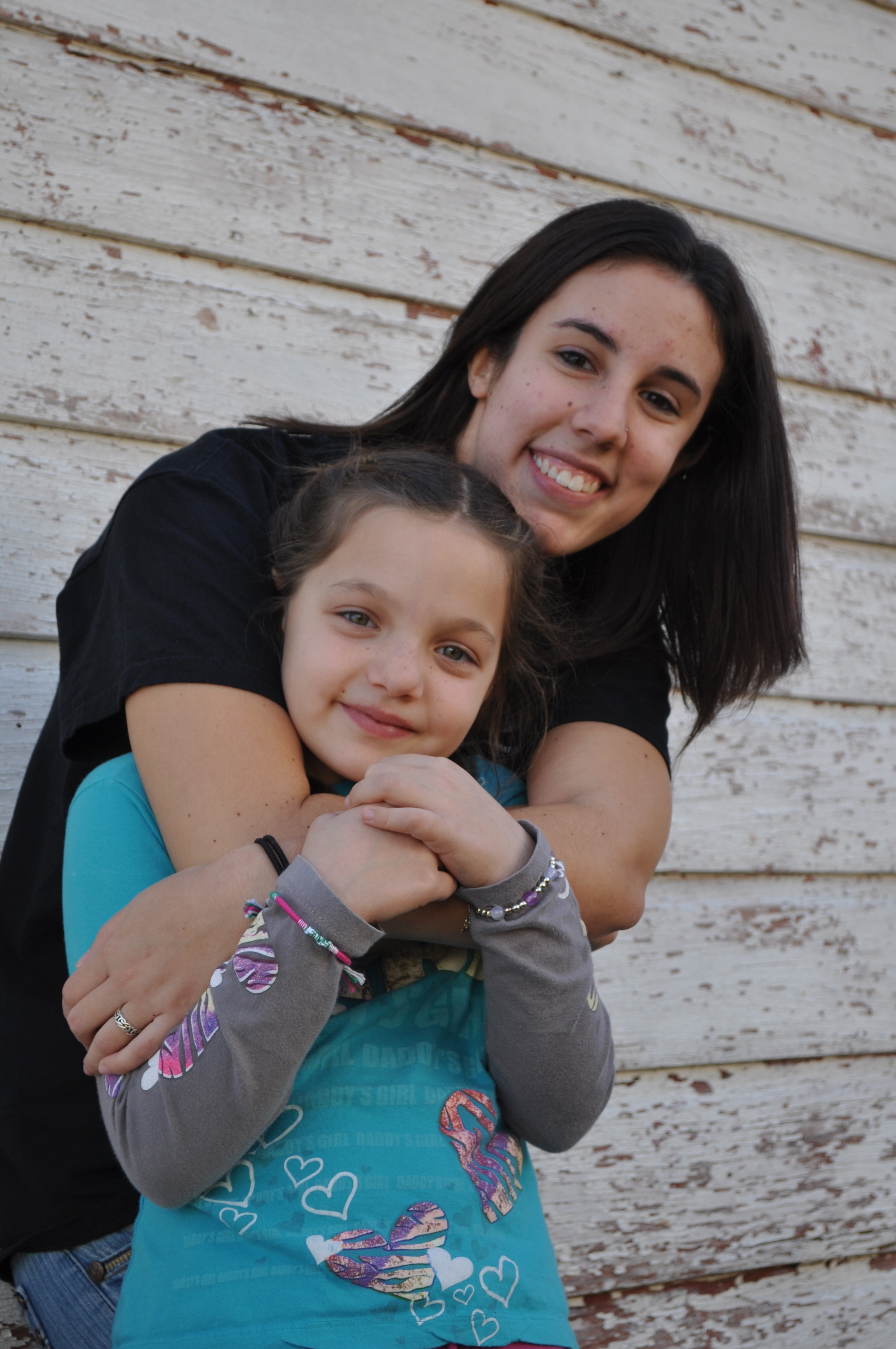
Maddie with her cousin Anna. Two beautiful girls!

for one of her winterim classes (a short January term we have at Wheaton Academy). This means, of course, that I’ve been reading some of it, too. Last night we discussed Chan’s chapter about heroes of the faith, how they were people just like us–but passionate about loving God. I told Jane, “That’s encouraging. They were regular, ordinary people.” But, my words aside, I still have doubts about whether that’s really true. The heroes were just like me? Really? I don’t think so. For instance, did they struggle with the “down–up–down–up–aah!” cycle I follow many days–sometimes accomplishing an entire rotation in a single hour? Were they mixed up, too?
YES! Or at least David was. This morning I talked with my winterim class (Bread of Life; it’s a combination of breadbaking and a Bible study on Christ as the Bread of Life) about avoiding the self-righteousness of the Pharisees. “Find some Scriptures that can help you pray honestly with God, verses that reveal your neediness.”
My search turned up Psalm 40.
Down-up-down-up-Aah! David’s cycle mirrored mine–or I could say that mine mirrors his!
Tight spot–God rescues–David thanks Him.
Praise! David commits to service.
Oh no! Troubles surround him. He focuses on those and loses heart.
Oh no! He understands more and more of his sinfulness!
“I can’t see!” he cries.
HELP!
Bad people–trying to bring him down.
“May you be brought to disgrace,” he cries.
And finally, “Oh, Lord, think of me. You are my help.
Do not delay.”
That’s awesome!
That’s ME!
And that’s encouraging!

House Hunt

I took this picture in N. Carolina at my family's Thanksgiving gathering. This beautiful sunset was a gift, as was the entire trip.

We’re in full house hunt mode right now—and I’m becoming consumed by it in my own particular “weird” way. I get obsessed with the “spiritual” aspect of these kinds of decisions. “Which house does God want us to have?” “Is this house a better action of our stewardship?” “What if He doesn’t want us to spend that much money?” “What if we pick the wrong house?” “What if He doesn’t want us to buy at all?”

I slip back into seeing God as someone other than what my studies and experience have shown me He actually is.
I worry over the house hunt as if it is a test with poor directions and He is some vague, distant teacher who will slash red all over it if I mess up.

I pray over our choice nervously, like he is a game show host presenting me with three doors that all look the same. “Which one are you going to pick? Only ONE is the right choice. The others are all wrong, wrong, WRONG!”

This morning I was doing more obsessive praying/answer-seeking when He turned the tables on me—and asked ME a question.

It was right out of the catechism I memorized in my childhood.

“What is the chief end of man?”

Answer: “To glorify God and enjoy Him forever.”

Ah!

In my quest to learn the seemingly illusive “will of God” regarding a house, I’ve lost sight of God Himself.

So it’s back to the basics I have to learn again and again. The question “How are You guiding us in regards to housing?” is not best answered by continually praying about THAT, but by spending time focusing on HIM, praising Him, ENJOYING Him. When my view of HIM becomes clearer, so do the answers to other questions.

Or, maybe, I can stop seeing the questions and see Him, my guide; I can stop seeking little answers and be satisfied with the biggest answer of all.

*Oh, Lord, help me to see YOU more clearly, may THAT be my aim—so that I may love You more dearly and, as a natural progression, follow You more nearly in all I do—including—ha!—decisions about housing that are not nearly as big as I make them out to be. Help me to make the Big decision each day, over and over: to seek You.

*St. Richard Chichester, a saint from the 13th century, wrote the original form of this prayer; it was also used in “Day by Day,” a song in the 70s musical Godspell. This is the original form:
Dearest Lord Jesus,
Savior and Friend,
Three things I pray: to
See thee more clearly, to
Love thee more dearly, to
Follow thee more nearly,
Day by Day.
Amen.

Rogaine’s new spokesman

Our kids recently spent a week at their grandparents’ house. They have television. We don’t, though we do use the Internet and Netflix to watch shows. The major difference: commercials.

Commercials was one of the main reasons we stopped a steady diet of television. Not only did we get tired of telling the kids, “Close your eyes,” when horror and action film previews came on during prime time, we also got tired of the constant “Can I get that?” requests prompted by the advertising gimmicks.

But our kids must be suffering withdrawal because they seemed to notice the commercials more than ever. We discovered how closely they watched them when Jake got a clear look at the top of his uncle’s head on our last day there and said, “You know, Uncle Scott, if you call the Hair Club for Men, they’ll guarantee some growth up there in about four weeks!”

Spade Work

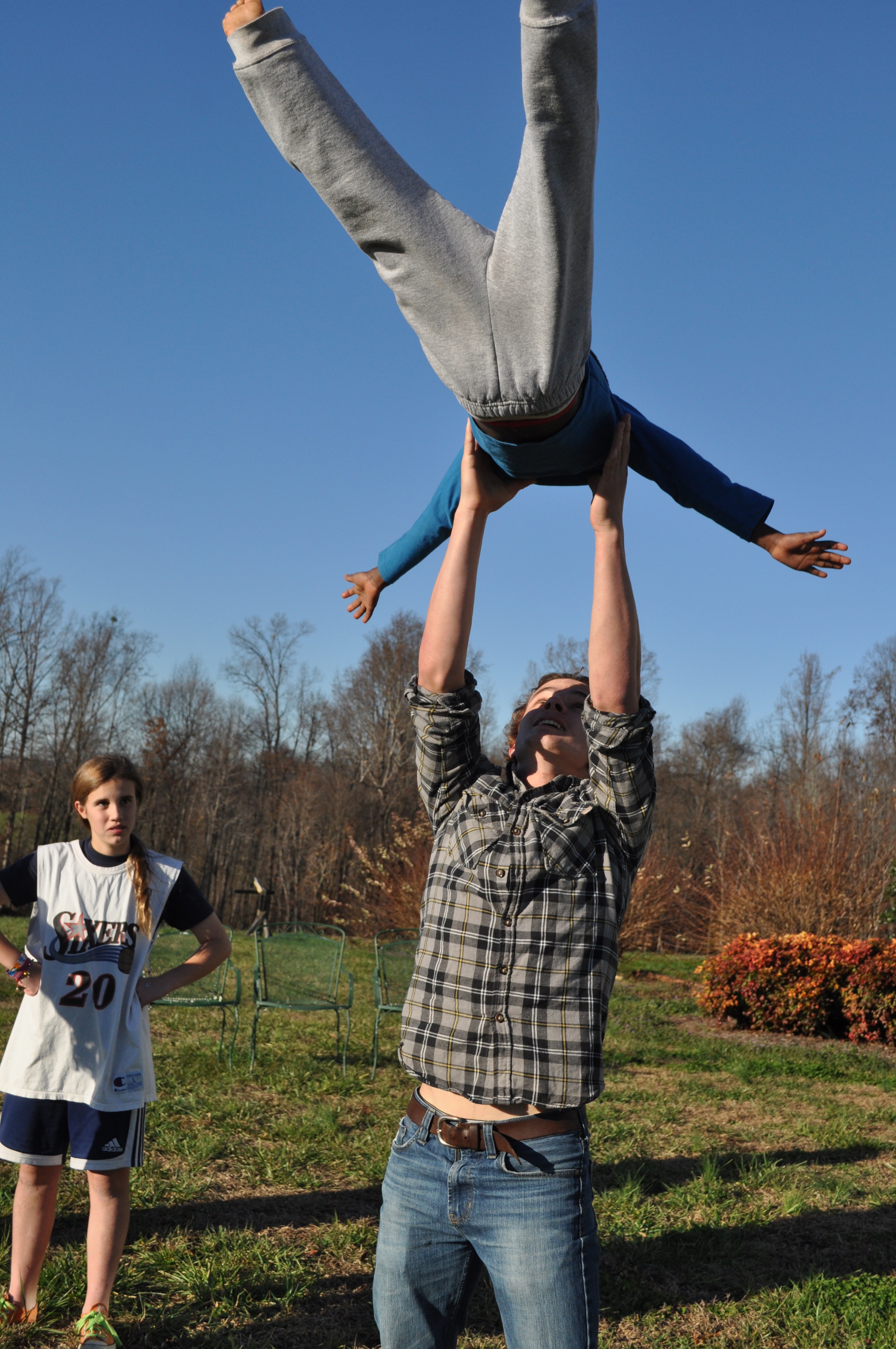
We spent Thanksgiving with my side of the family at my sister's place in North Carolina. Here's Seth (my sister Lynda's fourth child) throwing our PJ up in the air. What an awesome image of trust!

At this morning’s first church service, I read the Scripture passage for the Advent: “John 10: 10-18, ‘The thief comes only to steal and kill and destroy.’” Man, I have a good reading voice. “’I came that they may have life and have it abundantly.’” I wonder if anyone out there is thinking, “What a nice reading voice she has?”

Seriously, it happened. Maybe a bit more subtly than the way I wrote it above, but it happened. Darts of pride and self-awareness were shooting at me—and not from outside—from within! I had suddenly become the enemy.

I used to watch middle-aged-and-up women (and oh-my-word, I’m one of them now) in church and think: They have it! By it, I meant that they had “arrived,” that they had conquered sin habits and lived in a state of constant peace and faithfulness.

Well, if my own journey is anything to gauge it by, that’s not the way it works. I heard a preacher say recently (Rick McKinley at Imago Dei Church in Seattle) that Christians in their twenties haven’t yet discovered how truly sinful they are.

It’s true! In my twenties (and a little beyond) I remember taking stock of my sin problems and thinking it was only a matter of time and maturity before I had them licked—with God’s help, of course! I would add.

That makes me laugh now! With every passing year I discover more darkness within my own heart. The image I get is of roots going deep into the ground. I dig and dig—and find more and more, tiny tendrils (or not so tiny!) shooting out in all directions, growing faster than I can chop them off, going down into depths I can’t even see.

But I’ve made another discovery lately, this one far more hopeful: every sin root I find is an evidence of—and an opportunity for—GRACE!

I am often shocked by my sin. Seriously! I didn’t just think THAT! Maybe Satan planted that idea in my head; maybe I saw something that triggered it. That couldn’t come out of ME!

But it does, and God’s reaction to my sin is very different than my own. He is not surprised by it. He also doesn’t have my false levels of what is ok and what is not. He does NOT say what I sometimes imagine He does: You did what, Jen? That may be the last straw for you. That’s a new low!

No, He’s not shocked. In fact, He knew about it all along and is revealing it to me at just the right time. Last year a good friend told me, “I’ve learned to thank God when I recognize a sinful pattern in myself because it’s an area where He is leading me into growth. I can’t grow if I don’t see anything wrong or lacking.”

He knew about it all along (so it’s evidence of His great grace—loving me even though I’m far worse than I ever thought I was), AND He wants to use this new recognition I have of my sinfulness to help me to grow, i.e. OPPORTUNITY!

I limit and demean God’s grace when I am shocked by my sin AND when I try to deal with it on my own, wielding my trowels, shovels, even pickaxes in self-powered attempts to dig out the new roots I’ve discovered. Contrary to that, there’s great freedom in saying, as God gave me grace to do this morning, “Wow, Lord, You can see what I am wrestling with here. I confess that I’m struggling with some pretty nasty pride. I confess that it comes from me because I’m just as human as anybody else, and this is who I am in my human state. I’m so grateful You’re not blindsided by this, and I admit I need Your help to chop this root out. I know this won’t be accomplished immediately or even quickly—because it goes a lot deeper than I can see—but I ask for Your help in turning to You again and again when it pops up.”

This allows me to keep going (in this morning’s case, to keep reading) because I realize that my guilt-wallowing doesn’t accomplish my sanctification. I’m NOT saying I shouldn’t acknowledge my sin OR that I am not responsible for turning from it. Scripture uses strong language regarding sin in the lives of believers; “Put them to death,” it says”(Col. 3:5-8). But when I wallow in guilt, I resurrect the sins. I do the same when I try to pull the roots in my own power (oh, that awful “I got this” mentality). I choose either guilt or independence because it feels like I’m doing something, but both are counterproductive. I’m actually giving life to those sin roots.

So how do I pull them out/separate them from a power source? Well, God didn’t say to “put them to death” by myself. He wants me to cry out to Him. He WANTS to help me. And I have to acknowledge that I CAN’T to do that.

The battle is really a constant “setting aside” of self-sufficiency, a “putting on” of dependency that involves a deeper and deeper knowledge of who I really am without Christ.

Again, it’s paradoxical. Growth does not necessarily mean I struggle with sin LESS; it means I see more of it and I bring it to Christ again and again. As I do this, I grow more aware of my inability to deal with sin on my own.

And I also understand more deeply how God loves me—just as I am AND with a commitment to my growth.

“6And I am convinced and sure of this very thing, that He Who began a good work in you will continue until the day of Jesus Christ [right up to the time of His return], developing [that good work] and perfecting and bringing it to full completion in you” Philippians 1:6 (Amplified).

Time of Need

This morning I apologized to God. “Oh, Lord, I’m sorry, but I need You again. That’s all I do, just need You, need You, need You. I never have it all together.”

And then I laughed.

Because I really was serious when I said it, but then God allowed me to see the absolute absurdity of my statement.

What, exactly, could I provide for God?

What do I have besides my very neediness?

When I think I have something—anything—I’m delusional. I belong in the spiritual nuthouse.

How interesting that I am most sane when I am at my most needy, when I see that I am a complete mess. And I am most INsane when I feel like I have some control, like I have things together.

The prophet Isaiah, when he was transported to heaven, said, “I am undone.” In the presence of the holy, holy God, Isaiah recognized his own true state of inability and lack. Our self-help culture would say this is an unhealthy mental state, that Isaiah needs to buck up, pull it together, and think positively. And yet God orchestrated this. He wanted Isaiah to feel (as other translations say it) “ruined.” It was only after this that He led Isaiah into a bold, powerful ministry. Isaiah’s un-doing allowed him to see that his source of strength really was God, that Isaiah was powerless on his own.

I want to see—more frequently and more deeply—the holy God.

These true visions will undo me, they will ruin me; but this holy God is also merciful. He tells me to call on Him in time of need.

And my “time of need” is ALL the time.

Jackfruit

NOTE: It’s been finals week–ugh!–which is why I haven’t blogged lately. This post is the piece I wrote for my final writing class assignment (also this week). It’s about my time in Uganda but probably won’t fit into  the book about Patrick’s adoption.

“Jackfruit”

The pimply jackfruit sits on Vena’s knees like a second pregnant belly, the size of a basketball but misshapen, yellow-brown. The stink of rotten onions fills the small car—Vena picked it well—and Wilfred puts the windows down.

The look, smell—the dense weight—it would never sell in a U.S. grocery store, the muzungu thinks. But machete through the ugly rind and what a treasure. Pineapple-banana scent, warm yellow color, exotic tulip-shaped fruits nestled, jewel-like, in a yellow velvet pulp.

The muzungu peers her neck to catch fragments of the sky between the shacks, leaning buildings, trash heaps that crowd the narrow alleys and streets crisscrossing this hill-mountain. She shifts Patrick on her lap so he can see their upward climb. He points and jabbers, waves at children. Wilfred turns this way, that way—a fun maze without the fun.

At the very top is a flat space, with a large concrete building that looks as if a wrecking ball swung through it a few times but then gave up. Wilfred crunches to a stop on the rubble that is working its way out from the structure. Men, young and old, squat on the ground, sit on chunks of cement and in blown-out window ledges, stand around in small groups. It is a Sunday, but, judging by the looks of the area, this may be the scene every day of the week. Two young men approach as they get from the car, and Wilfred huddles with them, slips them some cash.

Vena hands Wilfred the jackfruit and leads, picking her way carefully in her Sunday shoes. Just over the crest of the hill, they see the slum, spilling down the side. Cast-off building materials poured from a giant dump truck, heaped up haphazardly into “homes.”

Vena nods at the women cooking over open charcoal fires, sitting on doorsteps feeding babies, hanging laundry. The muzungu follows her, clutching Patrick to her side as if he will somehow transform her white skin, her other-ness. She nods, too. Some women dip their heads, a couple even smile, but the men’s eyes are hard. The rare muzungu who comes here bears judgment or pity, neither of which builds a father’s sense of manhood.

I’m Alice, going deeper and deeper into the rabbit hole.

No, that’s not quite intense enough.

The red dirt paths between the homes form channels for run-off from above. They are walking on the slick, smooth bank of a stream. The smell of waste grows stronger when the water pools, covers the vegetable scent from cooking pots. She copies Vena’s flat-footed, splayed-out steps, leans on buildings at tricky spots. If she had her arms free she could touch fingertips to the walls on both sides, elbow-to-elbow in some spots.

Down, down, down. The maze driving up the hill was nothing compared to this. How does Vena know where to go?

Then Vena stops.

“Uncle? Uncle?” she calls.

She ducks her head inside a doorway.

Excited chatter. A woman steps out, near the same age as Vena but looking older with her hair in a kerchief and her chest sloping like a soft hill all the way to her waist. She hugs Vena, pats one large, strong hand on Vena’s belly. Wilfred, who came down the hill behind the muzungu, stands by, holding the jackfruit, smiling.

Vena turns to the muzungu. “This is my cousin. We grew up together.”

The cousin tucks her head, but the muzungu reaches out for one of her hands, shakes it. The cousin’s head comes up, her eyes brighten.

“This is Jennifer. She is adopting Patrick,” Vena tells her. “She is living with us for awhile.”

The cousin motions them in. Their eyes adjust to the sudden dark. One room, no windows, though light filters in through a jagged hole high up in the wall, covered with a piece of cloth. One small, upholstered chair sits next to the door. Across from it two others are stacked, with a small coffee table perched on top. Vena takes the jackfruit from Wilfred, puts it on a shelf that holds a bag of rice, a bag of beans, and says something to him, tipping her head toward the chairs. Wilfred sets the coffee table in the center of the room and places the chairs around it.

“Jennifer, sit there.” Obediently the muzungu sits. Her knees touch the table. Patrick slides from her lap and stomps his feet, glad to be down. He beats his hands on the table.

There is a rustle just above the muzungu’s head. Halfway up the wall, the bricks jut in, forming a wide, deep alcove. A man sits up inside this, swings his legs over the side.

“Uncle!” Vena says. He slips down, one hand clutching his loose pants, the other holding his buttonless cardigan closed over his bare brown chest. He blinks but then recognizes Vena and begins chattering in Lugandan. The muzungu pulls up her feet so he can shuffle between the table and the chairs. Vena hugs him gently.

“Jennifer, this is my uncle.”

He turns to the muzungu, a smile splitting his wrinkled face. Cracked brown teeth fill the gap. Beside him Vena’s white teeth gleam. A picture perfect for toothpaste advertising.

Vena told the muzungu once that she, Vena, had such nice teeth because she had no sugar as a child. “We were lucky to get one meal a day,” she said. “No money for sweets.”

“So if a person has nice teeth, they were probably poor growing up?”

Vena shook her head. “They were poor AND their mamas cared about their teeth. The ones with teeth like…?” She pointed at her gums and looked at the muzungu.

“Stumps? Decayed?”

“Yes. Their mamas gave them sugar cane as babies. Cheap. Keeps them from fussing. Easier for the mama, but bad for the teeth.”

The uncle settles in his chair, the one near the door. Wilfred stands, uncertain, until the young cousin pulls a wooden stool out from against the wall. She and Vena hold a hushed conference, and the cousin slips past the door cloth.

They talk, the voices up and down, laughter tinging. Patrick moves down the table, wiggles his way between the uncle’s knees. The uncle asks Patrick questions. More laughter.

The muzungu does not understand, but she smiles, watches, tries to look at the room without showing that she is. Labels—the plastic ones from 2-liter soda bottles—have been fastened to the wall. Coca-Cola, Fanta, Mountain Dew, Sundrop; a red, orange, purple, green, yellow patchwork. She watches the uncle’s hand rub Patrick’s head, answers the questions he asks her through Vena.

The cousin comes back with soft drinks, lukewarm in glass bottles, small cakes in cellophane packages. The muzungu hopes Vena gave the cousin money for this.

Is her reluctance to take—masked as guilt for their spending money on her—a way to separate? She remembers the story of the three Southern pastors, firm in their conviction that drinking alcohol was a sin, being offered beer by a pastor at an overseas conference. Two refused, one accepted. When the two later said, “How could you?” the other answered, “I thought one of us should act like a Christian.”

Translation: not separate, not better. Seeing past the outside, looking in.

The cousin pulls aside the doorcloth and sits on the stoop so she can talk to Vena and still greet passersby. A few stop to chat. A few try English with the muzungu. More laughter. The bright patchwork on the wall fades as the light changes. The cousin’s shadow stretches behind her.

Vena stands.

“No, Uncle, do not get up.” She leans down to hug him.

The muzungu steps over the table, stands near the uncle. “Good-bye,” he tells her. The cousin reaches for the muzungu’s hand, holds it for a moment before Vena leads them out.

Out to where sewage smell drifts up from the water in the path.

Just like jackfruit.

Leash Lessons

Chai running at the dog park

Our dog Chai was found a year and a half ago running around the farmlands surrounding our then-hometown Sterling, Kansas. We knew this when we got her from the animal shelter, and this knowledge of a wild side helped us in choosing her name.

“Pumpkin?” (the name given to her by the folks at the shelter.) Nah, too orange.

“Penny?” Right color, cute name—like her—but, too… tame. Her golden eyes have a James Dean look. She’s spunky and a bit…

“Spicy,” said Em.

“Like chai,” said one of us (probably me, since it’s my all-time favorite drink, but I don’t remember, so I can’t claim it.)

“Yeah, she’s a mix of sweet and spicy.”

She seemed to leave all the spice behind after we adopted her, but when we left on a trip and asked two neighbor boys to take care of the dogs while we were gone, we found out that without the constant activity of our family, Chai’s spice was alive and well.

“She found every possible hole in your fence,” one of the boys told us when we returned. He’d ”fixed” them with bungee cords he found in the garage. “Then she realized that with a running start, she could jump the fence. I finally had to tie her in the middle of the yard, and even then she figured out she could wiggle backwards out of her collar.”

For a week after we returned, neighbors would tell us how Chai had come visiting. They’d all just taken her back inside the fence—only to have her visit again.

The wild side had returned, and it didn’t want to leave. She began jumping the fence at every opportunity, running through town, then discovering the forest on the west side of it. She had a couple of all-nighters, not returning till the next morning, trailing a leash on one of those occasions. Finally we gave up training her—and worked on the kids: don’t let her out except on a leash. Don’t put the leash DOWN. Know that if she sees a squirrel or rabbit, you hold on tight.

Then we moved back to West Chicago. We joked about taking Chai—and PJ, for good measure—to the local police station that first week. “See this little boy and this dog,” we would say. “If you see either of them running around, they should be at ____________. Please bring them home.”

But after a few “excursions” (fortunately PJ’s was just around the block—though I scolded him like he’d crossed a major highway), they both seemed to settle in. We could even let Chai wander free around the back yard—as long as we were out there with her.

But lately the wild streak has come back. I blame the squirrels, who seem to be holding a tribal reunion in our town.

But maybe it’s the crisp weather.

Or the moon, as one of my Sterling neighbors used to say. “Full moons bring out the wild in dogs.” She said it happened with her dog, another rescue found running in the wild.

Regardless of the cause, Chai’s back on the leash whenever we set foot outside the house. I’m thankful for the local dog park.

I just came back in from taking her out to do her duty—on the leash.

And it made me think of myself.

I’m on a leash, and I’m really, really thankful God has the other end of it.

I’m not saying there isn’t freedom in following Christ—oh, there is—so much abundance, so much joy—but ironically, the abundance and joy and freedom are only found when I’m close to Him, the leash slack and easy, my closeness born of my desire to be with Him, born of my understanding that being with HIM is not “better,” it’s BEST, BEST, BEST.

But I’m like Chai, constantly pulling to the end of the leash (though my temptations are mirages of “orderliness” [legalism, guilt, self-righteousness, martyrdom) rather than the lures of entertainment and adventure).

And He pulls me back.

He lets me stick my nose in poop or step on a thorn or get briars in my coat, but He pulls me back, even while He knows that this is my bent, this is what is natural for my humanity. He knows that I will do it again and again and again. And every time He pulls me close, pulls me near.

He never lets go. Never gets so tired with my tugging that He says, “Ok, go, leave, if that’s what you want.”

Never. Not ever.

He HOLDS ON to me.