In this moving process, I keep returning to Psalm 27. This morning the part that jumped out at me was the purity of David’s prayers: “I will seek Your face,” “One thing I ask of the Lord,” etc. I thought, “Man, David was so single minded on You. He wasn’t like me, thoughts flitting all over the place, many of them of no consequence at all and most of them focused on myself and my struggles.”
Then the Lord whispered, “You think he wasn’t like you? You think he was some super saint?” And I pictured David up on that rooftop, indecisive about joining his army at war, itchy and unsettled because that’s where he SHOULD be. He may have thought, “What is wrong with me?” (which I often ask myself.) In that state he saw Bathsheeba, and her beauty seemed like the answer to the restlessness in his soul.
David wasn’t so different from me after all. Many of the Psalms follow a pattern of lament followed by remembrance of God’s goodness and faithfulness. I would imagine there were even more that were not recorded. My own journal writings often follow this pattern. It was NOT that David did not itch and squirm with his own sinful, selfish humanity, but over and over he brought his mixed-up mess to God—and found relief there. More than that, he became captivated by God. Perhaps some of his praise psalms were written directly after psalms of lament, when the miracle of God’s goodness broke into a time of discouragement or despair.
Even when David sought to relieve his itch elsewhere—with Bathsheeba or numbering the people—he recognized his error and turned back to the only true balm for the itch. It is this turning back, this turning away from self-centeredness or pride or whatever, that makes David a man after God’s own heart. David DID struggle, like I do, and he recognized and accepted his own lack and took it to the source of filling.
Did he get frustrated with his always-present need and lack, like I do? “I keep coming back with the same issues,” I cry to God so, so often. “I have to keep getting filled. Why can’t it be a ‘one-and-done’?” Is that why David went after Bathsheeba? Did he think it might soothe his restless beast forever?
I have to come to Your well of living water again and again, Lord. Not because You run dry but because my vessel is so small. Please protect me from seeking to fill my cup with other things. Help me to come, day after day, hour upon hour, my tiny, cracked cup empty, and fill it up with You. Help me to be all right with my lack and need. Help me to be fully satisfied with You. I think these two—acknowledgment of need and recognition of Your satisfaction—go hand-in-hand. I will seek other things to scratch my itch if I don’t see how deep it really is, that it is merely a symptom of a wound that goes all the way down to my heart. Or, to stop mixing my metaphors, I will try to fill my need with other sources if I do not recognize how damaged and flawed my vessel is, that it will always be that way this side of glory.
Uncategorized
Trust and hope
Last night Em had two friends over for dinner (the three of them fixed it, a nice thing, though their cleaning up skills still need a LOT of improvement). During the meal, one of them mentioned Father’s Day, and I gasped. “What?” Em asked, startled. “I completely forgot to call my dad on Father’s Day,” I said. “I didn’t even think of it as BEING Father’s Day.” Last week I sent my dad a card for Father’s Day (complete with a really cute recording of my kids singing to their “Pops”), but then we celebrated early with Dave because he left town before dawn on Sunday morning on a weeklong trip, so Sunday simply felt like a “normal” husband-is-out-of-town survival day. Plus I had two single-parent friends over for lunch, and we chatted for a long time that afternoon. So, with all that going on, and a crazy week following, I forgot about Father’s Day. Late last night I decided to send him an e-mail explaining and apologizing for my forgetfulness.
When I opened my e-mail, there it was, the response from the literary agency I’d been waiting five weeks for. It was a form rejection letter—no, it was a form rejection e-mail, about as impersonal as you can get, in my opinion. It had the standard “We’re sorry, but your submission does not meet our editorial needs” line that could mean just about anything, and it had a link in it to an article for aspiring writers that basically said (keep in mind that I read this in a discouraged state) that getting published is a fierce competition and “do you really want to keep entering the rat race?” It also said that rejection is good for my character.
I wanted to say, to the vague, nameless person who pushed the send button on the generic e-mail, “Who put you in charge of my character development?” but, all my snippy comments aside, I found myself clinging to trust, a much better alternative. (Dave expressed anger for me. When I told him about it, I said, “I’m okay. I really am.” He responded, “Well, I’m not. I think it’s crappy,” and I have to admit that was gratifying.)
But in the process of God reworking how I view my writing, I’m learning that it, like everything else, is a matter of trust in Him. That sounds too simplistic; at the same time, it really IS simplistic. If I truly believe that the transcendent God personally loves ME (more on this ongoing lesson in another post), then I must believe that He orders every bit of my life for good, capital-letter GOOD. This is not only the good of His entire universe—big picture scenario, reaching both into time and scope—but also MY good. I don’t believe God is a “lose the battle to win the war” commander in chief. He doesn’t sacrifice me (or any other individual believer) for the good of the “bigger, grander” cause (and here I must add that I think we often have skewed ideas about what IS the “grander” purpose. One individual soul may often be the grandest cause in the eyes of God.)
HOWEVER, I understand that the “good” God has for me generally doesn’t involve my comfort or the stroking of my self esteem. My good may be depth of trust in Him, a greater understanding of others’ pain or sufferings, a deepened relationship, or acknowledgement of a sinful pattern in my life. My “good” often hurts in the process of it being worked out.
Let me get back to writing, I LOVE to write. I have tried to stop multiple times, but I cannot; it’s a part of me. I’ve tried to be content with writing only for my own eyes. That also doesn’t work. Deep down is a longing for others to read my work and be impacted by it, for—I’m being raw-honest here—publishers to pronounce it good and worth reading.
Yet publication may not be my best good. God’s plan may be for me to never have a book published. So as I submit book proposals and queries, I have to do it in hope—perhaps this is the agent who will accept my work—as well as in trust—even if it is not and I continue to send it out time and time again and continually rework it and other projects without any outer signs of “success,” this IS God’s good for me. It may be that the rich and varied relationships I’ve formed because of my writing, the personal opportunities I’ve had to share my faith in a good God, these may be the bigger purpose of my writing.
Last night God provided both trust and hope. I read the “form rejection e-mail,” perused the discouraging article, read the e-mail again, and then somehow felt strength enough to look at another agent’s Web site, read her requirements for submitting a nonfiction proposal, and send it to her. The next morning I woke feeling a bit discouraged and tired and had a chaotic day with my own four and some extra neighborhood kids running around the house. I am so thankful God gave me energy, focus, and hope at a time when I had the quiet space to actually do something. What a gift!
Hope and trust. Actually I think trust and hope is probably the better order; hope flows from trust. When I believe that God really loves me and has good planned for me, then I can have hope that whatever happens is not only good, it is best, regardless of how it looks to anyone else, or even of how it may feel to me.
Stargazing with the kids
I am sitting on my back stoop looking at the stars. The air is finally bearable on the skin. Only 30 minutes ago my younger three children were still rolling around in their beds, prickly and sleepless with the heat. Usually the cool has fallen by this time of night, nearly 11, and you almost need a sweater to sit outside, but not tonight.
It is breezy, though, which always helps, and the winds have swept most of the clouds away. Straight above my head hangs the Big Dipper (one of the few constellations I know.)
And I learn that my children are still not asleep. Jake appears at the screen door behind me. “Mom, PJ can’t sleep.” I don’t point out that obviously he can’t either. First I tell him to go to bed, but then I call him back. “Go get Maddie and Patrick and bring them out here,” I tell him.
Now we’re sitting out together, looking for shooting stars (Maddie says, “Sometimes your wishes comes true.” She’s still working on subject-verb agreement.) and blinking lights (“Maybe it’s a spaceship,” says Jake, and it feels like I’m bursting a bubble to tell him it’s probably just a plane, that we couldn’t see a spaceship.) PJ wants to know if he can see Jesus, and then they begin a very strange conversation/argument about Pluto. Patrick thinks Pluto is a dog and begins calling for him.
Maddie notices that her name is on my computer screen and begins giving suggestions. “Write down what I just said,” she tells me. She asks me to read her what I’ve written, and she pronounces it good. I like that girl.
Unfortunately I am far more tired than my children seem to be, and I know that Jake will still, despite the late night, wake around 7, and a long day of “Mom, can you…” will begin early. But this is what summertime nights are sometimes for, and even though I am really ready for PJ to show any sign of being tired, I am still thankful for this time.
This World Is Not My Home

This is Broadway Avenue in Sterling, decorated with holiday lights. I took this picture late Christmas night, 2010.
When I was a teenager I read a short story titled “The Man without a Country,” and I’ve never forgotten it. In it a young lieutenant in the U.S. Army becomes friends with the traitor Aaron Burr (the story is set in the early 1800s) and supports his cause. Put on trial for treason, the lieutenant says, “I hate the United States. I wish I may never hear of her again.” His judge makes that his sentence. The lieutenant is put on board a ship, is never allowed to set foot on U.S. soil, and is not allowed to ever hear any news of the United States. He becomes a “man without a country.” His sense of loss grows the older he gets, and he hates the choice he made as a young man.
As teachers, Dave’s and my lives have always been ordered by the school year, and in every move made in the past, we’ve known by March, usually before, that we would be moving in the summer. With those decisions, there was always a longer term of separation, a sense of still being a part of life in the present place until the actual move occurred. That has not been the case in this decision to return to Chicago. I finished teaching my class at the College less than a week after the decision. Dave was officially finished with coaching only two weeks after that. The students and soccer players left; our kids finished school; and our church and college friends moved into that natural gap between the hectic end of school and the slower pace of summer, when people take a break and you just don’t see each other much. It’s made me feel very disconnected, “a woman without a town.”
It’s also reminded me of the lessons God has taught me, over and over, through our moves, that I don’t really belong in one particular place, that the pursuit of happiness and comfort is a short-sighted goal, and my gaze should be stretching into eternity. It’s hard to grasp these truths in my Western, comfort-centered world and life, no matter how hard I fight against the materialism and the this-world focus, but in times of transition I “get” it more, and I understand the heaven-focused gaze of many of the African brothers and sisters I have met, of believers in persecution or hardship. I’ve been singing the spiritual “This World Is Not My Home” to help me remember and identify with this heaven-set perspective.
This world is not my home I’m just passing through
My treasures are laid up somewhere beyond the blue
The angels beckon me from heaven’s open door
And I can’t feel at home in this world anymore.
Oh Lord, you know I have no friend like you
If heaven’s not my home then Lord what will I do
The angels beckon me from heaven’s open door
And I can’t feel at home in this world anymore.
They’re all expecting me and that’s one thing I know
My Savior pardoned me and now I onward go
I know he’ll take me through though I am weak and poor
And I can’t feel at home in this world anymore.
I don’t like the “not at home” feeling I have right now, but I believe it might be exactly what God wants for me, if only to remind me of the truths of this song.
I have no friend like You, Lord, and my home—present and future—is in You. My lonely soul can abide there.
Skin Color
NOTE: I wrote this more than a year ago (the date is above the entry), but in the midst of packing, my journal writing is limited to a few sleepy scratchings in my notebook before I drop off to sleep, so I’m posting something from the past.
4/9/10
I am unsettled today, with an itch in my soul.
I don’t know why.
I’m not sure I’m supposed to. Perhaps it’s spiritual warfare. Perhaps it is sinful self-centeredness. I become more aware of both as I grow older, it seems. In the past (and I confess this is still my tendency), I would fight this feeling with busyness. Do, do, do—I push down my uneasiness of the spirit when I can check off items on my to-do list.
But today I do not do that. I work out with my husband—he looks at me funny and asks if something is wrong. I realize I am sending off vibes. I tell him I do not know, but it is not him. He lets it be—that’s growth for him as well. I get a haircut, and then I take my preschooler to story time at the library. We visit afterward with the Shirley the librarian and her husband, Warren, who also works there. He will have surgery on his hip again soon. I have lost count of how many surgeries this will be for him. He does not complain.
PJ and I return home and I make him lunch and we look at books together. I brush the dog, do a load of laundry and finally sit at my computer—what I think may be the thing I’ve been avoiding all day. I am querying today—the job I like least about writing from home. I struggle with the smallness of my accomplishments, with my relative anonymity in the writing world, with the unstructured nature of freelance.
PJ runs in and out. I attach a blue arm to a Lego man who already has one red one. PJ puts the Lego man into the bucket of a toy backhoe and runs it across my office floor, making noises with his mouth. Suddenly he jumps up to show me the Lego man. He points to one arm. “Brue!” he announces. Then the other. “R-ed!” This is a new skill for my youngest, who joined our family only a year ago, a three-year-old orphan from Uganda, with almost no spoken language skills in either English or Lugandan.
I almost cry as I look at PJ, his beautiful white teeth shining so bright against his chocolate skin. He points to his arm—“Skin,” he cries—and then he touched my forearm. “Skin!”
“What color?” I ask him, laying my forearm next to his. “Black,” he says, and I wonder where he has heard this. It is not that I object to the term “black,” but it is not the color of his skin. PJ’s six-year-old brother often tells him he looks like fudge. I don’t think we’ve ever called his skin “black.”
“What color?” I ask, pointing to my arm. His eyebrows crinkle, and I laugh. “I don’t know either.”
“White?” he says, tilting his head.
“Not really. Tan maybe—a lighter brown?” He smiles, and the town siren goes off. I realize it is one o’clock, naptime. I scoop him up and carry him up the stairs, thinking about our differences in color. I know there will be times in the future when this will be a greater deal—a HUGE deal for him, but for right now we can see together—my skin, his skin, it’s both “skin” covering two souls who love each other. That is good.
I sing to him, kiss him and rub his earlobes—a little thing that is much for me as it is for him, they are very, very soft—and I leave the room.
When I return to my computer, I write this and forget query letters for a while. My itchiness has evaporated. Perhaps in that other world, the nebulous world of writing, I am unknown. But here, with my children, my husband, Shirley and Warren and the rest of my town, I am both known and called to know, to love, to share of myself.
This, too, is good.
More Funnies from the Kids

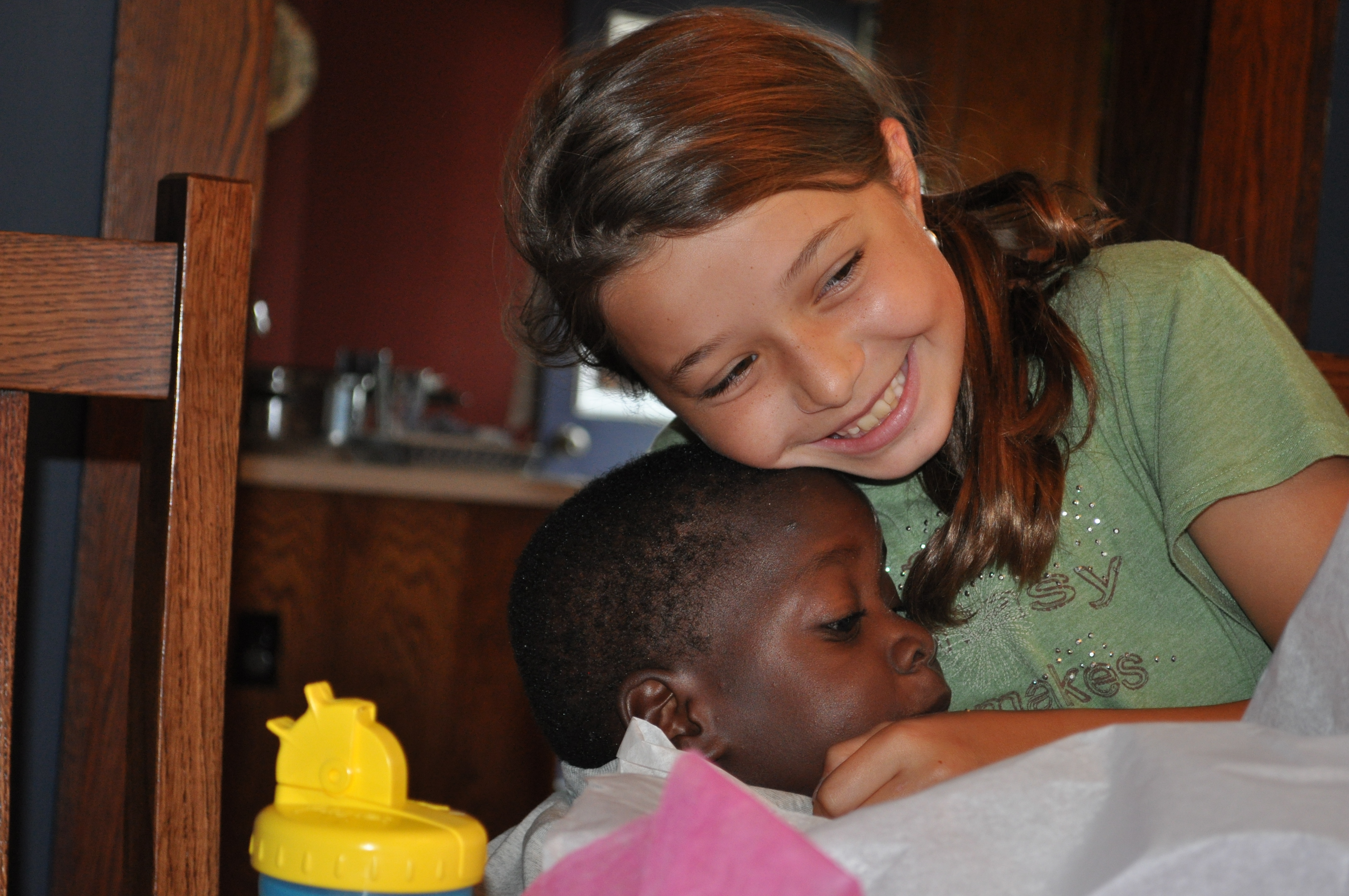
Em is a GREAT older sister. She often doesn't get text space when I write about "funnies" the kids say because she's older and thinks a lot, but I wanted to share this picture because it shows the love she definitely has for her younger siblings (even though they often annoy her.) Thanks, Em.
Here are a few from the last couple of weeks:
-I bought “real” Rice Crispies (usually we get generic, but I had a coupon), and the kids have been commenting on the three characters on the front of the box and learning their names. One morning they were discussing favorites.
“Mine’s Crap,” said Maddie.
Dave, Em, and I looked at each other.
“What, Maddie?” Dave finally asked.
Maddie pointed to the middle character on the box. “You know, that one. There’s Snap (she pointed to the first one), Crap (the second), and Pop.”
-Jake has been having moments of sadness over the upcoming move. I was sitting at my computer when he came and crawled on my lap.
“What’s wrong, buddy?” I asked him.
“I’m going to miss my friends,” he said.
“I understand,” I told him. “I’m going to miss my friends, too.”
He pulled his head back and looked at me, his eyebrows wrinkled. “You have friends?”
Thanks.
-This weekend we were all sitting on the front porch when a police car passed by. “You know,” PJ remarked, “policeman tickle robbers under their arms.”
We questioned him more about why he thought this and then laughed like crazy, but I think I have it figured out. He’s probably been wondering why policemen always tell the “bad guys” to put their hands up and has come up with this as an explanation. Not bad.
-Our verse for devotions a couple weeks ago was “Always be ready to give an answer for the hope that is in you.” Dave asked the kids if they could “give an answer.” Em said yes and shared the ABC pattern she learned from Sunday School.
“A is for ‘admit you’re a sinner’,” she said. “B is ‘believe that Jesus paid for your sins,’ and C is ‘choose to follow Christ.'”
There was a moment of quiet as they processed; then Jake said, “Hmm, I think I’ll take B and C.” Oh, the insight my kids provide into my own humanity!
Highway trash–and the value of humanity
We are traveling from Chicago to Kansas today, logging straight highway miles through Iowa and Missouri. National Public Radio is on, and an announcer just spoke of the brutal beating, to death, of a 12-year-old boy in Syria. As I listened to the account, I remembered the suitcase I saw on the side of the highway earlier on this drive. Flopped open and pressed up against the concrete half wall separating the two halves of the interstate, it spewed its contents along the side of the road. Those were important once, I thought when I saw a flutter of pink fabric and then noticed the rest of the lost items. Perhaps some were even treasured, stood for life events or special moments, told stories to their owner. Now they are scattered and exposed; they have become trash. I felt the sorrow of loss, and as I listened to the awful news of this nameless boy’s death, I connected the two images and realized that this young human, truly so precious, had also become a piece of trash to some people.
Like my mind was following a thread, another picture came to mind, this one from a long ago visit to the Holocaust Museum in D.C. Near the entrance was a giant bin of shoes, shoes taken from concentration camp victims, each one standing for a person whose value to the Nazis was less than the shoes he wore. Another image, this one from a movie, made me think of the RwandanTutsis, their personhood so unimportant that their slaughtered bodies were allowed to lie in the open air. These are gruesome images, extreme and very separate from my life, but then the Holy Spirit gently brought this sin home to my own heart. I realized that when I pretend I don’t see someone on the street because I have a schedule to keep and no time to chat, when I avoid eye contact simply because a person appears too different from myself, when I switch the news channel from another tale of human suffering, that in doing these things I have denied an innate human right and taken a tiny step toward considering someone else as worthless.
I suspect Philippians chapter 2, which I read this morning, has much to say about this. I am certain that Christ did not ever deny or ignore another’s personhood. What must that have looked like? He encountered all people as fellow human beings; He desired connection with them because each one was a soul, with depths they themselves didn’t understand; He saw them as the workmanship of a creative God. I cannot even imagine what this might be like in my life, but I would like the Holy Spirit to work some of that transformation, to “let this mind be in (me), which was also in Christ Jesus…who counted others as more significant and looked to their interests more than he did His own.”
Sometimes I read the Gospel accounts of Christ’s interactions with people and think His tone sounds combative or blunt, but I wonder if that is because I am unable to fathom someone who actually values each person. His questions to the Pharisees sound harsh, but isn’t anger with a person and the willingness to call out wrong you see in him or her, isn’t that more respectful than simply ignoring or glossing over wrongdoing? When He asked, “Who touched me?” drawing attention to a woman who tried so hard not to be noticed, wasn’t He, in effect, saying, “No, you ARE important. I want others to see you as a person like themselves. I am tired of their ignoring you.” When He spoke to Nicodemus in word pictures that would have left me, too, scratching my head, wasn’t He saying, “I know the brain I have given you. Use it for something greater and higher than devising rules that bear down on people”?
From all the things I have read, Mother Theresa seems to have had some of this gift. Not all of her statements “feel good.” To the downtrodden she spoke hope, but to those blessed with physical wealth, she had less comfortable messages. (My conscience is often stung when I think of her admonition to give the poor the best we have rather than our castoffs, our worst.) What would this intense interest in others as human souls look like in West Chicago and Wheaton, in my worlds?
I’m not sure, but I want to try it. I really

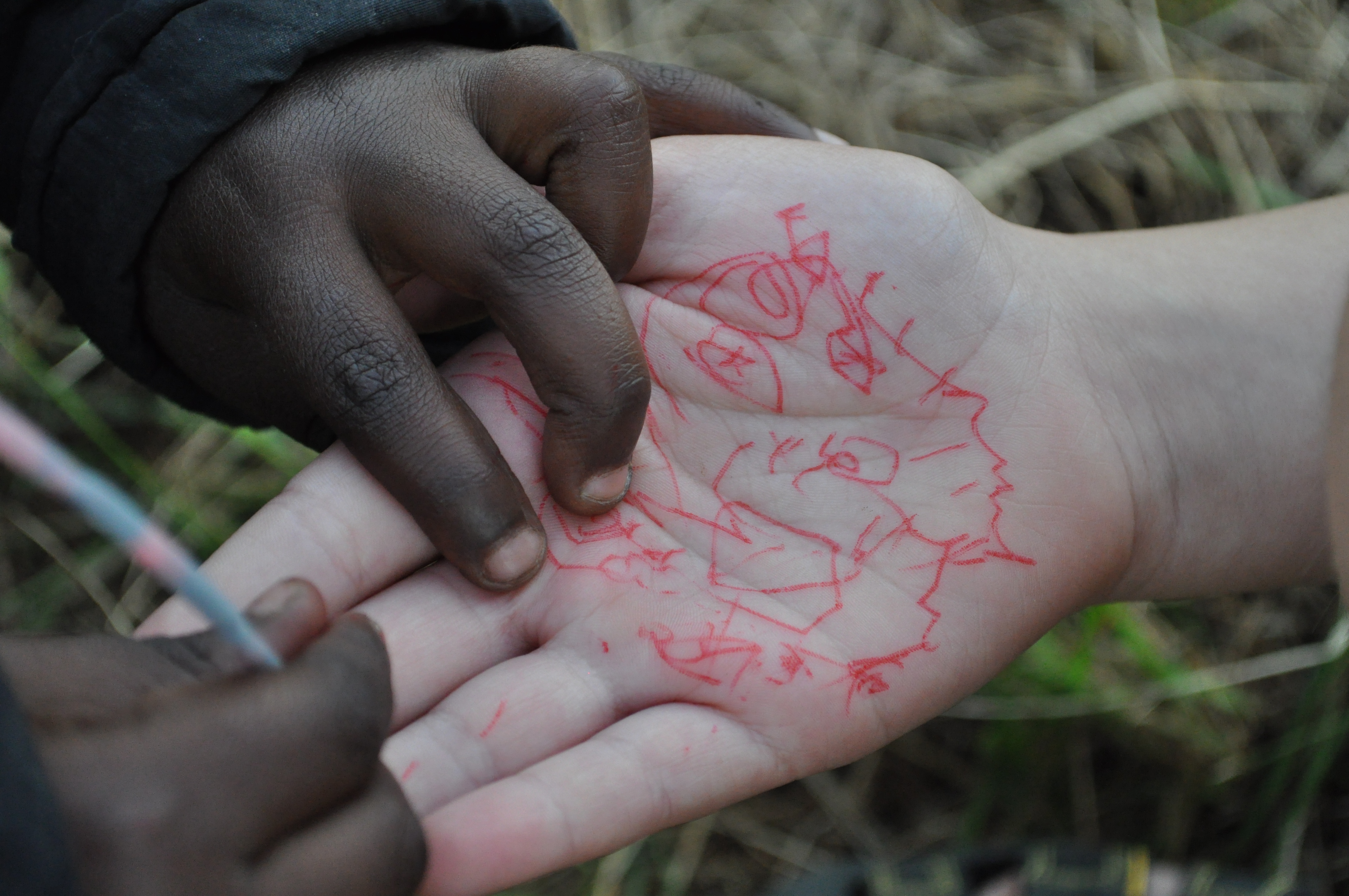
I took this picture in Kenya last year. A small child was fascinated with Emily's white skin and wanted to write on her hand. She was happy to let him.
do.
Sunflower Farm
Note: We’re currently in Chicago, looking at houses and schools and praying through too many big decisions. I wrote this journal entry on the trip up to Chicago, though the day I wrote about was last week. More on our crazy weekend in Chicago later!
Mr. and Mrs. Bates live a half mile outside town on the dirt perimeter road. She is from Belgium; he is African American, and they both have grown children from previous marriages and none, I don’t think, from their marriage together. I don’t know the story of when or how they met, though I’d like to hear it.
I began buying fresh eggs from the Bates a few months ago, and I rode my bike out to their farm this morning to get some. They put the eggs and a Tupperware with change in it in an old fridge—like the one in my Mammaw’s house when I was a child—in the carport attached to the back of their house. I left my bike at the front fence and walked down the lane with Chai. Their little dogs (mom and daughter, rat terrier size the both of them) set up a racket, and Mrs. Bates stepped out. I bought three dozen beautiful blue, tan, and green colored eggs, and we chatted, stepping out of the carport to look over the beautiful little piece of land they have named Sunflower Farm.
She asked me about our upcoming move to Chicago, and I told her I was sad to leave Sterling. In her beautiful accent she began telling me that when she was young, she could not have lived in Sterling. “Too small,” she said. “I needed the city, the life. Now it is perfect for us. We like the quiet. I even hang my clothes out like my grandmother in the old country.” She waved a hand at Bates’ bright-colored work shirts waving on the clothesline next to the chicken barn and laughed. “I always said I would never do that.”
She went on to tell me about her grandmother’s bleaching area, a section of the yard where the grass was left to grow long. “Oh, if we forgot and ran through the bleaching yard, oh how would get scolded!” She smiled at the memory. “My grandmother would wash her whites and then lay them wet on the long grass. The grass would somehow whiten the cloth. So bright. When the clothes were dry, she would gather them, wash them one more time and then hang them to dry. We never used bleach,” she said, shaking her head, “but they had to be so clean. It was a shame to have dingy clothes hanging on your line, you know. It reflected badly on them as housewives. That was their world, their only area to shine.”
I had never heard of such a thing, and I wondered at how we lose knowledge like this, understanding of how the natural world can do things we now use chemicals to accomplish. It made me want to let a section of grass in our yard grow long and try it myself (in the same way I want to try canning my own vegetables). Something tells me Dave might not be so interested in the idea!
Grace in the “funny” and “not-so-funny” moments
NOTE: I wrote this journal entry nearly a year and a half ago, but I decided to post it today. (One nice thing about going back through my journal is that I realize that I’m not the only one who has grown. My kids have made progress, too!)
A few days ago Jake and Patrick (PJ) got into it and PJ bit Jake on his butt, hard. When I pulled Jake’s shorts down to check, there was a serious red welt there, and PJ got a long timeout (for which he wailed as if I had beaten him—or bit him myself, I guess). Tonight when the boys got into the tub, the red welt was much smaller. PJ pointed to it and asked me, his face all screwed up the way it does when he asks me a real question (NOT “Why?”—that’s just standard response), “Mosquito?”
“No,” I said. “That’s where you bit Jake.”
“No,” he said. “Mosquito.”
“Not unless you’re the mosquito,” I answered.
And Jake lost it. He thought that was hilarious. “PJ,” he chortled. “You’re a mosquito and this,” he pointed to his butt, “is my mosquito bite.”
So funny.
Maddie did a not-so-funny tonight. She literally wrenched my work flash drive out of its socket, breaking it into several pieces. She came to me with the main piece in hand. “Mommy, you’re not going to like what I did.”
Uh, no.
But the grace of God intervened, and I did not yell or scream or make her cry. I started the “What were you thinking?” and then I stopped. “I don’t get it, Mads, but we’ll talk about this later,” I said and sent her to her room.
Em got on the phone and called Dave (I think she thought I might just lose it after all–she does understand what all might be on a flash drive–and wanted to call in the cavalry just in case or, probably more likely, she wanted to create drama. She is, after all, Emily.)
Dave came home a little later
.
And I was calm.
“I think it’s grace,” I said.
He grinned. “I know it is.”
Yeah.
So I went up to find Mads, and I put her on my lap so I could see her little face and told her I loved her, I wasn’t mad at her, I forgave her and the consequence would be that she couldn’t play on the computer for a week. She accepted it all and then she wanted to know what that little stick was anyway. As I explained it to her and told her that there was work on that little “stick” that is nowhere else and Mommy will have to redo it, her face crumpled into silent tears.
Maddie is generally a loud crier and the sobs and screams are generally of the “listen to how miserable I am” sort. Not these. Quiet, slipping-down-the-face tears.
It was another wonderful parenting moment, even more so as I explained to her the grace Jesus gave me so I could give it to her.
Oh, God, You’re good.
Letting the kids “float my boat” or at least my feet
Last Saturday Em and her best friend, Katie, gave me a “pedicure.” Katie told Em that I seemed stressed with the younger three kids and the upcoming move, and together they decided to do something special for me. So they set up a “spa” in one of the upstairs bedrooms (we’re not using those right now), took me by the hand and led me up there.
And here’s a wonderful little miracle! I squelched my nasty, first tendency to say, “Oh, girls, I have so much to do. I just can’t do this right now,” and I went right along with it—no hesitation whatsoever. And, that, if you know me, is definitely supernatural. (I struggle with a little god known as my to-do list.)
They pulled an armchair up to the blow-up footbath someone gave Em for her birthday last year. They put a robe on me and helped me sit down so I could soak my feet in warm, soapy water. They took turns massaging my shoulders. Ooh la la! Then it was time to dry my feet, buff my nails (I just sat there like a clam; they did ALL this), apply nail polish (they’d even made a little card with nail polish swatches on it for me to pick from), and then draw little swirly shapes on my toes! I even got a clear coat on my fingernails (I’m sure Em was hoping I would pick red, but I wasn’t THAT relaxed).
It was fantastic fun, and the price was great. It made me wish that I would throw my plans to the wind (here in Kansas, they’d fly two states away) and let the kids float my boat more often. I have a feeling there are many times when they are better at steering it than I am.