our second Advent

Here are the four beautiful girls Dave and I took to The Nutcracker in downtown Chicago (with the Joliffe Ballet--woohoo!) last Friday. It was a much-anticipated event, and it did not disappoint. Best part for Dave and me: watching the girls' faces as they watched the ballet!

Here are the four beautiful girls Dave and I took to The Nutcracker in downtown Chicago (with the Joliffe Ballet–woohoo!) last Friday. It was a much-anticipated event, and it did not disappoint. Best part for Dave and me: watching the girls’ faces as they watched the ballet! The boys spent the night with friends–which they said was the better deal! 

Just past 7 on Christmas morning Jake came into our bedroom—we’d said the digital clock could not have a 6 at the front—to announce that he, Patrick, and Maddie were awake.

As Dave and I sloshed mouthwash, Jake chattered, mostly about presents. Then, in the middle of his ramble, he announced, ““Christmas and Easter are the BEST! They’re God’s plan of redemption.”

Well put and true, though we still laughed at the way he said it.

It is now two days after Christmas, our celebration of the Savior’s birth. We anticipated Christmas through Advent, and then we will expect Good Friday and Easter through Lent. As Jake said: The whole picture of God’s capital-R Redemptive Plan.

Advent means “the arrival of a notable person, thing, or event.” Lent is a “season of penitence and fasting in preparation for Easter.” The only reason we are able to anticipate or prepare is because we know the outcome. We know the full scope of the story. So even our Lent preparation is tinged with hope, with expectancy of joy at the end.

But the Redemption begun at Christmas, finished on Good Friday, confirmed at Easter, still has a final chapter. This final chapter will end all tears, all injustice, all war. It will dethrone evil and establish God as the visible King of Kings and Christ as the Prince of Peace.

It will make us individually and collectively right and unbroken.

But this second Advent, second arrival, has not yet happened.

We still wait for it.

It is a waiting sustained by a sure hope, but this is often hard to remember.

For though the hope is certain, we know very little about the details. How could all that we see in the world around us, in our very lives—how could we ourselves, broken and flawed as we are—be part of this final Redemption?

Paul calls it “seeing through a glass, darkly.”

We are in many ways like the people of Israel during the first Advent, unable to see that the promises of old were about to unfold in tiny little Bethlehem—unable to see that Roman occupation, a travel edict, a young girl, a loving, faithful carpenter—and a slew of other details and people we know nothing of—could be used to usher in the Incarnation.

Perhaps the details of our lives are such that we, too, wonder if we are of any purpose in the Majestic Plan. Perhaps we, too, have tried to silence our soul-whispers of grand desire and settled for “the best we can make of life.” Perhaps we are going through heartache that makes us moan and cry out “Why?”

That is the reality of our earth-life. Uncertain at best, wailing at worst—waiting, waiting—because there must, must be more.

We must cling to the promise that there is. That the Promise Himself will return and shed light on this world so that the purposes of all that went before will be revealed. We will be amazed at how all of our lives, even the smallest details, was being used in God’s Plan.

Let’s not be like the sleepers in Bethlehem. As Christ was born yards from their beds, they slumbered and then woke the next morning with no difference in perspective.

They missed the Miracle.

If we fail to cling to God’s sovereign goodness (such a beautiful mystery—that in God “sovereign” and “goodness” are inseparably linked), we, too, will miss miracles, particularly the everyday ones of relationship and personal growth. We will lose sight of Purpose.

Anna and Simeon waited for years for the first Advent. There must have been times when they felt they waited in vain, when it was lonely and painful and hard.

But at the end of it, the Purpose they held in their arms shed light on the purposes of every one of their past moments.

So in this long period of the second Advent, let us wait and endure with the understanding that God’s Plan incorporates even our heartache, even our daily grind. Though we are in the dark involving the purposes, He is not.

For now we see through a glass, darkly; but then face to face: now I know in part; but then shall I know even as also I am known. I Corinthians 13:12, KJV

Glory and Goodness: a sure hope.

Communion Transformed

DSC_0269Communion terrified me for much of my growing-up years. Not because I believed I was ingesting real flesh and blood—oh, no. My father, a converted Catholic, was quite clear on his teaching against that. But he was also very clear regarding the I Corinthians verses about the Lord’s Supper. I got the message: Communion was NOT to be taken lightly. I was to do some self-examining prior to partaking and my attitude should be serious.

He needn’t have worried. I was SERIOUS!

As the pastor read from either I Corinthians or the Gospels, I would wrench my spirit, examining my life for sin. “Oh, God, please, please show me. I don’t want to do this in an unworthy manner,” I would pray, rolodex-ing through my past few days, looking for sins I had committed.

I don’t remember ever taking the little pill tablet of bread or the small cup of grape juice with joy. It was always with fear—“Did I do okay? Did I find everything to confess?”

Thankfully, that is no longer the case. I take Communion now as a symbol of Christ’s doing what I cannot do: (though I tried to for years on years) to rid myself of sin.

But there is another ironic change. I view sin differently, perhaps, oddly enough, more seriously than I did then.

Because I have realized it goes far deeper in my soul than I once thought it did.

I am “steeped” in sin. I like that description. The Pharisees used it when speaking to the man born blind—since, of course, his blindness proved that either his mother or he must have been more sinful than most—hence the blindness.

The word “steeped” makes me think of tea—the teabag infusing the entire pot—or of a chicken cooked all day in a sauce—till every bite of meat tastes of it. Separated from the goodness of God that I need at my very core, my being instead has steeped in my own selfishness. Hurtful actions, attitudes, and words are merely outpourings of this “steeping.”

I remember a Seinfeld episode in which George decided to do the opposite of all his natural impulses. It worked well for him—because every one of his natural impulses was actually destructive to either himself, others, or to relationship between himself and others.

If my sin issues are deeper than my actions or words, even thoughts… If my sin is actually the belief that I am most important in the universe—more important than any other person and certainly than God… If my sin is an attitude of self-sufficiency, of conviction that I am good and right—and, therefore, that anyone who disagrees with me is wrong…

Then the problem is not what I do, what I say, what I feel.

The problem is me, myself, I.

And I need transformation.

And I need to stop settling for conformation.

Back to communion.

My fears were based on the wrong belief that God wants conformation.

But Communion itself bears witness against this. If God wanted conformation, our sacrament would result in us putting something on, something that could be seen by others, like a perpetual Ash Wednesday.

But the commanded sacrament—“Do THIS in remembrance of Me”—is an ingestion that does not seem to change our outer selves at all. Eat of me, Christ says. Drink of me. Take Me into yourselves. Let Me be the nutrients that change you on the inside.

And “Do” this, present tense and ongoing. Again and again we must remember that Christ came to change the inner first. His work on the cross was complete—I am not saying that He must die again and again, oh, no—but I forget so easily and settle for conformity because I believe I can do that work myself.

So we take communion over and over and are reminded that He is in us, creating new hearts within, that THIS inner transformation is the substance of our faith, and outer change is merely the reflection, the outworking.

I no longer need to be terrified—either of my sin or that God is check-marking my confessions against a list of outward actions. What a wonderful change!

I take the wine: His blood covered and still covers my sin.

I take the bread: He is IN me!

The two together equal communion: friendship between human and GOD!

The terror is gone.

And I celebrate.

Consider Him

I consider weekends my heaviest work days. With all the kids home, there’s extra cooking, extra driving…

Extra.

Sunday afternoon, in the middle of cleaning for our church small group that we host on Sunday nights, with dinner prep still to do while one kid needed homework help and another needed nagging to get working on homework…

I got grumpy.

Self-centered.

Full of an inner rant about—

I’m not going to go into it. I’m assuming everyone pulls the martyr card sometimes, so you know what I mean.

And in my kitchen, bent over with a dustpan, God stopped me.

Look at the verse for the day.

It wasn’t audible, but I knew for certain that I was supposed to put down the dustpan, cross to the microwave, and flip the verse calendar that sits on it to that day’s verse.

“Consider him who endured such opposition from sinful men, so that you will not grow weary and lose heart.” Hebrews 12:3 (NIV ’84).

Seriously. That WAS the verse for that day.

Wow! You’re right, I prayed. How could I ever begin to compare my enduring to Christ’s? Help me to press on.

I did press on, but I still struggled with thoughts of self-pity, and this has continued off and on since Sunday (it would be better described as “on and off”). It’s been a recurring battle that I’ve either chosen to fight (with plenty of cries for help) or given into (yuck!).

On Sunday night, one of the women in our small group shared about a guilt battle that she has had to fight, over and over, in her head. It just won’t go away.

I’ve thought about her struggle as I’ve fought my own battle these last couple days. Why do some sin issues become recurring themes in our lives? Why aren’t they dealt with and done? Why do our cries for help for these sins grant release for only a short period before we have to do battle again?

But all my musings about the “why’s” haven’t helped me, either, even though I “know” some of the answers.

This morning I had to replace a burnt-out strand of lights on the Christmas tree. Even as I did this, my spirit continued to find all kinds of small things to gripe about. Tired of fighting the battle, I tried to shut my mind off. “Just stare at the lights,” I told myself. “They’re bright and beautiful.”

Look at the lights.

Somehow the phrase turned to Consider Him.

Consider Him, I thought. Consider Him.

“Oh, God!” I said in sudden realization, “Consider YOU!”

Not Your sufferings apart from You—like I’m trying to stack them up against my own petty “sufferings” and guilt myself into gratitude.

Consider YOU.

Because You are great and glorious and good. Because You are beautiful, bright light, and You long to shine into my darkness. And when I look at You, my darkness gets swallowed up.

When I look at You, I gain perspective. I see that, just as Your struggles had purpose, so do mine, even if I can’t see far enough to know what the purpose is. Just as You kept your eyes on the Joy of being reunited with Your Father Yourself and the Joy of reconciling many to Him, I can know there is an eternity ahead when I will know You in ways I can’t even imagine now.

When I consider Him, the rest of the Hebrews 12 passage gets worked out in my life.

I put up the lights, I wrote the above, and then I had to go to a dental appointment. The radio came on when I started the car, and the program was about women who are married to spouses who don’t follow Jesus. “Oh, that would be so hard,” I thought as I listened to the women’s stories of persistence and grace. “I’m so grateful for my marriage.”

Gratitude! For fellow believers—witnesses (Heb. 12:1)—who provide examples to me of turning to the Father again and again in their needs, and for the Father Himself, Who gives me exactly the right gifts—and exactly the right trials and discipline—to draw me closer to Him.

I’ve been far from gratitude these past few days. Most of my cheerfulness has been forced and false.

But considering Christ—Him alone—brought a real and genuine gratitude back and gave me sympathy for others.

Turn your eyes upon Jesus.

Look full in His wonderful face.

And the things of earth will grow strangely dim,

In the light of His glory and grace.*

Consider HIM.


*Turn Your Eyes Upon Jesus by Helen H. Lemmel, copyright 1922

That's Maddie under the paper-sack mask!

That’s Maddie under the paper-sack mask!

Pessimistic praying

I grew up spiritually fatalistic, in a family and in churches that firmly believed we were in the end times, and things were only going to get worse in our world until Christ’s return.

I still believe that Scripture bears witness to this, but lately the Holy Spirit has been convicting me about the pessimism that I’ve carried along with this belief. It is true that as a world, we are marching steadily further and further away from God, but I can’t find any place in Scripture that tells me to give up hope for God’s work in the middle of this.

I’ve begun to see that my “pessimism” has led me to pray limited prayers. I haven’t really prayed for great revival—in our nation or our world. I don’t remember ever asking for a widespread heart transformation of our political leaders—at least not with any real passion.

And this pessimism hasn’t just affected my “big” prayers. When I pray for someone seriously sick or injured in an accident, I hold back from boldly asking for healing. Instead I say, “if it be Your will, Lord” or I ask Him to “work things out for good.” Even when the longing in my heart is so great it throbs, I often hold back from praying in hope.

I think I began praying those words because Jesus prayed for the Father’s will to be done. It seemed right to follow His example, and I still think that is a valid way to pray. But I’ve been realizing that, though my WORDS may be the same as Christ’s, my attitude is entirely different. When I pray those words, they come out of doubt and not hope. When I pray them, I’m tamping down hope. I’m subconsciously thinking, “Well, if I don’t let my hopes get too high, then it won’t hurt when God doesn’t answer this prayer the way I want Him to.” This attitude seems pretty contrary to Scripture. In the Lord’s Prayer, the phrase “Your will be done on earth as it is in heaven” is incredibly hopeful! It’s asking for earth to be more like heaven, where a loving God—rather than a cruel Satan—reigns. When Christ prayed “Your will be done,” He did so KNOWING that His Father’s will was and is completely good. He KNEW that on the other side of suffering was unspeakable joy for him. I imagine there was great freedom when He cried that. I imagine He was thinking, I WILL triumph over the pain and loneliness. I WILL cling to the joy that is ahead.

I don’t pray for the Lord’s will in that way. My sight is incredibly limited, so there is no triumph, there is no ability to see what is on the other side. So when I pretend with my words to be able to do that, am I lying? What’s more important: the words that come out of my mouth or the stifled hope that is in my heart? If I think my words are going to hide a very different heart attitude from an all-knowing God, then I’m mistaken.

How silly to try to hide my longings from God. How silly to pretend to have the same wisdom and knowledge as Jesus. I am human, not divine. I can follow Paul’s very human example when he cried out for his “thorn in the flesh” to be removed. Again and again he “begged” for this. He didn’t try to pretend that it was okay. He didn’t try to be “spiritual” from the beginning. He didn’t act like he had God’s purpose in that thorn all figured out. No. He cried out. He let God know how he felt. He “begged”! His words honestly portrayed what was in his heart. THEN God began teaching him that “(His) grace is enough.” Paul, being human, didn’t start with that. He shared what was in his heart and then let God transform him.

Lately, God has given our family a rare rest time: No one is sick; all six kids are doing well at school and with each other; Dave’s enjoying his work; I’m not so incredibly busy that I’m barely clinging to sanity.

This is good, yes, but it’s also dangerous because it’s during these kinds of times that my prayer life often suffers. I don’t actively depend on God in rest times the ways I do when things are hard. I don’t pray with the same intensity. But God’s been reminding me that things are hard in others’ lives and—on a bigger scope—in the world and in the church. I can use this space of personal rest to pray with passion—and with HOPE!—for others.

I know that authentic prayer for others hurts. When I pray specifically for the persecuted church, my heart will have to stretch to care more about those brothers and sisters. When I pray for women and girls and boys who are being abused through sex trafficking, my sleep will at times be interrupted with urgings to pray in the middle of the night. When I pray for this nation’s political leaders, I will have to pay greater attention to what is going on in the government. When I pray for the members of our church, I will have to invest more of my time in their lives.

But HOPE requires that I pray. And faith requires that I pray in HOPE.

“For this reason I kneel before the Father, from whom every family in heaven and on earth derives its name. I pray that out of his glorious riches he may strengthen you with power through his Spirit in your inner being, so that Christ may dwell in your hearts through faith. And I pray that you, being rooted and established in love, may have power, together with all the Lord’s holy people, to grasp how wide and long and high and deep is the love of Christ, and to know this love that surpasses knowledge—that you may be filled to the measure of all the fullness of God.

Now to him who is able to do immeasurably more than all we ask or imagine, according to his power that is at work within us, to him be glory in the church and in Christ Jesus throughout all generations, for ever and ever!

Amen.” Galatians 3:14-21

I took this shot in Montana this summer and am posting it today because I find a lot of amazing lessons in the metamorphosis of butterflies and in their fragile, short lives following their transformation. I see them as very hopeful creatures.

Lessons in the journey

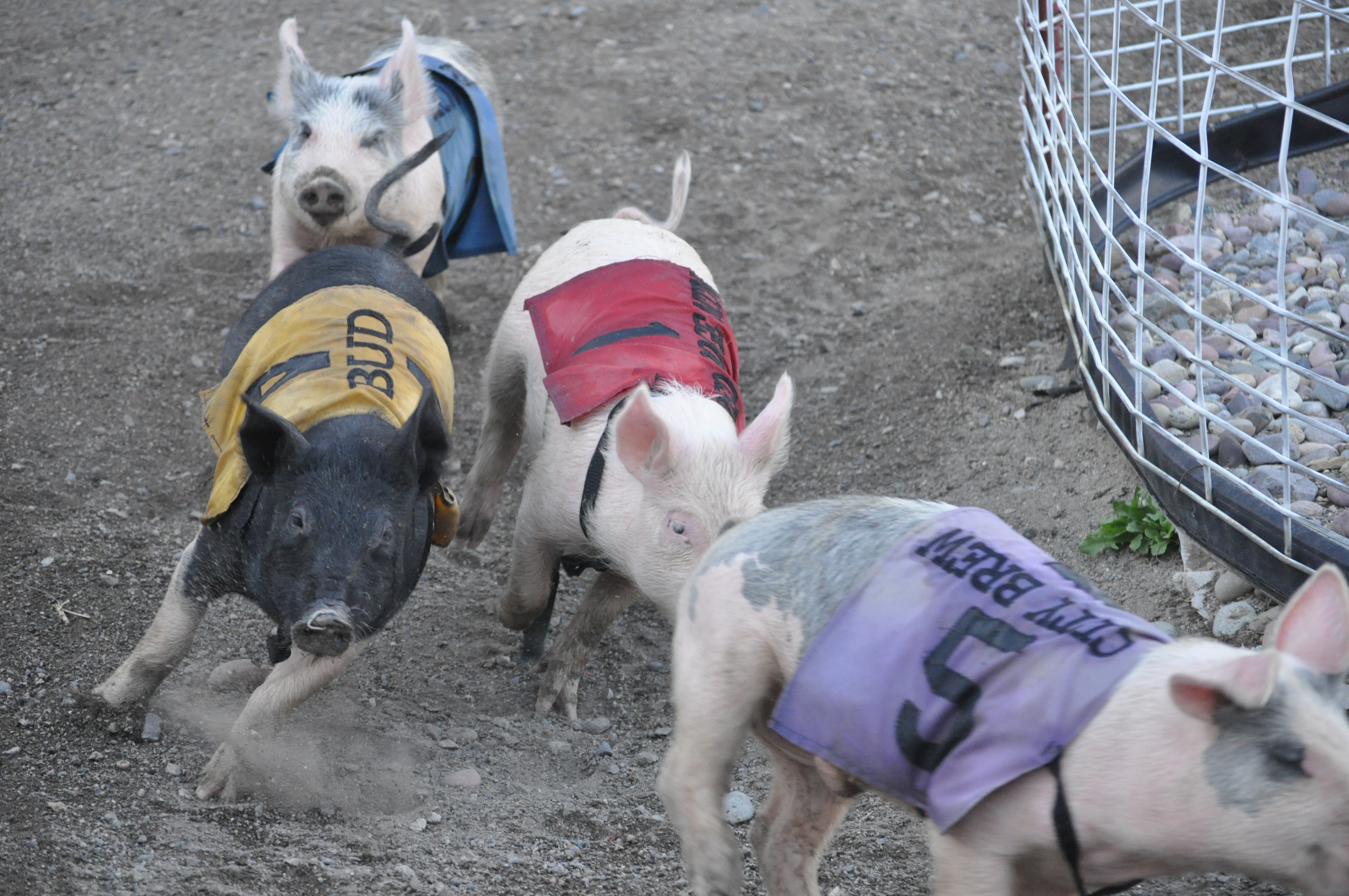
Yes, those are pigs racing. On my birthday, we went to hamburger joint in a tiny town near Red Lodge, Montana (we were on vacation there), that had pig races, one every fifteen minutes starting at 7 p.m. The kids absolutely loved it! I rooted for every little black pig, but not a one of them ever one. I think black pigs are CUTE!

NOTE: I wrote this a couple weeks ago, but am just now getting around to posting it.

I am 42 today. I woke without remembering this fact and had just about decided to slip out of bed without waking Dave when he whispered, “Happy Birthday, hon.” Since then I’ve been reminded of it often, since my children came up with the idea of singing “Happy Birthday” to me 42 times. They’re up to 12 by now, but I’m hoping they run out of steam.

I don’t mind the 40s, don’t mind getting older, but my birthday has reminded me of my “to be accomplished by 40” list. Actually, it was first a “by 30” list, but when it didn’t happen then, I just moved it, first to 35, then to 40.

The list only has one item:

Get a book accepted by a publisher.

It didn’t happen by 40, still hasn’t, but I’ve decided against a “by 45” list.

It’s not that I’ve given up. I’m still writing, still working on book proposals, still sending them out to be rejected and returned.

And, boy, am I still learning.

Still learning to write, more and more with every year, every assignment, every blog posting, every review one of my editor friends so graciously gives me—for free!

But I’m also learning about patience and faith. I’m learning about humility and peeling fingers off of brittle dreams and opening arms to the unknown.

It’s been an interesting journey.

About nine years ago, just before I learned I was pregnant with the twins, I decided my research/submit/rejection system wasn’t working, so I took a correspondence writing course. It started with baby steps: “Write an announcement for your church bulletin” and “Draft a help wanted ad.”

Two months in, it seemed to have barely moved forward. “Seek out opportunities to write for your church’s newsletter or for any small, local papers.”

“That isn’t the kind of writing I want to do,” I thought. “I want to write children’s and young adult stories. I want to write books.” I didn’t take the followup course, and the next spring I began attending a local writing class, where I shared the progression of my young adult novel, five pages a week.

Several from that class became good friends, and most of these have had some writing success. One has found a niche in genre literary journals; another works as a corporate freelance writer and is currently shopping around a novel; and the leader of the group is one of those professional editing friends who gives me the phenomenal advice I mentioned earlier.

But my journey has been more roundabout, as if God had some extra lessons for me that had nothing to do with the ability to write sizzling dialogue or attention-grabbing introductions.

In hindsight I can see His wonderful irony. For instance, my first “published” piece in those years was—aha!—a piece in our church’s newsletter. The second was the same.  Then we moved to Sterling, Kansas, primarily for Dave to coach the men’s soccer team at the college there but also so I could have more time to write, to finish the young adult novel and shop it around.

But I “fell” into a job almost right away, writing and editing copy for the college’s marketing department. I wrote brochures and letters, and worked my way into tracking down news releases, doing interviews, writing news stories for small-town newspapers, and, eventually, creating pretty much all the articles for the college’s alumni magazine.

It was exactly the kind of writing I had not been interested in a few years before.

But I learned so much! And I enjoyed it. In a tiny town in the middle of Kansas, I learned to value the “small stories” that, looked at with perspective, fit together into God’s BIG story.

And I began to value the “little” writing assignments I was getting to do as well.

Still, when Dave suggested that I write the story of Patrick’s adoption, I resisted—for lots of reasons, but in part because it’s just “one” adoption. I’ve met families who have adopted two, three, four children, others who took in kids with special needs. I’ve read about and known people who pursued orphans with a passion that makes mine look puny.

I’m writing it, though. I think I’m supposed to.

But I’m letting go of the dream of getting it published. Because maybe that’s not supposed to happen. Or maybe I’m supposed to swallow my pride and self-publish it.

Maybe this book—and every other bit of writing I do—isn’t supposed to be about me at all.

That, I think, is the biggest lesson of all.

A beautiful sunset we watched from the cabin’s back porch. We quoted “The heavens declare the glory of God!” a lot that week.

Unraveled but held

My daughter Em told me that I should try to make my pictures fit my blog entries more, so I took this beautiful yarn (which I bought on our 20th anniversary trip to Vermont) and set it on the windowsill and, voila, my amateur attempts at something artistic in the photo realm. Next time, though, the kids. I have some fun shots of them running through the sprinkler this past weekend.

Yesterday on my iPad I found a journal entry I wrote last fall, during a time when I felt unsettled and scattered. Reading old journal entries can sometimes feel like meeting a different version of myself, particularly when I’m no longer in the situation or mood I was in when I wrote. So, even though this is not recent, I’m posting it today as a blog entry, for a couple of reasons:

First, because I find great comfort and value in looking back and seeing, in hindsight, how messy I was (and still am) and yet how faithful, creative, and gracious God was in and through it. Continual reflection of this kind builds my faith, since every backward look reveals more of my messiness AND more of His never-failing faithfulness.

And second, because, though I’m not currently feeling anywhere near as scattered and unsettled, I may be tomorrow or the next day. Or maybe what I was feeling in that time is something someone else reading is feeling right now (if you are, I’d love to hear from you). What I wrote then is still true.

December 2011: This week I got an e-mail from a writing-class friend. He was critiquing a piece I’d read in class the week before. He said that my writing was as “strung tight” as his was “loosey goosey.”

Then today, as Dave and I finally had time to talk on a long car trip, he told me I was full of tension and seemed borderline annoyed much of the time–and that this was a trait I’d displayed for several weeks.  

I’ve reflected on these two comments, and I think they’re both right–and wrong. I’m actually feeling unraveled, ready to fall apart like a loose skein of yarn several times a week–and so I’m holding tight because one snag and I’m nothing more than strands of scattered color on the floor ready to be swept up. So, yeah, I am tense (and my current writing is probably pretty tight, too, technically correct but careful).

A few weeks ago I was driving to school after dropping the kids off, and I found myself catching my breath like it was a floating thread about to get away, like I had to suck it back in or it would be lost. Just then I passed a Thanksgiving greeting tied to a mailbox. “Count your blessings.”

Dutifully, I accepted this reminder and said, “Yes, I have so many blessings.” I was about to start listing some when I heard the Holy Spirit’s “Shush.”

In that moment I suddenly knew I was held–not because of my constant striving to be the good daughter of God–and, consequently, the good mom, the good homemaker, the good wife, the good host mom, the good teacher, the good writer.

Not held because of anything I do or feel.

But held because that is what God’s arms long to do. 

“Oh!” My lungs expanded to take in a full, deep breath, and I let go of my loose strands. I let it all fall apart for a few moments.

“You hold me, You pursue me, You never let go. That is my greatest blessing.” 

Later I read Psalm 27:1b “The Lord is the refuge of my life.” 

It says “stronghold” in the ESV, but a footnote says it can also be “refuge.”  

That’s what I need right now. A place to let go, stop holding on so tight and be held. 

I need a refuge.

And He is one.

Waste not

Even things like common grasses are not wasted. So much beauty even in the individual stalks!

I hate waste. I’m actually a little weird about it. Wasted time, wasted food, wasted money, I hate them all. I almost never throw leftovers away. They get turned into second meals or fed to the dog (good thing she’s skinny). I started knitting so I could “do” something in those odd, spare moments. Rather than buy something, I’m always tempted to “jerry-rig” an alternative.

A week ago, I talked to a friend who was considering applying for a job she would enjoy very much. She told me it was a long shot and wondered if she should even bother. I told her: “You know, even if you don’t get the job, God will still use the experience. He doesn’t waste anything.”

Then I said, “Wow, that just came out, but I like it. I’d never thought of that idea in those exact words.”

If God is sovereign, nothing is wasted.

Nothing. If my friend does not get this job, He will use the disappointment to draw her closer to Him, and He will use it in other ways she will not be able to see. His powers of orchestration are amazing. Not a bit of the process will be without value.

What an awesome truth: that God can use, DOES use, things we consider a waste. Dry times, disappointments, failed endeavors, even seasons when the “mundane” seems to occupy so much of our time—these will be used. Even if we are not able to see HOW, we can trust in a God who is incredibly creative, always purposeful, and all-powerful.

Hallelujah!

Emily recently taught the twins how to run “suicides.”


Pick ’em wisely, then fight them well

And speaking of fighting/wrestling, here are the two boys doing just that–one of their favorite activities. Once again, it’s at a soccer game!

I may have been standing up with the rest of the congregation, singing along with them, but inside I kicking and fussing. “I can’t believe they left that mess for me to clean up. Don’t they realize…” My hands clenched the back of the seat in front of me. It had been a month of what felt like non-stop service to my kids (the four of my own and our two international students)—without a bit of gratitude in return. I was burnt out.

And I was fighting mad—not enough to take on anyone out loud and in person, but enough to wage the battle inside my own head. I’d carried it into church. On the third song I felt God poking me, harder and harder, till I ceased my inner tirade enough to listen.

“You know, you’re not in the battle right now,” the Holy Spirit reminded me. “I’ve given you this space and time to regroup and rest, to connect with your life source. And you’re throwing punches like your opponent is still in your face.”

Oh, how often I do that. In moments of peace and quiet, I give into the urge to rehash past things I have perceived as wrongs. It makes me feel right and justified. It puffs me up into a martyr (ach, that mommy-martyr syndrome). I allow myself to think that I am building up ammunition so that one of these days—yes, one of these days—I’ll let it loose and air my grievances, and they’ll be really well-delivered because I’ve practiced them so much in my own head.

But this is the wrong battle.

I’m in a battle, all right—or at least I’m supposed to be.

But it’s not the one I choose to fight so much of the time.

It’s like the enemy is right there—throwing in lightning-fast crosses, catching me off guard with his left hook, jabbing me under the ribs with his knee.

And I’m swinging punches at myself, pummeling my own face, kicking my own shins. I weaken myself and become even more vulnerable to the enemy’s attack.

Because there IS an enemy. And he LOVES it when I fight the wrong battle.

Ever since that morning in church, I’ve been asking God to show me the battles I AM supposed to be fighting.

These battles are not WITHIN but are actually AGAINST my own mind. “(W)e take captive every thought to make it obedient to Christ.” That’s the second half of 2 Corinthians 10:5. The first part of that verse is also applicable. Though it is often used to refer to false philosophies and doctrines, it certainly applies to the false things I tell myself and the wrong perceptions I hold. “We demolish arguments and every pretension that sets itself up against the knowledge of God…”

“For we are not fighting against flesh-and-blood enemies, but against evil rulers and authorities of the unseen world, against mighty powers in this dark world, and against evil spirits in the heavenly places.” Ephesians 6:12 NLT

The enemy is never really my children or my students, my boss or my colleagues, my husband or my friends. The enemy is wholeheartedly focused on one goal: to keep my eyes and my mind OFF of Christ, away from true knowledge of Him and the Father. And this enemy will use whatever weapons work best to accomplish this.

So I DO have a battle to fight. But the one I often get drawn into is a false battle, a decoy, and being in that false battle is a sure sign that I’ve stopped fighting in the real one.

I have to listen closely to my Commander-in-Chief. “Jen, did you really take a look at that thought that just passed through your mind? It was full of self-pity and self-promotion. Don’t give into that thought. Fight it! Wrestle it down. Catch it NOW before it lures you in. Ask Me for help. Cry out to me and keep your eyes fixed on me. I will rescue you.”

I need to pick my battles wisely.

And then, I need to fight them well.

And here’s how it ends (usually)–collapsed in laughter! (There must have been a time-out between the earlier pic and this one, since PJ now has a hat on. Maybe the grass was tickling his head?)

Getting beyond age 7

I'm not sure what he was pretending to do, but that's Em's hat PJ is wearing.

I take Chai, our dog, for a “bike run” (I bike, she RUNS) nearly every day that it’s nice. Sometimes the kids join me. When they do, I have three rules for them: 1. Stay on the sidewalk; 2. Don’t panic; and 3. I WILL come back for you. Trust me.

They do really well with rule number one, but they break 2 and 3 nearly every time. Jake lags far behind, and Maddie panics: “Jake, we’re losing you!” Then someone, unable to keep up with me at first because Chai is running off her steam, yells, “Mom, don’t leave us.”

That’s when I circle back around, gather them together and remind them—again—of the rules. I usually end with, “Have I EVER left you?” They shake their heads. “Don’t I know exactly where you are?” They nod.

The other day the Holy Spirit nudged me during my “rule” review. “Oh,” I thought. “I do the same thing to God.”

And as I’ve listened to some of the conversations I’ve had lately with my younger three children, I’ve discovered that MANY of the things I say to them are the very things I know God tells me. I’m a lot like a 7-year-old in the ways I relate to Him. Not only does He have to say the same things I do, but He also has to say them over and over.

So I’ve been trying to take a spiritual lesson from what so often feels mundane and repetitive.

When Maddie asks, “Mom, are you getting me a sandwich(or whatever)?”—for the fourth time—and I answer, “Honey, I’ve told you I will put a sandwich in your lunch for tomorrow, but right now I’m fixing our dinner. I WILL get to it. Can you please stop worrying about it and trust me?”

Hmm.

Today PJ ate lunch with his dad while I met with a student. Dave texted me on our way into school to tell me he was not in his classroom. When PJ headed that direction, I told him, “No, buddy, Daddy’s somewhere else. You’re going to eat in a different place today. Just follow me.”

But that wasn’t good enough. “Where are we going?” he asked.

“The Maroon Room.”

“What’s that?”

My explanation didn’t make sense to him, so he asked it again.

“Buddy, you’ll see it when you get there. I can’t explain it to you in a way you’ll understand.”

So he changed tactic. “WHY are we going there? Why aren’t we eating in Daddy’s room?”

Once again I “saw” myself, questioning God’s plan, wondering why it’s different than what I think is best, frustrated when I can’t understand the answers He gives (and thinking that that’s HIS fault, not mine) and then asking “Why?” rather than simply trusting.

I could give lots more examples. This happens just about every day.

It all boils down to their lack of trust,

As it all boils down to MY lack of trust.

And it’s more than a lack of trust in His leading or His wisdom. Ultimately, it’s a lack of trust in God Himself, that He is who He says He is, that He loves me with an everlasting love.

“This is what the Sovereign LORD, the Holy One of Israel, says:

‘In repentance and rest is your salvation,
in quietness and trust is your strength,’”

Isaiah 30:15a

Names and a quote

Maddie, left, Patrick, middle, Em on the right, at a playground in downtown Philly.

My first daughter, Emily, is named after the main character of Emily of New Moon by L.M. Montgomery, also the author of Anne of Green Gables. I loved the Anne series, but the Emily series was about a girl who loved to write, who dreamed of writing stories that others might actually want to read someday. Obviously, I identified, especially when Emily (the character) was asked why she wanted to write and she answered, “I have to write–I can’t help it by times–I’ve just got to.”

Madeleine (our second daughter) is named after Madeleine L’Engle. I grew up with her Austin and Murray series; I wrote a twenty-pager on A Wrinkle in Time for a grad-school class; and then I discovered her nonfiction as an adult. Ah, here was the woman and the life behind the young adult books that still made me think deeply.

I discovered a quote from L’Engle today, and I’d like to share it.

“Those who believe they believe in God but without passion in the heart, without anguish of mind, without uncertainty, without doubt, and even at times without despair, believe only in the idea of God, and not in God himself.”

Here’s to belief that requires ALL of us: heart, soul, mind, strength, and all of them ever-stretching to comprehend more and more of this limitless “God himself.”

Thanks for reading.

Jen

Jake and Mads--there is something about being twins. I took this two weeks ago on a day trip to Jersey (hence the backside view of Lady Liberty).