Hollering for Help

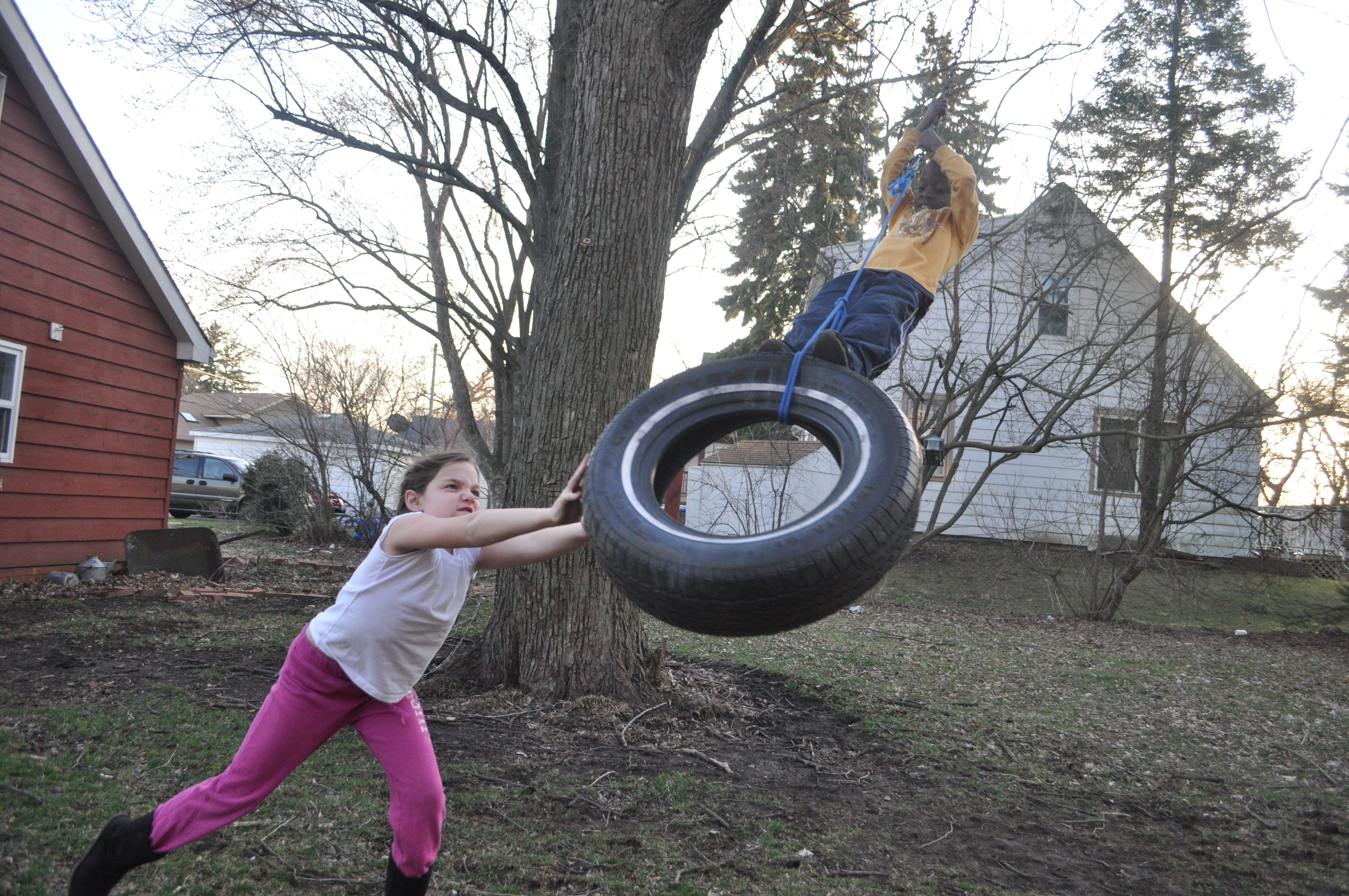
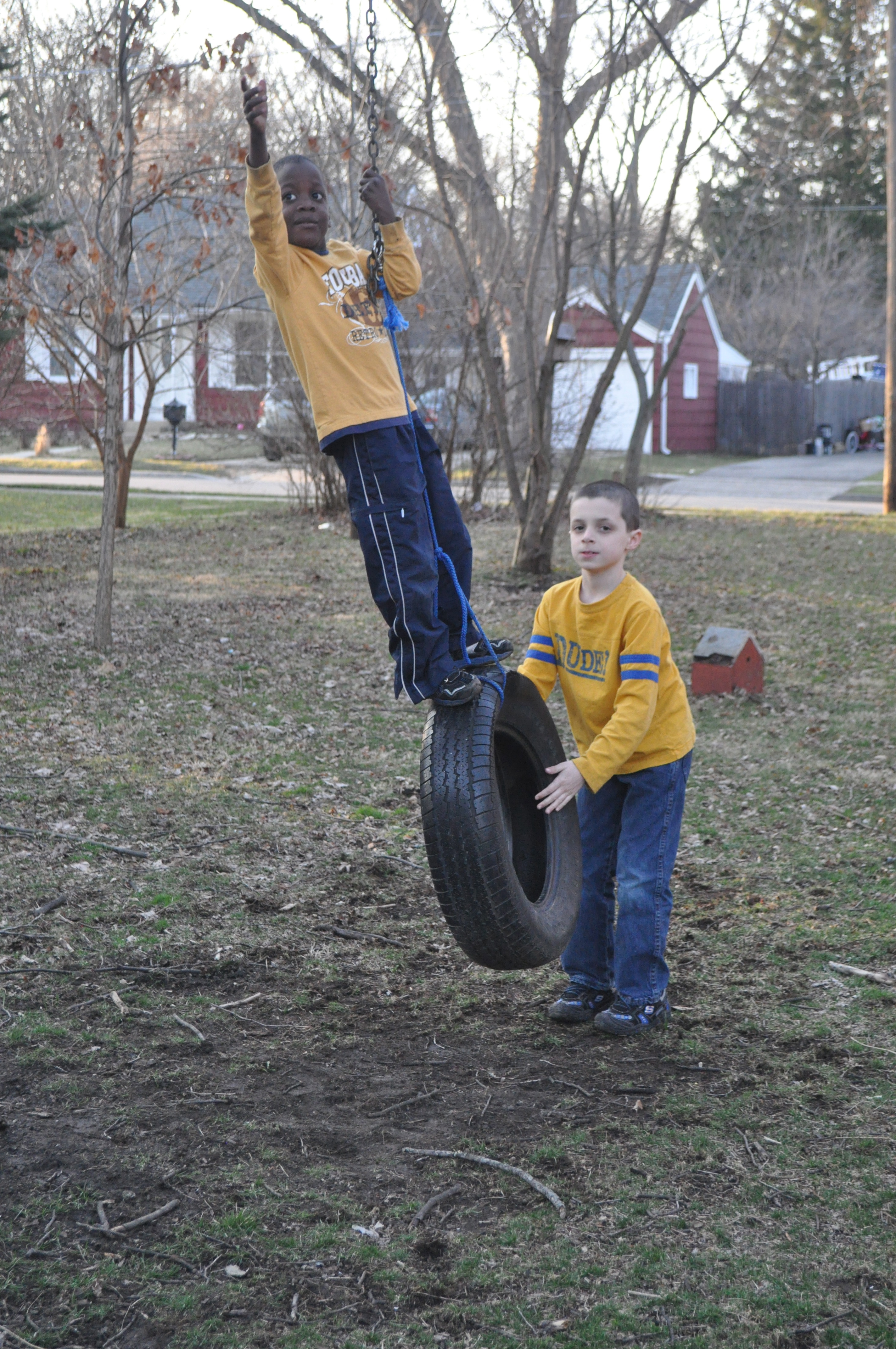
Spring! Time for housebound kids to get outside. I love the intensity on Maddie's face--so much a part of her personality.

I find it comforting to know that Paul, too, struggled. I guess that could be disheartening—“If PAUL struggled, what hope is there for ME?”—but I find it encouraging. Romans 7 is so honest about the human condition: the Law—God’s Way—is all good, and we are not capable of even KNOWING how to follow it. We’ve reduced it to rules, therein missing the entire point. Not only is that the state of all humanity, but Paul adds a personal cry wrenched from his own sense of inadequacy to be GOOD: “O unhappy and pitiable and wretched man that I am! Who will release and deliver me from the shackles of this body of death?” (Amplified).

But there is much good in being that aware of my helplessness, my need.

One school year a while back, I had a daily running partner, the only time I’ve ever had one. I think God gave us to each other to get through that particular season in our lives. In between the huffs and puffs of one of our runs, Amy, my running partner, said, “It’s helped me to see trust as a circle of light surrounded by darkness. It’s natural for me to stay in the dark, but I have the choice to step into the light. I have to do that over and over again, sometimes minute by minute.”

At that time Amy was in life circumstances in which the darkness outside the

circle was pretty dark. She KNEW when she had stepped out of it because she was almost immediately assailed with discouragement and doubt. I walked (or “ran”-Ha!) with her through this, and a year later when I had a few months of intense waiting on the Lord’s direction, I experienced it myself. I learned to plant my feet in the circle, dig in with my toes.

But sometimes the darkness outside the circle isn’t so instantaneous. Rather than being a plunge into despair or doubt, it’s a creeping into self-sufficiency, idolatry, busyness, a habitual “ok” sin (like anger or discontent), or any sin addiction. I inch my way out of the circle and don’t realize the lights have dimmed until I’m well away from it. These are often the times in my life when things are going “ok, not too bad.” I’m “doing all right.”

Those are dangerous periods in my life.

More than any of my other kids, Patrick wants to know where I am at all times. That may be because he’s the youngest and with me alone more than the others. It may be because of his chaotic life before his adoption. I don’t know, but when he doesn’t know where I am for even a few seconds, he hollers, immediately, “Mom, where are you?”

And when I answer, “I’m right here, Buddy,” he says, “Oh, good, I thought you were gone.”

Sometimes I think, “Really, bud, I’m just in the next room. You could try LOOKING for me.”

But he recognizes my absence, right away, and he knows the quickest way to remedy that is to holler for me.

It’s the same with God. I know He doesn’t ever leave; that’s a promise made firm by the Word. The circle of trust doesn’t move. But I do, and too often I creep, creep away without seeing my gradual movement.

I want to be like Patrick, super-sensitive to the close presence of my Lord. I want to be like Bartimaeus, the blind man in Mark 10, who cried out, not caring what others thought, heedless of his own image, comfortable with his own need: “Jesus, Son of David, have mercy on me!”

That same Jesus, my Jesus, gives me the power to step back into the intimate circle of trusting in His love (Ephesians 3:18-19). He, time and time again, “rescues me from the shackles (the darkness) of this body of death.”

But I have to cry out!

With a sense of my great need,

With eyes fixed on my awesome Deliverer,

Loud, loud, loud,

I,

Cry,

Out!

sick and sore

Patrick--with about four hats on. Don't ask me why, particularly since this day was about 60 degrees.

When Emily was about three, I came home from a solitary grocery store trip to find a silent house. Where were she and Dave? I found them in the living room, with Dave stretched out on his stomach on the rug, and Emily peering into one of his ears with her toy otoscope (I may be a doctor’s daughter, but I still had to look that up).

“What’s going on?” I asked.

Emily turned a very serious face toward me. “Mommy, Daddy’s sick. I’m taking care of him. He needs lots and lots of rest.”

Dave, very nearly asleep, didn’t say anything.

And I said, “You’ve got to be kidding.”

In the years since, Dave has found oh, so many ways to “play” with our children that involve his getting a nap. It helps that the man can doze through just about anything, and he is all right with getting a kind of pseudo-sleep that never really drops into the real thing. The doctor/nurse scenario has had some real staying power, but he has also been a mountain for climbing (when the twins were really small), a soldier injured in a war (that allows Jake to be a fellow soldier while Maddie nurses), and a dead body that Detectives Jake, Maddie and PJ investigate for clues (I think that one is a bit morbid, but they all like it).

A few months back I finished up the dinner dishes while Dave was upstairs getting the younger three in bed. I joined them when I finished. Dave was in his dead-body position on the boys’ carpeted floor. Maddie was rubbing his back, PJ his head, and Jake was reading his illustrated New Testament aloud to all three of them—with different voices for all the characters.

When Jake turned a page, Dave said, “A little higher up, Mads, and, PJ, right above my ears, please.”

They obliged.

“We’re massagers, Mom.”

It seemed like a better deal than the dishes, so the other night I decided to try it. Maddie was already asleep, so it was just PJ.

As his little hands moved, butterfly-soft, across my back, he asked me, “Mom, do you have a rope?”

Hmm.

“A rope?”

“Yeah, one that’s all twisted up.”

Aah! “A knot in my back?”

“Yes.”

I’ve always thought the injured-soldier/dead-body routine was a bit of a cop-out, but maybe Dave’s been onto something all along.

When you stay quiet long enough, they say—and we learn—wonderful, wonderful things!

Collective blame

I’m reading The Kite Runner with my seniors right now. Beautiful book.

Haunting book.

And because Afghani culture and history is not something I, a middle-class suburban American, know much about, I’ve been doing a lot of research on its recent history and current issues.

So far I’ve read about the massacre of the Hazaras, a minority group, in 1998; the widespread mistreatment of women; the regular and somewhat-accepted rape of young boys; the more than 2 million orphans—and the laws that prohibit adoption; the very recent destruction of schools by the Taliban; the huge numbers of Afghanis who have fled because a certain regime wants to wipe them out…

I’ll stop there.

Last Saturday Dave and I snuck away for an hour to have a breakfast date, and I processed this with him.

“You know,” I told him, “if I were God, and I looked at how humanity treats humanity, I would just want to wipe it all out right now. I mean, it only gets worse. I look at Afghanistan and think, ‘What do you do with that?’”

Lest I begin to think of this as some “other” culture’s problem, I started a poetry unit with my sophomores this week. I’ve been finding poetry slam videos to help 15-year-old boys get just a little enthusiastic about alliteration, similes, and rhyming couplets!

Today I learned that there are “special” poetry slams, as in poetry slams for people with cerebral palsy, Down syndrome, brain damage…

They were cool! I watched a little boy with a shrunken body, strapped tight to his wheelchair, share that if he were an animal, he would be a big black bear because “they are powerful.” I watched a woman about my age describe how she would like to be a princess with a big pink car.

And then, I don’t know why, I scrolled down and found the comments.

I thought I was going to be sick.

No, humanity treats humanity badly all over the world.

And rather than wondering—as our culture often does—how a loving God could JUDGE people, I had a moment of pure amazement that He could even tolerate us, much less love us, how He could hold back from judgment.

The other day, with music blaring from one computer in the dining room, a dance video game going in the living room, a huge mess of baking being created in the kitchen, and a Nerf gun battle raging in and out of everywhere, Dave and I retreated to our bedroom to do some schoolwork in relative quiet.

“They’ve taken over,” I thought, “as if they pay the rent and utilities—which they don’t. They do all the play and carry none of the responsibilities.” And when I came out to find the kitchen had exploded, I thought, “and they have an amazing ability to ignore their messes.”

(And God gave grace and helped me remember that we WANT our house to be full of life, that mess is just an unfortunate side effect.)

But truly, as I’ve been reminded of human trafficking and bullying and street children and our passive and sometimes active ignoring of them—all the ways we DON’T do justice and love kindness and walk humbly with our God—isn’t it true that we’ve treated God the same way? We’ve forgotten who made the house and keeps it running. We lay blame on Him, abdicate our responsibility, and ignore the messes we make.


*Sorry for the depressing ending. I’ve always been amazed at how so many of the prophets took on collective blame, saying, “WE have sinned,” when the specific sin they confessed did not apply to them personally. There must be something to seeing not only MY sin but how I am part of the general sin of humanity.

Ocean depths and sun’s rays

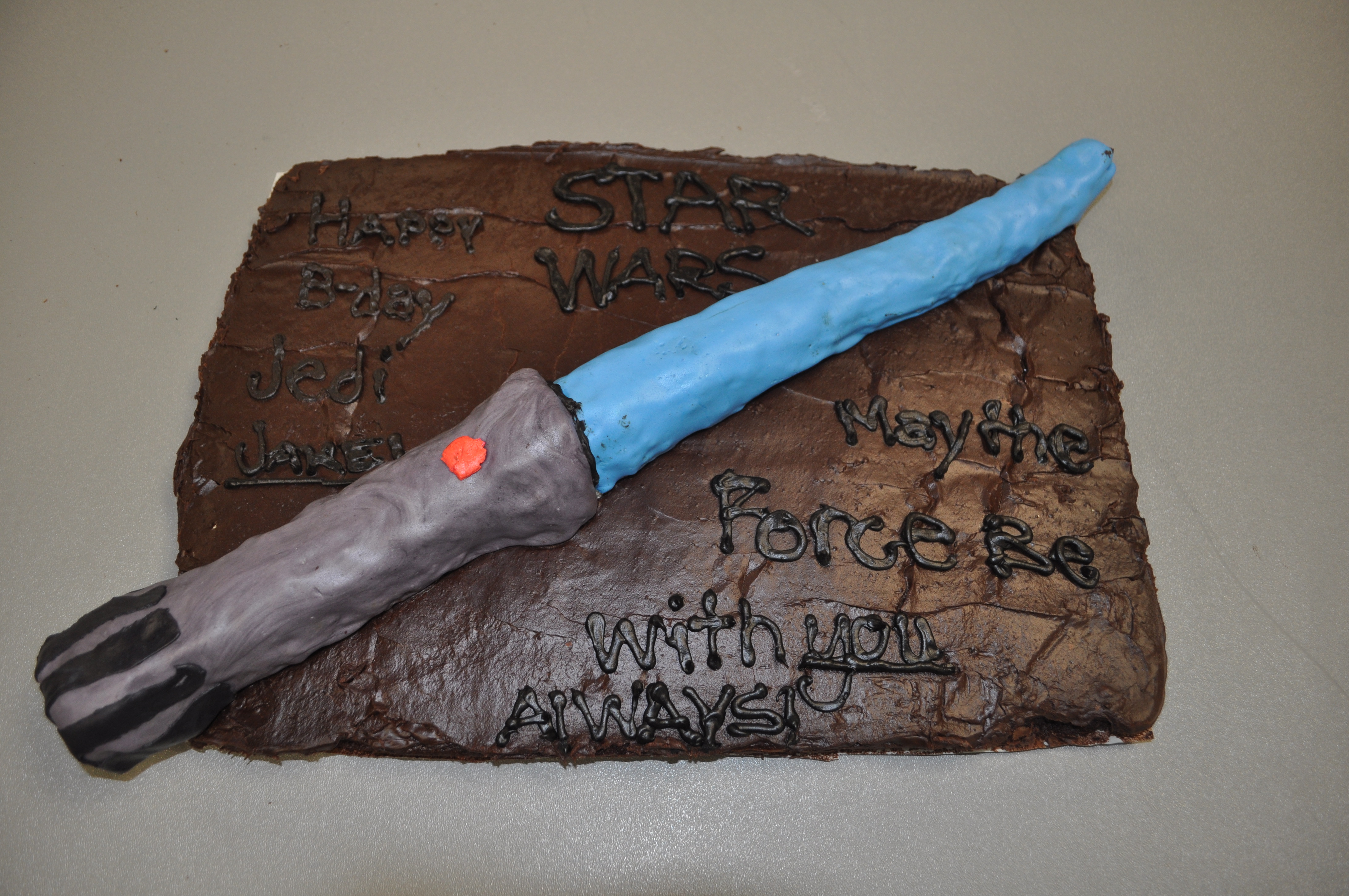
Birthday weekend is over! Whew! Chef Em (with me acting as her assistant) created her second cake in two days. This one is Jake's. I couldn't get the black writing on brown frosting to be bright enough in my camera lens, so here is what it said: Happy Birthday, Jedi Jake. Star Wars." The light saber is rice crispy treat covered in frosting and then in marshmallow fondant.

This past week I ran across the hymn “Oh Love that will not let me go” and was amazed at how much it speaks to the questions about significance that I’ve been writing about lately. So I did some research on the hymn writer: George Matheson (1842-1906), a man who experienced the failure of several significant dreams. He was born with poor eyesight, and it progressively grew worse until he went completely blind at age 18. That was when his fiancé decided she couldn’t be married to a blind man and broke off their engagement. Still, Matheson didn’t give up on his other passion: study. He was an excellent student, but he couldn’t become the scholar he wanted to without being able to read. His sister learned Latin, Greek, and Hebrew so she could read to him. He graduated from university and wrote a book on theology, that—though critics called it brilliant— contained several serious research errors. Matheson realized he couldn’t pursue scholarship at the level he wanted without the use of his eyes. He became a pastor instead and was able to memorize Scripture and his sermons so well that first-time listeners often did not realize he was blind.

Despite his fruitful ministry as a preacher, it was not his first dream, and Matheson saw his life as “an obstructed life, a circumscribed life… but a life of quenchless hopefulness, a life which has beaten persistently against the cage of circumstance, and which even at the time of abandoned work has said not ‘Good night’ but ‘Good morning.’”

Wow!

The blows continued. On the night of his sister’s wedding (the same sister who learned languages for him, his very close companion), Matheson, forty years old, never married, was alone at home. He wrote this about that night: “Something happened to me, which was known only to myself, and which caused me the most severe mental suffering. The hymn {“Oh Love That Will Not Let Me Go”} was the fruit of that suf­fer­ing. It was the quick­est bit of work I ever did in my life. I had the im­press­ion of hav­ing it dic­tat­ed to me by some in­ward voice ra­ther than of work­ing it out my­self. I am quite sure that the whole work was com­plet­ed in five min­utes, and equal­ly sure that it ne­ver re­ceived at my hands any re­touch­ing or cor­rect­ion. I have no na­tur­al gift of rhy­thm. All the other vers­es I have ever writ­ten are man­u­fact­ured ar­ti­cles; this came like a day­spring from on high.”

These are the words to that hymn:

Oh Love that will not let me go

I rest my weary soul in thee

I give thee back the life I owe

That in Thine ocean depths its flow

May richer, fuller be

O light that followest all my way,
I yield my flickering torch to thee;
My heart restores its borrowed ray,
That in thy sunshine’s blaze its day
May brighter, fairer be.

O Joy that seekest me through pain,
I cannot close my heart to thee;
I trace the rainbow through the rain,
And feel the promise is not vain,
That morn shall tearless be.

O Cross that liftest up my head,
I dare not ask to fly from thee;
I lay in dust life’s glory dead,
And from the ground there blossoms red
Life that shall endless be.

I obviously don’t know what Matheson’s “mental suffering” was, but I imagine him feeling thwarted, insignificant, and alone. But God gave him the image of his life being a small stream joining with the ocean, and somehow, in that joining, finding true significance. Matheson saw his little flame shining bright and true in the blaze of God’s great shining Son. In the middle of deep disappointment he heard God’s whisper: “Look for the rainbow. Morning is coming.” I know I’m just repeating his images, but they are powerful and vivid, and they bear repetition.

I also read I Corinthians 3 and 4 this week. Paul didn’t hold any punches when he warned the church at Corinth of the dangers of seeking significance the way the world around them did. “I follow Paul,” said one; “I’m an Apollos guy,” said another. It sounds a lot like the things we glory in today: our friends or acquaintances, degrees or experiences, responsibilities and accomplishments, and our STUFF.

But Paul has a lot to say about that: God’s wisdom is different. Don’t put men and men’s “stuff” in places of importance. You belong to Christ and God, not yourselves. Everything you “have” is a gift—how can you boast in it when it is provided FOR you and is not of your own making? Why are you pursuing the world’s values when you have the example of Christ—and now of the apostles—living for the purposes of eternity?

I think Paul would have liked Matheson’s song. I think he, too, would have sung, “O Cross that liftest up my head, I dare not ask to fly from thee; I lay in dust life’s glory dead, and from the ground there blossoms red, life that shall endless be.”

Wisdom from friends

Em's latest creation, this one for Maddie's birthday party on Friday night. She wrapped the doll's body in plastic wrap and then molded rice crispies/marshmallows on in the shape of a skirt. Then she "dirty iced" (new term for me!), made marshmallow fondant (she learns all of this from youtube videos, NOT from me), colored the fondant, wrapped it around and made a bow in the front, and last made cute little flowers out of regular icing using the icing tip kit my mom gave her last year for HER birthday. Tonight she'll be busy with Jake's cake--which, of course, is Star Wars!

A while back I asked for responses to these questions: What if the dreams/passions you have—that you think are given to you by God—aren’t working out? Do you continue to pursue them? Do you set them aside?

Two friends gave some very wise answers. I asked their permission (and they both said “yes”) to include their thoughts in a post.
Anne wrote: I think sometimes our passions match God’s desires. I think that we are given talents and abilities and that those gifts match what God has planned for us. My talents and abilities led me into theatre and into teaching. It has been my mission field for 20+ years now. I love every minute of it.
But I think we can also have passions and desires that God says no to because they get in the way of what He needs us to do. I have never married and have no kids and that is certainly not how I would have planned my life. Perhaps a husband and children would have kept me from working a particular job with a particular person who needed to be touched. Who is to say? I certainly don’t know the maze of God’s plan. It is a struggle learning to be content where we are placed. It is sometimes a struggle learning to be blessed by where we are if our passions lead us in a different direction.
Sometimes passions don’t get to be fulfilled for whatever reason. I don’t know that God so much cares if we feel “fulfilled”. I think He cares that we are obedient and that we find contentment in that.
I’ve been thinking about her last line—that phrase about contentment—for a couple of weeks. I’ve realized I don’t think too highly of “contentment.” I want happiness and a full sense of satisfaction. I want to feel like I’m “in the zone” of my own abilities and that others recognize me for what I’m doing. Contentment requires me to give up my sense of control, to accept the role of being a part of a whole—and never the focus of it, because the focal point is Christ.
Contentment is not necessarily about my feelings.
Contentment is hard.
But it is also very, very good.
And I think it may be a prerequisite (it and the thankfulness that is inherent in true contentment) for the joy we want to skip ahead to. Hmm. I want to think more about that.
My friend Holli wrote this: I feel as though our passions play a very integral part of God’s plan for our lives. When you are young you have this ideal for how your life will be (how wrong we often are!). You dream about it and that “passion” or drive is usually the central picture of those dreams. And when you are young you just don’t know yourself or God, really. So when you are young it makes sense to follow the path where your passion may lead. But then reality hits and you start to see just how much you need God. That is where you can decide to follow your passions or God. Sometimes they line up, but I do think that other times God uses these passions as a way to learn about yourself, Him, and your relationship with Him. If you continue to follow a passion that is not leading to a “success” (whatever that means to a person), then you have to start questioning what it is that God wants from you. He may want you to continue on that path. The way you can start to stray from His plan or path is to continue to tell yourself, “This has to be what He wants for me because… it’s my passion!!” How we can fool ourselves on this one. Sometimes your passions can be the jumping off point from God. If you keep yourself stuck in the ideal image of your passion then you may never reach the potential of the true gifts God wants you to use in this life. We have such a small view of God and his plans. We are not infinite like him, so for us it is easy to say that He has given me this passion within my heart and so I must continue but when we let go and let him lead us he is amazing. He can show us so many amazing things about ourselves that have nothing to do with our ideals and dreams. Also we can waste so much time chasing a dream or passion, which I am sure makes God very sad. But wonderful God uses that too! When you have moved beyond a path that is not in line with His intentions, the perspective you gain can bring it all together. I am thankful we are not bound to these self-dreams and passions that we create. God is so big! Sometimes God is very clear to people and he gives you a yearning that He wants you to follow. But he is very complex and so our passions must morph and gain in complexity so that we can serve Him in the most fulfilling way.
I love what she wrote about our passions having to “morph” (what a cool word!). I think of it as holding onto my dreams loosely. I can easily get a death-grip on my dreams. “It has to look like THIS!” But for one particular dream of mine, THIS hasn’t yet happened, and I have to continually pry my heart’s fingers loose from their grip. That doesn’t mean I don’t still pursue this dream, but I’m learning how to hold it loosely so I see other opportunities God brings my way, so my dream doesn’t become an idol.
Thanks so much for reading. I appreciate your comments, and I learn so much from them. What a great way to remember that we are all “pressing on” together.
Jen

What a way to start the day

Jake and Patrick were doing some kind of chant-dance. I just asked Patrick what they were saying in this picture. "Ooh-ha, ooh-ha. Something like that, Mom."

As usual Jake was the last one to get out of the car when I dropped the kids off at our carpool meeting spot. Just before he closed the door, I turned around in my seat and said, “Bye, J-man, have a great day.”

He gave me his impish sideways grin. “Goodbye, elderly mother.”

I started laughing. “What?”

“Wait.” His eyebrows wrinkled. “What does that mean?”

“Old,” I said, “very old.”

“Oh.” He was visibly thinking, and for a second I thought I might get a compliment, or at least an apology.

Not this morning.

“Well, it is true, Mom. You are really old. Bye.”

It’s a good thing I taught middle school years ago and developed a thick skin. I’ve discovered I need one as a mom, too!

The Long View

All of the kids except Nina. They love photo shoots.

I watched Wheaton Academy’s performance of Les Miserables tonight.

Amazing story, amazing performance, music, direction, and adult leadership.
It was seriously excellent, and I was moved,
But I needed some time to get past the amazing performance to the truth God wanted me to see in it.
You see, I left the show missing working with high school theatre, the incredible thrill of working with students, of helping them transmit a character and story they didn’t know they had within themselves, of getting to know students in the very personal ways theatre creates. I left missing the world I was involved in for many years.
With that longing still in my chest, I came home to my 11-year-old daughter baking shortbread–while listening to the music of Les Mis. Jane was in the kitchen, too, singing along. Then Nina came down. They all saw the show last week and have been waiting to hear my reaction to it. Nina wanted to talk through several of the scenes. We sang songs together–not very well.
No wow factor—just my life.
And it struck me that my longing for something I no longer have—though not wrong—is a desire for a different story than the one God has put me in right now. I, like most people I know, am drawn to redemptive stories, stories that have purpose and sacrifice and change and love. The problem is that, though I’m pretty good at recognizing redemption in others’ life stories, I can be really bad at spotting it in my own.
So I want someone else’s. Tonight I wanted what I used to have. Yesterday I read the blog of a friend who is working in Africa marketing jewelry handmade by Ugandan women (check out her blog on my blogroll), and I wanted to be on the front lines of a social justice mission. Two days ago I learned of an Iranian pastor who is on death row for his Christian faith. Though I did NOT want HIS life right now (or that of his wife’s!), I for certain thought of his story as being more redemptive and more important than my own.
But generally, when we look at a life from outside it, and think, oh, that’s so redemptive, so purposeful, the people in it don’t see it that way; often, they are asking for escape from it (a truth clearly showed by the characters in Les Mis).
It’s good that we recognize redemption in others’ stories—we should use that recognition to encourage them and pray for them—but we also have to START seeing redemption in our OWN stories.
We have to start seeing it in the crushing, painful times.
In the grind-it-out, nitty-gritty times.
In the waiting, I’m-not-going-anywhere times.
In the doubting, wandering, holding-on-by-a-thread times.
If ANY of our stories could be condensed down to the 2½-hour-movie-version, we would be able to see redemption in it—at least our OWN redemption. But life doesn’t come with a soundtrack that lets us know when big moments are coming—or that this IS a big moment, a moment full of grand and glorious purpose. So we don’t see the BIG story.
We need the long view, the big view. God tells us His view of time is entirely different from our own. Our days are but moments to him. Our lives like breaths. This does not at all mean that our lives don’t matter to Him (for we know His thoughts toward us are precious and numerous, like grains of sand on the seashore; see Psalm 139:17-18); no, it tells us that He HAS the long view, the big redemptive view of how all our lives web together into the biggest story of all.
All these things in my life that I am tempted to think DON’T have real meaning—they DO. They are part of that biggest story. They may be behind-the-scenes stuff, but they matter. My nitty-gritty is affecting the stories of Dave, Em, Jake, Maddie, Patrick, Nina, Jane—and all the others they bring home for dinner, for the night, for the weekend. My nitty-gritty is being used to change ME.
MY story is a story of redemption.
So is yours.
We need to ask for the long view
And for the grace to persevere when we don’t see it.
Scripture passages:

Psalm 90:4 (The entire psalm is one of lament, but even in his sorrow he looks to the Lord for the “long view” {verses 16 and 17})

2 Peter 3:8-9 (and from there to the end of the chapter—lots of long-view “stuff”)

It’s the end of the train as we know it…

Just a random picture I took at Macy's downtown. The colors in the ceiling glow!

We live on the wrong side of the tracks in our town. Not figuratively—there’s nothing really different about the two “sides” of West Chicago—but literally. We have to cross two intersecting railroad tracks to get to schools, work, church, friends, grocery store, and library. The only thing on this side of the tracks are Walmart and the shopping mall, both of which I avoid as much as possible.

I have heard that, on average, a train crosses the tracks here in West Chicago eight times an hour. I believe it. In fact, I think that number may be low. I often have days when I wait for a train every single time I cross the tracks. One day two weeks ago, that was eight times.

Early on in our renting of this house, I was sitting at the train crossing, drumming my fingers and looking and listening for the big engine that powers the end of particularly long freight trains like that one, when I realized that, if I was willing, God could use the trains to teach me patience. Since then, I’ve tried to use that time well. I sing, talk with those in the car with me, pray if I’m alone, jot down thoughts in my journal, even knit (that only happens when I’m not the one driving).

A few weeks ago I was waiting at a train with the three youngest kids. We were chatting and goofing off, and they were looking for the rear engine. For no reason at all I began singing the song, “It’s the end of the world as we know it.” I only know about two lines of that song, so I sang those phrases a few times and then slipped into another song I know better. Suddenly one of the kids shouted out, “There’s the engine.”

Sure enough, the heavy rumble announced its approach. As if on cue, the three kids, ranged across the back seat like a chorus, belted out, “It’s the end of the TRAIN as we know it, it’s the end of the TRAIN as we know it, it’s the end of the TRAIN as we know it,

“And we feel fine!” (And then they sang that funny line that sounds like the singer might be saying, “diggy, diggy, diggy, diggy.”)

All together, on key, like they had planned and practiced it (and as far as I know, they never had).

I laughed so hard.

This morning I thought about that story as I crossed the train tracks—without a wait. It made me think of my current favorite song: “This is not the End” by Gungor (if you haven’t heard of them, check them out—thought-provoking music). Here are a few of the lyrics:

“This is not the end of this.

We will open our eyes wide, wider.

This is not our last breath.

We will open our mouths wide, wider.

This is not the end of us.

We will shine like the stars, bright, brighter.”

I feel like crying and laughing at the same time when I sing that song—which I shout out as loud as I can if I’m alone. It’s full of so much hope! THIS, a life that often feels a lot like waiting for a train, is NOT the end of it all. One day it will pass, and that ending will be a huge beginning! I will be able to see with wide-open eyes. I will be able to praise with wide-open lips. I will fulfill that beautiful image of Philippians 2:15: I will shine like a star in my complete revelry in God.

But there is hope for this time, too, this train-waiting time; I can rest in the promise of Philippians 1:6: that until THAT end, God will open my eyes, bit by bit, wider and wider, so I can see less of my frustrations and more of Him. He will open my lips (and my pen/keyboard) so that testimony flows from them rather than selfish, hurtful things. He will turn up, degree by degree, my dimmer switch (or in this case, my brightening switch) so I shine His love brighter into the darkness that surrounds me.

In a few months we will move to the house we’re purchasing on the “right” side of the tracks, and my regular train-waiting times will be over. They’ve become almost enjoyable as necessary stopping points, worthwhile reminders that there is much good in waiting, listening, trusting, reflecting. It’s so easy to forget my true purposes when I’m incessantly running around. Good waiting (both for trains and in life) helps me remember.

He’s got the whole world

One of Maddie's art projects! I kept telling her, "I'm not sure that's going to work, Mads," but lo and behold, it did!

“The heart that breaks open can contain the whole universe.” Joanna Macy

“He’s got the whole world, in His hands. He’s got the whole wide world…

He’s got the itty bitty babies, in His hands…

He’s got the mamas and the papas, in His hands…”

I sang that song with my kids a while back and realized what a sweet, gentle picture it created in my head.

Giant, soft, smooth hands full of well-cared-for babies and constantly-smiling mothers and fathers.

A pretty, happy picture. I can see myself in those hands, my children, too.

But it’s FAKE.

For starters, my scene doesn’t include much of the world’s population.

To be accurate, I should see crack babies, starving people, sex slaves, and suicidal teens along with the dimpled infants and upper-crust citizens (who honestly comprise only a few percent of the world’s population).

But that’s still not really “true.” I’ve just lumped in the “victims.” The upper-crust set may shrink back from the dirt carried in by the crack babies and crew, but they can think, “At least we’re all deserving.”

Ah, I need another adjustment in my picture—because that kind of thought MUST make God laugh.

So the massive hands in my imagined scene stretch a bit, and I see, hidden in the crevices, the “others.”

Pimps, drug addicts, sadists and dictators, child molesters, murderers.

They’re in the mix, too.

But when the hands stretched—oh, dear—the well-fed slipped down among the others. They lost their shoes and tore their clothes, and, oh, they are not so polished any more. Hurtful, damaged souls throb in plain sight now, so it’s clear they aren’t any different from the rest. They only think they are (and THAT has kept them from nestling deep into the cupped hands.)

Yes, the cupped hands! They, too, are unlike my initial picture. They are NOT soft and smooth, groomed and manicured.

They are cracked, bruised, scuffed, and scarred.

Deeply scarred.

Pierced through.

All because God’s heart broke wide, wide open,

And His arms stretched out,

And His head hung low,

So that

His hands, His beautiful, scarred hands,

Could hold the WHOLE world.

cheating?

Still not adding sugar to my coffee, but…

Coffee with only creamer–

My tastebuds were convinced it was nasty crap.

I found myself avoiding it,

And drinking chai or spice tea instead.

Lots of sugar there.

Kind of defeating the purpose of the entire experiment.

So I tried flavored creamer.

Hmm. Better–and still not nearly as sweet as I usually have my coffee.

So, step in the right direction?

Or cheating?